
Redox Meter Market Size, Share & Demand by 2034
Coverage: by Modularity (Handheld/Portable, Benchtop); End-user (Laboratories, Industrial Plants, Surface/Ground water Treatment Plants, Others) , and Geography (North America, Europe, Asia Pacific, and South and Central America)
- Status : Data Released
- Report Code : TIPRE00009563
- Category : Electronics and Semiconductor
- No. of Pages : 150
- Available Report Formats :


- Last update date : September 16, 2026


2025 Market Size
US$ 206.08 Mn
Base year value
2034 Forecast
US$ 321.67 Mn
Projected by 2034
CAGR 2026-2034
5.07 %
Growth rate
Addressable Market
US$ 2,394.46 Mn
(2026-2034)
The redox meter market is positioned for steady expansion as electrochemical monitoring becomes more important across laboratory, industrial, and water-quality applications. The market is valued at US$ 206.08 Million in 2025 and is projected to reach US$ 321.67 Million by 2034, registering a CAGR of 5.07% during 2026–2034. Growth reflects broader adoption of oxidation-reduction potential measurement for process control, environmental monitoring, treatment optimization, and laboratory analysis.
North American demand is supported by established laboratory infrastructure, municipal wastewater monitoring, and industrial process-control requirements. The redox meter market size is expected to advance at an estimated CAGR of 4.8–5.4% during 2026–2034, supported by the replacement of aging analytical equipment and the greater use of portable instruments for field verification and compliance testing.
Redox Meter Market Assessment and Insights
- North America: The region represented an estimated 31–35% share in 2025, supported by mature analytical infrastructure and water-treatment applications. It is expected to grow at a CAGR of 4.8–5.4% between 2026–2034 as digital monitoring expands.
- US: The US accounted for approximately 70–74% of North America's 2025 market, with demand concentrated in laboratories, wastewater facilities, industrial plants, and environmental monitoring applications, growing at a CAGR of 4.9–5.5%.
- Europe: Europe held an estimated 28–32% share in 2025 and is projected to expand at a CAGR of 4.9–5.5%. Germany, the UK, France, Italy, and Spain benefit from stringent water-quality controls and established laboratory networks.
- Asia Pacific: Asia Pacific represented approximately 25–29% share in 2025 and is forecast to register a CAGR of 5.7–6.4%. China, Japan, South Korea, India, and Australia provide diverse demand across industrial processing and water treatment.
- Largest Segment: Industrial Plants held an estimated 34–38% market share in 2025 and is expected to grow at a CAGR of 5.4–6.0%, reflecting continuous process monitoring requirements.
- High Growth Segment: Handheld/Portable instruments represented approximately 54–58% market share in 2025 and are expected to grow at a CAGR of 5.5–6.2%, supported by mobile testing requirements.
- Key companies analyzed in detail: American Marine Inc., ELMETRON, Hanna Instruments Ltd., HI-TECH SWEET WATER TECHNOLOGIES PVT. LTD, PCE Deutschland GmbH, Thermo Fisher Scientific Inc., Trans Instruments (S) Pte Ltd, Xylem Analytics, Endress+Hauser Group Services AG, and Mettler-Toledo International Inc.
Source: The Insight Partners' analysis based on proprietary research, government publications, company annual reports, investor presentations, industry databases, and expert interviews.
The redox meter market has evolved from basic millivolt measurement devices toward portable, multiparameter, and digitally managed instruments. Product differentiation increasingly centers on electrode compatibility, temperature compensation, calibration workflows, data logging, ruggedization, and connectivity. Current portfolios from established suppliers demonstrate the convergence of pH and ORP measurement, while field instruments increasingly emphasize replaceable sensors, waterproof housings, and simplified calibration for decentralized testing.
Geography is projected to expand at a CAGR of 5.1–5.7% during 2026–2034, reflecting key Redox Meter Market Trends. Regional demand varies according to industrialization, water infrastructure, laboratory capacity, environmental regulation, and the maturity of analytical-equipment distribution. Asia Pacific offers stronger expansion potential, while established markets emphasize replacement and technology upgrades.
Redox Meter Market Report Scope
| Report Attribute | Details |
|---|---|
| Market size in 2025 | US$ 206.08 Million |
| Market Size by 2034 | US$ 321.67 Million |
| Global CAGR (2026 - 2034) | 5.07% |
| Historical Data | 2021-2024 |
| Forecast period | 2026-2034 |
Redox Meter Market Analysis
Demand for redox measurement is closely linked with processes where oxidation state influences treatment performance, corrosion, disinfection, biological activity, or chemical stability. This makes redox meter market growth dependent on laboratories, industrial users, and treatment operators seeking rapid verification of process conditions. Metering equipment producers, electrode suppliers, calibration solution providers, distribution services, water treatment installations and lab equipment providers make up the ecosystem. The supply chain is becoming more focused on the use of interchangeable probes, rugged probe housing, digital connectivity and customized configurations.
While industrial users need repeatable measurements at various temperatures, different chemical concentrations and various levels of contamination, laboratories demand high resolution, traceability of calibration, and high-quality data. Water treatment facilities need both aspects as they perform spot checks using portable equipment and monitor continuously using installed analyzers.
Competitive positioning spans specialist electrochemical suppliers and diversified analytical-instrument companies. Thermo Fisher Scientific Inc. offers Orion bench and portable pH/ORP platforms, while Hanna Instruments Ltd. combines handheld and laboratory products with application-focused testing equipment. Xylem Analytics extends ORP capability through YSI water-quality instrumentation, particularly for environmental and field applications. ELMETRON and Trans Instruments (S) Pte Ltd provide specialized redox products for laboratory and portable use.
Increasingly, strategic investments are being made in the direction of modular systems, sensor compatibility, and easy maintenance instead of measurement capabilities alone. PCE Deutschland GmbH and HI-TECH SWEET WATER TECHNOLOGIES PVT. LTD caters to application-specific needs, whereas American Marine Inc. focuses on special monitoring applications. Endress+Hauser Group Services AG and Mettler-Toledo International Inc. bring with them an extensive process and analysis knowledge base.
● REPORT CUSTOMIZATION
Tailor This Report To Align With Your Specific Business Requirements
This report can be customized to align precisely with your business objectives, scope, and target markets. Customization options include tailored segmentation, geography, competitive analysis, and strategic insights to support informed decision-making.
Customize This Report →WHAT YOU CAN ADJUST
- ● Segmentations
- ● Geography
- ● Competitive Analysis
- ● Language Preferences
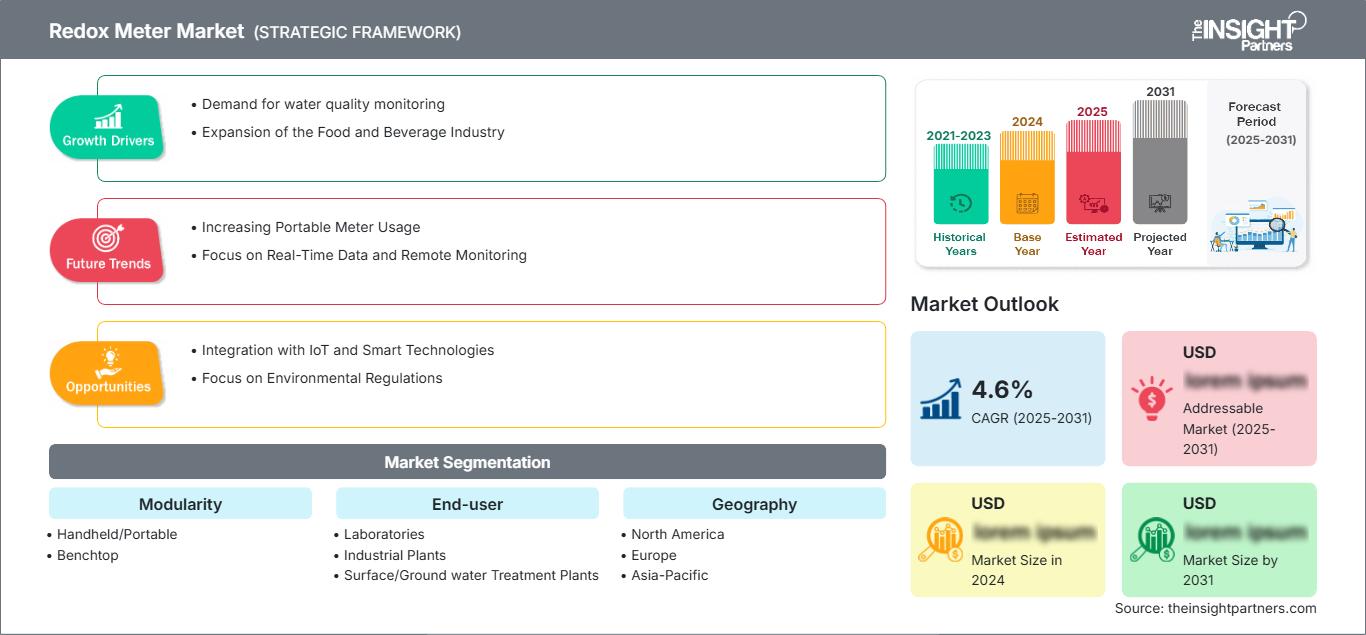
Redox Meter Market: Strategic Insights
Regional Insights
North America redox meter market
North America accounted for an estimated 31–35% of the redox meter market share in 2025 and is projected to expand at a CAGR of 4.8–5.4% through 2034. Demand in the US region is driven by high municipal wastewater systems, environmental labs, food processing, pharmaceuticals, chemicals, and power generation. An advanced laboratory network ensures that old equipment is replaced by digital meters that have improved features in data logging and calibration management. Demand in Canada comes from water monitoring, mining, food processing, and environmental sectors.
Regulation still plays an important role as a structural driver since reliable measurements are required to optimize processes and validate operations. Portable devices are more convenient in cases when comparisons of several sampling points are necessary without the installation of fixed equipment. There is also a well-developed network of distributors and service providers in the region, making the procurement process easier. Cost-life cycle and compatibility become more important for industrial customers.
U.S. redox meter Market
The US represents approximately 70–74% of North America's 2025 redox meter market and is expected to grow at a CAGR of 4.9–5.5%. Demand is diversified across environmental laboratories, wastewater treatment, industrial plants, pharmaceutical production, food processing, and academic research. Products for portable, benchtop, and multiparameter uses come from companies such as Thermo Fisher Scientific Inc., Xylem Analytics, Hanna Instruments Ltd., and other well-established providers. Demand for replacement will be provided by existing analytical equipment and routine testing requirements.
There is a clear trend towards portability, along with online process instruments. One may employ hand-held units for quick tests in treatment tanks, process lines, and environmental samples, leaving lab units for more precise measurement procedures. Another advantage of the US market is the high level of purchasing requirements and support services available, along with distribution across the country. Industrial buyers pay increasing attention to data management, electrode replacement, calibration, and integration with lab documents.
Europe redox meter Market
Europe held approximately 28–32% of the 2025 redox meter market and is expected to register a CAGR of 4.9–5.5%, with Germany representing a leading national market. Water analysis laboratories and industrial processes in the UK and Germany form a substantial customer base. Further demand can be sourced from municipal water treatment, food processing, chemistry, pharmacy, and environment monitoring in France, Italy, and Spain. European purchasers tend to value accuracy, documentation, longevity, and compliance with regulations.
In the UK, there is continuous demand from environmental laboratories, water treatment plants, pharmaceutical laboratories, and research institutions. The German market has benefited from its solid industrial foundation and the existence of an ecosystem of analytical instrumentation. France and Italy supply the demand with food, beverage, and industrial process monitoring, while the water management needs of Spain provide field and treatment monitoring.
APAC redox meter Market
APAC represented approximately 25–29% of the 2025 redox meter Market and is projected to grow at a CAGR of 5.7–6.4%, making it one of the fastest-expanding regions. China leads regional demand, followed by Japan, South Korea, India, and Australia. Industrialization, wastewater treatment investment, environmental monitoring, and laboratory expansion support adoption.
China and India provide significant industrial and infrastructure demand, while Japan and South Korea emphasize precision manufacturing and advanced laboratories. Australia contributes through environmental and mining applications. Policy attention to water quality and industrial discharge, combined with expanding treatment capacity, should support greater deployment of portable and benchtop instruments.
Middle East & Africa redox meter Market
The Middle East and Africa redox meter market is projected to grow at a CAGR of 4.1–4.7%, supported by water scarcity, desalination, wastewater reuse, and industrial infrastructure. Saudi Arabia and the UAE are leading Gulf markets, while South Africa provides substantial laboratory, mining, municipal, and industrial demand. Investment in water security increases the relevance of process and field measurements.
Saudi Arabia and the UAE emphasize desalination and water-reuse infrastructure, creating opportunities for monitoring technologies across treatment stages. South Africa benefits from mining and municipal applications, while the rest of MEA remains more fragmented. Energy-intensive water infrastructure encourages operators to improve treatment efficiency, process stability, and chemical-use management through dependable electrochemical measurements.
Segmentation Analysis
Modularity
Modularity is expected to grow at a CAGR of 5.5–6.1% during 2026–2034 in the Redox Meter Market Report. Users increasingly prefer instruments that can accommodate changing measurement requirements without replacing the complete system. Portable platforms support field testing, while benchtop systems address repeatable laboratory measurements, creating differentiated purchasing criteria around flexibility, accuracy, durability, and data handling.
- Handheld/Portable: Portable meters maintain a strong market position because operators can test multiple sampling points rapidly. Rugged construction, waterproofing, replaceable sensors, and battery operation strengthen adoption in environmental, treatment, agricultural, and industrial field applications.
- Benchtop: Benchtop instruments remain strategically important for laboratories requiring controlled sample handling, repeatable calibration, higher workflow integration, and structured data records. Their value is strongest where measurement consistency and documentation outweigh mobility requirements.
End-user
End-user demand is projected to increase at a CAGR of 5.0–5.6% during 2026–2034. Industrial plants and water-treatment facilities require dependable measurement for process control, while laboratories prioritize analytical consistency. Adoption is influenced by monitoring frequency, operating conditions, regulatory requirements, and the cost of electrode maintenance.
- Laboratories: Laboratories require controlled measurements, calibration traceability, and dependable electrode performance. Demand spans academic research, environmental testing, pharmaceutical analysis, food testing, and chemical laboratories, where redox potential complements broader electrochemical characterization.
- Industrial Plants: Industrial plants represent the largest end-user category, driven by process monitoring in chemicals, food and beverage, pharmaceuticals, pulp and paper, mining, and power applications where oxidation state affects production or treatment conditions.
- Surface/Ground water Treatment Plants: Treatment facilities use redox measurement to monitor chemical and biological conditions across treatment stages. Demand benefits from environmental monitoring, treatment optimization, and the need to identify changing water chemistry rapidly.
- Others: Other users include aquaculture, agriculture, educational facilities, and specialized environmental applications. These customers typically favor cost-effective portable instruments that simplify routine spot measurements without requiring complex fixed analytical infrastructure.
Geography
Geography is projected to expand at a CAGR of 5.1–5.7% during 2026–2034 in the Redox Meter Market Forecast. Regional demand varies according to industrialization, water infrastructure, laboratory capacity, environmental regulation, and the maturity of analytical equipment distribution. Asia Pacific offers stronger expansion potential, while established markets emphasize replacement and technology upgrades.
- North America: Mature laboratory networks and water-treatment infrastructure support replacement demand, while industrial users increasingly evaluate digital records, ruggedized field equipment, and lifecycle support when upgrading electrochemical measurement systems.
- Europe: Regulatory discipline, advanced industrial processing, and established environmental laboratories support sustained demand. Buyers place strong emphasis on traceability, maintenance requirements, measurement reliability, and integration with laboratory workflows.
- Asia-Pacific: Industrial expansion and water-infrastructure investment support rising adoption. China, India, Japan, South Korea, and Australia present differentiated demand across manufacturing, treatment, mining, environmental testing, and research.
- South and Central America: Demand is concentrated in water treatment, mining, food processing, agriculture, and environmental monitoring. Distribution reach and equipment affordability remain important considerations for expanding adoption.
- Middle East and Africa: Desalination, wastewater reuse, mining, and industrial development provide opportunities. Procurement is increasingly linked to water-security investment, process reliability, service availability, and the ability to operate under demanding conditions.
Opportunity Snapshot
| End-user | Revenue Contribution (High/Medium/Low) | Trend Tag | Adoption Stage |
| Laboratories | High | Data Logging | Mature |
| Industrial Plants | High | Process Control | Mature |
| Surface/Ground water Treatment Plants | High | Water Monitoring | Scaling |
| Others | Medium | Field Testing | Scaling |
Redox Meter Market Growth Drivers and Impact Analysis
Expansion of Industrial Water and Wastewater Monitoring
The monitoring of water chemistry has become an important issue in the operation of industrial facilities due to the possibility of treating water that may affect the quality of products, stability of equipment, discharge regulations, and operational costs. The redox measurement serves as a convenient tool for monitoring oxidation-reduction processes in cases where disinfection, biological treatment, corrosion prevention, and chemical processes are performed. The effect is more pronounced in those cases when an operator needs prompt confirmation prior to the changes of dosages or process parameters. Pharmaceutical, chemical, food, pulp & paper, and power plants have all the reasons to invest in such equipment due to process stability, and not only measurements. Treatment facilities also find the use of redox measurement beneficial since portable equipment helps validate fixed sensors and troubleshoot unusual processes.
Increasing Need for Decentralized Environmental Testing
Measurement within environmental monitoring has become less and less dependent on central laboratories, especially where water parameters may change suddenly in rivers, groundwater sites, processing plants, and industrial discharge points. The use of portable meters for redox measurement minimizes the gap between sampling and measurement, helping the technicians detect any abnormal oxidation parameter before the sample arrives at the lab. This makes a practical demand for portability of rugged casing, replaceable electrodes, battery-powered devices, and simple calibration. Public utility organizations and environmental contractors can use portable meters at different locations without having an online analyzer for every site. This would make a good basis for buying such a device due to its coverage and portability.
Integration of Electrochemical Measurement into Digital Workflows
Measurement data is now being transformed through the digitalization of laboratory and process control systems. Redox meters now often differentiate by their capabilities for logging data, user and sample identification, USB or serial exporting, and integration into larger analysis processes. This means that there will be more importance placed on instruments that provide consistent measurement logs rather than one-off measurements. There will be benefits for laboratories due to better documentation and for industrial facilities that can trace measurement history in order to identify possible reasons for process anomalies. There will also be improvements in automation of measurement recording and reproducibility of tests. Suppliers who offer high-quality electrodes along with intuitive software and flexible connectivity options will gain an advantage over those who only focus on measurement precision.
Redox Meter Market Future Trends
Connected Redox Measurement and Predictive Monitoring
Connectivity of measurement instruments is expected to increase in importance, as labs and plant operators look for constant insight into the changes in the quality of water. Future devices will likely integrate measurements of redox potential with those of temperature, pH, conductivity, dissolved oxygen, and other variables, giving their users an opportunity to understand oxidation processes in relation to a wider chemical environment. Connectivity of instruments through wireless communication, cloud storage of records, and automated notifications might also help decrease the need for regular manual measurements. For industrial users, historical data can help with prediction and maintenance, as well as process optimization, by recognizing recurring anomalies. In labs, connectivity can be used to enhance traceability and eliminate transcription errors.
Greater Sensor Interchangeability and Low-Maintenance Design
Future developments in the products will see emphasis put on interchangeable probes and simple maintenance, since the condition of the electrodes plays a very important role in ensuring the reliability of the measurements. Tools that can automatically detect probes, remember calibrations, or replace sensors rapidly could help avoid the need for manual operations and increase efficiency out in the field. This concept would be highly beneficial for environmental contractors and water treatment operators who have several measurement points. The manufacturers can also design electrodes and sensors that can be applied to hard matrices like contaminated wastewater, salt water, and industrial process water. Reduced needs for maintenance can be an important factor for organizations that do not have qualified personnel.
Redox Meter Market Opportunities
Specialized Solutions for Water-Reuse and Desalination Projects
Expansion of water reuse and desalination infrastructure creates opportunities for suppliers to develop specialized measurement packages rather than standalone meters. Operators can benefit from systems combining redox, pH, conductivity, temperature, and other measurements within common workflows. Suppliers targeting these projects can differentiate through corrosion-resistant sensor configurations, low-maintenance electrodes, remote data access, and service contracts. Opportunities are particularly relevant in water-stressed regions where treatment assets operate continuously and process deviations can have significant consequences. Equipment providers can also partner with engineering contractors and system integrators to embed electrochemical measurement into new treatment projects. Such partnerships can improve specification-stage visibility and create recurring revenue through calibration standards, replacement sensors, maintenance, and technical support.
Application-Specific Portable Platforms for Emerging Markets
Emerging markets offer an opportunity to adapt portable instruments to the practical requirements of decentralized laboratories, municipal facilities, agriculture, aquaculture, mining, and industrial sites. Successful products should prioritize durability, simple operation, long battery life, accessible replacement electrodes, and multilingual interfaces. Distribution partnerships can reduce service barriers where specialized technical networks remain limited. Manufacturers can also develop tiered portfolios that separate basic spot-testing requirements from advanced multiparameter applications, allowing customers to upgrade as monitoring needs become more sophisticated. Training programs for operators and distributors can strengthen adoption because measurement quality depends on correct electrode handling, calibration, and storage. These approaches can expand the addressable customer base without relying solely on high-end laboratory procurement.
Frequently Asked Questions

- Comprehensive Market Sizing and Forecast Analysis
- Detailed Segmentation Analysis
- In-Depth Market Dynamics Assessment
- Regional and Country-Level Insights
- Competitive Landscape and Company Benchmarking
- Strategic Business Intelligence
Recent Reports
Testimonials

The Insight Partners provided valuable market intelligence that supported our global go-to-market strategy. Their team was professional, responsive, and attentive to our feedback, providing thoughtful analysis and helpful methodological clarifications throughout the project.
Junmo Kim Chief Financial Officer (CFO), Enertech Co., Ltd.
The Insight Partners' SCADA System Market report is comprehensive, with valuable insights on current trends and future forecasts. The team was highly professional, responsive, and supportive throughout. We are very satisfied and highly recommend their services.
RAN KEDEM Partner, Reali Technologies LTDs
I requested a report on a very specific software market and the team produced the report in a few days. The information was very relevant and well presented. I then requested some changes and additions to the report. The team was again very responsive and I got the final report in less than a week.
JEAN-HERVE JENN Chairman, Future Analytica
We worked with The Insight Partners for an important market study and forecast. They gave us clear insights into opportunities and risks, which helped shape our plans. Their research was easy to use and based on solid data. It helped us make smart, confident decisions. We highly recommend them.
PIYUSH NAGPAL Sr. Vice President, High Beam Global
The Insight Partners delivered insightful, well-structured market research with strong domain expertise. Their team was professional and responsive throughout. The user-friendly website made accessing industry reports seamless. We highly recommend them for reliable, high-quality research services
YUKIHIKO ADACHI CEO, Deep Blue, LLC.
This is the first time I have purchased a market report from The Insight Partners.While I was unsure at first, I visited their web site and felt more comfortable to take the risk and purchase a market report.I am completely satisfied with the quality of the report and customer service. I had several questions and comments with the initial report, but after a couple of dialogs over email with their analyst I believe I have a report that I can use as input to our strategic planning process.Thank you so much for taking the extra time and making this a positive experience.I will definitely recommend your service to others and you will be my first call when we need further market data.
JOHN SUZUKI President and Chief Executive Officer, Board Director, BK Technologies
I wish to appreciate your support and the professionalism you displayed in the course of attending to my request for information regarding to infectious disease IVD market in Nigeria. I appreciate your patience, your guidance, and the fact that you were willing to offer a discount, which eventually made it possible for us to close a deal. I look forward to engaging The Insight Partners in the future, all thanks to the impression you have created in me as a result of this first encounter.
DR CHIJIOKE ONYIA MANAGING DIRECTOR, PineCrest Healthcare Ltd.Reason to Buy
- Informed Decision-Making
- Understanding Market Dynamics
- Competitive Analysis
- Identifying Emerging Markets
- Customer Insights
- Market Forecasts
- Risk Mitigation
- Boosting Operational Efficiency
- Strategic Planning
- Investment Justification
- Tracking Industry Innovations
- Aligning with Regulatory Trends





 Get Free Sample for