
Refuse Compactor Market Share, Growth & Forecast by 2034
Coverage: By Type (Stationary, Portable, Others); Application (Commercial Use, Agricultural Use, Residential Use, Municipal Use, Industrial Use, Others) , and Geography (North America, Europe, Asia Pacific, and South and Central America)
- Status : Data Released
- Report Code : TIPRE00022046
- Category : Manufacturing and Construction
- No. of Pages : 150
- Available Report Formats :


- Last update date : September 02, 2026


2025 Market Size
US$ 5.98 Bn
Base year value
2034 Forecast
US$ 9.7 Bn
Projected by 2034
CAGR 2026-2034
5.53 %
Growth rate
Addressable Market
US$ 71.12 Bn
(2026-2034)
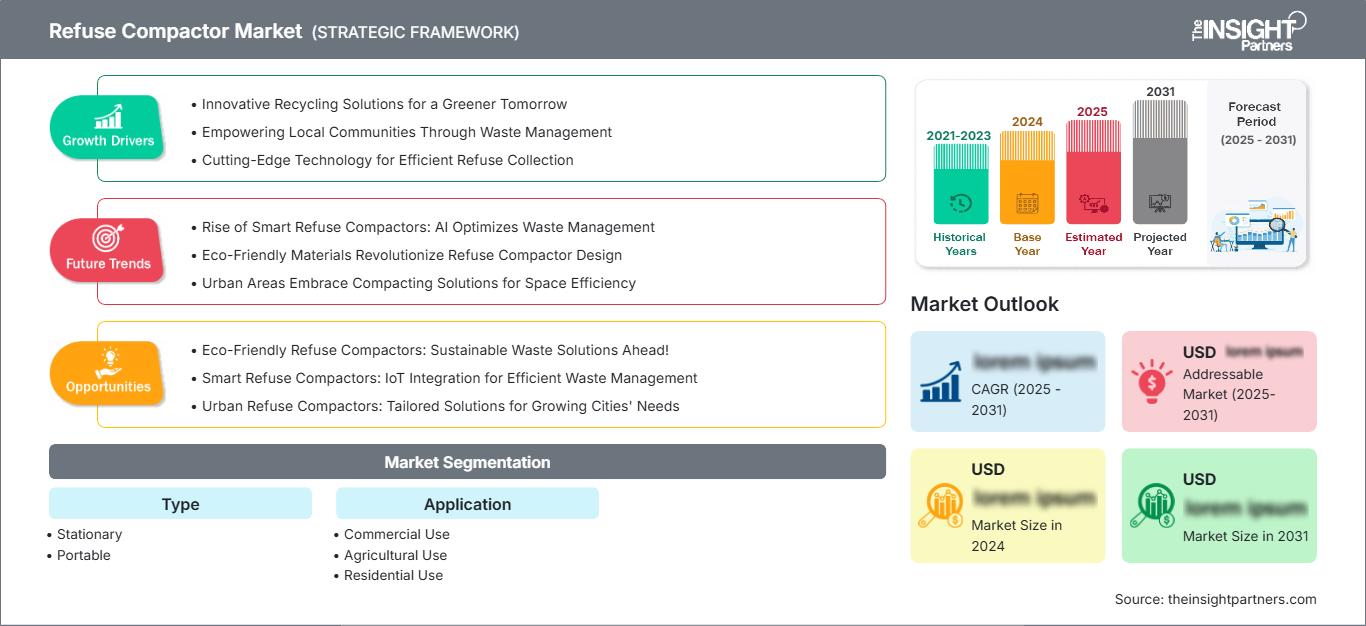
The refuse compactor market is projected to expand from US$ 5.98 Billion in 2025 to US$ 9.7 Billion by 2034, registering a CAGR of 5.53% from 2026 to 2034. Expansion is supported by rising waste volumes, tighter collection economics, urban infrastructure investment, and increasing demand for equipment that reduces waste volume before transportation, storage, recycling, or disposal across commercial, residential, agricultural, industrial, and municipal environments.
Across North America, refuse compactor adoption is expected to advance at an estimated 5.1–5.8% CAGR between 2026 and 2034, contributing significantly to the refuse compactor market size, supported by the replacement of aging waste-handling equipment and continued optimization of collection routes. Higher landfill and transportation costs are encouraging commercial operators and municipalities to prioritize equipment that increases container utilization while reducing collection frequency and associated operating requirements.
Refuse Compactor Market Assessment and Insights
- North America: North America is estimated to account for a 31–35% share in 2025, with the regional market growing at a 5.1–5.8% CAGR between 2026–2034. Commercial waste handling, municipal modernization, and replacement demand support steady equipment investment.
- US: The US represents approximately 72–76% of North America’s 2025 share, growing at a 5.0–5.7% CAGR between 2026–2034, supported by commercial facilities, municipalities, retail networks, and waste-hauling efficiency requirements.
- Europe: Europe is estimated at a 25–29% share in 2025, growing at a 4.8–5.5% CAGR between 2026–2034. Germany, the UK, France, Italy, and Spain remain important markets as waste prevention, recycling, and collection-efficiency policies influence equipment selection.
- Asia Pacific: Asia Pacific is estimated to hold a 28–32% share in 2025, expanding at a 6.0–6.8% CAGR between 2026–2034. China, Japan, India, South Korea, and Australia are key markets, with urbanization and municipal infrastructure development supporting adoption.
- Largest Segment: Stationary compactors are estimated to hold a 60–65% market share in 2025, expanding at a 5.0–5.7% CAGR between 2026–2034, reflecting strong commercial and municipal suitability.
- High Growth Segment: Portable compactors are estimated at a 35–40% market share in 2025, with a 6.0–6.8% CAGR between 2026–2034, supported by flexible deployment and temporary waste-intensive sites.
- Key companies analyzed in detail: Ace Equipment Company, Compactor Management Company, Electrolux, GE Appliances, Genesis Waste Handling Pvt. Ltd., Krushr, Precision Machinery Systems LLC, SP Industries, Inc., Wastequip, and Whirlpool Corporation.
Source: The Insight Partners' analysis based on proprietary research, government publications, company annual reports, investor presentations, industry databases, and expert interviews.
The refuse compactor market has evolved from basic mechanical volume-reduction equipment toward application-specific systems emphasizing operating reliability, safety, container utilization, and serviceability. Stationary units remain central to high-volume facilities, while portable configurations provide deployment flexibility. Manufacturers increasingly differentiate through hydraulic performance, compact footprints, controls, maintenance accessibility, and equipment configurations designed around particular waste streams and facility constraints.
Looking ahead, demand should broaden across developing urban centers where collection infrastructure is expanding alongside commercial construction and municipal services, supporting growth in the Refuse Compactor Market Share. Investment is likely to favor equipment that integrates operational monitoring, energy-conscious hydraulic systems, modular components, and service support. Regulatory emphasis on responsible waste handling and landfill diversion should further encourage users to evaluate compaction as part of broader material recovery and waste logistics strategies.
Refuse Compactor Market Report Scope
| Report Attribute | Details |
|---|---|
| Market size in 2025 | US$ 5.98 Billion |
| Market Size by 2034 | US$ 9.7 Billion |
| Global CAGR (2026 - 2034) | 5.53% |
| Historical Data | 2021-2024 |
| Forecast period | 2026-2034 |
Refuse Compactor Market Analysis
Demand for refuse compactor market equipment is closely linked to the quantity, density, and handling frequency of waste generated at commercial, industrial, agricultural, residential, and municipal sites. The market growth is supported by the economic value of reducing waste volume before transportation. Equipment suppliers operate across steel fabrication, hydraulic systems, electrical controls, container integration, distribution, installation, maintenance, and replacement parts, creating a diversified ecosystem.
The value chain is influenced by steel prices, hydraulic component availability, motor and control-system sourcing, fabrication capacity, and local service networks. Buyers increasingly assess total ownership cost rather than acquisition price alone, particularly when equipment is used continuously. Municipal procurement tends to emphasize durability and lifecycle support, while commercial customers often prioritize footprint, cycle time, ease of loading, and compatibility with existing containers or hauling arrangements.
Competitive positioning in the refuse compactor market is fragmented between specialized waste-equipment manufacturers and diversified appliance companies. The company has a wide range of equipment types, including stationary, self-contained, vertical, and energy-efficient equipment designs. The competition between Ace Equipment Company and Precision Machinery Systems LLC exists in terms of application-specific machines. The companies SP Industries, Inc. and Genesis Waste Handling Pvt. Ltd. provide solutions for specialized waste handling needs.
Service provision and aftermarket support become important competitive issues as well. Compactor Management Company specializes in equipment-based waste management solutions, Krushr and GE Appliances provide solutions in compact design, whereas Electrolux and Whirlpool Corporation provide appliance design solutions for waste. Priority investment areas include reliable hydraulic systems, safe controls, modular servicing, and energy-efficient equipment designs.
● REPORT CUSTOMIZATION
Tailor This Report To Align With Your Specific Business Requirements
This report can be customized to align precisely with your business objectives, scope, and target markets. Customization options include tailored segmentation, geography, competitive analysis, and strategic insights to support informed decision-making.
Customize This Report →WHAT YOU CAN ADJUST
- ● Segmentations
- ● Geography
- ● Competitive Analysis
- ● Language Preferences
Refuse Compactor Market: Strategic Insights
Regional Insights
North America refuse compactor market
North America is estimated to represent 31–35% of global demand in 2025 and is projected to grow at a 5.1–5.8% CAGR through 2034, as highlighted in the Refuse Compactor Market Report. The USA continues to be the key buyer, aided by a well-developed business infrastructure, distribution networks, manufacturing plants, hospitals, hospitality establishments, and municipal waste systems. The replacement market is also significant, owing to mature users who constantly replace their machines to increase efficiency, safety, and reduce costs.
The contribution of Canada comes through municipal and commercial uses, whereas that of Mexico is through incremental demand driven by industrial growth, retailing, and municipal waste infrastructure. The regional customers become more and more demanding in terms of use of containers, frequency of hauling, hydraulic efficiency, and serviceability. Stationary equipment becomes especially relevant for those facilities where the volume of waste is certain. Portable equipment is benefited by construction works and other temporary installations where permanent installation of equipment is impossible.
U.S. refuse compactor Market
The U.S. accounts for approximately 72–76% of North America’s 2025 market share and is expected to expand at a 5.0–5.7% CAGR through 2034. The following include some potential markets: commercial establishments, distribution centers, food service establishments, healthcare facilities, manufacturing facilities, and municipalities. The existing waste collection systems also provide incentives to use compactors in order to minimize the frequency of collections and maximize container utilization.
Wastequip, GE Appliances, Whirlpool Corporation, Ace Equipment Company, Compactor Management Company, and others stay competitive either by supplying equipment or by providing services or both, using their existing distribution channels. The commercial market is inclined towards the use of stationary and self-contained units, while the residential market depends more on kitchen design, replacement cycles of appliances, and consumer awareness.
Europe refuse compactor Market
Europe is estimated to hold a 25–29% share in 2025 and expand at a 4.8–5.5% CAGR through 2034, according to the Refuse Compactor Market Forecast, with Germany representing a leading national market.Commercial waste management facilities have been developed by the UK and Germany, while France, Italy, and Spain offer demand for these facilities through modern municipal systems, hospitality business, manufacturing industry, and retail uses. Procurement in Europe is now evaluating equipment efficiency and resource usage.
In the UK, there is much benefit derived from dense urbanization and commercial waste management. Germany focuses on good engineering, industrial usage, recycling, and efficient logistics. France, Italy, and Spain provide demand for the equipment in municipalities, the hospitality industry, retail establishments, and manufacturing industries. In Europe, the compaction of waste is evaluated together with source separation and recycling, instead of using it as a replacement for recycling.
APAC refuse compactor Market
APAC is estimated to account for 28–32% of 2025 demand and grow at a 6.0–6.8% CAGR through 2034, making it the fastest-growing major region. Demand for equipment starts in China, with Japan, India, South Korea, and Australia following suit. Urbanization, industrialization, organized retail, and the development of municipal facilities facilitate equipment usage in various operating conditions.
In China, there is manufacturing on a large scale combined with the development of urban solid waste facilities, whereas in India, there is great potential in the long run due to the modernization of municipalities and business operations. In Japan and South Korea, the focus lies on efficient and technically advanced equipment, whereas Australia enjoys the advantage of mature solid waste facilities.
Middle East & Africa refuse compactor Market
The Middle East and Africa represent a smaller but expanding opportunity, with demand supported by infrastructure development, urbanization, hospitality construction, and municipal waste-system investment. Saudi Arabia and the UAE are leading Gulf markets, while South Africa remains important in the African region. The broader MEA market is expected to expand at approximately 4.5–5.2% CAGR through 2034, reflecting key Refuse Compactor Market Trends.
Saudi Arabia benefits from large-scale urban and infrastructure programs, while the UAE combines high-density commercial development with advanced municipal services. South Africa provides demand from industrial, commercial, and municipal applications. Other MEA markets are more project-driven and sensitive to infrastructure budgets. Energy efficiency, equipment durability, heat tolerance, corrosion resistance, and accessible servicing remain important purchasing criteria, particularly where operating environments are demanding.
Segmentation Analysis
Type
Type segmentation distinguishes stationary and portable equipment according to installation requirements, mobility, waste volume, and operating environment. Stationary systems remain dominant because fixed commercial and municipal facilities value predictable operation and high throughput. Portable configurations provide flexibility where waste generation varies or equipment must be relocated. The type segment is expected to expand at approximately 5.1–5.9% CAGR from 2026–2034.
- Stationary: Stationary compactors serve facilities with consistent waste volumes and dedicated loading areas. Their fixed installation supports continuous commercial, industrial, and municipal operations where durability and container compatibility are important.
- Portable: Portable compactors address temporary, changing, or space-constrained requirements. Their mobility supports construction locations, events, agricultural facilities, and operations where fixed infrastructure would limit deployment flexibility.
Application
Application segmentation covers commercial, agricultural, residential, municipal, and industrial use. Application requirements differ substantially according to waste composition, operating frequency, available space, collection schedules, and required compaction intensity. Commercial and municipal users generally prioritize lifecycle economics and serviceability, while residential users emphasize convenience and integration. The application segment is projected to grow at approximately 5.3–6.1% CAGR from 2026–2034. This supports the broader refuse compactor market scope across heterogeneous end-use environments.
- Commercial Use: Retail stores, restaurants, hotels, distribution facilities, and offices use compactors to control waste accumulation, improve storage efficiency, and reduce unnecessary collection movements.
- Agricultural Use: Farms and agricultural processing facilities require flexible handling for packaging, crop-related residues, and operational waste, with equipment selected according to material characteristics and seasonal generation patterns.
- Residential Use: Residential systems emphasize compact dimensions, safe operation, low maintenance, and kitchen integration, making appliance design and consumer convenience important determinants of purchasing decisions.
- Municipal Use: Municipal applications prioritize durability, throughput, operator safety, container compatibility, and predictable maintenance because equipment must support public-service operations over extended operating periods.
- Industrial Use: Industrial facilities generate varied and often bulky waste streams, requiring robust compaction systems capable of repeated cycles and integration with established material-handling and collection processes.
End-user
End-user segmentation covers industrial, commercial, and residential users, each characterized by different purchasing priorities. Industrial customers generally emphasize throughput and reliability, commercial operators focus on space and collection economics, while residential users prioritize convenience and appliance integration. The segment is expected to expand at approximately 4.9–5.8% CAGR from 2026–2034, with industrial and commercial demand remaining structurally important.
- Industrial: Industrial buyers require rugged equipment, dependable hydraulic operation, straightforward maintenance, and compatibility with production-site waste-handling workflows.
- Commercial: Commercial users prioritize reduced storage requirements, collection efficiency, manageable footprints, and equipment reliability across retail, hospitality, food service, and institutional facilities.
- Residential: Residential demand is influenced by kitchen layouts, appliance replacement, consumer convenience, noise considerations, safety mechanisms, and availability of replacement bags and service support.
Opportunity Snapshot
| End-user | Revenue Contribution (High/Medium/Low) | Trend Tag | Adoption Stage |
| Industrial | High | Heavy Duty | Mature |
| Commercial | High | Space Optimization | Mature |
| Residential | Medium | Kitchen Integration | Scaling |
Refuse Compactor Market Growth Drivers and Impact Analysis
Rising Waste Volumes and Collection Efficiency Requirements
The increasing amount of municipal waste and commercial waste results in additional strain on the collection process and transportation infrastructure. As of today, the annual amount of global municipal solid waste produced is measured in billions of tonnes per year, making it necessary to have an efficient handling of waste prior to transportation. Compaction helps to lower the volume of material to be stored and transported, thus making better use of containers and possibly reducing the frequency of collection of the waste. In terms of its commercial effect, compaction is most beneficial when waste removal is a recurring cost. Thus, retailers, hospitality establishments, food service companies and municipalities can make a business case out of it due to efficiency considerations rather than purely environmental ones.
Urbanization and Expansion of Organized Waste Infrastructure
Urban population growth increases the concentration of waste generation within commercial districts, residential developments, logistics hubs, and municipal service zones. Dense development creates a premium on available storage space, making volume reduction increasingly relevant for facilities with limited waste-handling areas. Refuse compactor market adoption consequently benefits from shopping centers, apartment developments, hospitals, hotels, warehouses, and industrial parks that require predictable waste movement. Emerging economies present additional opportunities as organized collection systems replace fragmented handling practices. Equipment demand is particularly responsive when municipalities or private operators introduce scheduled collection, centralized transfer, or formalized waste segregation. Manufacturers can benefit by developing scalable models suited to different infrastructure maturity levels, including lower-capital configurations for smaller facilities and higher-throughput systems for large centralized operations.
Lifecycle Cost Pressure and Equipment Modernization
The buyers now evaluate compactors based on lifecycle costs rather than just their prices. Inability to effectively operate due to hydraulic issues, high levels of downtime, inability to easily reach certain components, and inefficient collection schedule will significantly raise the cost of operation during the equipment’s lifetime. This is why there is a need to invest in systems that have robust structural components, easy-to-service systems, good control systems, and maintenance systems. Modernization leads to the need for more sophisticated systems when old machines become hard to service or are no longer compatible with the improved containers and haulage procedures. Companies should be able to gain a competitive advantage by offering their customers standardized replacement parts, service, equipment reconditioning, and custom power packages.
Refuse Compactor Market Future Trends
Connected Monitoring and Predictive Service Architecture
Future compactor platforms are expected to have connected control capabilities that track cycle counts, operating conditions, container condition, hydraulic condition, and maintenance needs. This technology can move maintenance from repair-based to condition-based maintenance, especially in multi-facility fleet applications. Utilization studies can be performed using such technology that can help customers detect underutilized equipment, better schedule their collections, and plan service calls. With the decreasing cost of digital technology, compactors can become connected devices in facility management systems. Companies with good service infrastructures can use operational data for parts planning and warranty management. The importance of such technology will be based on issues related to interoperability, cybersecurity, data ownership, and cost savings.
Lower-Impact Materials and Energy-Conscious Equipment Design
Environmental issues will shape the design of future equipment based on less energy-consuming hydraulic circuits, recyclable steel elements, increased component durability, and decreased production scrap. Procurement requirements may become oriented to lifecycle performance, primarily for municipal governments and big companies with sustainable goals. This will not remove the requirement of mechanical strength due to dynamic loading in the compactor. Manufacturers may be inclined to optimize hydraulic circuits, motor management, component durability, and ease of refurbishing instead. Product labeling may disclose more information about the material used, maintainability, and recycling. All of the listed changes may result in the emergence of distinctions between low-priced equipment and that created with lifecycle performance in mind.
Refuse Compactor Market Opportunities
Localized Manufacturing for Emerging Urban Waste Systems
Opportunities in the developing countries' market segments can be capitalized through forming regional assemblies, supply, and services partnerships instead of wholly depending on equipment imports. Assembly can help reduce logistic risk, time delay and customization according to regional waste characteristics and environmental conditions. India, Southeast Asia, Latin America, and certain Middle East regions present potential markets considering the development of construction and municipal waste infrastructures. Potential investments should consider applications that generate waste volume regularly, have contract agreements on waste management and have well-connected service networks. The design of equipment based on power standards, climatic conditions, type of containers and maintenance availability will increase the rate of adoption of such equipment. Partnerships with waste-management companies will give manufacturers insight into operations and demonstrate potentialities of their products without developing full-fledged distribution systems.
Integrated Equipment and Aftermarket Service Models
The market presents an opportunity for manufacturers and distributors to integrate equipment sales along with maintenance service, spare parts, reconditioning, telemetric monitoring, and training services. This kind of approach is likely to result in steady revenue generation and address a customer need regarding equipment availability during constant handling of waste. Service programs can be designed depending on the number of cycles, operating conditions, and the age of the equipment. The refuse compactor market is therefore suited to a lifecycle business model in which equipment becomes the entry point for recurring service relationships. Strategic investment should prioritize technician coverage, parts inventory, standardized maintenance procedures, and digital service records. These capabilities can become differentiators where competing machines have broadly comparable mechanical specifications.
Frequently Asked Questions

- Comprehensive Market Sizing and Forecast Analysis
- Detailed Segmentation Analysis
- In-Depth Market Dynamics Assessment
- Regional and Country-Level Insights
- Competitive Landscape and Company Benchmarking
- Strategic Business Intelligence
Recent Reports
Testimonials

The Insight Partners' SCADA System Market report is comprehensive, with valuable insights on current trends and future forecasts. The team was highly professional, responsive, and supportive throughout. We are very satisfied and highly recommend their services.
RAN KEDEM Partner, Reali Technologies LTDs
I requested a report on a very specific software market and the team produced the report in a few days. The information was very relevant and well presented. I then requested some changes and additions to the report. The team was again very responsive and I got the final report in less than a week.
JEAN-HERVE JENN Chairman, Future Analytica
We worked with The Insight Partners for an important market study and forecast. They gave us clear insights into opportunities and risks, which helped shape our plans. Their research was easy to use and based on solid data. It helped us make smart, confident decisions. We highly recommend them.
PIYUSH NAGPAL Sr. Vice President, High Beam Global
The Insight Partners delivered insightful, well-structured market research with strong domain expertise. Their team was professional and responsive throughout. The user-friendly website made accessing industry reports seamless. We highly recommend them for reliable, high-quality research services
YUKIHIKO ADACHI CEO, Deep Blue, LLC.
This is the first time I have purchased a market report from The Insight Partners.While I was unsure at first, I visited their web site and felt more comfortable to take the risk and purchase a market report.I am completely satisfied with the quality of the report and customer service. I had several questions and comments with the initial report, but after a couple of dialogs over email with their analyst I believe I have a report that I can use as input to our strategic planning process.Thank you so much for taking the extra time and making this a positive experience.I will definitely recommend your service to others and you will be my first call when we need further market data.
JOHN SUZUKI President and Chief Executive Officer, Board Director, BK Technologies
I wish to appreciate your support and the professionalism you displayed in the course of attending to my request for information regarding to infectious disease IVD market in Nigeria. I appreciate your patience, your guidance, and the fact that you were willing to offer a discount, which eventually made it possible for us to close a deal. I look forward to engaging The Insight Partners in the future, all thanks to the impression you have created in me as a result of this first encounter.
DR CHIJIOKE ONYIA MANAGING DIRECTOR, PineCrest Healthcare Ltd.Reason to Buy
- Informed Decision-Making
- Understanding Market Dynamics
- Competitive Analysis
- Identifying Emerging Markets
- Customer Insights
- Market Forecasts
- Risk Mitigation
- Boosting Operational Efficiency
- Strategic Planning
- Investment Justification
- Tracking Industry Innovations
- Aligning with Regulatory Trends





 Get Free Sample for