
Retail Automation Market Growth, Trends & Demand by 2034
Coverage: by Type(Point of Sale, Electronic Shelf Labels, Barcode & RFID, AGV, and Others); Area of Usage (Warehouse and Stores); End User (Supermarkets; Hypermarkets, Fuel Stations, Pharmacies, Retail Stores, and Others), and Geography (North America, Europe, Asia Pacific, and South and Central America)
- Status : Data Released
- Report Code : TIPEL00002152
- Category : Electronics and Semiconductor
- No. of Pages : 150
- Available Report Formats :


- Last update date : September 16, 2026


2025 Market Size
US$ 21.69 Bn
Base year value
2034 Forecast
US$ 41.59 Bn
Projected by 2034
CAGR 2026-2034
7.50 %
Growth rate
Addressable Market
US$ 285.16 Bn
(2026-2034)
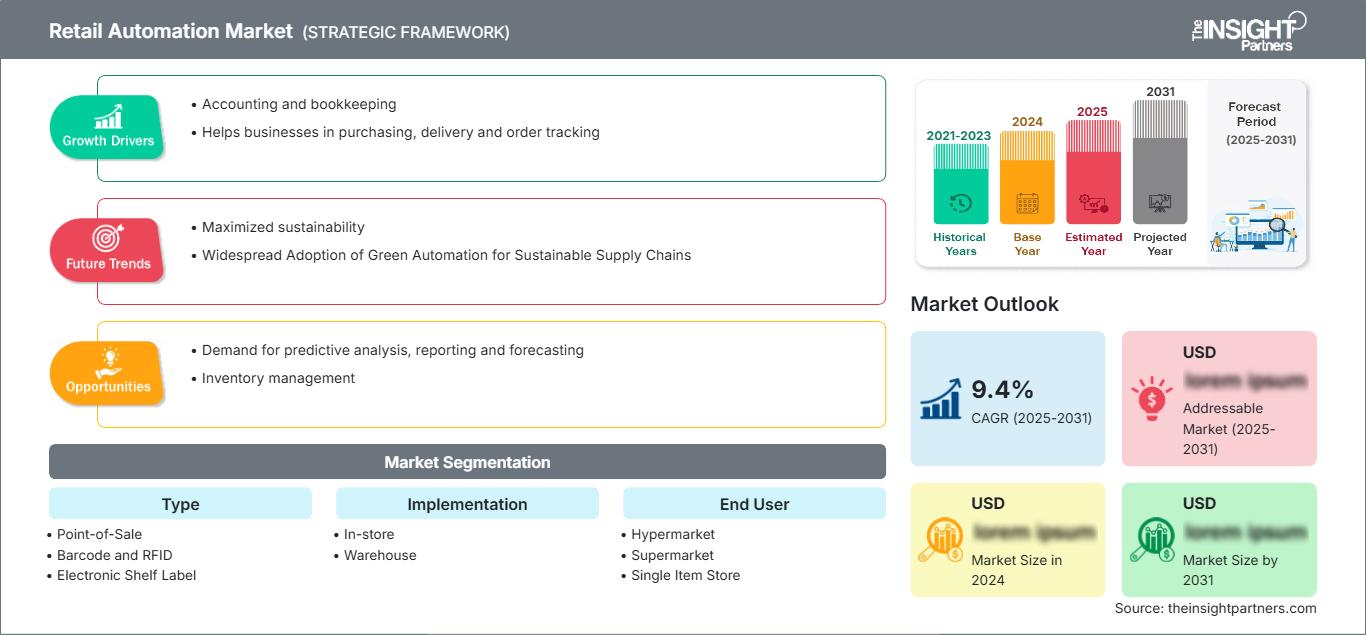
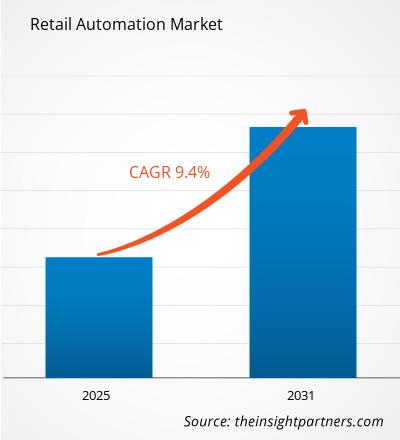
The retail automation market was valued at US$ 21.69 Billion in 2025 and is projected to reach US$ 41.59 Billion by 2034, registering a CAGR of 7.50% during 2026–2034. Expansion reflects the increasing integration of automated checkout, identification, shelf intelligence, computer vision, and warehouse robotics across physical retail environments, with retailers prioritizing operational consistency, inventory visibility, labor productivity, and faster customer transactions.
North America is positioned for sustained expansion, with the retail automation market size expected to grow at an estimated 8.5–10.5% CAGR during 2026–2034. Structural drivers include persistent labor-cost pressure and accelerating deployment of connected store technologies. Large retail chains are increasingly integrating electronic shelf labels, RFID, self-service checkout, computer vision, and warehouse automation into unified operating environments.
Retail Automation Market Assessment and Insights
- North America: North America is expected to hold a 34–38% share in 2025 and expand at an 8.5–10.5% CAGR between 2026–2034, supported by large-format retail networks, labor optimization, warehouse modernization, and rapid deployment of connected store technologies.
- US: The US is estimated to represent 82–86% of North America's 2025 market, supported by extensive retail chains and technology investment, with an 8.5–10.5% CAGR during 2026–2034.
- Europe: Europe is estimated to account for a 25–29% share in 2025 and grow at a 7.0–9.0% CAGR through 2034, led by Germany, the UK, France, Italy, and Spain across grocery, specialty retail, and warehouse operations.
- Asia Pacific: Asia Pacific is estimated to represent a 23–27% share in 2025 and grow at a 9.5–11.5% CAGR through 2034, led by China, Japan, South Korea, India, and Australia as retailers modernize stores and fulfillment networks.
- Largest Segment: Point-of-Sale is estimated to represent a 28–32% market share in 2025 and grow at a 6.5–8.0% CAGR during 2026–2034, supported by transaction automation and payment modernization.
- High Growth Segment: Autonomous Guided Vehicle is estimated to represent a 7–11% market share in 2025 and grow at a 12–15% CAGR through 2034, driven by warehouse and fulfillment automation.
- Key companies analyzed in detail: Fujitsu Limited, Honeywell International Inc., KUKA Aktiengesellschaft, Toshiba Corporation, Datalogic S.p.A., ZIH Corp., Future Way Technical Services LLC, Pricer AB, Teraoka Seiko Co., Ltd., Display Data Limited.
Source: The Insight Partners' analysis based on proprietary research, government publications, company annual reports, investor presentations, industry databases, and expert interviews.
Retail automation has developed from the standalone point-of-sale device to being integrated into the wider retail infrastructure. The point-of-sale system is the basic requirement, whereas barcodes and RFID tags make item identification and tracking more accurate. Shelf-edge displays ensure that pricing can be centrally controlled, cameras assist in computer vision applications, and AGVs are used in warehousing automation. Process dynamics have moved from standalone hardware towards software interoperability, cloud connectivity, sensor integration, and module installations, so retailers can automate certain functions without having to automate an entire store infrastructure.
Future trends in retail automation will include retail automation solutions that are connected through in-store systems and the warehouse platforms sharing operational data. New adoption will occur in the Asia Pacific region and some markets within the Middle East, as organized retail grows and distribution systems become better developed. Future investment is going towards scalable platforms, cybersecurity, computer vision, and robotics solutions. The regulatory requirements related to consumer privacy, payment security, accessibility, and data governance will affect implementation models.
Retail Automation Market Report Scope
| Report Attribute | Details |
|---|---|
| Market size in 2025 | US$ 21.69 Billion |
| Market Size by 2034 | US$ 41.59 Billion |
| Global CAGR (2026 - 2034) | 7.50% |
| Historical Data | 2021-2024 |
| Forecast period | 2026-2034 |
Retail Automation Market Analysis
The retail automation market growth is supported by retailers seeking measurable improvements in checkout throughput, inventory accuracy, pricing consistency, and fulfillment productivity. The ecosystem consists of POS vendors, barcode/RFID solutions providers, electronic shelf labels producers, robotics suppliers, camera/vision systems vendors, system integrators, payment systems providers, and retail software companies. The demand trends towards interoperable products and systems to enable connection between the operations at the store level and the inventory at the warehouse and omnichannel delivery. The supply side is impacted by semiconductor availability, sensor costs, robotic parts, software development, and installation capabilities.
Automation in the stores is usually introduced gradually due to the different characteristics of the store networks, which include different layouts, technological preparedness, workforce, and customers. The in-store deployment involves applications for the checkout, pricing, identification, and shelf management, while the warehouse deployment involves movement, picking, sorting, and replenishment. This results in a diversified ecosystem where the performance of the hardware alone cannot be the determinant of the buying decision.
The competitive landscape combines established industrial technology companies with specialized retail automation providers. Fujitsu Limited and Honeywell International Inc. bring broad enterprise and automation capabilities, while KUKA Aktiengesellschaft contributes robotics expertise. Datalogic S.p.A. focuses strongly on automatic identification and data capture, whereas Pricer AB and Display Data Limited are positioned around electronic shelf-label technologies. Teraoka Seiko Co., Ltd. participates across weighing, checkout, and retail systems, while ZIH Corp. provides established identification and printing capabilities.
Positioning in today’s market is highly dependent upon the integration capabilities of hardware, software, analysis tools, and professional implementation services. Toshiba Corporation has an advantage due to the company’s history and background in technologies in the areas of retail and digital, whereas Future Way Technical Services LLC specializes in a service-oriented approach. The investments will be made in computer vision technology, autonomous warehouse movement, connected shelf systems, and cloud-based retail environments. Compatibility with current point-of-sale (POS), enterprise resource planning, warehouse management, and payments is key for multi-site deployment.
● REPORT CUSTOMIZATION
Tailor This Report To Align With Your Specific Business Requirements
This report can be customized to align precisely with your business objectives, scope, and target markets. Customization options include tailored segmentation, geography, competitive analysis, and strategic insights to support informed decision-making.
Customize This Report →WHAT YOU CAN ADJUST
- ● Segmentations
- ● Geography
- ● Competitive Analysis
- ● Language Preferences
Retail Automation Market: Strategic Insights
Regional Insights
North America retail automation market
North America is estimated to account for 34–38% of the global retail automation Market in 2025 and expand at an 8.5–10.5% CAGR through 2034. Strengths in the market include the presence of major retailers, efficient distribution systems, higher cost of labor, and good technology infrastructure. Retailers seek to implement self-checkout, RFID, electronic shelf labels, computer vision, and warehouse robots to increase their efficiency without compromising the customer experience.
The US is the key regional demand driver, with support coming from national retailers and omnichannel order fulfillment needs. Canada makes its contributions through the modernization of groceries, warehouse automation, and connected stores deployments. The regional market opportunity has moved past simply deploying checkout technology into full-fledged inventory, pricing, and order fulfillment platforms. Economics of deployment continue to matter since retailers need projects to prove productivity improvement before wider deployment.
U.S. retail automation Market
The US is estimated to represent 82–86% of North America's 2025 retail automation Market and is projected to grow at an 8.5–10.5% CAGR through 2034. Large retail chains, grocery operators, pharmacies, fuel stations, and specialty stores provide diverse automation applications. Demand is particularly strong for checkout modernization, RFID, electronic shelf labels, computer vision, and warehouse robotics.
Technology companies like Honeywell International Inc., Datalogic S.p.A., and ZIH Corp. are some examples of those providing services to applications in areas such as identification, scanning, warehouse management, and retail infrastructures. Retail store owners are now beginning to integrate front-end transaction systems into inventory and fulfillment systems. Additionally, computer vision and autonomous systems are being considered as ways of monitoring shelves, protecting against losses, and analyzing customer traffic patterns.
Europe retail automation Market
Europe is estimated to hold a 25–29% share of the retail automation Market in 2025 and expand at a 7.0–9.0% CAGR through 2034. One of the prominent markets is Germany, owing to its capabilities in automation in manufacturing, retail systems, and logistics. The other key market for deployments is the United Kingdom, especially concerning grocery automation, electronic pricing, self-service technologies, and warehousing.
Germany has the combination of robotics along with well-developed distribution channels, which support automated movement and material handling. Other significant European markets include France, Italy, and Spain, owing to their supermarket reformatting, pharmacy automation, convenience format, and omnichannel delivery. The European approach to technology deployment is influenced by the privacy, cybersecurity, and data governance standards, which make compliance-focused deployment important.
APAC retail automation Market
APAC is estimated to account for a 23–27% share in 2025 and grow at a 9.5–11.5% CAGR through 2034. China continues to dominate in terms of regional expansion due to its vast retail networks, industrial development, warehouse development, and e-commerce. The other countries involved include Japan and South Korea in the form of robotics and electronics, and India and Australia in the form of opportunities for development in organized retail and logistics automation.
Digitization of retail and industrial policies are fueling investment in connected retail and automation of logistics. China dominates while Japan continues to have high demand for labor-reducing technologies. South Korea focuses on intelligent retail and logistics, India on organized retail infrastructure development, and Australia on warehouse development. Increasingly, regional vendors are incorporating robotics, identification, shelving technologies, and analytics within automation solutions.
Middle East & Africa retail automation Market
Middle East and Africa retail automation Market are expected to expand at a 6.5–8.5% CAGR through 2034, supported by retail infrastructure development, logistics investment, and digital transformation. Saudi Arabia and the UAE represent leading markets because of large-scale infrastructure programs, modern shopping destinations, and technology-oriented retail development. South Africa remains an important market for established grocery and specialty retail automation.
Saudi Arabia is developing advanced logistics and retail infrastructure, while the UAE emphasizes smart-city technologies, digital commerce, and automated fulfillment. South Africa supports demand through established retail chains and distribution networks, while the rest of MEA remains more selective. Energy efficiency, labor productivity, and warehouse throughput are relevant considerations where automated systems can improve asset utilization and support expanding retail infrastructure.
Segmentation Analysis
Type
Type is projected to expand at a 7.5–9.0% CAGR during 2026–2034 in the Retail Automation Market. The segment encompasses transaction systems, identification technologies, electronic shelf labels, cameras, autonomous guided vehicles, and associated equipment. Adoption is increasingly determined by the operational problem being addressed. Retailers may prioritize POS modernization in customer-facing environments while selecting RFID, vision, or AGVs for inventory and fulfillment applications, creating multiple technology pathways.
- Point-of-Sale: Point-of-sale remains a core retail automation technology because every transaction requires reliable identification, payment processing, and receipt generation. Demand increasingly favors self-service, mobile, contactless, and integrated transaction platforms.
- Barcode and RFID: Barcode and RFID technologies support item identification, inventory visibility, replenishment, and checkout processes. Their strategic importance increases as retailers seek more accurate stock information across stores and fulfillment operations.
- Electronic Shelf Label: Electronic shelf labels automate price and product-information updates while reducing manual shelf maintenance. Integration with centralized pricing platforms enables faster synchronization between digital systems and physical retail environments.
- Camera: Camera-based systems enable computer vision for shelf monitoring, customer-flow analysis, loss prevention, and autonomous checkout. Adoption depends heavily on accuracy, privacy controls, data processing, and integration with store operations.
- Autonomous Guided Vehicle: Autonomous guided vehicles support warehouse movement and material handling, reducing repetitive transportation tasks. Their strategic value increases as retailers expand fulfillment capacity and seek consistent internal logistics performance.
- Others: Other technologies complement core automation through specialized equipment and software. Demand varies by retail format, store architecture, regional labor economics, and the retailer's broader digital transformation strategy.
Implementation
Implementation is expected to grow at a 7.0–8.5% CAGR during 2026–2034 in the Retail Automation Market. In-store automation directly influences shopper interactions, pricing, checkout, and inventory visibility, whereas warehouse automation focuses on throughput, movement, picking, and fulfillment. Retailers increasingly evaluate both environments together because inventory accuracy and fulfillment speed depend on data flowing consistently between stores, distribution centers, and digital commerce channels.
- In-store: In-store automation targets checkout, pricing, identification, inventory visibility, and customer interaction. Adoption is strongest where retailers can standardize technology across multiple locations and demonstrate measurable labor or service improvements.
- Warehouse: Warehouse automation emphasizes material movement, sorting, picking, replenishment, and order fulfillment. Demand is supported by omnichannel retail and the need to process greater order volumes without proportionally expanding manual handling.
End User
End User is forecast to grow at a 7.5–9.0% CAGR during 2026–2034 in the Retail Automation Market. Retail formats differ substantially in transaction volume, product variety, store footprint, staffing models, and inventory complexity. Hypermarkets and supermarkets can justify broader automation because of scale, while pharmacies, fuel stations, and single-item stores often prioritize compact, targeted solutions. Adoption therefore, depends on operational economics and technology fit.
- Hypermarket: Hypermarkets can deploy multiple automation technologies across checkout, pricing, inventory, and warehouse functions. Their large footprints create opportunities for integrated automation platforms spanning customer-facing and back-end operations.
- Supermarket: Supermarkets increasingly adopt automation for checkout, shelf pricing, inventory control, and replenishment. Frequent product turnover makes accurate stock visibility and rapid operational response strategically important.
- Single Item Store: Single-item stores typically require focused automation rather than extensive infrastructure. POS, barcode, payment, and compact inventory solutions can address repetitive transactions while limiting deployment complexity.
- Fuel Station: Fuel stations prioritize rapid transactions, unattended or self-service operations, payment integration, and inventory monitoring. Automation can improve transaction consistency while supporting extended operating hours and lean staffing models.
- Retail Pharmacy: Retail pharmacies use automation to improve transaction handling, inventory management, dispensing workflows, and customer service. Technology selection must accommodate accuracy, security, regulatory requirements, and controlled access.
- Others: Other retail formats include specialty and convenience-oriented operations with varying automation needs. Adoption is generally determined by store scale, transaction intensity, inventory complexity, and available technology budgets.
Opportunity Snapshot
| End User | Revenue Contribution (High/Medium/Low) | Trend Tag (MAX 2 words) | Adoption Stage (Emerging/Scaling/Mature) |
| Hypermarket | High | Smart Checkout | Scaling |
| Supermarket | High | Shelf Intelligence | Scaling |
| Single Item Store | Medium | Compact POS | Scaling |
| Fuel Station | Medium | Unattended Checkout | Scaling |
| Retail Pharmacy | Medium | Inventory Control | Scaling |
| Others | Low | Store Digitization | Emerging |
Retail Automation Market Growth Drivers and Impact Analysis
Labor optimization and persistent workforce constraints
There is consistent pressure on retailers to increase productivity per worker due to high salaries, a lack of workers, and operating hours that influence the profitability of stores. Automation deals with repetitive functions like checking out, updating prices, scanning, inventory counts, and moving within warehouses, thus enabling workers to engage in customer service and exceptional functions. The effect becomes especially important in cases of large-scale grocery and merchandise companies, where even slight improvements in productivity could be applied on a massive scale, including hundreds or thousands of locations. Point of sale automation could streamline processes of transactions, whereas electronic shelf labels help to eliminate repetitive price-changing. Similarly, robotic warehouse technology can address repetitive transportation functions. Under closer scrutiny of the cost of capital investments, technology providing labor substitution, productivity improvement, or decreased errors will be preferred over other customer experience-enhancing solutions.
Omnichannel fulfillment increases demand for connected automation
The emergence of click-and-collect, ship-from-store, same-day delivery, and online ordering is altering the place of physical stores in retail supply chains. Physical stores will be more inventory-centric than customer-centric, requiring precise tracking of inventory levels and timely restocking of goods. Automation can facilitate this shift through the integration of identification, inventory, checkout, and warehouse systems. While RFID could increase visibility at the item level, guided autonomous vehicles and warehouse systems can speed up internal logistics. The market opportunity goes beyond software since orchestration in the store and distribution environments becomes necessary for the retailer. Suppliers able to integrate automation hardware with warehouse management systems, ERP, and e-commerce solutions can cater to the entire process of order fulfillment.
Computer vision strengthens loss prevention and operational intelligence
Retail shrinkage, checkout errors, and limited visibility into shelf conditions are encouraging retailers to evaluate computer vision and intelligent scanning systems. Cameras combined with machine learning can identify product interactions, monitor shelf conditions, support self-checkout verification, and detect selected operational anomalies. The value proposition extends beyond security because the same infrastructure can generate information about product availability, customer movement, and store execution. However, adoption depends on accuracy, privacy safeguards, data processing architecture, and the ability to integrate outputs into existing workflows. Retailers are therefore increasingly assessing vision as part of a broader automation platform rather than as an isolated surveillance technology. Suppliers that combine cameras, edge processing, analytics, and operational software can address multiple use cases while reducing duplicated infrastructure across the store.
Retail Automation Market Future Trends
AI-native retail automation platforms
The retail automation market trends are moving toward AI-native platforms that interpret operational data and recommend or initiate actions across connected store environments. Future systems will increasingly combine POS information, inventory records, camera feeds, shelf data, workforce inputs, and fulfillment signals within common software layers. Rather than simply automating a single task, these platforms can coordinate pricing, replenishment, exception management, and customer assistance according to real-time conditions. Edge computing will remain important where response time, connectivity resilience, or privacy considerations limit cloud-only processing. Retailers are also likely to demand explainable automation, audit trails, and configurable human approval for consequential actions. The strategic shift will therefore be from equipment automation toward decision automation, creating greater value for suppliers with strong data integration, machine-learning capabilities, and retail-specific workflow expertise.
Digital twins connect stores with fulfillment operations
Digital representations of stores and distribution facilities are expected to become more useful as retailers integrate automation assets and operational data. A digital twin can represent shelf locations, inventory positions, equipment status, customer flows, warehouse movement, and replenishment requirements, enabling operators to test process changes before physical implementation. In mature deployments, simulation can help determine where additional checkout capacity, cameras, shelf infrastructure, or autonomous vehicles would deliver the greatest operational benefit. Integration with real-time data can also support predictive maintenance and exception management. The commercial significance lies in improving capital allocation because retailers can evaluate alternative automation configurations before committing to large-scale rollouts. Over time, digital twins may become an orchestration layer connecting physical infrastructure with analytics, planning, and autonomous decision systems.
Retail Automation Market Opportunities
Cloud-managed automation for distributed retail networks
The retail automation market Forecasts indicate increasing opportunity for cloud-managed platforms that allow retailers to monitor, configure, update, and analyze equipment across geographically distributed stores. Centralized management can reduce the operational burden associated with thousands of devices and improve visibility into equipment performance. Electronic shelf labels, scanners, mobile terminals, cameras, and selected POS components can increasingly be administered through software platforms rather than location-specific processes. Investors and technology providers can target recurring revenue models based on software subscriptions, device management, analytics, maintenance, and cybersecurity services. The opportunity is strongest among retailers with large networks and standardized technology environments. Suppliers should prioritize open application programming interfaces, remote diagnostics, role-based access, secure firmware management, and integration with enterprise platforms to improve scalability and reduce the complexity of multi-site deployment.
Localized automation solutions for emerging retail markets
Emerging retail markets provide an opportunity for modular automation designed around local store formats, labor structures, payment systems, and infrastructure conditions. Instead of replicating high-cost deployments from mature markets, suppliers can develop compact POS systems, mobile scanning, electronic shelf labels, inventory tools, and targeted warehouse automation that can scale as retailers expand. This approach can reduce initial capital requirements while creating a pathway toward broader automation. India, Southeast Asia, Latin America, and selected Middle Eastern markets offer potential because organized retail and digital commerce are expanding from different starting points. Technology providers can build partnerships with regional systems integrators and retailers to adapt solutions to local requirements. Flexible financing, managed services, and phased deployment models can further reduce adoption barriers for operators with limited automation budgets.
Frequently Asked Questions

- Comprehensive Market Sizing and Forecast Analysis
- Detailed Segmentation Analysis
- In-Depth Market Dynamics Assessment
- Regional and Country-Level Insights
- Competitive Landscape and Company Benchmarking
- Strategic Business Intelligence
Recent Reports
Testimonials

The Insight Partners' SCADA System Market report is comprehensive, with valuable insights on current trends and future forecasts. The team was highly professional, responsive, and supportive throughout. We are very satisfied and highly recommend their services.
RAN KEDEM Partner, Reali Technologies LTDs
I requested a report on a very specific software market and the team produced the report in a few days. The information was very relevant and well presented. I then requested some changes and additions to the report. The team was again very responsive and I got the final report in less than a week.
JEAN-HERVE JENN Chairman, Future Analytica
We worked with The Insight Partners for an important market study and forecast. They gave us clear insights into opportunities and risks, which helped shape our plans. Their research was easy to use and based on solid data. It helped us make smart, confident decisions. We highly recommend them.
PIYUSH NAGPAL Sr. Vice President, High Beam Global
The Insight Partners delivered insightful, well-structured market research with strong domain expertise. Their team was professional and responsive throughout. The user-friendly website made accessing industry reports seamless. We highly recommend them for reliable, high-quality research services
YUKIHIKO ADACHI CEO, Deep Blue, LLC.
This is the first time I have purchased a market report from The Insight Partners.While I was unsure at first, I visited their web site and felt more comfortable to take the risk and purchase a market report.I am completely satisfied with the quality of the report and customer service. I had several questions and comments with the initial report, but after a couple of dialogs over email with their analyst I believe I have a report that I can use as input to our strategic planning process.Thank you so much for taking the extra time and making this a positive experience.I will definitely recommend your service to others and you will be my first call when we need further market data.
JOHN SUZUKI President and Chief Executive Officer, Board Director, BK Technologies
I wish to appreciate your support and the professionalism you displayed in the course of attending to my request for information regarding to infectious disease IVD market in Nigeria. I appreciate your patience, your guidance, and the fact that you were willing to offer a discount, which eventually made it possible for us to close a deal. I look forward to engaging The Insight Partners in the future, all thanks to the impression you have created in me as a result of this first encounter.
DR CHIJIOKE ONYIA MANAGING DIRECTOR, PineCrest Healthcare Ltd.Reason to Buy
- Informed Decision-Making
- Understanding Market Dynamics
- Competitive Analysis
- Identifying Emerging Markets
- Customer Insights
- Market Forecasts
- Risk Mitigation
- Boosting Operational Efficiency
- Strategic Planning
- Investment Justification
- Tracking Industry Innovations
- Aligning with Regulatory Trends





 Get Free Sample for