
RF Tunable Filter Market Growth, Size & Forecast by 2034
Coverage: by Application (Aerospace Engineering, Military Combat Vehicles, Construction, Public Administration, Research and Development, Event Management); Tuning Component (Surface Acoustic Wave, Varactor Diodes, Mems Capacitors, Oscillator Filters, Digitally Tunable Capacitors, Surface Mount Device Variants); System (Handheld and Pocket Radios, Radar Systems, RF Amplifiers, Software-Defined Radios, Mobile Antennae, Avionics Communications Systems, Test and Measurement Systems); Vertical (Aerospace and Defense, Energy and Power, Mining, Transportation, Smart Cities, TV White Spaces, Medical) , and Geography (North America, Europe, Asia Pacific, and South and Central America)
- Status : Data Released
- Report Code : TIPRE00004344
- Category : Electronics and Semiconductor
- No. of Pages : 150
- Available Report Formats :


- Last update date : September 15, 2026


2025 Market Size
US$ 160.68 Mn
Base year value
2034 Forecast
US$ 253.48 Mn
Projected by 2034
CAGR 2026-2034
5.2 %
Growth rate
Addressable Market
US$ 1,879.30 Mn
(2026-2034)
The global RF Tunable Filter market was valued at US$ 160.68 million in 2025 and is expected to reach US$ 253.48 million by 2034; it is estimated to record a CAGR of 5.2% during 2026-2034.
RF Tunable Filter Market Assessment and Insights
- North America: North America is expected to hold a 35–39% share in 2025 and grow at a 6.0–6.6% CAGR between 2026–2034, supported by defense electronics, communications modernization, and established microwave component manufacturing capabilities.
- US: The US is estimated to represent 84–88% of North America in 2025 and expand at a 6.1–6.7% CAGR between 2026–2034, driven by defense, radar, electronic warfare, and software-defined radio deployments.
- Europe: Europe is projected to account for a 25–29% share in 2025 and grow at a 5.4–6.1% CAGR between 2026–2034, with Germany, the UK, France, and Italy supporting aerospace, defense, transportation, and industrial electronics demand.
- Asia Pacific: Asia Pacific is expected to capture a 27–31% share in 2025 and register a 6.3–7.1% CAGR between 2026–2034, led by China, Japan, South Korea, and India through electronics manufacturing, communications infrastructure, and defense investment.
- Largest Segment: Band Pass Filters are estimated at a 62–66% market share in 2025, expanding at a 6.0–6.6% CAGR between 2026–2034 because selective passband control remains central to RF receiver architectures.
- High Growth Segment: Electronic tuning is estimated at a 38–42% market share in 2025, growing at a 7.0–7.8% CAGR between 2026–2034, reflecting demand for rapid, programmable frequency adjustment.
- Key companies analyzed in detail: Analog Devices, Inc.; Coleman Microwave Company; DiCon Fiberoptics, Inc.; Dover Corporation; EXFO Inc.; LGL Group, Inc.; Netcom Inc.; RF Products Inc.; Telonic Berkeley; Thorlabs, Inc.
Source: The Insight Partners' analysis based on proprietary research, government publications, company annual reports, investor presentations, industry databases, and expert interviews.
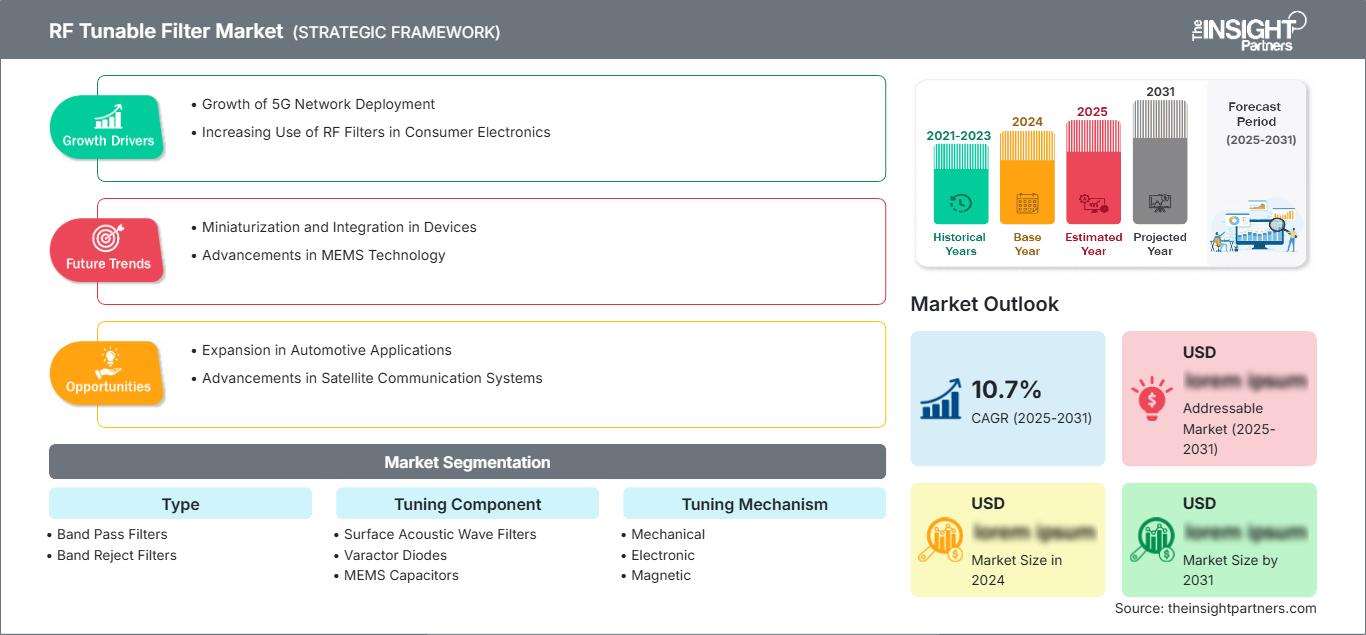
The rf tunable filter market has evolved from predominantly mechanically adjusted cavity and waveguide architectures toward compact electronically controlled solutions. With the advent of miniaturization, higher levels of semiconductor integration, and digitally variable frequency states, reliance on larger switched filter banks has been reduced. For example, Analog Devices, Inc. produces digitally-tunable bandpass filters for different RF frequencies, showing that the trend in the industry is towards programmable filter design, reduced package size, and quick frequency switching.
In the future, it is likely that there will be an increased demand from applications related to defense, transport, smart-city communication systems, and specialized industrial sensing applications. With the growing application of software-defined radios, there will be an increased value added by electronically adjustable filters. The problem of size and insertion loss can be overcome through advanced packaging technologies and MEMS.
RF Tunable Filter Market Report Scope
| Report Attribute | Details |
|---|---|
| Market size in 2025 | US$ 160.68 Million |
| Market Size by 2034 | US$ 253.48 Million |
| Global CAGR (2026 - 2034) | 5.2% |
| Historical Data | 2021-2024 |
| Forecast period | 2026-2034 |
RF Tunable Filter Market Analysis
The rf tunable filter market growth is closely linked to the transition toward radios and RF systems that must operate across multiple frequency bands without requiring numerous discrete filter banks. Demand is generated by defense systems, wireless communication infrastructure, radar, transport communications, and laboratory instruments. Participants of the value chain include filter designers, MEMS and semiconductor manufacturers, machinists, packagers, RF module assembly firms, and system OEMs. Digital control of the filters makes frequency selection simpler and easier and physical switching unnecessary.
Supply is still different depending on the technology used. While precision mechanical and waveguide filters need special machining, calibration, and temperature tuning, semiconductors need RF processes and packaging know-how. This results in a dual-track supply chain where high-end defense applications can benefit from customized solutions while communications and instrumentation applications benefit from smaller and more controllable devices.
Competitive positioning in the rf tunable filter market analysis varies considerably by application. Analog Devices, Inc. emphasizes integrated digitally tunable RF products, while Coleman Microwave Company maintains capabilities in tunable coaxial and waveguide filters for demanding microwave applications. DiCon Fiberoptics, Inc. contributes MEMS-based tunable filtering expertise, particularly in photonic systems, whereas Thorlabs, Inc. addresses precision optical instrumentation.
Other participants pursue differentiated niches. Telonic Berkeley supplies precision filtering and RF measurement-related products, while RF Products Inc., Netcom Inc., and LGL Group, Inc. participate in specialized RF component applications. EXFO Inc. and Dover Corporation provide broader technology capabilities that can intersect with communications and instrumentation ecosystems. Competitive advantage increasingly depends on tuning speed, rejection, power handling, integration, qualification, and the ability to customize products for system-level requirements.
● REPORT CUSTOMIZATION
Tailor This Report To Align With Your Specific Business Requirements
This report can be customized to align precisely with your business objectives, scope, and target markets. Customization options include tailored segmentation, geography, competitive analysis, and strategic insights to support informed decision-making.
Customize This Report →WHAT YOU CAN ADJUST
- ● Segmentations
- ● Geography
- ● Competitive Analysis
- ● Language Preferences
RF Tunable Filter Market: Strategic Insights
Regional Insights
North America rf tunable filter market
North America is estimated to hold a 35–39% of the rf tunable filter market share in 2025 and expand at a 6.0–6.6% CAGR through 2034. The US accounts for most regional demand, supported by defense electronics, radar modernization, electronic warfare, satellite communications, and software-defined radio architectures. Canada contributes through aerospace, telecommunications, and research instrumentation applications. Established RF engineering ecosystems and domestic procurement requirements strengthen regional production capabilities.
Defense programs represent a major source of technically demanding applications because platforms require frequency agility, interference rejection, and compact RF front ends. Commercial opportunities also arise from wireless infrastructure and advanced instrumentation. Coleman Microwave Company maintains tunable microwave filter capabilities extending across coaxial and waveguide architectures, while Analog Devices, Inc. supplies digitally tunable RF filters. These capabilities illustrate the coexistence of customized microwave products and highly integrated semiconductor solutions.
U.S. rf tunable filter Market
The US represents approximately 84–88% of North America's 2025 rf tunable filter market share and is projected to grow at a 6.1–6.7% CAGR through 2034. Its demand base spans aerospace and defense, radar, electronic warfare, satellite communications, test equipment, and advanced wireless systems. Domestic suppliers benefit from government procurement, specialized RF engineering, and extensive defense-electronics manufacturing networks.
Application requirements increasingly favor programmable filtering, where a single receiver must cover multiple bands or reject changing interferers. Analog Devices, Inc. has developed digitally tunable band-pass filters covering several frequency ranges, while Coleman Microwave Company provides mechanically adjustable microwave filters designed for demanding applications. Such technology diversity allows buyers to select between integrated semiconductor architectures and customized high-power microwave designs.
Europe rf tunable filter Market
Europe is estimated to command a 25–29% share of the rf tunable filter market in 2025 and grow at a 5.4–6.1% CAGR through 2034, with Germany representing a leading national market. The UK and France provide substantial aerospace and defense demand, while Italy and Spain contribute through transportation, industrial electronics, communications, and defense programs. Regional procurement increasingly emphasizes compact, reliable RF components capable of supporting multi-band systems.
The UK benefits from aerospace, defense, and communications research, while Germany combines industrial automation with automotive electronics and advanced RF engineering. France maintains strong aerospace and defense capabilities, Italy has established industrial and transportation electronics expertise, and Spain is strengthening communications and defense technologies. European manufacturers and integrators are therefore positioned across both specialized military filtering and broader commercial RF applications, with Germany expected to remain a leading contributor.
APAC rf tunable filter Market
APAC is expected to account for 27–31% of the 2025 rf tunable filter market and register a 6.3–7.1% CAGR through 2034, with China representing the leading market. Japan and South Korea benefit from advanced electronics manufacturing, while India is expanding telecommunications and defense electronics. Australia contributes through aerospace, defense, mining, and communications applications.
Industrial digitization and domestic electronics manufacturing policies support demand for compact RF components. China, Japan, and South Korea provide extensive production ecosystems, while India is increasing its local defense-electronics capabilities. These conditions encourage adoption of electronically controlled filters for communications, transportation, and industrial systems, although high-performance applications continue to require stringent qualification, thermal stability, and frequency-control characteristics.
Middle East & Africa rf tunable filter Market
The Middle East and Africa rf tunable filter market demand is developing from a smaller base, with Saudi Arabia, the UAE, and South Africa representing important markets. The region is expected to expand at a 6.2–7.0% CAGR through 2034, supported by communications infrastructure, defense modernization, energy systems, and mining operations requiring resilient RF connectivity and interference management.
Saudi Arabia and the UAE are investing in advanced communications and defense infrastructure, while South Africa has established industrial, mining, and research applications. The Rest of MEA remains fragmented but offers opportunities through satellite communications, security systems, and energy infrastructure. Regional adoption will depend strongly on system integrator partnerships, environmental qualification, local support, and availability of components suited to high-temperature operating conditions.
Segmentation Analysis
Type
Type segmentation is led by Band Pass Filters, reflecting their fundamental role in selecting desired frequency channels while suppressing adjacent interference. The segment is estimated to grow at a 6.0–6.6% CAGR from 2026–2034. Band Reject Filters remain strategically important for interference suppression, especially where receiver sensitivity and spectrum congestion require selective attenuation. As indicated in the RF tunable filter market forecast, increasing demand for adaptive spectrum management and multi-band communication systems is expected to support continued adoption of both filter types across advanced wireless applications.
- Band Pass Filters: These filters provide controlled transmission around designated frequency ranges and remain central to receivers, radar, communications equipment, and instrumentation requiring selective signal isolation.
- Band Reject Filters: These products target unwanted frequency bands and are important where strong interferers, harmonics, or adjacent-channel signals could compromise receiver performance.
Tuning Component
Tuning Component selection is increasingly influenced by the required balance between tuning range, insertion loss, linearity, size, speed, and manufacturing complexity. The segment is projected to expand at a 6.3–7.1% CAGR from 2026–2034. Electronic and MEMS approaches are gaining strategic importance as systems move toward programmable architectures. RF tunable filter market trends indicate increasing adoption of electronically tunable and MEMS-based solutions as wireless, defense, and spectrum-management systems require greater flexibility, adaptability, and real-time frequency optimization.
- Surface Acoustic Wave Filters: SAW technologies provide compact frequency-selective functionality and remain relevant where stable filtering, small form factors, and repeatable frequency characteristics are required.
- Varactor Diodes: Varactor-based tuning enables voltage-controlled frequency adjustment and supports compact RF architectures where analog control and relatively simple circuit implementation are priorities.
- MEMS Capacitors: MEMS capacitors offer electronically controllable capacitance with potential benefits in miniaturization, quality factor, and low-power operation for advanced RF systems.
- Oscillator Filters: Oscillator-based approaches support frequency-selective architectures where tunability must be coordinated with signal generation and receiver control.
- Digitally Tunable Capacitors: Digitally controlled capacitance enables programmable frequency states and facilitates integration with software-defined RF architectures and automated calibration systems.
- Surface-Mount Device Variants: Surface-mount implementations address compact board-level integration, supporting high-density equipment where assembly efficiency and component footprint are important.
Tuning Mechanism
Tuning Mechanism is transitioning toward electronic control as RF platforms increasingly require rapid frequency selection and software-driven configuration. The segment is forecast to grow at a 6.7–7.5% CAGR from 2026–2034, with electronic architectures benefiting from programmability and reduced mechanical complexity. The RF tunable filter market is increasingly driven by demand for agile spectrum management, adaptive communication systems, and configurable RF architectures across commercial, industrial, and defense applications.
- Mechanical: Mechanical tuning remains valuable in high-performance applications requiring robust physical adjustment, high power handling, or customized microwave characteristics.
- Electronic: Electronic tuning supports rapid programmable adjustment and integration with digital control systems, making it strategically important for agile communications, defense, and instrumentation.
- Magnetic: Magnetic tuning provides an alternative mechanism for specialized microwave architectures where wide frequency adjustment and low static power characteristics can be advantageous.
Application
Application diversity is increasing as tunable filtering moves beyond conventional communications into defense, transportation, energy, mining, healthcare, and smart-city systems. The segment is estimated to grow at a 6.2–7.0% CAGR from 2026–2034. Application requirements differ substantially by operating environment, frequency range, power level, and certification needs.
- Aerospace and Defense: Requires high rejection, frequency agility, environmental resilience, and specialized qualification for radar, electronic warfare, communications, and avionics.
- Smart Cities: Uses adaptable RF filtering within connected infrastructure, wireless networks, sensing systems, and communication nodes exposed to increasingly dense spectrum environments.
- Transportation: Supports wireless connectivity, navigation, telemetry, and communication systems where reliable operation across changing RF environments is essential.
- Energy and Power: Applies RF filtering to communications and monitoring infrastructure supporting substations, distributed assets, industrial control, and remote equipment.
- Mining: Requires rugged RF systems for autonomous equipment, telemetry, worker communications, and monitoring in interference-prone industrial environments.
- Healthcare: Uses frequency-selective components in medical communications, monitoring equipment, imaging-related systems, and specialized laboratory instrumentation.
Opportunity Snapshot
| Application | Revenue Contribution (High/Medium/Low) | Trend Tag | Adoption Stage |
| Aerospace and Defense | High | EW Agility | Mature |
| Smart Cities | Medium | Dense Spectrum | Scaling |
| Transportation | Medium | V2X Filtering | Scaling |
| Energy and Power | Medium | Grid Telemetry | Scaling |
| Mining | Low | Rugged RF | Emerging |
| Healthcare | Medium | Medical Wireless | Scaling |
| Others | Low | Niche Systems | Emerging |
RF Tunable Filter Market Growth Drivers and Impact Analysis
Expansion of Software-Defined Radio Architectures
SDR is adding value to frequency-agile filtering, since receivers are increasingly needing to operate on several different bands without depending on large numbers of fixed components. This would help in simplifying the front-end design, making it compact and enabling automated adjustments in case of any changes in frequencies. This particular driver is important, especially in the military communications segment, tactical radios, spectrum analysis and instrumentation applications. It has an influence on the entire value chain, as filter suppliers have to offer a wide tuning range, stable calibration, fast switching and digital interface. These types of products help to cut down integration costs for OEMs. Analog Devices, Inc. is one such example.
Increasing RF Spectrum Congestion
The increase in wireless devices, private network deployments, industrial networking, and defense systems is increasing the difficulties associated with coexistence in the spectrum. With stronger adjacent signals and interference affecting the receivers, there is a need for increased selectivity in terms of filtering. There are tunable filter designs that can change according to the varying frequencies of use rather than relying on the fixed response for a particular channel. In the business, the impact is felt most with multi-frequency equipment such as infrastructure radios, testing equipment, transportation communication equipment, and spectrum analyzers. In this respect, manufacturers have to improve their out-of-band rejection without causing too much insertion loss.
Miniaturization of RF Front-End Components
The system designer is now moving towards having a smaller RF front end due to limited enclosure sizes for portable radio transceivers, sensor communication devices, aerospace electronics, and instruments. Conventionally used cavity and switch filters have proven to be quite bulky and heavy, which has created a need for integration. The semiconductor or MEMS technology will be able to move the tuning close to the amplifiers, switches, mixers, and controllers, thus eliminating complex interconnections. The market effect includes higher demand for surface-mountable parts, small LGA packages, control interface integration, and digital tunability. However, while miniaturizing the component, linearity, isolation, power handling, and temperature stability cannot be compromised.
RF Tunable Filter Market Future Trends
Digital Calibration and Closed-Loop Frequency Control
The future systems may adopt more complex calibration techniques that automatically adjust for the temperature changes, aging, variations in components, and tolerances in the manufacturing process. Rather than performing tuning as an individual step, RF systems can monitor the responses and automatically adjust the center frequency and bandwidth using the digital controls. Such a method can enhance repeatability in high-volume manufacturing while minimizing the need for calibration. Closed-loop designs will prove to be very useful in military radios, automated test systems, and communications systems that work under wide environmental ranges. The suppliers who make programmable interfaces and diagnostics accessible will prove to have deeper integration in the OEM control software. In the long run, this will result in the transition from tunable components to digital filtering subsystems.
Integration of Tunable Filters with RF Front Ends
Integration is going to link more filters together with amplifiers, switches, mixers, detectors, and control electronics instead of keeping each function isolated. This approach might lower signal chain losses, packaging, interconnect parasitics, and system qualification efforts. More advanced semiconductor technologies and heterogeneous packaging will make it possible to achieve greater functional integration between frequency control circuits and RF circuits. Integrated modules in defense and instrumentation applications will allow simpler platform-specific tailoring, where multiple functionalities are integrated into one qualified subsystem. Integration does not mean elimination of filters; discrete filters will continue to be used in high-power and specialized microwave applications. There will be two parallel market development trends: highly integrated RF programmable modules for volume production and tunable assemblies for tough applications.
RF Tunable Filter Market Opportunities
Customized Filters for Defense and Electronic Warfare
The area of defense electronics constitutes a lucrative field for those providers who can supply their customers with customized tuning ranges, rejection characteristics, thermal stability, and environmental qualification. There are certain limitations in electronic warfare that call for flexible tuning ranges. The provider can earn from combining filters with software data regarding calibration and digital interface, in addition to application-specific control electronics. Moreover, the opportunity arises in case customization can help to develop stronger ties with the client, since the qualification process, along with platform implementation, will make it hard to replace components in case of the client’s dissatisfaction with them after the design approval. It is also a good chance for manufacturers possessing microwave machining, RF simulation, high-power testing, and military qualification competencies.
Programmable Components for Advanced Test and Instrumentation
Another opportunity is offered through automated test equipment, as laboratories and production facilities increasingly need flexible frequency ranges without manually changing multiple filters. Tunable filters that can be programmed to operate automatically may serve the purposes of sweep testing, interference testing, receiver testing, and production testing. Vendors can capitalize on their market positions through the provision of software interfaces, remote control capabilities, calibration procedures, and module configurations, along with the RF equipment. The integration with the entire instrumentation systems may help in generating continuous demand for such products, as customers will need to increase their testing capabilities or to include additional frequency bands. This opportunity is especially appropriate for vendors with experience in measurement systems, photonics, and RF components.
Frequently Asked Questions

- Comprehensive Market Sizing and Forecast Analysis
- Detailed Segmentation Analysis
- In-Depth Market Dynamics Assessment
- Regional and Country-Level Insights
- Competitive Landscape and Company Benchmarking
- Strategic Business Intelligence
Recent Reports
Testimonials

The Insight Partners provided valuable market intelligence that supported our global go-to-market strategy. Their team was professional, responsive, and attentive to our feedback, providing thoughtful analysis and helpful methodological clarifications throughout the project.
Junmo Kim Chief Financial Officer (CFO), Enertech Co., Ltd.
The Insight Partners' SCADA System Market report is comprehensive, with valuable insights on current trends and future forecasts. The team was highly professional, responsive, and supportive throughout. We are very satisfied and highly recommend their services.
RAN KEDEM Partner, Reali Technologies LTDs
I requested a report on a very specific software market and the team produced the report in a few days. The information was very relevant and well presented. I then requested some changes and additions to the report. The team was again very responsive and I got the final report in less than a week.
JEAN-HERVE JENN Chairman, Future Analytica
We worked with The Insight Partners for an important market study and forecast. They gave us clear insights into opportunities and risks, which helped shape our plans. Their research was easy to use and based on solid data. It helped us make smart, confident decisions. We highly recommend them.
PIYUSH NAGPAL Sr. Vice President, High Beam Global
The Insight Partners delivered insightful, well-structured market research with strong domain expertise. Their team was professional and responsive throughout. The user-friendly website made accessing industry reports seamless. We highly recommend them for reliable, high-quality research services
YUKIHIKO ADACHI CEO, Deep Blue, LLC.
This is the first time I have purchased a market report from The Insight Partners.While I was unsure at first, I visited their web site and felt more comfortable to take the risk and purchase a market report.I am completely satisfied with the quality of the report and customer service. I had several questions and comments with the initial report, but after a couple of dialogs over email with their analyst I believe I have a report that I can use as input to our strategic planning process.Thank you so much for taking the extra time and making this a positive experience.I will definitely recommend your service to others and you will be my first call when we need further market data.
JOHN SUZUKI President and Chief Executive Officer, Board Director, BK Technologies
I wish to appreciate your support and the professionalism you displayed in the course of attending to my request for information regarding to infectious disease IVD market in Nigeria. I appreciate your patience, your guidance, and the fact that you were willing to offer a discount, which eventually made it possible for us to close a deal. I look forward to engaging The Insight Partners in the future, all thanks to the impression you have created in me as a result of this first encounter.
DR CHIJIOKE ONYIA MANAGING DIRECTOR, PineCrest Healthcare Ltd.Reason to Buy
- Informed Decision-Making
- Understanding Market Dynamics
- Competitive Analysis
- Identifying Emerging Markets
- Customer Insights
- Market Forecasts
- Risk Mitigation
- Boosting Operational Efficiency
- Strategic Planning
- Investment Justification
- Tracking Industry Innovations
- Aligning with Regulatory Trends





 Get Free Sample for