
Rotary Die Cutters Market Demand, Trends & Forecast by 2034
Coverage: By Type (Automatic, Semi-Automatic); Application (Die Cutting, Perforating, Scoring, Slitting, Embossing); End-User Industry (Food and Beverages, Pharmaceuticals, Cosmetics and Personal Care, Electronics and Electrical, Others) , and Geography (North America, Europe, Asia Pacific, and South and Central America)
- Status : Data Released
- Report Code : TIPRE00015025
- Category : Electronics and Semiconductor
- No. of Pages : 150
- Available Report Formats :


- Last update date : September 21, 2026


2025 Market Size
US$ 383.15 Mn
Base year value
2034 Forecast
US$ 573.83 Mn
Projected by 2034
CAGR 2026-2034
4.59 %
Growth rate
Addressable Market
US$ 4,344.84 Mn
(2026-2034)
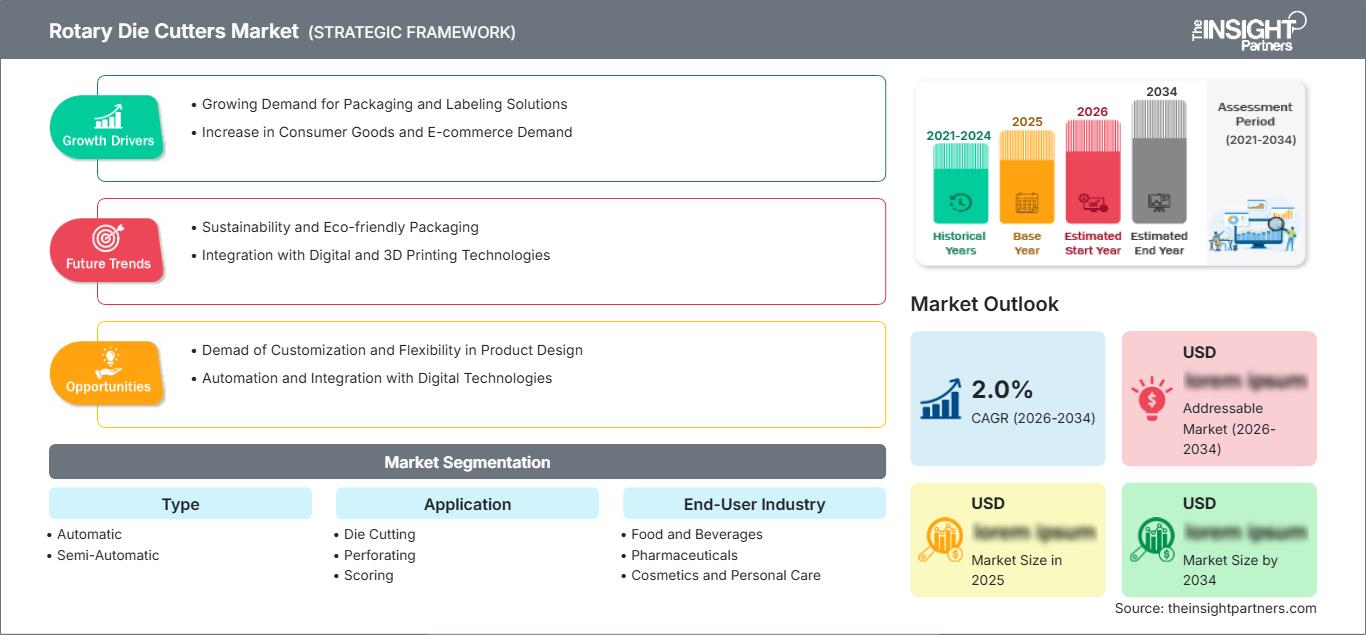
The rotary die cutters market is projected to grow from US$ 383.15 Million in 2025 to US$ 573.83 Million by 2034, registering a CAGR of 4.59% during 2026–2034. Demand is driven by high-speed packaging conversion, short-run print finishing, label customization, folding carton production, and the need for accurate cutting, scoring, slitting, perforating, and embossing across consumer-facing industries.
The North America rotary die cutters market size is supported by corrugated packaging, commercial print finishing, pharmaceutical cartons, and digitally printed labels. The region is expected to grow at a CAGR of 4.1–4.6% during 2026–2034 as converters invest in automation, faster changeovers, waste reduction, and finishing systems that support shorter production cycles.
Rotary Die Cutters Market Assessment and Insights
- North America accounted for 25–28% share in 2025 and is expected to grow at a CAGR of 4.1–4.6% during 2026–2034, supported by corrugated packaging, direct mail, labels, and folding carton modernization.
- US represented 78–82% of North America demand in 2025 and is projected to expand at 4.0–4.5% CAGR due to print finishing upgrades and packaging line automation.
- Europe held 24–27% share in 2025 and is expected to grow at 3.8–4.3% CAGR, with Germany, the UK, France, Italy, and Spain contributing through carton, label, and corrugated converting investment.
- Asia Pacific represented 34–38% share in 2025 and is forecast to grow at 5.0–5.6% CAGR, supported by China, India, Japan, South Korea, and Australia as packaged food, e-commerce, and electronics output expands.
- Largest Segment: Automatic rotary die cutters held 58–62% share in 2025 and are projected to grow at 4.8–5.3% CAGR because converters prioritize throughput, registration accuracy, and labor efficiency.
- High Growth Segment: Embossing applications accounted for 10–13% share in 2025 and are expected to grow at 5.2–5.8% CAGR as premium packaging, cosmetics, and promotional print finishing add tactile differentiation.
- Key companies analyzed in detail: Bograma AG, Duplo Corporation, Kempsmith Machine Company, Inc., MBO America, BOBST Group SA, Plockmatic International AB, Preco, LLC, Rollem International, SYSCO Machinery Corporation, and THERM-O-TYPE Corporation.
Source: The Insight Partners' analysis based on proprietary research, government publications, company annual reports, investor presentations, industry databases, and expert interviews.
Equipment evolution is moving from mechanically intensive finishing toward servo-driven, digitally assisted, and modular systems. The rotary die cutters market benefits from shorter makeready times, flexible dies, automated waste stripping, and inline compatibility with printing, folding, gluing, and delivery systems. These competencies enable converters to cope with changing SKUs on an ongoing basis without compromising their output performance.
Future demand for the service is expected to be influenced by the regional packaging capacity, the growing need to meet brand quality standards, and increasing capital expenditure on print-on-demand finishing operations. The new geographies are expanding their carton and label capacity, whereas the developed geographies are upgrading their old equipment.
Rotary Die Cutters Market Report Scope
| Report Attribute | Details |
|---|---|
| Market size in 2025 | US$ 383.15 Million |
| Market Size by 2034 | US$ 573.83 Million |
| Global CAGR (2026 - 2034) | 4.59% |
| Historical Data | 2021-2024 |
| Forecast period | 2026-2034 |
Rotary Die Cutters Market Analysis
The rotary die cutters market growth is closely tied to packaging producers that need accurate finishing at high speeds. Food and beverages, pharmaceuticals, cosmetics, and electronics brands increasingly use differentiated cartons, labels, sleeves, tags, and inserts. Rotary systems provide continuous processing, fast repeatability, and efficient waste removal, making them attractive for medium and long runs where flatbed finishing may create bottlenecks.
Supply dynamics are shaped by machine builders, die makers, print finishing equipment suppliers, and packaging automation integrators. Rotary die cutters market analysis shows that buyers compare machine format, substrate range, registration control, stripping capability, die changeover time, and compatibility with digital or offset workflows. Flexible magnetic dies are gaining importance because they reduce tooling costs and shorten job preparation.
Positioning is based on the manufacturers who integrate machines, knowledge of applications, and services. BOBST Group SA focuses on packaging automation and connected converting systems, whereas Bograma AG and MBO America cater to B2 and B1 rotary finishing processes. Duplo Corporation, Rollem International, THERM-O-TYPE Corporation, and Preco, LLC cater to short-run, digital and industrial converting processes.
The strategic focus now centers on systems that are not labor-intensive and give stable production irrespective of materials. Kempsmith Machine Company, Inc., Plockmatic International AB, SYSCO Machinery Corporation, and suppliers catering to specific requirements are pertinent for those converters who need specialized formats, rebuilding capabilities, and regional converting systems.
● REPORT CUSTOMIZATION
Tailor This Report To Align With Your Specific Business Requirements
This report can be customized to align precisely with your business objectives, scope, and target markets. Customization options include tailored segmentation, geography, competitive analysis, and strategic insights to support informed decision-making.
Customize This Report →WHAT YOU CAN ADJUST
- ● Segmentations
- ● Geography
- ● Competitive Analysis
- ● Language Preferences
Rotary Die Cutters Market: Strategic Insights
Regional Insights
North America Rotary Die Cutters Market
North America accounted for 25–28% share in 2025 and is expected to expand at 4.1–4.6% CAGR. The rotary die cutters market share is reinforced by corrugated conversion, carton finishing, labels, and commercial print specialists serving e-commerce, healthcare, and consumer goods customers.
Converters in the region invest in automation to reduce setup losses and respond to short-run orders. Product portfolios from Duplo Corporation, Rollem International, Preco, LLC, THERM-O-TYPE Corporation, and BOBST Group SA support applications ranging from digital print finishing to high-volume packaging.
U.S. Rotary Die Cutters Market
The U.S. represented 78–82% of North America Rotary Die Cutters Market demand in 2025 and is projected to grow at 4.0–4.5% CAGR. Demand reflects strong carton, corrugated, pharmaceutical label, and promotional print finishing activity, where accurate die cutting reduces manual trimming and supports brand-specific shapes.
Domestic converters are upgrading equipment to improve throughput, registration, and waste stripping. The country benefits from an established base of print finishing dealers, packaging equipment service networks, and industrial converting suppliers, allowing small printers and large packaging groups to specify machines for different run lengths.
Europe Rotary Die Cutters Market
Europe held 24–27% share in 2025 and is expected to grow at 3.8–4.3% CAGR. Germany leads through machinery, carton, and industrial packaging activity, while the UK maintains demand from commercial print finishing, labels, and direct mail applications.
France, Italy, and Spain contribute through food packaging, cosmetics, wine and spirits labels, and folding cartons. European converters emphasize energy efficiency, precise cut-to-print registration, low waste, and compliance-ready packaging quality. Bograma AG, BOBST Group SA, MBO America distribution channels, and Plockmatic International AB support regional adoption.
APAC Rotary Die Cutters Market
APAC represented 34–38% share in 2025 and is forecast to grow at 5.0–5.6% CAGR. China is the leading country due to packaging scale, while India, Japan, South Korea, and Australia support demand from food, pharmaceuticals, electronics, and personal care packaging.
Regional converters invest in semi-automatic and automatic systems depending on labor availability, order mix, and capital intensity. Rising e-commerce shipments, organized retail growth, and consumer product localization increase the need for reliable high-speed finishing across cartons, labels, and corrugated inserts.
Middle East & Africa Rotary Die Cutters Market
The Middle East & Africa Rotary Die Cutters Market is expected to grow at 3.5–4.0% CAGR, driven by packaging investment in Saudi Arabia, the UAE, South Africa, and the Rest of MEA. Food processing, pharmaceuticals, personal care, and logistics packaging create steady equipment demand.
South Africa leads regional adoption due to its established print and packaging base, while the UAE acts as a distribution and packaging hub. Buyers prioritize machine durability, local service access, operator training, and the ability to run corrugated, cartonboard, and label materials efficiently.
Segmentation Analysis
Type
Type includes Automatic and Semi-Automatic. The rotary die cutters market scope under this segment reflects the difference between high-throughput automated lines and cost-sensitive machines used by smaller converters. Type-level demand is expected to grow at 4.3–4.9% CAGR during 2026–2034.
- Automatic: Automatic machines lead where converters need high sheet or web speeds, precise registration, inline stripping, fast changeovers, and reduced operator intervention across repeat packaging and label jobs.
- Semi-Automatic: Semi-automatic systems remain important for small and medium converters seeking affordability, flexible job handling, and practical finishing capacity without full-line automation investment.
Application
The application includes die cutting, perforating, scoring, slitting, and embossing. Application-level demand is projected to grow at a CAGR of 4.4% to 5.0% as converters increasingly integrate multiple finishing operations into fewer production passes, improving efficiency while enhancing downstream folding, packaging, and product presentation quality. The ability to streamline workflows, reduce material handling, and support high-precision converting processes is expected to drive sustained adoption across packaging, labeling, and commercial printing applications, according to the Rotary Die Cutters Market report
- Die Cutting: Die cutting is the core application, supporting shaped cartons, labels, tags, pockets, inserts, and promotional pieces that require repeatable profiles and accurate waste separation.
- Perforating: Perforating supports tear-off labels, coupons, security seals, mailers, and packaging openings where controlled separation improves usability and consumer interaction.
- Scoring: Scoring is critical for cartons, folders, and folded packaging because clean crease formation reduces cracking, improves assembly, and protects printed surfaces.
- Slitting: Slitting enables roll and sheet conversion into precise widths, supporting labels, flexible materials, cards, and packaging components moving into downstream processes.
- Embossing: Embossing adds raised or recessed effects to cartons, cosmetics packaging, greeting cards, and premium labels, increasing visual and tactile value for brand differentiation.
End-User Industry
End-User Industry includes Food and Beverages, Pharmaceuticals, Cosmetics and Personal Care, and Electronics and Electrical. This segment is expected to grow at 4.5–5.1% CAGR as regulated labeling, brand differentiation, and protective packaging needs intensify. The increasing focus on compliance, product safety, shelf appeal, and packaging performance across these industries is expected to support continued demand, according to the Rotary Die Cutters Market forecast.
- Food and Beverages: Food and beverage converters use rotary die cutting for sleeves, cartons, labels, trays, and promotional packaging that must combine visual appeal, throughput, and reliable repeatability.
- Pharmaceuticals: Pharmaceutical applications require accurate cartons, labels, inserts, and tamper-evident features where registration, traceability, and consistent finishing quality are essential.
- Cosmetics and Personal Care: Cosmetics and personal care brands use die cutting, scoring, and embossing to create premium cartons, labels, and displays that communicate product differentiation.
- Electronics and Electrical: Electronics packaging relies on precision-cut inserts, labels, insulation materials, and protective components that require clean edges and consistent dimensions.
Opportunity Snapshot
| Application | Revenue Contribution | Trend Tag | Adoption Stage |
| Die Cutting | High | Shape Control | Mature |
| Perforating | Medium | Tear Features | Scaling |
| Scoring | High | Clean Folds | Mature |
| Slitting | Medium | Roll Conversion | Mature |
| Embossing | Medium | Premium Texture | Scaling |
Rotary Die Cutters Market Growth Drivers and Impact Analysis
Packaging SKU Proliferation and Shorter Production Runs
Product manufacturers continue to introduce new flavor profiles, different packaging sizes, seasonal products, and promotional editions, which results in an increase in the number of finishing tasks performed by converters. This trend can be controlled using rotary die cutting since flexible dies, faster changeover time, and continuous production make the changeover process more affordable. This effect is felt most in food, beverages, personal care, and labels categories, where time-to-market is an important consideration. For those converters that have been doing finishing tasks manually or with slow flat finishing methods, rotary equipment would come in handy.
Automation Pressure Across Print and Packaging Plants
Issues related to labor, quality control requirements, and increased operating costs are leading converters to automate their finishing equipment. Rotary die cutting machines decrease manual handling of sheets, provide better registration and waste stripping as part of the manufacturing process. Automation enables converters to maintain uniform production throughout the shift, which is especially important when dealing with packaging customers. In practice, automation means less reworking, less waste sheets, and efficient use of resources. Automatic machines become more popular in cases where converters deal with recurring orders.
Premium Packaging and Functional Finishing Demand
Packaging is being used increasingly as a brand communication device rather than just a container mechanism. Die cutters allow rotary shapes such as windows, perforations, embossing, folds, and multilevel packaging to be created, thus adding to the appearance of the product and the ease with which it can be handled. In cosmetics, drugs, electronic devices, and high-end foods, such finishing touches distinguish the products. In terms of market implications, more use of equipment will be made possible since the same system will perform cutting, scoring, slitting, perforation, and embossing operations.
Rotary Die Cutters Market Future Trends
Digitally Integrated Finishing Workflows
The rotary die cutters market trends point toward tighter integration between digital printing, workflow software, and finishing systems. Future lines will increasingly use job data, registration marks, automated setup memory, and production monitoring to shorten makeready and improve repeatability. This matters as converters accept smaller orders with more design variation. Digitally assisted finishing will also help operators identify waste, track performance, and maintain consistent output. Equipment suppliers that connect rotary cutting to broader print and packaging workflows will gain stronger positions with commercial printers and carton converters.
Greater Use of Flexible Dies and Modular Tooling
The usage of flexible dies and modular tools is expected to grow as converters deal with various shapes and change designs frequently. When compared with the regular tooling methods, the use of flexible dies will decrease costs, storage, and delivery time for many jobs involving paperboard, labels, and marketing purposes. The use of modular stations will enable users to mix different processes, such as die cutting, scoring, perforation, and waste removal, depending on the job requirements. This will enable investments in equipment that is not dedicated to a specific product line.
Rotary Die Cutters Market Opportunities
Digital Print Finishing for On-Demand Packaging
The Rotary Die Cutters market forecast reveals a huge potential in on-demand packaging and digitally printed products for commercial purposes. Small brands, e-commerce companies, and local stores need customized boxes, labels, and marketing materials in smaller numbers but with faster turnarounds. Finishing equipment, which supports digital sheet feeding along with flexible dies, may allow print shops to do more in-house jobs without any outsourced production delays. This potential may be tapped by manufacturers through small machines, an efficient die ordering process, and service packages.
Aftermarket Tooling and Service Revenue
The advantage of aftermarket sales comes from the fact that die cutting technology uses quality tooling, spare parts, the skills of the operator, and preventive maintenance. Suppliers of dies, machines, and services have the ability to assist converters in flexible dies manufacturing, the use of magnetic cylinders, accessories for stripping, registration modifications, and refurbishing. This is a very recurring opportunity, as the designs of packaging are changing often and the equipment needs to stay consistent. Suppliers of shorter die delivery time and application testing can build stronger connections with converters.
Frequently Asked Questions

- Comprehensive Market Sizing and Forecast Analysis
- Detailed Segmentation Analysis
- In-Depth Market Dynamics Assessment
- Regional and Country-Level Insights
- Competitive Landscape and Company Benchmarking
- Strategic Business Intelligence
Recent Reports
Testimonials

The Insight Partners provided valuable market intelligence that supported our global go-to-market strategy. Their team was professional, responsive, and attentive to our feedback, providing thoughtful analysis and helpful methodological clarifications throughout the project.
Junmo Kim Chief Financial Officer (CFO), Enertech Co., Ltd.
The Insight Partners' SCADA System Market report is comprehensive, with valuable insights on current trends and future forecasts. The team was highly professional, responsive, and supportive throughout. We are very satisfied and highly recommend their services.
RAN KEDEM Partner, Reali Technologies LTDs
I requested a report on a very specific software market and the team produced the report in a few days. The information was very relevant and well presented. I then requested some changes and additions to the report. The team was again very responsive and I got the final report in less than a week.
JEAN-HERVE JENN Chairman, Future Analytica
We worked with The Insight Partners for an important market study and forecast. They gave us clear insights into opportunities and risks, which helped shape our plans. Their research was easy to use and based on solid data. It helped us make smart, confident decisions. We highly recommend them.
PIYUSH NAGPAL Sr. Vice President, High Beam Global
The Insight Partners delivered insightful, well-structured market research with strong domain expertise. Their team was professional and responsive throughout. The user-friendly website made accessing industry reports seamless. We highly recommend them for reliable, high-quality research services
YUKIHIKO ADACHI CEO, Deep Blue, LLC.
This is the first time I have purchased a market report from The Insight Partners.While I was unsure at first, I visited their web site and felt more comfortable to take the risk and purchase a market report.I am completely satisfied with the quality of the report and customer service. I had several questions and comments with the initial report, but after a couple of dialogs over email with their analyst I believe I have a report that I can use as input to our strategic planning process.Thank you so much for taking the extra time and making this a positive experience.I will definitely recommend your service to others and you will be my first call when we need further market data.
JOHN SUZUKI President and Chief Executive Officer, Board Director, BK Technologies
I wish to appreciate your support and the professionalism you displayed in the course of attending to my request for information regarding to infectious disease IVD market in Nigeria. I appreciate your patience, your guidance, and the fact that you were willing to offer a discount, which eventually made it possible for us to close a deal. I look forward to engaging The Insight Partners in the future, all thanks to the impression you have created in me as a result of this first encounter.
DR CHIJIOKE ONYIA MANAGING DIRECTOR, PineCrest Healthcare Ltd.Reason to Buy
- Informed Decision-Making
- Understanding Market Dynamics
- Competitive Analysis
- Identifying Emerging Markets
- Customer Insights
- Market Forecasts
- Risk Mitigation
- Boosting Operational Efficiency
- Strategic Planning
- Investment Justification
- Tracking Industry Innovations
- Aligning with Regulatory Trends





 Get Free Sample for