
Satellite-Based Augmentation Systems Market Size, Trends & Demand by 2034
Coverage: By Aircraft Type (Fixed-Wing, Rotary Wing); Application (Military Aircraft, Commercial Aircraft, General Aviation Aircraft) , and Geography (North America, Europe, Asia Pacific, and South and Central America)
- Status : Data Released
- Report Code : TIPRE00019907
- Category : Electronics and Semiconductor
- No. of Pages : 150
- Available Report Formats :


- Last update date : September 28, 2026


2025 Market Size
US$ 653.78 Mn
Base year value
2034 Forecast
US$ 997.05 Mn
Projected by 2034
CAGR 2026-2034
4.80 %
Growth rate
Addressable Market
US$ 7,493.04 Mn
(2026-2034)
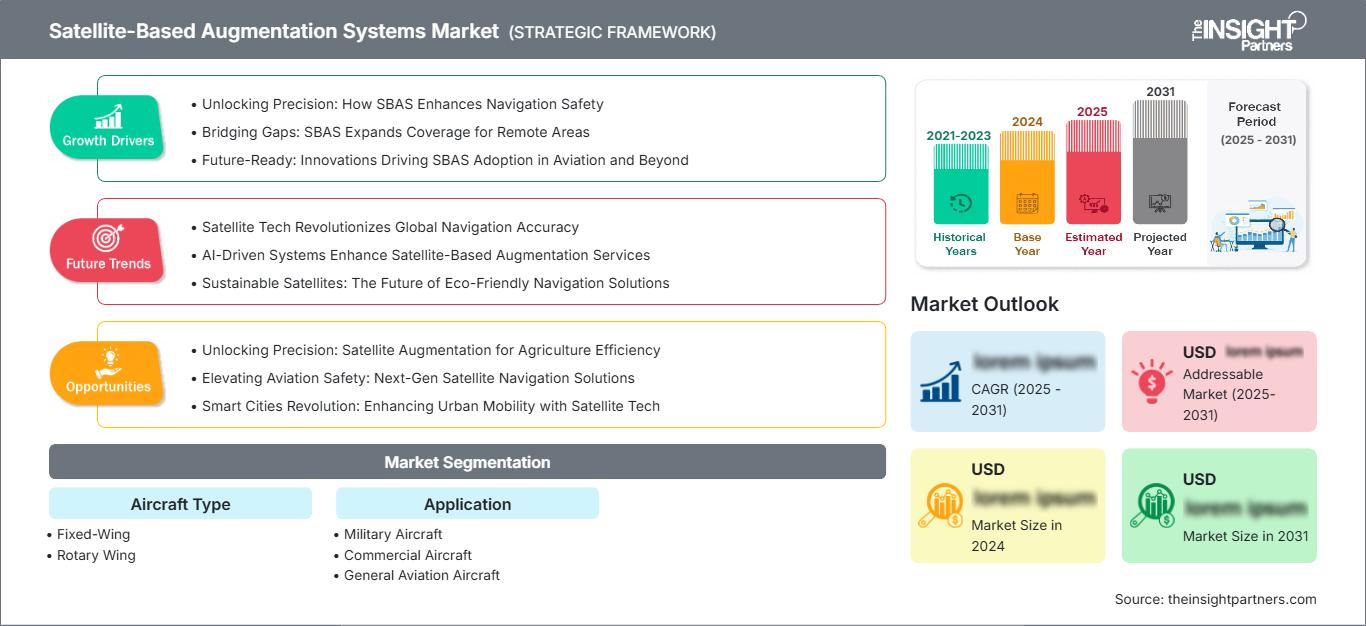
The satellite-based augmentation systems market is projected to grow from US$ 653.78 Million in 2025 to US$ 997.05 Million by 2034, registering a CAGR of 4.80% during 2026–2034. Growth is supported by aviation safety modernization, greater reliance on GNSS-enabled positioning, and the need for integrity-assured navigation during approach, landing, route planning, and low-visibility operations.
North America remains central to the satellite-based augmentation systems market size because WAAS-backed aviation procedures, strong avionics adoption, and federal navigation infrastructure investments support consistent demand. The region is expected to grow at a 4.5–4.9% CAGR during 2026–2034, led by commercial aviation, general aviation upgrades, and defense-related navigation resilience programs.
Satellite-Based Augmentation Systems Market Assessment and Insights
- North America held 35–38% share in 2025 and is expected to grow at a CAGR range of 4.5–4.9% between 2026–2034, supported by WAAS utilization and aircraft navigation modernization.
- US accounted for 78–82% of North America revenue in 2025 and is projected to grow at a 4.4–4.8% CAGR during 2026–2034.
- Europe captured 24–27% share in 2025 and is forecast to grow at a 4.2–4.6% CAGR, led by the UK, Germany, France, Italy, and Spain.
- Asia Pacific represented 23–26% share in 2025 and is expected to grow at a 5.2–5.8% CAGR, supported by China, Japan, South Korea, India, and Australia.
- Largest Segment: Fixed-Wing aircraft held 68–72% market share in 2025 and is projected to grow at a 4.6–5.0% CAGR during 2026–2034.
- High Growth Segment: Commercial Aircraft held 46–50% market share in 2025 and is forecast to grow at a 5.1–5.7% CAGR during 2026–2034.
- Key companies analyzed in detail: Advanced Navigation and Positioning Corporation, Garmin Ltd., GMV GROUP, Honeywell International Inc., Lockheed Martin Corporation, Northrop Grumman Corporation, RTX Corporation, Saab AB, Thales Group, and Universal Avionics Systems Corporation, an Elbit Systems Company.
Source: The Insight Partners' analysis based on proprietary research, government publications, company annual reports, investor presentations, industry databases, and expert interviews.
The technology development trajectory in this segment has shifted from regional GPS augmentation services to multi-satellite system, dual frequency, and integrity-oriented navigation systems. The current generation of SBAS is based on a combination of satellite constellations, reference ground stations, master control stations, and avionics receivers to enhance precision and warn of unreliable positioning signals.
The future growth drivers will be based on modernization of the aircraft fleet, performance-based navigation, and new SBAS services in Asia Pacific and Oceania. The investments are growing to build a resilient PNT infrastructure in response to the the requirements of aviation agencies, defense users, and avionics providers for dependable positioning.
Satellite-Based Augmentation Systems Market Report Scope
| Report Attribute | Details |
|---|---|
| Market size in 2025 | US$ 653.78 Million |
| Market Size by 2034 | US$ 997.05 Million |
| Global CAGR (2026 - 2034) | 4.80% |
| Historical Data | 2021-2024 |
| Forecast period | 2026-2034 |
Satellite-Based Augmentation Systems Market Analysis
The SBAS market is witnessing consistent growth due to the growing demand for high-precision and reliable navigation services in the civil aviation, defense, and mobility sectors. The augmentation systems provide correction and integrity information to augment GNSS signals, thereby facilitating navigation where GNSS service fails to deliver desired performance levels. Airlines, airport authorities, general aviation entities, and military bodies are now dependent on SBAS to ensure flight safety and perform precision approach activities while reducing dependency on costly ground navigation and landing aids. Increased traffic and a move towards performance-based navigation systems are aiding the growth of the SBAS market.
The supply-side dynamics of satellite-based augmentation systems (SBAS) are impacted by several different elements, such as satellite payload launch schedules, network of ground reference stations, communication infrastructure, requirement for receiver certification and avionics integration schedules. Since the implementation of SBAS is contingent upon the availability of suitable avionics equipment, navigation systems, and approved procedures of operations, market development is usually consistent with programs involving retrofits of existing aircraft, delivery of new commercial airplanes, airport modernization efforts, and airspace management activities.
Market analysis for satellite-based augmentation systems market reveals that the market has an environment that is highly competitive due to the existence of established avionics providers, aerospace technology providers, defense electronics providers, and navigation solution providers. Some of the leading organizations in the market include Garmin Ltd., Honeywell International Inc., Thales Group, RTX Corporation, Universal Avionics Systems Corporation, and GMV GROUP and all these organizations contribute to the growth of the market through providing certifiable avionics platforms, navigation software, integrity monitors, flight management technologies, and integration solutions.
More strategic investments are being made in the dual-frequency SBAS systems, multi-GNSS constellation compatibility, cybersecurity-enhanced navigation solutions, and PNT resilient solutions within the sector. These advancements are meant to enhance the availability of signals as well as reduce any potential interferences while making sure that next-generation aviation activities are facilitated effectively. Some of the firms involved in these advancements include Lockheed Martin Corporation, Northrop Grumman Corporation, Saab AB, and Advanced Navigation and Positioning Corporation, among others, through their experience in the areas of defense navigation solutions, sensor fusion technologies, systems engineering, and reliable positioning solutions for civil aviation, as well as mission-critical applications.
● REPORT CUSTOMIZATION
Tailor This Report To Align With Your Specific Business Requirements
This report can be customized to align precisely with your business objectives, scope, and target markets. Customization options include tailored segmentation, geography, competitive analysis, and strategic insights to support informed decision-making.
Customize This Report →WHAT YOU CAN ADJUST
- ● Segmentations
- ● Geography
- ● Competitive Analysis
- ● Language Preferences
Satellite-Based Augmentation Systems Market: Strategic Insights
Regional Insights
North America satellite-based augmentation systems market
North America held 35–38% satellite-based augmentation systems market share in 2025 and is forecast to grow at a 4.5–4.9% CAGR through 2034. The area is well served by established WAAS systems, extensive coverage of procedures at airports, a large number of aircraft equipped with avionics, and solid support from the government on behalf of satellite-based navigation.
In addition to domestic air traffic, there is an increasing need for navigation services arising from Canada and Mexico, which include cross-border commercial flights, remote communities' connections, and regional aircraft operations.
U.S. satellite-based augmentation systems Market
The US represented 78–82% of North America satellite-based augmentation systems market revenue in 2025 and is projected to grow at a 4.4–4.8% CAGR during 2026–2034. The fact that WAAS-enabled LPV approaches are used in the nation makes it the leading region adopting them.
Some of the companies that operate in the field include Garmin Ltd., Honeywell International Inc., RTX Corporation, Lockheed Martin Corporation, and Northrop Grumman Corporation. Areas of application include the efficiency of commercial routes, access to small airports in general aviation, and military navigation robustness.
Europe satellite-based augmentation systems Market
Europe accounted for 24–27% of the satellite-based augmentation systems market in 2025 and is expected to grow at a 4.2–4.6% CAGR. The UK supports adoption through commercial aviation, regional airports, and avionics-led flight efficiency programs. Germany contributes through aerospace manufacturing, defense electronics, and industrial navigation demand.
France benefits from EGNOS-linked aviation modernization and the presence of Thales Group, while Italy and Spain support uptake through regional aviation, airport modernization, and public navigation infrastructure. Europe’s regulatory alignment around GNSS integrity services reinforces long-term use across civil and safety-critical operations.
APAC satellite-based augmentation systems Market
APAC held 23–26% share of the satellite-based augmentation systems market in 2025 and is projected to grow at a 5.2–5.8% CAGR. Japan, India, South Korea, China, and Australia are improving augmentation coverage through national or regional navigation programs, airport modernization, and demand for safer operations across dense flight corridors.
India’s GAGAN, Japan’s MSAS, South Korea’s KASS, and Australia’s SouthPAN rollout support long-term adoption. Commercial aviation growth, regional connectivity, and unmanned aircraft applications create a strong policy and industrial base for SBAS-enabled avionics.
Middle East & Africa satellite-based augmentation systems Market
The Middle East & Africa satellite-based augmentation systems market is expected to grow at a 4.6–5.1% CAGR during 2026–2034. Saudi Arabia and the UAE lead adoption through airport expansion, defense aviation, and regional air traffic modernization, while South Africa supports demand through aviation safety and remote navigation needs.
Rest of MEA demand is linked to airspace modernization, humanitarian aviation, and infrastructure constraints across remote operating environments. Long-term opportunity depends on interoperability with global SBAS services and investments in receiver certification, airline readiness, and airport procedures.
Segmentation Analysis
Aircraft Type
The aircraft type segment, covering fixed-wing and rotary wing platforms, is forecast to grow at a 4.7–5.2% CAGR during 2026–2034. Satellite-based augmentation systems market scope is shaped by aircraft mission profile, avionics certification, approach procedure availability, and the operational value of vertical guidance in weather-affected or infrastructure-limited airports.
- Fixed-Wing aircraft dominate adoption because commercial, regional, business, and general aviation fleets use SBAS-enabled avionics to support approach guidance, route efficiency, and procedure access at airports without full ground landing systems.
- Rotary Wing platforms use SBAS for emergency medical services, offshore transport, defense missions, and low-altitude operations where precise navigation supports landing-zone access, obstacle awareness, and operational continuity.
Application
The application segment, covering military aircraft, commercial aircraft, and general aviation aircraft, is projected to grow at a 4.8–5.4% CAGR during 2026–2034. The segment benefits from navigation modernization, safety requirements, and the expanding use of SBAS procedures across civil and mission-critical aircraft operations.
- Military Aircraft adoption is driven by resilient positioning, mission planning, degraded-environment navigation, and the need for dependable guidance when terrestrial infrastructure or conventional navigation aids are unavailable.
- Commercial Aircraft represent the highest revenue opportunity because airline fleets use SBAS-enabled procedures to improve approach reliability, reduce diversions, and support route efficiency across regional and major airport networks.
- General Aviation Aircraft rely on SBAS-capable avionics to access smaller airports, improve safety margins, and enable precision-like approaches without expensive ground-based landing systems.
Opportunity Snapshot
| Application | Revenue Contribution | Trend Tag | Adoption Stage |
| Military Aircraft | Medium | Resilient PNT | Scaling |
| Commercial Aircraft | High | LPV Access | Mature |
| General Aviation Aircraft | Medium | Airport Access | Scaling |
Satellite-Based Augmentation Systems Market Growth Drivers and Impact Analysis
Expansion of Performance-Based Navigation Procedures
The performance-based navigation is making the utility of SBAS more valuable in terms of the airline’s and airport’s use of the satellite-based procedures in order to improve accessibility, safety, and operational efficiency. With the SBAS, the vertical guidance becomes possible without installing costly precision landing equipment. It is very important for the regional airports, the remote areas, and the general aviation airports where the infrastructure is not enough. The driver drives the need to upgrade the avionics, the procedure publications, and the market for certified receivers, etc.
Fleet Modernization and Certified Avionics Upgrades
Avionics in commercial, business, and general aviation fleets are being updated to enable GNSS procedures, flight operations, and better situational awareness. Aircraft with receivers capable of receiving SBAS signals, flight management systems, and cockpit displays are often part of larger upgrade packages for surveillance, communication, and navigation. This can be observed in the retrofit cycles of older aircraft and the installation of avionics in new-generation aircraft. Companies providing integration of navigation systems along with experience in certification and worldwide support will likely gain from this situation.
Growing Need for Resilient Positioning in Defense Aviation
The users of defense aviation systems need to have positioning solutions capable of sustaining mission continuity even if the ground systems are compromised. The SBAS technology will make the PNT solutions resilient by increasing signal integrity and enhancing the navigation capabilities in such environments. Aircraft of the military, the surveillance devices, as well as the rotorcrafts, may take advantage of augmentation-based navigation to increase route planning, approach reliability, and interoperability within civil aviation systems.
Satellite-Based Augmentation Systems Market Future Trends
Dual-Frequency and Multi-Constellation SBAS
The satellite-based augmentation systems market trends point toward dual-frequency and multi-constellation services that can process signals from GPS, Galileo, BeiDou, and other GNSS constellations. The upgrade will increase the availability, minimize the chances of being affected by the ionospheric error, and help enhance positioning for aircraft flying in different geographic regions. With the modernization of the SBAS systems by aviation regulators, it is important that manufacturers of the avionics have the capacity to receive the upgraded systems.
SBAS Integration with Unmanned and Advanced Air Mobility
There is an expectation that unmanned aircraft systems and advanced air mobility aircraft would lead to a higher need for reliable navigation services. These aircraft would require accurate positioning, integrity monitoring, and processes capable of handling routes, vertiports, emergency landing sites, and low-altitude corridors. The solution to this transition would be the SBAS system, as it would deliver avionics-grade correction and monitoring to certifiable receivers. Sustainable development will depend on regulatory systems that cater to autonomous flight and suitable receiver design.
Satellite-Based Augmentation Systems Market Opportunities
Regional Airport Access Programs
The satellite-based augmentation systems market forecasts favor investments that allow underserved airports to publish satellite-based approaches without installing full precision landing infrastructure. Regional access programs for airports can also help avoid weather diversions, enhance emergency and medical aviation services, and increase resilience in the airline’s network. Manufacturers of avionics systems, procedures developers, airport authorities, and aviation agencies can work together to increase the number of certified approaches available. The greatest potential exists in countries that have spread-out populations, mountainous areas, island flights, or community airports needing safety upgrades.
Avionics Retrofit Packages for Mixed Fleets
Mixed fleets offer the advantage of an integrated solution package that would consist of receiver systems capable of supporting SBAS, cockpit displays, navigation databases, installation services, and training for the operator. There is a need for predictable compliance paths for airlines, charter companies, helicopter operators, and GA fleets instead of individual pieces of equipment. Suppliers should enhance implementation rates by providing upgrade kits certified for the aircraft and its intended operation.
Frequently Asked Questions

- Comprehensive Market Sizing and Forecast Analysis
- Detailed Segmentation Analysis
- In-Depth Market Dynamics Assessment
- Regional and Country-Level Insights
- Competitive Landscape and Company Benchmarking
- Strategic Business Intelligence
Recent Reports
Testimonials

The Insight Partners provided valuable market intelligence that supported our global go-to-market strategy. Their team was professional, responsive, and attentive to our feedback, providing thoughtful analysis and helpful methodological clarifications throughout the project.
Junmo Kim Chief Financial Officer (CFO), Enertech Co., Ltd.
The Insight Partners' SCADA System Market report is comprehensive, with valuable insights on current trends and future forecasts. The team was highly professional, responsive, and supportive throughout. We are very satisfied and highly recommend their services.
RAN KEDEM Partner, Reali Technologies LTDs
I requested a report on a very specific software market and the team produced the report in a few days. The information was very relevant and well presented. I then requested some changes and additions to the report. The team was again very responsive and I got the final report in less than a week.
JEAN-HERVE JENN Chairman, Future Analytica
We worked with The Insight Partners for an important market study and forecast. They gave us clear insights into opportunities and risks, which helped shape our plans. Their research was easy to use and based on solid data. It helped us make smart, confident decisions. We highly recommend them.
PIYUSH NAGPAL Sr. Vice President, High Beam Global
The Insight Partners delivered insightful, well-structured market research with strong domain expertise. Their team was professional and responsive throughout. The user-friendly website made accessing industry reports seamless. We highly recommend them for reliable, high-quality research services
YUKIHIKO ADACHI CEO, Deep Blue, LLC.
This is the first time I have purchased a market report from The Insight Partners.While I was unsure at first, I visited their web site and felt more comfortable to take the risk and purchase a market report.I am completely satisfied with the quality of the report and customer service. I had several questions and comments with the initial report, but after a couple of dialogs over email with their analyst I believe I have a report that I can use as input to our strategic planning process.Thank you so much for taking the extra time and making this a positive experience.I will definitely recommend your service to others and you will be my first call when we need further market data.
JOHN SUZUKI President and Chief Executive Officer, Board Director, BK Technologies
I wish to appreciate your support and the professionalism you displayed in the course of attending to my request for information regarding to infectious disease IVD market in Nigeria. I appreciate your patience, your guidance, and the fact that you were willing to offer a discount, which eventually made it possible for us to close a deal. I look forward to engaging The Insight Partners in the future, all thanks to the impression you have created in me as a result of this first encounter.
DR CHIJIOKE ONYIA MANAGING DIRECTOR, PineCrest Healthcare Ltd.Reason to Buy
- Informed Decision-Making
- Understanding Market Dynamics
- Competitive Analysis
- Identifying Emerging Markets
- Customer Insights
- Market Forecasts
- Risk Mitigation
- Boosting Operational Efficiency
- Strategic Planning
- Investment Justification
- Tracking Industry Innovations
- Aligning with Regulatory Trends





 Get Free Sample for