
Semiconductor Lasers Market Growth, Demand & Size by 2034
Coverage: by Type (Fiber Optic Lasers (FOL), Vertical Cavity Surface Emitting Lasers (VCSEL), Compact Disc Lasers (CDL), High Power Diode Lasers (HPDL), Red Lasers, Violet Lasers, Green Lasers, Blue Lasers, Others); Application (Optical Storage Devices, Instrumentation and Sensors, Lithography, Display, Printing, Healthcare, Industrial, Others) , and Geography (North America, Europe, Asia Pacific, and South and Central America)
- Status : Data Released
- Report Code : TIPRE00008286
- Category : Electronics and Semiconductor
- No. of Pages : 150
- Available Report Formats :


- Last update date : July 10, 2026


2025 Market Size
US$ 9.8 Bn
Base year value
2034 Forecast
US$ 22.07 Bn
Projected by 2034
CAGR 2026-2034
9.44 %
Growth rate
Addressable Market
US$ 142.25 Bn
(2026-2034)
The Semiconductor Lasers market size was valued at US$ 9.8 Billion in 2025 and is anticipated to grow to US$ 22.07 Billion in 2034 at a CAGR of 9.44% during 2026-2034. The need for compact, efficient laser diodes that generate specific wavelengths of light for applications such as optical communications, medical lasers, sensing, industrial processing, and automotive applications is driving market demand.
According to the Semiconductor Lasers market report, North America is anticipated to exhibit a CAGR of 8.6-9.1% during 2026-2034, driven by investments in hyperscale data centers, military modernization, and the adoption of medical technologies. Advanced photonics manufacturing ecosystem, strong adoption of optical transceivers, and early commercial adoption of VCSEL-based sensing solutions are among some of the factors boosting the regional market growth of semiconductor lasers.
Semiconductor Lasers Market Assessment and Insights
- North America: The region accounted for 31–34% Semiconductor Lasers Market share in 2025 and is forecast to grow at a CAGR of 8.6–9.1% between 2026–2034, supported by AI data centers, medical devices, and defense photonics procurement.
- US: The country represented 78–82% of North America in 2025 and is expected to grow at a CAGR of 8.7–9.2% between 2026–2034, led by optical networking and sensing.
- Europe: Europe held 22–25% share in 2025 and is projected to grow at a CAGR of 7.8–8.5% between 2026–2034, with Germany, the UK, and France leading demand.
- Asia Pacific: APAC captured 35–38% share in 2025 and is expected to grow at a CAGR of 10.1–10.8% between 2026–2034, led by China, Japan, South Korea, and India.
- Largest Segment: Communication held 32–36% market share in 2025 and is projected to grow at a CAGR of 9.1–9.7% between 2026–2034 as optical links scale.
- High Growth Segment: Automotive held 8–11% market share in 2025 and is expected to grow at a CAGR of 11.2–12.4% between 2026–2034 as LiDAR and sensing adoption rises.
- Key companies analyzed in detail: ASML Holding N.V., Axcel Photonics, Inc., Coherent Corp., IPG Photonics Corporation, MKS Instruments, Inc., ROHM Co., Ltd., Sharp Corporation, Sumitomo Electric Industries, Ltd., TRUMPF SE + Co. KG, Lumentum Holdings Inc., ams-OSRAM AG, Hamamatsu Photonics K.K.
Source: The Insight Partners' analysis based on proprietary research, government publications, company annual reports, investor presentations, industry databases, and expert interviews.
The Semiconductor Lasers Market trends indicate that the market has shifted its production focus from discrete laser diodes towards photonic integrated subsystems that require wavelength stability, temperature management, and wafer yield as competitive indicators. Manufacturing involves compound semiconductors, assembly automation, and qualification in accordance with the standards of the telecom industry, automotive sector, and medical field. The size of Semiconductor Lasers reflects increasing content per optical module, and Semiconductor Lasers’ share depends on vendors capable of performing epitaxial growth, packaging, and engineering for specific applications.
The Semiconductor Lasers market forecast indicates that drivers in the coming years include developments in co-packaging optics, high-power diode pumping, mid-infrared sensors, and automotive VCSEL platforms. Geographies that are emerging markets enhance photonics ecosystems through semiconductor incentives, electric-vehicle policies, and industrial-automation programs. The scope of Semiconductor Lasers expands as original equipment manufacturers require efficient light sources for diagnostics, metrology, laser processing, and secure communications.
Semiconductor Lasers Market Report Scope
| Report Attribute | Details |
|---|---|
| Market size in 2025 | US$ 9.8 Billion |
| Market Size by 2034 | US$ 22.07 Billion |
| Global CAGR (2026 - 2034) | 9.44% |
| Historical Data | 2021-2024 |
| Forecast period | 2026-2034 |
Semiconductor Lasers Market Analysis
Demand is expanding because semiconductor lasers convert electrical input into coherent optical output with compact footprints, enabling direct modulation in communications and precision energy delivery in industrial and clinical systems. Fiber broadband, AI compute clusters, minimally invasive care, and vehicle sensing create recurring demand for infrared lasers, blue lasers, and VCSEL arrays. Semiconductor Lasers analysis indicates that component value rises when devices meet tighter bandwidth, lifetime, wavelength, and thermal specifications.
The value chain in the Semiconductor Lasers Market spans substrate suppliers, epitaxial wafer producers, chip fabrication, packaging, module integration, and OEM qualification. Supply dynamics remain sensitive to gallium arsenide, indium phosphide, and gallium nitride capacity, because yield losses at epitaxy or facet coating stages affect cost. Buyers increasingly dual-source qualified lasers to reduce exposure to single-fab constraints while maintaining application-specific performance across communication, medical, military and defense, industrial, instrumentation and sensor, and automotive uses.
The Semiconductor Lasers market is focused on photonics experts and diversified semiconductor companies. Coherent Corp., Lumentum Holdings Inc., ams-OSRAM AG, and Hamamatsu Photonics K.K. are competing in optical communications and sensing sectors, whereas IPG Photonics Corporation and TRUMPF SE + Co. KG improve industrial and high-power laser segments. ROHM Co., Ltd., Sharp Corporation, and Sumitomo Electric Industries, Ltd. have presence in the optoelectronics segment, in packaging, and customer qualification.
The areas of focus are 100G and 200G VCSEL platforms, indium phosphide lasers for coherent optics, and quantum cascade lasers for gas sensing. The strategic alignment lies in securing design wins with transceiver manufacturers, medical device original equipment manufacturers, Tier suppliers for the automotive industry, and defense contractors. ASML Holding N.V. and TRUMPF SE + Co. KG also demonstrate how innovation in the laser space drives lithography and semiconductor manufacturing efficiency.
● REPORT CUSTOMIZATION
Tailor This Report To Align With Your Specific Business Requirements
This report can be customized to align precisely with your business objectives, scope, and target markets. Customization options include tailored segmentation, geography, competitive analysis, and strategic insights to support informed decision-making.
Customize This Report →WHAT YOU CAN ADJUST
- ● Segmentations
- ● Geography
- ● Competitive Analysis
- ● Language Preferences
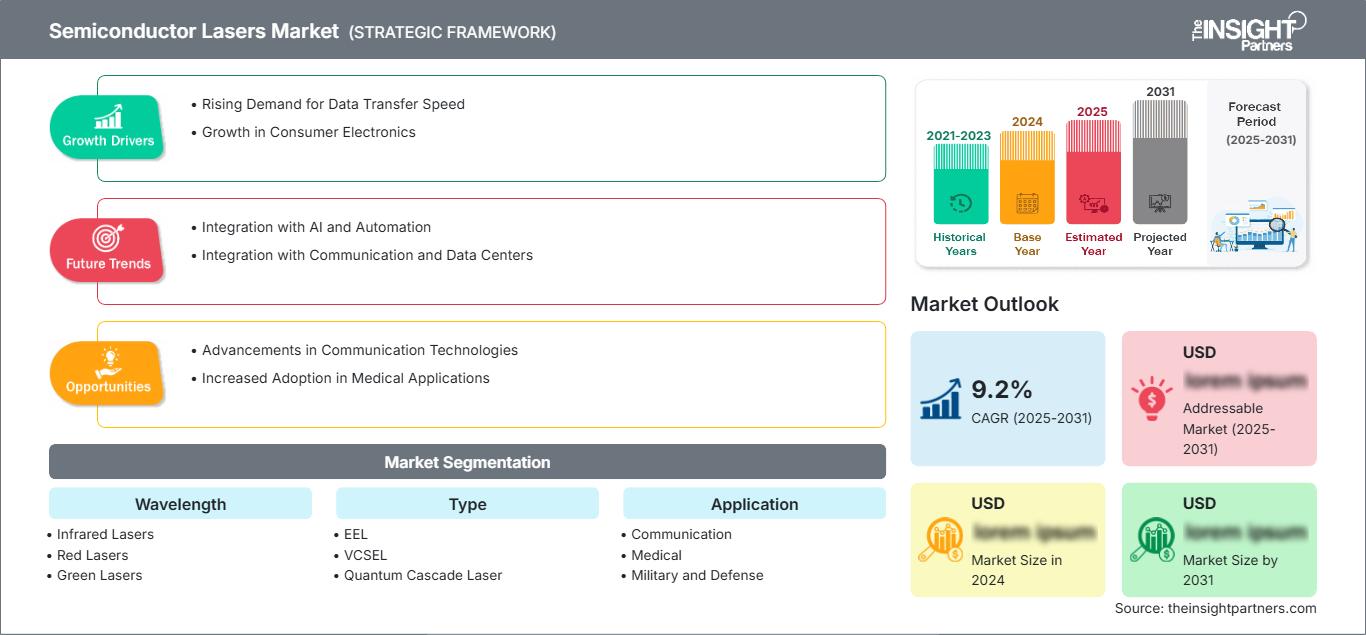
Semiconductor Lasers Market: Strategic Insights
Regional Insights
North America Semiconductor Lasers
The Semiconductor Lasers Market in North America accounted for 31-34% of worldwide revenues in 2025 and will expand at a CAGR of 8.6-9.1% during 2026-2034. Optical network upgrade projects, AI clusters, military applications for electro-optics, and healthcare applications for laser systems are driving demand for reliable edge-emitting lasers, VCSELs, and fiber laser sources. Local incentives for semiconductors are helping to advance local packaging in photonics.
Market procurement trends tend to favor vendors with established qualifications and extensive life cycle support and testing capabilities. The data center industry is pushing towards short-reach optical interconnects and aerospace and defense segments are looking for rugged emitter diodes for applications such as targeting, ranging, and secure communications.
U.S. Semiconductor Lasers Market
The Semiconductor Lasers Market in the U.S. accounted for 78–82% of North America in 2025 and is projected to grow at a CAGR of 8.7–9.2% during 2026–2034. The country leads regional demand because hyperscale cloud, national laboratories, defense electronics, and medical device manufacturers require qualified semiconductor laser platforms. Strong venture and corporate investment also supports photonic integrated circuit development.
Company presence is broad, with Coherent Corp., IPG Photonics Corporation, MKS Instruments, Inc., and Lumentum Holdings Inc. serving communications, industrial, life science, and sensing markets. Application trends include 800G optical links, LiDAR validation, laser pumping, and surgical energy delivery. Federal support for domestic semiconductor capacity strengthens long-term supply assurance.
Europe Semiconductor Lasers Market
Europe has had a 22–25% share in 2025 and is estimated to increase at a CAGR of 7.8–8.5% till 2034. The UK derives benefits from universities with photonics clusters, defense projects, and technological purchasing in healthcare. Optical instrumentation, quantum technology demonstrations, and specific medical equipment are driving factors, with traceability and reliability influencing the selection of suppliers.
The most developed country in Europe is Germany, due to laser processing, automotive production, and semiconductor equipment fabrication, which are at the core of the manufacturing industry there. The company TRUMPF SE + Co. KG and the photonics cluster are contributing in diode pumping, EUV lasers, and precise materials processing. The demand is steady due to spending on machinery automation.
The contribution of France, Italy, and Spain stems from aerospace electronics, medical devices, defense optics, and machinery modernization. France focuses on secure communication solutions and research infrastructure, Italy promotes laser processing of machinery and packaging and Spain shows increasing demand for automotive equipment and infrastructure for renewable energy monitoring.
APAC Semiconductor Lasers Market
APAC accounted for 35–38% share in 2025 and is forecast to grow at a CAGR of 10.1–10.8% during 2026–2034. China leads regional demand through electronics manufacturing, fiber broadband, electric vehicles, and industrial automation. Policy support for domestic semiconductors encourages compound semiconductor capacity and photonics packaging investment.
Japan and South Korea add strength through laser diode manufacturing, displays, memory fabs, and advanced sensors. ROHM Co., Ltd., Sharp Corporation, Hamamatsu Photonics K.K., and Sumitomo Electric Industries, Ltd. reinforce regional supply depth. India and Australia are emerging through telecom networks, defense electronics, medical equipment, and mining automation.
The region’s growth is also supported by EV localization, smart factory deployment, and public funding for semiconductor supply chains. As OEMs diversify sourcing beyond single-country exposure, APAC remains central to wafer processing, device assembly, and high-volume customer qualification.
Middle East & Africa Semiconductor Lasers Market
The Semiconductor Lasers Market in Middle East & Africa is projected to grow at a CAGR of 6.9–7.6% from 2026 to 2034. Saudi Arabia and the UAE lead regional adoption through smart infrastructure, energy diversification, medical technology investment, and defense modernization. Fiber networks and surveillance systems require reliable optical sources.
South Africa is engaged in mining automation, diagnostic equipment for medical care, and research instruments, while the rest of MEA focuses on telecom network updates and infrastructure monitoring. The demand in the region is not very large and is technical in nature, particularly for harsh-environment sensing.
Applications in the energy sector are significant since pipelines, electric grids, and plants require laser-based sensing solutions for inspection, safety, and emissions monitoring purposes. High import dependency forces procurement to be conducted via trusted international vendors and system integrators.
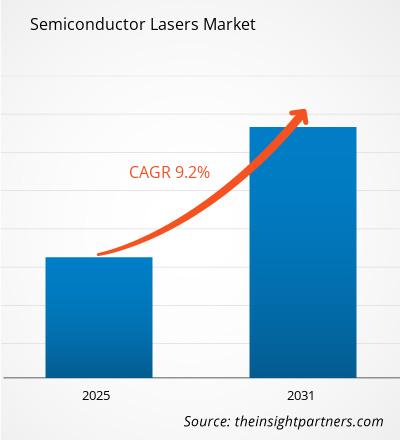
Segmentation Analysis
Wavelength
The wavelength segment in the Semiconductor Lasers Market is expected to grow at a CAGR of 9.0–9.8% from 2026 to 2034. Infrared wavelengths dominate optical communications and sensing, while visible and ultraviolet options support displays, biomedical instrumentation, lithography support, and inspection. Buyers select wavelength families according to absorption characteristics, eye-safety requirements, transmission media, and application-specific power needs.
- Infrared Lasers serve optical communications, LiDAR, medical diagnostics, and industrial sensing, making them strategically important for data transmission and safety-critical distance measurement across automotive and infrastructure applications.
- Red Lasers remain relevant in barcode scanning, alignment, medical therapy, and instrumentation where mature manufacturing, stable output, and cost-effective modules support recurring demand.
- Green Lasers support projection, biomedical imaging, alignment, and inspection applications that require higher visibility and stronger contrast than red wavelengths in selected environments.
- Blue Lasers are important in displays, high-density optical storage, material processing, and biomedical applications, especially where shorter wavelengths improve focusing precision and absorption performance.
- Ultraviolet Lasers address inspection, curing, medical, and microfabrication requirements where short wavelengths enable fine feature interaction, surface treatment, and high-resolution processing.
Type
The type segment in the Semiconductor Lasers Market is projected to grow at a CAGR of 9.2–10.0% from 2026 to 2034. EEL devices remain critical where output power and beam quality matter, while VCSELs scale in sensing and short-reach links. Quantum cascade lasers address molecular sensing, and fiber lasers continue expanding in industrial processing, medical systems, and precision manufacturing.
- EEL platforms are used in telecom, pumping, printing, and industrial systems where high optical power, directional output, and proven packaging support demanding operating conditions.
- VCSEL adoption is rising in facial sensing, LiDAR, datacom, and proximity sensing because wafer-level testing, compact arrays, and low power support scalable production.
- Quantum Cascade Laser devices serve mid-infrared spectroscopy, gas detection, defense sensing, and environmental monitoring where wavelength tunability enables molecule-specific detection.
- Fiber Laser systems combine semiconductor pumping with robust beam delivery, supporting cutting, welding, marking, surgery, and scientific tools that require efficiency and high beam quality.
Application
The application segment in the Semiconductor Lasers Market is expected to grow at a CAGR of 9.3–10.2% from 2026 to 2034. Communication remains the largest revenue contributor, while automotive delivers the strongest growth profile. Medical, military and defense, industrial, and instrumentation and sensor applications provide resilience by spreading demand across regulated, mission-critical, and productivity-focused end markets.
- Communication uses semiconductor lasers in optical transceivers, fiber access, data center interconnects, and coherent networks, making the segment central to bandwidth expansion and cloud infrastructure.
- Medical applications rely on compact lasers for ophthalmology, dermatology, surgery, diagnostics, and therapeutic devices where precision, reliability, and controlled energy delivery are essential.
- Military and Defense demand rugged laser sources for rangefinding, targeting, secure communication, directed sensing, and surveillance systems operating under strict reliability standards.
- Industrial applications use diode and fiber laser platforms for cutting, welding, marking, soldering, polymer joining, and additive manufacturing workflows that require productivity gains.
- Instrumentation and Sensor applications include spectroscopy, metrology, environmental monitoring, gas detection, and laboratory equipment where wavelength control and signal stability create value.
- Automotive adoption is increasing through LiDAR, driver monitoring, lighting, battery inspection, and in-cabin sensing as vehicles integrate more photonic safety and automation features.
Opportunity Snapshot
| Application | Revenue Contribution | Trend Tag | Adoption Stage |
| Communication | High | AI Optics | Mature |
| Medical | Medium | Precision Care | Scaling |
| Military and Defense | Medium | Secure Sensing | Scaling |
| Industrial | High | Smart Welding | Mature |
| Instrumentation and Sensor | Medium | Gas Monitoring | Scaling |
| Automotive | Medium | LiDAR Safety | Emerging |
Semiconductor Lasers Market Growth Drivers and Impact Analysis
AI Data Center Optical Interconnect Expansion
AI clusters are increasing the number of short-reach optical links inside and between racks, raising demand for VCSELs, indium phosphide lasers, and integrated photonic transmitters. Copper interconnects face power and reach limits as bandwidth moves toward 800G, 1.6T, and higher architectures. This shift increases semiconductor laser content per server cluster and supports premium pricing for devices that reduce latency, heat, and power consumption. Suppliers with high-yield array production and transceiver relationships are positioned to capture repeat orders.
Medical Procedures Moving Toward Compact Photonic Platforms
Healthcare providers increasingly prefer compact, precise, and energy-efficient systems for ophthalmology, urology, dermatology, dentistry, and diagnostics. Semiconductor lasers enable portable equipment, lower maintenance needs, and more controllable tissue interaction than many legacy energy sources. Aging populations and outpatient procedure growth support procurement of devices that shorten recovery times and improve workflow efficiency. The market impact is steady because medical device qualification cycles are long, reimbursement pathways encourage proven platforms, and OEMs prioritize component suppliers with traceable quality and lifecycle support.
Automotive Sensing and Electrification Programs
Automakers are expanding optical sensing for advanced driver assistance, in-cabin monitoring, battery manufacturing, and quality inspection. VCSELs and infrared laser diodes support LiDAR, time-of-flight sensing, and eye-safe illumination, while blue and fiber laser systems contribute to battery tab welding and precision materials processing. The impact is strongest where platforms move from premium vehicles into higher-volume models. Qualification remains demanding, but approved suppliers gain long program lifecycles, predictable volumes, and opportunities to bundle emitters with optics and driver electronics.
Semiconductor Lasers Market Future Trends
Co-Packaged Optics Reshaping Laser Architectures
Co-packaged optics will shift laser requirements from discrete pluggable modules toward sources designed for close integration with switching silicon. This will increase demand for highly reliable external laser sources, low-noise emitters, and packaging that manages heat near dense electronics. The trend favors companies that can co-design lasers, photodiodes, packaging, and test methods with system vendors. As AI traffic grows, power efficiency per transmitted bit will become a purchasing criterion equal to price and availability.
Mid-Infrared Sensing Becoming More Commercial
Quantum cascade lasers and related mid-infrared sources are moving from specialist laboratories into field-deployable gas sensing, industrial safety, environmental monitoring, and medical breath analysis. Their ability to target molecule-specific absorption lines creates value in applications where conventional sensors lack selectivity. Future adoption will depend on cost reduction, rugged packaging, and easier calibration. Growth is likely to accelerate as methane monitoring, industrial emissions compliance, and process analytics require more precise, real-time measurement tools.
Semiconductor Lasers Market Opportunities
Localized Photonics Packaging and Test Capacity
Regional semiconductor policies create an opportunity for suppliers in the Semiconductor Lasers Market to invest in photonics packaging, burn-in, reliability testing, and failure analysis closer to customers. Laser chips can be fabricated globally, but qualification bottlenecks often occur in packaging and test. Establishing local capacity improves lead times, supports defense and medical compliance, and strengthens customer collaboration. Companies that combine automated assembly with application laboratories can reduce design-cycle friction and become preferred partners for OEMs seeking resilient, traceable supply chains.
Application-Specific Laser Modules for OEM Integration
OEMs increasingly prefer modules that combine laser emitters, drivers, optics, thermal management, and diagnostics rather than bare components. This opens margin opportunities for suppliers able to deliver certified subsystems for medical devices, automotive sensors, industrial tools, and spectroscopy equipment. Application-specific modules shorten engineering cycles and reduce integration risk for customers. Vendors can differentiate through software monitoring, predictive maintenance data, and configurable wavelength or power options aligned with each end-use environment.
Recent Developments
- October 2025: ASML awarded TRUMPF with the Supplier Award in the "Technology" segment. The event signifies the development of a novel EUV High Energy Laser and its first light. This is designed to offer the highest-power microchips in the next-gen EUV lithography machines of ASML. TRUMPF has recently conducted the test run of the laser for the first time ever, and series production is expected to start from 2026.
- September 2025: Coherent Corp. announced that it had achieved a new milestone in developing short-reach optical interconnects by representing the company’s innovative generation of 2D VCSEL and PD arrays. They are ideally suited for “slow and wide” interconnects within the large-scale up AI network infrastructure.
- November 2024: Mitsubishi Electric Corporation announced the development of a high-energy short pulse (sub-nanosecond) deep ultraviolet (DUV) wavelength laser system, which was achieved in cooperation with the Institute of Physical and Chemical Research (RIKEN) and the Institute for Molecular Science (IMS), National Institutes of Natural Sciences, and which reaches an output energy of 235 millijoules, the world's highest class pulse energy.
Frequently Asked Questions

- Comprehensive Market Sizing and Forecast Analysis
- Detailed Segmentation Analysis
- In-Depth Market Dynamics Assessment
- Regional and Country-Level Insights
- Competitive Landscape and Company Benchmarking
- Strategic Business Intelligence
Recent Reports
Testimonials

The Insight Partners' SCADA System Market report is comprehensive, with valuable insights on current trends and future forecasts. The team was highly professional, responsive, and supportive throughout. We are very satisfied and highly recommend their services.
RAN KEDEM Partner, Reali Technologies LTDs
I requested a report on a very specific software market and the team produced the report in a few days. The information was very relevant and well presented. I then requested some changes and additions to the report. The team was again very responsive and I got the final report in less than a week.
JEAN-HERVE JENN Chairman, Future Analytica
We worked with The Insight Partners for an important market study and forecast. They gave us clear insights into opportunities and risks, which helped shape our plans. Their research was easy to use and based on solid data. It helped us make smart, confident decisions. We highly recommend them.
PIYUSH NAGPAL Sr. Vice President, High Beam Global
The Insight Partners delivered insightful, well-structured market research with strong domain expertise. Their team was professional and responsive throughout. The user-friendly website made accessing industry reports seamless. We highly recommend them for reliable, high-quality research services
YUKIHIKO ADACHI CEO, Deep Blue, LLC.
This is the first time I have purchased a market report from The Insight Partners.While I was unsure at first, I visited their web site and felt more comfortable to take the risk and purchase a market report.I am completely satisfied with the quality of the report and customer service. I had several questions and comments with the initial report, but after a couple of dialogs over email with their analyst I believe I have a report that I can use as input to our strategic planning process.Thank you so much for taking the extra time and making this a positive experience.I will definitely recommend your service to others and you will be my first call when we need further market data.
JOHN SUZUKI President and Chief Executive Officer, Board Director, BK Technologies
I wish to appreciate your support and the professionalism you displayed in the course of attending to my request for information regarding to infectious disease IVD market in Nigeria. I appreciate your patience, your guidance, and the fact that you were willing to offer a discount, which eventually made it possible for us to close a deal. I look forward to engaging The Insight Partners in the future, all thanks to the impression you have created in me as a result of this first encounter.
DR CHIJIOKE ONYIA MANAGING DIRECTOR, PineCrest Healthcare Ltd.Reason to Buy
- Informed Decision-Making
- Understanding Market Dynamics
- Competitive Analysis
- Identifying Emerging Markets
- Customer Insights
- Market Forecasts
- Risk Mitigation
- Boosting Operational Efficiency
- Strategic Planning
- Investment Justification
- Tracking Industry Innovations
- Aligning with Regulatory Trends





 Get Free Sample for