
Sensor Signal Conditioner ICs Market Growth, Size & Forecast by 2034
Coverage: by Type (Resistive, Capacitive); Application (Accelerometer, Sensors, Motor Drive Controllers, Strain Gauges, Others); Industry (Automotive, Industrial, Consumer Electronics, Others) , and Geography (North America, Europe, Asia Pacific, and South and Central America)
- Status : Data Released
- Report Code : TIPRE00011822
- Category : Electronics and Semiconductor
- No. of Pages : 150
- Available Report Formats :


- Last update date : July 17, 2026


2025 Market Size
US$ 4.72 Bn
Base year value
2034 Forecast
US$ 7.76 Bn
Projected by 2034
CAGR 2026-2034
5.68 %
Growth rate
Addressable Market
US$ 56.57 Bn
(2026-2034)
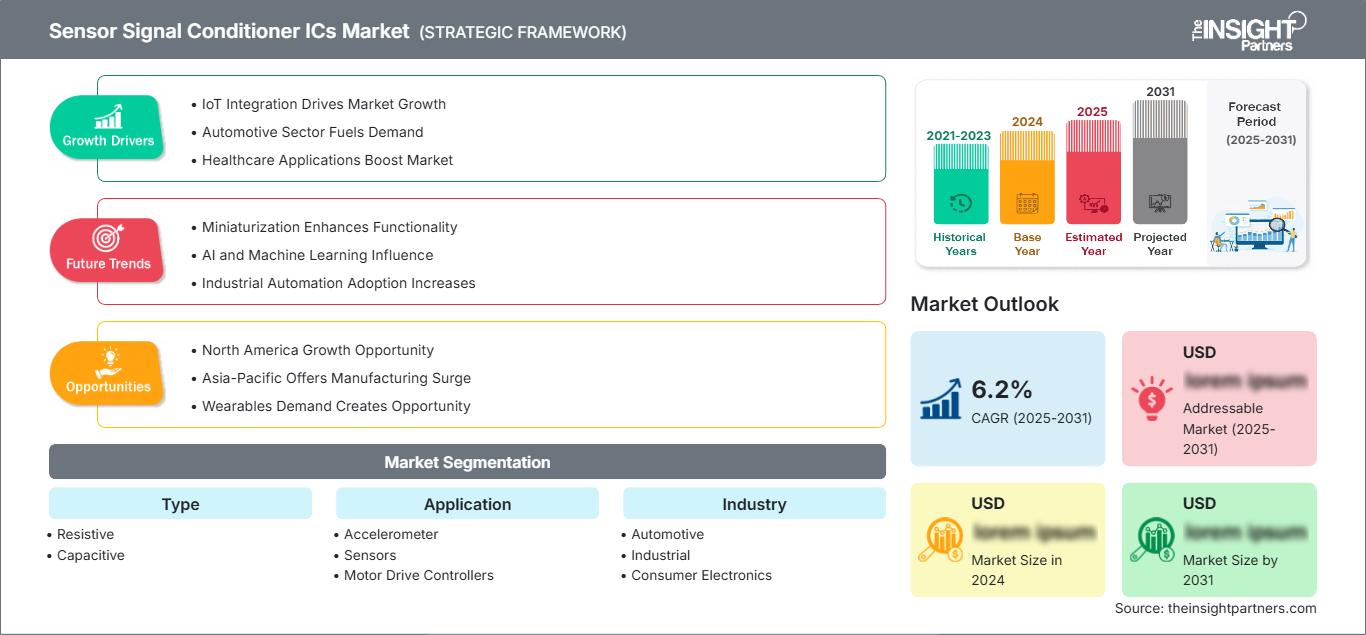
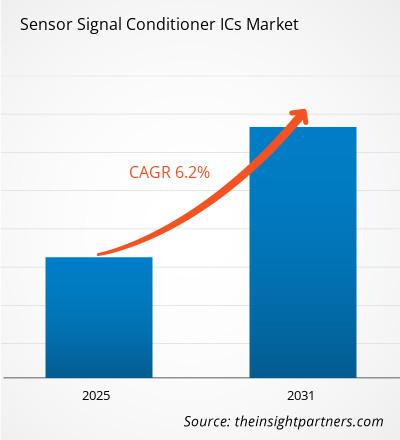
The global Sensor Signal Conditioner ICs market was valued at US$ 4.72 billion in 2025 and is expected to reach US$ 7.76 billion by 2034; it is estimated to record a CAGR of 5.68% during 2026-2034.
Sensor Signal Conditioner ICs Market Assessment and Insights
- North America: Held 31–34% share in 2025 and is projected to grow at a 5.8–6.3% CAGR between 2026–2034, led by vehicle electrification and industrial instrumentation.
- US: Accounted for 74–78% of North America in 2025 and is forecast to grow at a 5.9–6.4% CAGR, supported by semiconductor design leadership.
- Europe: Represented 23–26% share in 2025 and is set for a 5.5–6.1% CAGR, with Germany, France, and the UK leading automotive and industrial demand.
- Asia Pacific: Captured 32–35% share in 2025 and is expected to grow at a 7.0–7.6% CAGR, led by China, Japan, South Korea, and India.
- Largest Segment: Automotive held 39–43% market share in 2025 and is projected to grow at a 6.5–7.0% CAGR, reflecting higher sensor density in vehicles.
- High Growth Segment: Capacitive type held 28–32% market share in 2025 and is forecast to grow at a 7.1–7.7% CAGR, driven by touch, position, and proximity sensing.
- Key companies analyzed in detail: Analog Devices, Inc.; Elmos Semiconductor SE; Fujitsu Limited; iC-Haus GmbH; Analog Devices, Inc. (Maxim Integrated portfolio); Micro Analog Systems Oy; OMEGA Engineering, Inc.; Renesas Electronics Corporation; Suzhou Novosense Microelectronics Co., Ltd.; Texas Instruments Incorporated; STMicroelectronics N.V.; Infineon Technologies AG.
Source: The Insight Partners' analysis based on proprietary research, government publications, company annual reports, investor presentations, industry databases, and expert interviews.
Technology development has moved signal conditioning from discrete analog stages toward programmable mixed-signal front ends that combine excitation, gain control, linearization, diagnostics, and digital interfaces. Production dynamics are also shifting as automotive-grade qualification, compact packaging, and factory calibration reduce module cost. The Sensor Signal Conditioner ICs Market analysis increasingly reflects demand for lower noise, wider temperature tolerance, and embedded compensation in harsh operating environments.
Future growth will be shaped by Asia-based electronics capacity, North American industrial automation spending, and European functional-safety requirements. The Sensor Signal Conditioner ICs Market scope is broadening as edge sensing, electrified mobility, smart meters, and condition monitoring require stable signal translation near the sensor. Regulatory emphasis on vehicle safety, emissions monitoring, and energy efficiency will keep design activity focused on accuracy, reliability, and calibration speed.
Sensor Signal Conditioner ICs Market Report Scope
| Report Attribute | Details |
|---|---|
| Market size in 2025 | US$ 4.72 Billion |
| Market Size by 2034 | US$ 7.76 Billion |
| Global CAGR (2026 - 2034) | 5.68% |
| Historical Data | 2021-2024 |
| Forecast period | 2026-2034 |
Sensor Signal Conditioner ICs Market Analysis
Demand is driven by the need to convert low-level resistive and capacitive sensor signals into stable outputs for microcontrollers, data acquisition units, and embedded processors. Automotive pressure sensing, industrial strain measurement, motor control feedback, and accelerometer modules rely on signal conditioners to reduce noise, compensate temperature drift, and improve repeatability across production lots.
The ecosystem includes wafer manufacturers, analog IC designers, sensor module assemblers, calibration equipment suppliers, and OEM electronics teams. Supply dynamics are influenced by analog foundry capacity, automotive qualification cycles, and inventory discipline after the semiconductor shortages of 2021–2023. The Sensor Signal Conditioner ICs Market growth is therefore closely linked to design wins rather than short replacement cycles.
Competition is concentrated among broad analog semiconductor suppliers and specialized sensor-interface vendors. As discussed in the Sensor Signal Conditioner ICs Market Report, Analog Devices, Texas Instruments, Renesas Electronics, Elmos Semiconductor, iC-Haus, STMicroelectronics, and Infineon compete on noise performance, safety diagnostics, integration, package size, and interface flexibility. Smaller specialists differentiate through custom calibration, ultra-low-power designs, and application-specific bridge conditioning.
Investment trends favor mixed-signal integration, IO-Link readiness, automotive SENT outputs, and high-temperature operation. Strategic positioning depends on aligning IC roadmaps with EV platforms, smart factories, and connected consumer devices. The Sensor Signal Conditioner ICs Market share will likely shift toward suppliers that can combine stable long-term availability with configurable platforms for multiple sensor architectures.
● REPORT CUSTOMIZATION
Tailor This Report To Align With Your Specific Business Requirements
This report can be customized to align precisely with your business objectives, scope, and target markets. Customization options include tailored segmentation, geography, competitive analysis, and strategic insights to support informed decision-making.
Customize This Report →WHAT YOU CAN ADJUST
- ● Segmentations
- ● Geography
- ● Competitive Analysis
- ● Language Preferences
Sensor Signal Conditioner ICs Market: Strategic Insights
Regional Insights
North America Sensor Signal Conditioner ICs Market
North America accounted for 31–34% of 2025 revenue and is projected to grow at a 5.8–6.3% CAGR. The region benefits from analog semiconductor design capability, defense-grade instrumentation, high factory automation intensity, and growing deployment of calibrated sensing in EV battery, thermal, braking, and steering systems.
Demand is reinforced by US and Canadian industrial modernization, where predictive maintenance depends on reliable vibration, load, pressure, and current measurements. Automotive suppliers are also increasing redundant sensing to support safety functions, making low-drift and diagnostic-capable conditioners more important in module-level design decisions.
U.S. Sensor Signal Conditioner ICs Market
The US represented 74–78% of North America in 2025 and is expected to post a 5.9–6.4% CAGR. Its leadership reflects the presence of Texas Instruments, Analog Devices, OMEGA Engineering, and major automotive electronics, aerospace, test, and industrial automation customers that specify precision analog components early in platform development. These factors support a positive Sensor Signal Conditioner ICs Market Forecast in the United States.
Application trends center on accelerometers for safety systems, strain gauges for structural monitoring, and motor drive controllers in robotics and electrified equipment. Domestic semiconductor incentives and reshoring programs improve supply-chain visibility, although many devices still depend on global assembly, test, and wafer capacity.
Europe Sensor Signal Conditioner ICs Market
Europe held 23–26% share in 2025 and is forecast to grow at a 5.5–6.1% CAGR. Germany leads demand through automotive electronics, industrial drives, pressure sensing, and automation, supported by suppliers such as Elmos Semiconductor, iC-Haus, Infineon, and STMicroelectronics. These developments reflect key Sensor Signal Conditioner ICs Market Trends across Europe.
The UK market is shaped by aerospace instrumentation, medical electronics, advanced manufacturing, and motorsport engineering. High-value applications prioritize low noise, long-term calibration stability, and traceable measurement accuracy, especially where sensor modules operate in regulated or safety-critical settings.
France, Italy, and Spain contribute through automotive components, energy infrastructure, and industrial equipment production. France emphasizes aerospace and power systems; Italy supports machine automation and motion control; Spain benefits from vehicle assembly and renewable-energy monitoring that uses pressure, current, and vibration sensing.
APAC Sensor Signal Conditioner ICs Market
APAC accounted for 32–35% share in 2025 and is expected to expand at a 7.0–7.6% CAGR, the fastest regional pace. China leads in electronics manufacturing, EV supply chains, and industrial automation deployment.
Japan and South Korea add demand through precision manufacturing, robotics, automotive safety systems, and consumer electronics. Suppliers benefit when compact conditioners simplify calibration for high-volume sensor modules.
India and Australia support regional growth through electronics localization, renewable-energy monitoring, mining automation, and infrastructure sensing. Policy-backed manufacturing incentives increase the long-term Sensor Signal Conditioner ICs trends opportunity.
Middle East & Africa Sensor Signal Conditioner ICs Market
The Middle East and Africa are forecast to grow at a 5.2–5.8% CAGR. Saudi Arabia leads regional demand through energy infrastructure, industrial diversification, and smart-city projects requiring pressure, flow, and structural sensing. These factors are driving growth in the Sensor Signal Conditioner ICs Market across the region.
The UAE is increasing adoption in building automation, utilities, logistics, and clean-energy assets, where reliable sensing improves asset monitoring and operational safety.
South Africa and the Rest of MEA rely on mining, power, water, and transportation infrastructure upgrades. Harsh environments make temperature-compensated and rugged signal conditioners strategically important.
Segmentation Analysis
Type
The type segment is projected to grow at a 6.3–6.8% CAGR during 2026–2034. Selection depends on sensor physics, input impedance, noise tolerance, calibration method, and output architecture. Resistive interfaces dominate bridge-based pressure and strain measurement, while capacitive conditioning gains traction in touch, proximity, displacement, humidity, and MEMS-related sensing designs.
- Resistive conditioners hold a strong position in pressure sensors, load cells, and strain gauges because bridge outputs require accurate excitation, offset correction, gain trimming, and temperature compensation.
- Capacitive conditioners are strategically important for compact human-machine interfaces, liquid-level sensing, proximity detection, and MEMS devices where low power and stable capacitance-to-digital conversion matter.
Application
The application segment is expected to expand at a 6.4–6.9% CAGR during 2026–2034. Adoption is led by measurement accuracy requirements in motion sensing, closed-loop control, structural monitoring, and multiparameter sensor modules. Designers value integrated diagnostics and digital outputs because they simplify production calibration and improve reliability across distributed electronics.
- Accelerometer applications require stable low-noise interfaces for vibration monitoring, inertial sensing, safety systems, and machine health analysis across vehicles, industrial assets, and portable electronics.
- Sensors applications cover pressure, temperature, humidity, current, and position modules, where conditioners improve signal integrity before data reaches embedded processors or control platforms.
- Motor drive controllers use conditioning for current, torque, temperature, and position feedback, enabling efficient power conversion, predictive maintenance, and safety monitoring in automated equipment.
- Strain gauges remain vital in weighing, structural health, industrial force measurement, and automotive pressure sensing, where precise bridge excitation and compensation determine measurement repeatability.
Industry
The industry segment is projected to grow at a 6.2–6.7% CAGR during 2026–2034. Automotive is the largest revenue contributor, while industrial systems remain critical for durable, calibrated measurement. Consumer electronics add volume through compact sensing, but design cycles are shorter and price sensitivity is higher than in automotive or industrial applications.
- Automotive demand is anchored in powertrain, battery, chassis, safety, thermal, and cabin systems, where higher sensor density increases the need for rugged, qualified conditioners.
- Industrial users prioritize long operating life, calibration stability, noise immunity, and flexible interfaces for automation, process control, robotics, utilities, and condition-monitoring deployments.
- Consumer electronics applications favor compact, low-power, and cost-efficient conditioners for wearables, appliances, gaming devices, and smart-home products that rely on responsive sensing.
Opportunity Snapshot
Market Opportunity Snapshot
| Industry | Revenue Contribution | Trend Tag | Adoption Stage |
| Automotive | High | EV Sensing | Scaling |
| Industrial | High | Factory IO | Mature |
| Consumer Electronics | Medium | Compact Sensing | Scaling |
| Others | Low | Specialty Modules | Emerging |
Sensor Signal Conditioner ICs Market Growth Drivers and Impact Analysis
Rising Sensor Density in Electrified and Software-Defined Vehicles
Electric/hybrid/SDV cars will need more sensors for monitoring battery pressure, thermal management, braking, steering, passenger safety, and chassis control applications. Every extra sensor port adds to the increasing demands for reliable amplification and filtering of small signals while maintaining precision at varying temperatures. This translates into greater demand for qualified conditioners with diagnostics, SENT, or digital interfaces, and extended product life. Companies capable of delivering conditioners in line with functional safety requirements will be able to grab multi-cycle design wins and create substantial value propositions within the Sensor Signal Conditioner ICs Market.
Industrial Automation Requires Reliable Edge Measurement
Factories, utilities, and process industries are incorporating vibration, pressure, force, current, and position sensors to implement predictive maintenance and closed-loop control systems. Signal conditioners make it possible for raw signals from sensors to be turned into repeatable and calibrated signals before being sent to the controller or cloud server system. It will increase the uptime since the maintenance will not be done based on noisy signals but on accurate data. From the business perspective, there is an increasing need for sensors with larger input ranges and low noise.
Miniaturization of Smart Sensors Expands Addressable Designs
As smart sensor modules become more common, there is an increasing trend to integrate sensors, conditioners, memory for calibration data, diagnostics, and digital communications into a single assembly. Integrated circuit conditioners allow a reduction in the number of external components, board space used, and calibration time, which is crucial in large-scale production. In consumer electronics, medical equipment, and small industrial nodes, smaller size allows for lower power usage and enhanced mechanical flexibility as well. This leads to a gradual shift in the market from analog discrete circuits towards flexible mixed-signal integrated circuits.
Sensor Signal Conditioner ICs Market Future Trends
Shift Toward Digitally Configurable Sensor Front Ends
In the future, the designs will include programmable front-ends that will be capable of handling various kinds of sensors, calibration capabilities, output signals, and diagnostics. This will allow manufacturers of modules to employ one conditioner platform for pressure sensors, force sensors, position sensors and current sensors, which will save effort during engineering and qualifications. Digital configurability of sensors will allow for customization of sensors at the late stages to match OEM requirements without changing hardware. In the long run, suppliers with software tools and flexible analog circuits will prevail.
Integration of Condition Monitoring at the Sensor Edge
Condition Monitoring Will Take On More Local Decisions as Factories, Cars, and Infrastructure Assets Need Them. Diagnostic Signal Conditioners Will Detect Drift, Open Circuits, Overload, Temperature Excursion, and Aging of Sensors Before the System Fails. This trend will aid low latency control and lighten the load of data to central processors. Manufacturers who incorporate diagnostic algorithms and reliable data paths in tiny ICs can emerge as key partners for predictive maintenance and safety critical electronics programs, driving growth prospects in the Sensor Signal Conditioner ICs Market.
Sensor Signal Conditioner ICs Market Opportunities
Automotive Safety and Battery Systems Design Wins
Battery packs, brakes, steer-by-wire systems, and thermal management systems provide market openings for conditioners that are highly reliable and diagnosable. Suppliers may capture long-term sales by providing AEC-qualified conditioners, safety data, application examples, and supply assurances. The best market prospects are those where there is early involvement with Tier 1 suppliers and the OEM’s electronics department, since the conditioner will be locked in once the sensors have gone through validation.
Industrial IO-Link and Smart Sensor Modules
IO-Link and smart sensor architecture present a significant chance for the design of signal conditioners that are both high-precision analogs and digital interface-friendly devices. The customers require sensor module designs that provide calibrated data, diagnostic information, and configurable parameters without having to integrate additional microcontroller ICs and larger PCB boards. Manufacturers may choose to allocate their investments to two-channel ICs, integrated calibration software, and reference platforms for pressure, force, and position sensors. Such an innovation will decrease costs of the customer’s bill of materials and bring new opportunities in the Sensor Signal Conditioner ICs Market.
Recent Developments
- April 2025: Texas Instruments (TI) (Nasdaq: TXN) introduced a new portfolio of automotive lidar, clock and radar chips to help automakers transform vehicle safety by bringing more autonomous features to a wider range of cars. TI's new LMH13000, the industry's first integrated high-speed lidar laser driver, delivers ultra-fast rise time to improve real-time decision-making. The industry's first automotive BAW-based clocks, the CDC6C-Q1 oscillator and LMK3H0102-Q1 and LMK3C0105-Q1 clock generators, improve advanced driver assistance system (ADAS) reliability. Addressing evolving ADAS needs, TI's new AWR2944P mmWave radar sensor offers advanced front and corner radar capabilities.
- January 2025: Texas Instruments (TI) (Nasdaq: TXN) introduced new integrated automotive chips to enable safer, more immersive driving experiences at any vehicle price point. TI's AWRL6844 60GHz mmWave radar sensor supports occupancy monitoring for seat belt reminder systems, child presence detection and intrusion detection with a single chip running edge AI algorithms, enabling a safer driving environment. With TI's next-generation audio DSP core, the AM275x-Q1 MCUs and AM62D-Q1 processors make premium audio features more affordable. Paired with TI's latest analog products, including the TAS6754-Q1 Class-D audio amplifier, engineers can take advantage of a complete audio amplifier system offering. TI is showcasing these devices at the 2025 Consumer Electronics Show (CES), Jan. 7-10, in Las Vegas, Nevada.
- October 2024: Renesas Electronics Corporation (TSE: 6723), a premier supplier of advanced semiconductor solutions, introduced two semiconductor solutions for the rapidly growing IO-Link market: the CCE4511 four-channel IO-Link master IC and the ZSSC3286 - IO-Link ready, dual-channel resistive sensor signal conditioner IC. IO-Link is a digital communication protocol that is used most widely in industrial automation applications. As a standardized technology, it enables seamless communication between sensors, actuators, and other devices in an automation system. IO-Link has become increasingly popular in recent years due to its ability to provide real-time data and diagnostics and its ease of use and compatibility with existing systems. It also regulates & reduces wiring, enhances data availability, and offers remote configuration and monitoring. Market research firm Infogence Global Research estimates IO-Link will grow at over 20 percent per year, reaching over USD 34B in 2028. As a leader in industrial automation solutions, Renesas is committed to providing customers with innovative IO-Link solutions.
Frequently Asked Questions

- Comprehensive Market Sizing and Forecast Analysis
- Detailed Segmentation Analysis
- In-Depth Market Dynamics Assessment
- Regional and Country-Level Insights
- Competitive Landscape and Company Benchmarking
- Strategic Business Intelligence
Recent Reports
Testimonials

The Insight Partners provided valuable market intelligence that supported our global go-to-market strategy. Their team was professional, responsive, and attentive to our feedback, providing thoughtful analysis and helpful methodological clarifications throughout the project.
Junmo Kim Chief Financial Officer (CFO), Enertech Co., Ltd.
The Insight Partners' SCADA System Market report is comprehensive, with valuable insights on current trends and future forecasts. The team was highly professional, responsive, and supportive throughout. We are very satisfied and highly recommend their services.
RAN KEDEM Partner, Reali Technologies LTDs
I requested a report on a very specific software market and the team produced the report in a few days. The information was very relevant and well presented. I then requested some changes and additions to the report. The team was again very responsive and I got the final report in less than a week.
JEAN-HERVE JENN Chairman, Future Analytica
We worked with The Insight Partners for an important market study and forecast. They gave us clear insights into opportunities and risks, which helped shape our plans. Their research was easy to use and based on solid data. It helped us make smart, confident decisions. We highly recommend them.
PIYUSH NAGPAL Sr. Vice President, High Beam Global
The Insight Partners delivered insightful, well-structured market research with strong domain expertise. Their team was professional and responsive throughout. The user-friendly website made accessing industry reports seamless. We highly recommend them for reliable, high-quality research services
YUKIHIKO ADACHI CEO, Deep Blue, LLC.
This is the first time I have purchased a market report from The Insight Partners.While I was unsure at first, I visited their web site and felt more comfortable to take the risk and purchase a market report.I am completely satisfied with the quality of the report and customer service. I had several questions and comments with the initial report, but after a couple of dialogs over email with their analyst I believe I have a report that I can use as input to our strategic planning process.Thank you so much for taking the extra time and making this a positive experience.I will definitely recommend your service to others and you will be my first call when we need further market data.
JOHN SUZUKI President and Chief Executive Officer, Board Director, BK Technologies
I wish to appreciate your support and the professionalism you displayed in the course of attending to my request for information regarding to infectious disease IVD market in Nigeria. I appreciate your patience, your guidance, and the fact that you were willing to offer a discount, which eventually made it possible for us to close a deal. I look forward to engaging The Insight Partners in the future, all thanks to the impression you have created in me as a result of this first encounter.
DR CHIJIOKE ONYIA MANAGING DIRECTOR, PineCrest Healthcare Ltd.Reason to Buy
- Informed Decision-Making
- Understanding Market Dynamics
- Competitive Analysis
- Identifying Emerging Markets
- Customer Insights
- Market Forecasts
- Risk Mitigation
- Boosting Operational Efficiency
- Strategic Planning
- Investment Justification
- Tracking Industry Innovations
- Aligning with Regulatory Trends





 Get Free Sample for