
Short Range Servo Motors Market Size, Growth & Trends by 2034
Coverage: By Type (2-phase Hybrid Stepper Motors, 3-phase Hybrid Stepper Motors); Application (Automotive and Transportation, Semiconductor and Electronics, Food Processing, Textile Machines, Others) , and Geography (North America, Europe, Asia Pacific, and South and Central America)
- Status : Data Released
- Report Code : TIPRE00023398
- Category : Electronics and Semiconductor
- No. of Pages : 150
- Available Report Formats :


- Last update date : July 15, 2026


2025 Market Size
US$ 3.77 Bn
Base year value
2034 Forecast
US$ 5.86 Bn
Projected by 2034
CAGR 2026-2034
5.03 %
Growth rate
Addressable Market
US$ 43.72 Bn
(2026-2034)
In 2025, the Short Range Servo Motors Market size amounted to US$ 3.77 billion and will reach up to US$ 5.86 billion by 2034, growing at a CAGR of 5.03%. There will be demand for such products due to the need for precise movements within small automated devices, electronics assembly, automotive handling, food machines, textile machines where the torque, positioning, and acceleration are crucial factors when making the purchase decision.
North America is expected to retain its growth trajectory, having CAGR in the range from 4.6% to 5.2% during 2034. North American Market size is influenced by the re-shoring of manufacturing operations, large investments in semiconductor equipment, as well as automation of the automotive assembly process.
Short Range Servo Motors Market Assessment and Insights
- North America accounted for 24–27% share in 2025 and is projected to grow at a CAGR of 4.6–5.2% during 2026–2034, supported by factory automation, semiconductor capacity additions, and energy-efficient motion systems.
- US represented 72–76% of North America in 2025 and is expected to grow at a CAGR of 4.7–5.3% during 2026–2034, led by robotics, CNC upgrades, and EV manufacturing.
- Europe held 21–24% share in 2025 and is forecast to expand at a CAGR of 4.4–5.0% during 2026–2034, with Germany, Italy, France, and the UK leading adoption.
- Asia Pacific captured 39–43% share in 2025 and is expected to grow at a CAGR of 5.4–6.1% during 2026–2034, led by China, Japan, South Korea, India, and electronics manufacturing investments.
- Largest Segment Automotive and Transportation held 33–37% market share in 2025 and is projected to grow at a CAGR of 4.8–5.4% during 2026–2034 as automation expands in EV platforms.
- High Growth Segment Semiconductor and Electronics held 27–31% market share in 2025 and is forecast to grow at a CAGR of 5.8–6.5% during 2026–2034 amid wafer handling and inspection automation.
- Key companies analyzed in detail: ABB Ltd., FANUC CORPORATION, Siemens AG, Yaskawa America, Inc., Mitsubishi Electric Corporation, Panasonic Corporation of North America, Rockwell Automation, Inc., Emerson Electric Co., TECO Electro Devices Co., Ltd., Moog Inc.
Source: The Insight Partners' analysis based on proprietary research, government publications, company annual reports, investor presentations, industry databases, and expert interviews.
The market has seen a transition from traditional position-control motors to smaller, digitally controlled motion platforms that incorporate feedback components, servo amplifiers, and programmable controllers. There is a movement towards producing motion systems with modular components that will require less cabling, will ease up commissioning, and will work well on equipment that requires less installation space. Factors affecting supply include copper, high-precision ball bearings, rare earth magnets, encoders, and power electronics.
During the forecasted period, developing regions stand to gain from developments in industrial corridors, localization of electronics, and automation programs. Regulations related to energy consumption and machine safety are likely to drive the adoption of closed-loop servos over open loop systems. The Market will stand to gain from communication standards, predictive maintenance, and availability of compact drives.
Short Range Servo Motors Market Report Scope
| Report Attribute | Details |
|---|---|
| Market size in 2025 | US$ 3.77 Billion |
| Market Size by 2034 | US$ 5.86 Billion |
| Global CAGR (2026 - 2034) | 5.03% |
| Historical Data | 2021-2024 |
| Forecast period | 2026-2034 |
Short Range Servo Motors Market Analysis
Short Term Servo Motors Market Demand is generated through automation initiatives needing accurate positioning, synchronization, and repeatability. Consumers of automotive, electronic, food manufacturing, and textile machines find that the small size of servo motors helps increase throughput while keeping the equipment footprint the same. The market’s value chain involves component suppliers, motor makers, drive makers, control software providers, distributors, and machine makers.
Current Supply Conditions Current supply conditions are positive as major automation companies have localized production and extended their services networks, but lead times are still dependent upon magnetic materials, semiconductors, and machining availability. End-users are now prioritizing more lifecycle considerations, diagnostics, and compatibility with industrial communication protocols. Integration is now equally important as performance with multi-axis machinery and fast pick-and-place applications.
In Short Range Servo Motors Market analysis, competitive positioning involves portfolio breadth, controller compatibility, customer services, and application engineering. For ABB Ltd., Siemens AG, Rockwell Automation, Inc., and Emerson Electric Co., the competitive advantage is based on the wide automation portfolio, and FANUC CORPORATION, Yaskawa America, Inc., Mitsubishi Electric Corporation, and Panasonic Corporation of North America have an advantage based on their robotics, CNC, and electronics automation.
In terms of future investments, focus is being laid on intelligence, functional safety, form factor, and software-based commissioning of drives. The competitive landscape includes TECO Electro Devices Co., Ltd. and Moog Inc., which offer expertise in motion control and application engineering. Competitive positioning increasingly relies on minimizing machine downtime, easy installation, and global presence to help exporters of machinery.
● REPORT CUSTOMIZATION
Tailor This Report To Align With Your Specific Business Requirements
This report can be customized to align precisely with your business objectives, scope, and target markets. Customization options include tailored segmentation, geography, competitive analysis, and strategic insights to support informed decision-making.
Customize This Report →WHAT YOU CAN ADJUST
- ● Segmentations
- ● Geography
- ● Competitive Analysis
- ● Language Preferences
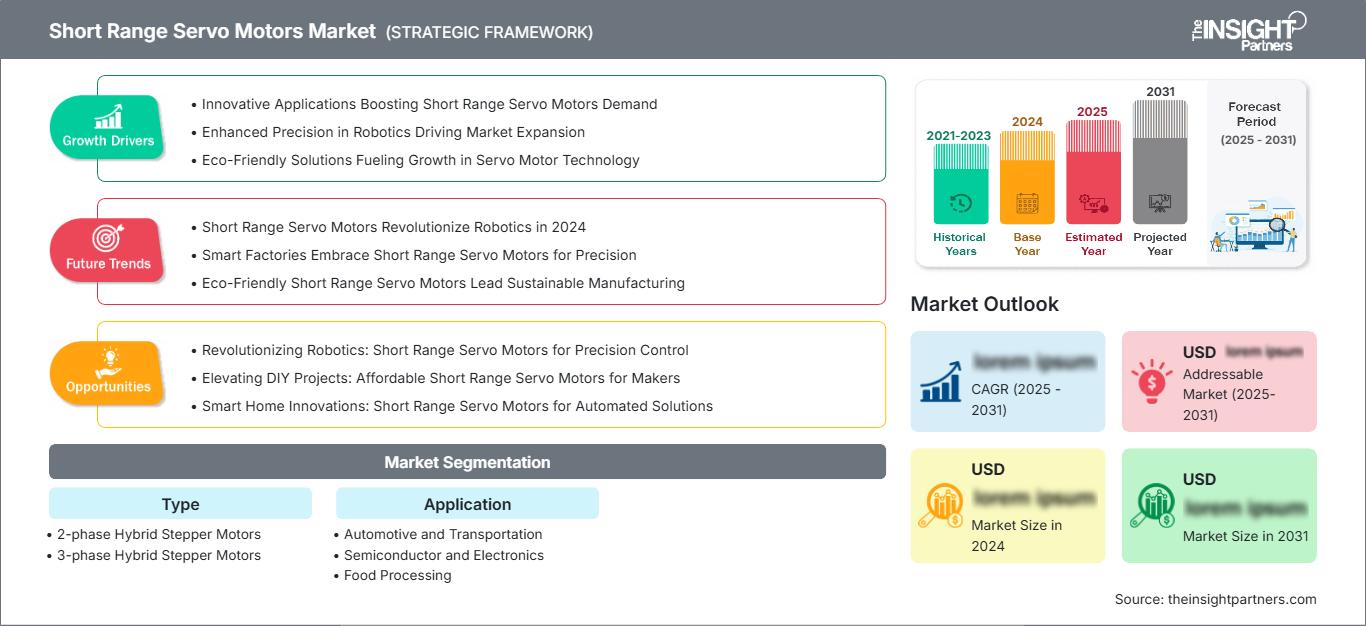
Short Range Servo Motors Market: Strategic Insights
Regional Insights
North America Short Range Servo Motors Market
North America held 24–27% of global revenue in 2025 and is expected to grow at a CAGR of 4.6–5.2% during 2026–2034. The Short Range Servo Motors Market share in the region is supported by industrial automation upgrades, semiconductor equipment demand, EV assembly lines, packaging machinery, and logistics robotics. Manufacturing investment in the US and Mexico is increasing demand for compact motion components.
Regional purchasers prioritize fast service availability, controller interoperability, and energy performance. Automation suppliers with local technical teams are better positioned because machine builders need validation support during commissioning. Food processing and textile machinery users also contribute stable replacement demand, especially where tighter throughput control and reduced manual adjustment are required.
U.S. Short Range Servo Motors Market
The US comprised 72-76% of North America in 2025 and is expected to grow at a CAGR of 4.7-5.3% during 2034. The use of short range servo motors has been found in CNC machines, robots, semiconductors, automation in warehouse, and EV component assembling. High presence has been observed with companies like Rockwell Automation, Inc., Yaskawa America, Inc., FANUC CORPORATION, and Siemens AG to support OEMs and end users.
From an application perspective, there has been increasing demand for short range servo motors, which offer accuracy along with feedback. Low vibration and repeatability have been important factors for electronics and medical device makers while the automotive industry looks out for durability and uptime. The market will get benefited through reshoring activities.
Europe Short Range Servo Motors Market
The Europe market share accounted for 21% to 24% in 2025, and it is forecast to grow at a CAGR of 4.4% to 5.0% from 2026 to 2034. Germany is the top country due to machine tool application, automobile automation, and industrial robot. Italy drives demand with packaging and textile machines, while the UK, France, and Spain drive demand with electronics, aerospace, and food automation systems.
Regulation on energy efficiency and machine safety affect purchases in this region. The OEMs are demanding servo package solutions for making CE-marked machinery exports and easy digital commissioning. Food automation lines in France and Spain are getting selective upgrades, while Germany and Italy are significant for precision motion equipment.
APAC Short Range Servo Motors Market
APAC dominated 39%-43% in 2025 and estimated to witness CAGR growth between 5.4%-6.1% from 2026-2034. China is the key contributor region-wise because of electronics, electric vehicles (EV), and machinery exports. Japan and South Korea continue to contribute to precision robotics and semiconductor equipment. Automation demand is provided by India and Australia by manufacturing upgrades.
Local policies supporting electronics localization and industrial automation are driving the adoption. Moreover, the Short Range Servo Motors Market in APAC is driven by dense supply chain ecosystems minimizing costs and customizing the product range. Machine builders in markets where there is need of compact motors for assembly, inspection, and material handling processes drive the demand.
Middle East & Africa Short Range Servo Motors Market
In the Middle East and Africa, the forecast for the CAGR for 2026-2034 would be around 4.2%-4.8%. Leading the adoption here is Saudi Arabia and UAE due to diversified industries and automation in logistic and infrastructure-based manufacturing processes. In South Africa, food processing, packaging, and mining machinery fuel the demand, whereas the rest of MEA is project-driven.
Projects in energy and infrastructure will provide an opportunity for fabricating, handling materials, and maintenance equipment. The buyers in the region look for robustness, easy integration, and access to services. Growth is lower than that of APAC and North America, although increasing industrial policies are improving the foundation for precision motion products.
Segmentation Analysis
Type
The forecast growth rate for Type will be in the range of 4.9% to 5.5% from 2026 to 2034. The scope of market based on the types of products is impacted by torque density, phase structure, controllability, and cost-to-performance ratio. In applications requiring short distance positioning, hybrid stepper-based servo systems are favored over long-range movements.
- 2-phase Hybrid Stepper Motors hold a strong position in compact automation because they offer cost-effective positioning, simpler control, and dependable performance for packaging, textile, and light assembly systems.
- 3-phase Hybrid Stepper Motors serve applications requiring smoother rotation, lower vibration, and better torque stability, making them strategically important for electronics handling and higher-speed automated machinery.
Application
Application is expected to grow at a CAGR of 5.1–5.8% during 2026–2034. Application demand is concentrated where machines require accurate positioning in confined spaces and frequent motion cycles. Automotive and transportation remains the largest revenue contributor, while semiconductor and electronics is the fastest-growing application due to clean, precise, and repeatable handling requirements.
- Automotive and Transportation relies on short-range servo motion for assembly stations, component testing, battery handling, and robotic positioning, making the segment central to production flexibility.
- Semiconductor and Electronics requires precise motion in wafer handling, inspection, soldering, and pick-and-place systems, where repeatability and low vibration directly affect yield.
- Food Processing uses compact servo motors for filling, cutting, sorting, and packaging equipment, where hygiene, speed adjustment, and consistent portion control support operational efficiency.
- Textile Machines adopt servo systems for tension control, stitching, winding, and patterning, helping manufacturers improve fabric quality while reducing mechanical adjustments and downtime.
Opportunity Snapshot
| Application | Revenue Contribution | Trend Tag | Adoption Stage |
| Automotive and Transportation | High | EV Automation | Mature |
| Semiconductor and Electronics | High | Wafer Handling | Scaling |
| Food Processing | Medium | Hygienic Motion | Scaling |
| Textile Machines | Medium | Tension Control | Mature |
Short Range Servo Motors Market Growth Drivers and Impact Analysis
Automation Density in Precision Manufacturing
The increase in automation density will make the Short Range Servo Motors Market thrive as original equipment manufacturers re-engineer their machines to achieve high production capacity in terms of units per square meter, not necessarily by expanding the physical size of the production facility. In particular, semiconductor manufacturers, electronics manufacturers, and automakers have a specific interest in minimizing variation in their process cycle times since any variation might result in rework, scrap, or even an imbalance in the line. Servo motors that use digital feedback allow maintenance staff to detect any drift early enough.
Energy Efficiency and Lifecycle Cost Discipline
The total cost of ownership is becoming the criterion by which industrial buyers judge their investments in motion control rather than the cost of the motor itself. With effective servo solutions, there would be less wastage of power during the many starts and stops, as well as better control of torque, speed, and idle. This becomes important in industries like food processing, textiles, and automatic handling equipment that need to run for extended periods. The market will benefit because digital drives allow for optimizing the performance of motors.
Expansion of Compact Robotics and Machine Modules
With compact robotics, modular conveyors, and bench automation cells, the addressable market of short-range motion systems is increasing. Companies need automation solutions which can be easily relocated from one application to another within product families, especially those related to the electronics industry, packaging machinery, and small parts assembly. In this regard, servo motors facilitate precise control of robot gripper movement, table indexing, testing stations, and micromotion without the use of heavy mechanical linkage. Thus, the market is connected with the transition towards flexible automation.
Short Range Servo Motors Market Future Trends
AI-Assisted Motion Diagnostics
AI-based diagnostic systems are likely to transform Short Range Servo Motors market trends by converting the drive information into maintenance and quality information. The future servo motors are anticipated to monitor vibration levels, energy consumption, temperature levels, and position errors in real time, enabling operators to detect issues like bearing wear, misalignment, or loading issues even before a problem arises. This is going to be particularly significant for applications in semiconductors and electronics where any unexpected stoppage comes at an additional cost.
Voltage-Ready Global Servo Platforms
For machine producers who export their machinery to various regions, there will be an increasing tendency to opt for servo systems adaptable to different voltage levels, certifications and communication types. This makes the adaptation process easier when OEMs export their products to Europe, Asia and North America. Configurable servo motors and amplifiers will become more in demand. Machine producers will tend to select suppliers capable of delivering the required documentation, libraries and service within the region.
Short Range Servo Motors Market Opportunities
Semiconductor Equipment Localization
Semiconductor manufacturing equipment localization offers an obvious chance for those who will be able to provide high-precision motors, corresponding drives, and engineering services near the fabrication centers. Wafer handling, inspection, bonding, and testing equipment requires precise motion control with minimal vibrations and consistent thermal characteristics. There is room for cooperation with equipment manufacturers who will require specific torque curves and cleanroom-compatible products. Investment should go to establishing technical centers, local stock, and controllers to shorten qualification process.
Retrofit Programs for Mid-Sized Manufacturers
Mid-size manufacturing businesses present an interesting option for retrofits since many of them possess reliable mechanical equipment that relies on less accurate motion control. By installing newer drives in place of old ones using miniaturized servo units, one will manage to increase productivity, shorten setup times, and perform digital surveillance without replacing the whole machine. In order to capitalize on this opportunity, the Short Range Servo Motors Market should offer its clients pre-designed packages, funding, and simple programming.
Recent Developments
- April 2026: Yaskawa Electric Corporation have launched the new “GA501” series, a compact, high-performance AC drive with built-in Ethernet communication functions, targeting the expanding industrial Ethernet network market. Towards realizing the solution concept “i3-Mechatronics,” which adds digital data management to conventional automation solutions, the GA501 series will enhance data connectivity with AC servo drive and robotic products, contributing to the IoT integration, space saving, and higher functionality of equipment. The “GA501” series will be rolled out sequentially in the European, American, Chinese, and ASEAN markets.
- September 2025: FANUC America, the global leader in robotics, CNC systems, and factory automation, will showcase its latest innovations at FABTECH 2025, held September 8–11 at McCormick Place in Chicago. Designed to help manufacturers improve productivity, reduce labor challenges and increase flexibility, FANUC’s solutions span robotic welding, industrial painting, CNC machining and collaborative automation.
- July 2025: Panasonic Industry division, a business unit of Panasonic Life Solutions India (PLSIND) a leading diversified technology company, has announced the launch of its new-generation servo system — the MINAS E7 series. Built upon Panasonic’s acclaimed A7 core algorithm platform, the MINAS E7 series delivers fast, intelligent, and compact automation performance tailored to the evolving needs of Indian original equipment manufacturers (OEMs).
Frequently Asked Questions

- Comprehensive Market Sizing and Forecast Analysis
- Detailed Segmentation Analysis
- In-Depth Market Dynamics Assessment
- Regional and Country-Level Insights
- Competitive Landscape and Company Benchmarking
- Strategic Business Intelligence
Recent Reports
Testimonials

The Insight Partners' SCADA System Market report is comprehensive, with valuable insights on current trends and future forecasts. The team was highly professional, responsive, and supportive throughout. We are very satisfied and highly recommend their services.
RAN KEDEM Partner, Reali Technologies LTDs
I requested a report on a very specific software market and the team produced the report in a few days. The information was very relevant and well presented. I then requested some changes and additions to the report. The team was again very responsive and I got the final report in less than a week.
JEAN-HERVE JENN Chairman, Future Analytica
We worked with The Insight Partners for an important market study and forecast. They gave us clear insights into opportunities and risks, which helped shape our plans. Their research was easy to use and based on solid data. It helped us make smart, confident decisions. We highly recommend them.
PIYUSH NAGPAL Sr. Vice President, High Beam Global
The Insight Partners delivered insightful, well-structured market research with strong domain expertise. Their team was professional and responsive throughout. The user-friendly website made accessing industry reports seamless. We highly recommend them for reliable, high-quality research services
YUKIHIKO ADACHI CEO, Deep Blue, LLC.
This is the first time I have purchased a market report from The Insight Partners.While I was unsure at first, I visited their web site and felt more comfortable to take the risk and purchase a market report.I am completely satisfied with the quality of the report and customer service. I had several questions and comments with the initial report, but after a couple of dialogs over email with their analyst I believe I have a report that I can use as input to our strategic planning process.Thank you so much for taking the extra time and making this a positive experience.I will definitely recommend your service to others and you will be my first call when we need further market data.
JOHN SUZUKI President and Chief Executive Officer, Board Director, BK Technologies
I wish to appreciate your support and the professionalism you displayed in the course of attending to my request for information regarding to infectious disease IVD market in Nigeria. I appreciate your patience, your guidance, and the fact that you were willing to offer a discount, which eventually made it possible for us to close a deal. I look forward to engaging The Insight Partners in the future, all thanks to the impression you have created in me as a result of this first encounter.
DR CHIJIOKE ONYIA MANAGING DIRECTOR, PineCrest Healthcare Ltd.Reason to Buy
- Informed Decision-Making
- Understanding Market Dynamics
- Competitive Analysis
- Identifying Emerging Markets
- Customer Insights
- Market Forecasts
- Risk Mitigation
- Boosting Operational Efficiency
- Strategic Planning
- Investment Justification
- Tracking Industry Innovations
- Aligning with Regulatory Trends





 Get Free Sample for