
Short Wave Infrared (SWIR) Market Trends, Size & Forecast by 2034
Coverage: by Scanning Type (Area Scan and Line Scan); Application (Monitoring & Inspection, Identifying and sorting, and Security & Surveillance); End-Use (Industrial Manufacturing, Military & Defense, and Scientific Research & Life Sciences), and Geography (North America, Europe, Asia Pacific, and South and Central America)
- Status : Data Released
- Report Code : TIPRE00003161
- Category : Electronics and Semiconductor
- No. of Pages : 150
- Available Report Formats :


- Last update date : July 15, 2026


2025 Market Size
US$ 691.21 Mn
Base year value
2034 Forecast
US$ 1,817.39 Mn
Projected by 2034
CAGR 2026-2034
11.34 %
Growth rate
Addressable Market
US$ 11,058.16 Mn
(2026-2034)
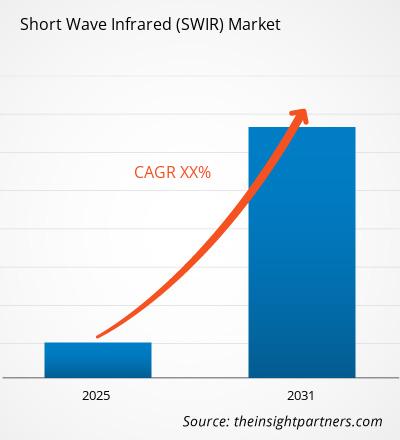
The Short Wave Infrared Market held a value of US$ 691.21 Million in 2025 and will have an estimated valuation of US$ 1,817.39 Million by 2034, recording a CAGR of 11.34% between 2026 and 2034. The market demand is driven by the requirements for contrast imaging in industries like manufacturing, defense, and science where reflected-light imaging aids inspection, surveillance, and material detection.
In North America, adoption rates are anticipated to grow at a 10.8%–11.4% CAGR on account of purchases for defense imaging and semiconductor inspections. North America Short Wave Infrared Market size is further impacted by investments in machine vision for the electronics, food sorting, and aerospace manufacturing industries, where SWIR cameras detect moisture, coating, and silicon anomalies that cannot be seen via visible imaging.
Short Wave Infrared (SWIR) Market Assessment and Insights
- North America accounted for 36–39% Short Wave Infrared Market share in 2025 and is growing at a 10.8–11.4% CAGR between 2026–2034, led by defense surveillance, semiconductor inspection, and domestic photonics supply chain investments.
- US represented 78–82% of North America in 2025 and is growing at a 10.9–11.5% CAGR between 2026–2034, supported by aerospace, defense, and electronics manufacturing adoption.
- Europe held 24–27% share in 2025 and is expanding at a 9.6–10.4% CAGR between 2026–2034, with Germany, the UK, and France leading industrial inspection, recycling, and security deployments.
- Asia Pacific captured 26–29% share in 2025 and is growing at an 11.9–12.6% CAGR between 2026–2034, driven by China, Japan, South Korea, and India manufacturing automation.
- Largest Segment Area Scan held 68–72% market share in 2025, with a 10.7–11.3% CAGR between 2026–2034, reflecting its role in stationary inspection and laboratory imaging.
- High Growth Segment Line Scan held 28–32% market share in 2025 and is advancing at a 12.1–12.8% CAGR between 2026–2034, led by conveyor-based sorting and roll-to-roll inspection.
- Key companies analyzed in detail: Allied Vision Technologies GmbH, Teledyne FLIR LLC, Hamamatsu Photonics K.K., IRCameras LLC, New Imaging Technologies SAS, Opgal Optronic Industries Ltd., Princeton Instruments, Raptor Photonics Limited, Sensors Unlimited Inc., Xenics NV.
Source: The Insight Partners' analysis based on proprietary research, government publications, company annual reports, investor presentations, industry databases, and expert interviews.
Technology developments have gone from sophisticated defense-grade equipment to smaller InGaAs cameras, reduced power consumption sensors, and computer-assisted imaging modules. Manufacturing trends change with standardizing camera interfaces, minimal cooling demands, and artificial intelligence used for defects classification. Industrial clients analyze the SWIR systems' value as integrated parts of automation systems instead of optical equipment alone that allows better transparency of purchases and repetition of installations on electronic, food processing, packaging, and photovoltaic inspection production lines.
Further development would result from rising manufacturing areas, military modernization, and policy support of resilient semiconductor and recycling industries. The Asia Pacific area will see higher rates of deployment of SWIR systems because of inspections moving closer to electronics and displays manufacturing lines. Material recovery regulations will be helpful in Europe, whereas North America stays a leader thanks to aerospace, military, and research programs. These factors make the Short Wave Infrared Market use associated with efficiency, security, and non-destructive tests.
Short Wave Infrared (SWIR) Market Report Scope
| Report Attribute | Details |
|---|---|
| Market size in 2025 | US$ 691.21 Million |
| Market Size by 2034 | US$ 1,817.39 Million |
| Global CAGR (2026 - 2034) | 11.34% |
| Historical Data | 2021-2024 |
| Forecast period | 2026-2034 |
Short Wave Infrared (SWIR) Market Analysis
Short Wave Infrared Market growth is fuelled by inspection requirements where conventional visible cameras cannot provide contrast reliably. Inspection of wafers through silicon by semiconductor fabs employs SWIR imagery, and food processing makes use of it for moisture and contamination inspections. Military applications have the ability to see through haze, smoke, and in low-light environments, generating a customer base that includes not only periodic purchases but also critical procurements.
The supply chain involves InGaAs detector makers, camera module producers, lens suppliers, machine vision software providers, and system integrators. The key supply factors continue to be the price of sensors, export control issues, and the availability of precise optics. With increasing number of inspection programs calling for SWIR capability, original equipment manufacturers are developing modular platforms reducing integration risks and speeding qualification processes.
Competitive Analysis entails an array of vertically-integrated imaging experts and application-based camera manufacturers. Teledyne FLIR LLC, Hamamatsu Photonics K.K., Xenics NV, and Sensors Unlimited Inc. utilize the features such as detector sensitivity, high resolution, and military certification. Allied Vision Technologies GmbH, Raptor Photonics Limited, and New Imaging Technologies SAS focus on the use of SWIR technology in machine vision, miniaturization, and industrial applications.
Money flows to the development of uncooled cameras, increased focal plane arrays, and software enabling the transformation of spectral contrast into reliable decision-making processes. IRCameras LLC, Opgal Optronic Industries Ltd., and Princeton Instruments cater for the defense, scientific, and laboratory applications of the short wave infrared cameras. Competitive advantage is gradually shifting to application enablement, supply chain integrity, and capability of combining SWIR hardware with analytics.
● REPORT CUSTOMIZATION
Tailor This Report To Align With Your Specific Business Requirements
This report can be customized to align precisely with your business objectives, scope, and target markets. Customization options include tailored segmentation, geography, competitive analysis, and strategic insights to support informed decision-making.
Customize This Report →WHAT YOU CAN ADJUST
- ● Segmentations
- ● Geography
- ● Competitive Analysis
- ● Language Preferences
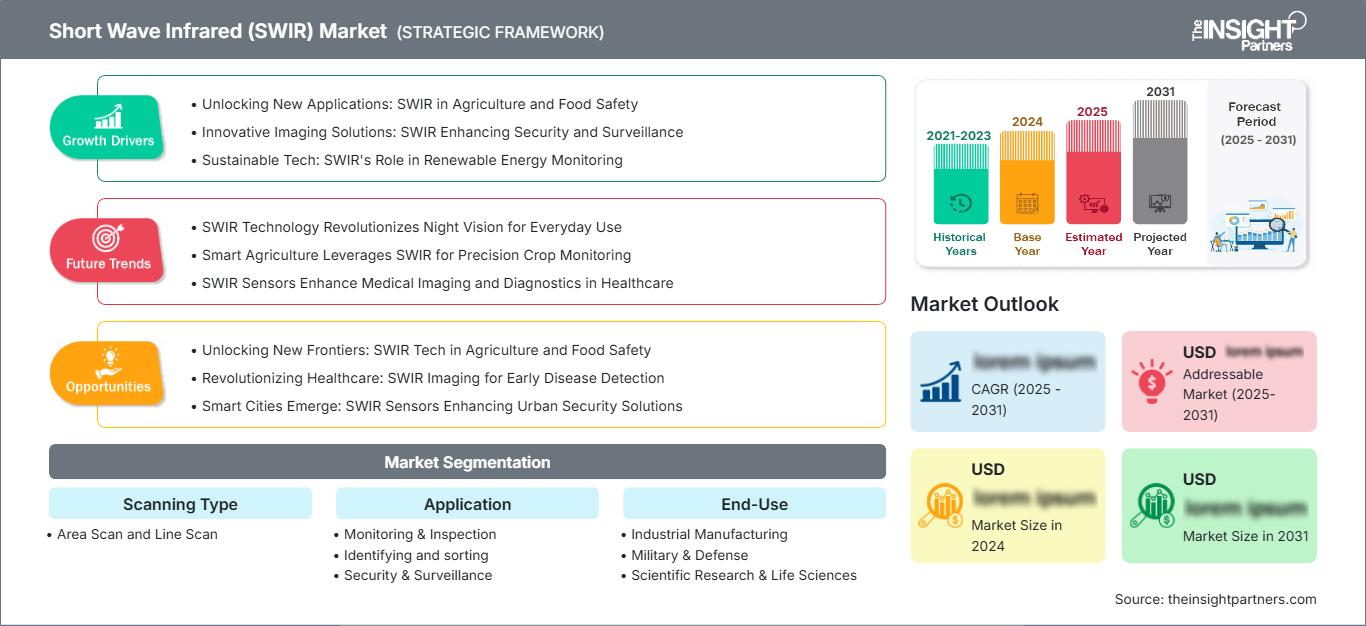
Short Wave Infrared (SWIR) Market: Strategic Insights
Regional Insights
North America Short Wave Infrared Market
North America accounted for 36-39% SWIR Market Share in 2025 and is projected to register a 10.8-11.4% CAGR up to 2034. The market is driven by military surveillance, semiconductor inspection, aerospace manufacturing, and laboratory imaging applications. Machine vision integration expertise and procurement policies favoring domestic sensor solutions have also aided in boosting market growth in the region.
Industrial automation is the second key driver, especially for electronics, food, and solar manufacturing industries. Applications include crack detection, moisture presence, coating inconsistencies, and packaging issues without resorting to destructive testing. Testing of miniature sensors for UAVs and favorable semiconductor policies ensure growth in inspection equipment demand in North American supply chains.
U.S. Short Wave Infrared Market
U.S. comprised 78% to 82% of North America’s market share in 2025 and will continue to grow with a CAGR of 10.9% to 11.5%. Application intensity is high in defense imaging, semiconductor process control, aerospace inspection, and scientific instrument applications. Company presence is ensured by Teledyne FLIR LLC, Sensors Unlimited Inc., IRCameras LLC, Princeton Instruments, and integrators for machine vision systems.
Changing procurement trends include the increasing adoption of small, low-power consumption SWIR cameras in unmanned systems, perimeter surveillance, and production line applications. Increasing semiconductor incentives drive the inspection application, whereas life sciences laboratories use the sensitive cameras for spectroscopy and biomedical imaging purposes. The market in the United States thus combines mission assurance and productivity enhancement, resulting in steady procurements.
Europe Short Wave Infrared Market
The European share was estimated to be at 24-27%, and its anticipated CAGR is 9.6-10.4%. Germany dominates adoption within the region, driven by demand from the automotive industry, electronics, recycling, and process automation. The UK provides defense-related, scientific imaging, and aerospace testing applications, backed by the presence of photonics R&D centers and specialized cameras manufacturers.
France, Italy, and Spain contribute to demand due to security infrastructure, food inspection, cultural heritage examination, and manufacturing quality control needs. Recycling and traceability policies drive the use of optical sorting systems in Europe, along with defense system upgrades, which ensure surveillance. Growth in this region is not as explosive as in Asia Pacific but sustainable since SWIR capability suits its needs.
APAC Short Wave Infrared Market
The APAC region accounted for 26%-29% market share in 2025 and forecasted to grow at an 11.9-12.6% CAGR, the fastest regional growth rate. China is the major player with the help of electronics, solar, and industrial automation projects, whereas Japan and South Korea lead the precision inspection applications in semiconductors, display, and advanced materials segments.
Opportunities emerge from India and Australia because of military modernization, mining, agricultural surveillance, and scientific institutions. Local production focus in policies helps its adoption. SWIR Market will get boosted because of the use of imaging in the region for yield enhancement, contaminant detection, and non-destructive quality control.
Middle East & Africa Short Wave Infrared Market
The Middle East and Africa market is growing at an 8.7-9.5% CAGR, with Saudi Arabia and the UAE driving local demand growth. Energy infrastructure, border security, airport security, and industrial asset monitoring generate focused demand in the region. South Africa provides mining, R&D, and security use cases, while the remainder of MEA follows the project-based model.
Ruggedized cameras that can function in dusty, hot, hazy, and low-light environments are important to buyers in the region. Energy companies are using SWIR cameras for inspections in situations where visible cameras fail to provide sufficient imagery, while the military and infrastructure groups are considering miniature cameras for perimeter security purposes.
Segmentation Analysis
Scanning Type
Scanning Type is projected to grow at a 10.9–11.7% CAGR during 2026–2034. The Short Wave Infrared Market scope across scanning formats is widening as factories choose area scan cameras for static inspection and line scan systems for continuous material flow. Selection depends on object speed, field of view, illumination design, and required defect resolution.
- Area Scan remains the dominant format because it captures full-frame images for semiconductor wafers, laboratory samples, and security scenes where objects are stationary or intermittently positioned.
- Line Scan is strategically important for conveyor-based inspection, food sorting, recycling, textiles, and roll-to-roll manufacturing, where continuous imaging improves throughput and defect traceability.
Application
Application is expected to advance at an 11.0–11.8% CAGR between 2026–2034. Monitoring and inspection remain central because SWIR detects hidden defects, moisture, and material differences. Identifying and sorting applications are scaling with recycling and food automation, while security and surveillance demand benefits from imaging through haze, smoke, and low-light conditions.
- Monitoring & Inspection holds a strong position in electronics, solar cells, pharmaceuticals, and packaging because non-destructive imaging supports yield improvement and real-time process control.
- Identifying and sorting is gaining relevance in food, minerals, plastics, and recycling streams, where spectral contrast enables material separation beyond visible color differences.
- Security & Surveillance remains strategically important for border monitoring, maritime observation, perimeter security, and unmanned platforms requiring visibility under low-light or obscured atmospheric conditions.
End-Use
End-Use is forecast to expand at an 11.1–11.9% CAGR during 2026–2034. Industrial manufacturing leads adoption because SWIR inspection reduces scrap, improves traceability, and supports high-speed automation. Military and defense sustain premium demand, while scientific research and life sciences require sensitive imaging for spectroscopy, biomedical studies, and material characterization.
- Industrial Manufacturing is the largest end-use because electronics, food, packaging, and solar producers use SWIR cameras to detect defects invisible to conventional machine vision.
- Military & Defense remains a high-value buyer group due to surveillance, target recognition, vehicle vision, and intelligence applications requiring performance in haze, smoke, and nightglow.
- Scientific Research & Life Sciences supports specialized demand through spectroscopy, microscopy, biomedical imaging, and material analysis where spectral sensitivity and low-noise performance are essential.
Opportunity Snapshot
| Application | Revenue Contribution | Trend Tag | Adoption Stage |
| Monitoring & Inspection | High | Wafer Inspection | Mature |
| Identifying and sorting | Medium | Material Sorting | Scaling |
| Security & Surveillance | Medium | Low-Light ISR | Scaling |
Short Wave Infrared (SWIR) Market Growth Drivers and Impact Analysis
Rising Need for Non-Destructive Industrial Inspection
The reason industrial manufacturers are implementing SWIR systems is that these imaging systems can detect defects, moisture, and differences in material composition without damaging the object being tested, staining it, or stopping manufacturing. For semiconductor inspection, the capability to see through the silicon wafers plays an important role in wafer-level and die-level quality control. For food processing, spectral contrast is useful for identifying bruises, water presence, and foreign objects. The largest market influence occurs when there are losses due to poor yield rates and when speed hinders manual inspection. With increased investments in automation, Short Wave Infrared Market vendors will benefit greatly.
Defense Imaging Demand in Low-Visibility Environments
For military and defense applications, imaging in haze, smoke, low illumination, and partial atmospheric attenuation is required. SWIR imaging provides more detailed imaging compared to thermal imagers, and this helps in identifying targets, perimeters, and navigation of unmanned vehicles. In defense acquisitions, smaller size sensors are preferred since they ease the payload and provide better detection capabilities. This demand driver ensures lasting requirements for suitable vendors who meet export control policies, ruggedization, and extended product lifecycles. For commercial purposes, this results in increased technology transfer since defense-driven miniaturization and sensor development makes the process more economical.
Automation of Sorting, Recycling, and Process Control
Sorting technology is increasing because of the ability of SWIR cameras to separate materials based on their differences in the SWIR spectrum even though they look identical in visible light. The sorting of plastics, minerals, crops, and other material used in pharmaceuticals is now being carried out due to the distinctive features in their absorption spectra. Process controls are utilizing the SWIR camera feedback for monitoring coatings, moisture levels, and consistency in their products. There is an influence on how decision-making is taking place, moving from post-process inspections to inline process decision-making.
Short Wave Infrared (SWIR) Market Future Trends
AI-Enabled Spectral Decision Systems
In Short Wave Infrared Market trends, the development of AI solutions capable of translating spectral contrast into automated decisions such as accept or reject or classify or raise an alert is likely to grow in popularity. Rather than selling the camera just as an imaging solution, the vendors would be embedding the calibration process, library of defects, and re-training capabilities. This would be important for applications like food sorting, semiconductors inspection, batteries, or pharmaceutical packaging, where the results need to be reproducible and not just pictures taken.
Lower-Cost Sensors Expanding Commercial Reach
Cheaper detector designs, along with simpler camera systems should increase the deployment of SWIR technology beyond high-end military and research applications. The development of non-cooled detectors, smaller form factors, and standardization of interface technologies will make it easier for factories to consider SWIR technology for their machine vision applications. For commercial success, it will be important to find the right balance between resolution, sensitivity, and cost for each application, and not aim at finding a one-size-fits-all solution. Companies that offer product lines can start from low-end applications and work up.
Short Wave Infrared (SWIR) Market Opportunities
Inline Quality Control for Semiconductor and Solar Manufacturing
The potential value for semiconductor and photovoltaic manufacturers lies in the direct relationship between failed inspections and yield losses, warranties, and delays. Short-wave infrared cameras can detect microcracks, impurities, wafer defects, and coating uniformity problems which traditional vision would not be able to detect. Manufacturers must sell not only end-users but also equipment providers using compact modules integrated into their metrology and automation systems. Collaboration with lighting vendors and inspection software providers will expedite implementation timeframes. The best business model would be to demonstrate a positive ROI from reduced waste, increased throughput, and greater traceability on production lines.
Rugged SWIR Systems for Security and Critical Infrastructure
The operators of critical infrastructure require imaging technologies that are capable of functioning at all times of day and night and in dusty, hazy or other variable conditions. There is opportunity for SWIR technology to be used in perimeter protection, airport surveillance, ports, pipelines, and unmanned observations. The greatest opportunities exist where suppliers include ruggedized housing, low power consumption, and analysis tools that minimize false alarms. Operators in energy-related, transportation and defense-related infrastructure may emphasize reliability throughout the lifetime of the system over lowest cost at acquisition.
Recent Developments
- January 2025: Lynred of Grenoble, France — which designs and makes infrared (IR) sensors for aerospace, defense and commercial applications — has launched Eyesential SW, its latest VGA-format shortwave infrared (SWIR) sensor for machine vision. Designed to offer the ideal cost-performance ratio for visible-like imaging to address specific performance needs in machine vision, Eyesential SW is said to have the performance and features sought by industry but at half the price of comparable IR sensors on the market. It also includes specific functions for spectroscopy applications, such as spectral line selection/deselection.
- April 2024: Quantum Solutions, a pioneer in quantum dot technology, announce the launch of Q.Eye SWIR (short-wave infrared) image sensors with a broad spectral range of 400 – 1700 nm. This innovative sensor is set to unlock new imaging capabilities for machine vision and robotics applications.
- October 2023: Omron Automation, a firm that provides industry automation solutions, unveils the new SWIR camera series, which incorporates a Short Wave Infrared technology, and is designed to address some of the most common manufacturing problems. With the application of this state-of-the-art technology, Omron Automation offers unparalleled image and data acquisition that outperforms any conventional camera.
Frequently Asked Questions

- Comprehensive Market Sizing and Forecast Analysis
- Detailed Segmentation Analysis
- In-Depth Market Dynamics Assessment
- Regional and Country-Level Insights
- Competitive Landscape and Company Benchmarking
- Strategic Business Intelligence
Recent Reports
Testimonials

The Insight Partners' SCADA System Market report is comprehensive, with valuable insights on current trends and future forecasts. The team was highly professional, responsive, and supportive throughout. We are very satisfied and highly recommend their services.
RAN KEDEM Partner, Reali Technologies LTDs
I requested a report on a very specific software market and the team produced the report in a few days. The information was very relevant and well presented. I then requested some changes and additions to the report. The team was again very responsive and I got the final report in less than a week.
JEAN-HERVE JENN Chairman, Future Analytica
We worked with The Insight Partners for an important market study and forecast. They gave us clear insights into opportunities and risks, which helped shape our plans. Their research was easy to use and based on solid data. It helped us make smart, confident decisions. We highly recommend them.
PIYUSH NAGPAL Sr. Vice President, High Beam Global
The Insight Partners delivered insightful, well-structured market research with strong domain expertise. Their team was professional and responsive throughout. The user-friendly website made accessing industry reports seamless. We highly recommend them for reliable, high-quality research services
YUKIHIKO ADACHI CEO, Deep Blue, LLC.
This is the first time I have purchased a market report from The Insight Partners.While I was unsure at first, I visited their web site and felt more comfortable to take the risk and purchase a market report.I am completely satisfied with the quality of the report and customer service. I had several questions and comments with the initial report, but after a couple of dialogs over email with their analyst I believe I have a report that I can use as input to our strategic planning process.Thank you so much for taking the extra time and making this a positive experience.I will definitely recommend your service to others and you will be my first call when we need further market data.
JOHN SUZUKI President and Chief Executive Officer, Board Director, BK Technologies
I wish to appreciate your support and the professionalism you displayed in the course of attending to my request for information regarding to infectious disease IVD market in Nigeria. I appreciate your patience, your guidance, and the fact that you were willing to offer a discount, which eventually made it possible for us to close a deal. I look forward to engaging The Insight Partners in the future, all thanks to the impression you have created in me as a result of this first encounter.
DR CHIJIOKE ONYIA MANAGING DIRECTOR, PineCrest Healthcare Ltd.Reason to Buy
- Informed Decision-Making
- Understanding Market Dynamics
- Competitive Analysis
- Identifying Emerging Markets
- Customer Insights
- Market Forecasts
- Risk Mitigation
- Boosting Operational Efficiency
- Strategic Planning
- Investment Justification
- Tracking Industry Innovations
- Aligning with Regulatory Trends





 Get Free Sample for