
Shunt Reactor Market Share, Demand & Growth by 2034
Coverage: by Type (Air Core Shunt Reactors, Oil Immersed Shunt Reactors); Voltage (Up to 200 kV, 200 to 400 kV, Above 400 kV); Phase (Single Phase, Three Phase) , and Geography (North America, Europe, Asia Pacific, and South and Central America)
- Status : Data Released
- Report Code : TIPRE00008871
- Category : Electronics and Semiconductor
- No. of Pages : 150
- Available Report Formats :


- Last update date : July 17, 2026


2025 Market Size
US$ 2.95 Bn
Base year value
2034 Forecast
US$ 5.28 Bn
Projected by 2034
CAGR 2026-2034
6.69 %
Growth rate
Addressable Market
US$ 37.22 Bn
(2026-2034)
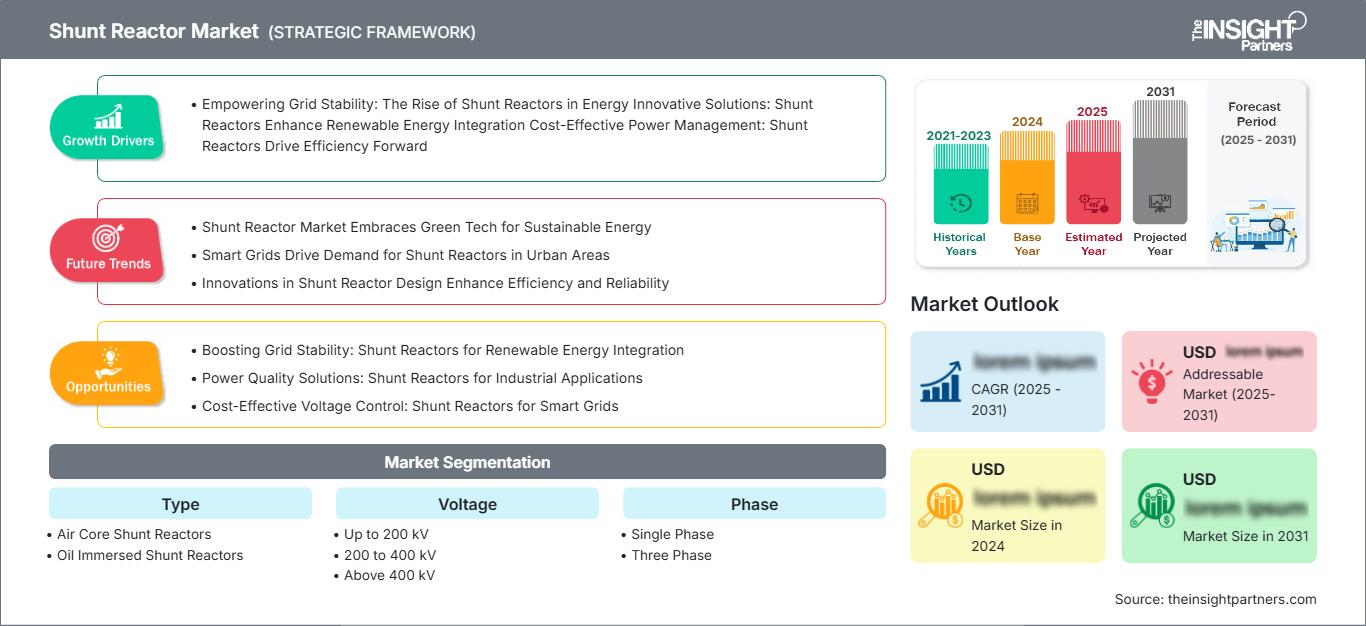
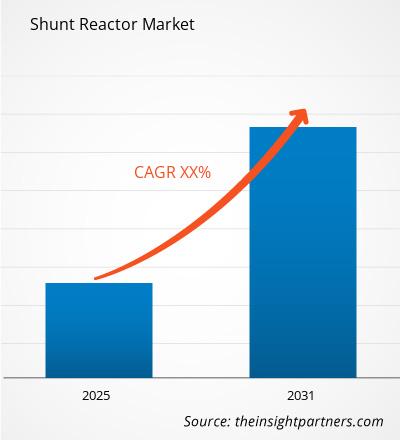
The Shunt Reactor Market was valued at US$ 2.95 Billion in 2025 and is projected to reach US$ 5.28 Billion by 2034, registering a CAGR of 6.69% from 2026 to 2034. Demand is anchored in high-voltage transmission expansion, renewable power evacuation, and utility efforts to control reactive power across increasingly complex electricity networks.
Across North America, the Shunt Reactor Market size is supported by grid hardening, interconnection queues, and transmission upgrades required for variable renewable resources. The region is assessed to expand at a 5.7–6.3% CAGR through 2034, with replacement of aging transformers and long-distance power transfer creating stable procurement needs for oil immersed and air core units.
Shunt Reactor Market Assessment and Insights
- North America held 26–29% share in 2025 and is growing at a 5.7–6.3% CAGR between 2026–2034, supported by grid resilience funding, renewable interconnections, and replacement of aging high-voltage assets.
- US accounted for 78–82% of North America in 2025 and is growing at a 5.8–6.4% CAGR between 2026–2034, led by transmission expansion and utility modernization.
- Europe represented 22–25% share in 2025 and is growing at a 5.9–6.5% CAGR between 2026–2034, with Germany, the UK, France, Italy, and Spain leading renewable grid reinforcement.
- Asia Pacific captured 34–38% share in 2025 and is growing at a 7.2–7.8% CAGR between 2026–2034, driven by China, India, Japan, South Korea, and Australia transmission investments.
- Largest Segment Oil Immersed Shunt Reactors held 63–67% market share in 2025 and is growing at a 6.3–6.9% CAGR between 2026–2034 due to high-voltage utility adoption.
- High Growth Segment Above 400 kV held 24–28% market share in 2025 and is growing at a 7.5–8.1% CAGR between 2026–2034 as extra-high-voltage corridors expand.
- Key companies analyzed in detail: ABB Ltd., Aktif Group of Companies, CG Power and Industrial Solutions Ltd., Coil Innovation GmbH, General Electric Company, Hyosung Heavy Industries Co., Ltd., Mitsubishi Electric Corporation, Siemens AG, Trench Group, and TSEA Energia.
Source: The Insight Partners' analysis based on proprietary research, government publications, company annual reports, investor presentations, industry databases, and expert interviews.
The growth of technology is shifting focus from static compensation to digitally controlled equipment that has lower losses and is more appropriate for grids having a lot of renewables. There is emphasis by utility companies on designs that will enhance voltage stability in long AC power lines. Manufacturers are gearing towards producing products that cater for extra-high voltage requirements, thermal capacity and quicker execution of projects. Oil immersed reactors are the choice of equipment in heavy transmission operations while air core reactors find application in cities, industries and places where there is requirement of minimal risk of fire.
Future demands for the industry are likely to increase due to the need for the construction of high capacity corridors in emerging economies and improvement in established regions for grid electrification. Regulations supporting renewable evacuation, interregional connections and reliability are fostering multi-year purchases in the market. Local manufacturing in countries such as India, China, Europe and North America will favor the industry.
Shunt Reactor Market Report Scope
| Report Attribute | Details |
|---|---|
| Market size in 2025 | US$ 2.95 Billion |
| Market Size by 2034 | US$ 5.28 Billion |
| Global CAGR (2026 - 2034) | 6.69% |
| Historical Data | 2021-2024 |
| Forecast period | 2026-2034 |
Shunt Reactor Market Analysis
Market is linked with the increasing requirement of voltage regulation due to the transfer of electricity through the transmission lines, where renewable energy is used intermittently over increased distances. The use of wind and solar generation leads to greater fluctuations in reactive power and hence fixed and variable reactors are required to maintain an acceptable range of voltages and avoid overvoltages along with minimizing losses in low load situations.
Components of value chain include steel, copper, insulation, tank manufacturing, bushing, testing labs, EPC firms, and power transmission firms. Dynamics of the market depend upon the supply of transformer steel, cost of copper, and loading of factories for large electrical power equipment. Trends in procurement involve laboratory testing within regions and performance at 220kV, 400kV, and 765 kV levels.
Analysis of the Shunt Reactors Market reveals an oligopoly market characterized by technological diversity. The competing players include ABB Ltd., Siemens AG, General Electric Company, Mitsubishi Electric Corporation, and Hyosung Heavy Industries Co., Ltd. These competitors have high voltage portfolio competencies. On the other hand, Coil Innovation GmbH, Trench Group, TSEA Energia, Aktif Group of Companies, and CG Power and Industrial Solutions Ltd. focus on enhancing specialization.
As far as the investment strategy is concerned, the businesses are working on factory capacity, diagnostics, and local logistics for grid investments. The 2025 order by GE Vernova in India for over 70 units of 765 kV transformers and shunt reactors for renewable corridors demonstrates this approach taken by suppliers to be prepared for the national development of the transmission systems.
● REPORT CUSTOMIZATION
Tailor This Report To Align With Your Specific Business Requirements
This report can be customized to align precisely with your business objectives, scope, and target markets. Customization options include tailored segmentation, geography, competitive analysis, and strategic insights to support informed decision-making.
Customize This Report →WHAT YOU CAN ADJUST
- ● Segmentations
- ● Geography
- ● Competitive Analysis
- ● Language Preferences
Shunt Reactor Market: Strategic Insights
Regional Insights
North America Shunt Reactor Market
North America held 26–29% of the Shunt Reactor Market share in 2025 and is projected to grow at a 5.7–6.3% CAGR. Expansion is driven by transmission hardening, renewable interconnection queues, and utility replacement cycles. Grid operators are adding reactive compensation to manage voltage rise on long lines and protect substations during lower-load periods.
Federal and state-level investments in high-voltage transmission, wildfire resilience, and offshore wind interconnection support reactor demand. Oil immersed units dominate large utility corridors, while air core designs gain use in distribution substations and industrial power systems where safety and maintenance considerations influence specification decisions.
U.S. Shunt Reactor Market
United States represents 78-82% of North America in 2025 and is forecasted to grow at 5.8-6.4% CAGR. Highest demand is seen for reactor use along transmission lines that connect renewable energy zones to load center cities. Utilities are installing reactors to enhance voltage stability and equipment protection as well as better utilization of existing grid infrastructure.
Company presence is defined by established suppliers of grid equipment and reactor producers for investor owned utilities, independent transmission developers, and industries. Trends are characterized by applications in extra-high-voltage substation, renewable energy collectors, and line-end compensation where reliability, monitoring, and fast commissioning are key purchase criteria.
Europe Shunt Reactor Market
Share held by Europe was 22–25% in 2025 and will be growing at a CAGR of 5.9–6.5%. Germany is leading the regional adoption of the technology. The UK has been making investments in offshore wind grid connection and high voltage reinforcements and thus creating a need for compact reactors which ensure voltage stability in cable-intensive grids.
Germany is important for various reasons, such as the need for transferring renewable energy from north to south, transmission bottlenecks, and compensation. France, Italy, and Spain have created incremental demand with their interconnector developments, grid modernization, and solar installations. The European market buyers prefer low losses and environmental benefits in addition to service life.
APAC Shunt Reactor Market
APAC held 34–38% share in 2025 and is forecast to grow at a 7.2–7.8% CAGR, making it the fastest regional contributor. China leads through ultra-high-voltage corridors, while India accelerates 765 kV procurement for renewable evacuation and interstate transmission.
Japan and South Korea prioritize grid stability for renewable integration and resilient substations. Australia adds demand through remote solar, wind, and mining-related transmission. Policy-backed electrification and domestic manufacturing incentives make the region central to long-term supplier capacity planning.
Middle East & Africa Shunt Reactor Market
Middle East and Africa is projected to grow at a 6.1–6.7% CAGR, led by Saudi Arabia and the UAE. Large renewable parks, grid interconnections, and industrial load growth require reactive compensation for long transmission routes and desert operating conditions.
South Africa and Rest of MEA add demand through grid reliability programs, mining power systems, and regional interconnection projects. Buyers focus on robust insulation, thermal endurance, and service support, especially where substations operate in high-temperature or remote environments.
Segmentation Analysis
Type
Type is expected to grow at a 6.4–7.0% CAGR during 2026–2034. Shunt Reactor Market scope across type is shaped by the balance between high-capacity oil immersed systems for transmission substations and air core units for urban, industrial, and safety-sensitive installations. Utilities select technologies according to voltage duty, installation footprint, fire-risk profile, losses, and maintenance access.
- Air Core Shunt Reactors serve distribution substations, industrial networks, and indoor or space-constrained locations where dry insulation, lower fire risk, and easier inspection support adoption.
- Oil Immersed Shunt Reactors dominate high-voltage transmission projects because they handle larger ratings, provide strong thermal performance, and integrate well with established utility substation practices.
Voltage
Voltage is expected to grow at a 6.6–7.2% CAGR during 2026–2034. Higher voltage classes are gaining importance as utilities expand long-distance transmission and renewable evacuation corridors. Up to 200 kV systems support sub-transmission and industrial use, 200 to 400 kV remains central to national grids, and above 400 kV benefits from extra-high-voltage buildouts.
- Up to 200 kV supports regional substations, industrial campuses, and distribution reinforcement where moderate reactive power compensation improves power quality and protects equipment.
- 200 to 400 kV remains strategically important for transmission utilities balancing conventional generation exits, renewable integration, and cross-regional electricity transfers.
- Above 400 kV is expanding quickly as countries build extra-high-voltage corridors to move renewable electricity from remote generation zones to dense load centers.
Phase
Phase is expected to grow at a 6.2–6.8% CAGR during 2026–2034. Selection depends on grid architecture, redundancy requirements, transport limits, and maintenance strategy. Single phase units are common in very high-voltage systems where modular handling is advantageous, while three phase units provide compact integrated solutions for medium and high-voltage substations.
- Single Phase reactors are favored in extra-high-voltage networks because separate units simplify transportation, replacement, and operational redundancy across large utility substations.
- Three Phase reactors are used where compact installation, balanced operation, and simplified station layouts provide advantages for utilities and industrial grid operators.
Opportunity Snapshot
| Voltage | Revenue Contribution | Trend Tag | Adoption Stage |
| Up to 200 kV | Medium | Industrial Grid | Mature |
| 200 to 400 kV | High | Grid Renewal | Scaling |
| Above 400 kV | High | Renewable Corridors | Scaling |
Shunt Reactor Market Growth Drivers and Impact Analysis
Renewable Power Evacuation Requires Reactive Compensation
Large wind and solar projects are often located far from consumption centers, creating longer transmission paths and more variable reactive power flows. The International Energy Agency expects renewable capacity additions to keep expanding through 2030, reinforcing the need for grid equipment that manages voltage under fluctuating generation. For the Shunt Reactor Market, this translates into recurring demand at line terminals, substations, and renewable pooling stations. Equipment specifications increasingly include low losses, fast protection coordination, and compatibility with digital monitoring. The impact is strongest in APAC, North America, and Europe, where renewable corridors are becoming central to electricity planning and utility procurement cycles.
Aging Transmission Networks Need Voltage Stability Upgrades
Mature power systems are facing higher stress from electrification, decentralized generation, and delayed transmission expansion. Utilities are therefore upgrading substations with reactive power assets that extend the useful life of existing corridors and reduce operational risk. Shunt reactors help prevent overvoltage during light-load conditions, improve system reliability, and reduce switching stress on other high-voltage equipment. This driver supports replacement and retrofit opportunities in the U.S., Canada, Germany, the UK, France, and Japan. It also favors suppliers offering field services, diagnostics, and proven insulation systems because asset owners are increasingly evaluating lifecycle reliability alongside upfront equipment cost.
Extra-High-Voltage Corridors Expand in Emerging Economies
Emerging economies are scaling extra-high-voltage corridors to connect renewable resource zones, industrial clusters, and fast-growing cities. India’s 765 kV programs and China’s ultra-high-voltage grid demonstrate how transmission voltage escalation directly increases reactor requirements. The Shunt Reactor Market benefits because higher voltage lines generate stronger capacitive effects, making compensation essential for safe operation. Procurement is also becoming more localized, as governments seek domestic manufacturing and faster delivery for nationally important infrastructure. This creates opportunities for global suppliers with regional factories and for specialist manufacturers capable of meeting stringent testing, insulation, and thermal performance standards.
Shunt Reactor Market Future Trends
Digitally Monitored Reactors Become Standard Utility Assets
Shunt Reactor Market trends are moving toward embedded sensors, online dissolved gas monitoring, thermal analytics, and condition-based maintenance platforms. Utilities are shifting from periodic inspection to continuous asset visibility because grid interruptions carry higher economic and regulatory consequences. Future reactor tenders are expected to include digital interfaces that connect with substation automation systems and utility control rooms. This will change competitive differentiation from equipment supply alone to performance assurance over the asset lifecycle. Suppliers that combine reactor design expertise with analytics, cybersecurity readiness, and remote diagnostics will be better positioned for framework agreements with transmission operators.
Low-Loss and Sustainable Materials Gain Procurement Weight
Grid operators are beginning to assess reactors through energy losses, carbon footprint, recyclable materials, and lifecycle service requirements. As transmission assets remain in service for decades, small efficiency improvements can create meaningful operational savings. Future specifications may increasingly request lower-noise designs, improved insulation fluids, recycled copper, and documentation of manufacturing emissions. This trend will affect supplier qualification, especially in Europe and North America, where sustainability criteria are becoming part of public utility procurement. Manufacturers that redesign products without compromising dielectric strength, thermal stability, or short-circuit performance can gain measurable tender advantages.
Shunt Reactor Market Opportunities
Localized Manufacturing for High-Voltage Grid Programs
Shunt Reactor Market Forecasts point to strong opportunity for suppliers that localize winding, tank fabrication, testing, and service support near major transmission programs. Large reactors are costly to transport, require specialized logistics, and face project delays when factory slots are constrained. Regional manufacturing can reduce lead times, improve compliance with local content rules, and strengthen after-sales responsiveness. India, the U.S., Saudi Arabia, and Europe offer attractive investment cases because grid modernization plans are multi-year rather than one-off. Partnerships with EPC firms and utilities can further improve order visibility and reduce execution risk.
Variable Reactors for Flexible Renewable Grids
Variable shunt reactors create an opportunity where renewable generation, cable networks, and changing load profiles require adjustable reactive power compensation. Unlike fixed units, variable designs can respond to seasonal and daily network changes, reducing the need for multiple static devices. Their adoption is likely to grow in Europe, offshore wind grids, urban cable systems, and renewable evacuation corridors where voltage profiles are less predictable. Suppliers can capture value through engineering studies, control integration, and lifecycle maintenance contracts. The opportunity is commercially attractive because variable systems command higher technical differentiation and closer customer engagement than standard fixed-reactor supply.
Recent Developments
- May 2026: ABB announced that it is investing around US$ 200 million in its medium-voltage manufacturing capabilities across Europe over the next three years to expand production capacity, accelerate the transition to next-generation technologies for power distribution and strengthen supply for customers that are modernizing their power infrastructure. This includes utilities, industry, and rapidly growing data center markets.
- May 2026: Lithuania’s electricity transmission system operator, Litgrid, has announced the procurement of three 220 kV controlled shunt reactors for the construction of the Harmony Link interconnection. To date, Lithuania has only one such electrical device in operation, designed for 330 kV voltage and reactive power control within the transmission network. The controlled shunt reactors will be installed at the new Gižai transformer substation, where the second overland electricity interconnection with Poland, Harmony Link, will commence. Due to lengthy equipment delivery lead times, the procurement process for the shunt reactors is being carried out before completion of the Gižai transformer substation design phase.
- December 2024: Two shunt reactors were put into operation in the Gorski Kotar area in December 2024. One shunt reactor, with a nominal power of 3,000 kVAr, is installed in the TS 35/20 kV Gerovo substation, while the other, with a nominal power of 1,200 kVAr, is installed in the TS 20/0.4 kV Curak 1 substation. This event represents a key step forward in modernizing the distribution network of the mentioned area.
Frequently Asked Questions

- Comprehensive Market Sizing and Forecast Analysis
- Detailed Segmentation Analysis
- In-Depth Market Dynamics Assessment
- Regional and Country-Level Insights
- Competitive Landscape and Company Benchmarking
- Strategic Business Intelligence
Recent Reports
Testimonials

The Insight Partners' SCADA System Market report is comprehensive, with valuable insights on current trends and future forecasts. The team was highly professional, responsive, and supportive throughout. We are very satisfied and highly recommend their services.
RAN KEDEM Partner, Reali Technologies LTDs
I requested a report on a very specific software market and the team produced the report in a few days. The information was very relevant and well presented. I then requested some changes and additions to the report. The team was again very responsive and I got the final report in less than a week.
JEAN-HERVE JENN Chairman, Future Analytica
We worked with The Insight Partners for an important market study and forecast. They gave us clear insights into opportunities and risks, which helped shape our plans. Their research was easy to use and based on solid data. It helped us make smart, confident decisions. We highly recommend them.
PIYUSH NAGPAL Sr. Vice President, High Beam Global
The Insight Partners delivered insightful, well-structured market research with strong domain expertise. Their team was professional and responsive throughout. The user-friendly website made accessing industry reports seamless. We highly recommend them for reliable, high-quality research services
YUKIHIKO ADACHI CEO, Deep Blue, LLC.
This is the first time I have purchased a market report from The Insight Partners.While I was unsure at first, I visited their web site and felt more comfortable to take the risk and purchase a market report.I am completely satisfied with the quality of the report and customer service. I had several questions and comments with the initial report, but after a couple of dialogs over email with their analyst I believe I have a report that I can use as input to our strategic planning process.Thank you so much for taking the extra time and making this a positive experience.I will definitely recommend your service to others and you will be my first call when we need further market data.
JOHN SUZUKI President and Chief Executive Officer, Board Director, BK Technologies
I wish to appreciate your support and the professionalism you displayed in the course of attending to my request for information regarding to infectious disease IVD market in Nigeria. I appreciate your patience, your guidance, and the fact that you were willing to offer a discount, which eventually made it possible for us to close a deal. I look forward to engaging The Insight Partners in the future, all thanks to the impression you have created in me as a result of this first encounter.
DR CHIJIOKE ONYIA MANAGING DIRECTOR, PineCrest Healthcare Ltd.Reason to Buy
- Informed Decision-Making
- Understanding Market Dynamics
- Competitive Analysis
- Identifying Emerging Markets
- Customer Insights
- Market Forecasts
- Risk Mitigation
- Boosting Operational Efficiency
- Strategic Planning
- Investment Justification
- Tracking Industry Innovations
- Aligning with Regulatory Trends





 Get Free Sample for