
Shunt Regulators Market Size, Share & Demand by 2034
Coverage: By Product Type (Low Energy Consumption, High Energy Consumption); Applications (Controllers, Household Appliances, Intelligent Instruments, Other) , and Geography (North America, Europe, Asia Pacific, and South and Central America)
- Status : Data Released
- Report Code : TIPRE00017172
- Category : Electronics and Semiconductor
- No. of Pages : 150
- Available Report Formats :


- Last update date : July 17, 2026


2025 Market Size
US$ 1.28 Bn
Base year value
2034 Forecast
US$ 2.78 Bn
Projected by 2034
CAGR 2026-2034
8.98 %
Growth rate
Addressable Market
US$ 18.15 Bn
(2026-2034)
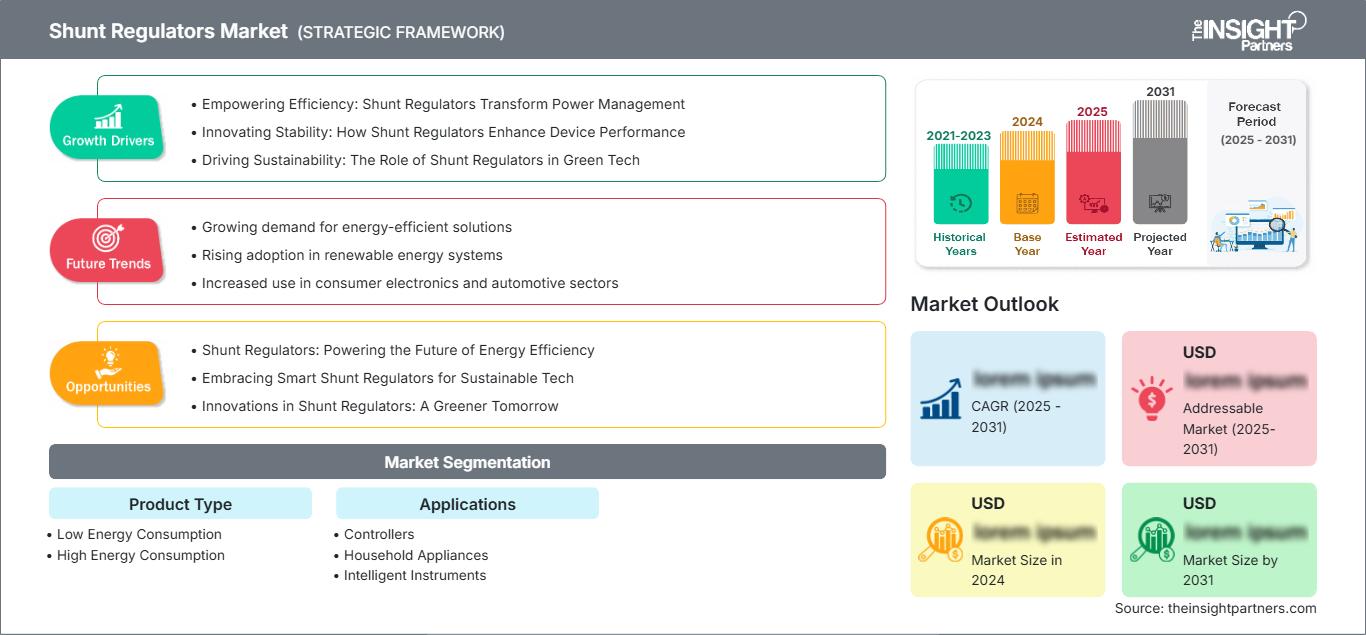
The Shunt Regulators Market is projected to grow from US$ 1.28 Billion in 2025 to US$ 2.78 Billion by 2034, registering a CAGR of 8.98% during 2026–2034. Demand is supported by the expanding use of stable voltage references, compact power-control circuits, and protection components across controllers, household appliances, and intelligent instruments, where circuit reliability and lower standby losses remain core design priorities.
Across North America, the Shunt Regulators Market size is shaped by electronics reshoring, automotive electrification, and automation investments that require stable low-voltage regulation. The region is estimated to expand at a CAGR of 8.1–8.6% through 2034, with the US driving design wins in industrial controllers, smart appliances, and test instruments supported by local semiconductor engineering capacity.
Shunt Regulators Market Assessment and Insights
- North America held 28–31% share in 2025 and is expected to grow at a CAGR of 8.1–8.6% during 2026–2034, supported by industrial controls, automotive electronics, and domestic semiconductor design activity.
- US accounted for 74–78% of North America in 2025 and is projected to grow at a CAGR of 8.2–8.7% during 2026–2034.
- Europe represented 20–23% share in 2025 and is expected to expand at a CAGR of 7.6–8.1% during 2026–2034, led by Germany, the UK, France, Italy, and Spain.
- Asia Pacific accounted for 36–39% share in 2025 and is forecast to grow at a CAGR of 9.5–10.1% during 2026–2034, with China, Japan, South Korea, India, and Taiwan leading production and demand.
- Largest Segment Low Energy Consumption held 58–62% market share in 2025 and is expected to grow at a CAGR of 8.6–9.1% during 2026–2034.
- High Growth Segment Intelligent Instruments held 24–27% market share in 2025 and is projected to grow at a CAGR of 9.8–10.5% during 2026–2034.
- Key companies analyzed in detail: ADVANCED Motion Controls, Inc.; Diodes Incorporated; Analog Devices, Inc.; Nisshinbo Micro Devices Inc.; Nexperia B.V.; NTE Electronics, Inc.; NXP Semiconductors N.V.; onsemi; Renesas Electronics Corporation; TentLabs.
Source: The Insight Partners' analysis based on proprietary research, government publications, company annual reports, investor presentations, industry databases, and expert interviews.
The technology shift is changing the nature of the market as designers move away from simple Zener-type regulators in favor of highly refined devices with reduced impedance, greater voltage tolerances, and improved thermal characteristics. The production trends are now shifting towards SOT23, SOT753, and smaller automotive-qualified packages that facilitate increased board density in switched-mode power supplies, embedded control systems, appliance boards, and sensors.
In terms of future growth from an outlook perspective, this will be based on new APAC manufacturing hubs, North American industrial rejuvenation, and European efficiency legislation. The increased investments in electronic devices for electric vehicles, smart meters, medical devices, and distributed energy generation products will increase volume demands. The pressure to cut down on power consumption in standby mode and improve energy efficiency of appliances will create the need for very precise current regulation, as well as multiple sources of global analog semiconductor companies.
Shunt Regulators Market Report Scope
| Report Attribute | Details |
|---|---|
| Market size in 2025 | US$ 1.28 Billion |
| Market Size by 2034 | US$ 2.78 Billion |
| Global CAGR (2026 - 2034) | 8.98% |
| Historical Data | 2021-2024 |
| Forecast period | 2026-2034 |
Shunt Regulators Market Analysis
There has been increased demand for voltage references that offer stable voltages in the presence of controllers, electronic devices, and intelligent instruments that perform sensoring and communication activities. There are also low-cost and reliable implementations of circuit designs in which voltage clamping, error amplification, and loop stability should be met.
The industry supply chain includes wafers production, analog IC design, package assembly, official distribution, and OEM board manufacturing. The supply in this industry is dominated by analog semiconductor companies, and the demand is highly dispersed among industrial electronics products, consumer electronics devices, and embedded applications. Availability, automotive qualifications, and multiple sourcing are crucial considerations in purchase decision making.
Consolidation in the competitive environment is moderate, and it involves firms like Diodes Incorporated, Analog Devices, Inc., Nexperia B.V., Renesas Electronics Corporation, and onsemi, contending on the basis of voltage precision, variety of packaging, automotive grade quality, and distribution network. Market analysis of Shunt Regulators Market suggests there are opportunities for niche companies like ADVANCED Motion Controls, Inc., NTE Electronics, Inc., and TentLabs through specialized applications marketing.
Some of the investment trends are diversification into low power products, high precision products, and temperature extreme products that are used in industrial automation and automobiles. NXP Semiconductors N.V. and Nisshinbo Micro Devices Inc. help in improving the local supply, while those who have full catalogs gain in board redesign efforts of OEMs.
● REPORT CUSTOMIZATION
Tailor This Report To Align With Your Specific Business Requirements
This report can be customized to align precisely with your business objectives, scope, and target markets. Customization options include tailored segmentation, geography, competitive analysis, and strategic insights to support informed decision-making.
Customize This Report →WHAT YOU CAN ADJUST
- ● Segmentations
- ● Geography
- ● Competitive Analysis
- ● Language Preferences
Shunt Regulators Market: Strategic Insights
Regional Insights
North America Shunt Regulators Market
North America held 28–31% share in 2025 and is projected to grow at a CAGR of 8.1–8.6% during 2026–2034. The Shunt Regulators Market share is supported by industrial automation, EV charging electronics, aerospace instrumentation, and medical-device manufacturing. Local design teams emphasize long lifecycle components, qualification documentation, and supply continuity for mission-critical boards.
Demand is concentrated in the US and Canada, where controller platforms, smart appliance modules, and power-conversion equipment use shunt devices for feedback regulation and transient protection. Federal incentives for semiconductor capacity and electrification strengthen ecosystem resilience, while distributor-managed inventory helps OEMs handle component redesigns and multi-source approvals.
U.S. Shunt Regulators Market
In 2025, the US market share stood at 74-78%, with an expected CAGR of 8.2-8.2% for the period 2026-2034. The use of the components has been noted in controller units, testing equipment, building automation systems, appliance electronics, and intelligent instruments, which need constant voltage references despite changing loading and environmental conditions.
Brand presence includes companies such as Analog Devices, Inc., onsemi, Diodes Incorporated, ADVANCED Motion Controls, Inc., and NTE Electronics, Inc., through extensive distributor network. Application trends involve more compact SMPS feedback circuitry and sensor interface boards, industrial controllers, where BOM optimization and validation play an important role.
Europe Shunt Regulators Market
Europe held 20–23% market share in 2025 and is expected to register a growth rate of 7.6–8.1% CAGR for 2026–2034. In terms of applications, Germany stands out owing to automation, automotive electronics, and machinery control. The UK contributes to instrumentation, aerospace, and specialty electronics design applications. France contributes via energy management, industrial equipment, and medical technology purchases.
Italy and Spain are responsible for providing the applications such as household appliances, HVAC control, and renewable energy electronics. In Europe, OEMs concentrate on efficiency and compliance, longevity, and traceability. Nexperia B.V. and NXP Semiconductors N.V. contribute to the regional significance while global companies by virtue of their automotive approvals and catalog products for high mix industrial production.
APAC Shunt Regulators Market
APAC region had 36-39% market share in 2025 and is estimated to witness a CAGR of 9.5-10.1% from 2026 to 2034. China dominates usage with electronics assembly, appliances, smart meters, and industrial controls, whereas Japan and South Korea provide usage in instruments, factory automation, and automotive modules.
India and Australia are growing due to usage in infrastructure electronics, energy management, and wireless technology devices. Supportive regional policies with regard to semiconductor packaging, local electronics manufacturing, and energy-efficiency programs help improve sourcing over the long run. Vendors with local distribution, wide temperature ranges, and large packaging capabilities will benefit from fast design cycles.
Middle East & Africa Shunt Regulators Market
The Middle East and Africa segment will register a CAGR between 7.1% and 7.6% from 2026 to 2034, led by Saudi Arabia due to energy infrastructure, building automation, and industrial control applications. The UAE contributes smart city electronics and metering as well as commercial automation applications.
Requirement from Rest of MEA is project-oriented and related to power distribution system, telecommunication network infrastructure, and appliance imports. The shunt regulator is preferred for voltage control in adverse environments since the importance of their thermal properties, availability of components, and distributor availability is more significant than miniaturization.
Segmentation Analysis
Product Type
Product Type is projected to grow at a CAGR of 8.4–9.0% during 2026–2034. The Shunt Regulators Market scope within product type reflects a shift toward lower standby-loss designs, tighter voltage references, and smaller packages. Low-energy devices dominate portable, appliance, and sensor boards, while high-energy variants remain necessary in power supplies, motor-control circuits, and equipment exposed to higher transient loads.
- Low Energy Consumption devices hold the strongest position as OEMs prioritize efficiency compliance, compact layouts, and stable reference voltage in connected appliances, controllers, and battery-assisted instruments.
- High Energy Consumption devices serve power-control boards, protection circuits, and industrial equipment where heat tolerance, transient handling, and robust regulation outweigh ultra-low quiescent consumption.
Applications
Applications are expected to grow at a CAGR of 8.7–9.4% during 2026–2034. Controllers generate stable baseline demand because shunt regulators support feedback loops and reference nodes. Household appliances contribute through efficiency-driven power boards, while intelligent instruments show faster adoption as measurement accuracy, embedded processing, and reliable low-voltage regulation become essential to smart sensing platforms.
- Controllers remain the leading application as industrial, automotive, and appliance control boards require predictable voltage references, fast response, and low-cost protection across long product lifecycles.
- Household Appliances show steady demand from smart washers, refrigerators, HVAC units, and cooking appliances where efficient standby power and compact control electronics are critical.
- Intelligent Instruments are strategically important because precision sensing, calibration stability, and embedded diagnostics increase the need for accurate shunt regulation in compact measurement platforms.
Opportunity Snapshot
| Applications | Revenue Contribution | Trend Tag | Adoption Stage |
| Controllers | High | Feedback Loops | Mature |
| Household Appliances | Medium | Standby Power | Scaling |
| Intelligent Instruments | Medium | Precision Sensing | Emerging |
Shunt Regulators Market Growth Drivers and Impact Analysis
Rising Need for Stable Low-Voltage Control Circuits
Electronic systems are adding more sensors, microcontrollers, and communication functions, making stable reference voltage essential for reliable operation. Shunt Regulators Market demand benefits because these devices provide simple, low-component-count regulation in feedback loops, overvoltage protection, and precision current limiting. In controllers and intelligent instruments, small voltage drift can affect readings, switching behavior, or calibration stability. OEMs therefore value parts with 0.5–2.0% reference tolerance, broad temperature operation, and predictable impedance. The market impact is strongest in compact boards where designers need low-cost regulation without increasing layout complexity.
Expansion of Smart Appliances and Connected Equipment
Household appliances are becoming electronically controlled platforms with displays, motor drives, connectivity modules, and standby power stages. This shift increases the number of low-voltage rails and feedback circuits requiring stable regulation. Shunt devices are used where appliance makers need dependable reference points in low-cost, high-volume designs. Efficiency regulation also pushes manufacturers toward components that support lower standby consumption. As smart refrigerators, HVAC controls, washing machines, and cooking appliances add diagnostics and sensors, the market gains recurring volume demand from appliance board redesigns, replacement cycles, and regional energy-label compliance programs.
Industrial Automation and Instrumentation Modernization
Factories are upgrading control panels, power supplies, measurement systems, and field devices to improve reliability and data visibility. Shunt regulators support these systems by stabilizing analog reference nodes, protecting inputs, and enabling compact SMPS feedback control. Industrial buyers often prioritize long availability, temperature range, and supplier traceability, which favors established vendors with qualified portfolios. The impact is visible in demand for rugged packages and automotive or industrial-grade variants. As automation spreads into logistics, energy, and process industries, replacement and retrofit projects create steady design-in demand beyond consumer electronics cycles.
Shunt Regulators Market Future Trends
Miniaturized Precision Regulation for Dense Boards
Future Shunt Regulators Market trends will focus on miniaturized precision parts that maintain thermal stability in smaller packages. As appliance boards, intelligent instruments, and embedded controllers compress more functions into limited space, designers will favor SOT23 and similarly compact packages with tighter reference tolerance and low dynamic impedance. Vendors will differentiate by offering pin-compatible families, automotive-grade options, and clear reliability documentation. This trend will also support faster board redesigns because engineers can upgrade accuracy or temperature range without major layout changes, reducing qualification time and lifecycle risk.
Broader Use in Distributed Energy and Smart Infrastructure
Smart infrastructure will create new design requirements for stable voltage references in meters, control nodes, energy monitors, and communication-enabled equipment. Distributed energy systems contain auxiliary supplies and sensing circuits that require inexpensive but dependable regulation. Shunt devices will be selected where transient protection, feedback stability, and low BOM complexity matter. Growth will be strongest where grid modernization, EV charging, and building automation projects expand installed electronics. Suppliers able to provide wide-temperature, long-lifecycle, and multi-source compatible devices will gain stronger access to infrastructure procurement channels.
Shunt Regulators Market Opportunities
Automotive-Grade Portfolio Expansion
Automotive electronics offer a strong opportunity for suppliers that can extend shunt regulator families with AEC-Q qualification, broader operating temperatures, and clear lifecycle support. Vehicle platforms need stable reference circuits in lighting, infotainment, battery management, sensor modules, and auxiliary power supplies. Shunt Regulators Market Forecasts indicate that suppliers can gain design-ins by providing pin-compatible accuracy grades and documentation that shortens validation cycles. Investment should prioritize automotive distribution agreements, PPAP support, and dual-sourcing strategies so OEMs and tier suppliers can reduce redesign risk while maintaining quality consistency.
Localized Distribution and Application Engineering
Regional electronics manufacturing is creating opportunities for suppliers that combine catalog breadth with local application engineering. APAC, North America, and Europe each require faster component substitution, compliance support, and inventory visibility. Vendors can capture value by helping OEMs qualify equivalent shunt regulators across packages, temperature grades, and tolerance levels. This opportunity is especially relevant for appliance, industrial controller, and instrument manufacturers that face lifecycle extensions and redesign pressures. Distributor partnerships, sample availability, and reference designs will become practical levers for converting demand into recurring revenue.
Recent Developments
- June 2026: Diodes Incorporated expands its innovative load switch portfolio with the introduction of DML1012ALDSQ, an automotive-compliant low drain-source on-resistance (RDS(ON)) N-channel MOSFET smart load switch. The device is ideal for reliable power sequencing and power rail control in automotive applications that include advanced driver-assistance systems (ADAS), infotainment platforms, and display clusters. The smart load switch features an input voltage range of 0.8V to 4V, allowing use in numerous subsystem power rail domains. The ultra-low RDS(ON) of 8mΩ (max.) minimizes on-state losses and reduces heat generation in and around the device. A junction-to-case thermal resistance (RθJC) of 8°C/W enables up to 6A of continuous output current. The device also features a low quiescent current, improving efficiency during power gating and minimizing standby power consumption. In addition, the enable control pin provides precise, microcontroller-driven power sequencing.
- March 2026: Renesas Electronics Corporation introduced the industry’s first bidirectional switch using depletion-mode (d-mode) GaN technology, capable of blocking both positive and negative currents in a single device with DC blocking. Targeting single-stage solar microinverters, AI data centers and onboard electric vehicle chargers, the high-voltage TP65B110HRU dramatically simplifies power converter designs and replaces conventional back-to-back FET switches with a single low-loss, fast-switching, easy-to-drive device.
- January 2023: Nisshinbo Micro Devices Inc. has launched a new LDO voltage regulator NR1600 series for use in consumer and industrial applications. The NR1600 series is a standard LDO voltage regulator designed for a wide range of applications with a maximum input voltage of 5.5 V (rating: 6.5 V) and an output current of 500 mA. This product provides two types of output voltage setting: one is an adjustable output voltage type which can set an output voltage externally between 1.0 V and 4.8 V, and the other is an internally fixed output voltage type between 1.0 V and 3.6 V.
Frequently Asked Questions

- Comprehensive Market Sizing and Forecast Analysis
- Detailed Segmentation Analysis
- In-Depth Market Dynamics Assessment
- Regional and Country-Level Insights
- Competitive Landscape and Company Benchmarking
- Strategic Business Intelligence
Recent Reports
Testimonials

The Insight Partners' SCADA System Market report is comprehensive, with valuable insights on current trends and future forecasts. The team was highly professional, responsive, and supportive throughout. We are very satisfied and highly recommend their services.
RAN KEDEM Partner, Reali Technologies LTDs
I requested a report on a very specific software market and the team produced the report in a few days. The information was very relevant and well presented. I then requested some changes and additions to the report. The team was again very responsive and I got the final report in less than a week.
JEAN-HERVE JENN Chairman, Future Analytica
We worked with The Insight Partners for an important market study and forecast. They gave us clear insights into opportunities and risks, which helped shape our plans. Their research was easy to use and based on solid data. It helped us make smart, confident decisions. We highly recommend them.
PIYUSH NAGPAL Sr. Vice President, High Beam Global
The Insight Partners delivered insightful, well-structured market research with strong domain expertise. Their team was professional and responsive throughout. The user-friendly website made accessing industry reports seamless. We highly recommend them for reliable, high-quality research services
YUKIHIKO ADACHI CEO, Deep Blue, LLC.
This is the first time I have purchased a market report from The Insight Partners.While I was unsure at first, I visited their web site and felt more comfortable to take the risk and purchase a market report.I am completely satisfied with the quality of the report and customer service. I had several questions and comments with the initial report, but after a couple of dialogs over email with their analyst I believe I have a report that I can use as input to our strategic planning process.Thank you so much for taking the extra time and making this a positive experience.I will definitely recommend your service to others and you will be my first call when we need further market data.
JOHN SUZUKI President and Chief Executive Officer, Board Director, BK Technologies
I wish to appreciate your support and the professionalism you displayed in the course of attending to my request for information regarding to infectious disease IVD market in Nigeria. I appreciate your patience, your guidance, and the fact that you were willing to offer a discount, which eventually made it possible for us to close a deal. I look forward to engaging The Insight Partners in the future, all thanks to the impression you have created in me as a result of this first encounter.
DR CHIJIOKE ONYIA MANAGING DIRECTOR, PineCrest Healthcare Ltd.Reason to Buy
- Informed Decision-Making
- Understanding Market Dynamics
- Competitive Analysis
- Identifying Emerging Markets
- Customer Insights
- Market Forecasts
- Risk Mitigation
- Boosting Operational Efficiency
- Strategic Planning
- Investment Justification
- Tracking Industry Innovations
- Aligning with Regulatory Trends





 Get Free Sample for