
Signal Conditioning Market Size, Growth & Demand by 2034
Coverage: By Input Type (Temperature Input, Process Input, Frequency Input, LVDT/RVDT); Form Factor (DIN Rail -/ Rack-Mounted Modules, Modular/Standalone Modules); Application (Data Acquisition, Process Control, Others); End-User (Water and Wastewater, Oil and Gas, Energy and Power, Metals and Mining, Aerospace and Defense, Others); Protocol (HDMI, Display Port, PCIe, USB, Others) , and Geography (North America, Europe, Asia Pacific, and South and Central America)
- Status : Data Released
- Report Code : TIPRE00011823
- Category : Electronics and Semiconductor
- No. of Pages : 150
- Available Report Formats :


- Last update date : July 17, 2026


2025 Market Size
US$ 4.13 Bn
Base year value
2034 Forecast
US$ 5.16 Bn
Projected by 2034
CAGR 2026-2034
2.5 %
Growth rate
Addressable Market
US$ 42.14 Bn
(2026-2034)
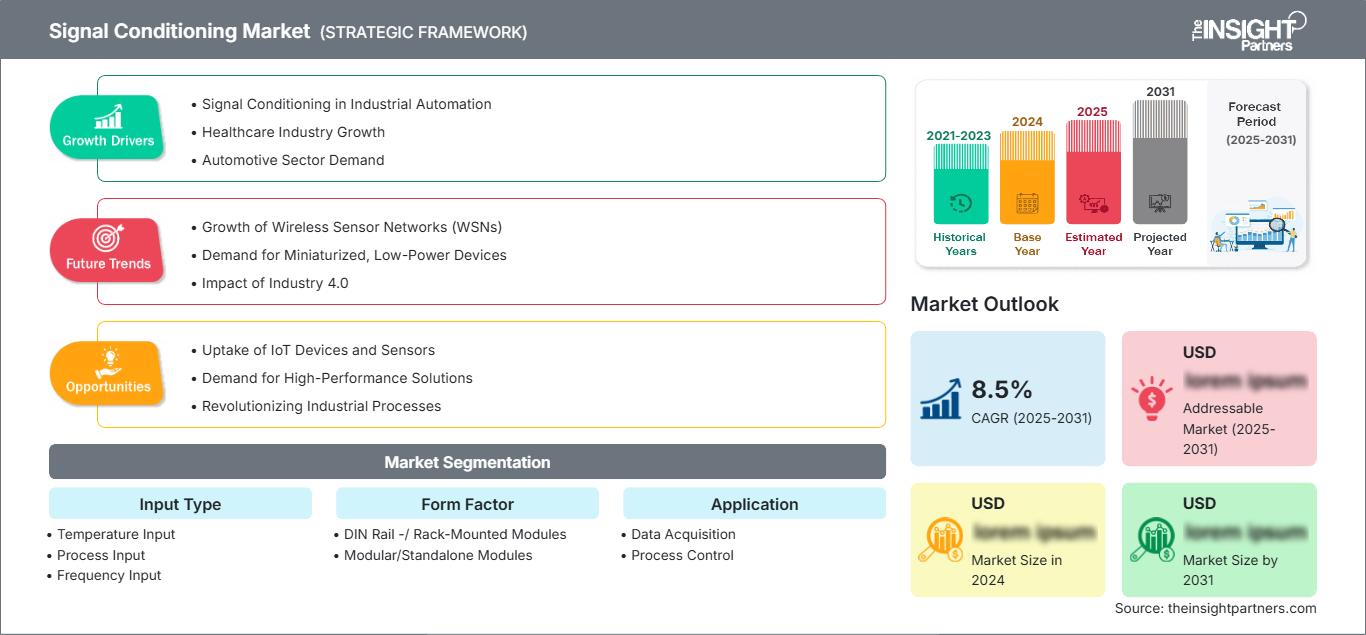
The global Signal Conditioning market was valued at US$ 4.13 billion in 2025 and is expected to reach US$ 5.16 billion by 2034; it is estimated to record a CAGR of 2.5% during 2026-2034.
Signal Conditioning Market Assessment and Insights
- North America accounted for 31–34% share in 2025 and is expected to grow at a CAGR between 2.6–3.1% during 2026–2034, driven by automation retrofits and defense-grade instrumentation demand.
- US represented 78–82% of North America in 2025 and is projected to grow at a CAGR between 2.7–3.2% during 2026–2034, supported by aerospace testing and process industries.
- Europe held 25–28% share in 2025 and is expected to expand at a CAGR between 2.3–2.8% during 2026–2034, with Germany, the UK, and France leading industrial instrumentation demand.
- Asia Pacific captured 28–31% share in 2025 and is forecast to grow at a CAGR between 3.1–3.6% during 2026–2034, led by China, Japan, South Korea, and India.
- Largest Segment DIN Rail -/ Rack-Mounted Modules held 55–59% market share in 2025 and is projected to grow at a CAGR between 2.7–3.2% during 2026–2034.
- High Growth Segment Process Input held 24–27% market share in 2025 and is expected to grow at a CAGR between 3.2–3.7% during 2026–2034.
- Key companies analyzed in detail: Advantech Co., Ltd.; AMETEK, Inc.; Analog Devices, Inc.; Keysight Technologies, Inc.; National Instruments Corporation; Phoenix Contact GmbH & Co. KG; Rockwell Automation, Inc.; TE Connectivity plc; Microchip Technology Inc.; Yokogawa Electric Corporation.
Source: The Insight Partners' analysis based on proprietary research, government publications, company annual reports, investor presentations, industry databases, and expert interviews.
In industrial measurement architectures, there has been an evolution from specialized analog transmitters towards conditioners which are capable of handling mixed sensors, isolators and diagnostics. There is also a change in the dynamics of production with respect to vendors, who have to consider reliability of components and also channel density as well as easy installation within a control panel. The market thus becomes increasingly oriented towards lifecycle optimization rather than mere signal processing, where old facilities require integration with PLC, DCS and edge-based monitoring systems.
New geographic regions, during the forecast period, will drive growth due to water treatment projects, renewable power monitoring, metal processing and manufacturing investments made locally. Focus on safety, emissions and data integrity further enhances the requirements for dependable measurement chains. The investments are likely to be more on modular devices with high isolation capability.
Signal Conditioning Market Report Scope
| Report Attribute | Details |
|---|---|
| Market size in 2025 | US$ 4.13 Billion |
| Market Size by 2034 | US$ 5.16 Billion |
| Global CAGR (2026 - 2034) | 2.5% |
| Historical Data | 2021-2024 |
| Forecast period | 2026-2034 |
Signal Conditioning Market Analysis
The demand is based on the transformation of raw signal output from sensors to signals that are reliable and standardized as the basis of the control process, logging and data acquisition. Demand growth will be fastest where the measurement of temperatures, pressures, vibrations, frequencies and displacements requires high accuracy even under conditions of electrical noise, long cables and challenging environments.
The value chain consists of sensor suppliers, module suppliers, systems integrators, automation equipment manufacturers, utilities and factories. Factors such as availability, calibration choices, housing styles and after-market support affect purchases. The supply chain supports those suppliers that can provide universal input capability, certified isolation, and compact size without increasing validation costs for their regulated industry customers.
Competitive positioning will be driven by companies that have both instrumentation pedigree and automation channel reach. Signal Conditioning Market analysis reveals that Analog Devices, Inc., Microchip Technology Inc., and TE Connectivity plc have impact at component level design, whereas Rockwell Automation, Inc., Phoenix Contact GmbH & Co. KG, and Yokogawa Electric Corporation will derive advantage from existing control system connections.
Investment themes will include modular product lines, increased channel density, range configurations via software, and convergence with industrial cybersecurity around connected measurement points. Advantech Co., Ltd., AMETEK, Inc., Keysight Technologies, Inc., and National Instruments Corporation provide solutions for lab testing and data acquisition applications, providing the competitive landscape with an equal blend of automation leaders and measurement companies.
● REPORT CUSTOMIZATION
Tailor This Report To Align With Your Specific Business Requirements
This report can be customized to align precisely with your business objectives, scope, and target markets. Customization options include tailored segmentation, geography, competitive analysis, and strategic insights to support informed decision-making.
Customize This Report →WHAT YOU CAN ADJUST
- ● Segmentations
- ● Geography
- ● Competitive Analysis
- ● Language Preferences
Signal Conditioning Market: Strategic Insights
Regional Insights
North America Signal Conditioning Market
North America represented 31–34% of global revenue in 2025 and is projected to grow at a CAGR between 2.6–3.1% during 2026–2034. The Signal Conditioning Market share is supported by refinery automation, grid modernization, aerospace testing, and replacement demand in mature water and wastewater systems.
Regional buyers prioritize reliability, safety approvals, and integration with existing controllers because brownfield assets dominate capital planning. IEA electricity outlooks indicating strong demand growth through 2027 reinforce utility investment in monitoring equipment, while aerospace and defense programs sustain demand for high-precision acquisition and conditioning hardware.
U.S. Signal Conditioning Market
In 2025, the US made up 78-82% of North America, while it is estimated that the US will grow at a CAGR of 2.7-3.2% from 2026-2034. Applications include oil and gas control systems, defense electronic equipment, semiconductor fabrication plants, urban utility companies, and high accuracy laboratory data acquisition.
Companies that use these devices include Analog Devices, Inc., Keysight Technologies, Inc., National Instruments Corporation, Rockwell Automation, Inc., AMETEK, Inc., Microchip Technology Inc., and TE Connectivity plc. It is worth mentioning that the implementation rate is favorable to the technology of modular signal path.
Europe Signal Conditioning Market
Share of Europe was around 25-28% in 2025, and it is expected that it will register a CAGR of 2.3-2.8% from 2026-2034. Germany is the largest country in Europe due to its needs for building machines, process automation, power equipment, and precision engineering applications.
In the UK, there are aerospace & defence industry, offshore energy production, and lab instrumentation application, while in France nuclear plants, water infrastructure, and transport electronics need contribute to the market. In Italy and Spain, metal processing, machinery, renewables, and municipal utilities generate demand for replacements.
APAC Signal Conditioning Market
APAC held a share of 28-31% in 2025 and is expected to register a CAGR of 3.1-3.6% over 2026-2034, which is the fastest growing region. This is driven by electronics production in China, power projects, chemicals, and industrial automation.
In addition, Japan and South Korea help foster the growth through their support in terms of demand from proper manufacturing and testing methods, while India adds in its contribution through the provision of solutions relating to water, energy, and metal. Australia contributes in terms of mining and utilities monitoring applications.
Middle East & Africa Signal Conditioning Market
Middle East & Africa is expected to grow at a CAGR between 2.4–2.9% during 2026–2034. Saudi Arabia is the leading country, supported by oil and gas automation, desalination, petrochemicals, and infrastructure diversification programs that require dependable process measurements.
Whereas the demand in the UAE includes utilities, logistics infrastructure, and industrial parks, the demand in South Africa includes mining, energy production, and water usage. The demand in other parts of MEA is project-based, where the demand is specified by engineers in the use of durable conditioners that can be used under harsh conditions.
Segmentation Analysis
Input Type
Input Type is expected to register a CAGR between 2.8–3.3% during 2026–2034. The market scope across input categories reflects the need to standardize thermocouple, current, voltage, frequency, and displacement signals before they enter control loops or acquisition platforms. Selection depends on measurement accuracy, isolation level, calibration effort, and compatibility with plant sensors.
- Temperature Input remains widely adopted in process plants, utilities, and industrial furnaces because thermocouple and RTD measurements require stable amplification, cold-junction compensation, and noise-resistant transmission.
- Process Input is strategically important for pressure, flow, level, and analytical measurements, where standardized 4–20 mA and voltage conversion supports safety, uptime, and remote monitoring.
- Frequency Input serves rotating equipment, flow metering, and speed monitoring applications, giving maintenance teams reliable pulse interpretation for condition tracking and performance diagnostics.
- LVDT/RVDT supports aerospace, defense, turbine, and precision motion applications where displacement and angular position signals require high accuracy, repeatability, and rugged conditioning electronics.
Form Factor
Form Factor is projected to grow at a CAGR between 2.6–3.1% during 2026–2034. Cabinet architecture, installation speed, maintenance access, and channel density determine purchasing behavior. The market favors form factors that reduce wiring time, improve serviceability, and allow automation teams to expand measurement points without redesigning existing panels.
- DIN Rail -/ Rack-Mounted Modules dominate control cabinets because standardized mounting, dense channel layouts, and quick replacement reduce engineering time in brownfield automation and utility projects.
- Modular/Standalone Modules remain relevant in laboratories, skid systems, remote assets, and test benches where flexible configuration, portability, and application-specific measurement chains are more valuable than panel density.
Application
Application is anticipated to grow at a CAGR between 2.7–3.2% during 2026–2034. Demand is split between measurement-centric acquisition systems and real-time control environments. Buyers evaluate latency, accuracy, channel isolation, software compatibility, and validation requirements because conditioned signals influence both analytics quality and operational response.
- Data Acquisition is essential in laboratories, aerospace testing, equipment monitoring, and plant diagnostics where raw sensor data must be converted into reliable records for analysis.
- Process Control supports continuous operations by delivering stable signals to PLCs and DCS platforms, reducing false alarms, loop instability, and measurement drift in harsh environments.
End-User
End-User is expected to grow at a CAGR between 2.9–3.4% during 2026–2034. Adoption is strongest where measurement failure can interrupt safety, quality, compliance, or asset availability. The market serves industries that need durable interfaces between field sensors and automation systems across hazardous, high-noise, and mission-critical environments.
- Water and Wastewater uses conditioners for flow, level, pressure, and chemical measurements, supporting compliance reporting, pump control, and reliable operations across distributed treatment assets.
- Oil and Gas requires rugged isolation and conversion for upstream, midstream, and refining assets where hazardous environments and long signal paths increase measurement risk.
- Energy and Power applies conditioners in generation, substations, storage, and grid monitoring to improve signal integrity for temperature, current, vibration, and auxiliary systems.
- Metals and Mining depends on robust modules for conveyors, mills, furnaces, crushers, and remote sites where vibration, dust, and electrical noise challenge data reliability.
- Aerospace and Defense needs high-precision conditioning for test stands, avionics validation, propulsion monitoring, and mission systems where displacement, vibration, and thermal measurements must remain repeatable.
Opportunity Snapshot
| End-User | Revenue Contribution | Trend Tag | Adoption Stage |
| Water and Wastewater | Medium | Smart Treatment | Scaling |
| Oil and Gas | High | Hazard Monitoring | Mature |
| Energy and Power | High | Grid Sensing | Scaling |
| Metals and Mining | Medium | Remote Assets | Scaling |
| Aerospace and Defense | Medium | Test Precision | Mature |
Signal Conditioning Market Growth Drivers and Impact Analysis
Industrial Automation Retrofits Require Reliable Measurement Layers
As brownfield plants implement additional sensors, remote I/O, and analysis without having to replace all their controllers, there will be an actual need for signal conditioners to connect legacy field equipment with more modern control system architectures. It is important that this demand driver will have a direct effect on the market as well since most times, when performing retrofit projects, there is a necessity for isolation, scaling, filtering, and diagnostic functions to avoid having any inaccurate analog data entering the digital systems. The market will get the benefit whenever the plant operator tries to do predictive maintenance, energy saving, and reporting.
Electrification and Grid Investment Expand Monitoring Points
Increasingly, electrical networks will be more heavily dependent upon measurements to deal with variations in renewables, storage integration, transformer loading, and distributed generation. The International Energy Agency (IEA) found that electricity usage increased by 4.3% globally in 2024 from the year before, and that robust growth is expected to continue. Every new measuring point involves conditioning of signals for current, temperature, vibration, and auxiliary equipment. The market benefits from investments into substations, power plants, and industry electrification projects because of reliable field measurements.
Aerospace and Defense Testing Needs High-Fidelity Signal Capture
The aerospace & defense industries require verified sensor measurements from propulsion, flight structure, environmental chambers, and mission electronic systems. Passenger traffic projections for 2025 were stated by the IATA. Defense upgrade programs keep growing and will continue to grow and create more demand for test facilities and instrumentation capabilities. These needs call for superior conditioners for LVDT/RVDT, vibration, temperature, and pressure channels where noise, drift, or channel mismatch will corrupt the readings. The segment will thrive because of laboratories expansion, airplane lifespan tests, unmanned vehicles development, and sustainment programs.
Signal Conditioning Market Future Trends
Software-Configurable Universal Input Modules
Signal Conditioning Market trends are moving toward universal input modules that can be configured through software rather than stocked as many dedicated variants. This shift will reduce spare-part complexity for maintenance teams and shorten commissioning cycles for system integrators managing mixed temperature, process, frequency, and displacement signals. Over time, suppliers will differentiate through intuitive configuration tools, embedded diagnostics, and secure parameter management. The trend also supports distributed architectures because technicians can standardize hardware across panels while adapting input behavior at the application level. Adoption will be strongest in facilities with frequent process changes, modular skids, and multi-site maintenance programs.
Conditioning Closer to the Sensor Edge
Future architectures will place more signal conditioning near the sensor to reduce noise exposure, improve diagnostics, and deliver cleaner data to edge gateways. This direction is relevant for long cable runs, remote pumping stations, offshore assets, mines, and distributed energy equipment where weak analog signals can degrade before reaching a control cabinet. Vendors will need rugged designs, better thermal stability, and communication-ready interfaces that preserve measurement integrity without adding maintenance burden. The Signal Conditioning Market will gradually shift from cabinet-only modules toward hybrid solutions that combine local conditioning, health monitoring, and secure data transfer.
Signal Conditioning Market Opportunities
Retrofit Packages for Water and Utility Infrastructure
Utilities and municipalities need practical upgrade paths for aging treatment plants, pumping stations, substations, and distributed monitoring assets. Suppliers can create opportunity by bundling signal conditioners with enclosure kits, calibration services, documentation, and integration support for common PLC and SCADA environments. Signal Conditioning Market Forecasts favor vendors that reduce engineering risk and make modernization possible within constrained public budgets. Water and power operators value solutions that improve measurement confidence for flow, level, pressure, temperature, and asset condition without forcing wholesale system replacement. Partnerships with engineering contractors and panel builders can convert project-based upgrades into repeatable regional programs.
Precision Test Systems for Advanced Manufacturing
Advanced manufacturing, aerospace validation, battery systems, and semiconductor equipment create opportunity for higher-accuracy conditioning integrated with data acquisition platforms. Buyers in these environments require stable calibration, low noise, synchronization, and traceable measurement workflows that support quality assurance and product development. Suppliers can capture value by offering application-specific bundles for vibration, temperature, strain, displacement, and process inputs. The Signal Conditioning Market is especially attractive where test teams need repeatable measurements across multiple labs or production lines. Strong documentation, software compatibility, and lifecycle support will influence procurement as much as hardware specifications.
Recent Developments
- July 2026: Analog Devices, Inc. announced the completion of its acquisition of Empower Semiconductor. The combination further strengthens ADI's position as a leading strategic, system-level grid-to-core power partner across the entire AI ecosystem, expanding ADI's total addressable market and capabilities in AI compute power delivery.
- July 2026: Astera Labs ALAB is benefiting from surging demand for its PCIe (Peripheral Component Interconnect Express) solutions, particularly as the AI infrastructure market accelerates and hyperscalers, AI labs and sovereign entities invest heavily in next-generation data center technologies. In the first quarter of 2026, Astera Labs delivered strong financial results, with revenues reaching $308 million, up 14% sequentially and 93% year over year. PCIe Gen 6 revenues accounted for more than one-third of the company's total revenues in the quarter, underscoring the centrality of this product line to Astera Labs' growth. Millions of PCIe Gen 6 ports have been shipped to date, demonstrating the maturity and adoption of Astera Labs' portfolio across AI fabric and signal conditioning applications.
- April 2026: STMicroelectronics has introduced the TSB192 dual operational amplifier, designed to deliver high precision across a wide supply-voltage range of 4 V to 36 V. The device targets applications requiring accurate analog signal conditioning under varying operating conditions, combining low offset voltage, minimal temperature drift, and stable frequency performance. The TSB192 features a typical input offset voltage of 20 µV, with a maximum of 30 µV across the full temperature range. Temperature drift is specified at 100 nV/°C, reducing the need for external calibration or compensation in precision analog front-end designs. Unlike many precision amplifiers that operate at lower supply voltages, the TSB192 maintains accuracy over a significantly broader voltage range, supporting flexible system integration across industrial, automotive, healthcare, and consumer applications.
Frequently Asked Questions

- Comprehensive Market Sizing and Forecast Analysis
- Detailed Segmentation Analysis
- In-Depth Market Dynamics Assessment
- Regional and Country-Level Insights
- Competitive Landscape and Company Benchmarking
- Strategic Business Intelligence
Recent Reports
Testimonials

The Insight Partners' SCADA System Market report is comprehensive, with valuable insights on current trends and future forecasts. The team was highly professional, responsive, and supportive throughout. We are very satisfied and highly recommend their services.
RAN KEDEM Partner, Reali Technologies LTDs
I requested a report on a very specific software market and the team produced the report in a few days. The information was very relevant and well presented. I then requested some changes and additions to the report. The team was again very responsive and I got the final report in less than a week.
JEAN-HERVE JENN Chairman, Future Analytica
We worked with The Insight Partners for an important market study and forecast. They gave us clear insights into opportunities and risks, which helped shape our plans. Their research was easy to use and based on solid data. It helped us make smart, confident decisions. We highly recommend them.
PIYUSH NAGPAL Sr. Vice President, High Beam Global
The Insight Partners delivered insightful, well-structured market research with strong domain expertise. Their team was professional and responsive throughout. The user-friendly website made accessing industry reports seamless. We highly recommend them for reliable, high-quality research services
YUKIHIKO ADACHI CEO, Deep Blue, LLC.
This is the first time I have purchased a market report from The Insight Partners.While I was unsure at first, I visited their web site and felt more comfortable to take the risk and purchase a market report.I am completely satisfied with the quality of the report and customer service. I had several questions and comments with the initial report, but after a couple of dialogs over email with their analyst I believe I have a report that I can use as input to our strategic planning process.Thank you so much for taking the extra time and making this a positive experience.I will definitely recommend your service to others and you will be my first call when we need further market data.
JOHN SUZUKI President and Chief Executive Officer, Board Director, BK Technologies
I wish to appreciate your support and the professionalism you displayed in the course of attending to my request for information regarding to infectious disease IVD market in Nigeria. I appreciate your patience, your guidance, and the fact that you were willing to offer a discount, which eventually made it possible for us to close a deal. I look forward to engaging The Insight Partners in the future, all thanks to the impression you have created in me as a result of this first encounter.
DR CHIJIOKE ONYIA MANAGING DIRECTOR, PineCrest Healthcare Ltd.Reason to Buy
- Informed Decision-Making
- Understanding Market Dynamics
- Competitive Analysis
- Identifying Emerging Markets
- Customer Insights
- Market Forecasts
- Risk Mitigation
- Boosting Operational Efficiency
- Strategic Planning
- Investment Justification
- Tracking Industry Innovations
- Aligning with Regulatory Trends





 Get Free Sample for