
Signal Conditioning Modules Market Size, Trends & Demand by 2034
Coverage: By Form Factor (DIN rail-/rack-mounted modules, Standalone/modular modules); Input Type (Temperature input, Process input, Frequency input); Application (Data acquisition, Process control, Others); End Use Industry (Oil and Gas, Energy and Power, Chemical Processing, Food and Beverage, Metal and Mining, Paper and Pulp, Water and Wastewater, Aerospace and Defense) , and Geography (North America, Europe, Asia Pacific, and South and Central America)
- Status : Data Released
- Report Code : TIPRE00020282
- Category : Electronics and Semiconductor
- No. of Pages : 150
- Available Report Formats :


- Last update date : July 17, 2026


2025 Market Size
US$ 1.39 Bn
Base year value
2034 Forecast
US$ 2.31 Bn
Projected by 2034
CAGR 2026-2034
5.82 %
Growth rate
Addressable Market
US$ 16.78 Bn
(2026-2034)
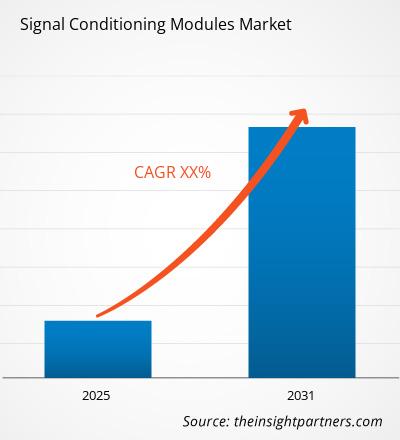
The Signal Conditioning Modules Market is projected to expand from US$ 1.39 Billion in 2025 to US$ 2.31 Billion by 2034, registering a CAGR of 5.82% during 2026–2034. Demand is supported by rising use of sensor interfaces, industrial automation systems, and reliable analog-to-digital conversion across process and discrete industries where measurement accuracy, electrical isolation, and data integrity remain critical operating requirements.
North America remains a structurally important market, with the Signal Conditioning Modules Market size benefiting from brownfield plant modernization, reshoring of industrial electronics, and high adoption of certified modules for hazardous-area monitoring. The region is estimated to grow at a 5.4–5.9% CAGR through 2034, led by automation upgrades in oil and gas, power generation, water infrastructure, and aerospace test environments.
Signal Conditioning Modules Market Assessment and Insights
- North America accounted for 33–36% share in 2025 and is projected to grow at a 5.4–5.9% CAGR between 2026–2034, supported by automation retrofits, shale infrastructure, and certified safety requirements.
- US represented 74–78% of North America in 2025 and is expected to grow at a 5.5–6.0% CAGR, led by process automation and aerospace testing.
- Europe held 25–28% share in 2025 and is forecast to grow at a 5.0–5.5% CAGR, with Germany, the UK, and France leading industrial instrumentation upgrades.
- Asia Pacific captured 27–30% share in 2025 and is expected to advance at a 6.4–6.9% CAGR, driven by China, Japan, South Korea, and India.
- Largest Segment DIN rail-/rack-mounted modules held 56–60% market share in 2025 and are projected to grow at a 5.6–6.1% CAGR, reflecting cabinet density advantages.
- High Growth Segment Temperature input modules held 34–38% market share in 2025 and are projected to grow at a 6.2–6.7% CAGR due to thermal monitoring needs.
- Key companies analyzed in detail: Rockwell Automation, Inc., Siemens Aktiengesellschaft, Phoenix Contact GmbH & Co. KG, Schneider Electric SE, Yokogawa Electric Corporation, Advantech Co., Ltd., Moore Industries-International, Inc., PR electronics A/S, Keysight Technologies, Inc., Omega Engineering Inc.
Source: The Insight Partners' analysis based on proprietary research, government publications, company annual reports, investor presentations, industry databases, and expert interviews.
Signal Conditioning Modules market technology has evolved from the traditional analog isolation to smaller, configurable and multi-channel modules enabling diagnostics, wide temperature capabilities, and simple commissioning. Manufacturing aspects have also been evolving due to the need to provide high reliability components while retaining the ability to reuse the module platforms and creating different variants for temperature, process and frequency inputs.
Going forward, adoption will increase within newly developed industrial zones where the utilities, chemical zones, and food processing units install SCADA infrastructure. Due to regulatory focus on worker safety, emissions tracking, and water purification, there is going to be continued adoption of isolated modules in areas where traceability of measurements, increased reliability, and safer connection of field devices to the control system are required.
Signal Conditioning Modules Market Report Scope
| Report Attribute | Details |
|---|---|
| Market size in 2025 | US$ 1.39 Billion |
| Market Size by 2034 | US$ 2.31 Billion |
| Global CAGR (2026 - 2034) | 5.82% |
| Historical Data | 2021-2024 |
| Forecast period | 2026-2034 |
Signal Conditioning Modules Market Analysis
Signal Conditioning Modules market technology has evolved from the traditional analog isolation to smaller, configurable and multi-channel modules enabling diagnostics, wide temperature capabilities, and simple commissioning. Manufacturing aspects have also been evolving due to the need to provide high reliability components while retaining the ability to reuse the module platforms and creating different variants for temperature, process and frequency inputs.
Going forward, adoption will increase within newly developed industrial zones where the utilities, chemical zones, and food processing units install SCADA infrastructure. Due to regulatory focus on worker safety, emissions tracking, and water purification, there is going to be continued adoption of isolated modules in areas where traceability of measurements, increased reliability, and safer connection of field devices to the control system are required.
Signal Conditioning Modules Market Analysis
The market is based on the demand for transformation of the raw output signals into standardized inputs for use by PLCs, DCSs, and other data acquisition systems. The development of the market is spurred by predictive maintenance programs, energy measurement applications, and increasing demands for uptime from process plants.
The market participants consist of sensor vendors, module makers, panel makers, system integrators, and automation software vendors. The dynamics of supply still depend on analog components' precision, isolation transformers, semiconductors, and enclosures material.
Positioning within the competitive environment involves precision, hazardous location certifications, channel density, speed of configuration, and compatibility with automation architectures. An assessment of the Signal Conditioning Modules Market reveals that Rockwell Automation, Siemens Aktiengesellschaft, Phoenix Contact GmbH & Co. KG, Schneider Electric SE, and Yokogawa Electric Corporation use wider control systems and installed base to gain competitive advantage.
Specializing in application software from providers such as Moore Industries-International, Inc., PR electronics A/S, Omega Engineering Inc., Advantech Co., Ltd., and Keysight Technologies, Inc., makes the market landscape better by bringing in expertise in isolation, test measuring, and industrial I/O. More investments are being channeled into thin modules, digitized configuring, and diagnosing to reduce installation time.
● REPORT CUSTOMIZATION
Tailor This Report To Align With Your Specific Business Requirements
This report can be customized to align precisely with your business objectives, scope, and target markets. Customization options include tailored segmentation, geography, competitive analysis, and strategic insights to support informed decision-making.
Customize This Report →WHAT YOU CAN ADJUST
- ● Segmentations
- ● Geography
- ● Competitive Analysis
- ● Language Preferences
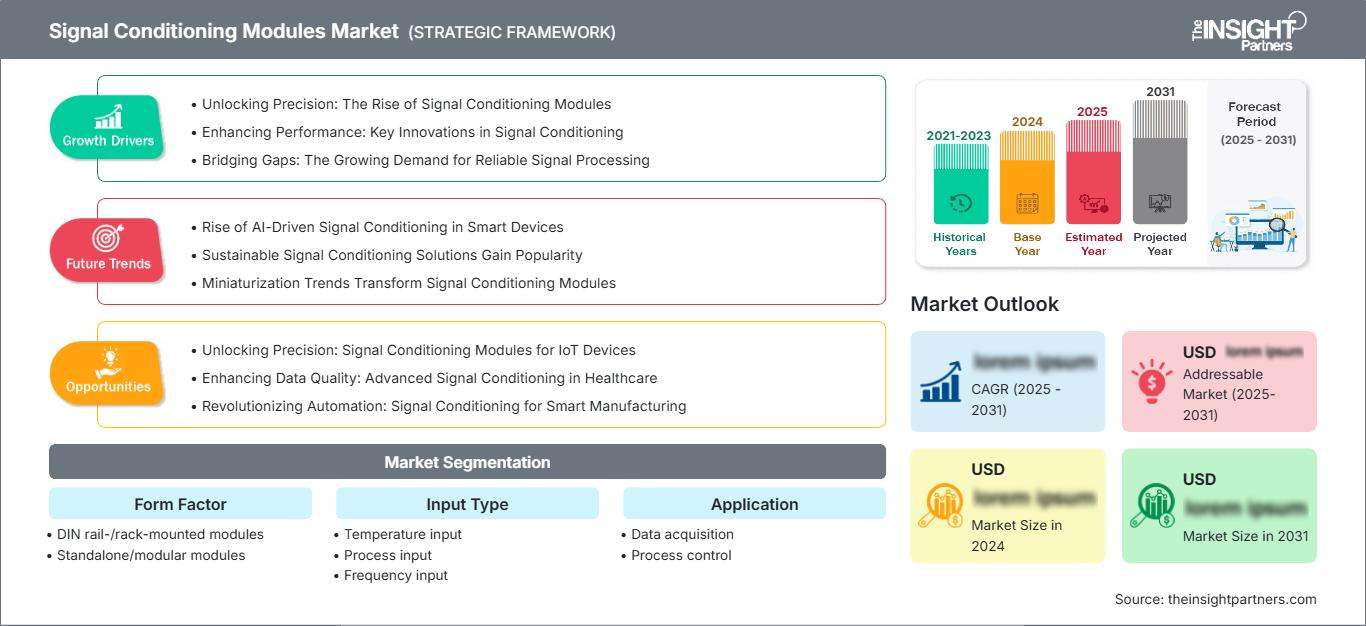
Signal Conditioning Modules Market: Strategic Insights
Regional Insights
North America Signal Conditioning Modules Market
North America held 33–36% share in 2025 and is expected to grow at a 5.4–5.9% CAGR through 2034. The region benefits from high installed bases of process automation, aging instrumentation cabinets, and stricter safety compliance in hazardous oil, gas, chemical, and power assets.
The Signal Conditioning Modules Market share in North America is also supported by semiconductor test, aerospace telemetry, and water infrastructure modernization. Utilities and manufacturers are prioritizing electrically isolated, diagnostics-ready modules to protect controllers, reduce signal drift, and improve maintenance visibility in plants operating with mixed legacy and digital assets.
U.S. Signal Conditioning Modules Market
The United States accounted for 74–78% of North American sales in 2025 and is expected to have a CAGR growth rate of 5.5–6.0%. The demand centers on automation systems for refineries, shale gas compressors, test beds in the aerospace & defense industry, semiconductor facilities, and municipal water projects that require reliable sensor interfacing.
Rockwell Automation, Inc., Keysight Technologies, Inc., Moore Industries-International, Inc., and Omega Engineering Inc. provide a strong domestic market environment. Application needs to use DIN Rail modules, temperature conditioners, and process input isolators as they need cabinet efficiency, precision measurements, and PLG structure compatibility.
Europe Signal Conditioning Modules Market
In 2025, Europe had a 25-28% share and is expected to have a CAGR of 5.0-5.5%. Germany dominates through process automation, machinery export, and energy transition initiatives. The UK is showing robust demands in oil and gas, water utilities, and military instrumentation, while France benefits from power and aviation applications.
Italy and Spain add through food processing, chemicals, and metals upgrades. The importance placed by European customers on functional safety, electromagnetic compatibility, and compact enclosure design makes Phoenix Contact GmbH & Co. KG, Siemens Aktiengesellschaft, Schneider Electric SE, and PR electronics A/S prominent vendors in the region.
APAC Signal Conditioning Modules Market
The APAC region held around 27-30% share in 2025 and is forecasted to grow at a CAGR of 6.4-6.9%, the fastest among regions. China has dominance in manufacturing, Japan in precision automation, South Korea in electronics, India in infrastructure, and Australia in mining & water systems.
Favorable policies for digitization of industries, power supply stability, and environment monitoring boost the deployment of modules. Two companies in particular – Yokogawa Electric Corporation and Advantech Co., Ltd. – stand out in light of their relevance in the APAC region.
Middle East & Africa Signal Conditioning Modules Market
MEA and Africa region is predicted to register 5.6%-6.1% CAGR during 2034, with major contributions from Saudi Arabia for oil, gas, petrochemicals, and utilities. UAE contributes to growth through infrastructure, desalination, and energy management projects, whereas South Africa provides impetus for mining and water automation applications.
The implementation of Rest of MEA is dependent on the upgrading of refineries, compliance of wastewater treatment systems, and increased reliability of the grid. The users appreciate the thermal resistance, isolation, and low maintenance due to harsh environment, reduced downtimes, and long life expectancy of the installed technology.
Segmentation Analysis
Form Factor
Form Factor is projected to grow at a 5.5–6.0% CAGR during 2026–2034. Signal Conditioning Modules Market scope in this segment is defined by cabinet design, installation density, maintenance access, and compatibility with PLC or DCS architectures across both new automation projects and retrofit programs.
- DIN rail-/rack-mounted modules dominate industrial panels because they support dense layouts, standardized wiring, and faster replacement, making them preferred for process plants and utility automation projects.
- Standalone/modular modules serve distributed equipment, test systems, and smaller installations where flexible placement, dedicated conditioning, and easier customization outweigh the need for centralized cabinet density.
Input Type
Input Type is forecast to grow at a 5.8–6.3% CAGR during 2026–2034. Selection depends on sensor mix, signal noise, temperature exposure, and the need for isolation or scaling before controller input, making this segmentation central to performance and safety.
- Temperature input modules are widely used with thermocouples and RTDs, supporting furnaces, boilers, cold chains, and reactors where stable thermal readings protect quality and safety.
- Process input modules condition current and voltage signals from pressure, flow, level, and analytical instruments, making them essential for continuous-process control loops.
- Frequency input modules address speed, rotation, and pulse-based measurements in turbines, conveyors, pumps, and metering systems where conversion accuracy affects control response.
Application
Application is expected to grow at a 5.7–6.2% CAGR during 2026–2034. Data acquisition and process control use cases increasingly require accurate field-to-controller signal conversion as operators pursue plant visibility, closed-loop control, condition monitoring, and compliance reporting.
- Data acquisition benefits from conditioners that filter, amplify, and isolate sensor outputs before analysis, improving measurement repeatability in laboratories, test benches, and remote monitoring systems.
- Process control remains critical where conditioners stabilize input signals for PLCs and DCS platforms, reducing nuisance trips and supporting safer automated decision-making.
End Use Industry
End Use Industry is projected to grow at a 5.6–6.1% CAGR during 2026–2034. Adoption is strongest where harsh environments, safety-critical operations, and continuous monitoring require reliable conversion between sensors, actuators, controllers, and supervisory systems.
- Oil and Gas uses conditioners for pressure, temperature, and flow loops across upstream, midstream, and refinery assets where isolation reduces operational risk.
- Energy and Power requires reliable signal handling in generation, substations, renewables, and grid monitoring where measurement continuity supports asset protection.
- Chemical Processing depends on intrinsically safe and accurate modules for hazardous reactors, storage, and dosing systems where control precision safeguards product quality.
- Food and Beverage adopts modules for hygienic processing, packaging lines, temperature monitoring, and clean-in-place systems where repeatability supports quality assurance.
- Metal and Mining uses rugged modules for crushers, conveyors, furnaces, and mine water systems exposed to vibration, dust, and electrical noise.
- Paper and Pulp needs conditioners for moisture, pressure, and temperature loops that stabilize continuous production and reduce quality variation.
- Water and Wastewater relies on signal conditioning for flow, level, pH, and pump control in treatment plants and distribution networks.
- Aerospace and Defense applies high-precision modules in test stands, telemetry, environmental chambers, and mission-critical equipment validation.
Opportunity Snapshot
| End Use Industry | Revenue Contribution | Trend Tag | Adoption Stage |
| Oil and Gas | High | Hazard Safety | Mature |
| Energy and Power | High | Grid Monitoring | Scaling |
| Chemical Processing | High | Loop Integrity | Mature |
| Food and Beverage | Medium | Quality Control | Scaling |
| Metal and Mining | Medium | Rugged Sensing | Scaling |
| Paper and Pulp | Medium | Process Stability | Mature |
| Water and Wastewater | Medium | Flow Compliance | Scaling |
| Aerospace and Defense | Medium | Test Accuracy | Scaling |
Signal Conditioning Modules Market Growth Drivers and Impact Analysis
Industrial Automation Retrofits Raise Module Replacement Demand
The brownfield sites are upgrading the outdated analog interface prior to the controller upgrades because of the low quality of the signal, which might inhibit any benefits from the automation process. It is advantageous for the industry when these facilities install new conditioners that are isolated, reconfigurable transmitters, and compact DIN rail modules into the current cabinets instead of constructing new control rooms.
Safety and Compliance Requirements Strengthen Certified Designs
The hazardous area devices need galvanic isolation, intrinsically safe certifications, and functional safety certification to protect employees and machines. Chemical, oil and gas, wastewater treatment, and hydrogen plants now tend to have certified signal conditioners used in areas where there is a risk of operating because of electrical energy, flammable gases, or dust. There will be a commercial gain as a result of increased revenue from sales per item sold and increased need for replacements.
Data Acquisition Expansion Increases Precision Interface Needs
The success of industrial data applications requires accurate and comparable sensor inputs to enable better decision-making through analysis. With the interconnection of pumps, compressors, furnaces, turbines, and environment sensors to analytics platforms, the conditioner becomes necessary for the elimination of noise, calibration, and protection of the measurement equipment. The growth in the number of use cases increases the need for conditioning outside of just the traditional feedback loop.
Signal Conditioning Modules Market Future Trends
Digitally Configurable and Diagnostics-Ready Modules
Signal Conditioning Modules Market trends are shifting toward devices that can be configured through software, near-field tools, or asset management platforms without extensive manual switch settings. Future designs will place more emphasis on diagnostic transparency, parameter backup, and faster replacement after faults. For plant operators, this reduces commissioning labor and supports standardized engineering across multiple sites. For suppliers, differentiation will depend on usability, cybersecurity-aware connectivity, and lifecycle documentation rather than analog performance alone.
Higher Density Interfaces for Space-Constrained Panels
Space on the panel is now becoming an issue because of the increase in the number of sensors, safety loops, and monitoring points being installed by plants without increasing the size of the electrical room. In reaction to this, manufacturers are developing smaller housing sizes, pluggable terminals, bus bars of power supply, and multiplex designs to minimize wiring requirements. This issue becomes very important especially when it comes to retrofit situations and skid mounted equipment.
Signal Conditioning Modules Market Opportunities
Localized Supply for Industrial Electronics Resilience
Regional assembly and second-source qualification programs present an opportunity to suppliers catering to customers who are subject to regulation and need reliability. As stated in Signal Conditioning Modules Market Forecasts, procurement organizations will seek assurance of availability, equivalence certification, and technical support closer to the point of operation. Suppliers may adapt to this trend through expanded local assembly, calibration services, and collaboration on application engineering. This trend is applicable especially for utilities, defense manufacturers, and process industries with lengthy product support periods and fast replacements.
Water Infrastructure and Environmental Monitoring Upgrades
Municipal and industrial water networks represent a practical opportunity because treatment performance depends on dependable flow, level, pressure, and analytical measurements. Signal conditioners can improve data stability across pumping stations, filtration systems, chemical dosing units, and discharge monitoring points. Suppliers that package rugged modules with simple commissioning and corrosion-resistant accessories can address utilities with limited technical staff. The opportunity is reinforced by global pressure to reduce water loss, improve compliance, and digitize infrastructure operations.
Recent Developments
- July 2026: Analog Devices, Inc. announced the completion of its acquisition of Empower Semiconductor. The combination further strengthens ADI's position as a leading strategic, system-level grid-to-core power partner across the entire AI ecosystem, expanding ADI's total addressable market and capabilities in AI compute power delivery.
- July 2026: Astera Labs ALAB is benefiting from surging demand for its PCIe (Peripheral Component Interconnect Express) solutions, particularly as the AI infrastructure market accelerates and hyperscalers, AI labs and sovereign entities invest heavily in next-generation data center technologies. In the first quarter of 2026, Astera Labs delivered strong financial results, with revenues reaching $308 million, up 14% sequentially and 93% year over year. PCIe Gen 6 revenues accounted for more than one-third of the company's total revenues in the quarter, underscoring the centrality of this product line to Astera Labs' growth. Millions of PCIe Gen 6 ports have been shipped to date, demonstrating the maturity and adoption of Astera Labs' portfolio across AI fabric and signal conditioning applications.
- April 2026: STMicroelectronics has introduced the TSB192 dual operational amplifier, designed to deliver high precision across a wide supply-voltage range of 4 V to 36 V. The device targets applications requiring accurate analog signal conditioning under varying operating conditions, combining low offset voltage, minimal temperature drift, and stable frequency performance. The TSB192 features a typical input offset voltage of 20 µV, with a maximum of 30 µV across the full temperature range. Temperature drift is specified at 100 nV/°C, reducing the need for external calibration or compensation in precision analog front-end designs. Unlike many precision amplifiers that operate at lower supply voltages, the TSB192 maintains accuracy over a significantly broader voltage range, supporting flexible system integration across industrial, automotive, healthcare, and consumer applications.
Frequently Asked Questions

- Comprehensive Market Sizing and Forecast Analysis
- Detailed Segmentation Analysis
- In-Depth Market Dynamics Assessment
- Regional and Country-Level Insights
- Competitive Landscape and Company Benchmarking
- Strategic Business Intelligence
Recent Reports
Testimonials

The Insight Partners' SCADA System Market report is comprehensive, with valuable insights on current trends and future forecasts. The team was highly professional, responsive, and supportive throughout. We are very satisfied and highly recommend their services.
RAN KEDEM Partner, Reali Technologies LTDs
I requested a report on a very specific software market and the team produced the report in a few days. The information was very relevant and well presented. I then requested some changes and additions to the report. The team was again very responsive and I got the final report in less than a week.
JEAN-HERVE JENN Chairman, Future Analytica
We worked with The Insight Partners for an important market study and forecast. They gave us clear insights into opportunities and risks, which helped shape our plans. Their research was easy to use and based on solid data. It helped us make smart, confident decisions. We highly recommend them.
PIYUSH NAGPAL Sr. Vice President, High Beam Global
The Insight Partners delivered insightful, well-structured market research with strong domain expertise. Their team was professional and responsive throughout. The user-friendly website made accessing industry reports seamless. We highly recommend them for reliable, high-quality research services
YUKIHIKO ADACHI CEO, Deep Blue, LLC.
This is the first time I have purchased a market report from The Insight Partners.While I was unsure at first, I visited their web site and felt more comfortable to take the risk and purchase a market report.I am completely satisfied with the quality of the report and customer service. I had several questions and comments with the initial report, but after a couple of dialogs over email with their analyst I believe I have a report that I can use as input to our strategic planning process.Thank you so much for taking the extra time and making this a positive experience.I will definitely recommend your service to others and you will be my first call when we need further market data.
JOHN SUZUKI President and Chief Executive Officer, Board Director, BK Technologies
I wish to appreciate your support and the professionalism you displayed in the course of attending to my request for information regarding to infectious disease IVD market in Nigeria. I appreciate your patience, your guidance, and the fact that you were willing to offer a discount, which eventually made it possible for us to close a deal. I look forward to engaging The Insight Partners in the future, all thanks to the impression you have created in me as a result of this first encounter.
DR CHIJIOKE ONYIA MANAGING DIRECTOR, PineCrest Healthcare Ltd.Reason to Buy
- Informed Decision-Making
- Understanding Market Dynamics
- Competitive Analysis
- Identifying Emerging Markets
- Customer Insights
- Market Forecasts
- Risk Mitigation
- Boosting Operational Efficiency
- Strategic Planning
- Investment Justification
- Tracking Industry Innovations
- Aligning with Regulatory Trends





 Get Free Sample for