
Signaling Analyzer Market Size, Trends & Growth by 2034
Coverage: By Offering (Real Time Software Analysis, Data Access Interface Card, Others); Technology (LTE, GSM, GPRS and EDGE, Voice/Video Over Wi-Fi, Others); Vertical (Automotive and Transportation, Aerospace and Defense, IT and Telecommunication, Others) , and Geography (North America, Europe, Asia Pacific, and South and Central America)
- Status : Data Released
- Report Code : TIPRE00014092
- Category : Electronics and Semiconductor
- No. of Pages : 150
- Available Report Formats :


- Last update date : July 20, 2026


2025 Market Size
US$ 2.53 Bn
Base year value
2034 Forecast
US$ 4.84 Bn
Projected by 2034
CAGR 2026-2034
7.47 %
Growth rate
Addressable Market
US$ 33.21 Bn
(2026-2034)
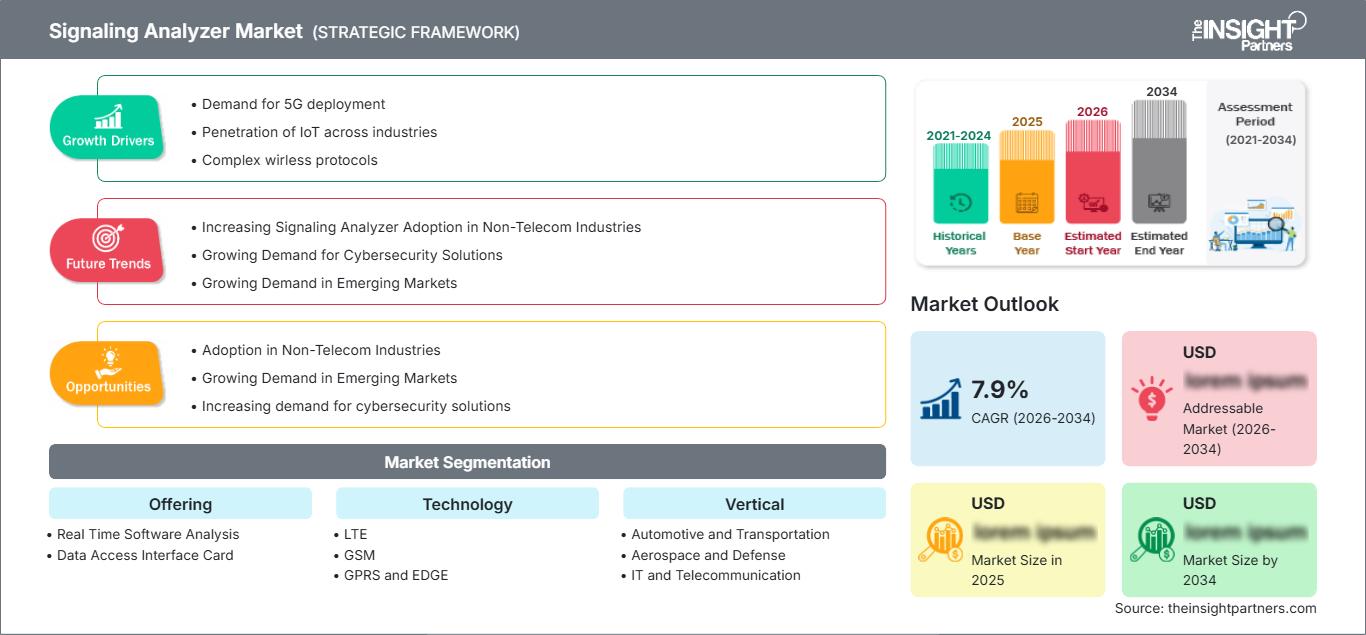
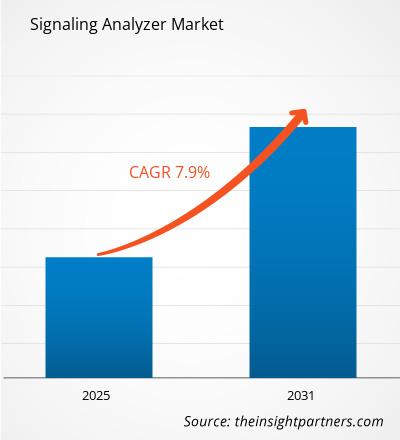
The global Signaling Analyzer Market size was recorded to be US$ 2.53 Billion in 2025 and is expected to be US$ 4.84 Billion in 2034, representing a CAGR of 7.47% between 2026 and 2034. The market growth drivers include the requirement for accurate protocol decoding, field verification and laboratory testing of signaling protocols within LTE, GSM, GPRS and EDGE, and Voice/Video Over Wi-Fi network environments.
North America is driven by the increasing density of 5G Standalone deployments, O-RAN validations, Aerospace Electronics Testing, and Automotive Connectivity applications. North America is projected to expand at a CAGR of 6.8–7.4% from 2026–2034. The market drivers include carrier laboratories, defense contractors, and equipment manufacturers needing interoperable solutions for software analysis and protocol traceability.
Signaling Analyzer Market Assessment and Insights
- North America accounted for 34–37% share in 2025 and is growing at a CAGR range of 6.8–7.4% during 2026–2034, supported by carrier modernization, defense communications programs, and advanced test labs.
- US represented 78–82% of North America in 2025 and is growing at 6.9–7.5%, driven by telecom R&D, aerospace electronics, and automotive connectivity testing.
- Europe held 24–27% share in 2025 and is advancing at 6.3–6.9%, led by Germany, the UK, and France through industrial automation, automotive electronics, and 5G private network projects.
- Asia Pacific captured 29–32% share in 2025 and is expanding at 8.1–8.8%, led by China, Japan, South Korea, and India through electronics manufacturing and telecom infrastructure investment.
- Largest Segment Real Time Software Analysis held 62–66% market share in 2025 and is growing at 7.2–7.8%, reflecting demand for automated protocol diagnostics.
- High Growth Segment Voice/Video Over Wi-Fi held 18–22% market share in 2025 and is growing at 8.6–9.3%, driven by enterprise mobility and indoor coverage optimization.
- Key companies analyzed in detail: Advantest Corporation, Anritsu Corporation, Keysight Technologies, Inc., National Instruments Corporation, Rigol Technologies Co., Ltd., Rohde & Schwarz GmbH & Co. KG, Tektronix, Inc., Texas Instruments Incorporated, VIAVI Solutions Inc., Yokogawa Electric Corporation.
Source: The Insight Partners' analysis based on proprietary research, government publications, company annual reports, investor presentations, industry databases, and expert interviews.
Network test environments are evolving away from the hardware-oriented protocol tests to software-based real-time analysis that cuts down on troubleshooting time and improves conformance testing. Production processes are also becoming dynamic with vendors now integrating signaling captures, protocol decodes, and traffic visualizations into an overall solution platform. The growth of the Signaling Analyzer Market can be attributed to such developments, particularly in cases where telcos, automotive electronics manufacturers, and defense integrators need accurate validation of their connectivity solutions.
In the coming years, new opportunities will arise in Asia-Pacific manufacturing centers, 5G private networks in Europe, and the modernization of mission-critical communication solutions in North America and the Middle East. Software upgrades, modular interfaces, and multi-standard testing capabilities are expected to drive investments. The regulatory drive towards ensuring quality services, efficient spectrum utilization, and interoperable equipment certification will further drive demand from laboratories and network operators.
Signaling Analyzer Market Report Scope
| Report Attribute | Details |
|---|---|
| Market size in 2025 | US$ 2.53 Billion |
| Market Size by 2034 | US$ 4.84 Billion |
| Global CAGR (2026 - 2034) | 7.47% |
| Historical Data | 2021-2024 |
| Forecast period | 2026-2034 |
Signaling Analyzer Market Analysis
Demand will grow with the emergence of a more diversified mix of communications networks that include cellular, Wi-Fi, satellite, automotive and industrial connectivity. Service providers require analysis tools capable of discovering issues with protocols before these have an impact on low latency applications. Value chain participants consist of semiconductor providers, tool makers, software analytic vendors, calibration firms, telecommunications labs and system integrators who use measurement data for deployments.
Supply trends favor providers able to integrate broadband capture, automated trace correlation and field portability features. Availability of components, RF front end capabilities and software licensing terms contribute to supply chain lead times. With new releases of 3GPP standards and the migration of Wi-Fi activity to enterprise voice and video traffic, demand for upgradable devices grows.
The competitive environment centers on diverse test and measurement solutions providers with excellent RF, protocol, and software expertise. Among such firms are Keysight Technologies, Inc., Rohde & Schwarz GmbH & Co. KG, Anritsu Corporation, and VIAVI Solutions Inc. Meanwhile, Tektronix, Inc. and Yokogawa Electric Corporation target specific measurement processes.
Current investment trends include automation, cloud-enabled test management, and energy efficiency testing for O-RAN and next-gen wireless communications. The Signaling Analyzer Market analysis reveals that strategic positioning requires consideration of software proficiency, standards compatibility, partner ecosystem, and services, rather than hardware specifications alone.
● REPORT CUSTOMIZATION
Tailor This Report To Align With Your Specific Business Requirements
This report can be customized to align precisely with your business objectives, scope, and target markets. Customization options include tailored segmentation, geography, competitive analysis, and strategic insights to support informed decision-making.
Customize This Report →WHAT YOU CAN ADJUST
- ● Segmentations
- ● Geography
- ● Competitive Analysis
- ● Language Preferences
Signaling Analyzer Market: Strategic Insights
Regional Insights
North America Signaling Analyzer Market
North America held 34–37% of Signaling Analyzer Market share in 2025 and is expected to grow with 6.8–7.4% CAGR. The region will be fueled by early adaptation of standalone 5G, O-RAN testing, aerospace telemetry testing, and military communications upgrade. Laboratories and telecom equipment providers will buy signaling analyzers capable of performing multi-protocol decoding and real-time monitoring of network.
The purchase will also be driven by the development of connected car initiatives, industrial private wireless networks, and cybersecurity linked to network resilience. The existing presence of advanced RF laboratories in the region creates a repeatable revenue opportunity for vendors.
U.S. Signaling Analyzer Market
In 2025, the U.S. constituted 78–82% of the market share of North America and has a growth rate of 6.9–7.5% CAGR. Demand for test solutions is primarily generated by telecom service providers, chipset vendors, government contractors, and automotive electronics laboratories. High company presence includes Keysight Technologies, Inc., Tektronix, Inc., VIAVI Solutions Inc., and National Instruments Corporation.
Applications include emergency communication validation, connected-vehicle module validation, Wi-Fi calling testing, and private-network interoperability testing. Other applications include defense and aerospace program development, which require secure and low-latency signal analysis capabilities. Universities and testing laboratories provide a continuous demand for conformity testing and training for standards compliance.
Europe Signaling Analyzer Market
Europe occupied market share of 24–27% in 2025 and is growing at a CAGR of 6.3–6.9%. Europe’s leadership is seen in automotive electronics, industrial automation, and manufacturing plants that implement 5G technologies privately. United Kingdom participates in development through telecom research and innovation, satellite communications, and defense electronics. France, Italy, and Spain drive demand in the aerospace industry, rail communications, smart infrastructure projects, and security network updates.
The European market is driven by needs for spectrally efficient solutions, interoperability testing, and energy efficient network infrastructure. European vendors include Rohde & Schwarz GmbH & Co. KG and Anritsu Corporation, while multinational players help update laboratories’ equipment with protocol analyzers to software defined solutions.
APAC Signaling Analyzer Market
The APAC segment occupied 29-32% market share in 2025 and is expected to witness 8.1-8.8% CAGR, the highest among all regions. China dominates due to its infrastructure, electronics industry, and in-country analyzer usage. Japan and South Korea help in advanced device testing, while India and Australia provide network expansions and wireless enterprise projects.
Government initiatives toward digital infrastructure, semiconductor localization, and smart manufacturing drive the analyzer market. The region prefers platforms for LTE, 5G migration, Wi-Fi voice, and communication modules in automobiles.
Middle East & Africa Signaling Analyzer Market
MEA is expected to experience growth in the range of 6.0 – 6.6% CAGR. Saudi Arabia is dominating the market by virtue of smart city initiatives, oil and gas communication projects, and 5G network developments. Private networks, airline connectivity, and the requirement for network devices in South Africa and the rest of MEA are driving the UAE market.
Analyzers are needed in energy, transport, and public safety networks. Growth is still expected to be modest due to cycle-based procurement of these devices, but digital transformation efforts help with equipment replacement programs.
Segmentation Analysis
Offering
Offering is expected to grow at 7.1–7.7% CAGR during 2026–2034 as buyers shift toward integrated tools that combine capture, decoding, storage, and visualization. The Signaling Analyzer Market scope across offerings is widening because laboratories want flexible platforms that support both high-volume regression testing and field-level troubleshooting.
- Real Time Software Analysis leads adoption because operators and equipment vendors require instant protocol visibility, automated fault isolation, and faster validation cycles for complex wireless and enterprise communication environments.
- Data Access Interface Card remains strategically important where laboratories need controlled data capture, traffic access, and repeatable measurement interfaces for chipset, network equipment, and production test workflows.
Technology
Technology is projected to grow at 7.4–8.0% CAGR as multi-standard network environments require analyzers capable of validating legacy and next-generation traffic. LTE remains important for wide-area coverage, while Wi-Fi voice and video testing grows as enterprises shift critical communication indoors.
- LTE maintains strong demand because operators continue optimizing coverage, roaming, handovers, and service continuity while integrating LTE anchors with newer radio access technologies.
- GSM remains relevant in selective markets where legacy networks support machine-to-machine traffic, emergency fallback, and low-cost voice connectivity.
- GPRS and EDGE support niche but durable analyzer demand where utilities, transport systems, and industrial assets still rely on low-bandwidth cellular links.
- Voice/Video Over Wi-Fi is gaining strategic importance as enterprises, hospitals, campuses, and transport hubs need dependable indoor voice quality, video performance, and roaming validation.
Vertical
Vertical is expected to grow at 7.0–7.6% CAGR as connected systems spread across transportation, aerospace, defense, telecom, and enterprise IT. Adoption is strongest where communication failure creates operational risk, compliance exposure, or safety concerns, making protocol visibility a core testing requirement.
- Automotive and Transportation adopts analyzers for connected vehicle modules, rail signaling, fleet communications, and roadside infrastructure where latency, reliability, and interoperability directly influence safety and service availability.
- Aerospace and Defense requires high-integrity signal validation for secure communications, radar-adjacent systems, avionics support networks, and mission-critical platforms operating under strict reliability expectations.
- IT and Telecommunication remains the principal demand center as operators, labs, and service providers validate call setup, roaming, Wi-Fi calling, and multi-vendor network performance.
Opportunity Snapshot
| Industry Vertical | Revenue Contribution | Trend Tag | Adoption Stage |
| Automotive and Transportation | Medium | Connected Mobility | Scaling |
| Aerospace and Defense | Medium | Secure Links | Mature |
| IT and Telecommunication | High | Network Assurance | Mature |
| Others | Low | Industrial Links | Emerging |
Signaling Analyzer Market Growth Drivers and Impact Analysis
Expansion of Multi-Standard Wireless Networks
Operators must handle the coexistence of LTE, Wi-Fi, private cellular, and existing traffic, increasing the demand for analyzers capable of cross-correlating signaling issues between different technologies. This has direct implications on purchasing processes since fault finding has moved from individual radio problems to end-to-end service assurance. Practically speaking, this means that laboratories require equipment that can record call initiation, roaming capabilities, handover performance, and session failures without changing platforms.
Growth in Connected Mobility and Defense Electronics
For vehicles and defense systems that rely on communications to navigate, diagnose problems, and coordinate their operation, maintaining a stable communication link is crucial. With the increasing amount of data being exchanged between vehicles and mission systems, there is a growing need for analyzers that can demonstrate that the protocol behaves correctly despite interference, mobility, and high reliability requirements. It affects the markets by widening the range of potential customers and increasing their demand.
Rising Need for Automated Test and Faster Certification
Equipment manufacturers and labs will see shortened product lifecycles as communication standards change and the number of device variations grows. Automatic signaling analysis reduces the need for trace inspection, enhances repeatability, and helps engineers identify compliance issues early in the process. As such, this driver makes software-rich systems, subscription updates, and standard-compliant libraries even more valuable. On a commercial level, this means that the buying decision will no longer be based on up-front hardware purchase cost.
Signaling Analyzer Market Future Trends
AI-Assisted Protocol Diagnostics
Signaling Analyzer Market trends are moving toward AI-assisted diagnostics that classify trace anomalies, recommend root causes, and shorten escalation cycles. Future platforms are likely to learn from historical failure libraries, correlate RF measurements with protocol events, and provide guided workflows for less-specialized engineers. This will matter as networks become more distributed and testing teams face skill shortages. Vendors that combine explainable analytics with standards-based reporting can improve buyer confidence while reducing dependency on senior protocol experts.
Cloud-Connected and Remote Test Operations
Remote engineering models will push analyzers toward cloud-connected control, shared trace repositories, and collaborative test review. Field teams can capture complex failures while centralized experts analyze data without travel, improving response time and equipment utilization. This trend is especially relevant for multinational operators, certification labs, and automotive programs with distributed development centers. Security, access control, and data governance will become important buying criteria, alongside measurement accuracy and supported protocol depth.
Signaling Analyzer Market Opportunities
Private Networks and Enterprise Wireless Assurance
Industrial sites, hospitals, ports, campuses, and warehouses are deploying private wireless and Wi-Fi voice services that require measurable reliability before scaling. Signaling Analyzer Market Forecasts show that vendors can capture this opportunity by packaging analyzers with simplified workflows, service-level templates, and integration support for enterprise IT teams. The investment case is strongest where downtime disrupts production or safety. Suppliers that offer training, managed calibration, and remote diagnostics can address customers that lack deep telecom engineering resources.
O-RAN and Energy-Efficient Network Validation
Open radio access networks create new validation requirements because multi-vendor components must interoperate while meeting power and performance expectations. Test vendors have an opportunity to provide combined signaling, RF, and power measurement workflows that help operators evaluate energy-saving features without degrading service quality. This is commercially important as network energy consumption becomes a cost and sustainability issue. Solutions that document compliance, automate repeat tests, and support plugfest-style interoperability programs can become embedded in operator approval processes.
Recent Developments
- June 2026: Keysight Technologies, Inc. introduced the Pro XA6 SA6320A and Expert XA5 SA6210A signal analyzers, designed to help engineers design and validate increasingly complex wireless systems faster and with greater confidence. As wireless systems evolve toward wider bandwidths, higher frequencies, and more advanced multi-antenna architectures, RF validation workflows are becoming more difficult and time-consuming. Even with multiple captures and repeated tests, engineers often lack complete visibility into signal behavior. These workflows can slow debugging, increase measurement uncertainty, and delay identification of signal impairments until late in development.
- January 2026: Eurotunnel, concessionaire of the Channel Tunnel and operator of the Truck and Passenger (cars and coaches) Shuttles running between Folkestone (Great Britain) and Coquelles (France), is launching the first phase of the roll-out of a new railway signalling system. This project is part of the Channel Tunnel signalling system modernisation programme and the strategy for interoperability and accessibility for the latest generations of trains. By equipping itself with the European Rail Traffic Management System (ERTMS), Eurotunnel is preparing for the future of its operations and will take advantage of technical advances aimed at improving infrastructure performance and enhancing safety.
- June 2025: Rohde & Schwarz launch of the FSWX signal and spectrum analyzer, an innovative instrument designed to overcome the limitations of current measurement methods. Featuring a groundbreaking architecture that integrates multiple input ports with advanced cross-correlation techniques, the FSWX enables entirely new measurement scenarios in RF system testing. Tailored for mobile communications, wireless, and satellite applications, it meets the growing demand for higher data rates, wider modulation bandwidths, and increased modulation orders – areas where traditional signal analyzers often struggle.
Frequently Asked Questions

- Comprehensive Market Sizing and Forecast Analysis
- Detailed Segmentation Analysis
- In-Depth Market Dynamics Assessment
- Regional and Country-Level Insights
- Competitive Landscape and Company Benchmarking
- Strategic Business Intelligence
Recent Reports
Testimonials

The Insight Partners provided valuable market intelligence that supported our global go-to-market strategy. Their team was professional, responsive, and attentive to our feedback, providing thoughtful analysis and helpful methodological clarifications throughout the project.
Junmo Kim Chief Financial Officer (CFO), Enertech Co., Ltd.
The Insight Partners' SCADA System Market report is comprehensive, with valuable insights on current trends and future forecasts. The team was highly professional, responsive, and supportive throughout. We are very satisfied and highly recommend their services.
RAN KEDEM Partner, Reali Technologies LTDs
I requested a report on a very specific software market and the team produced the report in a few days. The information was very relevant and well presented. I then requested some changes and additions to the report. The team was again very responsive and I got the final report in less than a week.
JEAN-HERVE JENN Chairman, Future Analytica
We worked with The Insight Partners for an important market study and forecast. They gave us clear insights into opportunities and risks, which helped shape our plans. Their research was easy to use and based on solid data. It helped us make smart, confident decisions. We highly recommend them.
PIYUSH NAGPAL Sr. Vice President, High Beam Global
The Insight Partners delivered insightful, well-structured market research with strong domain expertise. Their team was professional and responsive throughout. The user-friendly website made accessing industry reports seamless. We highly recommend them for reliable, high-quality research services
YUKIHIKO ADACHI CEO, Deep Blue, LLC.
This is the first time I have purchased a market report from The Insight Partners.While I was unsure at first, I visited their web site and felt more comfortable to take the risk and purchase a market report.I am completely satisfied with the quality of the report and customer service. I had several questions and comments with the initial report, but after a couple of dialogs over email with their analyst I believe I have a report that I can use as input to our strategic planning process.Thank you so much for taking the extra time and making this a positive experience.I will definitely recommend your service to others and you will be my first call when we need further market data.
JOHN SUZUKI President and Chief Executive Officer, Board Director, BK Technologies
I wish to appreciate your support and the professionalism you displayed in the course of attending to my request for information regarding to infectious disease IVD market in Nigeria. I appreciate your patience, your guidance, and the fact that you were willing to offer a discount, which eventually made it possible for us to close a deal. I look forward to engaging The Insight Partners in the future, all thanks to the impression you have created in me as a result of this first encounter.
DR CHIJIOKE ONYIA MANAGING DIRECTOR, PineCrest Healthcare Ltd.Reason to Buy
- Informed Decision-Making
- Understanding Market Dynamics
- Competitive Analysis
- Identifying Emerging Markets
- Customer Insights
- Market Forecasts
- Risk Mitigation
- Boosting Operational Efficiency
- Strategic Planning
- Investment Justification
- Tracking Industry Innovations
- Aligning with Regulatory Trends





 Get Free Sample for