
Small Cell Backhaul Market Size, Demand & Growth by 2034
Small Cell Backhaul Market Size and Forecasts (2021–2034), Global and Regional Share, Trends, and Growth Opportunity Analysis Report Coverage : By Access Technology Generation (2G, 3G, and 4G/LTE); Backhaul Technology (Copper, Fiber, Millimeter wave, Microwave, Sub-6 GHz, and Satellite); Transmission Medium(Wired, Wireless)
- Status : Data Released
- Report Code : TIPRE00039627
- Category : Electronics and Semiconductor
- No. of Pages : 150
- Available Report Formats :


- Last update date : July 28, 2026


2025 Market Size
US$ 2.29 Bn
Base year value
2034 Forecast
US$ 7.99 Bn
Projected by 2034
CAGR 2026-2034
14.9 %
Growth rate
Addressable Market
US$ 43.98 Bn
(2026-2034)
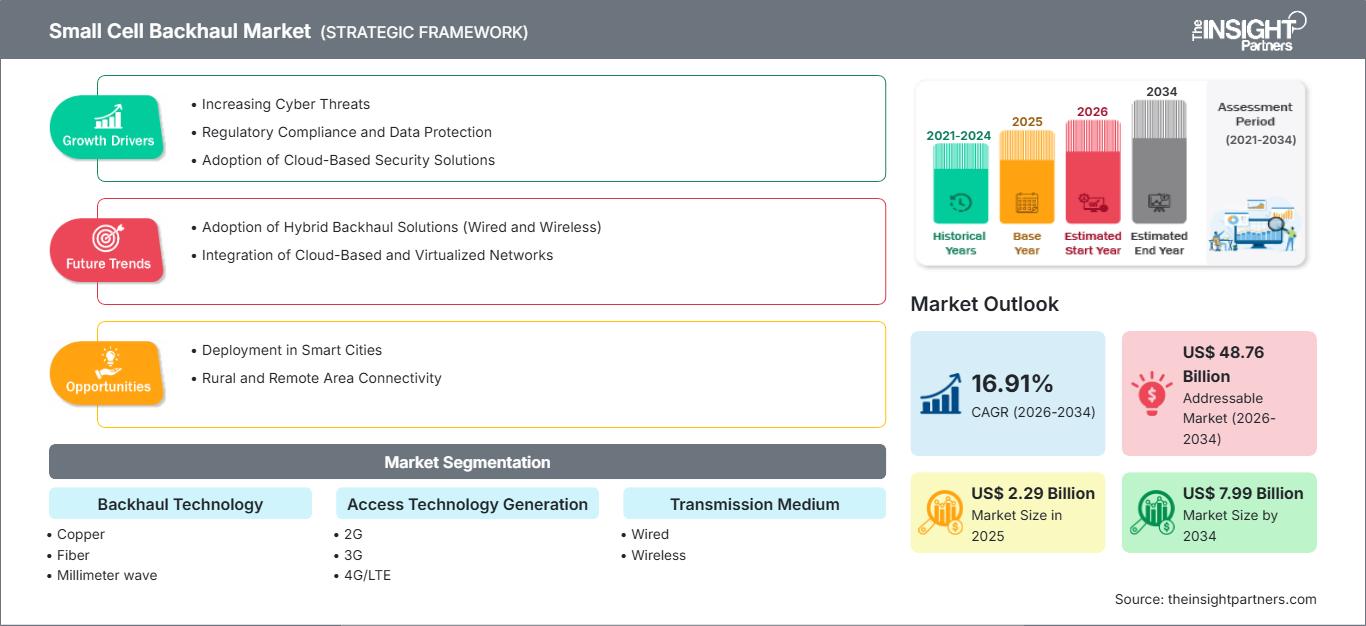
The Small Cell Backhaul market was valued at US$ 2.29 billion in 2025 and is expected to reach US$ 7.99 billion by 2034; it is estimated to record a CAGR of 14.9% during 2026-2034.
Small Cell Backhaul Market Assessment and Insights
- North America held 32–35% Small Cell Backhaul Market share in 2025 and is growing at a CAGR range of 15.8–17.2% during 2026–2034, supported by 5G densification, venue connectivity, and fiber-plus-wireless transport planning.
- US accounted for 78–82% of North America in 2025 and is growing at a CAGR range of 15.9–17.3% during 2026–2034, led by operator capex and enterprise coverage needs.
- Europe represented 24–27% share in 2025 and is growing at a CAGR range of 14.6–16.0% during 2026–2034, with Germany, the UK, France, Italy, and Spain leading deployments.
- Asia Pacific captured 27–30% share in 2025 and is growing at a CAGR range of 18.0–19.6% during 2026–2034, driven by China, Japan, South Korea, India, and Australia.
- Largest Segment Fiber held 38–42% market share in 2025, growing at a CAGR range of 15.2–16.6% during 2026–2034 as operators prioritized capacity and reliability.
- High Growth Segment Millimeter wave held 14–17% market share in 2025, growing at a CAGR range of 19.4–21.0% during 2026–2034 due to short-hop gigabit backhaul demand.
- Key companies analyzed in detail: Airspan Networks Holdings Inc.; Ceragon Networks Ltd.; CommScope Holding Company, Inc.; Telefonaktiebolaget LM Ericsson; Huawei Technologies Co., Ltd.; Nokia Corporation; NEC Corporation; Siklu Communication Ltd.; Samsung Electronics Co., Ltd.; ZTE Corporation.
Source: The Insight Partners' analysis based on proprietary research, government publications, company annual reports, investor presentations, industry databases, and expert interviews.
There has been a change in network architecture from one that is driven by macro-coverage expansion to one that features dense and layered radio access design, which calls for flexible backhaul economics. Fiber continues to be preferred for use in locations with ducts and rights-of-way, but microwave, millimeter wave, and sub-6GHz are preferred where deployment is needed in locations with urban street furniture and campus environments. There is an evolving trend towards the manufacture of equipment with software-driven backhaul.
The progress is going to be faster in urban areas, where small cell zoning, spectrum re-use, and neutral host approaches will help make it easier to implement. The emerging geography is looking at adopting wireless backhaul to address issues that may result from a lack of fiber, while the mature geography is seeking a secondary path to provide redundancy.
Small Cell Backhaul Market Report Scope
| Report Attribute | Details |
|---|---|
| Market size in 2025 | US$ 2.29 Billion |
| Market Size by 2034 | US$ 7.99 Billion |
| Global CAGR (2026 - 2034) | 14.9% |
| Historical Data | 2021-2024 |
| Forecast period | 2026-2034 |
Small Cell Backhaul Market Analysis
Drivers for Small Cell Backhaul Market include increase in mobile video usage, indoor coverage requirements in enterprise spaces, and the need to bring capacity nearer to end users. The demand is high where macro networks are not able to provide consistent throughput at economical cost, which includes transport facilities, stadiums, hospitals, industries, and commercial spaces.
The value chain consists of radio companies, microwave providers, fiber providers, towers providers, system integrators, municipalities, and cloud edge companies. The drivers for supply side include spectrum, site access, power, chipset efficiency, and traffic management software.
The Small Cells Backhaul Market reveals competition dominated by transport specialists and end-to-end telecom network providers. Competition between Ericsson, Nokia, Huawei Technologies, Samsung Electronics, and ZTE is based on their comprehensive radio access and transport solutions portfolios, while Ceragon Networks, Siklu Communication, Airspan Networks, CommScope, and NEC have focus on microwave, mmWave and deployment flexibility.
The focus of investments shifts from single-technology backhaul solutions towards multi-technology backhaul solutions that use fiber if possible and wireless if civil works are difficult. Positioning in this market becomes more and more dependent on channel capabilities, open interfaces, automation, small size, and capacity to serve carrier, enterprise, and neutral-host purchase models.
● REPORT CUSTOMIZATION
Tailor This Report To Align With Your Specific Business Requirements
This report can be customized to align precisely with your business objectives, scope, and target markets. Customization options include tailored segmentation, geography, competitive analysis, and strategic insights to support informed decision-making.
Customize This Report →WHAT YOU CAN ADJUST
- ● Segmentations
- ● Geography
- ● Competitive Analysis
- ● Language Preferences
Small Cell Backhaul Market: Strategic Insights
Regional Insights
North America Small Cell Backhaul Market
North America contributed 32–35% of 2025 revenue and is forecast to grow at a CAGR of 15.8-17.2% from 2025 to 2034. Drivers include densification of 5G infrastructure, private wireless initiatives, traffic between clouds and edges, and the need for robust transport in crowded cities.
Operators are employing a mix of fiber, microwave, and millimeter wave technologies to mitigate issues with permits and facilitate easy installation. Small Cell Backhaul Market in North America is driven by high levels of enterprise digitization, improvements to venues and connectivity, and broadband spending from government agencies.
U.S. Small Cell Backhaul Market
The United States accounted for 78-82% of North America in 2025, and the growth of the region is expected to be at a CAGR of 15.9-17.3% during 2026-2034. Large mobile operators, fiber players, tower companies, and municipal alliances are influencing the deployments in downtown areas, campuses, and transport corridors.
Trends in the applications are enterprise private networks, indoor venues coverage, FWA (Fixed Wireless Access), and public safety connections. Vendors with local sales and integration capabilities have an advantage, as customers demand low-latency, easy installation, and hybrid network solutions.
Europe Small Cell Backhaul Market
Europe has a share of 24-27% in 2025, and is projected to see a CAGR of 14.6-16.0%. Germany takes leadership due to strong activities of industrial private networks, and rapid urban modernizations, whereas the UK has its strengths through neutral-host solutions, transport connectivity enhancements, and investments into enterprise indoor networks.
France, Italy, and Spain are making progress through venues, smart cities, and transport deployments, yet permitting challenges and multiple infrastructure owners may delay deployments. Wireless backhaul deployments are being evaluated by operators when fiber economics become unfavorable, especially in old city centers and temporary high-capacity zones.
APAC Small Cell Backhaul Market
APAC accounted for 27–30% in 2025, with CAGR of 18.0-19.6%, the highest rate among regions. In APAC, China takes the lead due to intensive 5G deployment, and other countries, such as Japan, South Korea, India, and Australia contribute to the growth via spectrum upgrades, automation, and smart infrastructure.
Industrial zones, logistics routes, ports, and smart city initiatives are increasing the need for short-haul connectivity. Government policies promoting digital infrastructure and mobile broadband provide a good market environment for both fiber-based urban areas and wireless-based expansion of large urban areas.
Middle East & Africa Small Cell Backhaul Market
The Middle East and Africa region is expected to have a compound annual growth rate of 16.2% to 17.8%. It is expected that Saudi Arabia will lead in the implementation of technology in this region. There is the use of connectivity solutions in the UAE, enterprise and venue services in South Africa, and wireless backhaul in other regions of MEA.
There will be a need for reliable low-latency transport due to energy needs, hospitality services, logistics, and national infrastructure projects. This is because of harsh environments, dispersed locations, and lack of fiber optics network.
Segmentation Analysis
Backhaul Technology
Backhaul Technology is expected to grow at a CAGR range of 16.3–17.7% during 2026–2034. The Small Cell Backhaul Market scope across technologies is broad because operators select links according to capacity, distance, line-of-sight, site access, and cost. Fiber anchors high-capacity nodes, while microwave, millimeter wave, sub-6 GHz, copper, and satellite extend reach where civil works or geography limit deployment.
- Copper remains relevant in legacy indoor and short-distance deployments where existing wiring lowers installation cost, although capacity constraints limit its role in advanced densification programs.
- Fiber is the largest technology segment, valued for high throughput, reliability, and future-proof capacity in urban clusters, enterprise campuses, and high-traffic transport nodes.
- Millimeter wave is gaining importance for short-hop, high-capacity links where fiber is delayed or uneconomic, especially in dense street-level and rooftop deployments.
- Microwave continues to support fast rollout across urban fringe, suburban, and rural sites by offering reliable non-fiber transport with mature equipment ecosystems.
- Sub-6 GHz supports non-line-of-sight and broader coverage scenarios, making it useful for challenging terrain, obstructed city streets, and selective enterprise networks.
- Satellite serves remote, emergency, and hard-to-fiber locations, providing resilience and reach where terrestrial backhaul options are unavailable or economically unattractive.
Access Technology Generation
Access Technology Generation is projected to grow at a CAGR range of 15.7–17.1% during 2026–2034. Although 5G influences network planning, the input scope centers on 2G, 3G, and 4G/LTE, where backhaul modernization remains essential for coverage continuity, enterprise migration, voice services, and LTE densification in regions with phased spectrum transitions.
- 2G backhaul demand is concentrated in coverage-preservation markets, machine communications, and transitional networks where operators maintain basic connectivity while reallocating capital toward higher-capacity layers.
- 3G continues to decline structurally, yet selective backhaul support remains necessary in markets managing staged shutdowns, roaming continuity, and service migration for installed subscriber bases.
- 4G/LTE remains strategically important because LTE carries substantial mobile broadband traffic and often acts as the anchor layer for small-cell densification and enterprise indoor coverage.
Transmission Medium
Transmission Medium is expected to grow at a CAGR range of 16.0–17.4% during 2026–2034. Medium choice increasingly depends on deployment lead time, capacity headroom, rights-of-way, and resilience planning. Wired links dominate high-capacity nodes, while wireless options accelerate rollout in constrained city streets, private campuses, temporary venues, and remote infrastructure environments.
- Wired transmission supports predictable performance, low latency, and long asset life, making it preferred for major urban nodes, enterprise campuses, and traffic-intensive public venues.
- Wireless transmission addresses speed-to-market and site-access constraints, giving operators flexible backhaul options for dense streets, industrial zones, disaster recovery, and fiber-constrained coverage expansion.
Opportunity Snapshot
| Backhaul Technology | Revenue Contribution | Trend Tag | Adoption Stage |
| Copper | Low | Legacy Reuse | Mature |
| Fiber | High | Gigabit Core | Mature |
| Millimeter wave | High | Street Links | Scaling |
| Microwave | Medium | Rapid Sites | Scaling |
| Sub-6 GHz | Medium | NLOS Reach | Scaling |
| Satellite | Low | Remote Resilience | Emerging |
Small Cell Backhaul Market Growth Drivers and Impact Analysis
Urban Densification Requires Flexible Transport
Mobile traffic patterns are becoming so dense that network operators need to bring radio resources closer to the users, especially in business centers, train stations, sports arenas, and mixed-use facilities. Every deployment of small cells generates an issue of transport which needs to strike a balance between speed, capacity, economics, and accessibility. Practically, it means an increased variety of solutions in procurement, where fiber will be deployed for anchoring sites while wireless backhaul will be used when digging trenches becomes too slow or too costly.
Private Networks Increase Indoor Backhaul Demand
Manufacturers, hospitals, logistics providers, universities, and large corporations are increasingly implementing their own private wireless networks to enhance automation and control, and to provide connectivity and visibility for workers. This is a setting where predictability of coverage in complex buildings where the macro network provides inadequate coverage is critical. The backhaul becomes the key factor in determining performance as the success of applications is determined by how reliably the connection between the access nodes, edge nodes, and the carrier or corporate core is maintained.
Fiber Constraints Strengthen Wireless Alternatives
Fiber is attractive for capacity, but city permits, construction timelines, duct congestion, and high civil costs often delay small-cell activation. Wireless backhaul fills this gap by enabling faster service introduction, especially where short-hop line-of-sight is available or where temporary capacity is needed for events and seasonal traffic. Microwave, millimeter wave, and sub-6 GHz options also provide route diversity for resilience. This driver changes purchasing behavior by making operators evaluate hybrid architectures rather than fiber-only plans, improving addressable demand for specialized radio transport suppliers.
Small Cell Backhaul Market Future Trends
Automation-Led Backhaul Optimization
Small Cell Backhaul Market trends point toward automated transport orchestration that adjusts routing, capacity allocation, and fault response with less manual intervention. As small-cell counts rise, manual planning cannot keep pace with traffic shifts, weather impacts on wireless links, or localized congestion. Future systems will use telemetry, predictive maintenance, and policy-based controls to improve service continuity. This trend will favor suppliers that integrate radios, network management, and analytics into operationally simple platforms for carriers, neutral hosts, and enterprise network managers.
Higher-Frequency Wireless Backhaul Planning
Higher-frequency wireless links are expected to become more important as operators require fiber-like capacity for short urban hops. E-band is already part of commercial planning, while W-band and D-band development could extend capacity options for future network layers. Adoption will depend on spectrum policy, propagation performance, equipment cost, and installation skill. The result will be more segmented backhaul design, where frequency bands are matched to distance, capacity, resilience, and deployment economics rather than treated as interchangeable alternatives.
Small Cell Backhaul Market Opportunities
Neutral-Host Backhaul Partnerships
Neutral-host models create an opportunity to improve utilization by sharing small-cell infrastructure across multiple operators, venue owners, and public agencies. Backhaul providers can participate through managed transport, shared fiber access, wireless link design, and service-level monitoring. Small Cell Backhaul Market Forecasts indicate that shared infrastructure can reduce duplicate civil works and accelerate indoor and outdoor coverage programs. The opportunity is especially attractive in airports, stadiums, rail systems, commercial towers, and city districts where multiple networks require consistent performance but individual deployments face cost and permitting barriers.
Enterprise Edge and Industrial Connectivity
Enterprise edge adoption creates a revenue opportunity for suppliers that can connect small cells, local compute, sensors, and cloud platforms with predictable latency. Industrial sites need reliable links for robotics, video analytics, asset tracking, and worker safety, but many facilities have complex layouts and limited telecom infrastructure. Vendors can differentiate through pre-engineered backhaul kits, service assurance software, and integration partnerships. This opportunity supports recurring services because enterprises often require lifecycle support, performance monitoring, upgrades, and resilience planning beyond the initial equipment sale.
Recent Developments
- July 2026: Amazon Leo announced it has partnered with South African fixed ISP Herotel to launch a new service called “evry”, powered by Amazon’s LEO satellite network. The Herotel agreement marks Amazon Leo’s first such deal in Africa in terms of providing internet connectivity to end users via a local partner. Amazon Leo’s other Africa-based agreements so far have focused on cellular backhaul.
- May 2026: MaxLinear, Inc. announced availability of the Trinity platform, based on the URX processor family, delivering carrier-grade, bidirectional wireless backhaul speeds of up to 10Gbps. Trinity combines the URX850 SoC with a purpose-built cloud-native API framework that seamlessly integrates with MaxLinear’s millimeter and microwave modems.
- June 2025: Keysight Technologies, Inc. in collaboration with NTT Corporation and NTT Innovative Devices Corporation (NTT Innovative Devices), announced a groundbreaking world record in data rate achieved using sub-THz frequencies. This milestone was reached with Keysight's Vector Component Analyzer (VCA) in conjunction with NTT’s and NTT Innovative Devices' high-output, wide-bandwidth J-band Indium Phosphide (InP)-based power amplifier (PA). In addition, advanced digital predistortion techniques were employed to mitigate amplifier non-linearities, ensuring robust, high-fidelity signal generation.
Frequently Asked Questions

- Comprehensive Market Sizing and Forecast Analysis
- Detailed Segmentation Analysis
- In-Depth Market Dynamics Assessment
- Regional and Country-Level Insights
- Competitive Landscape and Company Benchmarking
- Strategic Business Intelligence
Recent Reports
Testimonials

The Insight Partners provided valuable market intelligence that supported our global go-to-market strategy. Their team was professional, responsive, and attentive to our feedback, providing thoughtful analysis and helpful methodological clarifications throughout the project.
Junmo Kim Chief Financial Officer (CFO), Enertech Co., Ltd.
The Insight Partners' SCADA System Market report is comprehensive, with valuable insights on current trends and future forecasts. The team was highly professional, responsive, and supportive throughout. We are very satisfied and highly recommend their services.
RAN KEDEM Partner, Reali Technologies LTDs
I requested a report on a very specific software market and the team produced the report in a few days. The information was very relevant and well presented. I then requested some changes and additions to the report. The team was again very responsive and I got the final report in less than a week.
JEAN-HERVE JENN Chairman, Future Analytica
We worked with The Insight Partners for an important market study and forecast. They gave us clear insights into opportunities and risks, which helped shape our plans. Their research was easy to use and based on solid data. It helped us make smart, confident decisions. We highly recommend them.
PIYUSH NAGPAL Sr. Vice President, High Beam Global
The Insight Partners delivered insightful, well-structured market research with strong domain expertise. Their team was professional and responsive throughout. The user-friendly website made accessing industry reports seamless. We highly recommend them for reliable, high-quality research services
YUKIHIKO ADACHI CEO, Deep Blue, LLC.
This is the first time I have purchased a market report from The Insight Partners.While I was unsure at first, I visited their web site and felt more comfortable to take the risk and purchase a market report.I am completely satisfied with the quality of the report and customer service. I had several questions and comments with the initial report, but after a couple of dialogs over email with their analyst I believe I have a report that I can use as input to our strategic planning process.Thank you so much for taking the extra time and making this a positive experience.I will definitely recommend your service to others and you will be my first call when we need further market data.
JOHN SUZUKI President and Chief Executive Officer, Board Director, BK Technologies
I wish to appreciate your support and the professionalism you displayed in the course of attending to my request for information regarding to infectious disease IVD market in Nigeria. I appreciate your patience, your guidance, and the fact that you were willing to offer a discount, which eventually made it possible for us to close a deal. I look forward to engaging The Insight Partners in the future, all thanks to the impression you have created in me as a result of this first encounter.
DR CHIJIOKE ONYIA MANAGING DIRECTOR, PineCrest Healthcare Ltd.Reason to Buy
- Informed Decision-Making
- Understanding Market Dynamics
- Competitive Analysis
- Identifying Emerging Markets
- Customer Insights
- Market Forecasts
- Risk Mitigation
- Boosting Operational Efficiency
- Strategic Planning
- Investment Justification
- Tracking Industry Innovations
- Aligning with Regulatory Trends





 Get Free Sample for