
Small Cell Power Amplifier Market Trends, Demand & Growth by 2034
Coverage: By Type (5dB, 32 dB, 36dB, 39dB); Application (Wideband Instrumentation, Data-cards with Terminals, Small Cell Base Stations, Power Amplifier Driver, Customer Premises Equipment) , and Geography (North America, Europe, Asia Pacific, and South and Central America)
- Status : Data Released
- Report Code : TIPRE00004353
- Category : Electronics and Semiconductor
- No. of Pages : 150
- Available Report Formats :


- Last update date : July 28, 2026


2025 Market Size
US$ 3.32 Bn
Base year value
2034 Forecast
US$ 13.99 Bn
Projected by 2034
CAGR 2026-2034
17.32 %
Growth rate
Addressable Market
US$ 72.20 Bn
(2026-2034)
The Small Cell Power Amplifier Market size stood at US$ 3.32 Billion in 2025 and is projected to reach US$ 13.99 Billion by 2034, with a compound annual growth rate of 17.32% from 2026-2034. Some of the factors affecting demand include densification of radio access networks, the need for 5G indoor coverage, and increasing adoption of small form factor amplifiers in small cells, customer premises equipment, power amplifier drivers, wideband test instruments, and terminal-equipped data cards.
North America continues to act as a pioneering region, where operators are investing in deployments based on their enterprises private networks, fixed wireless access, and densification efforts. The Small Cell Power Amplifier Market in the region is predicted to grow at a 15.8-17.2% CAGR over 2026-2034, driven by 166,264 U.S. small cells installed at the end of 2024 and growing 5G traffic as indicated by industry bodies.
Small Cell Power Amplifier Market Assessment and Insights
- North America held 34–36% share in 2025 and is growing at a CAGR of 15.8–17.2% during 2026–2034, led by carrier densification, private 5G campuses, and high mobile data usage.
- US represented 78–82% of North America in 2025 and is expanding at a CAGR of 15.6–16.9% during 2026–2034, supported by enterprise small cells.
- Europe accounted for 21–23% share in 2025 and is growing at a CAGR of 14.6–16.0% during 2026–2034, with Germany, the UK, France, Italy, and Spain leading adoption.
- Asia Pacific captured 29–31% share in 2025 and is advancing at a CAGR of 18.8–20.4% during 2026–2034, driven by China, Japan, South Korea, India, and Australia.
- Largest Segment Small Cell Base Stations held 44–48% market share in 2025, with a CAGR of 17.0–18.4% during 2026–2034 as dense 5G radio access expands.
- High Growth Segment Customer Premises Equipment held 13–16% market share in 2025, with a CAGR of 18.6–20.2% during 2026–2034 due to fixed wireless access demand.
- Key companies analyzed in detail: IBS Electronics Inc., CommScope Holding Company, Inc., NXP Semiconductors N.V., RFHIC Corporation, TEKTELIC Communications Inc., Skyworks Solutions, Inc., Texas Instruments Incorporated, Tessco Technologies Incorporated, ZTE Corporation, and Qorvo, Inc.
Source: The Insight Partners' analysis based on proprietary research, government publications, company annual reports, investor presentations, industry databases, and expert interviews.
Network architecture has evolved from macro coverage only to multilayered radio access networks where power consumption, heat dissipation, and linearity drive overall cost of ownership. The Small Cell Power Amplifier Market has been gaining from gallium nitride, LDMOS improvement, and RF front-end integration. Manufacturing emphasis has been shifting towards smaller size, low heat generation, and scalable production of small cell power amplifiers for outdoor, indoor, enterprise, and fixed wireless access applications.
Future opportunities will arise from regions where spectrum refarming, neutral-host approach, and enterprise automation need more densified network coverage. Countries like India, Southeast Asia, the Gulf, and Eastern Europe would see additional investments in future as telcos roll out 5G in mid-band spectrum. Favorable policies on shared spectrum usage, smart factories, and broadband access will support the procurement of small cell power amplifiers through the forecast period.
Small Cell Power Amplifier Market Report Scope
| Report Attribute | Details |
|---|---|
| Market size in 2025 | US$ 3.32 Billion |
| Market Size by 2034 | US$ 13.99 Billion |
| Global CAGR (2026 - 2034) | 17.32% |
| Historical Data | 2021-2024 |
| Forecast period | 2026-2034 |
Small Cell Power Amplifier Market Analysis
Demand will be supported by increased data traffic on mobiles, fixed wireless access, and requirements for enterprise coverage. There will be a very close relationship between demand for the Small Cell Power Amplifier Market and the introduction of capacity in places where macro cell towers will not be able to support indoors, stadiums, campuses, and dense urban areas.
Some of the components within the supply chain include compound semiconductor wafers, RF design firms, module assembly, telecom equipment makers, distributors, and network operators. The supply dynamics are such that suppliers will be favored who can offer efficiency, linearity, and thermal characteristics that span multiple bands. Inventory management is becoming more application specific because of the differing needs of wideband instrumentation, data cards with terminals, and base station amplifiers.
The competitive environment is moderately fragmented, with RF solutions providers and wide semiconductor firms having differentiated portfolios. According to Small Cell Power Amplifier Market, Qorvo, Inc., Skyworks Solutions, Inc., NXP Semiconductors N.V., Texas Instruments Incorporated, and RFHIC Corporation compete through the use of efficiency, bands supported, and integrated solutions, whereas CommScope Holding Company, Inc., ZTE Corporation, TEKTELIC Communications Inc., Tessco Technologies Incorporated, and IBS Electronics Inc. have an impact on the deployment route.
The investment trend seems to be moving towards increased investments into research & development activities of GaN, envelope tracking, digital predistortion compatibility, and modular RF front end technologies. Strategic positioning requires increasing focus on securing winning designs from radio access equipment vendors and distributors supplying equipment for private network deployments.
● REPORT CUSTOMIZATION
Tailor This Report To Align With Your Specific Business Requirements
This report can be customized to align precisely with your business objectives, scope, and target markets. Customization options include tailored segmentation, geography, competitive analysis, and strategic insights to support informed decision-making.
Customize This Report →WHAT YOU CAN ADJUST
- ● Segmentations
- ● Geography
- ● Competitive Analysis
- ● Language Preferences
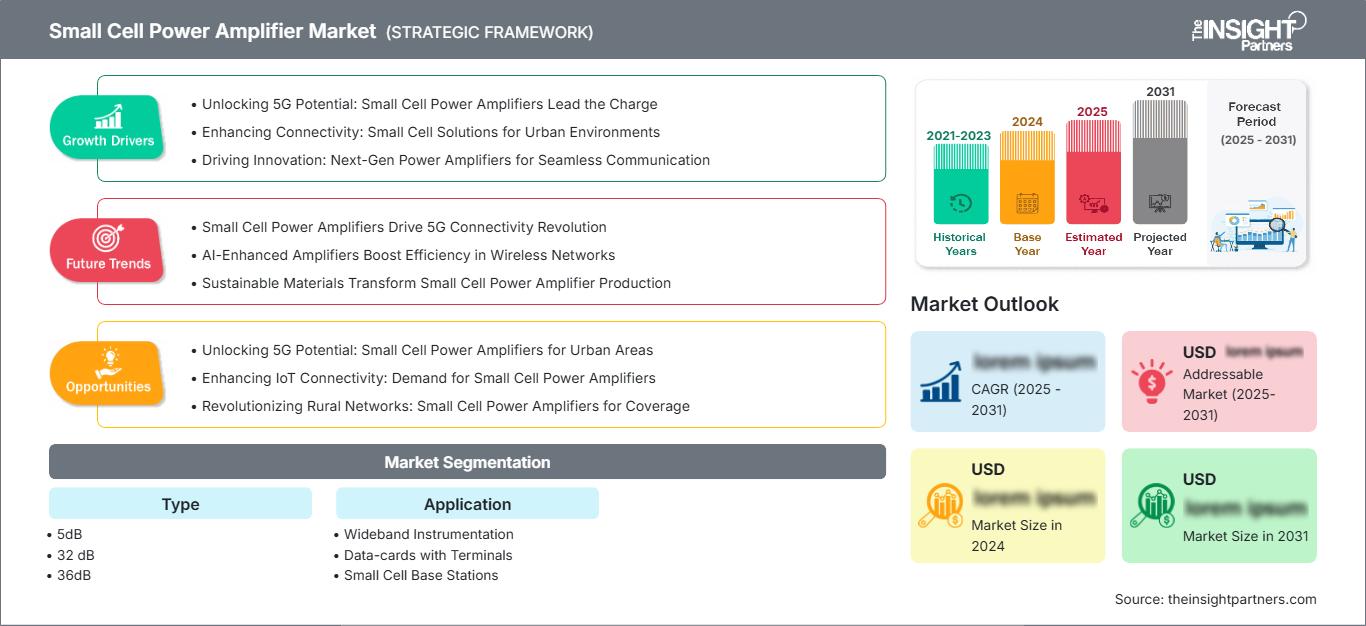
Small Cell Power Amplifier Market: Strategic Insights
Regional Insights
North America Small Cell Power Amplifier Market
North America held 34–36% share in 2025 and is forecast to grow at a CAGR of 15.8–17.2% during 2026–2034. The Small Cell Power Amplifier Market share is supported by dense mobile broadband usage, private 5G pilots, and small cell installations across transport hubs, campuses, stadiums, hospitals, and enterprise buildings.
Carrier capital allocation is more disciplined than the initial 5G buildout, yet densification remains necessary because traffic growth is moving indoors and toward uplink-intensive applications. Suppliers with U.S. distribution, thermal design support, and compatibility with mid-band radios should remain favored as operators and enterprises expand neutral-host and fixed wireless access networks.
U.S. Small Cell Power Amplifier Market
The U.S. represented 78–82% of North America in 2025 and is expected to grow at a CAGR of 15.6–16.9% during 2026–2034. CTIA reported 166,264 small cells in service at year-end 2024, creating a strong installed base for amplifier upgrades, replacements, and band-specific expansion.
Application trends are strongest in small cell base stations, fixed wireless access customer premises equipment, and power amplifier drivers used by equipment manufacturers. Qorvo, Inc., Skyworks Solutions, Inc., Texas Instruments Incorporated, CommScope Holding Company, Inc., Tessco Technologies Incorporated, and IBS Electronics Inc. provide product, channel, or integration presence that supports domestic procurement.
Europe Small Cell Power Amplifier Market
Europe was contributing with a market share between 21–23% in 2025 and is estimated to grow at a CAGR of 14.6–16.0% between 2026 and 2034. Germany is expected to have the largest market in this region because of the needs in industrial 5G campuses, automotive plants, and private spectrum, which need reliable indoor coverage and low latency connectivity.
The United Kingdom follows because of neutral-host venue network and enterprise digitization. France, Italy, and Spain have the potential to contribute due to transport modernization, smart manufacturing, and urban connectivity, but the rollout depends on the cycle of investments of each operator. Procurement in Europe focuses on energy efficiency, interoperability, and radio equipment regulations.
APAC Small Cell Power Amplifier Market
APAC had 29-31% market share in 2025 and is expected to have a CAGR of 18.8-20.4% in 2026-2034. APAC was led by China, followed by Japan, South Korea, India, and Australia due to growing 5G densification in cities, factories, ports, and transportation corridors.
Government policies and network upgrades from operators have bolstered amplifier sales. Growing Indian data consumption, Japanese 5G private networks, and South Korean advanced manufacturing will help in high-frequency purchases. Regional companies also gain from local electronics manufacturing facilities and fast RF component qualification times.
Middle East & Africa Small Cell Power Amplifier Market
Middle East & Africa is expected to grow at a CAGR of 16.4–18.0% during 2026–2034. Saudi Arabia is the leading country, supported by smart city, energy, and venue connectivity programs, while the UAE uses indoor 5G and enterprise networks to support logistics, tourism, and financial districts.
South Africa and the Rest of MEA remain selective but increasingly important as operators improve urban capacity and fixed broadband alternatives. Energy sites, ports, airports, and large commercial properties create demand for rugged small cell hardware, where amplifier reliability, thermal resilience, and service availability influence procurement decisions.
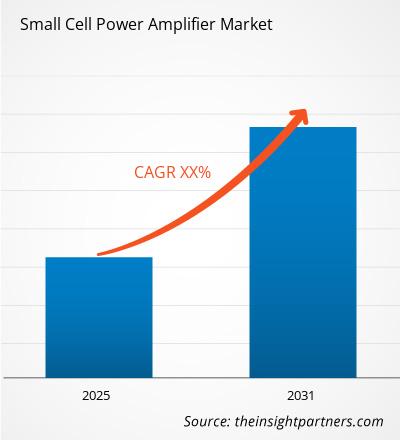
Segmentation Analysis
Type
Type is expected to grow at a CAGR of 16.8–18.2% during 2026–2034. The Small Cell Power Amplifier Market scope across gain categories reflects network design requirements rather than one-size-fits-all adoption. Lower gain supports compact equipment, while higher gain types address stronger transmission needs in dense small cell base stations and driver applications.
- 5dB products serve compact and low-power designs where space, thermal management, and efficiency matter more than maximum output, supporting specialized terminals and embedded communication hardware.
- 32 dB amplifiers balance gain, efficiency, and design flexibility, making them suitable for mid-range small cell systems, driver stages, and equipment requiring predictable RF performance.
- 36dB devices occupy a strong market position in base station-oriented designs because they support reliable signal amplification, broader coverage, and stable performance in dense networks.
- 39dB amplifiers address higher-output use cases where link budget, coverage consistency, and network quality are critical, especially in outdoor or infrastructure-heavy deployments.
Application
Application is forecast to grow at a CAGR of 17.4–18.8% during 2026–2034. Small Cell Power Amplifier Market demand is strongest where compact transmit chains improve coverage economics. Base stations dominate near-term procurement, while customer premises equipment and power amplifier drivers gain relevance as fixed wireless access and enterprise connectivity scale.
- Wideband Instrumentation requires stable frequency response, measurement accuracy, and repeatable gain, making amplifiers important for testing, validation, and RF development environments.
- Data-cards with Terminals use compact amplifiers to improve transmission quality in mobile broadband devices, industrial terminals, and portable connectivity equipment operating across multiple bands.
- Small Cell Base Stations represent the largest application, as operators need efficient amplification for dense 5G, indoor coverage, transport hubs, and enterprise radio access networks.
- Power Amplifier Driver applications support signal chain conditioning before final amplification, improving linearity, system efficiency, and performance consistency in compact RF modules.
- Customer Premises Equipment is becoming strategically important as fixed wireless access expands, requiring efficient amplification inside residential, enterprise, and industrial broadband access hardware.
Opportunity Snapshot
| Application | Revenue Contribution | Trend Tag | Adoption Stage |
| Wideband Instrumentation | Medium | RF Testing | Scaling |
| Data-cards with Terminals | Low | Portable Broadband | Emerging |
| Small Cell Base Stations | High | Network Densification | Mature |
| Power Amplifier Driver | Medium | Signal Linearity | Scaling |
| Customer Premises Equipment | Medium | 5G FWA | Scaling |
Small Cell Power Amplifier Market Growth Drivers and Impact Analysis
5G densification is reshaping amplifier procurement
The shift is now underway from a coverage-focused deployment model for 5G technology towards a densification approach that is driven by capacity. This trend means more amplifier requirements per square kilometer for business centers, public transport systems, stadia, hospitals, and campus networks. For small cell networks, amplifiers are required that can remain linear while restricting the amount of power and heat produced within small form factors. The market effect for this driver is that orders will be made repeatedly rather than occasionally when upgrading macro networks.
Fixed wireless access expands CPE amplifier demand
Fixed wireless access is emerging as a viable broadband alternative in underserved suburban, rural, and urban environments, thereby creating a need for effective amplifiers within CPE. This is commercially relevant as CPE shipment volumes have the ability to outpace external infrastructure build-out when 5G broadband services are offered as part of home and business offerings. Amplifier manufacturers stand to gain if the amplifier design incorporates good uplink capability, low power requirements, and robustness under varying signal conditions. This particular driver also expands the market opportunity from RAN vendors to broadband device manufacturers.
Enterprise private networks require reliable indoor RF chains
Factories, logistics centers, ports, mines, and energy facilities are adopting private 5G to support automation, video analytics, connected workers, and low-latency control systems. These environments require small cells that perform reliably despite interference, metal structures, and challenging thermal conditions. Power amplifiers become a quality gate because unstable RF output can reduce coverage consistency and increase maintenance costs. The market impact is higher demand for rugged, application-specific amplifier designs that pass longer qualification cycles. Suppliers with field support, reference designs, and documented reliability can gain preferred status in industrial deployments.
Small Cell Power Amplifier Market Future Trends
Software-defined RF tuning will influence hardware selection
Small Cell Power Amplifier Market trends point toward amplifiers that can operate within software-managed radio systems where calibration, power control, and interference mitigation are increasingly automated. Future small cells will need RF chains that support adaptive tuning across changing traffic loads and spectrum conditions. This favors amplifier designs compatible with digital predistortion, envelope tracking, and remote diagnostics. The strategic implication is a shift from component-level procurement to platform-level validation, where semiconductor vendors must prove that their devices improve uptime, reduce energy waste, and simplify multi-band deployment.
Thermal-efficient GaN adoption will broaden beyond macro radios
GaN-based amplification is expected to move deeper into compact infrastructure as cost curves improve and operators prioritize energy performance. While LDMOS and silicon-based solutions will remain relevant, GaN offers advantages in power density, efficiency, and thermal handling for demanding small cell environments. The future opportunity lies in adapting GaN packaging and reference designs for lower-power, high-volume deployments. Vendors that reduce complexity for equipment manufacturers can capture design wins as networks require smaller, cooler, and more reliable radios across enterprise and outdoor settings.
Small Cell Power Amplifier Market Opportunities
Design wins in fixed wireless access equipment
Small Cell Power Amplifier Market Forecasts indicate a strong opportunity in customer premises equipment as operators monetize 5G broadband without waiting for fiber extension. Component suppliers should target modem, router, and outdoor unit manufacturers with reference designs that reduce time to certification. The opportunity is action-oriented because early design wins can translate into repeat orders across operator service bundles. Vendors can differentiate through low-power operation, stable uplink support, compact packaging, and availability through trusted distributors that serve regional broadband hardware assemblers.
Localized supply support for enterprise private 5G
Private 5G projects often require faster customization, local compliance support, and field troubleshooting than national macro deployments. This creates an opportunity for amplifier suppliers and distributors to package products with engineering assistance, evaluation boards, and validated thermal guidance. Regional availability can become a purchasing advantage when integrators serve factories, campuses, energy facilities, and transport hubs with tight installation schedules. Companies that combine reliable RF performance with localized inventory and technical support can capture share in projects where procurement decisions are influenced by deployment risk rather than unit price alone.
Recent Developments
- October 2025: Skyworks, a global leader in high-performance analog and mixed-signal semiconductors, and Qorvo, a leading global provider of connectivity and power solutions, announced that they have entered into a definitive agreement to combine the two companies in a cash-and-stock transaction that values the combined enterprise at approximately $22 billion2 to create a U.S.-based, global leader in high-performance radio frequency (RF), analog and mixed-signal semiconductors. This merger is expected to drive Small Cell Power Amplifier demand by strengthening RF semiconductor capabilities, expanding product portfolios, and accelerating the development of advanced connectivity solutions for 5G small cell networks, where high-efficiency, high-performance power amplifiers are essential for improved coverage, capacity, and network densification.
- October 2025: Qorvo introduced the QPA9510, a compact RF power amplifier that delivers wideband coverage from 100 to 1000 MHz with industry-leading efficiency. This product launch is expected to drive Small Cell Power Amplifier demand by enabling more efficient, compact, and wideband RF solutions for small cell infrastructure, supporting enhanced 5G coverage, improved network capacity, and cost-effective deployment of next-generation wireless networks.
- January 2026: NXP Semiconductors has announced a strategic shift in its radio frequency (RF) power business, confirming plans to wind down its 5G power amplifier (PA) product line by 2027 and scale back operations at its RF gallium nitride (GaN) manufacturing facility in Chandler, Arizona. This strategic shift by NXP is expected to impact Small Cell Power Amplifier demand by creating opportunities for alternative RF semiconductor suppliers to capture market share, while potentially accelerating industry consolidation and driving demand for high-performance, reliable PA solutions from remaining vendors supporting 5G small cell deployments.
Frequently Asked Questions

- Comprehensive Market Sizing and Forecast Analysis
- Detailed Segmentation Analysis
- In-Depth Market Dynamics Assessment
- Regional and Country-Level Insights
- Competitive Landscape and Company Benchmarking
- Strategic Business Intelligence
Recent Reports
Testimonials

The Insight Partners' SCADA System Market report is comprehensive, with valuable insights on current trends and future forecasts. The team was highly professional, responsive, and supportive throughout. We are very satisfied and highly recommend their services.
RAN KEDEM Partner, Reali Technologies LTDs
I requested a report on a very specific software market and the team produced the report in a few days. The information was very relevant and well presented. I then requested some changes and additions to the report. The team was again very responsive and I got the final report in less than a week.
JEAN-HERVE JENN Chairman, Future Analytica
We worked with The Insight Partners for an important market study and forecast. They gave us clear insights into opportunities and risks, which helped shape our plans. Their research was easy to use and based on solid data. It helped us make smart, confident decisions. We highly recommend them.
PIYUSH NAGPAL Sr. Vice President, High Beam Global
The Insight Partners delivered insightful, well-structured market research with strong domain expertise. Their team was professional and responsive throughout. The user-friendly website made accessing industry reports seamless. We highly recommend them for reliable, high-quality research services
YUKIHIKO ADACHI CEO, Deep Blue, LLC.
This is the first time I have purchased a market report from The Insight Partners.While I was unsure at first, I visited their web site and felt more comfortable to take the risk and purchase a market report.I am completely satisfied with the quality of the report and customer service. I had several questions and comments with the initial report, but after a couple of dialogs over email with their analyst I believe I have a report that I can use as input to our strategic planning process.Thank you so much for taking the extra time and making this a positive experience.I will definitely recommend your service to others and you will be my first call when we need further market data.
JOHN SUZUKI President and Chief Executive Officer, Board Director, BK Technologies
I wish to appreciate your support and the professionalism you displayed in the course of attending to my request for information regarding to infectious disease IVD market in Nigeria. I appreciate your patience, your guidance, and the fact that you were willing to offer a discount, which eventually made it possible for us to close a deal. I look forward to engaging The Insight Partners in the future, all thanks to the impression you have created in me as a result of this first encounter.
DR CHIJIOKE ONYIA MANAGING DIRECTOR, PineCrest Healthcare Ltd.Reason to Buy
- Informed Decision-Making
- Understanding Market Dynamics
- Competitive Analysis
- Identifying Emerging Markets
- Customer Insights
- Market Forecasts
- Risk Mitigation
- Boosting Operational Efficiency
- Strategic Planning
- Investment Justification
- Tracking Industry Innovations
- Aligning with Regulatory Trends





 Get Free Sample for