
Small Signal Transistor Market Size, Trends & Growth by 2034
Coverage: By Type (PNP, NPN); Application (Automotive Application, Industrial Application, Consumer Electronics, Others) , and Geography (North America, Europe, Asia Pacific, and South and Central America)
- Status : Data Released
- Report Code : TIPRE00017009
- Category : Electronics and Semiconductor
- No. of Pages : 150
- Available Report Formats :


- Last update date : July 28, 2026


2025 Market Size
US$ 974.15 Mn
Base year value
2034 Forecast
US$ 1,712.68 Mn
Projected by 2034
CAGR 2026-2034
6.47 %
Growth rate
Addressable Market
US$ 12,152.88 Mn
(2026-2034)
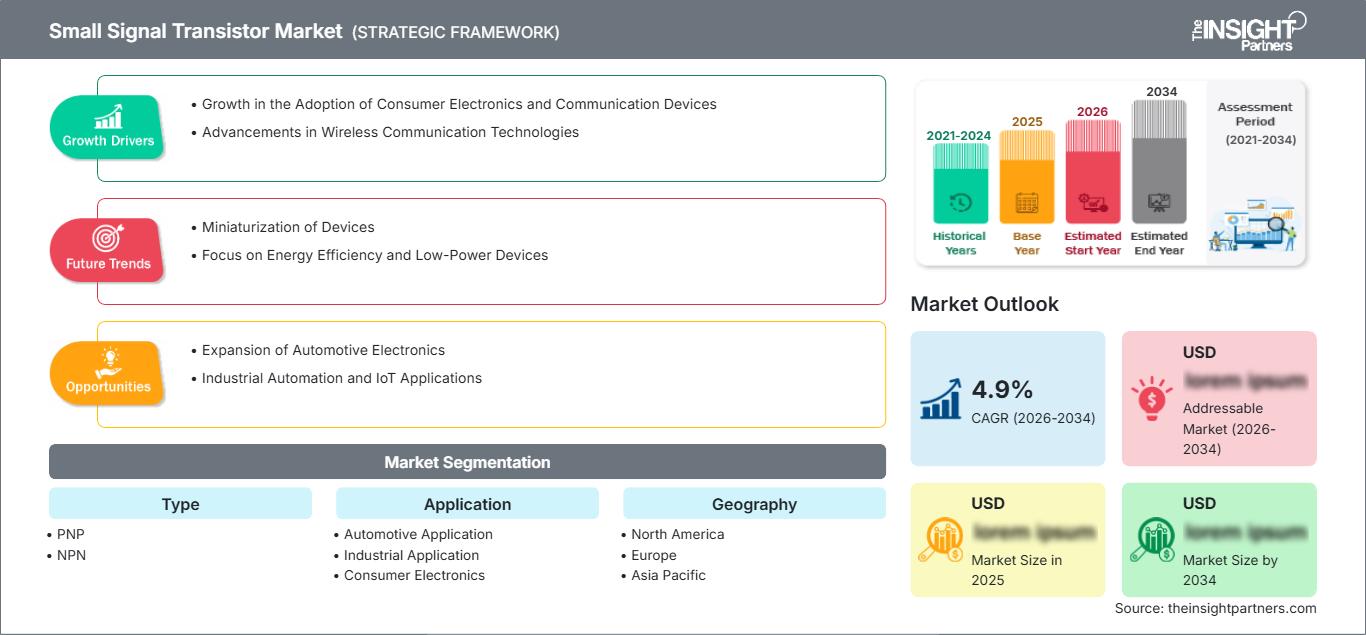
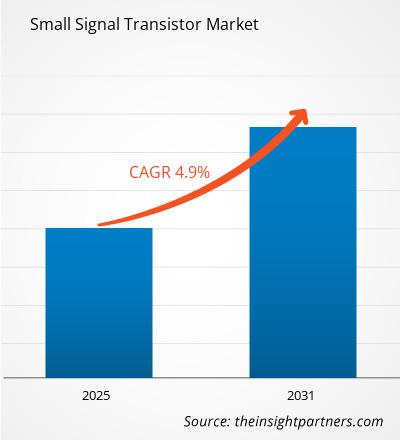
The Small Signal Transistor Market size will be valued at US$ 974.15 million in 2025 and will expand to reach US$ 1,712.68 million in 2034, at a CAGR of 6.47% between 2026 and 2034. Drivers include low current amplification, miniature switches, and signal processing needs in automotive electronics, industrial automation, and consumer electronics. The market is still a component-intensive one, where design wins depend on package size, switching performance, and qualification criteria.
In North America, the market is expected to post a CAGR of 5.8–6.3%, driven by demand from the manufacturing of automotive modules, factory digitalization, and electronics redesign cycles. The market size in North America is driven by replacement of old discrete components, increased sensor content in vehicles, and reliable low noise switching in industrial controls.
Small Signal Transistor Market Assessment and Insights
- North America represented 27–29% share in 2025 and is projected to grow at a CAGR range of 5.8–6.3% during 2026–2034, supported by automotive electronics, industrial controls, and distributor-led availability.
- US accounted for 78–82% of North America in 2025 and is expected to grow at 5.9–6.4% CAGR, led by automotive and defense-grade electronics.
- Europe held 21–23% share in 2025 and is expected to grow at 5.6–6.1% CAGR, with Germany, France, and the UK leading demand from automotive and industrial equipment.
- Asia Pacific captured 38–41% share in 2025 and is projected to grow at 6.9–7.5% CAGR, led by China, Japan, South Korea, and India across electronics manufacturing.
- Largest Segment NPN transistors held 58–62% market share in 2025 and are expected to grow at 6.2–6.8% CAGR due to broad switching and amplification use.
- High Growth Segment Automotive application held 24–27% market share in 2025 and is forecast to grow at 7.1–7.7% CAGR as vehicle electronics density increases.
- Key companies analyzed in detail: Central Semiconductor LLC, Diodes Incorporated, Infineon Technologies AG, NXP Semiconductors N.V., Renesas Electronics Corporation, ROHM Co., Ltd., onsemi, STMicroelectronics N.V., Toshiba Electronic Devices & Storage Corporation, Nexperia B.V.
Source: The Insight Partners' analysis based on proprietary research, government publications, company annual reports, investor presentations, industry databases, and expert interviews.
Technology migration has driven the market away from commodity through-hole components to surface mount and highly miniaturized packaging forms that conserve board real estate without compromising on gain, noise, and switching characteristics. Manufacturing economics are focused on wafer efficiency, multiple sourcing, and automotive qualified manufacturing capabilities as the industry responds to the need for assured availability after recent semiconductor shortages. NPNs are popular due to compatibility with standard low side switching architectures, whereas PNPs still have significance with respect to biasing and polarity.
Going forward, demand growth will be driven by new electronics clusters that provide local manufacturing capabilities for cars, household appliances, metering, and industrial machinery. The push for greater semiconductor resiliency in the US, Europe, India, Japan, and South Korea is helping drive this trend, providing support to the market as discrete components are required despite circuit integration.
Small Signal Transistor Market Report Scope
| Report Attribute | Details |
|---|---|
| Market size in 2025 | US$ 974.15 Million |
| Market Size by 2034 | US$ 1,712.68 Million |
| Global CAGR (2026 - 2034) | 6.47% |
| Historical Data | 2021-2024 |
| Forecast period | 2026-2034 |
Small Signal Transistor Market Analysis
The growth cycle depends on signal density in automotive control circuits, sensors, appliance control circuits, power management boards, and consumer electronics. Small transistors help achieve cost-effective amplification and switching when fully integrated circuits are not required or where it makes sense to use discrete circuits because of increased flexibility in design, easier repairability, or heat dissipation.
This market includes a value chain of silicon wafer production, packaging, testing, cataloging, and application engineering services. Supply trends for this market have been improving with an expansion in the range of package qualifications available from discrete semiconductor manufacturers and a long life cycle product strategy from discrete semiconductor suppliers.
Small Signal Transistor Market Report reveals the market to be competitive due to broadline semiconductor companies competing with discrete semiconductor manufacturers in terms of variety of packaging options, automotive qualification, reliable delivery and long-term support. Nexperia B.V., Diodes Incorporated, ROHM Co., Ltd., and Toshiba Electronic Devices & Storage Corporation prioritize offering deep catalogs, and Infineon Technologies AG and STMicroelectronics N.V. combine discretes with larger automotive or power offerings.
Investments are being made in package miniaturization, AEC-Q101 qualification, test throughput, and regional supply chain resilience. Central Semiconductor LLC serves specialty and legacy products, whereas NXP Semiconductors N.V., Renesas Electronics Corporation, and onsemi capitalize on strong customer relations in automotive space. Strategic positioning is becoming less about introducing new higher-performing products and more about securing long availability for mature products.
● REPORT CUSTOMIZATION
Tailor This Report To Align With Your Specific Business Requirements
This report can be customized to align precisely with your business objectives, scope, and target markets. Customization options include tailored segmentation, geography, competitive analysis, and strategic insights to support informed decision-making.
Customize This Report →WHAT YOU CAN ADJUST
- ● Segmentations
- ● Geography
- ● Competitive Analysis
- ● Language Preferences
Small Signal Transistor Market: Strategic Insights
Regional Insights
North America Small Signal Transistor Market
North America accounted for 27–29% of the Small Signal Transistor Market share in 2025 and is projected to expand at a 5.8–6.3% CAGR during 2026–2034. Demand is supported by automotive electronics, industrial automation, aerospace electronics, and distributor-managed inventories that help customers qualify multiple interchangeable parts for long-life platforms.
Regional purchasing patterns favor suppliers with automotive-grade documentation, stable lead times, and engineering support for redesigns. The market in North America also gains from reshoring initiatives and electronics content in electric vehicles, factory sensors, security systems, and medical devices, where discrete switching remains economical and dependable.
U.S. Small Signal Transistor Market
In 2025, the US accounted for 78–82% of the North American market and is anticipated to grow at a 5.9–6.4% CAGR. Automotive electronics, industrial control applications, defense systems, and communication hardware provide the demand for small transistors in their signal routing, relay drives, sensor processing circuits, and interface protection applications.
The vendor landscape includes Central Semiconductor LLC, Diodes Incorporated, and onsemi, among other global vendors with presence in the US design centers. The application trends include increasing adoption in battery management peripherals, infotainment modules, industrial meters, and low-power systems. The component choice is highly dependent on alternate availability, footprint compatibility, and lifecycle considerations.
Europe Small Signal Transistor Market
The Europe region has accounted for a market share of 21% to 23% in 2025 and is predicted to register a 5.6% to 6.1% CAGR over the forecast period owing to dominance in Germany. The UK has contributed due to instrumentations, aerospace, and specialized electronics where low noise amplification and long product life cycle are key features.
Germany continues to be the dominant country due to the application of automotive electronics, industrial robots, and automation requiring small-sized switching devices in control boards. The other European countries of France, Italy, and Spain contribute to energy systems, rail electronics, consumer appliances, and industrial machines.
APAC Small Signal Transistor Market
APAC held the highest market share of 38% to 41% in 2025 and is anticipated to exhibit a CAGR of 6.9% to 7.5%. In the APAC region, China is driving the demand side; however, Japan, South Korea, India, and Australia provide applications for consumer electronics, vehicles, industrial drives, and infrastructure electronics.
Incentive policies supporting electronics manufacturing and semiconductor packaging boost local supplies. The Small Signal Transistor Market is driven by high density of suppliers, assembly volumes, and design changes. High emphasis on quality and automotive reliability in Japan and South Korea, along with electronics manufacturing programs in India, provide clarity to distributors.
Middle East & Africa Small Signal Transistor Market
The Middle East & Africa region is forecast to expand with a 5.1-5.7% CAGR over 2026-2034. The market is being propelled by Saudi Arabia and the UAE on account of projects in energy infrastructure, smart building, telecoms and industrial monitoring applications, whereas South Africa is driving electronics distribution and maintenance across the region.
Although penetration is lower compared to more established manufacturing geographies, the market benefits from grid automation, solar inverters, metering systems, security electronics, and repair services for equipment. Demand from the rest of the MEA is driven by imported electronics assembly and infrastructure modernization, where discrete transistor replacements are required.
Segmentation Analysis
Type
Type is expected to grow at a 6.1–6.7% CAGR during 2026–2034, reflecting stable demand for complementary transistor configurations in analog and switching circuits. The Small Signal Transistor Market scope across type remains anchored in NPN dominance, while PNP devices remain necessary for high-side switching, bias networks, and compact polarity management.
- PNP devices serve high-side switching, complementary amplifier stages, and biasing functions where polarity management is essential, supporting stable demand in automotive modules, industrial controls, and appliance electronics.
- NPN devices retain the largest position because low-side switching, signal amplification, and interface drive circuits commonly favor their performance, availability, and design familiarity.
Application
Application is projected to grow at a 6.4–7.0% CAGR during 2026–2034 as transistor content rises across electronic control, sensing, and switching environments. Automotive applications are the fastest-growing use case, while industrial and consumer electronics maintain volume through automation boards, home devices, chargers, audio systems, and connected products.
- Automotive Application demand is rising as vehicles integrate more sensors, lighting controls, infotainment, body electronics, and battery-related circuits requiring qualified low-power switching and signal conditioning.
- Industrial Application adoption is supported by factory automation, motor controls, meters, safety systems, and instrumentation where discrete transistors provide rugged, repairable, and cost-efficient circuit functions.
- Consumer Electronics remains volume-intensive because smartphones, audio devices, chargers, appliances, wearables, and IoT products continue using small transistors for compact amplification and switching tasks.
Opportunity Snapshot
| Application | Revenue Contribution | Trend Tag | Adoption Stage |
| Automotive Application | High | Vehicle Sensors | Scaling |
| Industrial Application | Medium | Factory Controls | Mature |
| Consumer Electronics | High | Compact Boards | Mature |
Small Signal Transistor Market Growth Drivers and Impact Analysis
Rising Electronic Content in Vehicles
The growing number of small-signal components needed for lighting, entertainment systems, battery monitoring, comfort systems, and sensors in vehicle platforms is making way for the increasing number of transistors despite the high level of control provided by integrated circuits. This creates opportunities for the market of Small Signal Transistor since they will continue being economically viable for local power control, protection, and biasing purposes. Qualification under AEC-Q101 also forms an entry barrier for new players on the market since it favors well-known manufacturers with the automotive qualification.
Industrial Automation and Sensor Proliferation
Increased sensor, controller, drive, safety and metering equipment deployment within industrial settings is increasing as companies focus on improving their uptime and visibility into the processes. All designs involve switching and amplification of signals that require cost-effective low-power transistors. Buyers in the industrial sector appreciate products that continue to be available throughout the lifetime of the product to provide for any future replacements. The market benefits from this design trend because the discrete transistor allows an engineer to modify the circuit without redesigning an entire integrated system.
Miniaturization of Consumer and IoT Electronics
Consumer electronics and IoT devices continue to compress more functions into smaller board areas, increasing demand for compact SOT, SC, and leadless packages. Small transistors support audio amplification, load switching, LED drive, level shifting, and sensing circuits without adding unnecessary system complexity. The maket benefits when designers need predictable performance at high production volumes and low bill-of-materials cost. Wearables, smart home devices, chargers, and compact appliances also require efficient standby operation, making low-leakage and low-noise transistor variants strategically important. Suppliers that combine package breadth with stable distribution channels are best positioned.
Small Signal Transistor Market Future Trends
Package-Level Optimization for Dense Boards
Small Signal Transistor Market trends will increasingly center on package-level optimization rather than only silicon performance. Designers are expected to adopt ultra-small surface-mount and leadless packages that reduce parasitic effects, simplify routing, and support automated assembly. Suppliers will differentiate through thermal stability, moisture sensitivity ratings, and availability of dual or complementary devices in compact footprints. This trend will be important for automotive camera modules, wearables, industrial sensors, and compact power accessories where board density is rising. The commercial impact will be stronger product families with longer qualification cycles and greater dependence on application-specific packaging support.
Qualified Multi-Sourcing Becomes a Design Requirement
Future procurement strategies will treat qualified multi-sourcing as a design requirement rather than an afterthought. Customers are expected to approve interchangeable transistor families across at least two suppliers to reduce disruption risk. This will favor companies with consistent electrical specifications, package compatibility, and global distribution. The market will therefore reward suppliers that publish detailed parametric data, maintain lifecycle transparency, and support second-source validation. Over time, sourcing resilience may influence design-in decisions as much as unit price, especially in automotive, industrial, medical, and infrastructure electronics requiring stable production schedules.
Small Signal Transistor Market Opportunities
Automotive-Grade Portfolio Expansion
Automotive-grade portfolio expansion offers a practical route for suppliers seeking higher-margin design wins. Companies can prioritize AEC-Q101-qualified NPN and PNP families, dual transistor packages, and documentation that simplifies platform approval. Small Signal Transistor Market Forecasts suggest automotive applications will outpace average growth, creating opportunities in lighting modules, body electronics, battery monitoring peripherals, and sensor interfaces. Suppliers that align electrical characteristics with common automotive footprints can win recurring volumes across multiple vehicle platforms. The opportunity is not limited to electric vehicles because conventional models also add comfort, safety, and connectivity electronics that require reliable low-current switching.
Regional Distribution and Lifecycle Services
Regional distribution and lifecycle services are becoming important investment areas as customers reduce exposure to long lead-time disruptions. Suppliers and distributors can create value by offering parametric cross-reference tools, bonded inventory, engineering change alerts, and replacement guidance for obsolete components. The maket benefits because many designs depend on mature parts with long service lives. A stronger aftermarket and design-support model can improve customer retention in industrial, medical, aerospace, and energy equipment. Companies that provide transparent product continuity plans can convert routine catalog components into strategic supply relationships.
Recent Developments
- July 2026: Diodes Incorporated announced it has entered into a definitive agreement to acquire ElevATE Semiconductor, Inc. in an all-cash transaction for $250 million. This acquisition is expected to drive small signal transistor demand by expanding Diodes Incorporated’s semiconductor portfolio and strengthening its capabilities across high-performance analog and discrete solutions, supporting increased adoption of small signal transistors in automotive, industrial, consumer electronics, and connectivity applications.
- June 2026: Nexperia B.V. announced its financial results for the first quarter of 2026*, demonstrating resilient performance in a challenging operating environment. This strong performance by Nexperia is expected to support small signal transistor demand by reinforcing supply confidence, enabling continued investment in discrete semiconductor technologies, and supporting the growing use of small signal transistors across automotive, industrial, consumer electronics, and power management applications.
- June 2026: onsemi announced the launch of GaNEXUS, a new gallium nitride (GaN) power portfolio engineered to deliver higher efficiency, greater power density, and improved thermal performance across AI data centers, industrial automation, robotics, and energy infrastructure applications. This launch by onsemi is expected to drive small signal transistor demand by accelerating the adoption of advanced semiconductor solutions in high-efficiency power systems, increasing the need for complementary small signal transistors in switching, control, protection, and signal conditioning circuits across various applications.
Frequently Asked Questions

- Comprehensive Market Sizing and Forecast Analysis
- Detailed Segmentation Analysis
- In-Depth Market Dynamics Assessment
- Regional and Country-Level Insights
- Competitive Landscape and Company Benchmarking
- Strategic Business Intelligence
Recent Reports
Testimonials

The Insight Partners provided valuable market intelligence that supported our global go-to-market strategy. Their team was professional, responsive, and attentive to our feedback, providing thoughtful analysis and helpful methodological clarifications throughout the project.
Junmo Kim Chief Financial Officer (CFO), Enertech Co., Ltd.
The Insight Partners' SCADA System Market report is comprehensive, with valuable insights on current trends and future forecasts. The team was highly professional, responsive, and supportive throughout. We are very satisfied and highly recommend their services.
RAN KEDEM Partner, Reali Technologies LTDs
I requested a report on a very specific software market and the team produced the report in a few days. The information was very relevant and well presented. I then requested some changes and additions to the report. The team was again very responsive and I got the final report in less than a week.
JEAN-HERVE JENN Chairman, Future Analytica
We worked with The Insight Partners for an important market study and forecast. They gave us clear insights into opportunities and risks, which helped shape our plans. Their research was easy to use and based on solid data. It helped us make smart, confident decisions. We highly recommend them.
PIYUSH NAGPAL Sr. Vice President, High Beam Global
The Insight Partners delivered insightful, well-structured market research with strong domain expertise. Their team was professional and responsive throughout. The user-friendly website made accessing industry reports seamless. We highly recommend them for reliable, high-quality research services
YUKIHIKO ADACHI CEO, Deep Blue, LLC.
This is the first time I have purchased a market report from The Insight Partners.While I was unsure at first, I visited their web site and felt more comfortable to take the risk and purchase a market report.I am completely satisfied with the quality of the report and customer service. I had several questions and comments with the initial report, but after a couple of dialogs over email with their analyst I believe I have a report that I can use as input to our strategic planning process.Thank you so much for taking the extra time and making this a positive experience.I will definitely recommend your service to others and you will be my first call when we need further market data.
JOHN SUZUKI President and Chief Executive Officer, Board Director, BK Technologies
I wish to appreciate your support and the professionalism you displayed in the course of attending to my request for information regarding to infectious disease IVD market in Nigeria. I appreciate your patience, your guidance, and the fact that you were willing to offer a discount, which eventually made it possible for us to close a deal. I look forward to engaging The Insight Partners in the future, all thanks to the impression you have created in me as a result of this first encounter.
DR CHIJIOKE ONYIA MANAGING DIRECTOR, PineCrest Healthcare Ltd.Reason to Buy
- Informed Decision-Making
- Understanding Market Dynamics
- Competitive Analysis
- Identifying Emerging Markets
- Customer Insights
- Market Forecasts
- Risk Mitigation
- Boosting Operational Efficiency
- Strategic Planning
- Investment Justification
- Tracking Industry Innovations
- Aligning with Regulatory Trends





 Get Free Sample for