
Smart Glove Market Growth, Trends & Forecast by 2034
Coverage: By Usage (Fitness Tracker, Specific Health Monitoring Device, Media And Connected Device, Others); Industry Vertical (Healthcare, Industrial, Fitness, Others);, and Geography (North America, Europe, Asia Pacific, and South and Central America)
- Status : Data Released
- Report Code : TIPRE00005278
- Category : Electronics and Semiconductor
- No. of Pages : 150
- Available Report Formats :


- Last update date : August 13, 2026


2025 Market Size
US$ 3.22 Bn
Base year value
2034 Forecast
US$ 7.45 Bn
Projected by 2034
CAGR 2026-2034
9.76 %
Growth rate
Addressable Market
US$ 47.51 Bn
(2026-2034)
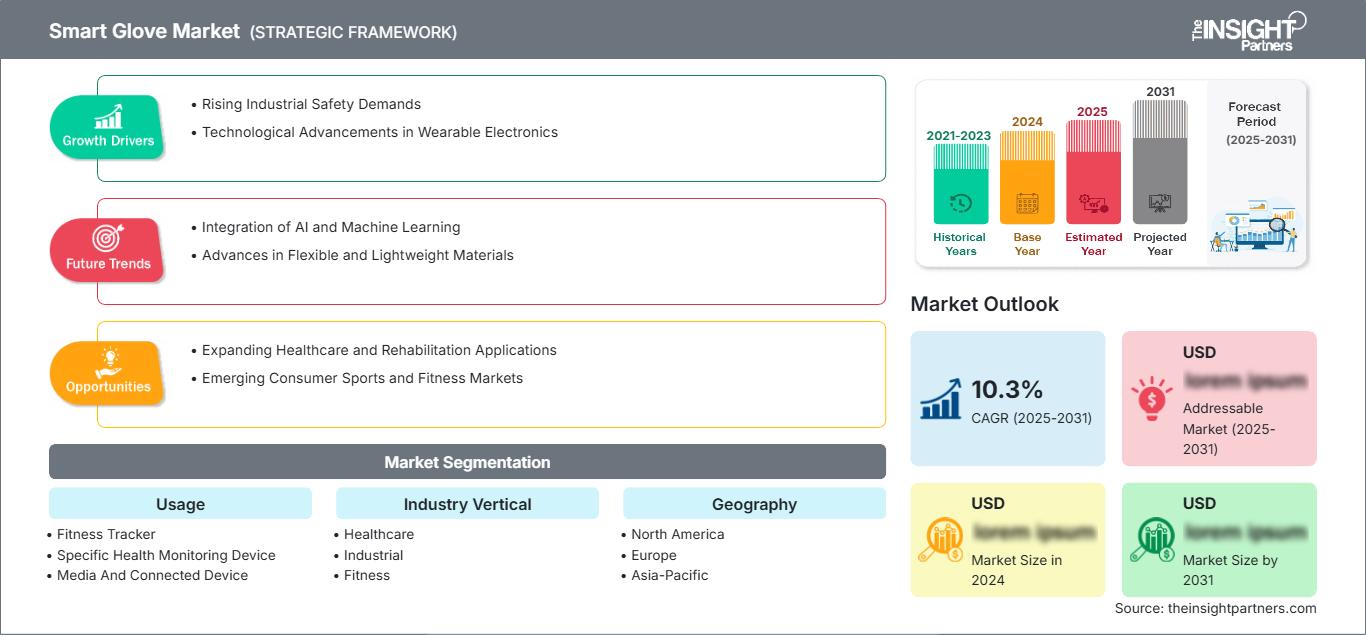
The Smart Glove Market was valued at US$ 3.22 billion in 2025 and is projected to reach US$ 7.45 billion by 2034, registering a CAGR of 9.76% during the forecast period from 2026 to 2034. The market growth is driven by increasing demand for wearable technology, the rising popularity of virtual reality (VR) and augmented reality (AR) applications, and growing industrial automation. Smart gloves are equipped with sensors, haptic feedback systems, and connectivity features that enable advanced hand motion tracking, gesture recognition, and health monitoring.
The Smart Glove Market size in North America accounted for a substantial share, driven by high technological adoption, strong healthcare infrastructure, and significant military expenditure. The region is experiencing steady growth with a projected CAGR of 8.5%–9.5% from 2026 to 2034, supported by the presence of key technology providers and increasing adoption of wearable solutions across healthcare and industrial sectors. Government investments in defense and workplace safety programs are further propelling market expansion.
Smart Glove Market Assessment and Insights
- North America – North America held a 28%–32% share in 2025 and is projected to grow at a CAGR of 8.5%–9.5% during 2026–2034, driven by high military expenditure, advanced healthcare infrastructure, and strong technological adoption.
- U.S. – The U.S. market represented 75%–80% of North America's share in 2025, with a CAGR of 8%–10%, supported by strong demand from the healthcare sector, gaming industry, and industrial safety applications.
- Europe – Europe captured 22%–26% of the global Market in 2025, growing at 8%–9% CAGR, led by Germany, the UK, and France, driven by industrial automation and rehabilitation applications.
- Asia Pacific – Asia Pacific held 33%–37% market share in 2025, growing at 10%–11% CAGR, led by China, Japan, and India due to rapid industrialization, growing healthcare expenditure, and expanding consumer electronics market.
- Largest Segment – The fitness tracker segment held the largest market share of 30%–34% in 2025, growing at 8%–9% CAGR, driven by increasing health awareness and the integration of advanced motion sensors in fitness applications.
- High Growth Segment – The specific health monitoring device segment is the high-growth segment with a 27%–31% market share in 2025, growing at 10%–11% CAGR, driven by remote patient monitoring needs and rehabilitation applications.
- Key companies analyzed in detail: Flint Rehab, HaptX Inc., Lab Brothers LLC, Maze Exclusive, Nuada, Neofect, Shenzhen Seekas Technology Co., Ltd., Samsung Electronics Co., Ltd., Soka Gakkai, Workaround GmbH (ProGlove).
Source: The Insight Partners' analysis based on proprietary research, government publications, company annual reports, investor presentations, industry databases, and expert interviews.
Smart Gloves Market Technology is witnessing rapid development, from primitive motion trackers to wearable devices equipped with haptic feedback, sensors for monitoring biometrics, and connection to the Internet of Things. Among recent developments are the incorporation of artificial intelligence-driven gesture recognition, flexible electronics, and real-time analytics capabilities. Manufacturers now tend to produce light, comfortable, and durable gloves equipped with more accurate sensors and wireless capabilities. The use of 5G networks will enable faster data transmission required for remote work, rehabilitation purposes, and collaborative applications. This technological development opens up new perspectives for the use of smart gloves in various industries.
In terms of future prospects, Smart Gloves Market growth is expected in developing countries due to the development of industry automation, higher healthcare expenses, and consumer electronics usage. Investments in wearable technology will create additional revenue flows through the creation of innovative products and services for immersive VR/AR experiences. Favorable regulatory trends such as legislation regarding workplace safety issues and digitalization programs in the area of healthcare will fuel the demand for smart gloves in the two sectors.
Smart Glove Market Report Scope
| Report Attribute | Details |
|---|---|
| Market size in 2025 | US$ 3.22 Billion |
| Market Size by 2034 | US$ 7.45 Billion |
| Global CAGR (2026 - 2034) | 9.76% |
| Historical Data | 2021-2024 |
| Forecast period | 2026-2034 |
Smart Glove Market Analysis
The market for Smart Gloves is fueled by rising consumer interest in wearable technology and automation needs in industries. By facilitating real-time tracking of hand movements, ambient conditions, and risks of harm, smart gloves help increase safety and efficiency among employees working in industrial environments. The value chain consists of the following players: sensor manufacturers, hardware components makers, software developers, and end-device manufacturers who work together to provide a solution as an end-to-end product. The supply chain is affected by the availability of new technologies such as advanced sensors, flexible electronics, and conductive materials with manufacturers making efforts to conduct research and development activities to optimize their products.
Key players mentioned in the Smart Gloves market report include Flint Rehab, HaptX Inc., Workaround GmbH (ProGlove), Samsung Electronics, and Neofect among others, each holding large market shares. Players are emphasizing innovation, partnerships, and geographical expansion. Significant amounts of resources are being allocated towards innovations in haptic feedback systems and sensor capabilities along with connectivity enhancements. While players like HaptX are at the forefront in developing real touch feedback technologies for use in VR/AR applications, Workaround GmbH has focused its efforts on manufacturing smart gloves for industrial purposes. There are also dedicated players in the healthcare rehabilitation segment, Flint Rehab and Neofect.
● REPORT CUSTOMIZATION
Tailor This Report To Align With Your Specific Business Requirements
This report can be customized to align precisely with your business objectives, scope, and target markets. Customization options include tailored segmentation, geography, competitive analysis, and strategic insights to support informed decision-making.
Customize This Report →WHAT YOU CAN ADJUST
- ● Segmentations
- ● Geography
- ● Competitive Analysis
- ● Language Preferences
Smart Glove Market: Strategic Insights
Regional Insights
North America Smart Glove Market
North America accounted for 28%–32% of the global Smart Glove Market Share in 2025 and is projected to grow at a CAGR of 8.5%–9.5% during the forecast period. The region's growth is driven by high technological adoption, strong healthcare infrastructure, and significant military expenditure on wearable technologies. The United States is the leading country in North America, with a high concentration of technology providers and healthcare institutions embracing smart glove solutions. The commercial sector, particularly healthcare and industrial applications, represents a significant growth driver. The region is also witnessing increasing demand for smart gloves in gaming and VR/AR applications. Market players in North America are investing in R&D to develop innovative products with enhanced haptic feedback and gesture recognition capabilities.
U.S. Smart Glove Market
The U.S. Market represented approximately 75%–80% of the North American Market in 2025 and is anticipated to register a CAGR of 8%–10% from 2026 to 2034. The U.S. market is characterized by strong demand from the healthcare sector, where smart gloves are used for rehabilitation, surgical training, and remote patient monitoring. Major companies like HaptX Inc., Flint Rehab, and Workaround GmbH have a strong presence in the U.S., offering advanced haptic feedback and therapeutic smart glove solutions. The gaming industry is also a significant market driver, with increasing adoption of smart gloves for immersive VR experiences. Government investments in defense and workplace safety are further supporting market growth.
Europe Smart Glove Market
Europe captured 22%–26% of the global Market in 2025 and is projected to grow at a CAGR of 8%–9% from 2026 to 2034. Germany, the United Kingdom, France, Italy, and Spain are the leading countries in the region, driven by industrial automation, healthcare digitalization, and strong research capabilities. The German Market is characterized by strong demand from the industrial sector for worker safety and productivity enhancement. The UK market is growing due to increasing adoption in healthcare rehabilitation and sports performance tracking. France and Italy are witnessing growth driven by healthcare applications and automotive industry demand. Spain is emerging as a significant market with increasing investments in wearable technology and rehabilitation solutions. The European market benefits from strong regulatory frameworks supporting workplace safety and healthcare innovation.
APAC Smart Glove Market
Asia Pacific held 33%–37% of the global Market in 2025 and is projected to register the highest CAGR of 10%–11% during the forecast period. China, Japan, India, South Korea, and Australia are the leading countries in the region, driven by rapid industrialization, growing healthcare expenditure, and the expanding consumer electronics sector. China is the largest Market in APAC, with its extensive manufacturing sector and government initiatives promoting industrial automation. India is emerging as a significant market, with growing healthcare infrastructure and demand for rehabilitation solutions. Japan and South Korea are at the forefront of technological innovation, with companies developing advanced sensor technologies and smart glove applications. Australia is contributing to market growth with its focus on sports and fitness applications.
Middle East & Africa Smart Glove Market
The Middle East & Africa region is experiencing steady growth in the Market, with a projected CAGR of 7%–8.5% from 2026 to 2034. Saudi Arabia, the UAE, and South Africa are the leading countries, driven by infrastructure development, growing healthcare investment, and industrial modernization. The UAE is at the forefront of smart glove adoption in healthcare and industrial safety applications. Saudi Arabia's Vision 2030 initiatives and industrial development programs are creating opportunities for smart glove applications in worker safety and rehabilitation. South Africa is witnessing growing adoption driven by mining industry safety requirements and healthcare modernization.
Segmentation Analysis
Usage
The Smart Glove Market is segmented by usage into Fitness Tracker, Specific Health Monitoring Device, Media and Connected Device, and Others. The fitness tracker segment dominated the Market in 2025 with a share of 30%–34% and is projected to maintain leadership with a CAGR of 8%–9% from 2026 to 2034. The demand for fitness tracker smart gloves is driven by increasing health awareness and the integration of advanced motion sensors for fitness and sports performance monitoring. The specific health monitoring device segment is the fastest-growing, with a CAGR of 10%–11%, driven by remote patient monitoring needs, rehabilitation applications, and neurological disorder treatment. Media and connected devices are gaining traction in gaming and VR/AR applications, while other uses include industrial safety and military applications.
- Fitness Tracker – Fitness tracker smart gloves are widely used in sports and fitness applications for monitoring hand movements, tracking performance metrics, and providing real-time feedback to athletes and fitness enthusiasts.
- Specific Health Monitoring Device – These smart gloves are designed for healthcare applications, including rehabilitation, remote patient monitoring, and neurological disorder treatment, offering precise motion tracking and biometric data collection.
- Media and Connected Device – Smart gloves in this segment are used for gaming, VR/AR applications, and media interaction, providing gesture recognition and haptic feedback for immersive user experiences.
Industry Vertical
The Smart Glove Market is segmented by industry vertical into Healthcare, Industrial, Fitness, and Others. The healthcare segment is the largest and fastest-growing, driven by increasing demand for rehabilitation solutions, remote patient monitoring, and surgical training applications. Smart gloves are used in physical therapy for motor skill recovery, enabling precise movement tracking and personalized treatment protocols. The industrial segment is growing significantly, driven by worker safety requirements, productivity enhancement, and gesture-based control in manufacturing environments. The fitness segment is expanding with the growing wellness trend and demand for performance monitoring. Other applications include gaming, military, and research institutions.
- Healthcare – The healthcare segment leads the Market, driven by demand for rehabilitation, remote patient monitoring, and surgical training applications, enabling precise movement tracking and personalized treatment protocols.
- Industrial – The industrial segment is growing with worker safety requirements and productivity enhancement, using smart gloves for gesture-based control and real-time monitoring in manufacturing environments.
- Fitness – The fitness segment is expanding with the growing wellness trend and demand for performance monitoring, tracking hand movements and providing real-time feedback to athletes.
Opportunity Snapshot
| Usage | Revenue Contribution | Trend Tag | Adoption Stage |
|---|---|---|---|
| Fitness Tracker | High | Performance Tracking | Mature |
| Specific Health Monitoring Device | High | Remote Monitoring | Scaling |
| Media and Connected Device | Medium | VR/AR Interaction | Emerging |
| Others | Medium | Industrial Safety | Scaling |
Smart Glove Market Growth Drivers and Impact Analysis
Rising Industrial Safety Demands
The increasing focus on workplace safety across manufacturing, construction, and logistics sectors is driving the Smart Glove Market. Advanced sensor technologies integrated into smart gloves enable real-time monitoring of worker movements, environmental conditions, and potential hazards, significantly reducing workplace accidents and enhancing overall safety protocols . Smart gloves with embedded safety sensors and haptic feedback capabilities provide instant warnings of potential risks, allowing workers to respond promptly to prevent accidents. The adoption of Industry 4.0 and increasing automation in industrial settings are further accelerating the demand for smart gloves as essential safety and productivity tools.
Technological Advancements in Wearable Electronics
Rapid progression in miniaturization, flexible electronics, and sensor technologies is enabling more sophisticated and compact smart glove designs . Innovations in materials science and embedded computing are creating more responsive, lightweight, and multifunctional gloves with enhanced connectivity and performance tracking capabilities across various professional and consumer applications. The integration of IoT and 5G connectivity allows smart gloves to transmit data quickly and seamlessly, supporting real-time communication and data sharing for remote work, collaborative projects, and augmented reality experiences . These advancements are making smart gloves more practical and user-friendly.
Expanding Healthcare and Rehabilitation Applications
The healthcare sector presents significant growth potential for smart gloves, particularly in physical therapy, motor skill rehabilitation, and assistive technologies for patients with neurological disorders . Advanced sensing capabilities and data-driven insights facilitate more precise movement tracking, personalized treatment protocols, and improved patient recovery outcomes. Smart gloves equipped with biometric sensors monitor vital signs such as heart rate, body temperature, and blood pressure, enabling continuous health tracking and real-time data collection for medical diagnostics and remote patient monitoring . The growing aging population and increasing prevalence of neurological disorders are driving demand for therapeutic smart gloves.
Smart Glove Market Future Trends
AI-Powered Motion Tracking and Gesture Recognition
The integration of artificial intelligence in smart gloves is enabling more precise movement tracking and gesture recognition capabilities. AI-powered algorithms allow for sign language recognition, hand-operated game controls, and precise hand movement monitoring for industrial robotics . This Smart Glove Market Trend is enhancing user interaction with virtual and physical environments, creating a seamless connection between user and device. The use of machine learning enables predictive analytics and adaptive functionality, allowing smart gloves to analyze user movements and provide real-time feedback across healthcare, sports, and industrial domains . As AI capabilities advance, smart gloves will become more intuitive and responsive.
Flexible and Stretchable Electronics
The development of flexible circuits and stretchable materials has opened possibilities for smart gloves to be more comfortable, robust, and adaptable to different hand shapes and movements . This trend is leading to improved ergonomics and wearability of smart gloves, making them more practical for extended use across healthcare, gaming, and industrial applications. Innovations in textile-based sensors, conductive fabrics, and flexible electronics are helping create gloves that are not only more functional but also more comfortable and less bulky . As manufacturers develop more advanced and user-friendly materials, the adoption of smart gloves is expected to expand across various sectors.
Smart Glove Market Opportunities
Emerging Consumer Sports and Fitness Markets
The growing wellness and performance optimization trends are creating substantial opportunities for smart gloves Market Forecast in sports and fitness segments. Applications include biomechanical analysis, gesture control, performance monitoring, and advanced training techniques across professional athletics, recreational sports, and personal fitness tracking markets. Smart gloves can track hand movements, monitor performance metrics, and provide real-time feedback to athletes, enabling data-driven training optimization. The integration of advanced sensors and AI analytics can provide personalized insights for injury prevention and performance enhancement. As fitness awareness grows globally, the consumer sports segment presents significant opportunities for smart glove manufacturers.
Virtual and Augmented Reality Applications
The rising popularity of VR and AR applications is creating significant opportunities for smart gloves in gaming, training, and simulation. Smart gloves with haptic feedback technology enable users to feel realistic tactile sensations, making training programs and virtual interactions more effective. This technology enhances user interaction by allowing users to "feel" virtual objects, improving the effectiveness of simulations and training programs across industries such as healthcare, military, and industry. As VR and AR technologies continue to advance and become more accessible, the demand for smart gloves as intuitive input devices is expected to grow significantly.
Recent Developments
- February 2026: Researchers at the University of Washington's Wearable Intelligence Lab have led a project to develop smart gloves that can record signals of pressure to measure the sense of touch. The goals for the devices are to help physical therapy patients track progress, to teach robots to grasp objects, and more, according to a release from UW. UW electrical and computer engineering doctoral student Devin Murphy says the glove uses a grid of wires to process signals to create a "heat map" to show where force is being applied.
- February 2026: The United Arab Emirates has secured the Secretariat General of the Gulf Cooperation Council Patent Office Award and a silver medal at the 16th International Invention Fair in the Middle East, held in Kuwait, for a smart assistive device designed to support people with visual impairments. The award-winning innovation, developed by Emirati inventor Aisha Al Zarooni and presented through the Emirates Inventors Association, is titled “Electronic Text Reading Device by Touch”. It consists of a smart glove equipped with a Braille cell that enables users to read digital content through tactile feedback without relying on audio output.
- February 2024: Researchers from MIT’s Computer Science and Artificial Intelligence Laboratory (CSAIL) and elsewhere developed an embroidered smart glove that can capture, reproduce, and relay touch-based instructions.
Frequently Asked Questions

- Comprehensive Market Sizing and Forecast Analysis
- Detailed Segmentation Analysis
- In-Depth Market Dynamics Assessment
- Regional and Country-Level Insights
- Competitive Landscape and Company Benchmarking
- Strategic Business Intelligence
Recent Reports
Testimonials

The Insight Partners' SCADA System Market report is comprehensive, with valuable insights on current trends and future forecasts. The team was highly professional, responsive, and supportive throughout. We are very satisfied and highly recommend their services.
RAN KEDEM Partner, Reali Technologies LTDs
I requested a report on a very specific software market and the team produced the report in a few days. The information was very relevant and well presented. I then requested some changes and additions to the report. The team was again very responsive and I got the final report in less than a week.
JEAN-HERVE JENN Chairman, Future Analytica
We worked with The Insight Partners for an important market study and forecast. They gave us clear insights into opportunities and risks, which helped shape our plans. Their research was easy to use and based on solid data. It helped us make smart, confident decisions. We highly recommend them.
PIYUSH NAGPAL Sr. Vice President, High Beam Global
The Insight Partners delivered insightful, well-structured market research with strong domain expertise. Their team was professional and responsive throughout. The user-friendly website made accessing industry reports seamless. We highly recommend them for reliable, high-quality research services
YUKIHIKO ADACHI CEO, Deep Blue, LLC.
This is the first time I have purchased a market report from The Insight Partners.While I was unsure at first, I visited their web site and felt more comfortable to take the risk and purchase a market report.I am completely satisfied with the quality of the report and customer service. I had several questions and comments with the initial report, but after a couple of dialogs over email with their analyst I believe I have a report that I can use as input to our strategic planning process.Thank you so much for taking the extra time and making this a positive experience.I will definitely recommend your service to others and you will be my first call when we need further market data.
JOHN SUZUKI President and Chief Executive Officer, Board Director, BK Technologies
I wish to appreciate your support and the professionalism you displayed in the course of attending to my request for information regarding to infectious disease IVD market in Nigeria. I appreciate your patience, your guidance, and the fact that you were willing to offer a discount, which eventually made it possible for us to close a deal. I look forward to engaging The Insight Partners in the future, all thanks to the impression you have created in me as a result of this first encounter.
DR CHIJIOKE ONYIA MANAGING DIRECTOR, PineCrest Healthcare Ltd.Reason to Buy
- Informed Decision-Making
- Understanding Market Dynamics
- Competitive Analysis
- Identifying Emerging Markets
- Customer Insights
- Market Forecasts
- Risk Mitigation
- Boosting Operational Efficiency
- Strategic Planning
- Investment Justification
- Tracking Industry Innovations
- Aligning with Regulatory Trends





 Get Free Sample for