
Smart HVAC Controls Market Growth, Trends & Forecast by 2034
Coverage: By Product Type (Smart Thermostat, Smart Air Vent); Implementation Type (New Construction, Retrofit); Application (Residential, Commercial, Industrial), and Geography (North America, Europe, Asia Pacific, and South and Central America)
- Status : Data Released
- Report Code : TIPRE00015823
- Category : Electronics and Semiconductor
- No. of Pages : 150
- Available Report Formats :


- Last update date : August 17, 2026


2025 Market Size
US$ 10.98 Bn
Base year value
2034 Forecast
US$ 27.29 Bn
Projected by 2034
CAGR 2026-2034
10.64 %
Growth rate
Addressable Market
US$ 169.47 Bn
(2026-2034)
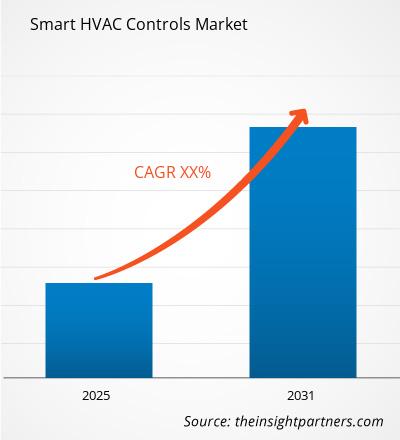
The global Smart HVAC Controls Market was valued at US$ 10.98 billion in 2025 and is projected to reach US$ 27.29 billion by 2034. The market is anticipated to register a compound annual growth rate (CAGR) of 10.64% during the forecast period from 2026 to 2034, driven by increasing demand for energy-efficient building solutions and the proliferation of connected devices.
The Smart HVAC Controls Market size in North America is estimated to account for a dominant share, with the region growing at a CAGR of approximately 8–10% through 2034. Growth is underpinned by stringent building energy codes, widespread smart home adoption, and federal incentive programs promoting energy-efficient retrofits in residential and commercial sectors.
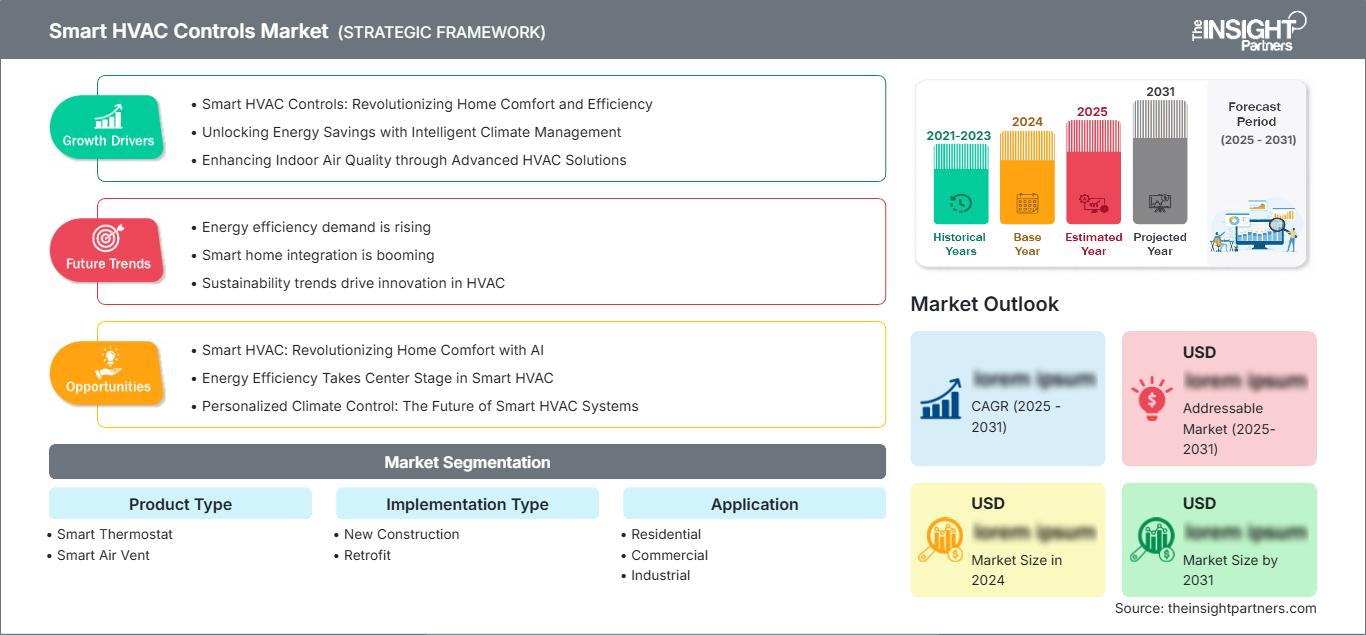
Smart HVAC Controls Market Assessment and Insights
- North America: The region held a significant market share of approximately 36–40% in 2025. It is projected to grow at a robust CAGR of 8–10% from 2026 to 2034, driven by mature smart home adoption, extensive commercial building automation, and supportive energy efficiency policies .
- US: The United States is the largest contributor in North America, accounting for over 85–90% of the region's market share in 2025. The US market is anticipated to grow at a CAGR of 8–10% during 2026–2034, propelled by advanced telecommunications infrastructure and widespread smart thermostat adoption.
- Europe: Europe captured around 24–28% share in 2025, with a projected CAGR of 9–11% through 2034. Leading countries include Germany, the UK, and France, where the Energy Performance of Buildings Directive and stringent sustainability regulations are accelerating demand .
- Asia Pacific: The APAC region held a 22–26% share in 2025 and is expected to grow at the fastest CAGR of 12–14%. China, Japan, and South Korea are leading the charge, driven by rapid urbanization, rising cooling demand, and large-scale commercial construction .
- Largest Segment: Smart Thermostats emerged as the largest product segment, holding approximately 55–60% market share in 2025. It is projected to grow at a CAGR of 9–11% through 2034, driven by consumer preference for remote access and energy savings.
- High Growth Segment: Retrofit Implementation is the high-growth segment, with a market share of 58–62% in 2025 and an anticipated CAGR of 11–13%. The segment's expansion is fueled by cost-effective upgrades to existing building infrastructure .
- Key companies analyzed in detail: Carrier; DAIKIN INDUSTRIES, Ltd; Haier Group; Hitachi Ltd.; Honeywell International Inc.; Johnson Controls; Lennox International Inc.; LG Electronics; Siemens AG; Trane Technologies plc.
Source: The Insight Partners' analysis based on proprietary research, government publications, company annual reports, investor presentations, industry databases, and expert interviews.
The Smart HVAC Controls Market is transitioning from basic programmable thermostats to sophisticated AI-driven building automation platforms. Technological convergence, including IoT connectivity, cloud-based analytics, and open communication protocols like BACnet and Modbus, is enabling centralized control and predictive optimization . Production dynamics are shifting towards modular, interoperable systems that integrate seamlessly with broader smart building ecosystems.
The forward-looking outlook for the Smart HVAC Controls Market points to significant growth in emerging economies across Asia Pacific and the Middle East, spurred by infrastructure development and government-backed smart city initiatives. Strategic investments in AI-enabled fault detection and cloud-based HVAC platforms are reshaping the competitive landscape.
Smart HVAC Controls Market Report Scope
| Report Attribute | Details |
|---|---|
| Market size in 2025 | US$ 10.98 Billion |
| Market Size by 2034 | US$ 27.29 Billion |
| Global CAGR (2026 - 2034) | 10.64% |
| Historical Data | 2021-2024 |
| Forecast period | 2026-2034 |
Smart HVAC Controls Market Analysis
The Smart HVAC Controls Market is experiencing strong demand driven by a combination of regulatory requirements and growing consumer focus on energy efficiency. Buildings account for a significant share of global energy consumption and emissions, increasing the need for advanced HVAC control systems that can reduce energy use while maintaining comfortable indoor environments. As a result, smart HVAC technologies are becoming an essential component of modern building management strategies.
The market value chain is changing in light of technology vendors working more closely with building owners, developers, and utility firms in the integration of intelligent HVAC controls in both new constructions and renovations. Such partnerships have played an integral part in the faster adoption of intelligent climate management systems, as well as contributing to sustainability and energy-efficiency goals.
Competitors in the market include prominent players like Honeywell International Inc., Siemens AG, Johnson Controls, Trane Technologies, and Lennox International. They keep investing in innovations in order to build their market position and cater to customer needs.
Vertical integration and partnerships are also being explored as an option to offer end-to-end HVAC solutions, which can be seen from collaborations between Carrier and Daikin Industries. Investments are now also being made in artificial intelligence and Internet of Things (IoT), with companies increasingly favoring recurring income streams from cloud-based subscriptions and predictive maintenance over one-off hardware purchases. This kind of strategy will become vital to retaining market share in the future.
● REPORT CUSTOMIZATION
Tailor This Report To Align With Your Specific Business Requirements
This report can be customized to align precisely with your business objectives, scope, and target markets. Customization options include tailored segmentation, geography, competitive analysis, and strategic insights to support informed decision-making.
Customize This Report →WHAT YOU CAN ADJUST
- ● Segmentations
- ● Geography
- ● Competitive Analysis
- ● Language Preferences
Smart HVAC Controls Market: Strategic Insights
Regional Insights
North America Smart HVAC Controls Market
North America dominated the global Smart HVAC Controls Market with a substantial share of 36–40% in 2025. North America’s well-developed market receives boosts through the availability of high-speed internet connectivity, an internet-savvy population base, and active policies by the government that encourage a reduction in energy usage. In the case of the US, for example, the country still maintains its position as the leading one because of the prevalence of smart thermostats, building automation systems, and demand response programs run by utilities. Canada closely follows the US with high adoption rates of devices in urban areas because of the regulation of heating pump systems during cold seasons.
U.S. Smart HVAC Controls Market
As the leading market globally, the U.S. accounted for a commanding 85–92% of the global Smart HVAC Controls Market share of the North American region in 2025. Market growth, which is estimated to be around 8–10% CAGR, will be driven by the high level of customer spending on smart home products and the presence of technology companies. Applications are becoming increasingly focused on integrated building management systems that include HVAC control along with lighting and security features, thus ensuring energy optimization across multiple aspects of buildings' functioning. Technology giants such as Johnson Controls and Honeywell International are rapidly expanding their range of smart products in response to the increasing demand for retrofits of buildings' infrastructure.
Europe Smart HVAC Controls Market
Europe held a significant 24–28% share of the global market in 2025, with a projected CAGR of 9–11%. The region is defined by the Energy Performance of Buildings Directive and the F-gas transition, making HVAC and energy management applications critical drivers. Germany leads the European market, followed by the UK and France. In the UK, demand is heavily influenced by building renovation requirements, while Germany focuses on integrating smart controls into its renewable energy ecosystem. Italy and Spain are also showing strong growth, driven by initiatives to modernize aging building infrastructure and comply with EU sustainability targets. The regulatory landscape in Europe is a primary catalyst, pushing manufacturers to innovate energy-saving solutions and supporting a positive Smart HVAC Controls Market forecast.
APAC Smart HVAC Controls Market
The Asia Pacific region, accounting for 22–26% of the global share in 2025, is projected to be the fastest-growing market with a CAGR of 12–14%. China stands as the leading country due to massive investment in commercial construction and smart city projects. Japan and South Korea are not far behind, driven by advanced electronics manufacturing and high-efficiency control systems. India is an emerging hotbed, supported by a burgeoning middle class and policy-led energy conservation initiatives. Australia, too, is witnessing steady growth due to rising awareness of energy efficiency and high renewable energy penetration. Rapid urbanization and rising cooling demand across the region make intelligent HVAC controls critical for managing electricity demand, as highlighted in the Smart HVAC Controls Market report.
Middle East & Africa Smart HVAC Controls Market
The MEA region is poised for significant growth at a CAGR of 11–13% during 2026–2034. Saudi Arabia is leading the market because of mega-projects and efficient cooling in extreme climates. UAE comes second because Dubai is positioning itself as a smart city center. South Africa is the key growth market in Africa because of the need for energy security and HVAC monitoring in healthcare and data centers. Infrastructure development, coupled with a high reliance on energy-intensive cooling systems, makes the region a promising frontier for smart HVAC control investments, reflecting key Smart HVAC Controls Market trends across the Middle East and Africa.
Segmentation Analysis
Product Type
The Product Type segment forms the core of the Smart HVAC Controls Market, encompassing devices designed for specific climate control functions. This segment is projected to grow at a CAGR of 9–11% during 2026–2034. The market is witnessing a convergence where individual products are becoming interoperable through central platforms, offering enhanced user convenience. Key drivers include the rising demand for energy-efficient solutions, the need for remote monitoring capabilities, and the increasing adoption of AI-powered predictive maintenance features.
- Smart Thermostat: This is the dominant product category, widely adopted for its ability to learn user preferences and optimize heating and cooling schedules, resulting in significant energy savings.
- Smart Air Vent: An emerging product type that enables room-by-room temperature control, enhancing comfort and energy efficiency by directing airflow based on occupancy and usage patterns.
Implementation Type
The Implementation Type segment distinguishes the market based on the installation approach, with each method exhibiting unique adoption drivers. This segment is projected to register a CAGR of 10–12% during the forecast period. While new construction offers opportunities for integrated, ground-up smart building solutions, the retrofit segment is experiencing robust growth due to the cost-effective upgrade of existing building stock. Government-backed renovation initiatives and efficiency upgrade programs are stimulating retrofit activity across aging buildings.
- New Construction: This segment benefits from the integration of smart HVAC controls during the building design phase, enabling seamless system optimization and compliance with energy codes.
- Retrofit: This is the high-growth segment, allowing building owners to upgrade existing HVAC infrastructure with intelligent controls without replacing entire systems, delivering quick efficiency gains while minimizing capital expenditure.
Application
The Application segmentation categorizes the Smart HVAC Controls Market based on the end-use environment, with each sector exhibiting distinct requirements and adoption drivers. This segment is projected to grow at a CAGR of 9–11% during the forecast period. While residential applications have historically led the market, there is a notable surge in commercial and industrial adoption, driven by the imperative to reduce operational costs and comply with stringent building codes.
- Residential: This segment is the primary driver of the market, dominated by a focus on comfort, convenience, and energy savings for homeowners.
- Commercial: Offices, retail spaces, and institutional buildings are increasingly adopting smart HVAC controls to reduce energy costs, improve indoor air quality, and meet sustainability targets.
- Industrial: Factories and warehouses are leveraging smart HVAC controls for operational efficiency, safety compliance, and environmental monitoring.
Opportunity Snapshot
| Application Segment | Revenue Contribution | Trend Tag | Adoption Stage |
| Residential | High | Smart Thermostat | Mature |
| Commercial | High | BAS Integration | Scaling |
| Industrial | Medium | Predictive Maintenance | Emerging |
Smart HVAC Controls Market Growth Drivers and Impact Analysis
Stringent Energy Efficiency Regulations
The global push for decarbonization is a primary driver for the Smart HVAC Controls Market. All across the world, countries have been tightening their energy performance standards on buildings, hence making HVAC control a necessity. Such policies and regulatory measures include the EU Energy Performance of Buildings Directive, which has created a need for HVAC controls to provide better energy performance in residential, commercial, and industrial buildings. Such a driver is especially relevant to Europe and North America, due to the policies in place, which promote energy efficiency in order to achieve carbon neutrality.
Rapid Adoption of IoT and AI Technologies
Advancements in connectivity through IoT, artificial intelligence, big data analytics, and cloud-based HVAC systems have changed the approach to management and improvement of these systems. Using the AI-powered model predictive control technology, it is possible to lower energy consumption by taking into account weather conditions, occupant behavior, tariff rates, and equipment performance history. By combining IoT technologies, it becomes possible to monitor the system remotely and collect data about its work at any time, which helps detect any issues and avoid failures. The combination of these technologies has not only helped improve the experience of the users but also simplified systems.
Growing Demand for Smart Building Automation
The rapid penetration of smart buildings and automated homes is a key driver for the Smart HVAC Controls Market. More than 65% of all new construction worldwide today uses smart HVAC controls within an integrated building management system. Owners are moving away from individual thermostats and manual controls to networked sensors and control logic that is software-driven. Smart HVAC controls allow for peak shaving and can enable grid-interactive, efficient buildings. It is through automation that these systems remain optimal and minimize disruption, as well as increase occupant comfort.
Smart HVAC Controls Market Future Trends
AI-Powered Predictive and Autonomous Controls
AI is enabling HVAC controls to evolve from reactive to proactive and autonomous systems. AI-driven fault detection and diagnostics, occupancy control, and demand-controlled ventilation are assisting building facility managers to recognize simultaneous heating and cooling, sensor inaccuracies, and inefficiencies in scheduling before they result in extra cost expenditure and customer complaints. Together, the effect of these developments is an increased autonomy in HVAC systems that enable remote diagnostics, predictive maintenance, adaptive ventilation, and participation in demand response programs.
Integration with Renewable Energy and Grid-Interactive Buildings
HVAC controls that are smart are increasingly being incorporated into renewable energy systems and GEBs. Integration enables HVAC systems to regulate their activities in response to signals in the electrical grid, renewable energy sources, and electricity rates. Buildings have gone from passive consumers to active participants in the energy grid. HVAC controls play an important role in achieving demand response and load-shedding in such environments with high penetrations of renewable energy.
Smart HVAC Controls Market Opportunities
Expansion of Retrofit Solutions for Aging Building Stock
A considerable opportunity exists in creating smart HVAC control solutions that can be easily retrofitted in aged buildings. Retrofitting helps in upgrading an old HVAC system with an intelligent one without having to replace the whole system, thus providing immediate efficiency and reducing capital costs significantly. The process is especially appealing to organizations such as governments and private firms operating within tight budgets and sustainability limitations. Renovation efforts by governments on aged buildings keep fueling interest in smart HVAC control solutions.
Integration of HVAC Controls with Broader Smart Building Ecosystems
There are many opportunities for HVAC control suppliers to incorporate their products into smart building environments. Suppliers that provide interoperable software with open standards, analysis capability, security, remote control, as well as integration with the building management system and energy management software are likely to gain an advantage in the market. Partnerships with construction firms, utility firms, and technology firms enable suppliers to increase energy saving and predictive maintenance capabilities. Expansion and localization enable suppliers to meet regional regulations and lower costs.
Recent Developments
- August 2026: South Korean construction giant POSCO E&C announced the commercial launch of Eco Saver, a per-unit AI HVAC control system for apartment buildings, becoming the first Korean builder to deploy automated, per-household energy optimization in actual residential complexes. The launch landed on one of the most consequential weeks in Korean climate history: temperatures in Yangsan surpassed 40°C for the first time in the country's recorded history in late July, placing residential cooling energy at the center of the national policy conversation.
- June 2026: Bosch Home Comfort Group is redefining light commercial HVAC installation and performance with the launch of SkyQ. The intelligent control system is engineered specifically for small to mid-sized buildings to deliver advanced, system-wide HVAC control without the complexities and costs of traditional building automation systems (BAS).
- February 2026: Samsung Electronics showcased SmartThings Pro at AHR 2026. The platform equips HVAC leaders, inclusive of contractors, service organizations, and owners, with an advanced enterprise solution to remotely manage, monitor and optimize diverse residential and commercial portfolios.
- October 2024: Siemens AG introduced the Desigo PXC7 building automation controller for HVAC applications in larger buildings, reinforcing its commitment to technological enhancements and strategic innovation in the HVAC sector. [URL]
Frequently Asked Questions

- Comprehensive Market Sizing and Forecast Analysis
- Detailed Segmentation Analysis
- In-Depth Market Dynamics Assessment
- Regional and Country-Level Insights
- Competitive Landscape and Company Benchmarking
- Strategic Business Intelligence
Recent Reports
Testimonials

The Insight Partners' SCADA System Market report is comprehensive, with valuable insights on current trends and future forecasts. The team was highly professional, responsive, and supportive throughout. We are very satisfied and highly recommend their services.
RAN KEDEM Partner, Reali Technologies LTDs
I requested a report on a very specific software market and the team produced the report in a few days. The information was very relevant and well presented. I then requested some changes and additions to the report. The team was again very responsive and I got the final report in less than a week.
JEAN-HERVE JENN Chairman, Future Analytica
We worked with The Insight Partners for an important market study and forecast. They gave us clear insights into opportunities and risks, which helped shape our plans. Their research was easy to use and based on solid data. It helped us make smart, confident decisions. We highly recommend them.
PIYUSH NAGPAL Sr. Vice President, High Beam Global
The Insight Partners delivered insightful, well-structured market research with strong domain expertise. Their team was professional and responsive throughout. The user-friendly website made accessing industry reports seamless. We highly recommend them for reliable, high-quality research services
YUKIHIKO ADACHI CEO, Deep Blue, LLC.
This is the first time I have purchased a market report from The Insight Partners.While I was unsure at first, I visited their web site and felt more comfortable to take the risk and purchase a market report.I am completely satisfied with the quality of the report and customer service. I had several questions and comments with the initial report, but after a couple of dialogs over email with their analyst I believe I have a report that I can use as input to our strategic planning process.Thank you so much for taking the extra time and making this a positive experience.I will definitely recommend your service to others and you will be my first call when we need further market data.
JOHN SUZUKI President and Chief Executive Officer, Board Director, BK Technologies
I wish to appreciate your support and the professionalism you displayed in the course of attending to my request for information regarding to infectious disease IVD market in Nigeria. I appreciate your patience, your guidance, and the fact that you were willing to offer a discount, which eventually made it possible for us to close a deal. I look forward to engaging The Insight Partners in the future, all thanks to the impression you have created in me as a result of this first encounter.
DR CHIJIOKE ONYIA MANAGING DIRECTOR, PineCrest Healthcare Ltd.Reason to Buy
- Informed Decision-Making
- Understanding Market Dynamics
- Competitive Analysis
- Identifying Emerging Markets
- Customer Insights
- Market Forecasts
- Risk Mitigation
- Boosting Operational Efficiency
- Strategic Planning
- Investment Justification
- Tracking Industry Innovations
- Aligning with Regulatory Trends





 Get Free Sample for