
Smart Sub-Meter Market Growth, Demand & Size by 2034
Coverage: By Phase (Single Phase, Three Phase); Application (Industrial, Commercial, Residential) , and Geography (North America, Europe, Asia Pacific, and South and Central America)
- Status : Data Released
- Report Code : TIPRE00026378
- Category : Electronics and Semiconductor
- No. of Pages : 150
- Available Report Formats :


- Last update date : August 27, 2026


2025 Market Size
US$ 9.27 Bn
Base year value
2034 Forecast
US$ 15.76 Bn
Projected by 2034
CAGR 2026-2034
6.07 %
Growth rate
Addressable Market
US$ 113.32 Bn
(2026-2034)
The Smart Sub-Meter market was valued at US$ 9.27 billion in 2025 and is expected to reach US$ 15.76 billion by 2034; it is estimated to record a CAGR of 6.07% during 2026-2034.
Smart Sub-Meter Market Assessment and Insights
- North America: North America is a leading regional market, driven by energy efficiency regulations and high digitalization of utility networks. It is estimated to hold a 36.40% share in 2025 and is projected to grow at a CAGR of 7-9% from 2026 to 2034.
- U.S.: The U.S. dominates the North American market, accounting for 85-89% of the region's share in 2025. Its growth is propelled by investments in smart grid modernization and rising electricity costs. The market is expected to grow at a CAGR of 8-10% from 2026 to 2034.
- Europe: Europe holds an estimated 28-32% share of the global market in 2025, with a projected CAGR of 6-8% from 2026 to 2034. Leading countries include Germany, the UK, and France, driven by regulatory frameworks promoting energy efficiency and carbon reduction targets.
- Asia Pacific: APAC is estimated to hold a 22-26% share in 2025 and is projected to grow at the fastest CAGR of 8-10% from 2026 to 2034. China, Japan, and India are key markets, fueled by rapid urbanization, industrial automation, and large-scale deployment of smart electricity meters.
- Largest Segment: The Three Phase segment is estimated to be the largest phase segment, holding a 60-65% share in 2025 and projected to grow at a CAGR of 6-8% from 2026 to 2034.
- High Growth Segment: The Single Phase segment is projected to be the fastest-growing, driven by increasing adoption in residential applications and smaller commercial establishments. It is expected to grow at a CAGR of 8-10% from 2026 to 2034.
- Key companies analyzed in detail: General Electric, Honeywell International, Itron Inc, Landis+Gyr, LARSEN and TOUBROL, Mitsubishi Electric Corporation, Siemens AG, WASION GROUP, Xylem Inc., and Badger Meter.
Source: The Insight Partners' analysis based on proprietary research, government publications, company annual reports, investor presentations, industry databases, and expert interviews.
There have been notable changes in the worldwide smart sub-meter market over time as the industry has advanced from simple electromechanical technology to complex internet of things (IoT) technology. The development in communication systems, cloud computing, and the use of artificial intelligence to enable predictive maintenance and demand response has seen these changes in the sub-metering industry. Currently, production trends in the industry have centered on the development of systems that are interoperable through open standards and able to integrate into BAS.
In the future, there will be notable growth in the smart sub-meter market due to increased demand for efficient energy management in developing countries experiencing high levels of urbanization and industrialization. Many investments will go into the development of IoT systems that will facilitate functionalities such as remote monitoring, automated energy reporting, and demand side management of energy. Energy efficiency and carbon reduction targets are expected to be some regulatory tailwinds in the development of the market.
Smart Sub-Meter Market Report Scope
| Report Attribute | Details |
|---|---|
| Market size in 2025 | US$ 9.27 Billion |
| Market Size by 2034 | US$ 15.76 Billion |
| Global CAGR (2026 - 2034) | 6.07% |
| Historical Data | 2021-2024 |
| Forecast period | 2026-2034 |
Smart Sub-Meter Market Analysis
According to the Smart Sub-Meter Market report, the demand is driven by the increasing emphasis on efficiency and sustainability in different industries. Precise and localized energy usage information is required as companies seek ways to minimize their operating expenses while making the process sustainable.
The IoT capabilities help in ensuring seamless data transfer and remote monitoring, thus increasing the usability and access to energy data. The ecosystem includes hardware suppliers, connectivity modules, software developers, and systems integrators.
On the supply side, companies are acquiring each other or building partnerships to increase their product portfolios and geographical reach. Firms like Itron Inc and Landis+Gyr have invested significantly in developing high-quality sub-meters equipped with wireless capability and artificial intelligence analytics.
The competition includes existing players like General Electric and Siemens AG, as well as other smaller firms that focus on specific applications. The investment patterns indicate an increasing trend towards cloud and IoT technology, which increases scalability and inter-operability and allows companies to derive valuable insights from data. Businesses use advanced analytics to allocate resources efficiently.
● REPORT CUSTOMIZATION
Tailor This Report To Align With Your Specific Business Requirements
This report can be customized to align precisely with your business objectives, scope, and target markets. Customization options include tailored segmentation, geography, competitive analysis, and strategic insights to support informed decision-making.
Customize This Report →WHAT YOU CAN ADJUST
- ● Segmentations
- ● Geography
- ● Competitive Analysis
- ● Language Preferences
Smart Sub-Meter Market: Strategic Insights
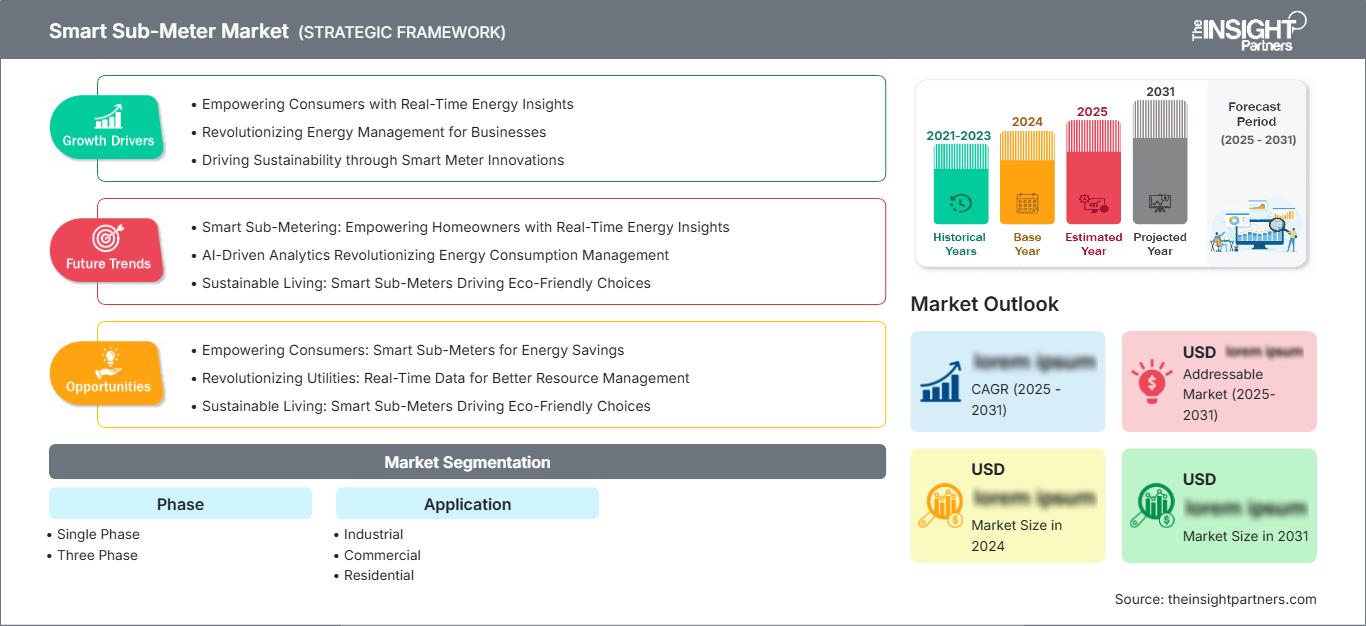
Regional Insights
North America Smart Sub-Meter Market
North America is a dominant force in the global smart sub-meter market, holding an estimated 36.40% share in 2025 and projected to grow at a CAGR of 7-9% from 2026 to 2034. The region's growth is underpinned by widespread deployment of smart grid infrastructure and stringent energy efficiency regulations. The U.S. leads the region, with more than 130 million smart electricity meters in operation by 2025, supporting the adoption of advanced sub-metering solutions.
U.S. Smart Sub-Meter Market
The U.S. accounts for approximately 85-89% of the North American smart sub-meter market share in 2025. The market is characterized by significant investments in smart grid modernization and rising electricity costs. The market is projected to grow at a CAGR of 8-10% from 2026 to 2034, driven by the integration of IoT-enabled sub-metering solutions and the demand for real-time energy management across commercial and industrial sectors.
Europe Smart Sub-Meter Market
Europe is estimated to hold a 28-32% share of the global market in 2025, with a projected CAGR of 6-8% from 2026 to 2034. Germany and the UK are leading countries, driven by strong regulatory frameworks and a focus on achieving carbon neutrality. France, Italy, and Spain are also significant markets, with demand fueled by investments in modernizing aging infrastructure and green building initiatives. The region's emphasis on compliance with energy efficiency directives is accelerating the adoption of smart sub-metering solutions.
APAC Smart Sub-Meter Market
APAC is estimated to hold a 22-26% share of the global market in 2025 and is projected to grow at the fastest CAGR of 8-10% from 2026 to 2034. China, Japan, and India are key markets, driven by rapid urbanization, industrial automation, and large-scale deployment of smart electricity meters. China is a significant market, supported by its strong manufacturing base and aggressive investments in digital power infrastructure. India's market is growing rapidly, fueled by smart metering projects and modernization of electricity distribution infrastructure.
Middle East & Africa Smart Sub-Meter Market
The MEA region is estimated to hold a 3-5% share of the global market in 2025, with a projected CAGR of 5-7% from 2026 to 2034. Saudi Arabia and the UAE are key markets, with growth driven by infrastructure development and investments in smart city initiatives. The UAE is a leader in the region, implementing advanced smart technologies in new developments. Energy efficiency and economic diversification are important contextual factors influencing market growth.
Segmentation Analysis
Phase
The phase segment is categorized into Single Phase and Three Phase. The Three Phase segment is estimated to be the largest, holding a 60-65% share in 2025, with a projected CAGR of 6-8% from 2026 to 2034. Three phase meters are widely used in industrial and commercial applications due to their ability to measure higher power loads and provide more detailed energy consumption data. The smart sub-meter scope encompasses a wide range of phase configurations to suit various application requirements.
- Single Phase: Single phase sub-meters are primarily used in residential settings and smaller commercial establishments. They are cost-effective and suitable for measuring lower power loads, making them ideal for individual apartments, small offices, and retail outlets. The segment is expected to witness higher growth due to increasing adoption in multi-tenant residential complexes.
- Three Phase: Three phase sub-meters dominate the market, driven by their extensive use in industrial facilities, large commercial buildings, and data centers. They provide accurate measurement of high-power loads and support advanced energy management strategies, including demand response and load optimization.
Application
The application segment is divided into Industrial, Commercial, and Residential. The Commercial segment is estimated to be the largest, holding a 35-40% share in 2025, with a projected CAGR of 6-8% from 2026 to 2034. Commercial buildings, including office complexes, shopping malls, and hospitals, require granular energy monitoring to optimize operational costs and comply with energy regulations.
- Industrial: Industrial applications account for a significant share of the market, driven by the need for precise energy monitoring in manufacturing facilities, production lines, and heavy machinery. Sub-meters enable cost allocation, identify inefficiencies, and support energy optimization initiatives.
- Commercial: Commercial sub-metering is essential for office buildings, retail spaces, and institutional facilities. These meters enable accurate cost allocation, tenant billing, and energy performance tracking, supporting sustainability goals and regulatory compliance.
- Residential: The residential segment is growing rapidly, driven by the increasing adoption of smart home technologies and the need for individual tenant billing in multi-unit buildings. Sub-meters in residential applications promote energy conservation and enable fair cost distribution.
Opportunity Snapshot
| Application | Revenue Contribution | Trend Tag | Adoption Stage |
|---|---|---|---|
| Commercial | High | Energy Efficiency | Scaling |
| Industrial | High | Load Optimization | Mature |
| Residential | Medium | Smart Homes | Emerging |
Smart Sub-Meter Market Growth Drivers and Impact Analysis
Growing Focus on Energy Efficiency and Cost Reduction
The trend towards energy efficiency and sustainability in diverse industries represents a driving factor for the development of smart sub-meters. Businesses are looking for accurate and localized data about energy consumption in order to find out energy inefficiency areas and implement measures for energy saving in order to cut costs. Regulations by the government and its policies about energy conservation represent another driving force behind the use of sub-metering which is an indispensable tool in reducing carbon footprint .
In addition, smart sub-metering allows businesses to collect energy consumption data by department, tenants, facilities and equipment. Thus, unusual energy consumption patterns and energy wastage as well as peak consumption times can be discovered, which would not have been possible with regular meters. Detailed information regarding energy consumption will allow optimizing equipment performance and implementing better energy saving strategies. Reduction in electricity consumption leads to cost saving on utilities while contributing to other sustainability goals. Energy costs still remain one of the main operational expenses for any company and it is obvious that the ability of smart sub-meters to provide useful information will promote their adoption in commercial, industrial and residential use.
Technological Advancements in IoT and Wireless Connectivity
The market will be driven by the constant innovations in the field of IoT technology, wireless communication, and cloud-based analytics. IoT-powered sub-meters have new abilities such as real-time information transfer, remote monitoring, and automated reporting of energy usage. The technologies provide a smooth integration into the building management and energy management systems that allow for proactive energy management and preventive maintenance.
Moreover, the improvements in communication technologies make the sub-meters flexible and cost-efficient. The absence of complex cables increases ease of installation, especially in the existing buildings where changes may become complicated. At the same time, cloud platforms allow gathering, analyzing, and accessing the energy data from different locations via a single dashboard. Furthermore, artificial intelligence and advanced analytics can find abnormalities in the energy usage, forecast the future demands, and predict possible equipment issues. Thus, the technologies improve decision-making processes and help facility managers respond promptly to the energy needs. With the expansion of the IoT ecosystem, the smart sub-meters gradually turn into an essential element of the smart buildings.
Stringent Government Regulations and Mandates
Government regulations mandating sub-metering in multi-tenant residential and commercial buildings are a significant driver . Regulatory frameworks promoting energy efficiency and carbon reduction targets are compelling property owners and facility managers to install sub-metering systems . The need for compliance reporting and transparent energy management practices is accelerating the adoption of smart sub-metering solutions across various sectors .
In addition to mandatory requirements, governments are increasingly introducing energy performance standards, building codes, and sustainability initiatives that encourage accurate measurement of electricity consumption. Smart sub-meters support these requirements by providing reliable, detailed, and accessible consumption records for individual units or operational areas. This transparency can help property owners demonstrate compliance while enabling tenants to better understand and manage their energy usage. Regulatory pressure is particularly relevant in commercial complexes, residential developments, industrial facilities, and institutional buildings where energy consumption can vary substantially between occupants or operational zones. As governments strengthen climate policies and energy-efficiency objectives, compliance requirements are expected to remain an important factor supporting the adoption of advanced sub-metering technologies.
Smart Sub-Meter Market Future Trends
Integration of AI and Predictive Analytics
A key future trend is the deep integration of artificial intelligence (AI) and predictive analytics into smart sub-metering systems, which is a major part of the smart sub-meter market trends analysis. AI algorithms will analyze historical and real-time energy consumption data to predict future usage patterns, identify anomalies, and optimize energy distribution . Predictive maintenance capabilities will enable early fault detection and reduce downtime, enhancing operational efficiency and cost savings.
Expansion of Cloud-Based Energy Management Platforms
The market is shifting toward cloud-based energy management platforms that offer scalability, flexibility, and remote access to energy consumption data. These platforms enable seamless integration with IoT-enabled sub-meters and building automation systems, providing a comprehensive view of energy usage dynamics . The adoption of cloud-based solutions is expected to accelerate, driven by the demand for real-time analytics, automated reporting, and centralized control across multiple sites.
Smart Sub-Meter Market Opportunities
Untapped Growth in Emerging Markets
A significant opportunity lies in the expanding adoption of smart sub-metering solutions in emerging markets across Asia Pacific, Latin America, and the Middle East. Rapid urbanization, industrial growth, and increasing energy demands are creating substantial market potential for sub-metering technologies . Companies that can offer cost-effective, scalable, and interoperable solutions tailored to local requirements are well-positioned to capture market share in these high-growth regions, as highlighted in smart sub-meter market forecasts.
Development of Integrated Energy Management Solutions
A major opportunity exists in the development of integrated energy management solutions that combine smart sub-metering with other building automation technologies, such as smart thermostats, occupancy sensors, and lighting controls . By leveraging interconnected IoT ecosystems, businesses can create holistic energy management strategies that optimize resource allocation, reduce carbon footprints, and improve overall building performance. Companies pioneering integrated solutions will be best positioned to benefit from the growing demand for smart buildings and sustainable infrastructure.
Recent Developments
- December 2025: Under Revamped Distribution Sector Scheme (RDSS), 20.33 crore smart meters have been sanctioned based on the proposal submitted by the States. In addition, many States have installed smart meters under the State schemes or externally aided projects. Till date 4.76 crore smart meters have been installed in the country under various schemes. Under RDSS, smart metering is being carried out through Public Private Partnership (PPP) in TOTEX (i.e total expenditure which is sum of capital expenditure and operational expenditure) mode. The Advanced Metering Infrastructure Service Provider (AMISP) is responsible for supplying, maintaining and operating the metering infrastructure post installation.
- February 2025: EDF India announced a strategic joint venture (JV) with Actis, a leading global investor in sustainable infrastructure, to deploy smart metering infrastructure. This collaboration aims to operate a dedicated platform company for Advanced Metering Infrastructure Service Provider (AMISP) concessions, reinforcing EDF India's and Actis' commitment to investing in the Indian power sector.
- February 2025: Tata Power Delhi Distribution said it has collaborated with Probus Smart Things to revolutionize smart metering technology through the adoption of a universal Network Interface Card (NIC) with Bluetooth enabled communication. As part of this collaboration, Tata Power-DDL and Probus will jointly create innovative use cases to advance smart metering technology and will file joint patents to protect the intellectual property arising from these efforts.
Frequently Asked Questions

- Comprehensive Market Sizing and Forecast Analysis
- Detailed Segmentation Analysis
- In-Depth Market Dynamics Assessment
- Regional and Country-Level Insights
- Competitive Landscape and Company Benchmarking
- Strategic Business Intelligence
Recent Reports
Testimonials

The Insight Partners' SCADA System Market report is comprehensive, with valuable insights on current trends and future forecasts. The team was highly professional, responsive, and supportive throughout. We are very satisfied and highly recommend their services.
RAN KEDEM Partner, Reali Technologies LTDs
I requested a report on a very specific software market and the team produced the report in a few days. The information was very relevant and well presented. I then requested some changes and additions to the report. The team was again very responsive and I got the final report in less than a week.
JEAN-HERVE JENN Chairman, Future Analytica
We worked with The Insight Partners for an important market study and forecast. They gave us clear insights into opportunities and risks, which helped shape our plans. Their research was easy to use and based on solid data. It helped us make smart, confident decisions. We highly recommend them.
PIYUSH NAGPAL Sr. Vice President, High Beam Global
The Insight Partners delivered insightful, well-structured market research with strong domain expertise. Their team was professional and responsive throughout. The user-friendly website made accessing industry reports seamless. We highly recommend them for reliable, high-quality research services
YUKIHIKO ADACHI CEO, Deep Blue, LLC.
This is the first time I have purchased a market report from The Insight Partners.While I was unsure at first, I visited their web site and felt more comfortable to take the risk and purchase a market report.I am completely satisfied with the quality of the report and customer service. I had several questions and comments with the initial report, but after a couple of dialogs over email with their analyst I believe I have a report that I can use as input to our strategic planning process.Thank you so much for taking the extra time and making this a positive experience.I will definitely recommend your service to others and you will be my first call when we need further market data.
JOHN SUZUKI President and Chief Executive Officer, Board Director, BK Technologies
I wish to appreciate your support and the professionalism you displayed in the course of attending to my request for information regarding to infectious disease IVD market in Nigeria. I appreciate your patience, your guidance, and the fact that you were willing to offer a discount, which eventually made it possible for us to close a deal. I look forward to engaging The Insight Partners in the future, all thanks to the impression you have created in me as a result of this first encounter.
DR CHIJIOKE ONYIA MANAGING DIRECTOR, PineCrest Healthcare Ltd.Reason to Buy
- Informed Decision-Making
- Understanding Market Dynamics
- Competitive Analysis
- Identifying Emerging Markets
- Customer Insights
- Market Forecasts
- Risk Mitigation
- Boosting Operational Efficiency
- Strategic Planning
- Investment Justification
- Tracking Industry Innovations
- Aligning with Regulatory Trends





 Get Free Sample for