
Smartwatch Chips Market Trends, Share & Demand by 2034
Coverage: By Type (32-bit, 64-bit, Others); Application (Android System Smartwatch, IOS System Smartwatch, Windows System Smartwatch, Others) , and Geography (North America, Europe, Asia Pacific, and South and Central America)
- Status : Data Released
- Report Code : TIPRE00017369
- Category : Electronics and Semiconductor
- No. of Pages : 150
- Available Report Formats :


- Last update date : October 30, 2026


2025 Market Size
US$ 2.3 Bn
Base year value
2034 Forecast
US$ 4.67 Bn
Projected by 2034
CAGR 2026-2034
8.19 %
Growth rate
Addressable Market
US$ 31.32 Bn
(2026-2034)
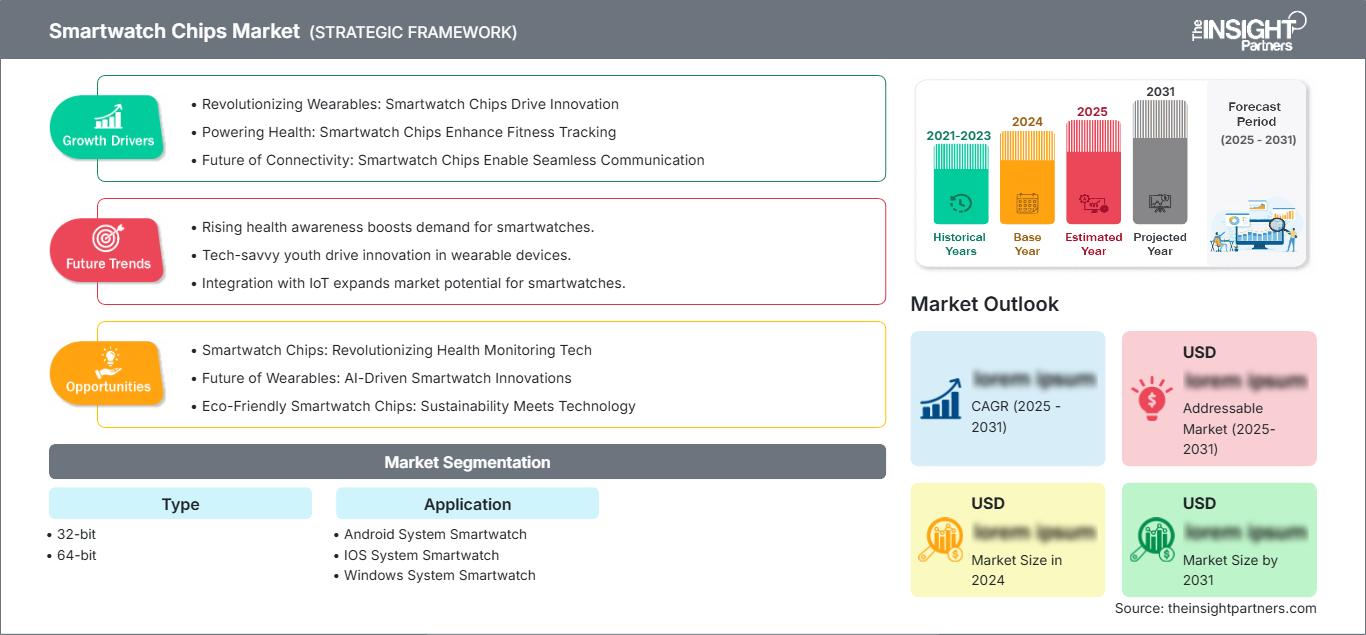
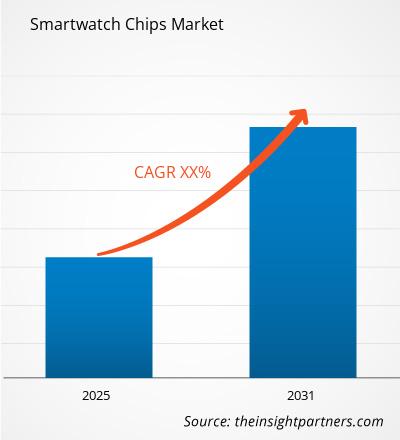
The Smartwatch Chips Market is valued at US$ 2.3 Billion in 2025 and is projected to reach US$ 4.67 Billion by 2034, expanding at a CAGR of 8.19% during 2026–2034. The market encompasses semiconductor processors, system-on-chip platforms, microcontrollers, connectivity-oriented silicon, and supporting processing architectures used in smartwatches across major operating-system ecosystems. Increasing integration of health sensing, wireless connectivity, display management, application processing, and on-device intelligence is reshaping chip requirements across premium and mass-market devices.
North America represents a mature demand center for smartwatch semiconductors, supported by established wearable brands, advanced semiconductor design capabilities, strong developer ecosystems, and high adoption of connected consumer electronics. The regional Smartwatch Chips Market Size is expected to expand at ~7% CAGR through 2034. Demand is increasingly influenced by premium devices requiring higher processing efficiency, sophisticated sensor fusion, AI acceleration, and extended battery performance rather than unit expansion alone.
Smartwatch Chips Market Assessment and Insights
Regional Outlook
- North America: ~31% of the global market in 2025 | ~7% CAGR through 2034. Market position: North America maintains a substantial regional position because of premium smartwatch adoption, advanced semiconductor design capabilities, strong software ecosystems, and demand for sophisticated health, connectivity, and computing functions.
- US: ~70% of North American market revenue in 2025 | ~7% CAGR through 2034. Market position: The US is the principal country market within North America, supported by leading wearable ecosystems, semiconductor innovation, strong consumer electronics spending, and demand for advanced health monitoring and connected smartwatch applications.
- Europe: ~24% of the global market in 2025 | ~6% CAGR through 2034. Market position: Europe represents a mature demand center, with Germany, the UK, France, Italy, and Spain supporting adoption through premium consumer electronics, health-oriented wearables, established distribution networks, and demand for energy-efficient connected devices.
- Asia Pacific: ~36% of the global market in 2025 | ~10% CAGR through 2034. Market position: Asia Pacific is the fastest-growing region, supported by large consumer electronics ecosystems, semiconductor manufacturing depth, expanding smartwatch penetration, and strong demand from China, Japan, South Korea, India, and Australia.
Segment Outlook
- Android System Smartwatch: ~57% Share in 2025 | ~8% CAGR through 2034. Market position: Android-compatible devices lead because the ecosystem spans numerous manufacturers and price tiers, creating broad requirements for processors supporting connectivity, health sensing, displays, applications, and increasingly sophisticated on-device intelligence.
- IOS System Smartwatch: ~39% Share in 2025 | ~9% CAGR through 2034. Market position: The iOS segment records the higher growth outlook as premium smartwatch platforms increasingly combine dedicated processing, health capabilities, AI-enabled functions, advanced displays, and tightly integrated hardware-software experiences.
Competitive Coverage
Arm Limited, Broadcom Inc., Huawei Technologies Co., Ltd., Ingenic Semiconductor Co., Ltd., Intel Corporation, MediaTek Inc., Microchip Technology Incorporated, NXP Semiconductors N.V., Qualcomm Technologies, Inc., SK hynix Inc.
Methodology
The Insight Partners follows Data Collection & Secondary Research, Primary Research, Data Analysis, and Data Triangulation & Final Review to validate market estimates and insights.
Source: The Insight Partners' analysis based on proprietary research, government publications, company annual reports, investor presentations, industry databases, and expert interviews.
Smartwatch Chips Market have grown from simpler low-power controllers to computing systems that have the capability of processing continuous sensing, wireless communications, graphical interfaces, geolocation services, and applications. Previous architectures focused on energy savings and sensor control, while the modern architectures have become more focused on distributing processing tasks across application processors, low-power processors, connectivity units, and accelerators. Arm architectures have been significant within the evolution due to the scalable processing capabilities that enable the handling of both always-on sensors as well as the higher processing tasks.
There is now increased focus on regional semiconductor capabilities as well as the growth of the intelligent wearable ecosystems. Asia Pacific region has become strategically significant due to its role in semiconductor fabrication, device assembly, localization of components, and the presence of large consumer markets. North America region has continued to be influential on the evolution of architectures through its chip design capabilities, software ecosystems, and the development of premium devices. Europe's significance has been from its expertise in electronics engineering and health-related applications. The investments are now being made on lower-power computing, edge AI, secure connectivity, and advanced packaging.
Smartwatch Chips Market Report Scope
| Report Attribute | Details |
|---|---|
| Market size in 2025 | US$ 2.3 Billion |
| Market Size by 2034 | US$ 4.67 Billion |
| Global CAGR (2026 - 2034) | 8.19% |
| Historical Data | 2021-2024 |
| Forecast period | 2026-2034 |
Smartwatch Chips Market Analysis
Demand for smartwatch chips is now largely driven by how many and how complex the functions that a smartwatch has. Monitoring health parameters, GPS location tracking, Bluetooth, Wi-Fi, cellular capability, display, voice input capabilities, and sensor fusion require processing from multiple silicon blocks. The choice of chips for smartwatch designs is increasingly driven by power management, heat dissipation, memory capabilities, software compatibility, and integration than pure processing speed as smartwatches grow into more powerful computing devices. Therefore, the growth expectations for smartwatch chips also depend on both trends in smartwatch shipments and rising semiconductor content of premium models.
Value chain ranges from semiconductor IP development, chip design, wafer manufacturing, package testing, module development, manufacturing of smartwatches, OS integration and distribution channels. Foundry capacity and packaging technology determine supply flexibility, while memory, connectivity chips, power management silicon and sensor interface chips affect cost structure of bill of materials. Integration of processing, connectivity, security and low-power capabilities allows reducing board size and development effort. However, this opens opportunities for differentiating SoCs and companion chips without compromising the need for dedicated sensors, memories or connectivity components.
The competition mentioned in the Smartwatch Chips Market Report includes large silicon suppliers, specific wearable chips providers, technology companies with proprietary silicon, and IP vendors. Qualcomm Technologies, Inc. has bolstered its wearable positioning through platforms that rely on performance, connectivity, power efficiency, and on-device AI. The strategic importance of Arm Limited comes from its processor architectures enabling several types of wearable silicon. MediaTek Inc. and Broadcom Inc. operate in both the connectivity and processing ecosystems, while Huawei Technologies Co., Ltd. designs tightly coupled products in tune with its own device ecosystem. Among the players in this space there are companies like Ingenic Semiconductor Co., Ltd., Microchip Technology Incorporated, NXP Semiconductors N.V., and SK hynix Inc., which cater to specific processing, connectivity, memory, and embedded needs.
The investments are being made into areas of AI acceleration, power-efficient architecture, connectivity and sensor processing integration. Premium smartwatches will need semiconductor roadmaps able to deliver increased computing performance while maintaining the battery life. For example, in 2026 Qualcomm Technologies, Inc. has introduced Snapdragon Wear Elite platform, which features integrated NPU and enhanced connectivity. Thus, strategic positioning in the future will be based on ecosystem compatibility, silicon efficiency, software support, manufacturing scalability, and multi-tier smartwatch offering capabilities.
● REPORT CUSTOMIZATION
Tailor This Report To Align With Your Specific Business Requirements
This report can be customized to align precisely with your business objectives, scope, and target markets. Customization options include tailored segmentation, geography, competitive analysis, and strategic insights to support informed decision-making.
Customize This Report →WHAT YOU CAN ADJUST
- ● Segmentations
- ● Geography
- ● Competitive Analysis
- ● Language Preferences
Smartwatch Chips Market: Strategic Insights
Regional Insights
North America Smartwatch Chips Market
North America remains an important Smartwatch Chips Market because of its concentration of technology companies, premium consumer-electronics demand, advanced chip-design capabilities, and mature digital ecosystems. The region is projected to register ~7% CAGR through 2034. Demand is increasingly associated with higher semiconductor content per device as manufacturers integrate more sophisticated health monitoring, connectivity, location services, display processing, and intelligent software functions.
The US contributes around 70% of North America’s market revenue by 2025 and acts as the primary source of demand in the region. Smartwatches that fall into the category of premium smartwatches need a system with customized processing capabilities and tightly coupled hardware and software. The role of semiconductor firms is that they can provide processor designs, connectivity capabilities, security and power management solutions. There is a change in investment priorities towards edge AI and heterogeneous computing so that certain applications can run on local devices instead of smartphones or clouds.
U.S. Smartwatch Chips Market
The U.S. is responsible for about 70% of North American smartwatch SoC revenues in 2025 and will grow at about 7% CAGR through 2034. It enjoys a rich semiconductor design base, premium wearables brands, software development, and consumer demand for wearable devices providing connected health and fitness solutions. Applications’ needs go beyond notifications to include continuous sensing, navigation, communications, and personal computing.
In the U.S., there is an extensive ecosystem of semiconductor vendors and companies developing platform solutions for wearables. There are differences in chip requirements for devices depending on their tier; premium products require chips with processing capabilities, good displays, wireless connections, sensors’ integration and artificial intelligence (AI) accelerators, while less expensive products require microcontrollers and integrated connections. Growing significance of on-device processing favors architectures capable of processing certain applications locally.
Europe Smartwatch Chips Market
Europe comprises of around 24% share of the worldwide smartwatch chips industry in 2025 and is anticipated to grow at about 6% CAGR till 2034. Europe region is characterized by developed consumer electronics sector along with growing interest in health, fitness, safety, and connected devices. Germany is the top country in Europe when it comes to smartwatch chips demand owing to its advanced technology in the industrial segment, engineering abilities, and huge electronics environment. United Kingdom is a contributing factor due to its technology, software knowledge, and premium wearables adoption.
France and Italy offer developed consumer electronics and luxurious demand environment whereas Spain is contributing owing to the increasing adoption of connected devices and digital consumers. Europe region witnesses an increasing trend of semiconductor requirements in terms of energy efficiency, security, integrated design, and reliable wireless connectivity. The smartwatch chips market in Europe is further influenced by the demand for wearables that can collect health data and facilitate continuous monitoring. As a result, semiconductor providers will have to compromise on computation capability and energy consumption in addition to sensor processing.
APAC Smartwatch Chips Market
Asia Pacific accounts for ~36% of the global smartwatch chips market share in 2025 and is projected to grow at ~10% CAGR through 2034, making it the fastest-growing region. China is the leading country in Asia Pacific, supported by its extensive consumer electronics manufacturing ecosystem, large domestic smartwatch market, semiconductor development, and vertically integrated device supply chains.
These markets offer complementing demand stimuli. The Japanese focus lies in small electronics and health-centric solutions, South Korea in high-tech electronics manufacturing along with premium wearables ecosystems, India offers a large consumer base with increasing use of smartwatches, and Australia with premium demand of connected devices. The local development of semiconductors is now driven by localization, advanced packaging, power efficiency, AI-powered sensing, and supply chain robustness. This creates an opportunity for both SoCs as well as companion silicon for smartwatches.
Middle East & Africa Smartwatch Chips Market
Middle East & Africa represents an emerging smartwatch semiconductor opportunity, with demand supported by connected-device adoption, premium consumer electronics, digital transformation, and expanding healthcare and fitness applications. The region is projected to grow at ~8% CAGR through 2034. Saudi Arabia is the leading country in the Middle East & Africa where available market evidence supports a clear national position, supported by technology investment and consumer electronics demand.
The UAE provides an important premium electronics market and digital infrastructure environment, while South Africa represents a major gateway for wearable distribution across parts of the African market. Rest of MEA demand remains more fragmented and dependent on income levels, retail availability, and smartphone ecosystems. Energy and infrastructure development also support connected-device adoption by expanding digital services and consumer access to wireless networks. Chip suppliers targeting the region must therefore balance advanced functionality with cost-efficient designs and strong interoperability.
Segmentation Analysis
Type
The Type segment in the Smartwatch Chips Market is projected to register a ~9% CAGR through 2034 as smartwatch designers balance application performance with energy efficiency. Architecture selection increasingly reflects operating-system requirements, graphics processing, health analytics, wireless connectivity, and AI workloads. Higher-performance architectures are gaining importance as smartwatches become more capable standalone computing devices rather than smartphone companions.
- 32-bit: 32-bit chips remain relevant in cost-sensitive, low-complexity, and power-constrained smartwatch designs. They can support basic sensing, notifications, simple interfaces, and selected connected functions where extensive application processing is unnecessary. Their strategic role is strongest in products emphasizing affordability and straightforward functionality.
- 64-bit: 64-bit chips are increasingly preferred for premium and advanced smartwatches requiring richer operating systems, multitasking, graphics, sophisticated sensor processing, and AI-assisted functions. Their greater computing headroom supports feature expansion and enables OEMs to accommodate more demanding software without rapidly redesigning the underlying hardware.
Application
The Application segment in the Smartwatch Chips Market is expected to expand at a ~9% CAGR through 2034 as operating-system ecosystems become increasingly differentiated by device integration, software functionality, and application availability. Chip suppliers must optimize processor performance, connectivity, security, and power consumption according to ecosystem requirements, creating distinct design priorities across Android, iOS, and Windows-oriented smartwatch products.
- Android System Smartwatch: Android-oriented smartwatches address a broad OEM ecosystem spanning premium and mass-market devices. Demand is supported by broad smartphone compatibility, Wear OS development, health and fitness applications, and increasing adoption of cellular connectivity. Chip platforms must balance application performance, battery endurance, wireless functionality, and software support.
- IOS System Smartwatch: iOS-oriented smartwatch products emphasize tight integration with Apple's device ecosystem, health services, communications, and privacy-focused processing. Chip requirements center on efficient proprietary architectures, secure sensor handling, graphics responsiveness, and sustained battery performance. The segment remains strategically important for premium wearable silicon.
- Windows System Smartwatch: Windows System Smartwatch applications represent a limited ecosystem compared with Android and iOS. Demand is primarily associated with compatibility-oriented or specialized deployments rather than broad consumer adoption. Opportunities depend on low-cost embedded processing, connectivity support, and specific device integration requirements.
Opportunity Snapshot
| Application | Revenue Contribution | Trend Tag | Adoption Stage |
| Android System Smartwatch | High | Wearable AI | Scaling |
| IOS System Smartwatch | High | Health Compute | Mature |
| Windows System Smartwatch | Low | Embedded Compatibility | Emerging |
Smartwatch Chips Market Growth Drivers and Impact Analysis
Expansion of On-Device AI and Continuous Sensor Processing
The increasing use of AI-enabled functions is raising processing requirements inside smartwatches. Instead of transferring every workload to a smartphone or cloud platform, manufacturers can execute selected tasks locally, including sensor interpretation, voice processing, activity recognition, and contextual functions. This creates demand for processors and accelerators that deliver useful computing performance within strict power and thermal constraints. Arm's low-power processor portfolio illustrates how wearable silicon is adapting to machine-learning workloads while retaining energy efficiency. Qualcomm's 2026 Snapdragon Wear Elite platform similarly demonstrates the growing emphasis on integrated NPU capability for wearable computing. The commercial impact is an increase in semiconductor value per premium device and greater differentiation through processing architecture.
Rising Semiconductor Content from Health and Connectivity Features
Smartwatches increasingly combine multiple health sensors with GNSS, Bluetooth, Wi-Fi, cellular connectivity, displays, storage, and power-management functions. Each additional capability increases the coordination required among processors, memory, connectivity silicon, and sensor interfaces. Continuous monitoring also requires low-power architectures capable of remaining active for long periods without materially reducing battery life. As a result, chip suppliers are increasingly designing heterogeneous architectures that divide high-performance and always-on workloads. This favors integrated SoCs and companion processors that can manage sensor data efficiently. The market impact extends beyond unit shipments because richer feature sets increase silicon complexity, packaging requirements, software integration work, and validation requirements for each new smartwatch generation.
Premiumization of Smartwatch Hardware
Premium smartwatch products are creating demand for higher-performance semiconductor platforms even when lower-priced device volumes remain under pressure. A premium device can incorporate brighter and more advanced displays, richer health sensing, cellular connectivity, faster application processing, navigation, secure payments, and intelligent software functions. This shifts purchasing decisions from simple processor cost toward power efficiency, integration, reliability, and long-term software support. Recent wearable market conditions also show that shipment growth does not always move in parallel with average device value, making semiconductor content an important consideration for suppliers. Premiumization therefore supports continued investment in more capable chips, advanced packaging, memory subsystems, and dedicated acceleration while encouraging vendors to differentiate platforms by performance per watt.
Smartwatch Chips Market Future Trends
AI-Native Wearable Processing Architectures
Future smartwatch platforms are likely to place greater emphasis on AI-native architectures in which neural processing, sensor fusion, and low-power computing are designed together rather than added as separate functions. This can allow watches to interpret physiological and environmental signals locally, support more responsive interfaces, and reduce dependence on continuous smartphone connections. Qualcomm's Snapdragon Wear Elite, introduced in 2026, integrates an NPU with a wearable platform and combines it with multiple low-power connectivity technologies. The smartwatch trends therefore point toward architectures that allocate workloads dynamically between application processors, AI accelerators, always-on cores, and connectivity blocks. Semiconductor suppliers will increasingly need software tools and development ecosystems that enable OEMs to exploit these heterogeneous resources efficiently.
Greater Integration of Processing, Connectivity, and Security
The next generation of smartwatch silicon is expected to combine more functions within compact packages as manufacturers seek thinner devices, longer battery life, and fewer discrete components. Integration can reduce board area and interconnect complexity while improving coordination between processors, wireless interfaces, security engines, and power-management functions. This Smartwatch Chips Market trend is particularly relevant for cellular and AI-capable watches where multiple demanding workloads operate simultaneously. Advanced packaging and heterogeneous integration can further improve performance within constrained thermal envelopes. Over time, the boundary between application processors, connectivity chips, sensor hubs, and security components may become less distinct, creating opportunities for suppliers with broad silicon portfolios and mature software support.
Smartwatch Chips Market Opportunities
Localized Semiconductor Platforms for Asia Pacific OEMs
Asia Pacific offers an important opportunity for chip suppliers because the region combines smartwatch manufacturing, component ecosystems, semiconductor expertise, and large consumer markets. Localized platforms can address regional requirements for cost, connectivity, language processing, power efficiency, and device customization while reducing development complexity for OEMs. Suppliers can pursue this opportunity through reference designs, configurable SoCs, regional engineering centers, and partnerships with smartwatch manufacturers and original design manufacturers. China, South Korea, Japan, and India provide distinct demand environments, allowing vendors to tailor product strategies rather than relying on a single architecture. The Smartwatch Chips Market Forecast opportunity is particularly relevant where domestic device makers seek greater control over component road maps and differentiated user experiences.
Low-Power AI and Health-Sensing Companion Chips
A second opportunity lies in specialized companion silicon designed to process health and sensor workloads without continuously activating the primary application processor. Such chips can manage physiological sensing, motion analysis, always-on displays, biometric signals, and selected AI functions while reducing overall energy consumption. This architecture can complement premium SoCs and extend functionality into mid-range devices where a fully integrated high-performance platform may be economically unsuitable. Suppliers with expertise in ultra-low-power processing, analog interfaces, memory, security, and sensor connectivity can develop differentiated products around these requirements. The commercial opportunity extends across smartwatches, fitness-oriented devices, and adjacent wearable categories, creating potential for scalable silicon platforms rather than single-product solutions.
Recent Developments
- July 2026: Qualcomm Technologies, Inc. announced that its Snapdragon 8 Elite Gen 5 Mobile Platform for Galaxy, Snapdragon Wear Elite Platform and Snapdragon AR1 Gen 1 will power Samsung’s newest devices – including the Samsung Galaxy Z Fold8 Ultra, Samsung Galaxy Z Fold8, Samsung Galaxy Z Flip8, Samsung Galaxy Watch9, Samsung Galaxy Watch Ultra21 and the new Intelligent Eyewear.
- March 2026: Qualcomm Technologies Inc. announced the Snapdragon Wear Elite Platform, a personal AI platform designed to unlock the next generation of truly personal, always-on, intelligent wearable computing devices. Personal AI devices will be a critical layer of the intelligent network for the AI era and Snapdragon Wear Elite is the world’s first Personal AI wearable platform that works across WearOS by Google, Android, and Linux with a NPU for on-device AI and advanced suite of ultra-low power connectivity solutions.
- September 2025: AUO, a global leader in next-generation display technologies, has teamed up with Garmin, a leading global provider of smartwatches and GPS-enabled technology across diverse markets, to launch the Garmin fēnix 8 Pro MicroLED—the world’s first smartwatch equipped with Micro LED display technology. This 1.4-inch display features an ultra-high pixel density of 326 PPI, delivering exceptional brightness, high dynamic contrast, and vivid color saturation for an unparalleled visual experience. By integrating Micro LED technology, AUO and Garmin are redefining the display standards for smartwatches, offering elite athletes and outdoor adventurers a transformative user experience.
Frequently Asked Questions

- Comprehensive Market Sizing and Forecast Analysis
- Detailed Segmentation Analysis
- In-Depth Market Dynamics Assessment
- Regional and Country-Level Insights
- Competitive Landscape and Company Benchmarking
- Strategic Business Intelligence
Recent Reports
Testimonials

The Insight Partners provided valuable market intelligence that supported our global go-to-market strategy. Their team was professional, responsive, and attentive to our feedback, providing thoughtful analysis and helpful methodological clarifications throughout the project.
Junmo Kim Chief Financial Officer (CFO), Enertech Co., Ltd.
The Insight Partners' SCADA System Market report is comprehensive, with valuable insights on current trends and future forecasts. The team was highly professional, responsive, and supportive throughout. We are very satisfied and highly recommend their services.
RAN KEDEM Partner, Reali Technologies LTDs
I requested a report on a very specific software market and the team produced the report in a few days. The information was very relevant and well presented. I then requested some changes and additions to the report. The team was again very responsive and I got the final report in less than a week.
JEAN-HERVE JENN Chairman, Future Analytica
We worked with The Insight Partners for an important market study and forecast. They gave us clear insights into opportunities and risks, which helped shape our plans. Their research was easy to use and based on solid data. It helped us make smart, confident decisions. We highly recommend them.
PIYUSH NAGPAL Sr. Vice President, High Beam Global
The Insight Partners delivered insightful, well-structured market research with strong domain expertise. Their team was professional and responsive throughout. The user-friendly website made accessing industry reports seamless. We highly recommend them for reliable, high-quality research services
YUKIHIKO ADACHI CEO, Deep Blue, LLC.
This is the first time I have purchased a market report from The Insight Partners.While I was unsure at first, I visited their web site and felt more comfortable to take the risk and purchase a market report.I am completely satisfied with the quality of the report and customer service. I had several questions and comments with the initial report, but after a couple of dialogs over email with their analyst I believe I have a report that I can use as input to our strategic planning process.Thank you so much for taking the extra time and making this a positive experience.I will definitely recommend your service to others and you will be my first call when we need further market data.
JOHN SUZUKI President and Chief Executive Officer, Board Director, BK Technologies
I wish to appreciate your support and the professionalism you displayed in the course of attending to my request for information regarding to infectious disease IVD market in Nigeria. I appreciate your patience, your guidance, and the fact that you were willing to offer a discount, which eventually made it possible for us to close a deal. I look forward to engaging The Insight Partners in the future, all thanks to the impression you have created in me as a result of this first encounter.
DR CHIJIOKE ONYIA MANAGING DIRECTOR, PineCrest Healthcare Ltd.Reason to Buy
- Informed Decision-Making
- Understanding Market Dynamics
- Competitive Analysis
- Identifying Emerging Markets
- Customer Insights
- Market Forecasts
- Risk Mitigation
- Boosting Operational Efficiency
- Strategic Planning
- Investment Justification
- Tracking Industry Innovations
- Aligning with Regulatory Trends





 Get Free Sample for