
SMD Thin Film Resistors Market Trends, Size & Growth by 2034
Coverage: By Type (0402 mm, 0603 mm, 0805 mm, 1206 mm, 1210 mm, 2010 mm, Others); Application (Instrumentation, Medical Equipment, Automotive Electronics, Communication Device, Others) , and Geography (North America, Europe, Asia Pacific, and South and Central America)
- Status : Data Released
- Report Code : TIPRE00017176
- Category : Electronics and Semiconductor
- No. of Pages : 150
- Available Report Formats :


- Last update date : October 30, 2026


2025 Market Size
US$ 627.66 Mn
Base year value
2034 Forecast
US$ 1,656.1 Mn
Projected by 2034
CAGR 2026-2034
11.38 %
Growth rate
Addressable Market
US$ 10,062.07 Mn
(2026-2034)
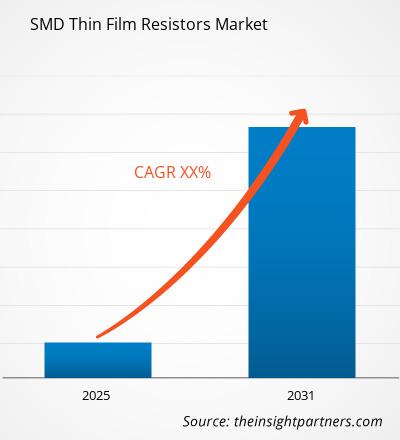
The SMD Thin Film Resistors Market size was valued at US$ 627.66 Million in 2025 and is projected to reach US$ 1,656.1 Million by 2034, expanding at a CAGR of 11.38% from 2026 to 2034. Growth is being supported by increasing demand for compact, high-precision passive components across instrumentation, medical equipment, automotive electronics, and communication devices. Thin film construction enables tighter resistance tolerance, lower temperature coefficients, improved long-term stability, and favorable high-frequency characteristics, supporting adoption where electrical accuracy and miniaturization are important.
North America remains an important demand center in the SMD Thin Film Resistors Market, supported by advanced electronics manufacturing, medical instrumentation, automotive electronics, and communications infrastructure. The regional market is estimated to expand at approximately ~10% CAGR through 2034, with demand reinforced by increasing electronic content in vehicles and continued development of precision measurement and connectivity systems. Automotive qualification requirements and the need for stable components in temperature-sensitive applications are also encouraging suppliers to broaden compact SMD thin film resistor portfolios.
SMD Thin Film Resistors Market Assessment and Insights
Regional Outlook
- North America: ~19% of the global SMD Thin Film Resistors Market share in 2025 | ~10% CAGR through 2034. Market position: North America represents a mature precision-electronics market supported by automotive electronics, medical instrumentation, aerospace-related electronics, communications equipment, and established component distribution channels.
- US: ~78% of North American market revenue in 2025 | ~10% CAGR through 2034. Market position: The US represents the leading country in North America, supported by high-value electronics design, medical equipment, communications infrastructure, automotive technology development, and demand for components with tight tolerance and stable electrical characteristics.
- Europe: ~18% of the global market in 2025 | ~11% CAGR through 2034. Market position: Europe has a mature industrial electronics base, with Germany representing the leading country in Europe. Automotive electronics, industrial automation, medical technology, and communications equipment support continued demand for precision SMD components.
- Asia Pacific: ~55% of the global market in 2025 | ~12% CAGR through 2034. Market position: Asia Pacific is the largest and fastest-growing regional market, supported by electronics manufacturing concentration, semiconductor and PCB ecosystems, automotive electrification, telecommunications infrastructure, and expanding component production in China, Japan, South Korea, and India.
Segment Outlook
- Type: ~55% Share in 2025 | ~11% CAGR through 2034. Market position: Type-based demand remains central to the market because package dimensions determine board utilization, assembly compatibility, electrical performance, and suitability for increasingly compact electronic designs.
- Application: ~45% Share in 2025 | ~12% CAGR through 2034. Market position: Application demand is expanding rapidly as precision resistors become increasingly important in instrumentation, medical electronics, automotive systems, and communication equipment requiring miniaturization and electrical stability.
Competitive Coverage
Bourns, Inc., Cyntec Co., Ltd., KOA Speer Electronics, Inc., Panasonic Corporation, Ralec Electronic Corp., Susumu Co., Ltd., TE Connectivity, Vishay Intertechnology, Inc., Walsin Technology Corporation, YAGEO Corporation
Methodology
The Insight Partners follows Data Collection & Secondary Research, Primary Research, Data Analysis, and Data Triangulation & Final Review to validate market estimates and insights.
Source: The Insight Partners' analysis based on proprietary research, government publications, company annual reports, investor presentations, industry databases, and expert interviews.
In terms of product development, the SMD thin film resistor industry has advanced from standard precision products to highly compact and application specific components. Developments in thin film depositing, patterning, protecting, and automation of SMD assembly have allowed companies to increase performance (tolerance, temperature coefficient, noise performance) and reliability while minimizing package size. More suppliers now offer 0402, 0603, 0805, 1206, 1210, and 2010 packages according to differing power ratings, board real estate, and operating environments. In addition, automotive qualification is growing in importance as electronic content increases in battery management, power conversion, sensing, communication, and control applications.
Growth to 2034 is forecast to be driven by electronics manufacturing in Asia Pacific, the continuation of vehicle electrification, and increased use of precision electronics in medicine and communications systems. Investments in electronics manufacturing capacity and local supply chain infrastructure will enhance regional availability of components. On the other hand, qualifications needs, traceability, environmental regulations, and demand for high frequency stability will all play a role in supplier selection. Thus, the industry is expected to grow due to volume growth, packaging miniaturization, application specific design, and higher performance.
SMD Thin Film Resistors Market Report Scope
| Report Attribute | Details |
|---|---|
| Market size in 2025 | US$ 627.66 Million |
| Market Size by 2034 | US$ 1,656.1 Million |
| Global CAGR (2026 - 2034) | 11.38% |
| Historical Data | 2021-2024 |
| Forecast period | 2026-2034 |
SMD Thin Film Resistors Market Analysis
The SMD Thin Film Resistors Market will follow the development of electronics that require accurate resistance, low temperature coefficient, stable operation, and miniaturization. Instrumentation and medical devices require resistors that exhibit consistent electrical behavior over long periods of time, and automotive electronics need reliable resistors that operate under thermal cycling and mechanical vibration. Communication systems also have demands regarding high-frequency behavior and minimal parasitic effects. Such demands make the value chain cover resistive-film materials vendors, substrate and coating suppliers, resistor makers, distributors, PCB assemblers, OEMs, and systems integrators.
The supply side dynamics include automation, high-precision technologies of deposition, packaging capabilities, and qualification processes. Manufacturers that have well-established process control and wide packaging options will be able to work in different applications, adjusting the resistance value, tolerance, TCR, and other environmental features. Moreover, a large share of electronics manufacturing in Asia Pacific contributes to an effective manufacturing and supply processes. On the other hand, buyers tend to have several qualified sources of supply, which makes suppliers increase their manufacturing and supply footprints.
Positioning is becoming more of a question of precision, reliability, packaging density, application qualification, and portfolio diversity, not just price. Vishay Intertechnology, Inc. has a diversified range of thin-film resistors covering automotive, high frequency, precision, and high reliability, whereas Susumu Co., Ltd. focuses on the development of thin-film resistors and high precision products. Bourns, Inc. offers more advanced thin-film automotive resistor products, while KOA Speer Electronics, Inc., Panasonic Corporation, TE Connectivity, YAGEO Corporation, Walsin Technology Corporation, Cyntec Co., Ltd., and Ralec Electronic Corp. cover precision and surface mount applications.
The emphasis in investments goes towards miniaturization, high frequency operation, automotive qualification, production automation, and development of application specific products. This means that positioning strategy becomes dependent on the capability of a company to combine consistent manufacturing with fast customizing and qualifying processes. Companies having customer connections with automotive, medical, industrial, and communications industries can leverage these capabilities in positioning purposes.
● REPORT CUSTOMIZATION
Tailor This Report To Align With Your Specific Business Requirements
This report can be customized to align precisely with your business objectives, scope, and target markets. Customization options include tailored segmentation, geography, competitive analysis, and strategic insights to support informed decision-making.
Customize This Report →WHAT YOU CAN ADJUST
- ● Segmentations
- ● Geography
- ● Competitive Analysis
- ● Language Preferences
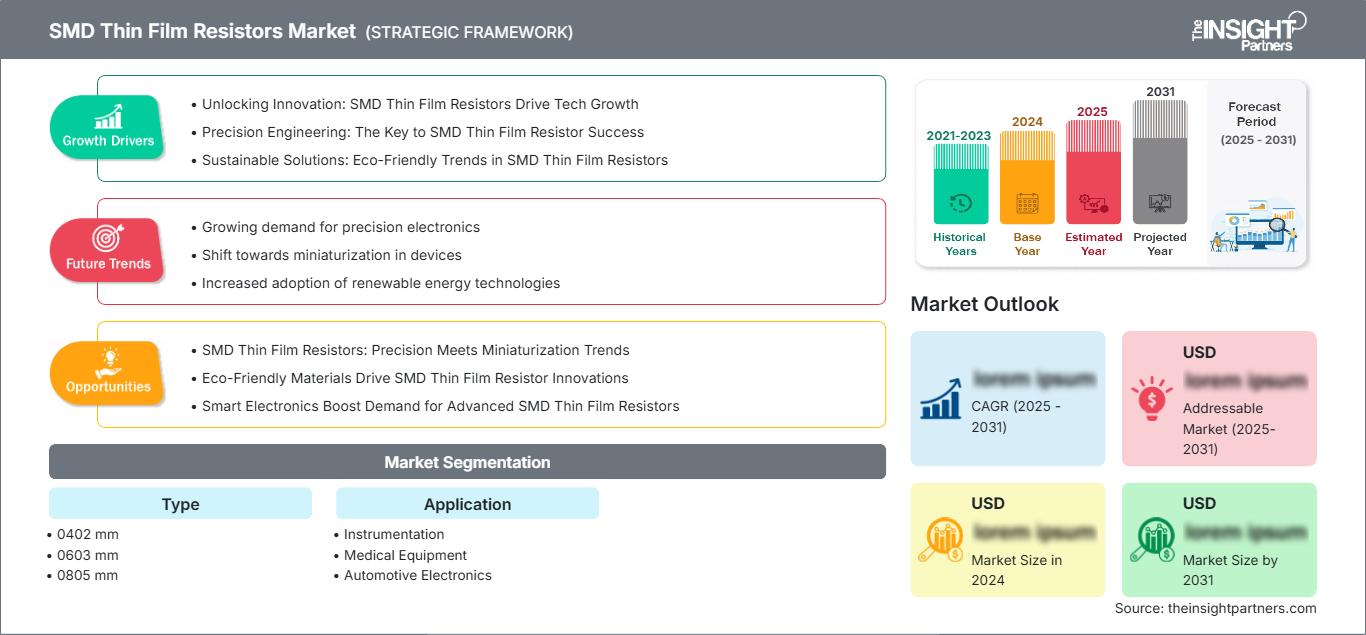
SMD Thin Film Resistors Market: Strategic Insights
Regional Insights
North America SMD Thin Film Resistors Market
North America accounted for approximately ~19% of the global SMD thin film resistor market in 2025 and is projected to expand at approximately ~10% CAGR through 2034. This area is served by well-developed ecosystems for automotive electronics, medical instruments, industrial instruments, telecommunications, and aerospace electronics. The need for products is focused on precision elements for use in control, sensing, signal conditioning, power management, and communications circuits.
The USA is the leader in North America and constitutes about ~78% of regional sales in 2025. There is an increasing emphasis on automotive and high-reliability applications, where high tolerance and consistent performance at higher temperatures matter. The product offerings of Bourns, Inc. and Vishay Intertechnology, Inc. demonstrate the ongoing trend towards the automotive-qualified thin-film products.
U.S. SMD Thin Film Resistors Market
The US represented approximately ~78% of the North American market in 2025 and is expected to expand at approximately ~10% CAGR through 2034. The demand foundation of the country consists of medical, industrial instrumentation, automotive electronics, communications, aerospace electronics, and high value added electronics with predictable electrical properties. The design phase is especially important due to the fact that precise passive components are chosen at an early stage of designing circuits.
Suppliers based both in the United States and abroad have good market penetration due to sales, engineering, qualification, and distribution infrastructure. Automotive thin film products become more and more important for battery management, sensing, signal conditioning, and connectivity. High frequency products are used in communication and RF equipment, whereas medical applications demand stable, noiseless components.
Europe SMD Thin Film Resistors Market
Europe represented approximately ~18% of the global market in 2025 and is estimated to expand at approximately ~11% CAGR through 2034. Germany is the leading country in Europe, supported by its automotive manufacturing base, industrial automation capabilities, electronics engineering ecosystem, and broad supplier network. Germany is followed by the UK, France, Italy, and Spain as important application and manufacturing markets. Automotive electronics remains a major demand channel, particularly for precision control, sensing, power conversion, and communications functions.
The UK contributes through aerospace, medical technology, telecommunications, and industrial electronics, while France has demand from automotive, aerospace, defense-related electronics, and industrial systems. Italy and Spain provide additional demand through industrial equipment, automotive supply chains, renewable-energy electronics, and automation. Across Europe, regulatory requirements and customer emphasis on reliability encourage component suppliers to provide documented performance, traceability, environmental compliance, and qualification support. The region's mature electronics ecosystem therefore favors suppliers able to meet demanding technical specifications while supporting established OEM and tier-supplier qualification processes.
APAC SMD Thin Film Resistors Market
The SMD Thin Film Resistors Market forecast shows that Asia Pacific represented approximately ~55% of the global market in 2025 and is projected to grow at approximately ~12% CAGR through 2034, making it the fastest-growing regional market. China is the leading country in Asia Pacific, supported by its extensive electronics manufacturing ecosystem, telecommunications equipment production, automotive manufacturing, and PCB assembly capacity. Japan and South Korea contribute through precision electronics, automotive systems, semiconductor-related equipment, and advanced communications.
India is gaining importance as electronics manufacturing and automotive production expand, while Australia contributes through industrial, communications, medical, and specialized electronics demand. The region's combination of manufacturing concentration, domestic electronics consumption, localization initiatives, and expanding automotive electronics provides a broad base for SMD thin film resistor adoption.
Middle East & Africa SMD Thin Film Resistors Market
Middle East and Africa demand is developing from a smaller base, with approximately ~11% CAGR through 2034. Saudi Arabia represents an important country within the region, supported by industrial diversification, infrastructure investment, communications modernization, and increasing deployment of electronically controlled equipment. The UAE also contributes through communications, infrastructure, transportation, and technology projects, while South Africa remains an important market for industrial and automotive electronics.
Demand is increasingly linked to infrastructure modernization, energy systems, industrial automation, telecommunications, and electronic control equipment. The region remains more dependent on imported electronic components than mature manufacturing centers, making distributor networks, supply continuity, and application engineering important factors in market development. Local electronics assembly and industrial investment could progressively broaden the addressable customer base.
Segmentation Analysis
Type
The Type segment is projected to expand at approximately ~11% CAGR from 2026 to 2034. Package dimensions influence PCB density, assembly compatibility, thermal behavior, power handling, and the physical integration of resistors into increasingly compact electronic systems. Demand is consequently shifting toward package configurations that balance miniaturization with application-specific electrical requirements.
- 0402 mm: Compact 0402 mm resistors support high-density PCB designs where board space is constrained. Their importance is particularly visible in mobile, communication, automotive electronics, and precision circuits where component footprint reduction must be balanced against assembly and reliability requirements.
- 0603 mm: 0603 mm packages provide a practical balance between compactness and handling, supporting broad use across instrumentation, medical electronics, automotive systems, and communications. Their established assembly compatibility makes them important for designs requiring precision without the smallest available footprint.
- 0805 mm: 0805 mm devices remain relevant where designers require greater physical area for electrical performance, thermal management, or manufacturing robustness. They are suitable for industrial, automotive, medical, and communication circuits in which miniaturization is important but extreme footprint reduction is not the primary requirement.
- 1206 mm: 1206 mm configurations address applications requiring greater physical size and comparatively higher power-handling capability. They remain relevant in industrial instrumentation, automotive electronics, and power-related signal circuits where electrical stability and mechanical robustness influence component selection.
- 1210 mm: 1210 mm packages serve applications requiring additional physical area while maintaining surface-mount assembly. Their strategic importance lies in designs where power dissipation, voltage handling, and reliability considerations outweigh the need for the smallest package.
- 2010 mm: 2010 mm configurations are used where higher power handling and physical robustness are prioritized over maximum miniaturization. They remain relevant to industrial and automotive electronic designs requiring stable resistance characteristics under comparatively demanding operating conditions.
Application
The Application segment is projected to grow at approximately ~12% CAGR from 2026 to 2034. Expansion is being supported by greater electronic content in vehicles, increasing instrumentation requirements, medical device sophistication, and communications equipment development. Applications requiring accurate signal conditioning and stable resistance characteristics provide a particularly strong design-in environment.
- Instrumentation: Instrumentation applications emphasize precision, low TCR, stability, and low electrical noise. These characteristics are important in measurement systems, laboratory equipment, industrial controls, and diagnostic instruments where resistance variation can directly affect measurement accuracy and system calibration.
- Medical Equipment: Medical equipment uses precision passive components in monitoring, imaging, diagnostic, and control circuits. Long-term stability, predictable temperature behavior, compact packaging, and reliability are important because electronic assemblies must maintain consistent operation across extended service periods and demanding operating conditions.
- Automotive Electronics: Automotive electronics represents a high-growth application as vehicles incorporate more sensors, control modules, connectivity, battery-management functions, and advanced driver-assistance electronics. AEC-Q200 qualification, compact packaging, environmental robustness, and low TCR are increasingly relevant to component selection.
- Communication Device: Communication devices require compact, stable components capable of supporting signal conditioning and high-frequency circuitry. Demand is reinforced by wireless infrastructure, connected devices, telecommunications equipment, and increasing requirements for compact RF and high-speed electronic assemblies.
Opportunity Snapshot
| Application | Revenue Contribution | Trend Tag | Adoption Stage |
|---|---|---|---|
| Instrumentation | High | Precision Measurement | Mature |
| Medical Equipment | Medium | Diagnostic Electronics | Scaling |
| Automotive Electronics | High | Vehicle Electrification | Scaling |
| Communication Device | Medium | RF Miniaturization | Scaling |
SMD Thin Film Resistors Market Growth Drivers and Impact Analysis
Rising Electronic Content in Vehicles and Electrification Systems
Automotive electronics is increasing the number of circuits requiring precision resistance, sensing, signal conditioning, and control. Electric and hybrid vehicles contain electronic systems spanning battery management, charging, power conversion, thermal management, connectivity, and motor control. These systems place greater emphasis on component reliability under temperature variation, vibration, and electrical stress. Thin film resistors can address applications requiring controlled resistance values, low TCR, compact footprints, and stable performance. Automotive qualification requirements also create entry barriers that favor manufacturers with established testing and process-control capabilities. As vehicle electronics become more distributed across control units and sensor systems, demand is shifting from simple volume procurement toward application-specific component qualification. This mechanism supports continued adoption across both conventional and electrified vehicle platforms.
Miniaturization of Precision Electronic Assemblies
Electronics manufacturers continue to seek higher circuit density without proportionally increasing PCB dimensions. This requirement encourages the adoption of smaller SMD packages while maintaining adequate tolerance, thermal performance, and manufacturing reliability. Thin film technology is particularly relevant because precise resistive layers can support stable electrical characteristics in compact form factors. The trend affects medical equipment, instrumentation, communication devices, automotive electronics, and industrial control systems. Smaller packages also support automated assembly and greater component density, allowing designers to reduce board area or incorporate additional functionality within existing form factors. Vishay's portfolio, for example, includes precision thin film products spanning compact package sizes, while Bourns has introduced automotive-grade thin film devices in 0402, 0603, 0805, and 1206 formats.
Expansion of High-Precision and High-Frequency Electronics
The increasing use of high-speed communication, RF equipment, medical imaging, advanced instrumentation, and connectivity systems creates demand for passive components with predictable high-frequency behavior. Thin film structures can provide low temperature coefficients, stable resistance, and favorable signal characteristics, supporting applications where parasitic effects and resistance drift can influence system performance. The demand mechanism extends beyond telecommunications to automotive radar, connected vehicles, medical imaging equipment, and specialized industrial electronics. Product development is consequently moving toward smaller packages combined with stronger high-frequency and environmental performance. Recent product introductions demonstrate this direction, including high-frequency thin film devices designed for automotive, telecom, medical, and other demanding applications.
SMD Thin Film Resistors Market Future Trends
Integration of High-Frequency Performance With Smaller Packages
The SMD Thin Film Resistors Market trends indicate that future product development is expected to increasingly combine miniaturized package dimensions with high-frequency performance and higher power density. Designers of communication, radar, medical imaging, and connected automotive systems require components that occupy limited PCB area while maintaining predictable electrical characteristics at higher operating frequencies. This trend is likely to encourage greater use of advanced substrates, improved thin-film deposition, optimized terminal structures, and tighter manufacturing controls. Vishay's September 2026 introduction of its CHEP series illustrates this direction, with 0402 and 0603 thin film chip resistors designed around high-frequency performance and enhanced power handling. Such developments indicate that package miniaturization is increasingly being pursued together with performance enhancement rather than as an isolated footprint-reduction objective.
Greater Emphasis on Reliability Qualification and Application-Specific Design
Future market development is expected to place greater emphasis on qualification, traceability, environmental robustness, and application-specific electrical performance. Automotive and aerospace applications increasingly require evidence that components can withstand thermal, mechanical, electrical, and environmental stresses. Medical and industrial systems similarly require stable performance over extended operating periods. This will encourage suppliers to develop specialized versions of standard package families, including products with tighter tolerance, lower TCR, improved moisture resistance, sulfur resistance, and high-frequency stability. Qualification capabilities can therefore become a differentiating factor alongside price and package availability. Suppliers that combine reliable mass production with application engineering and documented qualification data can address a broader range of demanding design environments.
SMD Thin Film Resistors Market Opportunities
Localized Electronics Manufacturing in Emerging Asian Markets
Expansion of electronics manufacturing in India and other emerging Asian economies creates opportunities for resistor manufacturers, distributors, and application-engineering partners. Growth in automotive electronics, telecommunications equipment, industrial automation, consumer electronics, and medical-device assembly can increase local demand for precision passive components. Manufacturers can capture this opportunity by establishing regional distribution, technical support, qualification assistance, and supply-chain partnerships rather than relying exclusively on centralized exports. Localization also provides opportunities to serve customers seeking shorter lead times and greater supply resilience. India is particularly relevant because growth in electronics production can increase demand for standardized SMD components while encouraging local assembly and design activity. The opportunity therefore extends beyond direct component sales to regional engineering support and long-term customer qualification.
Automotive and Advanced Communication Design-In Opportunities
Automotive electronics and advanced communication systems offer opportunities for suppliers capable of meeting demanding electrical and environmental requirements. Automotive radar, connectivity, battery management, sensing, and control systems increasingly require precision passive components that combine compact packaging with stable performance. Communication equipment similarly requires components capable of supporting high-frequency operation and dense PCB architectures. Suppliers can pursue design-in opportunities by developing application-specific product families, providing simulation data, qualification documentation, and engineering support, and maintaining consistent package availability. High-frequency thin film products are particularly relevant to systems where electrical parasitics and resistance stability influence signal integrity. This creates opportunities for manufacturers to compete through technical differentiation and customer-specific engineering rather than relying solely on volume and cost.
Recent Developments
- September 2026: Vishay Intertechnology, Inc. introduced the CHEP series of thin film high-frequency chip resistors in compact 0402 and 0603 case sizes. The devices use an aluminum nitride substrate and are designed to combine higher power handling with high-frequency performance without requiring a heatsink, supporting applications where board space and thermal management are constrained.
- August 2026: Susumu Co., Ltd. participated in TECHNO-FRONTIER 2026 and presented its resistor technology, product lineup, technical characteristics, and application focus. The event activity reflects the company's continued emphasis on resistor technology development and application-specific electronics requirements.
- August 2024: Bourns, Inc. announced its CRT-A Series of AEC-Q200-compliant automotive-grade thin film chip resistors. The SMD devices are available in 0402, 0603, 0805, and 1206 package sizes and target automotive and space-constrained electronic applications requiring improved tolerance and temperature-coefficient performance.
Frequently Asked Questions

- Comprehensive Market Sizing and Forecast Analysis
- Detailed Segmentation Analysis
- In-Depth Market Dynamics Assessment
- Regional and Country-Level Insights
- Competitive Landscape and Company Benchmarking
- Strategic Business Intelligence
Recent Reports
Testimonials

The Insight Partners provided valuable market intelligence that supported our global go-to-market strategy. Their team was professional, responsive, and attentive to our feedback, providing thoughtful analysis and helpful methodological clarifications throughout the project.
Junmo Kim Chief Financial Officer (CFO), Enertech Co., Ltd.
The Insight Partners' SCADA System Market report is comprehensive, with valuable insights on current trends and future forecasts. The team was highly professional, responsive, and supportive throughout. We are very satisfied and highly recommend their services.
RAN KEDEM Partner, Reali Technologies LTDs
I requested a report on a very specific software market and the team produced the report in a few days. The information was very relevant and well presented. I then requested some changes and additions to the report. The team was again very responsive and I got the final report in less than a week.
JEAN-HERVE JENN Chairman, Future Analytica
We worked with The Insight Partners for an important market study and forecast. They gave us clear insights into opportunities and risks, which helped shape our plans. Their research was easy to use and based on solid data. It helped us make smart, confident decisions. We highly recommend them.
PIYUSH NAGPAL Sr. Vice President, High Beam Global
The Insight Partners delivered insightful, well-structured market research with strong domain expertise. Their team was professional and responsive throughout. The user-friendly website made accessing industry reports seamless. We highly recommend them for reliable, high-quality research services
YUKIHIKO ADACHI CEO, Deep Blue, LLC.
This is the first time I have purchased a market report from The Insight Partners.While I was unsure at first, I visited their web site and felt more comfortable to take the risk and purchase a market report.I am completely satisfied with the quality of the report and customer service. I had several questions and comments with the initial report, but after a couple of dialogs over email with their analyst I believe I have a report that I can use as input to our strategic planning process.Thank you so much for taking the extra time and making this a positive experience.I will definitely recommend your service to others and you will be my first call when we need further market data.
JOHN SUZUKI President and Chief Executive Officer, Board Director, BK Technologies
I wish to appreciate your support and the professionalism you displayed in the course of attending to my request for information regarding to infectious disease IVD market in Nigeria. I appreciate your patience, your guidance, and the fact that you were willing to offer a discount, which eventually made it possible for us to close a deal. I look forward to engaging The Insight Partners in the future, all thanks to the impression you have created in me as a result of this first encounter.
DR CHIJIOKE ONYIA MANAGING DIRECTOR, PineCrest Healthcare Ltd.Reason to Buy
- Informed Decision-Making
- Understanding Market Dynamics
- Competitive Analysis
- Identifying Emerging Markets
- Customer Insights
- Market Forecasts
- Risk Mitigation
- Boosting Operational Efficiency
- Strategic Planning
- Investment Justification
- Tracking Industry Innovations
- Aligning with Regulatory Trends





 Get Free Sample for