
Soil Monitoring Market Growth, Share & Trends by 2034
Coverage: by Offering (Hardware, Software, Services); System Type (Sensing and Imagery Systems, Ground-Based Monitoring Systems, Others); Application (Agricultural, Non-Agricultural), and Geography (North America, Europe, Asia Pacific, and South and Central America)
- Status : Data Released
- Report Code : TIPRE00015027
- Category : Electronics and Semiconductor
- No. of Pages : 150
- Available Report Formats :


- Last update date : October 30, 2026


2025 Market Size
US$ 747.79 Mn
Base year value
2034 Forecast
US$ 2,419.97 Mn
Projected by 2034
CAGR 2026-2034
13.94 %
Growth rate
Addressable Market
US$ 13,670.27 Mn
(2026-2034)
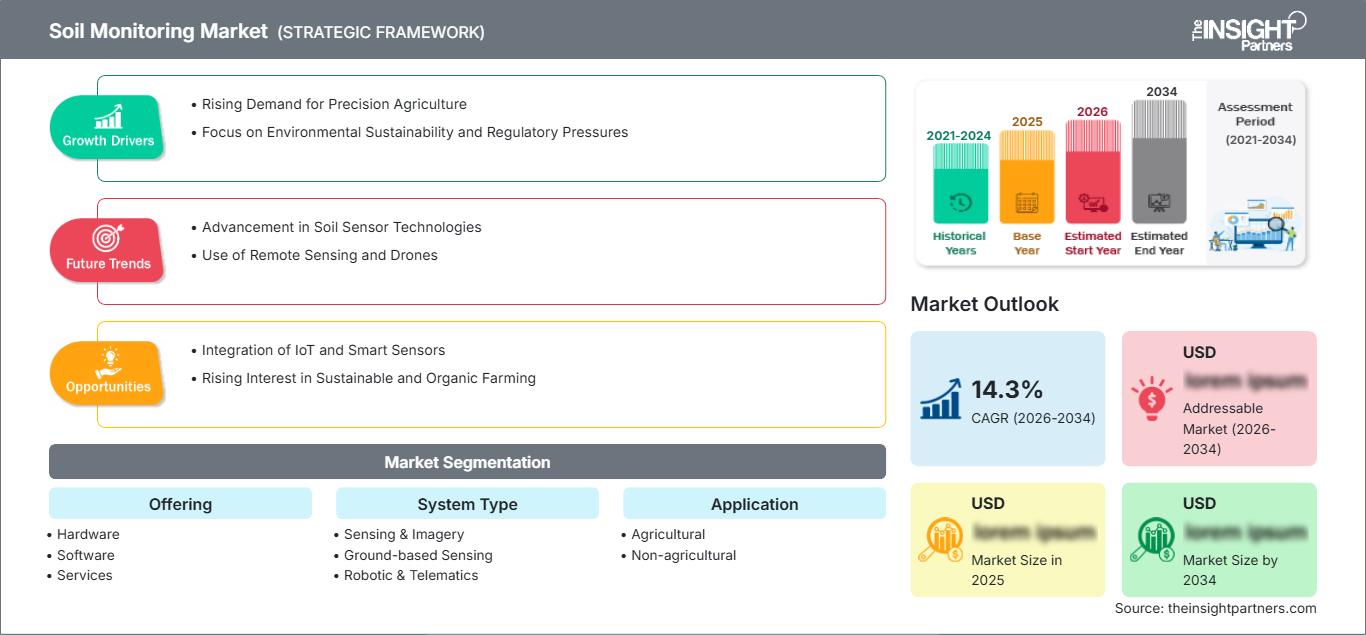
The Soil Monitoring Market was valued at US$ 747.79 Million in 2025 and is projected to reach US$ 2,419.97 Million by 2034, registering a CAGR of 13.94% during 2026–2034. The market encompasses hardware, software, and services used to capture, transmit, analyze, and interpret soil conditions across agricultural and non-agricultural environments. Increasing emphasis on water efficiency, soil health, precision agriculture, environmental management, and data-driven land stewardship is expanding the role of connected soil intelligence.
North America provides a mature technology base, with the region expected to register a ~12% CAGR through 2034. The Soil Monitoring Market size in the region is supported by precision irrigation, commercial agriculture, environmental research, and established sensor infrastructure. Continued investment in digital agriculture and increasingly sophisticated soil-health measurement are strengthening demand for connected sensing and analytics solutions.
Soil Monitoring Market Assessment and Insights
Regional Outlook
- North America: ~30% of the global market in 2025 | ~12% CAGR through 2034. Market position: North America maintains a major position through established precision-agriculture infrastructure, commercial irrigation adoption, environmental monitoring, and strong availability of sensor, telemetry, analytics, and farm-management technologies.
- US: ~84% of North American market revenue in 2025 | ~12% CAGR through 2034. Market position: The US represents the largest country market within North America, supported by precision farming, irrigation management, research applications, digital agriculture programs, and established suppliers serving agricultural and environmental monitoring requirements.
- Europe: ~27% of the global market in 2025 | ~13% CAGR through 2034. Market position: Europe has a mature environmental monitoring ecosystem and expanding soil-health policy requirements. Germany leads the region, while the UK, France, Italy, and Spain contribute through agricultural digitization and land-management applications.
- Asia Pacific: ~31% of the global market in 2025 | ~17% CAGR through 2034. Market position: Asia Pacific is the fastest-growing region, led by China, with Japan, South Korea, India, and Australia contributing. Water scarcity, agricultural modernization, and digital farming investments support rapid adoption.
Segment Outlook
- Hardware: ~52% Share in 2025 | ~13% CAGR through 2034. Market position: Hardware leads because physical sensing devices remain essential for generating soil moisture, temperature, electrical conductivity, nutrient, and related field measurements. Connected probes, telemetry units, and imaging equipment form the foundation for downstream analytics.
- Robotic & Telematics: ~18% Share in 2025 | ~17% CAGR through 2034. Market position: Robotic & Telematics is expanding rapidly as mobile platforms, autonomous equipment, wireless communications, and location-aware systems enable higher spatial coverage and more frequent soil observations without relying entirely on fixed sampling points.
Competitive Coverage
Stevens Water Monitoring Systems, Inc., SGS Société Générale de Surveillance SA, METER Group, Inc., Element Materials Technology Group Limited, The Toro Company, Campbell Scientific, Inc., Sentek Pty Ltd, Spectrum Technologies, Inc., Irrometer Company, Inc., CropX Technologies, Inc.
Methodology
The Insight Partners follows Data Collection & Secondary Research, Primary Research, Data Analysis, and Data Triangulation & Final Review to validate market estimates and insights.
Source: The Insight Partners' analysis based on proprietary research, government publications, company annual reports, investor presentations, industry databases, and expert interviews.
Soil Monitoring Market has evolved from periodic laboratory sampling and manually collected field observations toward continuous, connected measurement. Modern systems combine moisture, temperature, electrical conductivity, water potential, salinity, nutrient, and other indicators with telemetry, cloud platforms, imagery, and analytical software. This transition is changing the production ecosystem because farmers, researchers, irrigation managers, and environmental organizations can increasingly observe soil conditions at greater spatial and temporal resolution. Connected sensors are also being integrated with weather, crop, and irrigation information, allowing soil data to become part of broader decision-support workflows.
Looking ahead, the market will be influenced by the rise of new agricultural economies and government-led soil health policies. In Asia Pacific, there is potential for quick implementation because farmers face water limitations, varying soil types, and the requirement to improve production efficiency through better management of inputs. There is an increasing emphasis on building the institutional argument for soil monitoring standards in Europe, while low-cost and multispectral sensors are being developed as part of research activities in North America.
Soil Monitoring Market Report Scope
| Report Attribute | Details |
|---|---|
| Market size in 2025 | US$ 747.79 Million |
| Market Size by 2034 | US$ 2,419.97 Million |
| Global CAGR (2026 - 2034) | 13.94% |
| Historical Data | 2021-2024 |
| Forecast period | 2026-2034 |
Soil Monitoring Market Analysis
The Soils Monitoring Market is growing owing to the need for decisions regarding irrigation, fertilization, land management, and other actions based on detailed field information. In the ecosystem of the market, one can distinguish the companies that produce measuring instruments and imaging, telemetry providers, platforms, and analytics developers, providers of agronomic services, laboratories, machinery makers, distribution companies, and end customers. The hardware measures, software transforms data into information, and services facilitate calibration, installation, interpretation, maintenance, and integration. Such a structure provides opportunities because any monitoring system requires hardware and software infrastructure.
The supply chain is changing from separate measuring devices to integrated solutions. Nowadays, vendors incorporate their measuring probes with wireless communication channels, platforms in clouds, dashboards, and decision-making tools. Campbell Scientific, Inc. offers multi-parameter soil measurements and integration of data collection systems. METER Group, Inc. combines soil measuring instruments and logging data with cloud computing. CropX Technologies, Inc. integrates field measuring with agronomic analytics.
According to the Soil Monitoring Market Report, there is a fragmented competitive landscape featuring specialized instrumentation vendors, agricultural technology vendors, testing vendors, irrigation equipment manufacturers, and digital agronomy platforms. Stevens Water Monitoring Systems, Inc., and Campbell Scientific, Inc. concentrate on field measurement and field data acquisition, while METER Group, Inc. specializes in soil sensing and environmental monitoring. Toro Company considers soil intelligence in irrigation management solutions, while CropX Technologies, Inc. offers soil intelligence solutions that combine sensing with digital agronomy. Finally, SGS Société Générale de Surveillance SA and Element Materials Technology Group Limited specialize in testing services, thus expanding the addressable ecosystem.
Capital is increasingly flowing into hardware connectivity, wireless communications technologies, sensor miniaturization, remote sensing, artificial intelligence, and software interoperability. Competitive differentiation is therefore moving away from just sensor precision toward deployment, data continuity, analytics quality, integration with farm management systems, and prescriptive recommendations. The ability of the company to connect field data with irrigation, crops, weather or environmental workflows helps to build recurring service relationships and decrease the level of complexity for the end-users.
● REPORT CUSTOMIZATION
Tailor This Report To Align With Your Specific Business Requirements
This report can be customized to align precisely with your business objectives, scope, and target markets. Customization options include tailored segmentation, geography, competitive analysis, and strategic insights to support informed decision-making.
Customize This Report →WHAT YOU CAN ADJUST
- ● Segmentations
- ● Geography
- ● Competitive Analysis
- ● Language Preferences
Soil Monitoring Market: Strategic Insights
Regional Insights
North America Soil Monitoring Market
North America holds approximately 30% of the worldwide Soil Monitoring Market share in 2025 and expected to experience a CAGR of about 12% up to 2034. The North American region possesses an advanced infrastructure for precision agriculture, extensive commercial farms, advanced irrigation facilities, and environmental and agriculture-related research activity. The United States holds the major share in the regional market, whereas Canada offers its contribution through commercial agriculture, environmental assessment, and resource management application areas. The adoption is gradually shifting towards interconnected platforms from soil moisture measurement in isolation.
The regional market is also being driven by research on low-cost sensing methods, soil health indicators, digital mapping, and field-level data collection. Monitoring data is utilized by agricultural farmers to optimize irrigation scheduling and nutrient placement, whereas agricultural researchers need more precise measurements to assess soil variability and management strategies. The availability of advanced technology companies, agronomy consultancies, irrigation solutions providers, and platforms is providing an advanced route for commercializing the product.
U.S. Soil Monitoring Market
US generates nearly 84% share in the North American soil monitoring market share in 2025 and is anticipated to grow at a ~12% CAGR up to 2034. The drivers in the market include the precision farming, irrigation management, soil health studies, and environmental monitoring. Commercial growers need field-specific data to cope with different soil conditions, whereas research organizations and land managers need precise and long-lasting measurement devices.
Campbell Scientific, Inc., METER Group, Inc., Stevens Water Monitoring Systems, Inc., The Toro Company, and CropX Technologies, Inc. are some companies that participate in the sensing, data collection, irrigation, and digital farming. The trends in soil monitoring are the continuous monitoring, remote monitoring, automated decision about irrigation, and connection with weather and crops data. Additionally, the research in US also includes low cost, multi-sensors technology and new approaches in measurement of biological and chemical conditions of the soil.
Europe Soil Monitoring Market
The European region constitutes ~27% of the overall Soil Monitoring Market in 2025, and it will grow at a ~13% CAGR during 2024-2034. Germany is the market leader in Europe on account of high-end agricultural technology, environmental engineering skills, and high industrial demand for monitoring devices. The UK benefits from the use of precision agriculture, environmental monitoring and digital land management technologies, whereas France has a strong agricultural foundation and growing data-based resource management trend.
Italy and Spain represent the demand coming from the need of irrigation monitoring since water management is often necessary in crop production. Moreover, the soil health policy becomes another catalyst for the market apart from economic concerns for farms. The importance of soil condition, soil degradation, water management, and environment reporting creates more value in having standard measurements and traceable data. Thus, the monitoring solutions that can combine the laboratory data, field sensor information, mapping, and remote sensing become applicable in many aspects.
European demand is also influenced by the need for comparable soil information across geographic areas. This favors solutions that provide standardized measurements, calibration capabilities, data interoperability, and transparent analytical methodologies. The combination of agricultural digitization and stronger institutional emphasis on soil health supports adoption of hardware, software, and specialist services rather than relying exclusively on periodic manual sampling.
APAC Soil Monitoring Market
Asia Pacific represents ~31% of the global Soil Monitoring Market in 2025 and is projected to grow at a ~17% CAGR, making it the fastest-growing region. China is the leading country in Asia Pacific, supported by extensive agricultural production, domestic technology development, and increasing digitalization. Japan and South Korea contribute advanced sensing, electronics, and automation capabilities, while India offers significant adoption potential through precision farming and irrigation modernization.
Australia provides an established market for soil-water monitoring in large-scale agriculture and resource management. Across the region, water scarcity, climate variability, soil degradation, and pressure to improve farm productivity strengthen the economic rationale for measurement technologies. Government-supported digital agriculture programs and growing availability of affordable sensors are helping expand adoption beyond large farms toward smaller commercial operations and agricultural service providers.
Middle East & Africa Soil Monitoring Market
Middle East & Africa is projected to grow at a ~15% CAGR through 2034. Saudi Arabia represents the leading country in the Middle East & Africa region where evidence supports a distinct market position, supported by controlled-environment agriculture, irrigation modernization, food-security programs, and investments in resource-efficient farming. The UAE also provides a technologically advanced market for smart irrigation, environmental monitoring, and protected agriculture.
South Africa is an important African market, while Rest of MEA demand is linked to agricultural modernization, water scarcity, environmental management, and infrastructure development. Soil monitoring is particularly relevant where irrigation efficiency is critical and field conditions can vary substantially across relatively small production areas. Adoption should increasingly encompass wireless sensors, telemetry, remote diagnostics, and analytical services capable of operating in water-constrained environments and supporting more precise allocation of agricultural inputs.
Segmentation Analysis
Offering
The Offering segment in the Soil Monitoring Market is projected to register a ~13% CAGR through 2034. Hardware remains the foundation of measurement because reliable soil observations require physical sensing and data-acquisition infrastructure. Software and services are gaining importance as customers increasingly seek interpretation, remote access, analytics, installation, calibration, and system integration. The Soil Monitoring Market scope therefore extends beyond sensors to the complete solution lifecycle.
- Hardware: Hardware includes soil probes, moisture sensors, temperature and conductivity sensors, telemetry devices, imaging equipment, and related field instrumentation. Demand is strongest where users require continuous or high-resolution observations, while ruggedness, calibration stability, battery performance, and installation simplicity influence purchasing decisions.
- Software: Software converts measurements into dashboards, maps, alerts, recommendations, and historical datasets. Its strategic role is expanding as customers connect soil information with weather, irrigation, crop, and field-management data, increasing the importance of interoperability, cloud access, visualization, and analytics.
- Services: Services encompass installation, calibration, maintenance, data interpretation, consulting, and system integration. They are important for customers that lack internal agronomic or technical expertise and can support recurring revenue through monitoring, maintenance, analytics, and managed-data arrangements.
System Type
The System Type segment in the Soil Monitoring Market is expected to expand at a ~15% CAGR through 2034 as users move toward systems capable of collecting measurements across wider areas and integrating multiple data sources. Fixed and mobile sensing approaches increasingly complement one another, with connected systems improving monitoring frequency and reducing dependence on manual sampling.
- Sensing & Imagery: Sensing & Imagery combines direct measurements with visual or remotely collected information to characterize soil and field conditions. It is strategically important for extending spatial coverage and supporting mapping, variability assessment, and integration with crop and environmental observations.
- Ground-based Sensing: Ground-based Sensing provides direct field measurements through stationary or mobile instruments. It remains important where users require reliable soil moisture, temperature, conductivity, or related measurements at defined depths and locations, particularly for irrigation and research applications.
- Robotic & Telematics: Robotic & Telematics combines mobile platforms, autonomous equipment, wireless communications, positioning, and connected sensors. Its strategic importance is increasing because mobile systems can collect observations across larger areas while reducing repetitive manual fieldwork and improving spatial resolution.
Application
The Application segment in the Soil Monitoring Market is projected to grow at a ~14% CAGR through 2034. Agricultural use remains the principal demand center because irrigation, nutrient management, soil health, and crop productivity depend directly on field conditions. Non-agricultural applications broaden the addressable market through environmental research, construction, land management, and infrastructure-related monitoring.
- Agricultural: Agricultural applications use soil information for irrigation scheduling, nutrient management, crop planning, soil-health assessment, and precision farming. Integration with weather and farm-management platforms is increasing the operational value of continuous monitoring and enabling more targeted resource allocation.
- Non-agricultural: Non-agricultural applications include environmental monitoring, ecological research, land management, infrastructure projects, and water-resource studies. Demand is influenced by requirements for long-duration field data, site characterization, environmental assessment, and monitoring of soil conditions outside conventional crop-production systems.
Opportunity Snapshot
| Application | Revenue Contribution | Trend Tag | Adoption Stage |
| Agricultural | High | Precision Irrigation | Scaling |
| Non-agricultural | Medium | Land Assessment | Scaling |
Soil Monitoring Market Growth Drivers and Impact Analysis
Water Scarcity Is Increasing Demand for Precision Irrigation
Water availability is becoming a central consideration in agricultural planning, particularly in regions where irrigation accounts for a large share of crop production requirements. Soil moisture and water-potential measurements allow users to distinguish between insufficient, adequate, and excessive soil water conditions instead of relying solely on fixed irrigation schedules. This creates a direct commercial pathway for sensors, telemetry, analytics, and irrigation-control integrations. The impact extends across farms, irrigation managers, horticultural operations, and protected cultivation. More precise irrigation can also increase the value of software because raw measurements become inputs for scheduling recommendations and alerts. Consequently, water-management objectives are encouraging buyers to move from occasional manual checks toward continuous monitoring systems that can connect field conditions with automated or semi-automated irrigation decisions.
Soil Degradation Is Increasing the Need for Continuous Measurement
Soil degradation, nutrient imbalance, salinity, erosion, and declining soil quality are increasing the importance of objective measurements that can track changes over time. Monitoring enables users to establish field baselines, identify variability, evaluate management interventions, and assess whether soil conditions are improving or deteriorating. The commercial impact is broader than moisture sensing because customers increasingly require combinations of temperature, conductivity, salinity, nutrient, biological, and structural indicators. This supports demand for multi-parameter probes, imaging, laboratory services, and analytics platforms. For agricultural organizations, continuous information can complement conventional soil sampling by identifying where detailed investigation is most necessary. For environmental and land-management users, consistent datasets can support long-term assessment and documentation of soil conditions.
Digital Agriculture Is Connecting Soil Data With Broader Farm Intelligence
Digital agriculture is changing the role of soil monitoring from a standalone measurement activity into a component of integrated farm-management systems. Soil observations can be combined with weather, evapotranspiration, crop condition, irrigation infrastructure, satellite imagery, and equipment data to produce more contextual recommendations. This increases the commercial value of connectivity, cloud software, application programming interfaces, and analytics. Hardware suppliers consequently face stronger demand for interoperable systems that can transmit data reliably and connect with third-party platforms. The market impact is particularly significant for large farms and agronomic service providers managing multiple fields, where centralized dashboards can reduce the burden of interpreting separate datasets. As digital workflows mature, software and service revenue can become increasingly important alongside sensor deployment.
Soil Monitoring Market Future Trends
Shift Toward Multi-Parameter Root-Zone Intelligence
Future systems are likely to move beyond isolated moisture readings toward continuous root-zone intelligence combining moisture, temperature, salinity, conductivity, nutrient indicators, weather, and crop information. Higher measurement density will help distinguish short-term water fluctuations from persistent soil constraints and improve the contextual quality of irrigation and agronomic recommendations. Multi-depth sensing is particularly relevant because root-zone conditions can vary substantially with depth, crop type, and soil structure. The next generation of platforms is therefore likely to emphasize configurable sensor depth, continuous telemetry, and software capable of converting multiple measurements into practical field actions. This Soil Monitoring Market trend can increase the value of each deployment by transforming individual sensor observations into a more comprehensive representation of soil and crop conditions.
Remote and Autonomous Monitoring Will Expand Spatial Coverage
The next stage of development will increasingly combine fixed probes with mobile, robotic, aerial, and remote sensing approaches. Fixed sensors provide continuous time-series information at selected locations, while mobile systems can collect measurements across broader areas and identify spatial variability that stationary installations may miss. Autonomous vehicles, telematics, imaging, and wireless networks can therefore complement conventional sensor deployments rather than replace them. The resulting architecture can provide more representative field datasets while reducing manual scouting requirements. Software will play a central role in harmonizing observations from different sources and translating them into maps, alerts, and management recommendations. This shift should particularly benefit large agricultural operations, environmental monitoring networks, and research programs requiring repeated observations across extensive areas.
Soil Monitoring Market Opportunities
Integrated Platforms for Water-Efficient Agriculture
The Soil Monitoring Market Forecasts point toward commercial opportunities in integrated platforms that connect soil measurements with irrigation, weather, crop, and farm-management systems. Vendors can create differentiated offerings by combining sensors with telemetry, dashboards, automated alerts, and irrigation recommendations instead of selling individual instruments. This model is especially relevant in water-constrained agricultural regions where the economic value of improved irrigation decisions can justify investment in connected monitoring. Equipment manufacturers and digital agronomy providers can also use open interfaces to integrate third-party sensors and expand addressable deployments. Strategic opportunities include subscription-based analytics, managed monitoring, irrigation optimization services, and bundled hardware-software packages. These models can increase recurring revenue while reducing the technical complexity faced by farmers and agronomic service providers.
Low-Cost Sensor Networks for Emerging Agricultural Markets
Emerging agricultural markets provide opportunities for suppliers able to deliver reliable soil intelligence at lower installation and operating costs. Lower-cost sensors, wireless communications, solar or long-life battery systems, and simplified mobile interfaces can reduce barriers for farms that cannot justify complex precision-agriculture infrastructure. India, Southeast Asia, parts of Latin America, and water-constrained regions of Africa and the Middle East can provide particularly relevant deployment environments. Commercial strategies should emphasize modularity, simple installation, remote diagnostics, and compatibility with local agronomic practices. Partnerships with agricultural cooperatives, irrigation providers, research organizations, and extension networks can accelerate deployment by combining technology with local implementation capabilities. Such models can also create pathways for scaling from individual field installations to broader monitoring networks.
Recent Developments
- August 2026: CropX Technologies, a global leader in digital agronomy solutions, announced the acquisition of SCIO, a global leader in portable near-infrared (NIR) spectroscopy for agriculture and the food industry. Together, the companies connect intelligence across the agricultural lifecycle from soil and crop development to harvest, quality analysis and post-harvest operations. SCIO adds laboratory-grade measurement of crop quality and composition, connecting CropX’s agronomic recommendations with real-world outcomes. This creates a continuous feedback loop where measured outcomes can strengthen future insights and recommendations laying the foundation for a self-improving agronomic intelligence platform.
- May 2026: SGS will be attending to introduce visitors to its innovative environmental DNA (eDNA) services, which use DNA found in soil, water, air and other environmental samples to unlock valuable biodiversity data. The technology can support species detection, habitat assessment, sustainability monitoring and agricultural decision-making.
- November 2025: Toro is proud to announce the availability of Spatial Adjust, a first-of-its-kind software tool that provides streamlined, precision irrigation control for golf courses. Now available for order, this innovative irrigation software was developed through an exclusive partnership with TerraRad and integrates exclusively with the Toro Lynx® Central Control platform.
Frequently Asked Questions

- Comprehensive Market Sizing and Forecast Analysis
- Detailed Segmentation Analysis
- In-Depth Market Dynamics Assessment
- Regional and Country-Level Insights
- Competitive Landscape and Company Benchmarking
- Strategic Business Intelligence
Recent Reports
Testimonials

The Insight Partners provided valuable market intelligence that supported our global go-to-market strategy. Their team was professional, responsive, and attentive to our feedback, providing thoughtful analysis and helpful methodological clarifications throughout the project.
Junmo Kim Chief Financial Officer (CFO), Enertech Co., Ltd.
The Insight Partners' SCADA System Market report is comprehensive, with valuable insights on current trends and future forecasts. The team was highly professional, responsive, and supportive throughout. We are very satisfied and highly recommend their services.
RAN KEDEM Partner, Reali Technologies LTDs
I requested a report on a very specific software market and the team produced the report in a few days. The information was very relevant and well presented. I then requested some changes and additions to the report. The team was again very responsive and I got the final report in less than a week.
JEAN-HERVE JENN Chairman, Future Analytica
We worked with The Insight Partners for an important market study and forecast. They gave us clear insights into opportunities and risks, which helped shape our plans. Their research was easy to use and based on solid data. It helped us make smart, confident decisions. We highly recommend them.
PIYUSH NAGPAL Sr. Vice President, High Beam Global
The Insight Partners delivered insightful, well-structured market research with strong domain expertise. Their team was professional and responsive throughout. The user-friendly website made accessing industry reports seamless. We highly recommend them for reliable, high-quality research services
YUKIHIKO ADACHI CEO, Deep Blue, LLC.
This is the first time I have purchased a market report from The Insight Partners.While I was unsure at first, I visited their web site and felt more comfortable to take the risk and purchase a market report.I am completely satisfied with the quality of the report and customer service. I had several questions and comments with the initial report, but after a couple of dialogs over email with their analyst I believe I have a report that I can use as input to our strategic planning process.Thank you so much for taking the extra time and making this a positive experience.I will definitely recommend your service to others and you will be my first call when we need further market data.
JOHN SUZUKI President and Chief Executive Officer, Board Director, BK Technologies
I wish to appreciate your support and the professionalism you displayed in the course of attending to my request for information regarding to infectious disease IVD market in Nigeria. I appreciate your patience, your guidance, and the fact that you were willing to offer a discount, which eventually made it possible for us to close a deal. I look forward to engaging The Insight Partners in the future, all thanks to the impression you have created in me as a result of this first encounter.
DR CHIJIOKE ONYIA MANAGING DIRECTOR, PineCrest Healthcare Ltd.Reason to Buy
- Informed Decision-Making
- Understanding Market Dynamics
- Competitive Analysis
- Identifying Emerging Markets
- Customer Insights
- Market Forecasts
- Risk Mitigation
- Boosting Operational Efficiency
- Strategic Planning
- Investment Justification
- Tracking Industry Innovations
- Aligning with Regulatory Trends





 Get Free Sample for