
Soil Testing Equipment Market Size, Trends & Growth by 2034
Coverage: By Type (Laboratory testing equipment, On-site testing equipment); End-Use Industry (Agriculture, Construction, Education, Others) , and Geography (North America, Europe, Asia Pacific, and South and Central America)
- Status : Data Released
- Report Code : TIPEL00002725
- Category : Electronics and Semiconductor
- No. of Pages : 150
- Available Report Formats :


- Last update date : November 11, 2026


2025 Market Size
US$ 7.37 Bn
Base year value
2034 Forecast
US$ 15.23 Bn
Projected by 2034
CAGR 2026-2034
8.41 %
Growth rate
Addressable Market
US$ 101.50 Bn
(2026-2034)
The Soil Testing Equipment Market was valued at US$ 7.37 Billion in 2025 and is projected to reach US$ 15.23 Billion by 2034, registering a CAGR of 8.41% during 2026–2034. Demand is expanding as soil analysis becomes increasingly important across precision agriculture, infrastructure development, environmental assessment, land management, education, and research. Equipment adoption is also shifting toward automated laboratory workflows, portable field systems, higher-throughput testing, standardized analysis, and digitally traceable results.
North America remains a major commercial and technology center, with the regional market projected to expand at a ~8% CAGR through 2034. The Soil Testing Equipment Market size in the region benefits from established agricultural laboratories, mature geotechnical testing infrastructure, construction quality requirements, environmental monitoring, university research, and replacement demand for automated testing platforms.
Soil Testing Equipment Market Assessment and Insights
Regional Outlook
- North America: ~30% of the global Soil Testing Equipment Market share in 2025 | ~8% CAGR through 2034. Market position: Leading mature regional market, supported by established agricultural laboratories, advanced construction testing capabilities, environmental assessment, research infrastructure, equipment replacement, and increasing adoption of automated and portable soil-analysis technologies.
- US: ~83% of North American market revenue in 2025 | ~8% CAGR through 2034. Market position: Dominant country market in North America, supported by large agricultural operations, extensive construction activity, environmental testing, university laboratories, precision farming, and a strong ecosystem of analytical and geotechnical equipment suppliers.
- Europe: ~24% of the global market in 2025 | ~8% CAGR through 2034. Market position: Mature regional market supported by agricultural sustainability, construction standards, environmental monitoring, laboratory modernization, and geotechnical engineering, with Germany, the UK, France, Italy, and Spain representing important demand centers.
- Asia Pacific: ~31% of the global market in 2025 | ~10% CAGR through 2034. Market position: Largest and fastest-growing regional market, driven by agricultural modernization, infrastructure development, expanding soil laboratories, industrialization, land-management programs, and growing adoption of portable and automated testing systems across China, India, Japan, South Korea, and Australia.
Segment Outlook
- Laboratory testing equipment: ~63% Share in 2025 | ~8% CAGR through 2034. Market position: Largest main segment because centralized laboratories remain essential for standardized, repeatable, high-volume soil characterization across agriculture, construction, education, research, and environmental applications.
- Agriculture: ~42% Share in 2025 | ~9% CAGR through 2034. Market position: Largest end-use industry because soil testing directly supports nutrient management, fertility assessment, crop planning, irrigation decisions, soil-health monitoring, and increasingly data-driven agricultural practices.
Competitive Coverage
ALFA Testing Equipment, Agilent Technologies Inc., Controls S.p.A., Thermo Fisher Scientific Inc., ELE International, Merck KGaA, PerkinElmer Inc., MATEST S.p.A., LaMotte Company, Geotechnical Testing Equipment UK Ltd.
Methodology
The Insight Partners follows Data Collection & Secondary Research, Primary Research, Data Analysis, and Data Triangulation & Final Review to validate market estimates and insights.
Source: The Insight Partners' analysis based on proprietary research, government publications, company annual reports, investor presentations, industry databases, and expert interviews.
The current trend of soil testing has been moving towards more standardized, automated, and data-intensive processes from mainly manual sampling and basic physical and chemical tests. Modern lab systems now incorporate sample preparation, mechanical testing, element analysis, nutrient content determination, moisture determination, compaction testing, and data reporting using computers. The significance of portable equipment is on the rise due to the increasing need for preliminary test results at the farm, construction, remediation, and other dispersed projects sites. This advancement helps increase test efficiency and reduces dependency on fragmented manual processes.
Growth in soil testing equipment till 2034 is projected to be influenced by agricultural innovation, infrastructure spending, soil health initiatives, environmental management, and laboratory capacity enhancement. Asia-Pacific will lead the way through growth in agricultural and infrastructure testing capacities of China and India. Europe will continue to focus on laboratory quality, standardization, and sustainable soil management while North America will take advantage of developed agricultural, construction, environmental, and research ecosystems. Programs aimed at soil information and lab enhancement have also been encouraging investments in quality equipment and processes.
Soil Testing Equipment Market Report Scope
| Report Attribute | Details |
|---|---|
| Market size in 2025 | US$ 7.37 Billion |
| Market Size by 2034 | US$ 15.23 Billion |
| Global CAGR (2026 - 2034) | 8.41% |
| Historical Data | 2021-2024 |
| Forecast period | 2026-2034 |
Soil Testing Equipment Market Analysis
The Soil Testing Equipment Market growth is becoming more and more dependent on the requirement of information on soil fertility, physical properties, contamination, compaction, moisture content, and engineering properties of the soil. Agricultural customers need information for fertilization and soil health considerations, while construction firms and engineering laboratories rely on testing procedures to characterize soils and assess their quality. Education and research organizations add another layer of continuous demand source.
The ecosystem in the Soil Testing Equipment Market includes activities that go from sampling and preparation of samples through laboratory equipment, mechanical testing equipment, analytical equipment, portable equipment, sensors, software, calibration, consumables, technical services, and distribution. While laboratory equipment remains key for precise analysis, on-site equipment allows quicker screenings. Consequently, equipment needs will vary greatly depending on the applications that can go from portable kits and meters to analytical and geotechnical equipment.
In the analysis of the Soil Testing Equipment market, competitive positioning becomes progressively reliant upon measurement precision, compliance with standards, automation, processing capacity, portability, durability, calibration, and integration within laboratory processes. Agilent Technologies Inc., Thermo Fisher Scientific Inc., Merck KGaA, and PerkinElmer Inc. offer enhanced analytical technologies, whereas Controls S.p.A., ELE International, MATEST S.p.A., ALFA Testing Equipment, and Geotechnical Testing Equipment UK Ltd. enhance the geotechnical materials testing segment. LaMotte Company enhances the segment of field soil testing.
Current investments in the Soil Testing Equipment Market are increasingly aimed at automated testing and measurement, laboratory information systems, digital reporting, and technologies reducing operator involvement. Suppliers have to compete by offering complete processes and not by single instruments. Service, calibration, training, spare parts, and consumables can be sources of recurring income for suppliers; modular systems allow customers to grow in line with their expanding number of samples.
● REPORT CUSTOMIZATION
Tailor This Report To Align With Your Specific Business Requirements
This report can be customized to align precisely with your business objectives, scope, and target markets. Customization options include tailored segmentation, geography, competitive analysis, and strategic insights to support informed decision-making.
Customize This Report →WHAT YOU CAN ADJUST
- ● Segmentations
- ● Geography
- ● Competitive Analysis
- ● Language Preferences
Soil Testing Equipment Market: Strategic Insights
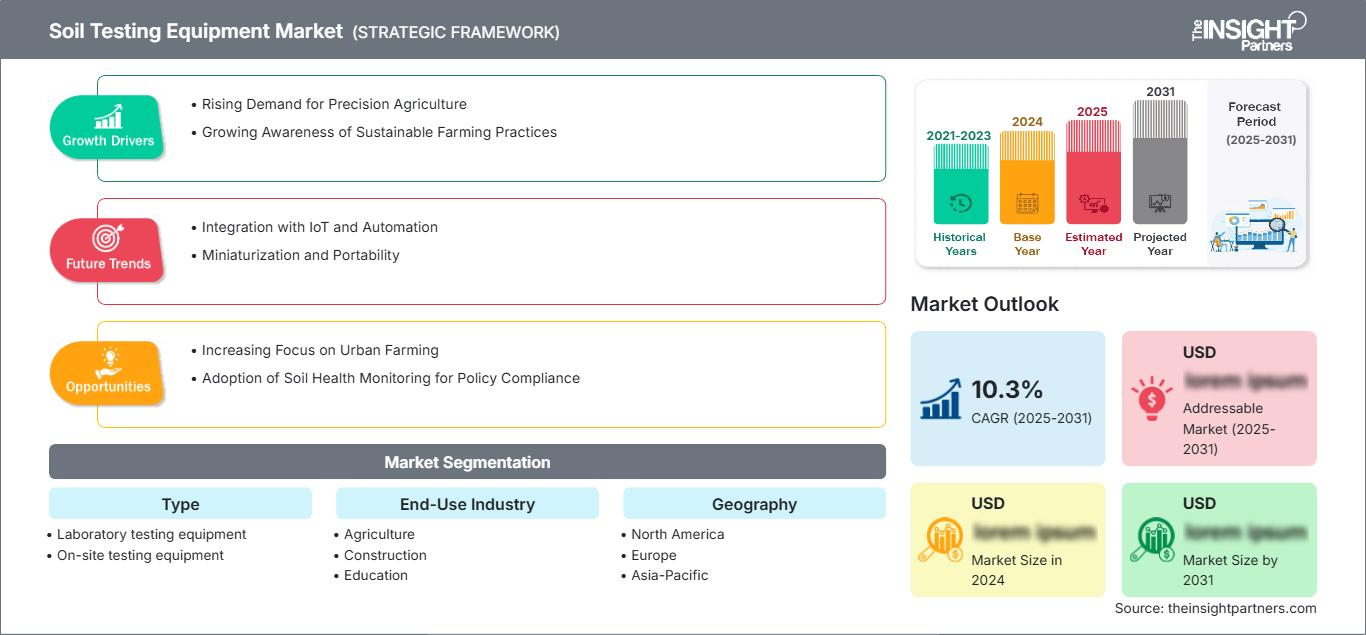
Regional Insights
North America Soil Testing Equipment Market
North America accounted for ~30% of global revenue in 2025 and is projected to register a ~8% CAGR through 2034. Share of Soil Testing Equipment Market comes from the presence of well-developed laboratory facilities in agriculture, established facilities in construction materials testing, environmental assessments, and research. Share of replacement is also considerable since mature laboratories need to upgrade mechanical testing machines, analyzers, sampling equipment, and digital laboratory facilities from time to time.
US stands out as the primary market of demand, with opportunities in Canada and Mexico in terms of agriculture, infrastructure, environmental monitoring, and research. Development of precision agriculture makes soil sampling increasingly systematic, whereas construction activities demand repeatable testing of compaction, density, strength, moisture, and other parameters. Demand in laboratory automation and robust field-based equipment can prove lucrative for equipment providers by shortening testing cycles. Moreover, the region offers favorable conditions for connected equipment due to well-established laboratories having necessary technical infrastructure.
U.S. Soil Testing Equipment Market
The US represented ~83% of North American market revenue in 2025 and is projected to expand at a ~8% CAGR through 2034, making it the leading country in North America. Demands include soil analysis for agriculture, geotechnical engineering, construction QA, environmental evaluation, academic research, and redevelopment of the land. Agricultural practices and advanced laboratory facilities necessitate continuous demands for both ordinary and advanced soil testing.
The nation includes providers of analysis and special testing for various sections of the environment. Agilent Technologies Inc. and Thermo Fisher Scientific Inc. supply for sophisticated analysis processes, whereas Lamotte Company delivers for soil testing in the field. Controls S.p.A., ELE International, and Geotechnical Testing Equipment UK Ltd. provide for geotechnical and construction testing applications. Increasingly, adoption is being driven by automation, portability, traceability, quick report generation, and linking field measurements with laboratory testing.
Europe Soil Testing Equipment Market
Europe held ~24% of the global market in 2025 and is projected to record a ~8% CAGR through 2034. Germany is considered the most prominent country in Europe because of its advanced industries, engineering, agricultural research, environmental monitoring, and laboratory facilities. The UK stands out in geotechnical and construction testing, academic research, environmental analysis, and agricultural application markets. The French have a high demand in the areas of agriculture, infrastructure, environmental assessments, and research.
Italy plays its part in the areas of construction, civil engineering, agriculture, and laboratory applications, whereas Spain offers its services in agricultural output, water scarcity, land management, construction, and environmental tests. European customers value repeatability, conformity, calibration, safety, and laboratory efficiency highly. This creates the need for equipment that can perform test procedures repeatedly and produce digitally verifiable results.
Soil quality and sustainable land management have gained more significance in the European market as well. Laboratories are increasingly focusing on having consistent methodologies and comparable data, which has helped them invest in test methodologies. Advanced users are replacing their existing devices so as to raise efficiency, reduce manual labor, and specialized suppliers are catering to the geotechnical and agricultural testing segments. Replacement needs and soil assessments for sustainability have helped the region expand consistently till 2034.
APAC Soil Testing Equipment Market
Asia Pacific represented ~31% of global revenue in 2025 and is projected to register a ~10% CAGR through 2034, making it the fastest-growing region. China is positioned as the leading country in Asia Pacific, supported by large agricultural activity, infrastructure construction, industrial development, expanding laboratory capacity, and increasing attention to soil productivity and land management.
Japan and South Korea contribute through technologically advanced agriculture, construction, research, and industrial testing ecosystems. India represents a significant expansion opportunity as agricultural soil-health initiatives, infrastructure development, and laboratory capacity continue to broaden testing demand. Australia contributes through agriculture, mining-related land assessment, environmental monitoring, infrastructure, and research. Portable systems and modular laboratories are particularly relevant where testing capacity needs to expand beyond established centralized facilities.
Middle East & Africa Soil Testing Equipment Market
The Middle East & Africa market is projected to expand at a ~7% CAGR through 2034. Saudi Arabia is positioned as a leading country in the Middle East & Africa, supported by agricultural development, controlled-environment farming, infrastructure investment, environmental assessment, and land-management programs. The UAE contributes through construction, smart infrastructure, environmental monitoring, and specialized laboratory services.
South Africa provides a diversified demand base spanning agriculture, construction, mining-related land assessment, environmental applications, and research. Rest of MEA presents opportunities as governments and agricultural organizations strengthen soil information capabilities and seek improved fertilizer efficiency. Soil testing is also relevant to irrigation management because water scarcity increases the importance of understanding soil characteristics. Portable equipment can provide practical value where centralized laboratory access is limited, while national laboratories require more sophisticated analytical and geotechnical systems.
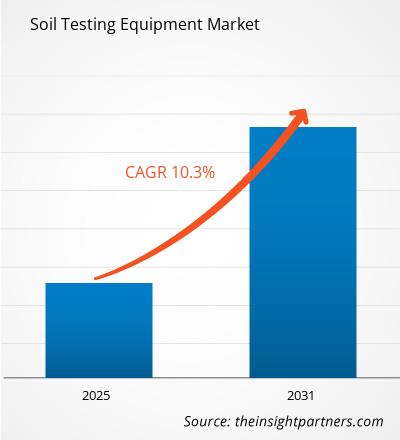
Segmentation Analysis
Type
Type is projected to record a ~9% CAGR during 2026–2034. The Soil Testing Equipment Market scope spans laboratory testing equipment and on-site testing equipment. Laboratory systems remain central to standardized and high-volume testing, while on-site systems are gaining importance because farms, contractors, consultants, and environmental teams increasingly require faster preliminary measurements. The resulting market structure combines mature laboratory demand with faster adoption of portable and field-oriented technologies.
- Laboratory testing equipment: Laboratory systems support detailed soil characterization through physical, chemical, mechanical, and analytical procedures. Their strategic importance remains high because centralized laboratories provide standardized testing, quality control, repeatability, calibration, and documentation required for agricultural, construction, environmental, educational, and research applications.
- On-site testing equipment: Field equipment supports rapid soil assessment directly at farms, construction sites, remediation locations, and project areas. Demand is strengthened by reduced sample transportation, faster decision-making, portable formats, simplified operation, and increasing use of digital tools that connect field measurements with broader soil-management workflows.
End-Use Industry
End-Use Industry is projected to record a ~9% CAGR during 2026–2034. Agriculture represents the largest demand base because soil testing directly informs fertility, nutrient management, crop planning, irrigation, and soil-health decisions. Construction remains a major application because geotechnical characterization is required for infrastructure and building projects. Education and other applications provide additional demand through laboratory teaching, research, environmental assessment, and specialized testing.
- Agriculture: Agriculture represents the largest end-use industry, driven by increasing attention to soil fertility, nutrient efficiency, crop productivity, irrigation management, and precision farming. Laboratory analysis and portable systems both contribute as users seek more frequent and spatially relevant soil information.
- Construction: Construction applications require soil testing for site characterization, compaction, density, moisture, strength, and related engineering properties. Equipment demand is sustained by infrastructure development, quality assurance, laboratory compliance, and the need to validate soil performance during construction.
- Education: Educational institutions use soil testing equipment for practical instruction, laboratory demonstrations, agricultural science, civil engineering, and research. Compact and automated systems can improve accessibility while allowing students to learn standardized testing procedures and data interpretation.
Opportunity Snapshot
| End-Use Industry | Revenue Contribution | Trend Tag | Adoption Stage |
| Agriculture | High | Precision Nutrients | Scaling |
| Construction | High | Site Characterization | Mature |
| Education | Low | Digital Laboratories | Scaling |
| Others | Medium | Environmental Testing | Scaling |
Soil Testing Equipment Market Growth Drivers and Impact Analysis
Precision Agriculture Is Increasing Demand for Actionable Soil Data
The expansion of precision agriculture is increasing the frequency and strategic importance of soil measurement. Farmers and agronomists increasingly require information on nutrient availability, pH, salinity, organic matter, and other soil properties to optimize input application and improve field-level decision-making. This changes equipment utilization from occasional testing toward more structured sampling programs. Laboratory equipment remains essential for comprehensive analysis, while portable systems support rapid screening and help determine where detailed laboratory investigation is necessary. The impact is particularly important for equipment suppliers because agricultural customers can require combinations of field kits, sensors, sample-preparation systems, analytical instruments, and software. Vendors that support repeatable workflows and easier interpretation can benefit as soil information becomes integrated with broader farm-management processes.
Infrastructure Development Sustains Geotechnical Testing Requirements
Infrastructure construction creates recurring demand for soil-testing equipment because ground characteristics influence foundation design, pavement performance, embankment stability, drainage, and long-term structural reliability. Contractors, engineering firms, laboratories, and project owners require equipment to measure compaction, density, moisture, shear behavior, particle characteristics, and other engineering properties. As project quality requirements become more rigorous, testing is performed across multiple construction stages rather than only during initial site investigation. This supports demand for both laboratory and field systems. Automated soil compactors, direct shear systems, consolidation equipment, density measurement systems, and portable field instruments can improve repeatability while reducing manual intervention. The resulting market impact extends beyond initial equipment purchases because calibration, maintenance, accessories, replacement components, and technical training create continuing service requirements.
Soil Health and Environmental Assessment Are Broadening Testing Applications
Soil testing is increasingly used for applications extending beyond traditional crop fertility and construction engineering. Environmental assessment, land redevelopment, remediation, soil degradation monitoring, and resource management all require reliable characterization of soil properties. Agricultural sustainability programs also increase the value of consistent soil information because soil-health decisions depend on comparable measurements over time. This broadening application base supports demand for analytical instruments capable of measuring multiple parameters and for laboratory workflows that improve quality control and traceability. It also creates cross-sector opportunities because some equipment can serve agricultural, environmental, educational, and research users. Suppliers with broad portfolios can therefore address multiple customer groups while supporting recurring requirements for calibration, consumables, training, and analytical services.
Soil Testing Equipment Market Future Trends
Digital and Connected Soil Testing Workflows
The Soil Testing Equipment Market trends increasingly point toward connected workflows linking sample collection, instrument results, laboratory records, geographic information, and reporting systems. Digital identification of samples can reduce transcription errors and improve traceability, while automated data transfer can shorten the time required to generate reports. Field instruments are also becoming more relevant to connected workflows because users can capture measurements close to the sampling location and transfer results for comparison with laboratory analysis. Through 2034, the competitive value of equipment is therefore expected to extend beyond measurement performance toward interoperability, software integration, automated reporting, and data management. Vendors capable of combining instruments with digital workflow tools can strengthen customer retention and support more frequent equipment utilization.
Automation and Portable Testing Will Reshape Equipment Selection
Automation and portability are expected to influence equipment purchasing decisions as laboratories seek greater throughput and field users require faster access to measurements. Automated laboratory systems can standardize repetitive procedures, reduce operator intervention, and support consistent testing across larger sample volumes. Portable systems address a different requirement by bringing measurement closer to farms, construction locations, remediation sites, and geographically dispersed projects. These technologies are complementary rather than mutually exclusive. Field testing can identify conditions requiring laboratory confirmation, while centralized systems provide more detailed analysis. As both categories mature, buyers are likely to evaluate total workflow productivity, ease of calibration, data handling, durability, and service support alongside conventional technical specifications.
Soil Testing Equipment Market Opportunities
Decentralized Testing Networks in Emerging Agricultural Markets
Soil Testing Equipment Market Forecasts indicate an opportunity to expand decentralized testing infrastructure in regions where farmers and local agricultural organizations have limited access to advanced laboratories. Portable nutrient-testing systems, compact analyzers, field kits, and modular laboratory platforms can shorten turnaround times and increase access to soil information. Commercial opportunities extend beyond hardware to calibration, consumables, training, maintenance, laboratory setup, and digital reporting. Partnerships with agricultural cooperatives, universities, government agencies, and soil-testing service providers can support distributed networks that combine rapid field screening with centralized confirmation. Such models allow users to begin with basic testing and add more sophisticated capabilities as sample volumes and analytical requirements increase.
Integrated Platforms for Construction and Environmental Laboratories
An additional opportunity lies in integrated testing platforms that combine physical soil testing, analytical measurement, sample preparation, digital records, and reporting. Construction and environmental laboratories often manage several project types and can benefit from equipment portfolios that reduce fragmented workflows. Suppliers can differentiate through automated test execution, calibration support, training, software integration, and standards-oriented documentation. Partnerships with engineering consultants, contractors, environmental laboratories, universities, and testing-service providers can expand equipment adoption and generate recurring service opportunities. Modular laboratory systems may be particularly attractive for organizations upgrading capacity incrementally. Vendors with complementary portfolios can also cross-sell mechanical testing equipment, analytical instruments, field kits, accessories, and service contracts.
Recent Developments
- May 2026: TerraBlaster announced progress toward the commercial launch of its real-time soil nutrient mapping technology, with the company targeting a late-2026 launch. The technology uses laser-induced breakdown spectroscopy (LIBS) sensors mounted behind a tractor or ATV to measure nitrogen, phosphorus, potassium, pH, and other soil properties while moving through the field. The system was reported to operate at approximately 5 mph, with the company targeting higher operating speeds as development continues.
- June 2025: The NITI Aayog Frontier Tech platform highlighted NutriSens, a portable soil-testing device developed by Dr. Rajul Patkar, co-founder and CEO of Proximal Soilsens Technologies, based on innovation originating during her PhD at IIT Bombay. The device is designed to provide rapid, on-site soil diagnostics and is positioned as an alternative to conventional laboratory testing.
- April 2025: Retired ISRO scientist Madhukant Patel developed a handheld, AI-based soil analyzer designed to generate a soil-health report within seconds. The prototype was presented to Gujarat agriculture department officials, who requested 5,000 soil-testing reports from government laboratories, IFFCO, and GSFC to help calibrate the instrument.
Frequently Asked Questions

- Comprehensive Market Sizing and Forecast Analysis
- Detailed Segmentation Analysis
- In-Depth Market Dynamics Assessment
- Regional and Country-Level Insights
- Competitive Landscape and Company Benchmarking
- Strategic Business Intelligence
Recent Reports
Testimonials

The Insight Partners provided valuable market intelligence that supported our global go-to-market strategy. Their team was professional, responsive, and attentive to our feedback, providing thoughtful analysis and helpful methodological clarifications throughout the project.
Junmo Kim Chief Financial Officer (CFO), Enertech Co., Ltd.
The Insight Partners' SCADA System Market report is comprehensive, with valuable insights on current trends and future forecasts. The team was highly professional, responsive, and supportive throughout. We are very satisfied and highly recommend their services.
RAN KEDEM Partner, Reali Technologies LTDs
I requested a report on a very specific software market and the team produced the report in a few days. The information was very relevant and well presented. I then requested some changes and additions to the report. The team was again very responsive and I got the final report in less than a week.
JEAN-HERVE JENN Chairman, Future Analytica
We worked with The Insight Partners for an important market study and forecast. They gave us clear insights into opportunities and risks, which helped shape our plans. Their research was easy to use and based on solid data. It helped us make smart, confident decisions. We highly recommend them.
PIYUSH NAGPAL Sr. Vice President, High Beam Global
The Insight Partners delivered insightful, well-structured market research with strong domain expertise. Their team was professional and responsive throughout. The user-friendly website made accessing industry reports seamless. We highly recommend them for reliable, high-quality research services
YUKIHIKO ADACHI CEO, Deep Blue, LLC.
This is the first time I have purchased a market report from The Insight Partners.While I was unsure at first, I visited their web site and felt more comfortable to take the risk and purchase a market report.I am completely satisfied with the quality of the report and customer service. I had several questions and comments with the initial report, but after a couple of dialogs over email with their analyst I believe I have a report that I can use as input to our strategic planning process.Thank you so much for taking the extra time and making this a positive experience.I will definitely recommend your service to others and you will be my first call when we need further market data.
JOHN SUZUKI President and Chief Executive Officer, Board Director, BK Technologies
I wish to appreciate your support and the professionalism you displayed in the course of attending to my request for information regarding to infectious disease IVD market in Nigeria. I appreciate your patience, your guidance, and the fact that you were willing to offer a discount, which eventually made it possible for us to close a deal. I look forward to engaging The Insight Partners in the future, all thanks to the impression you have created in me as a result of this first encounter.
DR CHIJIOKE ONYIA MANAGING DIRECTOR, PineCrest Healthcare Ltd.Reason to Buy
- Informed Decision-Making
- Understanding Market Dynamics
- Competitive Analysis
- Identifying Emerging Markets
- Customer Insights
- Market Forecasts
- Risk Mitigation
- Boosting Operational Efficiency
- Strategic Planning
- Investment Justification
- Tracking Industry Innovations
- Aligning with Regulatory Trends





 Get Free Sample for