
Soldering Stations and Accessories Market Share, Demand & Growth by 2034
Coverage: by Product (Soldering Station, Soldering Iron, Soldering Guns, Soldering Stand, Soldering Tip, Tweezers, Others); Application (Electronic Equipment, Musical Instruments, Automotive, Medical Equipment, Computer and Cellular Phones, Others); Distribution Channel (Direct Sales, Indirect Sales) , and Geography (North America, Europe, Asia Pacific, and South and Central America)
- Status : Data Released
- Report Code : TIPRE00010570
- Category : Electronics and Semiconductor
- No. of Pages : 150
- Available Report Formats :


- Last update date : October 26, 2026


2025 Market Size
US$ 1.64 Bn
Base year value
2034 Forecast
US$ 3.28 Bn
Projected by 2034
CAGR 2026-2034
8.01 %
Growth rate
Addressable Market
US$ 22.13 Bn
(2026-2034)
The Soldering Stations and Accessories Market was valued at US$ 1.64 Billion in 2025 and is expected to reach US$ 3.28 Billion by 2034, registering a CAGR of 8.01% during 2026–2034. The market covers equipment and supporting tools used to create, repair, rework, and maintain soldered connections across electronic and electromechanical assemblies. Demand is shaped by electronics manufacturing, component miniaturization, repair activity, automotive electrification, medical-device production, and the need for controlled thermal processes.
North America represents a structurally mature demand center for the Soldering Stations and Accessories Market, supported by electronics engineering, aerospace-related electronics, medical equipment manufacturing, automotive electronics, and professional repair operations. The regional market is modeled to expand at approximately ~7% CAGR through 2034. Demand is increasingly influenced by process traceability, electrostatic-discharge protection, operator ergonomics, and replacement of legacy equipment with digitally controlled systems.
Soldering Stations and Accessories Market Assessment and Insights
Regional Outlook
- North America: ~29% of the global Soldering Stations and Accessories Market share in 2025 | ~7% CAGR through 2034. Market position: North America maintains a substantial mature-market position because electronics assembly, repair, medical equipment, automotive electronics, and industrial manufacturing require reliable thermal-control equipment and repeatable soldering processes.
- US: ~78% of North American market revenue in 2025 | ~7% CAGR through 2034. Market position: The US represents the largest national demand center within North America, supported by electronics design activity, advanced manufacturing, professional repair, medical equipment production, and adoption of digitally managed production tools.
- Europe: ~24% of the global market in 2025 | ~7% CAGR through 2034. Market position: Europe is a mature regional market with established industrial electronics and automotive manufacturing. Germany represents the leading country in Europe, followed by important demand centers across the UK, France, Italy, and Spain.
- Asia Pacific: ~39% of the global market in 2025 | ~10% CAGR through 2034. Market position: Asia Pacific is the fastest-growing region because of its extensive electronics manufacturing ecosystem. China represents the leading country in Asia Pacific, while Japan, South Korea, India, and Australia contribute through specialized manufacturing and technology demand.
Segment Outlook
- Soldering Station: ~38% Share in 2025 | ~8% CAGR through 2034. Market position: Soldering stations lead because they combine controlled heating, temperature management, interchangeable tools, and repeatable operation, making them suitable for professional electronics production, repair, laboratory work, and increasingly demanding precision applications.
- Automotive: ~18% Share in 2025 | ~11% CAGR through 2034. Market position: Automotive represents the high-growth application as vehicle electronics expand across power electronics, sensing, control units, battery systems, connectivity modules, and advanced driver-assistance functions that require controlled and reliable soldered interconnections.
Competitive Coverage
Antex (Electronics) Limited, Bright Technologies, Noel, Kurtz Holding GmbH and Co. Beteiligungs KG, Metcal (OK International), PACE Worldwide, Sorny Roong Industrial Co., Ltd., Vimla Engineering, Weller Tools GmbH, XYtronic-USA, HAKKO Corporation, Ersa GmbH
Methodology
The Insight Partners follows Data Collection & Secondary Research, Primary Research, Data Analysis, and Data Triangulation & Final Review to validate market estimates and insights.
Source: The Insight Partners' analysis based on proprietary research, government publications, company annual reports, investor presentations, industry databases, and expert interviews.
Soldering Stations and Accessories Market has advanced from the simple use of temperature-controlled handheld tools to become tools based on precision, repeatability, ergonomics, safety, and process controls. The trend towards the miniaturization of electronic parts has raised the need for suitable tip shape, quick thermal recovery, stability of temperature, and use of specialized tweezers and irons. Manufacturing plants have begun to differentiate between professional soldering stations and general purpose tools using features such as programmable parameters, multiple handpiece capability, ESD protection, traceability, and integration into the manufacturing process. At the same time, repairs have continued to provide market for versatile systems that accommodate varied board and component sizes.
For the future, the development of soldering stations and accessories is likely to gain momentum from rising electronics manufacturing in Asia Pacific, localization of electronics manufacturing, and developments in automotive and industrial electronics. Concerns over safety, hazardous materials, energy consumption, and manufacturing quality among others are likely to facilitate replacement of old machines. There is an emerging focus on the digitization of workstations and tools capable of offering process information. There is likely to be further demand from the new manufacturing clusters forming in India and Southeast Asia.
Soldering Stations and Accessories Market Report Scope
| Report Attribute | Details |
|---|---|
| Market size in 2025 | US$ 1.64 Billion |
| Market Size by 2034 | US$ 3.28 Billion |
| Global CAGR (2026 - 2034) | 8.01% |
| Historical Data | 2021-2024 |
| Forecast period | 2026-2034 |
Soldering Stations and Accessories Market Analysis
Growth in the Soldering Stations and Accessories Market is driven directly by the growth in the number of printed circuit board assembly and repair projects undertaken. The demand occurs along the supply chain, starting from equipment manufacturers and suppliers to electronics contract manufacturers, OEM factories, labs, servicing centers, and independent repair companies. Equipment choice is determined by thermal parameters, the complexity of assembly, component density, production volume, operator’s skills, and process documentation needs. Therefore, the market includes both high-quality industrial soldering stations and cheaper units used for repair, educational, prototyping, and general electronics purposes.
Supply factors are becoming more influenced by differentiation. Heating, tip type, ergonomic design, monitoring, consumables compatibility, and services offered help vendors differentiate their products. The importance of replacement is evident since the frequent use leads to wearing of tips, irons, stands, and accessories. Distributors affect availability through maintaining local stock and technical support. As the size of the components and density of the printed circuit board increase, suppliers with extensive accessory lineups are able to satisfy more applications without changing the entire station.
Competitive positioning in the Soldering Stations and Accessories Market is related to thermal performance, reliability, diversity, ergonomic design, support capacity, and integration. Weller Tools GmbH competes via wide product lines of professional stations, irons, tips, tweezers, and other accessories, while Metcal (OK International) specializes in precision hand soldering and advanced rework equipment. PACE Worldwide competes in the area of production soldering and rework equipment, and HAKKO Corporation and Ersa GmbH compete in the field of equipment portfolios for industrial and professional markets.
Such specialists as Antex (Electronics) Limited, Bright Technologies, Noel, Sorny Roong Industrial Co., Ltd., Vimla Engineering, and XYtronic-USA provide wider competitive coverage in terms of professional, industrial, and regional markets' needs. Kurtz Holding GmbH and Co. Beteiligungs KG competes in manufacturing technology, and constant investments into connected equipment, precision handpieces, and automated soldering equipment create new opportunities of strategic differentiation in the industry. Competition in this way expands from equipment pricing into reliable operation.
● REPORT CUSTOMIZATION
Tailor This Report To Align With Your Specific Business Requirements
This report can be customized to align precisely with your business objectives, scope, and target markets. Customization options include tailored segmentation, geography, competitive analysis, and strategic insights to support informed decision-making.
Customize This Report →WHAT YOU CAN ADJUST
- ● Segmentations
- ● Geography
- ● Competitive Analysis
- ● Language Preferences
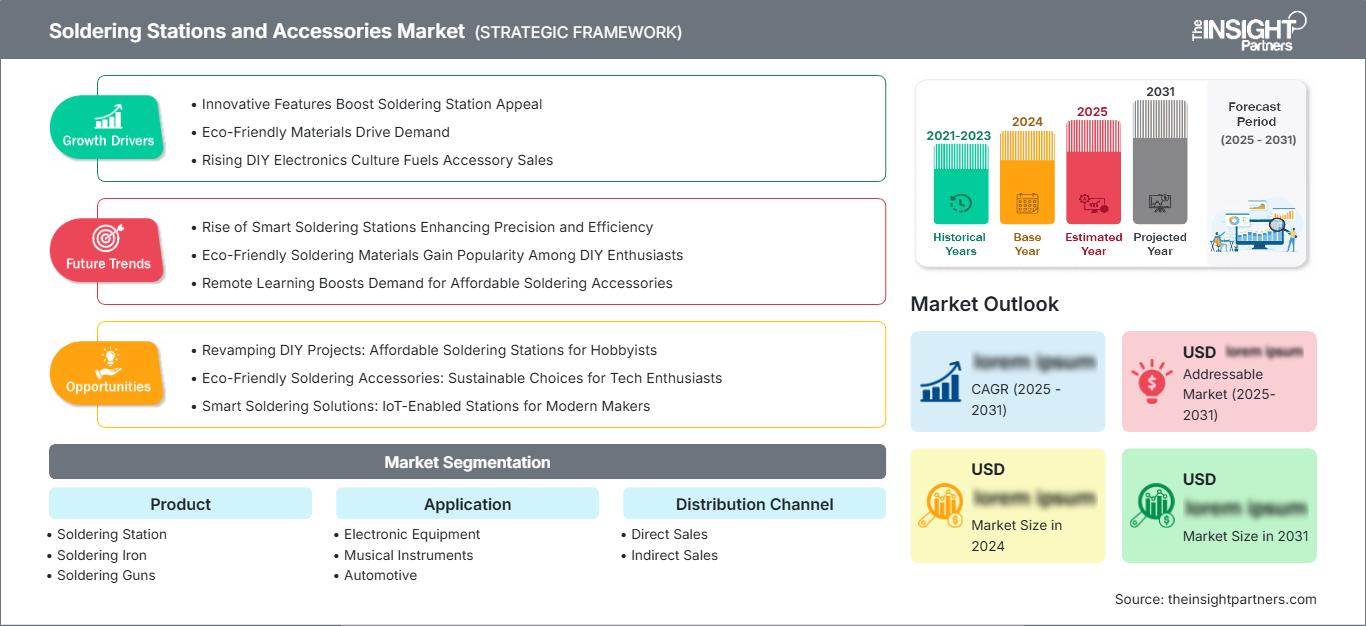
Soldering Stations and Accessories Market: Strategic Insights
Regional Insights
North America Soldering Stations and Accessories Market
North America accounted for ~29% of the global Soldering Stations and Accessories Market in 2025 and is projected to expand at approximately ~7% CAGR through 2034. There is the presence of existing electronics manufacturing, industrial repairs, medical equipment manufacturing, automotive electronics, and engineering-dependent products within the area. The US is the main consumer of the goods while Canada is represented in the area by its industrial electronics manufacturing and technical applications.
Demand within the region is driven more by the issue of quality as opposed to mere equipment replacement. Stable heat performance, ESD safety, ergonomics, and the capacity of handling fine pitch are what manufacturers and repairs are looking for. The implementation of connected systems leads to the need for equipment that can help gather data and trace it. This is what drives the demand for stations, tips, hand pieces, and stands.
U.S. Soldering Stations and Accessories Market
The US represented ~78% of North American Soldering Stations and Accessories Market revenue in 2025 and is expected to grow at approximately ~7% CAGR through 2034. Its position reflects the breadth of electronics engineering and manufacturing across consumer electronics, industrial systems, automotive electronics, communications equipment, and medical devices. Professional repair and refurbishment activity adds a separate replacement-driven demand stream.
Buyers of soldering tools in the US increasingly consider process reliability, safety, accuracy, and lifetime cost when assessing their options. Such well-known manufacturers of soldering tools as Weller Tools GmbH, Metcal (OK International), PACE Worldwide, and others cater to professionals working in manufacturing and repair operations. Furthermore, the demand for soldering tools is fueled by shrinking size of electronic components as well as by the growth of electronics in cars and machinery.
Europe Soldering Stations and Accessories Market
Europe represented ~24% of the global Soldering Stations and Accessories Market in 2025 and is modeled to grow at approximately ~7% CAGR through 2034. Germany is the leading country in Europe, supported by its large industrial manufacturing base, automotive ecosystem, machinery sector, and concentration of engineering-intensive electronics applications. The UK remains important for electronics engineering, aerospace-related systems, medical technology, and repair activity.
The contributions of France to the market include aerospace, industrial equipment, transport electronics, and medical equipment, whereas those of Italy and Spain include automobiles, industrial machinery, consumer goods, and electronic assembly. The purchasing decision by Europeans is largely influenced by equipment dependability, safety in the workplace, energy consumption, repeatability of processes, and regulations.
Another positive factor of the European market is the presence of well-known equipment manufacturers and industrial distributors. The industrial ecosystem of Germany is a good place to supply advanced soldering and rework equipment. The UK, France, Italy, and Spain are good markets for diversifying geographical needs. Replacement of old equipment and integration of electronics into various items, such as cars, machinery, and medicine systems, will support the market until 2034.
APAC Soldering Stations and Accessories Market
Asia Pacific represented ~39% of the global Soldering Stations and Accessories Market in 2025 and is expected to grow at approximately ~10% CAGR through 2034, making it the fastest-growing region. China is the leading country in Asia Pacific because of its extensive electronics manufacturing, assembly, repair, and component ecosystem. Japan and South Korea contribute through sophisticated electronics and automotive production.
India is gaining importance as electronics manufacturing expands, while Australia provides a smaller but established market for professional electronics, industrial maintenance, and technical applications. Regional growth is linked to manufacturing localization, increasing electronics content, smartphone and computer production, automotive electrification, and industrial automation. Demand spans high-volume production stations as well as precision equipment for repair and engineering applications.
Middle East & Africa Soldering Stations and Accessories Market
The Soldering Stations and Accessories Market forecast shows that Middle East & Africa is developing from a smaller base and is modeled to expand at approximately ~9% CAGR through 2034. Saudi Arabia represents an important country in the Middle East as industrial diversification, infrastructure investment, electronics deployment, and maintenance requirements broaden the addressable customer base. The UAE provides a major distribution and technical-service hub.
South Africa remains a significant market within Africa because of its industrial, telecommunications, automotive, and repair ecosystems. Across the wider region, demand is influenced by energy infrastructure, industrial automation, communications equipment, and maintenance operations. Growth opportunities are therefore linked not only to new electronics manufacturing but also to equipment replacement, technical training, repair services, and distributor-supported professional tool adoption.
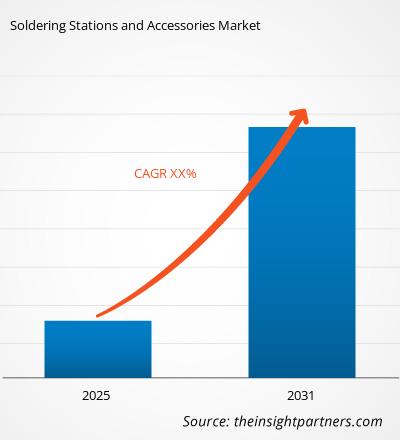
Segmentation Analysis
Product
The Product segment represents the core equipment structure of the Soldering Stations and Accessories Market. Soldering stations hold the largest position because they provide controlled and repeatable operation across professional production and repair applications. Specialized accessories increasingly influence equipment selection because component miniaturization and varied assembly requirements require application-specific tools. The overall Product segment is therefore shaped by replacement cycles, precision requirements, productivity, and accessory compatibility. The Soldering Station subsegment is estimated to expand at approximately ~8% CAGR through 2034.
- Soldering Station: The dominant product category, supported by professional electronics manufacturing, repair, prototyping, and laboratory use. Demand centers on temperature stability, thermal recovery, ESD protection, ergonomic operation, and compatibility with multiple handpieces and tips.
- Soldering Iron: Soldering irons remain essential for repair, maintenance, prototyping, and lower-volume assembly. Their flexibility and relatively simple operating structure make them relevant where users require portability, direct control, or specialized iron configurations.
- Soldering Guns: Soldering guns serve applications requiring comparatively higher heat delivery and rapid operation. Their importance remains concentrated in repair, maintenance, wiring, and applications where rapid heating is more important than the fine control associated with precision stations.
- Soldering Stand: Stands provide safe tool placement, reduce workplace hazards, and support efficient operator workflows. Their strategic importance rises alongside professional station use because organized tool positioning contributes to ergonomics, tip preservation, and safer production environments.
- Soldering Tip: Tips directly influence heat transfer, joint formation, component accessibility, and operating efficiency. Increasing board density and component miniaturization are expanding demand for specialized geometries, replacement tips, and application-specific thermal characteristics.
- Tweezers: Soldering tweezers are particularly relevant for miniature components and precision rework. Their role expands where operators need controlled simultaneous contact with small components, especially in repair, laboratory, medical electronics, and high-density board applications.
Application
The Application segment is driven by differences in board complexity, production volume, reliability requirements, and component density. Electronic Equipment remains a broad demand base, while Automotive is expected to exhibit the strongest expansion as electronics penetration increases across vehicles. Medical Equipment also benefits from requirements for controlled and repeatable assembly. The Automotive subsegment is modeled at approximately ~11% CAGR through 2034.
- Electronic Equipment: This application represents a broad demand pool spanning consumer, industrial, communications, and specialized electronics. High assembly volumes and frequent repair requirements support sustained use of professional soldering equipment.
- Musical Instruments: Electronic musical instruments require soldering during manufacturing, servicing, modification, and repair. Demand is comparatively specialized but remains relevant for control boards, pickups, connectors, wiring assemblies, and other electronic subsystems.
- Automotive: Automotive electronics require reliable soldered connections across control units, sensors, power-management systems, connectivity modules, and other assemblies. Electrification and increasing electronic content strengthen demand for precision and process-controlled equipment.
- Medical Equipment: Medical equipment requires consistent assembly practices because electronic failures can affect equipment functionality and reliability. Soldering tools are used across manufacturing, service, repair, and specialized electronics production environments.
- Computer and Cellular Phones: Computers and cellular phones contain densely packed electronic assemblies requiring precision soldering and rework. Repair centers and manufacturing facilities use specialized stations, irons, tips, and tweezers to address miniature components and high-density boards.
Distribution Channel
Distribution strategy affects availability, technical support, replacement speed, and customer access. Direct Sales are particularly relevant for large manufacturers and industrial buyers that require application consultation, configuration, training, or integrated equipment solutions. The Direct Sales subsegment is estimated to grow at approximately ~7% CAGR through 2034, while Indirect Sales are modeled at approximately ~8% CAGR as distributors broaden access to specialized equipment and replacement accessories.
- Direct Sales: Direct channels support complex industrial purchases where customers require technical evaluation, customized configurations, training, service agreements, or direct relationships with equipment manufacturers.
- Indirect Sales: Indirect channels provide broader geographic coverage and faster access to replacement products. Distributors, dealers, specialist electronics suppliers, and online channels are particularly important for tips, irons, stands, tweezers, and repair-oriented equipment.
Opportunity Snapshot
| Application | Revenue Contribution | Trend Tag | Adoption Stage |
| Electronic Equipment | High | Board Miniaturization | Mature |
| Musical Instruments | Low | Repair Demand | Mature |
| Automotive | High | Vehicle Electrification | Scaling |
| Medical Equipment | Medium | Precision Assembly | Scaling |
| Computer and Cellular Phones | High | Micro Rework | Mature |
Soldering Stations and Accessories Market Growth Drivers and Impact Analysis
Increasing Electronics Content Across Automotive and Industrial Systems
Automotive and industrial products increasingly depend on electronic control, sensing, connectivity, power management, and embedded computing. Each additional electronic function expands the number of circuit assemblies that must be produced, serviced, or reworked. This directly increases the addressable requirement for controlled soldering equipment across OEM facilities, contract manufacturers, component suppliers, and repair centers. Automotive demand is particularly significant because electrified powertrains, battery-management systems, charging electronics, sensing modules, and vehicle connectivity require reliable interconnections. Industrial automation creates a similar requirement through control boards, sensors, motor drives, and communication modules. The resulting demand is not limited to initial equipment purchases. Higher electronics content also increases replacement, maintenance, repair, and accessory consumption, strengthening recurring demand for soldering tips, handpieces, stands, and specialized tools.
Miniaturization and Higher Component Density Raise Precision Requirements
Electronic assemblies are becoming more compact while incorporating increasing functionality within constrained board areas. Smaller components and tighter spacing make conventional soldering practices less suitable for many precision applications because excessive heat, poor tip selection, or limited operator visibility can damage adjacent components or create inconsistent joints. The market consequently benefits from equipment designed for fine-pitch work, micro soldering, thermal tweezers, specialized tips, and stable temperature control. Precision requirements are particularly relevant in cellular-phone repair, medical electronics, industrial control equipment, and advanced automotive assemblies. For equipment suppliers, this trend expands the value of specialized accessories and replacement consumables because customers increasingly need different tip geometries and handpiece configurations for distinct tasks. It also encourages upgrades from general-purpose tools toward application-specific workstations.
Replacement of Legacy Equipment Supports Recurring Equipment Demand
Soldering equipment operates in environments where repeated thermal cycling, mechanical handling, tip wear, and changing assembly requirements gradually reduce the suitability of older systems. Replacement demand is therefore an important market mechanism alongside new production capacity. Industrial customers may replace legacy equipment when newer systems provide improved temperature stability, better ergonomics, greater energy efficiency, enhanced ESD protection, or more effective process monitoring. Repair organizations can similarly upgrade equipment when new component geometries require finer control. Replacement cycles also stimulate accessory sales because updated stations can require compatible tips, handpieces, stands, tweezers, and maintenance products. This creates a recurring revenue structure in which installed equipment generates continuing demand beyond the initial station purchase, supporting suppliers with broad product ecosystems and established service or distribution networks.
Soldering Stations and Accessories Market Future Trends
Connected Soldering Workstations Will Support Process Traceability
The Soldering Stations and Accessories Market trends indicate that connected soldering workstations are positioned to become more relevant as manufacturers seek greater visibility into manual production processes. Digital interfaces can allow operating parameters, temperature information, calibration status, and usage records to be incorporated into broader manufacturing-quality systems. The importance of this capability increases when electronics manufacturers need consistent assembly across multiple operators and production sites. Over time, equipment differentiation is therefore likely to shift from temperature control alone toward integrated process management. Suppliers that combine hardware with software connectivity, data interfaces, user controls, calibration functions, and traceability features can address the growing requirement for documented production processes. The trend may also support preventive maintenance by identifying abnormal usage or equipment performance before it results in quality problems.
Automation Will Extend Beyond High-Volume Electronics Assembly
Automation is expected to expand into applications that have traditionally depended heavily on skilled manual soldering. Improvements in motion control, thermal management, inspection, sensing, and machine communication can make automated or semi-automated soldering more practical for repeatable tasks. This development does not eliminate hand soldering because complex repair, prototyping, low-volume production, and irregular assemblies still require operator flexibility. Instead, automation is likely to coexist with professional stations, with machines handling repetitive operations and technicians addressing variable tasks. This creates opportunities for suppliers to develop equipment ecosystems that connect automated units with hand tools, inspection systems, fixtures, and process software. The result could be a more integrated soldering environment in which equipment choice depends on task repeatability and production architecture rather than a simple manual-versus-automatic distinction.
Soldering Stations and Accessories Market Opportunities
Localized Electronics Manufacturing Creates New Equipment Demand
The expansion of electronics manufacturing capacity in emerging production centers creates opportunities for soldering equipment suppliers to establish regional distribution, service, training, and technical-support networks. India and Southeast Asian manufacturing locations are particularly relevant because electronics assembly expansion increases the requirement for production stations, repair equipment, accessories, and replacement consumables. Suppliers can capture this opportunity by offering differentiated portfolios covering entry-level professional equipment, high-performance industrial stations, micro soldering tools, tips, stands, and rework accessories. Local technical support can become an important purchasing factor because industrial buyers need equipment configuration, operator training, maintenance, and rapid replacement. A channel strategy combining direct industrial relationships with specialized distributors can therefore improve market access while reducing service gaps in rapidly developing manufacturing clusters.
Precision Repair and Refurbishment Offer Untapped Accessory Revenue
The expansion of repair, refurbishment, and lifecycle extension for electronic products creates an opportunity beyond original equipment manufacturing. Repair centers frequently work across diverse board designs and component types, requiring flexible equipment and broad accessory compatibility. Micro soldering, thermal tweezers, specialized tips, ergonomic handpieces, and compact stations can address this requirement. Suppliers can increase recurring revenue by developing accessory ecosystems around installed stations, including replacement tips, holders, cleaning systems, tweezers, and compatible handpieces. Training and application support can further strengthen customer retention because repair quality depends heavily on operator technique and equipment configuration. This opportunity is especially relevant where consumer electronics, industrial equipment, communications systems, and medical electronics require component-level repair rather than complete unit replacement.
Recent Developments
- September 2026: Transfer Multisort Elektronik (TME) announced the expansion of its JBC Tools product assortment with 120V AC versions of popular JBC soldering stations, intended primarily for the US market. The new equipment includes soldering, desoldering, soldering/desoldering, and hot-air stations for professional, production, service, and advanced hobbyist applications.
- May 2026: Metcal introduced its MicroFine soldering tools and cartridge tips for microscope-level rework. The product line is designed for miniature components, including 01005 packages, and is compatible with MX and CV soldering systems. The development expands precision handpiece and tweezer capabilities for high-density electronic assemblies and repair applications.
- July 2025: HAKKO introduced new products within the evolved FX-971 series, including the FX-971 single-port station and associated soldering, micro soldering, nitrogen soldering, and hot-tweezer options. The platform combines compact equipment with higher-power operation and process-management features, supporting applications where productivity and precise thermal control are important.
Frequently Asked Questions

- Comprehensive Market Sizing and Forecast Analysis
- Detailed Segmentation Analysis
- In-Depth Market Dynamics Assessment
- Regional and Country-Level Insights
- Competitive Landscape and Company Benchmarking
- Strategic Business Intelligence
Recent Reports
Testimonials

The Insight Partners provided valuable market intelligence that supported our global go-to-market strategy. Their team was professional, responsive, and attentive to our feedback, providing thoughtful analysis and helpful methodological clarifications throughout the project.
Junmo Kim Chief Financial Officer (CFO), Enertech Co., Ltd.
The Insight Partners' SCADA System Market report is comprehensive, with valuable insights on current trends and future forecasts. The team was highly professional, responsive, and supportive throughout. We are very satisfied and highly recommend their services.
RAN KEDEM Partner, Reali Technologies LTDs
I requested a report on a very specific software market and the team produced the report in a few days. The information was very relevant and well presented. I then requested some changes and additions to the report. The team was again very responsive and I got the final report in less than a week.
JEAN-HERVE JENN Chairman, Future Analytica
We worked with The Insight Partners for an important market study and forecast. They gave us clear insights into opportunities and risks, which helped shape our plans. Their research was easy to use and based on solid data. It helped us make smart, confident decisions. We highly recommend them.
PIYUSH NAGPAL Sr. Vice President, High Beam Global
The Insight Partners delivered insightful, well-structured market research with strong domain expertise. Their team was professional and responsive throughout. The user-friendly website made accessing industry reports seamless. We highly recommend them for reliable, high-quality research services
YUKIHIKO ADACHI CEO, Deep Blue, LLC.
This is the first time I have purchased a market report from The Insight Partners.While I was unsure at first, I visited their web site and felt more comfortable to take the risk and purchase a market report.I am completely satisfied with the quality of the report and customer service. I had several questions and comments with the initial report, but after a couple of dialogs over email with their analyst I believe I have a report that I can use as input to our strategic planning process.Thank you so much for taking the extra time and making this a positive experience.I will definitely recommend your service to others and you will be my first call when we need further market data.
JOHN SUZUKI President and Chief Executive Officer, Board Director, BK Technologies
I wish to appreciate your support and the professionalism you displayed in the course of attending to my request for information regarding to infectious disease IVD market in Nigeria. I appreciate your patience, your guidance, and the fact that you were willing to offer a discount, which eventually made it possible for us to close a deal. I look forward to engaging The Insight Partners in the future, all thanks to the impression you have created in me as a result of this first encounter.
DR CHIJIOKE ONYIA MANAGING DIRECTOR, PineCrest Healthcare Ltd.Reason to Buy
- Informed Decision-Making
- Understanding Market Dynamics
- Competitive Analysis
- Identifying Emerging Markets
- Customer Insights
- Market Forecasts
- Risk Mitigation
- Boosting Operational Efficiency
- Strategic Planning
- Investment Justification
- Tracking Industry Innovations
- Aligning with Regulatory Trends





 Get Free Sample for