
SONAR System Market Trends, Demand & Growth by 2034
Coverage: By Frequency (Infrasonic SONAR, Ultrasonic SONAR); Type (Hull-Mounted, Diver-Detection SONAR, Hand-Held and Portable, Airborne, UUV); Application (Defense, Commercial, Research and Exploration) , and Geography (North America, Europe, Asia Pacific, and South and Central America)
- Status : Data Released
- Report Code : TIPEL00002044
- Category : Electronics and Semiconductor
- No. of Pages : 150
- Available Report Formats :


- Last update date : October 30, 2026


2025 Market Size
US$ 5.18 Bn
Base year value
2034 Forecast
US$ 8.41 Bn
Projected by 2034
CAGR 2026-2034
5.53 %
Growth rate
Addressable Market
US$ 61.61 Bn
(2026-2034)
The Sonar Systems Market is valued at US$ 5.18 Billion in 2025 and is projected to reach US$ 8.41 Billion by 2034, expanding at a CAGR of 5.53% from 2026 to 2034. The market encompasses acoustic sensing technologies used to detect, classify, locate, map, and monitor underwater objects and environments across defense, commercial, and research applications. Demand spans vessel-integrated systems, portable equipment, airborne platforms, and unmanned underwater vehicles, with technology development increasingly focused on detection accuracy, autonomous operation, signal processing, and integration with digital mission systems.
North America remains an important demand center, supported by naval modernization, underwater surveillance requirements, subsea infrastructure protection, and continued investment in autonomous maritime systems. The regional Sonar Systems Market Size is modeled to expand at approximately ~5% CAGR through 2034. Demand is reinforced by the use of sonar in anti-submarine warfare, mine countermeasures, hydrographic operations, seabed monitoring, and offshore infrastructure inspection, while domestic manufacturing and technology development strengthen supply-chain resilience.
SONAR System Market Assessment and Insights
Regional Outlook
- North America: ~31% of the global market in 2025 | ~5% CAGR through 2034. Market position: North America represents the largest regional market, supported by naval modernization, underwater surveillance, autonomous maritime systems, defense procurement, offshore activity, and extensive deployment of acoustic sensing across military and commercial subsea operations.
- US: ~74% of North American market revenue in 2025 | ~5% CAGR through 2034. Market position: The US is the leading country in North America, reflecting substantial naval and maritime security requirements, advanced sonar development capabilities, and broad application across anti-submarine warfare, mine detection, seabed surveillance, and subsea inspection.
- Europe: ~25% of the global market in 2025 | ~5% CAGR through 2034. Market position: Europe is a mature sonar market with established naval and commercial marine technology capabilities. Germany is the leading country in Europe, followed by strong demand centers in the UK, France, Italy, and Spain.
- Asia Pacific: ~29% of the global market in 2025 | ~7% CAGR through 2034. Market position: Asia Pacific is the fastest-growing region, supported by naval fleet expansion, maritime domain awareness, offshore development, autonomous underwater systems, and growing investment in underwater surveillance. China is the leading country in Asia Pacific.
Segment Outlook
- Hull-Mounted: ~51% Share in 2025 | ~5% CAGR through 2034. Market position: Hull-mounted systems lead the product structure because they provide persistent vessel-based sensing for navigation, object detection, seabed mapping, mine avoidance, and defense missions. Their integration with surface ships and naval platforms supports recurring procurement and replacement demand.
- UUV: ~18% Share in 2025 | ~8% CAGR through 2034. Market position: UUV represents the high-growth main segment as autonomous platforms expand underwater surveying, mine countermeasures, intelligence collection, infrastructure inspection, and scientific missions. Compact sonar payloads enable persistent operations while reducing dependence on crewed vessels.
Competitive Coverage
Klein Marine Systems, Kongsberg Maritime, Lockheed Martin, Neptune SONAR Ltd., Northrop Grumman, Raytheon Company, Saab AB, Teledyne RESON A/S, Thales Group, Ultra Electronics
Methodology
The Insight Partners follows Data Collection & Secondary Research, Primary Research, Data Analysis, and Data Triangulation & Final Review to validate market estimates and insights.
Source: The Insight Partners' analysis based on proprietary research, government publications, company annual reports, investor presentations, industry databases, and expert interviews.
The evolution of sonar technologies has involved the development of sensing platforms integrating sonar transducers along with processing and visualization, navigation, communications, and autonomous decision support capabilities. Modern sonars not only meet the demands of the military sphere but can be used for commercial purposes because of their multibeam and imaging capabilities enabling mapping, detection, and classification of objects as well as inspection and environmental monitoring on the seabed. As far as the manufacturing environment is concerned, the trend is related to the development of small-size sonar payloads, which could be installed onboard autonomous and remotely operated underwater vehicles.
Regarding future trends, investments will go towards sonar systems that will operate on unmanned and distributed platforms. The Asia Pacific region will show growth in demand owing to the modernization of the navy and maritime infrastructure. European manufacturers will have an advantage owing to subsea engineering capabilities in this country. The regulation associated with offshore infrastructure, maritime safety, and environmental monitoring can promote the commercial use of sonars. Regarding procurement trends, the demand will relate to interoperable systems that are able to exchange acoustic data with navigation, optical, autonomous control, and command and control systems.Sonar Systems Market Analysis
SONAR System Market Report Scope
| Report Attribute | Details |
|---|---|
| Market size in 2025 | US$ 5.18 Billion |
| Market Size by 2034 | US$ 8.41 Billion |
| Global CAGR (2026 - 2034) | 5.53% |
| Historical Data | 2021-2024 |
| Forecast period | 2026-2034 |
SONAR System Market Analysis
The Sonar Systems Market Demand is influenced by the necessity to locate objects underwater at places where optical and electromagnetical methods of sensing become restricted. The defense sector requires acoustic systems for anti-submarine warfare, mine location, port protection, navigation, and situation awareness, while commercial firms employ sonar devices for hydrographical surveys, offshore inspection, bottom profiling, and marine construction purposes. As a result, the Sonar Systems Market development is dependent not only on defense spending but also on commercial subsea activities, which provides for the diversity of demand.
The value chain comprises acoustic transducers, transmitters, receivers, signal processors, display units, navigational interfaces, software, integration, and maintenance services. Competitiveness is growing based on detection performance, resolution, reliability, weight, energy consumption, and integration abilities. High-quality production facilities are still crucial since sonar devices have to work in pressured and temperature-stable environment and be resistant to vibration and corrosion. Modern procurement requirements are being affected by integration with unmanned platforms and include the necessity to develop lightweight payload systems with automated processing and standard interface possibilities.
According to the Sonar Systems Market report, competition is based on technology depth, platform integration, acoustic capabilities, global support capabilities, and customer access to defense and commercial users. The products of Kongsberg Maritime integrate naval sonar with other subsea sensing systems and autonomy solutions. Lockheed Martin, Northrop Grumman, Raytheon Company, Saab AB, Thales Group, and Ultra Electronics compete in defense-focused underwater sensing and maritime systems. Teledyne RESON A/S and Klein Marine Systems remain highly relevant to hydrographic, imaging, mapping, and commercial marine sectors.
Priority areas of investments include autonomous operation, high-definition imaging, artificial intelligence-based interpretation of results, passive acoustic sensing, and miniaturization for unmanned platforms. Companies that already have installed user bases can benefit from upgrade cycles, offering additional processing and connectivity without necessity to replace the entire platform. Moreover, geographic extension of manufacturing capabilities and specialized acoustic engineering allow suppliers to gain more access to government initiatives and diversify supply chains.
● REPORT CUSTOMIZATION
Tailor This Report To Align With Your Specific Business Requirements
This report can be customized to align precisely with your business objectives, scope, and target markets. Customization options include tailored segmentation, geography, competitive analysis, and strategic insights to support informed decision-making.
Customize This Report →WHAT YOU CAN ADJUST
- ● Segmentations
- ● Geography
- ● Competitive Analysis
- ● Language Preferences
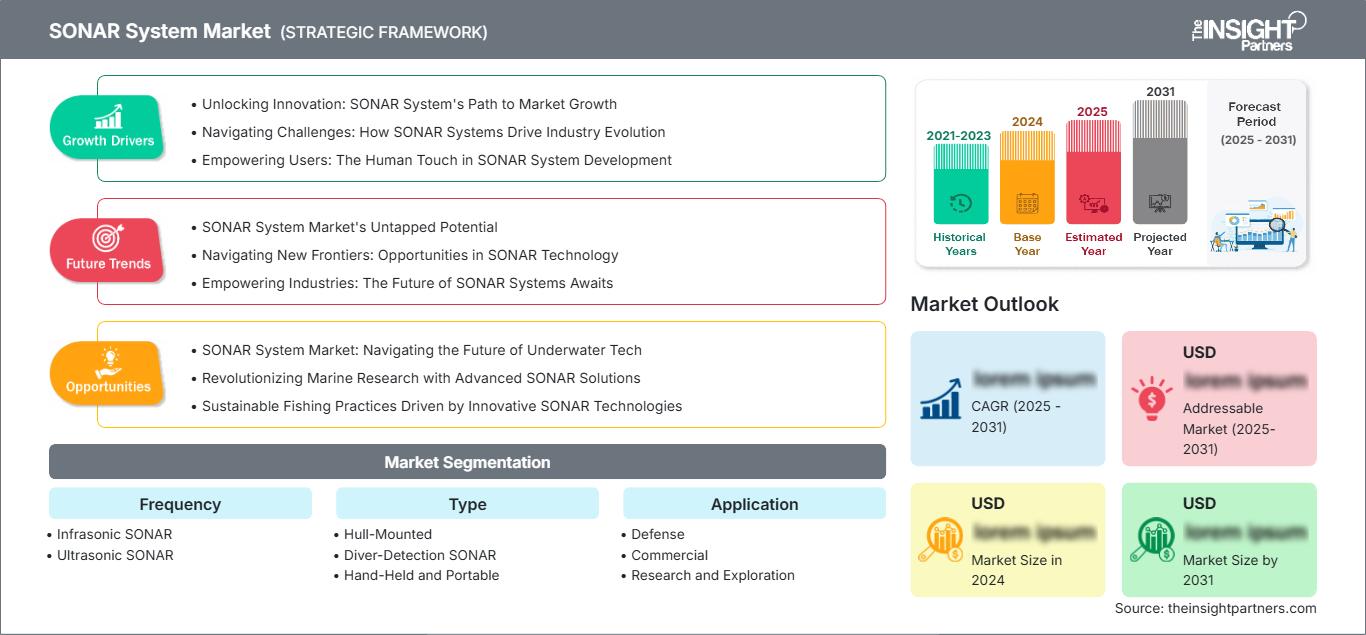
SONAR System Market: Strategic Insights
Regional Insights
North America Sonar Systems Market
North America holds about ~31% share of the worldwide market in 2025 and is expected to grow at ~5% CAGR up to 2034. This market is favored by the availability of strong naval infrastructures, defense research abilities, maritime security needs, and business activities at sea. The sonar equipment is applied on surface ships, submarines, drones, off-shore activities, hydrography, and infrastructure inspection. The synergy between defense and business needs makes this market resilient during the procurement cycle; the growing number of unmanned platforms increases the need for compact and energy efficient acoustics devices.
The US is the most important country in North America and holds about ~74% of the revenues generated in the region. The growth drivers include the modernization of the naval fleet, the anti-submarine operations, mine detection systems, seabed surveillance, and undersea situation awareness. The commercial applications include the oil and gas exploration, marine construction, environmental monitoring, and hydrography. The companies active in the market are increasingly focusing on domestic manufacturing, unmanned platforms, advanced signal processing, and maritime intelligence integration.
U.S. Sonar Systems Market
The US has a market share of around ~74% in North America in terms of revenue generated in 2025, which is expected to grow at a rate of ~5% CAGR until 2034. The market potential of the US includes various applications where there is a need for acoustic sensing of the ocean, such as anti-submarine warfare, mine detection, navigation, harbor security, intelligence gathering, and monitoring of underwater infrastructure. In addition, there are a lot of players involved in the country, including defense contractors, sonar developers, marine engineering firms, and research institutes.
The scope of sonar demand is moving from traditional manned platforms to unmanned and remotely operated platforms. UUVs have the ability to conduct sonar-based missions on persistent surveys and detections, ensuring that crewed platforms do not get exposed to any dangerous environment. Commercial end users use sonar for offshore inspections, seabed survey, marine construction, and environmental surveys. The presence of players like Lockheed Martin, Northrop Grumman, Raytheon Company, and Klein Marine Systems indicates a wide range of domestic technological capabilities.
Europe Sonar Systems Market
Europe is a ~25% global Sonar Systems Market Share in 2025 and forecasted to grow at ~5% CAGR through 2034. Germany is a leader in Europe due to the presence of naval engineering, underwater solutions, and industrial manufacturing. UK is another major market for underwater systems with its focus on defense procurement, maritime surveillance, and marine research. France contributes to the market via naval modernization and underwater security requirements, while Italy and Spain are markets driven by naval fleet needs, merchant marine, offshore activities, hydrographic surveying, and marine infrastructure.
Suppliers in the region are defense and commercial players and therefore serve a wide range of applications. Saab AB, Thales Group, and Ultra Electronics supply defense-related maritime systems, while Kongsberg Maritime and Teledyne RESON A/S supply subsea sensing and surveying equipment. The market in the region is also shaped by the needs in maritime domain awareness, securing critical underwater infrastructure, and higher usage of unmanned platforms. Future procurement will require interoperability of acoustic solutions that could integrate with navigation, unmanned systems, and maritime surveillance networks. Another source of procurement for the market is represented by commercial operators via hydrographic surveying, offshore construction, port management, and subsea inspection.
APAC Sonar Systems Market
Asia Pacific accounts for approximately ~29% of the global market in 2025 and is expected to expand at ~7% CAGR, making it the fastest-growing region. China is the leading country in Asia Pacific, with Japan, South Korea, India, and Australia also contributing substantial demand through naval programs, maritime security, commercial shipping, offshore development, and marine research.
Industrial activity is creating demand for seabed mapping, offshore inspection, navigation, and environmental monitoring, while defense programs are expanding requirements for underwater surveillance and autonomous systems. India is increasing indigenous underwater technology capabilities, while Japan and South Korea combine advanced maritime manufacturing with naval applications. Australia contributes through extensive maritime geography and subsea resource activity. The regional opportunity is increasingly connected to UUV deployment, compact sonar payloads, and automated interpretation of acoustic data.
Middle East & Africa Sonar Systems Market
The Middle East & Africa region is modeled to expand at approximately ~6% CAGR through 2034. Saudi Arabia represents an important Middle Eastern demand center because of offshore energy activity, maritime infrastructure development, and investments around coastal and port facilities. The UAE also contributes through commercial ports, offshore operations, maritime security, and subsea infrastructure monitoring. South Africa provides a regional technology and marine research base, while the Rest of MEA includes diverse defense, offshore, and coastal applications.
Energy and infrastructure requirements create opportunities beyond defense procurement. Sonar can support underwater inspection, seabed surveys, pipeline and structural monitoring, navigation, and offshore construction. In the Middle East, large-scale port and offshore developments increase the value of reliable acoustic sensing, while African coastal markets can benefit from portable and remotely operated systems where deployment flexibility is important. Demand is therefore expected to remain diversified across defense, energy, marine construction, and research.
Segmentation Analysis
Frequency
Frequency is divided into Infrasonic SONAR and Ultrasonic SONAR. The main segment is modeled to expand at approximately ~5% CAGR from 2026 to 2034. Frequency selection determines detection range, resolution, penetration characteristics, and suitability for different underwater environments. System designers balance acoustic performance with platform constraints, mission duration, environmental conditions, and the type of target or seabed feature being investigated.
- Infrasonic SONAR: This technology is suited to applications where low-frequency acoustic propagation and extended detection characteristics are important. Its strategic relevance is linked to applications requiring long-range underwater awareness, particularly where acoustic propagation conditions and target characteristics favor lower-frequency operation.
- Ultrasonic SONAR: Ultrasonic systems support higher-frequency acoustic sensing where resolution and detailed imaging are important. They are widely relevant to inspection, mapping, navigation, object identification, and compact platforms, making them important for commercial surveying and increasingly autonomous underwater operations.
Type
Type includes Hull-Mounted, Diver-Detection SONAR, Hand-Held and Portable, Airborne, and UUV systems. The main segment is modeled to expand at approximately ~6% CAGR from 2026 to 2034. Platform diversification is changing procurement as customers seek sonar that can operate across crewed vessels, aircraft, portable systems, and autonomous underwater vehicles.
- Hull-Mounted: Hull-mounted sonar provides persistent acoustic coverage from surface vessels and naval platforms. It remains strategically important for navigation, object detection, seabed awareness, mine avoidance, and surveillance because the sensor is integrated into a stable operating platform with continuous power and processing availability.
- Diver-Detection SONAR: Diver-detection systems address security requirements around ports, ships, offshore facilities, and restricted maritime areas. Their value comes from detecting small underwater targets in low-visibility conditions and providing an additional security layer where conventional visual monitoring is constrained.
- Hand-Held and Portable: Portable sonar systems provide flexibility for divers, survey teams, security personnel, and smaller vessels. Their compact architecture reduces deployment complexity and enables rapid use across changing sites, making portability particularly relevant to inspection, research, and specialized security missions.
- Airborne: Airborne sonar systems extend underwater sensing from aircraft and other aerial platforms. They are strategically important for rapid-area surveillance, anti-submarine missions, search operations, and deployment where surface platforms cannot provide sufficient geographic coverage within required response times.
- UUV: UUV-based sonar integrates acoustic sensing with autonomous underwater mobility. The segment is positioned for accelerated adoption because unmanned platforms can conduct persistent mapping, mine countermeasures, infrastructure inspection, and reconnaissance while reducing crew exposure and enabling operations in challenging environments.
Application
Application comprises Defense, Commercial, Research and Exploration. The main segment is modeled to expand at approximately ~6% CAGR from 2026 to 2034. Application diversity reduces dependence on a single customer group and allows sonar suppliers to address defense surveillance, commercial subsea operations, scientific research, and exploration requirements.
- Defense: Defense applications include anti-submarine warfare, mine detection, underwater surveillance, navigation, harbor protection, and tactical situational awareness. Procurement increasingly emphasizes networked sensors, autonomous platforms, improved classification, and the ability to operate in complex underwater environments.
- Commercial: Commercial demand spans hydrographic surveying, offshore energy, marine construction, subsea inspection, navigation, and infrastructure monitoring. Customers prioritize accurate data collection, operational efficiency, reliability, portability, and reduced vessel time, encouraging adoption of automated and high-resolution sonar solutions.
- Research and Exploration: Research and exploration users employ sonar to characterize seabeds, map underwater environments, monitor ecosystems, and investigate deep-water areas. Demand favors high-resolution systems, autonomous deployment, precise positioning, and data-processing capabilities capable of converting acoustic measurements into detailed environmental information.
Opportunity Snapshot
| Application | Revenue Contribution | Trend Tag | Adoption Stage |
|---|---|---|---|
| Defense | High | Underwater Surveillance | Mature |
| Commercial | Medium | Seabed Mapping | Scaling |
| Research and Exploration | Medium | Ocean Mapping | Scaling |
SONAR System Market Growth Drivers and Impact Analysis
Expansion of Underwater Surveillance and Maritime Security Requirements
Growing requirements for maritime domain awareness are increasing the operational importance of acoustic sensing across naval, port, and subsea security missions. Sonar can detect and classify underwater objects in environments where optical systems are limited by darkness, turbidity, depth, or distance. Defense organizations use acoustic technologies for anti-submarine warfare, mine countermeasures, harbor protection, navigation, and underwater surveillance, while commercial operators increasingly monitor critical infrastructure. The impact extends beyond new equipment purchases because installed sonar systems require periodic upgrades to processors, software, transducers, and data interfaces. As maritime security architectures become more networked, sonar suppliers can capture value through integration, analytics, maintenance, and lifecycle services rather than hardware sales alone.
Increasing Deployment of Autonomous Underwater Platforms
The expansion of UUVs, AUVs, and remotely operated platforms is changing how underwater sensing is performed. Autonomous vehicles can carry compact sonar payloads into areas that are difficult, expensive, or hazardous for crewed vessels to access. This creates demand for lower-power sensors, miniaturized electronics, automated processing, navigation integration, and reliable data storage and transmission. The growth mechanism is particularly relevant to mine countermeasures, seabed mapping, infrastructure inspection, environmental monitoring, and scientific exploration. Sonar manufacturers that optimize equipment for autonomous platforms can address new missions while also benefiting from fleet expansion. Platform-level integration is becoming increasingly important because customers evaluate the complete underwater system rather than the acoustic sensor in isolation.
Rising Need for High-Resolution Subsea Mapping and Inspection
Offshore infrastructure, marine construction, hydrographic surveying, and environmental programs increasingly require detailed information about underwater structures and seabed conditions. High-resolution sonar can map terrain, identify objects, inspect pipelines and other infrastructure, and generate data for engineering decisions. Commercial users have strong incentives to improve survey efficiency because vessel time and offshore operations are expensive. Automated acquisition and processing can shorten survey cycles while reducing manual interpretation requirements. This driver also supports replacement demand as users migrate from basic depth measurement toward multibeam, imaging, and integrated sensing systems. As offshore assets become more complex and geographically dispersed, sonar-enabled inspection can provide repeatable data for maintenance planning, risk assessment, and asset monitoring.
SONAR System Market Future Trends
AI-Assisted Sonar Interpretation and Autonomous Target Classification
Artificial intelligence in the Sonar Systems Market Trends is expected to become more deeply embedded in sonar processing as operators seek faster interpretation of large acoustic datasets. Current sonar platforms already generate increasingly detailed information, but extracting actionable targets can remain labor-intensive when large survey areas or persistent monitoring missions are involved. Future systems are likely to combine automated detection, classification, anomaly identification, adaptive signal processing, and mission-level decision support. AI can also support autonomous vehicles by allowing onboard systems to recognize relevant objects and modify mission behavior without continuous operator intervention. The commercial implication is a gradual shift in value from acoustic hardware alone toward software, algorithms, data management, and integrated analytics. Suppliers will therefore compete increasingly on the quality and explainability of processed underwater information.
Greater Integration of Sonar With Multi-Sensor Autonomous Architectures
Future underwater missions are likely to combine sonar with inertial navigation, optical cameras, acoustic communications, environmental sensors, and positioning technologies. Such integration can compensate for the limitations of individual sensing modalities and improve situational awareness in complex environments. For UUVs, synchronized sensor inputs can support navigation, mapping, target identification, and obstacle avoidance while reducing dependence on surface operators. On commercial platforms, integrated data streams can improve subsea inspection and survey productivity by linking acoustic maps with precise location and operational records. This evolution will increase demand for standardized interfaces, compact processing units, interoperable software, and reliable data synchronization. Suppliers capable of supporting multi-sensor architectures can participate in a broader portion of the underwater technology value chain.
SONAR System Market Opportunities
Development of Compact Sonar for UUV and Portable Deployments
Compact sonar represents an opportunity to address expanding demand from autonomous and rapidly deployable platforms. UUV operators require sensors that combine acoustic performance with low power consumption, limited weight, pressure tolerance, and simplified integration. Similar requirements apply to portable systems used for inspection, research, security, and specialized surveying. Manufacturers can differentiate through modular transducers, embedded processing, flexible communications, and software that simplifies configuration. Commercial opportunity also exists in retrofit markets where existing autonomous platforms can be upgraded with improved sensing without replacing the entire vehicle. Product architectures designed around modular payload interfaces can broaden the addressable customer base by allowing one sonar family to serve multiple vehicle sizes and mission profiles.
Expansion of Subsea Infrastructure Monitoring Solutions
The expansion of offshore energy assets, subsea cables, pipelines, ports, and other marine infrastructure creates opportunities for persistent acoustic monitoring. Operators increasingly require repeatable information about structural conditions, seabed changes, and underwater anomalies. Sonar can contribute to inspection programs by providing non-contact detection and mapping capabilities across difficult-to-access areas. Suppliers can strengthen commercial positioning by combining acoustic sensors with autonomous vehicles, cloud-connected data platforms, predictive analytics, and inspection software. This model creates recurring revenue opportunities through monitoring contracts, software, maintenance, and data services in addition to initial hardware sales. The Sonar Systems Market Forecast is particularly relevant where infrastructure owners seek to reduce costly vessel-based inspection frequency while maintaining reliable visibility into subsea assets.
Recent Developments
- September 2025: Kongsberg Maritime announced the global rollout of advanced passive acoustic technology following the integration of Naxys Technologies. The technology supports continuous underwater monitoring for applications including oil and gas, naval operations, and subsea infrastructure, with passive hydrophone systems designed to identify changes in flow conditions, structural integrity, leaks, and underwater acoustic anomalies.
- April 2025: Teledyne RESON / Teledyne Marine launched the SeaBat T51-S multibeam echosounder for subsea applications, including deployment on ROVs and AUVs. The system is designed for high-resolution subsea mapping and can operate at depths of up to 6,000 meters, extending multibeam sonar capabilities into demanding deep-sea exploration and underwater survey missions.
- March 2025: Kongsberg Maritime partnered with Viam to apply artificial intelligence to the Simrad SY50 fish-finding sonar. The collaboration focuses on translating sonar data into actionable targets, automatically tuning key settings, and connecting sonar information with cloud-based workflows for commercial and recreational fishing operations.
Frequently Asked Questions

- Comprehensive Market Sizing and Forecast Analysis
- Detailed Segmentation Analysis
- In-Depth Market Dynamics Assessment
- Regional and Country-Level Insights
- Competitive Landscape and Company Benchmarking
- Strategic Business Intelligence
Recent Reports
Testimonials

The Insight Partners provided valuable market intelligence that supported our global go-to-market strategy. Their team was professional, responsive, and attentive to our feedback, providing thoughtful analysis and helpful methodological clarifications throughout the project.
Junmo Kim Chief Financial Officer (CFO), Enertech Co., Ltd.
The Insight Partners' SCADA System Market report is comprehensive, with valuable insights on current trends and future forecasts. The team was highly professional, responsive, and supportive throughout. We are very satisfied and highly recommend their services.
RAN KEDEM Partner, Reali Technologies LTDs
I requested a report on a very specific software market and the team produced the report in a few days. The information was very relevant and well presented. I then requested some changes and additions to the report. The team was again very responsive and I got the final report in less than a week.
JEAN-HERVE JENN Chairman, Future Analytica
We worked with The Insight Partners for an important market study and forecast. They gave us clear insights into opportunities and risks, which helped shape our plans. Their research was easy to use and based on solid data. It helped us make smart, confident decisions. We highly recommend them.
PIYUSH NAGPAL Sr. Vice President, High Beam Global
The Insight Partners delivered insightful, well-structured market research with strong domain expertise. Their team was professional and responsive throughout. The user-friendly website made accessing industry reports seamless. We highly recommend them for reliable, high-quality research services
YUKIHIKO ADACHI CEO, Deep Blue, LLC.
This is the first time I have purchased a market report from The Insight Partners.While I was unsure at first, I visited their web site and felt more comfortable to take the risk and purchase a market report.I am completely satisfied with the quality of the report and customer service. I had several questions and comments with the initial report, but after a couple of dialogs over email with their analyst I believe I have a report that I can use as input to our strategic planning process.Thank you so much for taking the extra time and making this a positive experience.I will definitely recommend your service to others and you will be my first call when we need further market data.
JOHN SUZUKI President and Chief Executive Officer, Board Director, BK Technologies
I wish to appreciate your support and the professionalism you displayed in the course of attending to my request for information regarding to infectious disease IVD market in Nigeria. I appreciate your patience, your guidance, and the fact that you were willing to offer a discount, which eventually made it possible for us to close a deal. I look forward to engaging The Insight Partners in the future, all thanks to the impression you have created in me as a result of this first encounter.
DR CHIJIOKE ONYIA MANAGING DIRECTOR, PineCrest Healthcare Ltd.Reason to Buy
- Informed Decision-Making
- Understanding Market Dynamics
- Competitive Analysis
- Identifying Emerging Markets
- Customer Insights
- Market Forecasts
- Risk Mitigation
- Boosting Operational Efficiency
- Strategic Planning
- Investment Justification
- Tracking Industry Innovations
- Aligning with Regulatory Trends





 Get Free Sample for