
Sound Masking System Market Size, Growth & Trends by 2034
Coverage: By Masking Type (Temporal Masking, Frequency Masking); Quite Technology (QT 600, QT 200, QT 100); End User (Offices, Hospitals, Hotels, Pharmacies, Banks, Others) , and Geography (North America, Europe, Asia Pacific, and South and Central America)
- Status : Data Released
- Report Code : TIPEL100001372
- Category : Electronics and Semiconductor
- No. of Pages : 150
- Available Report Formats :


- Last update date : October 30, 2026


2025 Market Size
US$ 952.24 Mn
Base year value
2034 Forecast
US$ 2,229.36 Mn
Projected by 2034
CAGR 2026-2034
9.91 %
Growth rate
Addressable Market
US$ 14,158.67 Mn
(2026-2034)
The Sound Masking System Market was valued at US$ 952.24 Million in 2025 and is projected to reach US$ 2,229.36 Million by 2034, registering a CAGR of 9.91% during 2026–2034. The market covers technologies and equipment that introduce controlled background sound to reduce speech intelligibility, limit noise distractions, and improve acoustic privacy across commercial and institutional environments. Demand is supported by workplace acoustic requirements, healthcare privacy needs, flexible building layouts, and the integration of networked controls with broader building communication systems.
North America represents a mature demand center, supported by established acoustic consulting practices, large office inventories, healthcare facilities, and replacement activity across existing buildings. The regional Sound Masking System Market Size is projected to record a ~8% CAGR through 2034. Growth is increasingly associated with retrofit installations, speech privacy requirements, hybrid workplace layouts, and demand for centrally managed systems that can integrate sound masking with paging and other building audio functions.
Sound Masking System Market Assessment and Insights
Regional Outlook
- North America: ~42% of the global market in 2025 | ~8% CAGR through 2034. Market position: North America maintains a substantial market position because sound masking is well established in office acoustics and healthcare privacy applications. Retrofit opportunities, professional acoustic specification, and installed-base replacement support recurring demand across commercial facilities.
- US: ~78% of North American market revenue in 2025 | ~8% CAGR through 2034. Market position: The US accounts for most North American demand, supported by extensive office and healthcare infrastructure, established integrator networks, and strong adoption of speech privacy solutions in administrative, clinical, financial, and professional service environments.
- Europe: ~28% of the global market in 2025 | ~9% CAGR through 2034. Market position: Europe has a mature acoustic engineering ecosystem and expanding demand for workplace comfort and privacy. The UK and Germany represent leading countries in Europe, while France, Italy, and Spain contribute through commercial refurbishment and institutional construction.
- Asia Pacific: ~22% of the global market in 2025 | ~12% CAGR through 2034. Market position: Asia Pacific is the fastest-growing region as modern offices, healthcare facilities, hotels, and financial institutions adopt acoustic privacy technologies. China is the leading country in Asia Pacific, with Japan, South Korea, India, and Australia adding diversified demand.
Segment Outlook
- Offices: ~58% Share in 2025 | ~9% CAGR through 2034. Market position: Offices represent the largest end-user opportunity because open-plan layouts, shared meeting spaces, hybrid work patterns, and confidential conversations create a persistent need to manage speech intelligibility and background noise without major structural changes.
- Hospitals: ~14% Share in 2025 | ~12% CAGR through 2034. Market position: Hospitals represent a high-growth application because patient-provider conversations, reception areas, examination rooms, and administrative functions require stronger speech privacy. Healthcare expansion and acoustic quality initiatives are broadening the addressable installation base.
Competitive Coverage
Dukane Corporation, K R Moeller Assoc Ltd, Biamp Systems (Cambridge Sound Management), Communication Service Corporation, Lencore, LogiSon Acoustic Network, PRO ACOUSTICS LLC, Soft dB, Soundmask Global Pty Ltd., Vibra-Sonic Control
Methodology
The Insight Partners follows Data Collection & Secondary Research, Primary Research, Data Analysis, and Data Triangulation & Final Review to validate market estimates and insights.
Source: The Insight Partners' analysis based on proprietary research, government publications, company annual reports, investor presentations, industry databases, and expert interviews.
The market has changed from simple central generators and ceiling-mounted emitters to more advanced configurable systems and multi-zone products, which are often able to network and have digital control and may also interface with paging or background music systems. The specification of modern systems focuses on uniformity, frequency spectrum, zoning, commissioning, and the acoustics of the occupied space rather than simply adding background noise. Also, current offerings indicate a trend toward providing solutions that will work not only in new constructions but also in retrofits, for example, conference rooms, hospitals, exposed ceilings, and other nonconventional architectural installations.
During the forecast period, we expect the use of the products to expand beyond the well-established application in offices. New commercial areas in Asia Pacific and the Middle East provide new opportunities as developers include acoustic performance in their requirements. Another structural factor is healthcare modernization. As for future trends, investments in remotely configurable solutions, adaptive control of masking systems, and systems that may interface with building communication system are anticipated. Specification and regulation of the measurable acoustic performance could help buyers evaluate the actual performance and treat sound masking as something other than just an amenity.
Sound Masking System Market Report Scope
| Report Attribute | Details |
|---|---|
| Market size in 2025 | US$ 952.24 Million |
| Market Size by 2034 | US$ 2,229.36 Million |
| Global CAGR (2026 - 2034) | 9.91% |
| Historical Data | 2021-2024 |
| Forecast period | 2026-2034 |
Sound Masking System Market Analysis
The Sound Masking System Market for demand emerges in locations where it is essential to keep the conversation less intelligible without having an invasive acoustic environment. The most prominent application base for office space emerges, with healthcare establishments needing sound masking in examination rooms, reception areas, patient rooms, and administrative activities. Hotels, pharmacy outlets, and financial institutions provide additional markets in places where customers need to be served and confidential conversations take place in an open space. Acoustic consultants, architects, sound masking system manufacturers, distributors, integrators, installers, and facility managers comprise the value chain. Successful projects rely on proper emitter placement, zoning, commissioning, and calibration after installation.
Supply side is driven by acoustic engineering rather than mass manufacturing of speakers. It requires the controller, emitters, amplifiers, software, sensors, and mounting components to function as a coordinated system. Networking makes software configuration more important in addition to remote management, although non-networked sound masking systems still have some applications where zoning is simple and the system configuration is relatively straightforward. Thus, the competition among manufacturers takes place in terms of performance, installation capabilities, interoperability, and customer service abilities.
Competition in the Sound Masking System Market Report comes from specialty sound masking firms as well as from professional audio companies in general. Biamp Systems offers Qt platform products for applications ranging from small single zone through large multi-zone installations via their Cambridge division. Lencore focuses on speech privacy, soundscape creation, paging and healthcare applications; K R Moeller Assoc Ltd and the history of its LogiSon Acoustic Network product line offer long standing experience in networked sound masking. Soft dB offers both sound masking and acoustic measurement features while Dukane Corporation and PRO ACOUSTICS LLC offer professional audio channel products.
There is more focus on system manageability and channel extension rather than hardware alone. New product development shows the focus shifting to remote control, networked zoning, sensor-based and software solutions and installer training. This offers an opportunity to differentiate by offering lifecycle value – manufacturers able to provide specification, installation, tuning, monitoring and even reconfiguration in the future will be able to get into a larger piece of the project pie. There is also the opportunity to partner with representatives, acoustic consultants, integrators and building technology firms to overcome specification hurdles.
● REPORT CUSTOMIZATION
Tailor This Report To Align With Your Specific Business Requirements
This report can be customized to align precisely with your business objectives, scope, and target markets. Customization options include tailored segmentation, geography, competitive analysis, and strategic insights to support informed decision-making.
Customize This Report →WHAT YOU CAN ADJUST
- ● Segmentations
- ● Geography
- ● Competitive Analysis
- ● Language Preferences
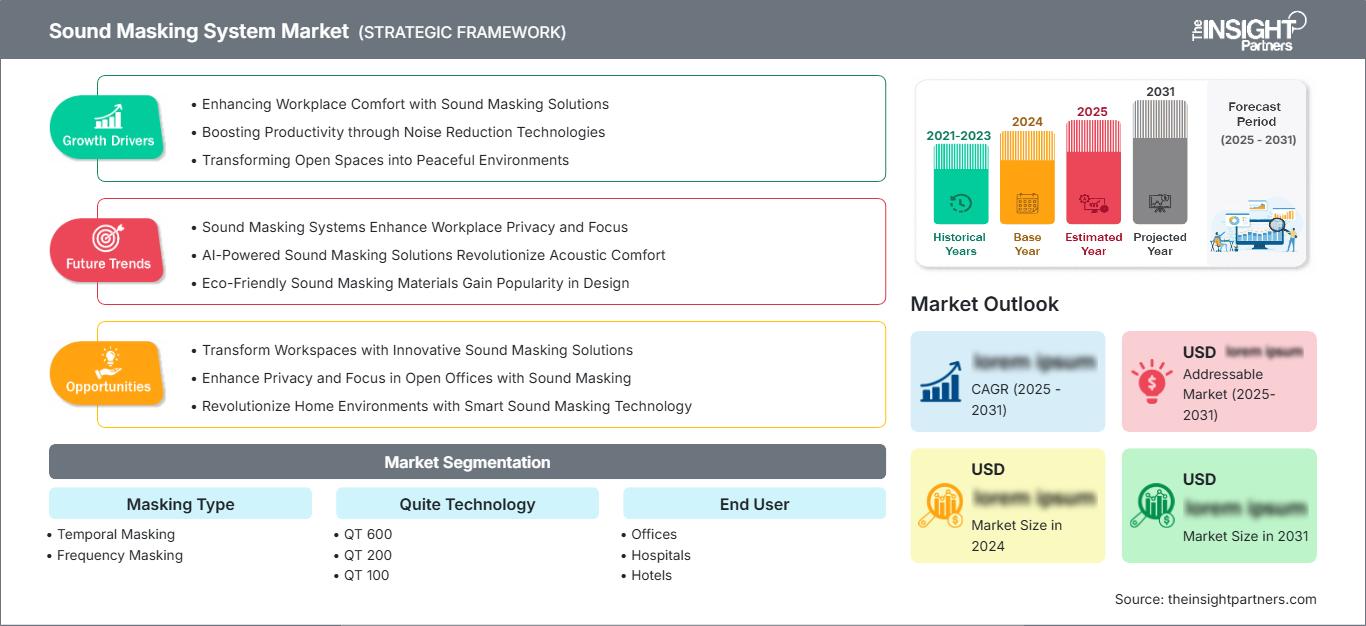
Sound Masking System Market: Strategic Insights
Regional Insights
North America Sound Masking System Market
The North American region contributed about 42% to the worldwide Sound Masking System Market share in 2025 and is estimated to grow with a CAGR of ~8% up to 2034. North America enjoys the presence of an established installed base in corporate offices, financial services, government buildings, healthcare, and professional services. Sound masking systems are often used as part of a wider acoustic solution involving spatial separation, sound absorption, and control of background sounds. Retrofitting will continue to play a role since buildings can allow the installation of emitters and controllers without requiring significant renovations to the building structure.
The US is the primary source of demand in the region, while Canada offers prospects through commercial constructions, healthcare facilities, and acoustic consulting companies. Purchasers give more attention to system zoning, commissioning, interoperability, and adjustability while choosing the equipment. Networked sound masking systems are especially applicable in large-scale buildings where different acoustic settings should be made in specific zones. The replacement of old systems and upgrading to digital management systems ensure the flow of recurring revenue along with sales.
U.S. Sound Masking System Market
The U.S. accounted for ~78% of North American market revenue in 2025 and is projected to record a ~8% CAGR through 2034. Its position is supported by extensive corporate real estate, healthcare infrastructure, financial institutions, law offices, government buildings, and professional services where speech privacy can influence facility design. Sound masking is also used in pharmacies and patient-facing healthcare areas where conversations can occur close to waiting spaces.
The competitive environment includes Biamp Systems, Lencore, Dukane Corporation, Soft dB, PRO ACOUSTICS LLC, Communication Service Corporation, and other specialist providers and integrators. Product portfolios increasingly support retrofit installation, multi-zone control, paging integration, and software-based adjustment. The combination of hybrid workplace layouts and continued investment in existing commercial buildings creates demand for systems that can be installed with limited disruption and recalibrated when occupancy, partitions, or space functions change.
Europe Sound Masking System Market
Europe constitutes ~28% of the Sound Masking System Market Share in 2025 and is expected to grow at a ~9% CAGR until 2034. Europe is well known for its knowledge and experience in building acoustics and performance, which makes it an ideal market for sound masking that needs professional specification. Europe has leading companies in the UK and Germany thanks to a good commercial building stock, finance and professional services sector, healthcare institutions, and acoustic consulting network. Office refurbishments, healthcare modernizations, and hospitality projects contribute to the French demand, and commercial buildings and hotels in Italy and Spain.
Acoustic privacy is an issue in open-plan offices, conference rooms, health care facilities, and professional services organizations in the UK. In Germany, the engineer-driven construction industry offers a perfect basis for solutions that emphasize acoustic performance, compatibility with building systems, and correct installation. In France, there are office and government refurbishment applications, while Italy and Spain have opportunities in hospitality, redevelopment, and health care markets. On average, buyers perceive sound masking as an acoustic design feature rather than a standalone noise control solution.
The European demand is also driven by the move towards flexible workspace arrangements. Multifunctional spaces may generate unstable acoustic environments, hence the increased relevance of zoning and customizable solutions. Networking-based control platforms will work well in the environment where the role of individual rooms changes often. Manufacturers who offer both the equipment and design services, installation, and maintenance can therefore cover a larger part of the procurement process.
APAC Sound Masking System Market
Asia Pacific accounted for ~22% of the global Sound Masking System Market in 2025 and is expected to grow at a ~12% CAGR through 2034, making it the fastest-growing region. China is the leading country in Asia Pacific, supported by large commercial construction activity and expanding technology, financial, healthcare, and hospitality facilities. Japan and South Korea provide mature demand for engineered workplace and institutional environments, while India is expanding from a lower adoption base through corporate offices, healthcare facilities, financial services, and premium commercial projects.
Contribution by Australia comes through the existing architectural and acoustic standards. In this part of the world, it is becoming common for developers to include workplace comfort, speech privacy, and integrated building technology in the modern building facilities. Development of professional and health care facilities, in addition to network audio system usage, facilitates the adoption of such technologies. The key challenge is to adopt the existing acoustic technologies to different construction methods.
Middle East & Africa Sound Masking System Market
Middle East and Africa is expected to record a ~10% CAGR through 2034. Saudi Arabia is the leading country in the Middle East & Africa region where evidence supports strong demand, with large-scale commercial, hospitality, healthcare, and mixed-use development creating opportunities for acoustic technology. The UAE also provides a significant project environment through premium offices, hotels, healthcare facilities, and financial centers.
South Africa represents an important African market because of its established commercial infrastructure and professional services sector. Rest of MEA demand is linked to urban development, hospitality projects, healthcare investment, and modernization of institutional buildings. High-end projects increasingly require integrated audio, communications, and acoustic solutions, creating opportunities for sound masking systems that can coexist with paging and emergency notification infrastructure. Adoption remains project-led, making consultant specification and system integrator relationships important channels.
Segmentation Analysis
Masking Type
Masking Type segment in the Sound Masking System Market is divided into Temporal Masking and Frequency Masking. Frequency Masking is the principal technology orientation because engineered masking sound is generally designed around the frequency characteristics of human speech. The segment is expected to expand at a ~10% CAGR through 2034 as buyers increasingly prioritize controlled acoustic performance, uniform coverage, and measurable speech privacy. Temporal Masking remains relevant where the timing and interaction of sounds are considered within broader acoustic design strategies.
- Temporal Masking: Temporal approaches address how one sound can reduce the perceptibility of another over time. Their strategic importance is linked to acoustic research and specialized applications, although commercial installations typically emphasize consistent background sound and predictable spatial coverage.
- Frequency Masking: Frequency-based approaches align masking energy with speech-relevant frequencies. Demand is supported by office privacy, healthcare conversations, and system designs that allow acoustic consultants to establish appropriate spectrum characteristics for the occupied environment.
Quite Technology
Quite Technology in the Sound Masking System Market includes QT 600, QT 200, and QT 100. The segment is expected to record a ~9% CAGR through 2034 as customers select system capacity and zoning according to facility size, room configuration, and control requirements. Product differentiation centers on coverage, number of zones, installation flexibility, control architecture, and compatibility with emitters and room controls. Larger controllers address complex facilities, while compact systems support smaller installations and targeted privacy treatment.
- QT 600: QT 600 addresses larger multi-zone requirements and is strategically important where centralized management, scalable emitter deployment, and differentiated acoustic settings are required across extensive commercial or institutional spaces.
- QT 200: QT 200 serves intermediate installation requirements where buyers need more capacity and flexibility than small single-zone solutions while maintaining manageable system complexity for offices and institutional facilities.
- QT 100: QT 100 is suited to smaller single-zone environments and targeted applications. Its compact control architecture supports retrofit projects where facility managers need practical installation and straightforward local adjustment.
End User
End User comprises Offices, Hospitals, Hotels, Pharmacies, and Banks. The segment is expected to grow at a ~10% CAGR through 2034. Offices remain the largest demand base because open-plan environments and shared meeting spaces create persistent speech privacy challenges. Hospitals represent a faster-expanding application because patient-provider confidentiality and acoustic comfort influence multiple facility areas. Hotels, pharmacies, and banks provide additional demand where customer interactions and sensitive conversations occur.
- Offices: Offices remain the core application, with open-plan layouts, meeting rooms, hybrid working arrangements, and flexible space planning increasing the need for controlled background sound and adjustable zoning.
- Hospitals: Hospitals use sound masking around patient rooms, examination spaces, reception areas, diagnostic environments, and administrative functions. Privacy requirements and patient experience make acoustic performance strategically significant.
- Hotels: Hotels can deploy sound masking in guest-facing areas, business centers, meeting spaces, and corridors where ambient sound management can complement architectural acoustics and guest comfort objectives.
- Pharmacies: Pharmacies provide a focused privacy application because medication consultations and customer discussions can occur within audible proximity of waiting or retail areas.
- Banks: Banks use sound masking to support privacy around teller areas, advisory rooms, customer service desks, and offices where financial information may be discussed.
Opportunity Snapshot
| End Users | Revenue Contribution | Trend Tag | Adoption Stage |
| Offices | High | Hybrid Workspaces | Mature |
| Hospitals | High | Patient Privacy | Scaling |
| Hotels | Medium | Guest Comfort | Scaling |
| Pharmacies | Medium | Consultation Privacy | Scaling |
| Banks | Medium | Financial Privacy | Mature |
Sound Masking System Market Growth Drivers and Impact Analysis
Expansion of Open and Flexible Workplace Layouts
Modern office planning increasingly combines open work areas, shared meeting rooms, collaboration zones, and flexible occupancy patterns. These configurations can increase the distance over which speech remains intelligible, particularly when architectural separation is limited. Sound masking addresses this issue by introducing controlled background sound rather than relying solely on physical barriers. The commercial impact of Sound Masking System Market is significant because retrofit projects can often add emitters, controllers, and room controls without rebuilding walls or ceilings. Facility managers can also adjust zones as departments move or space functions change. This supports demand from corporate campuses, coworking environments, professional services, and other workplaces where privacy and concentration need to coexist with flexible space utilization.
Growing Need for Speech Privacy in Healthcare Facilities
Healthcare environments generate frequent conversations involving sensitive patient information, while waiting rooms, corridors, examination rooms, and administrative areas often remain acoustically connected. Sound masking can form one layer of a broader acoustic strategy that also includes room separation and absorption. The resulting market opportunity extends beyond hospitals to outpatient centers, pharmacies, diagnostic facilities, and medical offices. Healthcare buyers can also favor systems that integrate with paging and communications infrastructure because multiple audio functions must coexist within the same building. As healthcare facilities modernize and expand, acoustic privacy becomes an architectural and operational consideration, supporting wider specification of purpose-designed masking systems rather than generic background audio equipment.
Integration of Acoustic Systems With Building Communications
Sound masking systems increasingly operate alongside paging, background music, emergency notification, and other building audio functions. This integration can reduce equipment duplication and allow facility managers to coordinate audio behavior across different zones. Networked architectures further support centralized configuration, monitoring, and changes to individual areas. The commercial impact is a shift from standalone acoustic equipment toward integrated building technology. Vendors can therefore differentiate through software, control interfaces, interoperability, commissioning support, and lifecycle services. For large commercial and institutional projects, these capabilities can simplify facility management while creating additional value for system integrators and acoustic consultants involved in design, installation, and long-term maintenance.
Sound Masking System Market Future Trends
Remote and Adaptive Acoustic Management
The next stage of sound masking development is likely to place greater emphasis on remote management and adaptive control. Networked platforms can allow facility teams to adjust zones without visiting individual equipment locations, while sensors can provide information about changing occupancy or acoustic conditions. This is particularly relevant to flexible offices where space utilization changes throughout the day and to large healthcare campuses requiring different acoustic settings across departments. The commercial implication is that system value will increasingly depend on software and control capabilities in addition to speakers and generators. Suppliers able to demonstrate reliable commissioning, secure remote access, intuitive interfaces, and measurable performance can address lifecycle requirements more effectively than hardware-only offerings.
Performance-Based Acoustic Specification
Future procurement is likely to place greater emphasis on measurable sound masking performance, including spatial uniformity, temporal consistency, spectrum shape, and operating level. ASTM E1573 provides a recognized method for evaluating masking sound in open offices, while industry work on system classification reflects demand for more consistent performance expectations. As architects and consultants adopt clearer performance criteria, manufacturers will need to provide better documentation, calibration procedures, and commissioning support. This Sound Masking System Market trend can shift purchasing decisions away from nominal equipment specifications toward demonstrated acoustic outcomes. It may also increase the role of specialist consultants and trained integrators in project design, testing, acceptance, and post-installation adjustment.
Sound Masking System Market Opportunities
Retrofit Packages for Existing Commercial Buildings
Existing commercial buildings in the Sound Masking System Market Forecast represent a substantial opportunity because acoustic problems often become visible after occupancy, when changing partitions, occupancy levels, or workplace configurations alter sound propagation. Retrofit-oriented packages can combine compact controllers, ceiling or exposed-ceiling emitters, room controls, and professional calibration to minimize disruption. Vendors can target corporate offices, banks, healthcare facilities, and hospitality properties undergoing refurbishment. A scalable retrofit proposition can also allow customers to begin with priority zones and expand later. The commercial opportunity extends beyond equipment sales to acoustic assessment, design, commissioning, software configuration, and periodic recalibration, creating a broader service model around installed systems.
Integrated Acoustic Solutions for Emerging Commercial Centers
Emerging commercial centers in Asia Pacific and the Middle East provide opportunities for suppliers to participate earlier in building design. New offices, hotels, healthcare campuses, financial facilities, and mixed-use developments can incorporate sound masking during architectural planning instead of adding it after occupancy. This allows manufacturers and integrators to influence specifications covering zoning, emitter placement, communications integration, and control architecture. Local partnerships with architects, acoustic consultants, distributors, and professional audio integrators can improve access to these projects. Vendors can also adapt product configurations to local construction practices and project budgets, helping expand adoption beyond established North American and European markets.
Recent Developments
- March 2025: Soft dB, a global leader in sound masking technology, is thrilled to announce a new strategic partnership with Network Products Inc. (NPI), one of the largest and most technically diverse manufacturer’s representative organizations in the Mid and South Atlantic. This marks Soft dB’s second major partnership announcement this year, reinforcing our commitment to delivering cutting-edge acoustic solutions and elevating speech privacy across North America.
- March 2025: Soft dB, a world-class manufacturer of Sound Masking Systems for offices and healthcare, is proud to announce a new partnership with PCT, a premier technology representative firm covering Ohio, Kentucky, Indiana, Michigan, Western Pennsylvania, Tennessee, and West Virginia. This collaboration will enhance Soft dB’s market reach and provide businesses across these regions with advanced sound masking solutions to improve workplace acoustics and employee productivity.
- January 2025: Biamp, a leading supplier of professional audiovisual solutions, announced that The Chamberlin Group, a financial advisory firm based in St. Louis, Missouri, has enhanced its new office space with the Cambridge Qt X 300 sound masking solution from Biamp. Designed to balance collaboration and privacy, this innovative technology creates an environment that supports productivity while safeguarding client confidentiality and compliance.
Frequently Asked Questions

- Comprehensive Market Sizing and Forecast Analysis
- Detailed Segmentation Analysis
- In-Depth Market Dynamics Assessment
- Regional and Country-Level Insights
- Competitive Landscape and Company Benchmarking
- Strategic Business Intelligence
Recent Reports
Testimonials

The Insight Partners provided valuable market intelligence that supported our global go-to-market strategy. Their team was professional, responsive, and attentive to our feedback, providing thoughtful analysis and helpful methodological clarifications throughout the project.
Junmo Kim Chief Financial Officer (CFO), Enertech Co., Ltd.
The Insight Partners' SCADA System Market report is comprehensive, with valuable insights on current trends and future forecasts. The team was highly professional, responsive, and supportive throughout. We are very satisfied and highly recommend their services.
RAN KEDEM Partner, Reali Technologies LTDs
I requested a report on a very specific software market and the team produced the report in a few days. The information was very relevant and well presented. I then requested some changes and additions to the report. The team was again very responsive and I got the final report in less than a week.
JEAN-HERVE JENN Chairman, Future Analytica
We worked with The Insight Partners for an important market study and forecast. They gave us clear insights into opportunities and risks, which helped shape our plans. Their research was easy to use and based on solid data. It helped us make smart, confident decisions. We highly recommend them.
PIYUSH NAGPAL Sr. Vice President, High Beam Global
The Insight Partners delivered insightful, well-structured market research with strong domain expertise. Their team was professional and responsive throughout. The user-friendly website made accessing industry reports seamless. We highly recommend them for reliable, high-quality research services
YUKIHIKO ADACHI CEO, Deep Blue, LLC.
This is the first time I have purchased a market report from The Insight Partners.While I was unsure at first, I visited their web site and felt more comfortable to take the risk and purchase a market report.I am completely satisfied with the quality of the report and customer service. I had several questions and comments with the initial report, but after a couple of dialogs over email with their analyst I believe I have a report that I can use as input to our strategic planning process.Thank you so much for taking the extra time and making this a positive experience.I will definitely recommend your service to others and you will be my first call when we need further market data.
JOHN SUZUKI President and Chief Executive Officer, Board Director, BK Technologies
I wish to appreciate your support and the professionalism you displayed in the course of attending to my request for information regarding to infectious disease IVD market in Nigeria. I appreciate your patience, your guidance, and the fact that you were willing to offer a discount, which eventually made it possible for us to close a deal. I look forward to engaging The Insight Partners in the future, all thanks to the impression you have created in me as a result of this first encounter.
DR CHIJIOKE ONYIA MANAGING DIRECTOR, PineCrest Healthcare Ltd.Reason to Buy
- Informed Decision-Making
- Understanding Market Dynamics
- Competitive Analysis
- Identifying Emerging Markets
- Customer Insights
- Market Forecasts
- Risk Mitigation
- Boosting Operational Efficiency
- Strategic Planning
- Investment Justification
- Tracking Industry Innovations
- Aligning with Regulatory Trends





 Get Free Sample for