
Sound Reinforcement Market Growth, Size & Forecast by 2034
Coverage: by Product (Microphones, Professional Speakers, Audio Sound Mixers, Audio Signal Processors, Power Amplifiers, Others (Cables and Audio Networking)); Format (Digital, Analog); End User (Corporate, Large venues and Events, Educational Institutions, Government, Studio and Broadcasting, Hospitality, Others) , and Geography (North America, Europe, Asia Pacific, and South and Central America)
- Status : Data Released
- Report Code : TIPRE00008879
- Category : Electronics and Semiconductor
- No. of Pages : 150
- Available Report Formats :


- Last update date : October 26, 2026


2025 Market Size
US$ 31.99 Bn
Base year value
2034 Forecast
US$ 45.27 Bn
Projected by 2034
CAGR 2026-2034
3.93 %
Growth rate
Addressable Market
US$ 350.84 Bn
(2026-2034)
The Sound Reinforcement Market is valued at US$ 31.99 Billion in 2025 and is projected to reach US$ 45.27 Billion by 2034, expanding at a CAGR of 3.93% during 2026–2034. The market encompasses microphones, professional speakers, audio sound mixers, audio signal processors, and power amplifiers used to capture, process, amplify, distribute, and reproduce sound across professional environments. Demand is shaped by live events, corporate communication, broadcasting, hospitality, education, and large-venue installations.
North America represents a structurally mature market supported by replacement demand, sophisticated venue infrastructure, professional touring activity, and rapid adoption of networked audio. The regional Sound Reinforcement Market Size is expected to expand at a modeled CAGR of ~3% through 2034, with digital signal processing, wireless microphone systems, installed loudspeakers, and integrated audio platforms supporting investment. The region also benefits from established professional-audio manufacturers, specialist integrators, rental companies, and a large installed base requiring periodic technology upgrades.
Sound Reinforcement Market Assessment and Insights
Regional Outlook
- North America: ~35% of the global market in 2025 | ~3% CAGR through 2034. Market position: North America holds the largest regional position, supported by extensive live-event infrastructure, mature commercial AV deployment, strong replacement cycles, professional touring, and high adoption of digital networking, DSP, wireless microphones, and powered loudspeaker systems.
- US: ~72% of North American market revenue in 2025 | ~3% CAGR through 2034. Market position: The US is the leading country in North America, benefiting from extensive entertainment venues, corporate AV installations, universities, houses of worship, broadcasting facilities, and a concentrated ecosystem of manufacturers, integrators, rental companies, and technology developers.
- Europe: ~26% of the global market in 2025 | ~3% CAGR through 2034. Market position: Europe is a mature professional-audio market, with the UK and Germany representing leading countries in Europe, supported by established entertainment industries, touring infrastructure, broadcast production, cultural venues, and sophisticated installed-audio requirements.
- Asia Pacific: ~30% of the global market in 2025 | ~5% CAGR through 2034. Market position: Asia Pacific is the fastest-growing region, supported by venue construction, urban entertainment development, expanding education and corporate AV requirements, and increasing professionalization of live events. China, Japan, South Korea, and India are important demand centers.
Segment Outlook
- End User: ~45% Share in 2025 | ~4% CAGR through 2034. Market position: End-user demand represents the principal revenue allocation dimension because sound reinforcement systems are deployed across multiple venue and institutional environments. Large venues and events create substantial equipment requirements due to audience coverage, scalability, reliability, and system redundancy.
- Format: ~68% Share in 2025 | ~5% CAGR through 2034. Market position: Digital formats have the stronger growth profile as users prioritize remote control, signal routing, software-based processing, audio networking, automation, compact system architecture, and integration with broader professional AV infrastructure.
Competitive Coverage
Audio-Technica U.S., Inc., Audix Corporation, Bose Corporation, CODA AUDIO, LEWITT GmbH, Music Tribe Global Brands Ltd, Samson Technologies Corp, Sennheiser electronic GmbH and Co. KG, Shure Incorporated, Sony Latin America Inc
Methodology
The Insight Partners follows Data Collection & Secondary Research, Primary Research, Data Analysis, and Data Triangulation & Final Review to validate market estimates and insights.
Source: The Insight Partners' analysis based on proprietary research, government publications, company annual reports, investor presentations, industry databases, and expert interviews.
This has involved the evolution of market products from analog signal chain to the integration of digital mixing, digital signal processing, networking of audio, wireless technology, and software control. Professional market products increasingly involve connecting microphones, mixers, digital signal processing equipment, amplifiers, and speakers using network technology to provide centralized monitoring and control capabilities. According to AVIXA, audio over IP is becoming an established technology consideration in new professional installations.
The focus of future investments in the market would be on networked systems, intelligent DSP, wireless workflows, immersive audio, and technologies that can serve multi-room/venue setups. Deployment of new markets in Asia, as infrastructure of entertainment venues, commercial buildings, educational institutions, and hospitality ventures increases, becomes another opportunity area. Standards relating to wireless frequency spectrum management and energy efficiency, coupled with customer expectations for interoperability and remote system control, would be the key drivers of product innovation and procurement.
Sound Reinforcement Market Report Scope
| Report Attribute | Details |
|---|---|
| Market size in 2025 | US$ 31.99 Billion |
| Market Size by 2034 | US$ 45.27 Billion |
| Global CAGR (2026 - 2034) | 3.93% |
| Historical Data | 2021-2024 |
| Forecast period | 2026-2034 |
Sound Reinforcement Market Analysis
The demand cycle begins with venue and application requirements, proceeding to system designers, consultants, integrators, distributors, rentals, and product manufacturers. Large venue projects normally need coordination of microphones, line array or point source speakers, mixers, DSP, amplification, monitoring, and control systems, whereas in the corporate and educational markets, intelligibility, manageability, and conferencing system interoperability are critical. AVIXA names loudspeakers, microphones, amplifiers, mixers, and processing as some of the significant audio product types for professional AV buyers.
The supply chain becomes increasingly dependent on the availability of semiconductors, transducers, wireless technology, digital processing hardware, network standards, and special manufacturing capabilities. Product differentiation will no longer be based on product specifications, but on complete system performance, interoperability, software control, reliability, and service. That means that ecosystem providers will have an advantage over others.
As per the Sound Reinforcement Market Report, competition is made up of specialist professional-audio firms, diverse electronics makers, and companies that have substantial installed-audio offerings. Audio-Technica, Audix, Sennheiser, Shure, and LEWITT possess strengths in microphones and wireless audio products, whereas Bose, CODA AUDIO, and Music Tribe are players in the loudspeaker, amplifier, processor, and overall systems category. Sony and other diverse electronics companies bring their technologies, reach, and production expertise to professional audio. Competitive advantage in audio is becoming more system-focused than simply hardware-focused.
Digital architectures, networking, wireless solutions, high-output compact loudspeakers, and software-driven configuration are among the areas seeing investment. Sennheiser noted in 2025 continued investments in professional audio innovation and strategic initiatives, as Spectera from Sennheiser shows how professional audio is moving towards bidirectional digital wireless systems.
● REPORT CUSTOMIZATION
Tailor This Report To Align With Your Specific Business Requirements
This report can be customized to align precisely with your business objectives, scope, and target markets. Customization options include tailored segmentation, geography, competitive analysis, and strategic insights to support informed decision-making.
Customize This Report →WHAT YOU CAN ADJUST
- ● Segmentations
- ● Geography
- ● Competitive Analysis
- ● Language Preferences
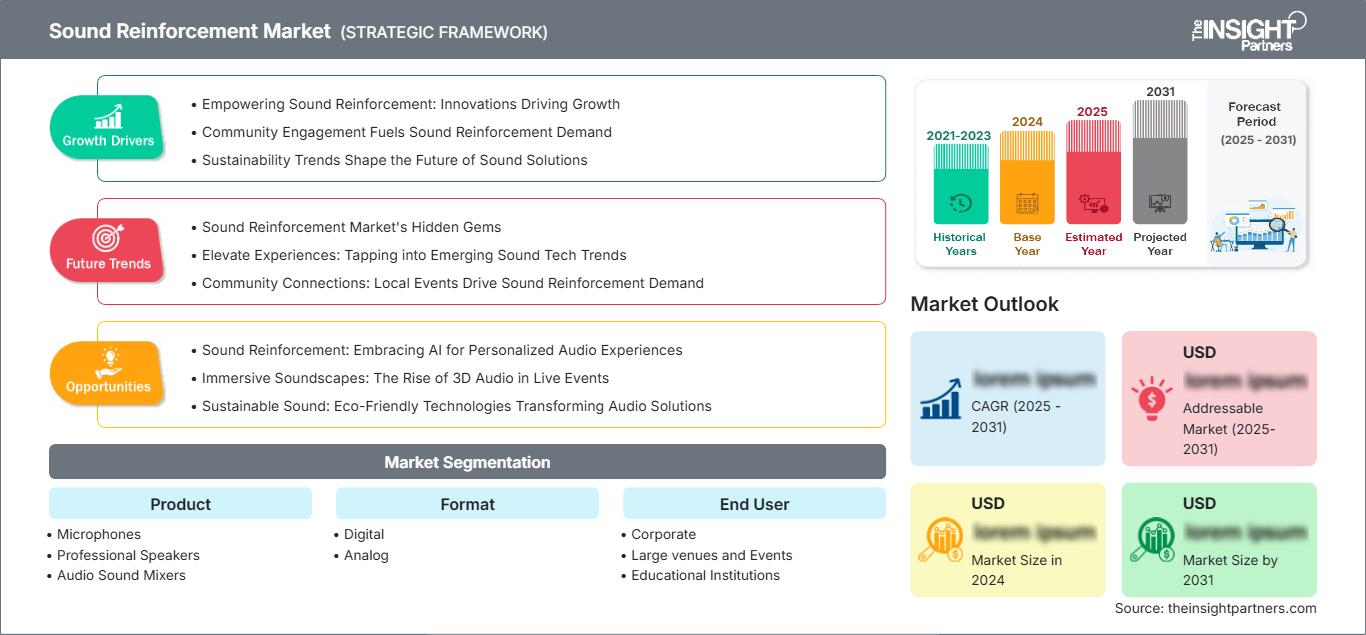
Sound Reinforcement Market: Strategic Insights
Regional Insights
North America Sound Reinforcement Market
North America captured ~35% Sound Reinforcement Market share of the world market in 2025 and is expected to register a CAGR of ~3% through 2034. The region boasts of an extensive installed base in concert venues, stadiums, conference facilities, colleges, corporate sites, hospitality destinations, places of worship, and broadcast studios. Replacement needs and modernization will continue to matter as professional customers look to move away from legacy or stand-alone systems to digital networked solutions.
The US will be the main regional demand generator, underpinned by a diverse entertainment ecosystem and a professional AV infrastructure. Canada will generate additional demand from the touring business, cultural institutions, educational facilities, hospitality sites, and commercial settings. Speech intelligibility, low latency, central control, wireless capability, and system compatibility have become increasingly valued characteristics in the market. At NAMM in 2025, it was noted that pro audio products attracted the most interest among buyers, with 28,165 visitors expressing interest in the category, while industry analysis showed the link between live music and professional audio.
U.S. Sound Reinforcement Market
The US represented ~72% of North American revenue in 2025 and is expected to expand at ~3% CAGR through 2034. The country combines a large installed base with extensive live entertainment, corporate communication, education, worship, hospitality, and broadcasting applications. Demand is supported by both new construction and replacement of aging microphones, loudspeakers, mixers, DSP systems, and amplification equipment.
Modern professional systems design is now based increasingly around digital routing, dense wireless microphone arrays, DSP networking, and control integration. Market leaders such as Shure, Bose, Audio-Technica, Audix, Sennheiser, Samson Technologies, and Music Tribe enjoy significant presence within relevant product lines. The procurement climate further favors devices that are flexible enough to be used in fixed installations, tour scenarios, or any combination of both. Investments in venues and production facilities provide an opportunity for suppliers to develop scalable products with easy commissioning and remote monitoring.
Europe Sound Reinforcement Market
Europe accounted for ~26% of global revenue in 2025 and is expected to witness ~3% CAGR growth through 2034. The market has reached maturity stage with demand spread across touring, broadcast production, theaters, concerts, cultural institutions, corporate installations, education, hospitality, and government installations. The UK and Germany are the key nations in Europe, backed by rich professional production infrastructure and proven audio engineering capabilities.
The UK enjoys the advantage of large live entertainment and touring sector infrastructure along with application in broadcast and theater segment. Germany is a combination of industrial AV demand along with major trade shows, concert halls, broadcast facilities, educational institutions, and professional audio manufacturers. France relies on its cultural venues, events, hospitality and corporate installations; while Italy and Spain enjoy their demand due to tourism, festivals, hospitality installations, theaters and events infrastructure. Network interoperability, ease of system configuration, smaller equipment and speech intelligibility are becoming important concerns for buyers in Europe.
Wireless technology and networked audio are particularly relevant as venues seek flexible system layouts and simplified management. Sennheiser's professional-audio activities demonstrate continued European investment in advanced wireless and broadcast technologies, including its Spectera ecosystem.
APAC Sound Reinforcement Market
APAC accounted for ~30% of global revenue in 2025 and is forecast to expand at ~5% CAGR through 2034, making it the fastest-growing region. China is the leading country in Asia Pacific, supported by its large entertainment, manufacturing, commercial construction, and event ecosystem. Japan and South Korea provide sophisticated demand for professional production, broadcasting, education, and entertainment applications.
India is getting advantages due to growth in infrastructure for events, development in hospitality sector, usage of audio visual technology by corporates, and increased professionalism in live entertainment. Contribution of Australia includes touring, education, hospitality, sports stadiums, and culture venues. In APAC region, there is increased investment in construction of new venues and upgrading of old venues, which is increasing demand for scalable digital mixing consoles, DSP systems, wireless microphones, and professional speakers.
Middle East & Africa Sound Reinforcement Market
The Middle East and Africa market is supported by venue construction, tourism development, hospitality investment, sports infrastructure, cultural projects, and large-scale entertainment initiatives. The region is projected to expand at ~5% CAGR through 2034. Saudi Arabia is a leading country in the Middle East & Africa market where evidence supports strong deployment momentum, particularly through entertainment and infrastructure development.
The United Arab Emirates continues to be an important regional center due to the presence of numerous hotels, convention centers, entertainment establishments, businesses, and international conferences. On the part of South Africa, contributions include broadcast centers, educational centers, religious worship centers, entertainment centers, and business centers. In the region as a whole, manufacturers are increasingly focusing on providing systems with high output, reliability, centralized control, and efficiency in covering large areas.
Segmentation Analysis
Product
The Product segment is expected to expand at ~4% CAGR through 2034. Product demand is determined by system architecture, venue size, acoustic requirements, portability, power requirements, and integration with digital control platforms. Professional users increasingly evaluate microphones, loudspeakers, mixers, processors, and amplifiers as interconnected system components rather than independent purchases. Replacement cycles and technology upgrades remain important as installed systems transition toward networked and software-configurable solutions.
- Microphones: Microphones remain essential input devices across live performance, broadcasting, conferencing, education, hospitality, and institutional applications. Demand emphasizes wireless flexibility, interference management, intelligibility, durability, and compact form factors, particularly where multiple simultaneous audio channels are required.
- Professional Speakers: Professional speakers address the output and coverage requirements of venues ranging from small rooms to stadium-scale environments. Line arrays, point-source systems, subwoofers, and powered loudspeakers are selected according to acoustic coverage, portability, output requirements, installation conditions, and system scalability.
- Audio Sound Mixers: Audio sound mixers coordinate multiple input sources and provide routing, level management, equalization, monitoring, and control. Digital consoles are increasingly preferred for complex installations and touring because scenes, presets, remote access, and software-based configuration can simplify recurring production workflows.
- Audio Signal Processors: Signal processors support equalization, crossover management, feedback control, delay, dynamics, routing, and room optimization. Their strategic importance is increasing as users seek consistent sound across distributed systems and more precise integration between microphones, mixers, amplifiers, and loudspeakers.
- Power Amplifiers: Power amplifiers remain fundamental to passive loudspeaker systems and large-scale deployments. Buyers increasingly consider efficiency, channel density, monitoring, network control, thermal management, and integration with DSP when selecting amplification platforms for demanding installations.
Format
The Format segment is projected to grow at ~5% CAGR through 2034. Digital systems are reshaping professional audio architecture by enabling programmable routing, network distribution, remote configuration, signal processing, automation, and integration with IT infrastructure. Analog equipment remains relevant where simplicity, familiarity, low-latency operation, or legacy compatibility is important, but new installations increasingly incorporate digital control and processing capabilities.
- Digital: Digital formats support flexible routing, integrated DSP, scene recall, networked audio, remote management, and software configuration. They are particularly relevant for complex venues and multi-room environments where centralized control and repeatable system settings reduce operational complexity.
- Analog: Analog systems continue to serve users prioritizing straightforward signal paths, familiar workflows, compatibility with existing equipment, and cost-conscious deployment. They remain relevant in smaller venues, legacy installations, educational facilities, and selected live-performance configurations.
End User
The End User segment is expected to expand at ~4% CAGR through 2034. Requirements vary according to audience size, acoustic environment, installation permanence, operational expertise, and content type. Large venues and events generate complex system requirements, while corporate, educational, government, studio, broadcasting, and hospitality environments increasingly prioritize intelligibility, centralized management, reliability, and integration with broader AV infrastructure.
- Corporate: Corporate users increasingly deploy professional audio for meeting rooms, auditoriums, training spaces, presentations, and hybrid communication. Ease of operation, speech clarity, interoperability, and centralized management are important purchasing considerations.
- Large venues and Events: Large venues and events require high-output, scalable systems capable of delivering consistent coverage to large audiences. Touring productions, festivals, stadiums, convention centers, and performance venues create demand for robust loudspeakers, wireless microphones, mixing, DSP, and amplification.
- Educational Institutions: Schools, colleges, universities, and training facilities use sound reinforcement for lectures, assemblies, performances, announcements, and hybrid learning. Procurement increasingly emphasizes straightforward control, speech intelligibility, reliability, and compatibility with installed AV systems.
- Government: Government applications include public meeting spaces, civic facilities, auditoriums, emergency communication environments, and institutional buildings. Reliability, lifecycle support, security considerations, and straightforward system administration influence purchasing decisions.
- Studio and Broadcasting: Studios and broadcasters require accurate capture, low-noise signal chains, dependable monitoring, flexible routing, and precise processing. Professional microphones, mixers, processors, and networked systems support increasingly integrated production workflows.
- Hospitality: Hotels, resorts, restaurants, clubs, and entertainment properties use sound reinforcement for background audio, conferences, live entertainment, announcements, and events. Systems must balance acoustic coverage, aesthetics, operational simplicity, and multi-zone control.
Opportunity Snapshot
| End User | Revenue Contribution | Trend Tag | Adoption Stage |
| Corporate | Medium | Hybrid Meetings | Scaling |
| Large venues and Events | High | Live Production | Mature |
| Educational Institutions | Medium | Campus AV | Scaling |
| Government | Low | Civic Audio | Scaling |
| Studio and Broadcasting | Medium | Networked Production | Mature |
| Hospitality | High | Multi-Zone Audio | Scaling |
Sound Reinforcement Market Growth Drivers and Impact Analysis
Expansion of Live Events and Experience-Based Entertainment
The continued development of concerts, festivals, sporting events, cultural performances, corporate experiences, and large public gatherings directly increases requirements for professional sound reinforcement. Event producers need systems capable of delivering intelligible, consistent audio across larger audiences while supporting fast setup, repeatable configurations, and flexible routing. NAMM's 2025 industry reporting connected professional-audio gains with renewed live-music activity, while its 2025 show identified pro audio as its most popular product category. The impact extends beyond loudspeakers because large deployments require coordinated microphones, digital mixers, DSP, amplifiers, monitoring, wireless infrastructure, and system-control equipment. As event formats become more technically complex, equipment suppliers can capture replacement and expansion demand through integrated platforms rather than individual hardware products.
Migration Toward Networked and Software-Configured Audio Systems
Audio networking is changing the architecture of professional sound reinforcement by allowing signals to move between microphones, mixers, processors, amplifiers, and loudspeakers through shared digital infrastructure. AVIXA describes audio over IP as a widely adopted technology for new professional installations, reflecting the shift from isolated analog connections toward networked systems. This transition increases the value of DSP, software control, remote monitoring, centralized configuration, and interoperable devices. It also changes procurement decisions because buyers increasingly assess lifecycle management, scalability, and integration rather than only acoustic specifications. Manufacturers able to combine hardware with reliable networking and control capabilities can address larger system requirements and recurring service opportunities.
Modernization of Installed AV Infrastructure
Replacement of aging equipment is an important demand mechanism as venues modernize microphones, loudspeakers, mixers, amplifiers, and processing systems. Existing installations increasingly need compatibility with digital networks, remote configuration, wireless systems, and modern production workflows. Modernization can occur without complete venue reconstruction because individual components can be replaced while retaining selected infrastructure. This creates a layered purchasing cycle in which amplifiers, processors, microphones, and loudspeakers may be upgraded at different times. For suppliers, the installed base creates recurring opportunities for equipment refreshes, accessories, integration services, and software-enabled management. For buyers, modernization can improve coverage consistency and operating efficiency while avoiding the disruption and cost associated with replacing an entire system simultaneously.
Sound Reinforcement Market Future Trends
AI-Assisted Audio Optimization and Automated System Control
AI-assisted audio technologies are likely to become increasingly integrated into professional sound reinforcement workflows, particularly for system tuning, feedback management, speech enhancement, source detection, monitoring, and configuration support. Rather than replacing audio engineers, these functions can reduce repetitive setup tasks and help maintain consistent performance across changing venue conditions. Automated acoustic analysis may enable systems to identify problematic frequencies, optimize equalization, and recommend configuration adjustments. The commercial significance lies in shortening commissioning time and making sophisticated processing accessible to smaller technical teams. As professional AV buyers increasingly evaluate software capabilities alongside hardware, AI-enabled DSP and management tools could become differentiating features across mixers, processors, amplifiers, and integrated loudspeaker systems.
Convergence of Immersive Audio, Wireless, and Network Infrastructure
Future systems in the Sound Reinforcement Market Trends are likely to combine immersive audio, high-density wireless channels, networked signal distribution, and centralized control within unified architectures. Professional wireless systems are already moving toward broader digital ecosystems. Sennheiser's Spectera platform, for example, illustrates the development of bidirectional wideband wireless infrastructure designed for professional audio workflows. The next stage is likely to emphasize interoperability between wireless microphones, digital consoles, DSP, amplification, and loudspeaker management. This convergence can simplify complex productions by reducing standalone equipment and enabling shared monitoring and configuration. Vendors that support open networking standards and flexible system architectures may gain relevance as venues seek scalable infrastructure capable of supporting multiple production formats.
Sound Reinforcement Market Opportunities
Integrated Audio Platforms for High-Growth Asian Markets
Asia Pacific Sound Reinforcement Market Forecast provides opportunities for suppliers that can combine equipment, system design, training, commissioning, and after-sales support. Rapid development of entertainment venues, hospitality properties, corporate facilities, educational campuses, and public infrastructure creates demand for scalable audio systems rather than isolated equipment. China, India, Japan, South Korea, and Australia have different purchasing structures, making channel strategy and local integration capabilities important. Suppliers can strengthen their position through regional distributors, certified integrator networks, localized technical support, and products designed for varying venue sizes. Digital mixers, networked DSP, wireless microphones, powered loudspeakers, and software-based control can address customers seeking simplified operation while retaining professional performance.
Software-Enabled Lifecycle Services and Remote System Management
A second opportunity lies in services built around installed equipment, including remote monitoring, predictive maintenance, configuration management, firmware support, system optimization, and asset tracking. Network-connected audio equipment provides a technical foundation for these services by allowing integrators and operators to observe system status and adjust configurations without visiting every installation. This can be particularly valuable for hotel chains, educational networks, corporate campuses, touring organizations, and multi-venue operators. Suppliers can create recurring revenue opportunities by combining hardware with management software, technical support, commissioning, and maintenance agreements. Such models also increase customer retention because system performance and operational continuity become part of the vendor relationship rather than a one-time equipment purchase.
Recent Developments
- August 2026: Bose Professional announced the acquisition of Fulcrum Acoustic, expanding its professional loudspeaker and audio-system capabilities and strengthening its portfolio for entertainment and installed applications. The transaction reflects continued consolidation and portfolio expansion in professional sound reinforcement as vendors seek broader system capabilities.
- January 2026: Sennheiser announced that its MD 421 Kompakt microphone received a NAMM TEC Award for technical achievement in the microphones and sound reinforcement category. The product was positioned as a compact evolution of the MD 421 platform for applications including dense stages, guitar cabinets, drums, and horns.
- March 2026: Bose Professional, developer of world-class audio experiences designed to transform any space, today announced the launch of the DesignMax DM12SE, the largest and most powerful member of the acclaimed DesignMax loudspeaker family. DM12SE combines the sleek DesignMax aesthetic with the power and durability demanded by performance spaces, retail stores, hospitality venues, and houses of worship. Built to perform indoors or out, DM12SE is a high-output loudspeaker designed to deliver room-filling bass and consistent 102° conical coverage.
Frequently Asked Questions

- Comprehensive Market Sizing and Forecast Analysis
- Detailed Segmentation Analysis
- In-Depth Market Dynamics Assessment
- Regional and Country-Level Insights
- Competitive Landscape and Company Benchmarking
- Strategic Business Intelligence
Recent Reports
Testimonials

The Insight Partners provided valuable market intelligence that supported our global go-to-market strategy. Their team was professional, responsive, and attentive to our feedback, providing thoughtful analysis and helpful methodological clarifications throughout the project.
Junmo Kim Chief Financial Officer (CFO), Enertech Co., Ltd.
The Insight Partners' SCADA System Market report is comprehensive, with valuable insights on current trends and future forecasts. The team was highly professional, responsive, and supportive throughout. We are very satisfied and highly recommend their services.
RAN KEDEM Partner, Reali Technologies LTDs
I requested a report on a very specific software market and the team produced the report in a few days. The information was very relevant and well presented. I then requested some changes and additions to the report. The team was again very responsive and I got the final report in less than a week.
JEAN-HERVE JENN Chairman, Future Analytica
We worked with The Insight Partners for an important market study and forecast. They gave us clear insights into opportunities and risks, which helped shape our plans. Their research was easy to use and based on solid data. It helped us make smart, confident decisions. We highly recommend them.
PIYUSH NAGPAL Sr. Vice President, High Beam Global
The Insight Partners delivered insightful, well-structured market research with strong domain expertise. Their team was professional and responsive throughout. The user-friendly website made accessing industry reports seamless. We highly recommend them for reliable, high-quality research services
YUKIHIKO ADACHI CEO, Deep Blue, LLC.
This is the first time I have purchased a market report from The Insight Partners.While I was unsure at first, I visited their web site and felt more comfortable to take the risk and purchase a market report.I am completely satisfied with the quality of the report and customer service. I had several questions and comments with the initial report, but after a couple of dialogs over email with their analyst I believe I have a report that I can use as input to our strategic planning process.Thank you so much for taking the extra time and making this a positive experience.I will definitely recommend your service to others and you will be my first call when we need further market data.
JOHN SUZUKI President and Chief Executive Officer, Board Director, BK Technologies
I wish to appreciate your support and the professionalism you displayed in the course of attending to my request for information regarding to infectious disease IVD market in Nigeria. I appreciate your patience, your guidance, and the fact that you were willing to offer a discount, which eventually made it possible for us to close a deal. I look forward to engaging The Insight Partners in the future, all thanks to the impression you have created in me as a result of this first encounter.
DR CHIJIOKE ONYIA MANAGING DIRECTOR, PineCrest Healthcare Ltd.Reason to Buy
- Informed Decision-Making
- Understanding Market Dynamics
- Competitive Analysis
- Identifying Emerging Markets
- Customer Insights
- Market Forecasts
- Risk Mitigation
- Boosting Operational Efficiency
- Strategic Planning
- Investment Justification
- Tracking Industry Innovations
- Aligning with Regulatory Trends





 Get Free Sample for