
Spintronic Logic Devices Market Trends, Share & Demand by 2034
Coverage: by Type (Semiconductor Based Devices, Metal Based Devices); Application (Electric Vehicles, Industrial Motors, Semiconductor Lasers, Magnetic Tunnel Transistors, Data Storage, Others) , and Geography (North America, Europe, Asia Pacific, and South and Central America)
- Status : Data Released
- Report Code : TIPRE00011146
- Category : Electronics and Semiconductor
- No. of Pages : 150
- Available Report Formats :


- Last update date : October 30, 2026


2025 Market Size
US$ 1.37 Bn
Base year value
2034 Forecast
US$ 3.45 Bn
Projected by 2034
CAGR 2026-2034
10.80 %
Growth rate
Addressable Market
US$ 21.32 Bn
(2026-2034)
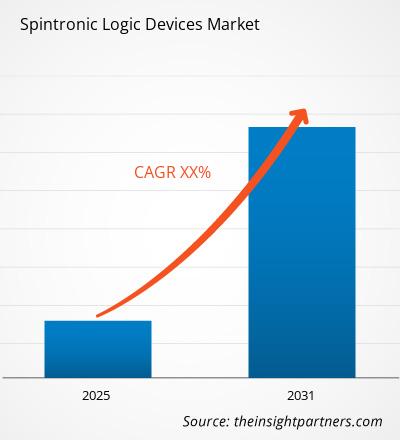
The Spintronic Logic Devices Market was valued at US$ 1.37 Billion in 2025 and is projected to reach US$ 3.45 Billion by 2034, expanding at a CAGR of 10.80% during 2026–2034. It involves semiconductor devices and metal devices that are used in electric vehicles, industrial motors, semiconductor lasers, magnetic tunnel transistors, and data storage systems. Commercialization will be driven by low-power switching, non-volatility, endurance, and use of magnetic functionality with semiconducting processes.
North America will grow at a ~10% CAGR up to 2034 due to advanced semiconducting R&D, domestic fabrication investments, and need for dependable memory and magnetic sensors. Growth of the Spintronic Logic Devices Market Size is also driven by electronic components used in electric vehicles, edge computing, industrial automation, and aerospace equipment requiring dependable data storage, low idle power, and reliability in thermal/electromagnetic stress.
Spintronic Logic Devices Market Assessment and Insights
Regional Outlook
- North America: ~36% of the global market in 2025 | ~10% CAGR through 2034. Market position: The region ranks first, supported by mature semiconductor design capabilities, MRAM commercialization, defense-grade electronics, data-center demand, and sustained university-industry research.
- US: ~82% of North American market revenue in 2025 | ~11% CAGR through 2034. Market position: The United States leads North America through concentrated vendor activity, advanced foundry research, automotive electronics adoption, and demand for persistent memory in industrial, aerospace, and edge-computing systems.
- Europe: ~25% of the global market in 2025 | ~9% CAGR through 2034. Market position: Europe combines established automotive and industrial automation demand with semiconductor localization programs; Germany leads, while France, the UK, Italy, and Spain broaden application development.
- Asia Pacific: ~31% of the global market in 2025 | ~13% CAGR through 2034. Market position: Asia Pacific is the fastest-growing region as China, Japan, and South Korea scale semiconductor manufacturing, while India and Australia strengthen research, electronics, and strategic-technology investment.
Segment Outlook
- Type: ~57% Share in 2025 | ~11% CAGR through 2034. Market position: Type leads because semiconductor-based devices align with CMOS integration, embedded memory, scalable fabrication, and logic-memory convergence across automotive, industrial, and data-processing architectures.
- Application: ~43% Share in 2025 | ~12% CAGR through 2034. Market position: Application revenue grows as electric vehicles, industrial motors, data storage, and magnetic tunnel transistor designs translate device performance into higher-value system functions.
Competitive Coverage
Everspin Technologies, Inc., FUTEK Advanced Sensor Technology, Inc., International Business Machines Corporation, Infineon Technologies AG, Intel Corporation, Kistler Holding AG, NVE Corporation, PCB Piezotronics, Inc., Samsung Electronics Co., Ltd., Spindeco Technologies Oy
Methodology
The Insight Partners follows Data Collection & Secondary Research, Primary Research, Data Analysis, and Data Triangulation & Final Review to validate market estimates and insights.
Source: The Insight Partners' analysis based on proprietary research, government publications, company annual reports, investor presentations, industry databases, and expert interviews.
Spintronic devices have graduated from narrow usage within magnetic detection and experimental logic circuits in laboratories into commercial MRAMs, TMR sensors, and advanced logic-memory systems. The better performance of the magnetic tunnel junction stacks, the low error rate in writing, compatibility with wafer fabrication processes, and robust packaging technology are surmounting the challenges of adoption. Wafer manufacturing would always be difficult because of issues like film deposition uniformity, interfacial properties, efficient use of switching current, and backend thermal budgets. But nevertheless, wafer fab support and standardization of serial interfaces is increasing the scope of customers beyond research projects.
The market expansion until 2034 needs to target Asia Pacific regions for wafer manufacturing centers and Europe for automotive and industrial segments, while North America will continue its strong position in IP, aerospace, and high-end computing. Semiconductors, electric vehicles, and energy-efficient systems will help in financial profitability but growth needs to depend on a qualified supply chain, design tools availability, and reliable devices. Therefore, investment needs to be in process integration, embedded MRAM, TMR sensing at high sensitivity, and specific application architecture.
Spintronic Logic Devices Market Report Scope
| Report Attribute | Details |
|---|---|
| Market size in 2025 | US$ 1.37 Billion |
| Market Size by 2034 | US$ 3.45 Billion |
| Global CAGR (2026 - 2034) | 10.80% |
| Historical Data | 2021-2024 |
| Forecast period | 2026-2034 |
Spintronic Logic Devices Market Analysis
Spintronic Logic Devices Market growth is stimulated by the necessity to reduce energy consumption for moving data and keeping it in storage without constant electricity. Electric drives require accurate measurement of position, velocity, and current parameters; factories require durable sensors and quick state recovery; edge computing requires non-volatile memory adjacent to processors. These applications benefit from magnetic components with their endurance, switching speed, and robustness.
The industry includes magnetic materials, thin-film deposition, tunnel junction manufacturing, integration into CMOS, packaging, firmware, and qualification. The supply chain is concentrated due to the need for nanometer-level control of film thickness and good quality of interfaces. Device manufacturers are increasingly cooperating with foundries, automotive Tier 1 companies, industrial controllers, and research institutions to decrease the qualification period.
The Spintronic Logic Devices Market Report suggests that the competition is split between experts in offering standalone MRAM or magnetic sensor and diversified semiconductor companies with spin-based technologies being integrated into a larger platform. Everspin Technologies, NVE Corporation, and Spindeco Technologies Oy specialize in being experts, but IBM, Intel, Samsung Electronics, and Infineon have deep research capabilities, good process integration, and access to worldwide customers.
Money flows towards scaling of magnetic tunnel junctions, automotive certification, and the concept of compute-near-memory. FUTEK Advanced Sensor Technology, Kistler Holding, and PCB Piezotronics are players of nearby sensor ecosystems helping with system-level integration and channel access. The competitive edge will not come from single devices' characteristics, but rather from ability to manufacture, certify, interface and solve power/latency/reliability problem.
● REPORT CUSTOMIZATION
Tailor This Report To Align With Your Specific Business Requirements
This report can be customized to align precisely with your business objectives, scope, and target markets. Customization options include tailored segmentation, geography, competitive analysis, and strategic insights to support informed decision-making.
Customize This Report →WHAT YOU CAN ADJUST
- ● Segmentations
- ● Geography
- ● Competitive Analysis
- ● Language Preferences
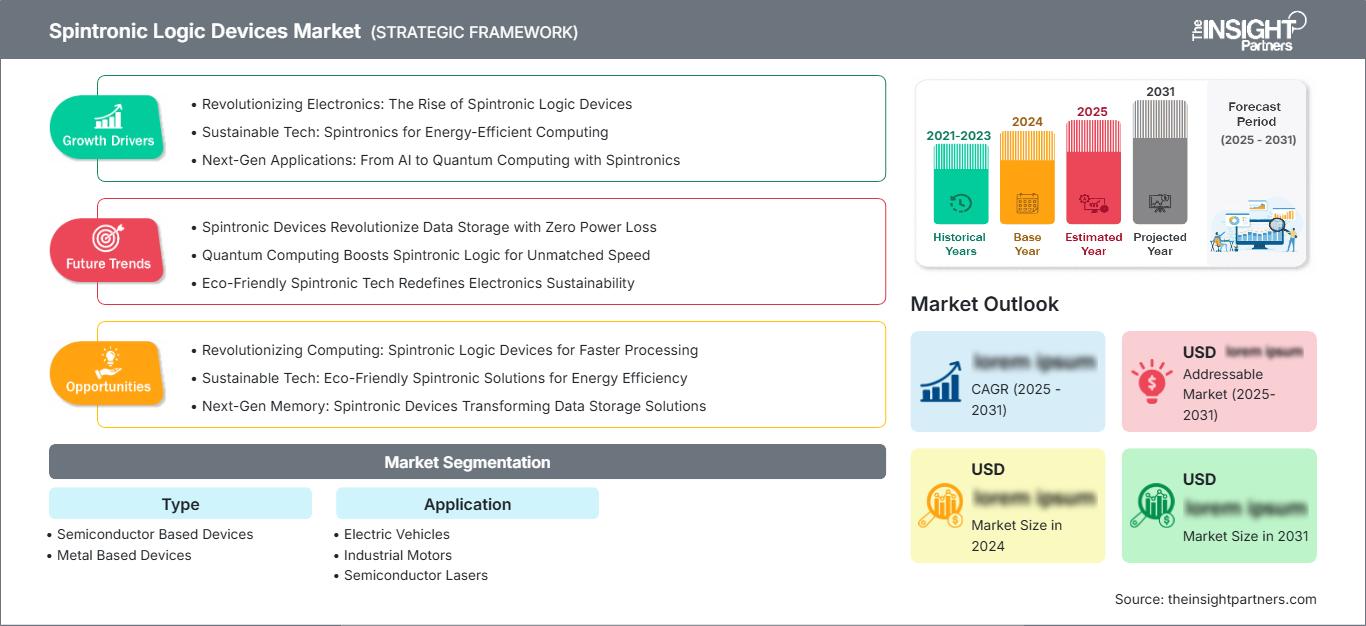
Spintronic Logic Devices Market: Strategic Insights
Regional Insights
North America Spintronic Logic Devices Market
North America is modeled to grow at ~10% CAGR through 2034. Its position rests on advanced semiconductor research, established MRAM commercialization, defense and aerospace electronics, and a large base of data-center and industrial-control customers. The Spintronic Logic Devices Market share in the region also benefits from collaboration among universities, national laboratories, foundries, and fabless specialists.
Requirements for commercialization are continuous memory, secure boot, event logging, and robust sensor systems. A policy that promotes the production of domestic chips could be of use to the issue of access to pilot manufacturing and packaging facilities, although magnetic-stack capabilities remain an issue. Canada can offer materials, quantum physics, and research expertise, while Mexico offers electronics manufacturing capacity.
U.S. Spintronic Logic Devices Market
The U.S. represents ~82% of North American revenue in 2025 and has a forecasted growth rate of ~11% CAGR. Everspin Technologies, IBM, Intel, and NVE Corporation lead in commercial MRAM, materials development, advanced integration, and magnetic sensors. Government funding of semiconductors and defense is another source of qualification-driven demand.
Adoption will happen where the benefits of non-volatility, endurance, and determinism outweigh the traditional memories and Hall effect sensors. Some of the application areas include automotive electronics, aerospace, industrial control applications, AI at the edge, and secure computing environments. It is succeeding in North America due to its presence of IP devices, system customers, funds, and research, but requires more foundries and yield learning.
Europe Spintronic Logic Devices Market
Europe accounts for ~25% of global revenues in 2025, with a CAGR of ~9% expected through 2034. For Europe, the demand is driven by its solid background in automotive engineering, industrial automation, power electronics, and metrology, which require precise and low-power magnetic sensing and embedded non-volatile memory. Furthermore, there are semiconductor sovereignty initiatives that drive pilot production and R&D partnerships.
Germany is the leading country in Europe, profiting from automotive engineering, industrial automation, and a wide network of semiconductor supply chain. France is characterized by microelectronics R&D skills, while the UK boasts its material sciences, chip design, and university spinoffs. Demand is generated in Italy by industrial machines and automotive suppliers and by semiconductor initiatives in Spain.
European customers have long qualification processes with a focus on functional safety, thermal robustness, availability throughout the product life cycle, and manufacturing traceability. It restricts the generation of revenues initially but can result in design wins. Partnerships between magnetic devices vendors and automotive Tiers 1 and industrial OEMs should remain central to any commercial activities.
APAC Spintronic Logic Devices Market
Asia Pacific holds ~31% of global revenue in 2025 and is the fastest-growing region at ~13% CAGR through 2034. China is the leading country in Asia Pacific because of its electronics scale, electric-vehicle production, and semiconductor localization agenda. Japan contributes magnetic materials and precision manufacturing, while South Korea adds memory and foundry capability.
India has been raising its profile in chip design and fabrication efforts while Australia provides research in quantum materials and sensors. Regional development requires a transition from experimental to qualified manufacturing, but the density of the supply chain, along with policy measures, strong demand for data storage, motors, and vehicle electronics, offer an effective scaling model.
Middle East & Africa Spintronic Logic Devices Market
The Middle East & Africa market is forecast to advance at ~8% CAGR through 2034. Demand is emerging around energy infrastructure, industrial monitoring, data centers, defense electronics, and smart-mobility projects. The UAE is the leading country in the Middle East & Africa where digital infrastructure, advanced manufacturing ambitions, and investment capacity support early adoption.
The Saudi Arabia’s industrial diversification and huge infrastructure development efforts would provide the basis for sensing and control opportunities, whereas South Africa would be helpful in providing mining, energy and research applications. The Rest of MEA would be import driven and hence the distributor capabilities and technical support would play an important role here.
Segmentation Analysis
Type
Type is projected to grow at ~11% CAGR through 2034. The Spintronic Logic Devices Market scope includes semiconductor-based devices optimized for CMOS-compatible integration and metal-based devices that exploit multilayer magnetic structures. Adoption depends on switching efficiency, fabrication compatibility, endurance, sensitivity, and the cost of integrating magnetic stacks with established electronics processes.
- Semiconductor Based Devices: These devices lead commercialization because they can combine magnetic junctions with logic, embedded memory, and standard interfaces. Demand centers on low-power computing, non-volatile controllers, automotive electronics, and scalable integration.
- Metal Based Devices: Multilayer metallic structures remain strategically important for high-sensitivity sensing, spin transport research, and specialized logic concepts. Their value lies in tunable magnetic behavior, materials innovation, and performance in precision applications.
Application
Application segment in the Spintronic Logic Devices Market is expected to expand at ~12% CAGR through 2034 as system designers convert device-level gains into lower energy use, faster state recovery, and improved sensing precision. The strongest opportunities arise where reliability and power savings offset qualification costs, particularly in electric mobility, industrial control, persistent storage, and emerging logic-memory architectures.
- Electric Vehicles: TMR sensing and persistent memory support motor position, transmission speed, battery management, secure logging, and instant recovery. Automotive qualification and long platform lifecycles make validated components strategically valuable.
- Industrial Motors: Spintronic sensors enable precise speed, position, and current feedback in compact, electrically noisy environments. Factory automation and predictive maintenance increase demand for robust, low-drift components.
- Semiconductor Lasers: Spin-dependent carrier control can support polarization management and novel optoelectronic functions. Commercial uptake remains emerging, with research focused on integration, temperature stability, and manufacturability.
- Magnetic Tunnel Transistors: These devices offer potential for spin-dependent amplification and logic functions. Strategic importance lies in heterogeneous computing and research platforms, although process complexity limits near-term volume.
- Data Storage: MRAM and related architectures provide non-volatility, high endurance, fast writes, and lower standby energy. Demand spans embedded controllers, industrial systems, edge AI, aerospace electronics, and specialized enterprise infrastructure.
Opportunity Snapshot
| Application | Revenue Contribution | Trend Tag | Adoption Stage |
| Electric Vehicles | High | Motor Sensing | Scaling |
| Industrial Motors | High | Predictive Control | Mature |
| Semiconductor Lasers | Low | Spin Photonics | Emerging |
| Magnetic Tunnel Transistors | Low | Logic Integration | Emerging |
| Data Storage | High | Persistent Memory | Scaling |
Spintronic Logic Devices Market Growth Drivers and Impact Analysis
Persistent, energy-efficient computing
Memory traffic consumes energy and delays processing when data repeatedly moves between storage and logic. Spintronic devices address this constraint through non-volatility, high endurance, and rapid state retention, allowing systems to resume without lengthy reload cycles. The impact is strongest in edge controllers, industrial automation, and always-on electronics where standby power and recovery time affect total operating cost. As AI inference shifts closer to sensors, persistent memory can store model parameters, logs, and configuration data locally. Commercial success will depend on density, write current, and integration cost, but the underlying system-level value supports sustained adoption.
Electrification and precision magnetic sensing
Electric vehicles and automated machinery require accurate measurement of speed, position, torque-related variables, and current under tight space and thermal constraints. TMR devices offer high sensitivity and strong signal output, enabling larger air gaps, smaller magnets, or more flexible placement than some incumbent approaches. This can simplify mechanical design while improving control responsiveness. The real-world impact extends from traction motors and transmissions to robotics and industrial drives. Automotive qualification remains demanding, yet once a sensor is designed into a platform, long production cycles and stringent validation can support durable supplier relationships.
Semiconductor localization and pilot-line access
Public and private investment in domestic semiconductor capacity is widening access to advanced process development, specialty materials, packaging, and prototyping. Spintronic logic benefits because commercialization requires coordinated control of magnetic deposition, CMOS compatibility, wafer-level uniformity, and backend thermal limits. Shared pilot lines can reduce the capital burden for specialists and help customers validate devices before committing to volume. The market impact is not automatic: funding must translate into qualified processes, design kits, and repeatable yields. Regions that connect research institutes, foundries, equipment suppliers, and end users are better positioned to convert scientific progress into revenue.
Spintronic Logic Devices Market Future Trends
Logic-memory convergence for edge intelligence
Spintronic Logic Devices Market trends point toward architectures that place persistent memory and stochastic magnetic elements closer to computation. Magnetic tunnel junctions can support embedded storage, random-number generation, and probabilistic operations, reducing data movement and enabling new compute patterns. Through 2034, development is likely to prioritize co-design among materials, circuits, compilers, and workloads rather than isolated device benchmarks. Early deployment should concentrate in security, industrial edge AI, and specialized accelerators where deterministic persistence or hardware entropy has measurable value. Broader adoption will require foundry-ready process modules, predictable variability, and software tools that expose device advantages to system designers.
Higher-density and harsh-environment MRAM
Product roadmaps are moving toward higher-density serial and embedded MRAM with stronger temperature, radiation, and automotive qualification. This transition expands the addressable market from configuration storage and logging into code storage, edge inference, aerospace, and safety-relevant control. Vendors will compete on sustained bandwidth, retention at elevated temperature, endurance, interface compatibility, and supply assurance. Over time, qualified families spanning multiple densities can lower redesign costs for customers and improve platform reuse. The constraint will remain economics: MRAM must demonstrate system-level savings in power, components, or downtime to justify adoption against entrenched flash and SRAM combinations.
Spintronic Logic Devices Market Opportunities
Automotive-grade TMR and persistent-memory platforms
Suppliers can capture value by offering qualified device families rather than isolated components. A platform combining TMR sensing, persistent memory, reference designs, safety documentation, and long-term supply commitments can shorten validation for electric powertrains and industrial drives. Spintronic Logic Devices Market Forecasts support targeted investment in AEC-qualified products, application engineering, and partnerships with Tier 1 suppliers. Revenue potential is strongest where a device reduces magnet size, backup-power circuitry, calibration effort, or recovery time. Companies should prioritize measurable system benefits and design reuse across vehicle and industrial platforms instead of pursuing specification improvements without a clear customer cost case.
Foundry-enabled embedded MRAM and secure edge systems
Embedded MRAM creates an opportunity for foundries, IP vendors, and fabless designers to replace selected non-volatile functions within microcontrollers and system-on-chip designs. Security controllers, industrial nodes, and aerospace electronics need fast, durable storage for keys, logs, and firmware state. Investment should focus on qualified process modules, compact models, error management, and design enablement. Partnerships with edge-AI and industrial OEMs can identify workloads where persistent state changes system architecture. Commercial timing will depend on yield learning and density, so staged programs linking prototypes to defined customer qualification gates offer a disciplined route to scale.
Recent Developments
- July 2026: National University of Singapore (NUS) developed probabilistic spintronic processors designed to accelerate complex optimisation problems while reducing energy consumption. The technology uses stochastic behaviour in magnetic devices to perform optimisation more efficiently than conventional computing approaches. The research targets applications including logistics, financial modelling, chip design, communications, and artificial intelligence.
- May 2026: University of Tokyo researchers demonstrated a non-volatile spintronic memory device based on manganese-tin (Mn₃Sn) that can switch magnetic states in about 40 picoseconds. The antiferromagnetic device uses spin-orbit torque rather than heat-driven switching, enabling ultrafast operation with very low heat generation. Researchers also demonstrated optical switching using ultrafast laser-generated photocurrent, highlighting potential applications in energy-efficient memory and AI computing.
Frequently Asked Questions

- Comprehensive Market Sizing and Forecast Analysis
- Detailed Segmentation Analysis
- In-Depth Market Dynamics Assessment
- Regional and Country-Level Insights
- Competitive Landscape and Company Benchmarking
- Strategic Business Intelligence
Recent Reports
Testimonials

The Insight Partners provided valuable market intelligence that supported our global go-to-market strategy. Their team was professional, responsive, and attentive to our feedback, providing thoughtful analysis and helpful methodological clarifications throughout the project.
Junmo Kim Chief Financial Officer (CFO), Enertech Co., Ltd.
The Insight Partners' SCADA System Market report is comprehensive, with valuable insights on current trends and future forecasts. The team was highly professional, responsive, and supportive throughout. We are very satisfied and highly recommend their services.
RAN KEDEM Partner, Reali Technologies LTDs
I requested a report on a very specific software market and the team produced the report in a few days. The information was very relevant and well presented. I then requested some changes and additions to the report. The team was again very responsive and I got the final report in less than a week.
JEAN-HERVE JENN Chairman, Future Analytica
We worked with The Insight Partners for an important market study and forecast. They gave us clear insights into opportunities and risks, which helped shape our plans. Their research was easy to use and based on solid data. It helped us make smart, confident decisions. We highly recommend them.
PIYUSH NAGPAL Sr. Vice President, High Beam Global
The Insight Partners delivered insightful, well-structured market research with strong domain expertise. Their team was professional and responsive throughout. The user-friendly website made accessing industry reports seamless. We highly recommend them for reliable, high-quality research services
YUKIHIKO ADACHI CEO, Deep Blue, LLC.
This is the first time I have purchased a market report from The Insight Partners.While I was unsure at first, I visited their web site and felt more comfortable to take the risk and purchase a market report.I am completely satisfied with the quality of the report and customer service. I had several questions and comments with the initial report, but after a couple of dialogs over email with their analyst I believe I have a report that I can use as input to our strategic planning process.Thank you so much for taking the extra time and making this a positive experience.I will definitely recommend your service to others and you will be my first call when we need further market data.
JOHN SUZUKI President and Chief Executive Officer, Board Director, BK Technologies
I wish to appreciate your support and the professionalism you displayed in the course of attending to my request for information regarding to infectious disease IVD market in Nigeria. I appreciate your patience, your guidance, and the fact that you were willing to offer a discount, which eventually made it possible for us to close a deal. I look forward to engaging The Insight Partners in the future, all thanks to the impression you have created in me as a result of this first encounter.
DR CHIJIOKE ONYIA MANAGING DIRECTOR, PineCrest Healthcare Ltd.Reason to Buy
- Informed Decision-Making
- Understanding Market Dynamics
- Competitive Analysis
- Identifying Emerging Markets
- Customer Insights
- Market Forecasts
- Risk Mitigation
- Boosting Operational Efficiency
- Strategic Planning
- Investment Justification
- Tracking Industry Innovations
- Aligning with Regulatory Trends





 Get Free Sample for