
Spotting Scope Market Size, Growth & Demand by 2034
Coverage: By Type (Straight Body Spotting Scope, Angled Body Spotting Scope); Application (Civilian, Defense and Law Enforcement) , and Geography (North America, Europe, Asia Pacific, and South and Central America)
- Status : Data Released
- Report Code : TIPRE00017013
- Category : Electronics and Semiconductor
- No. of Pages : 150
- Available Report Formats :


- Last update date : November 12, 2026


2025 Market Size
US$ 1.65 Bn
Base year value
2034 Forecast
US$ 2.96 Bn
Projected by 2034
CAGR 2026-2034
6.71 %
Growth rate
Addressable Market
US$ 20.84 Bn
(2026-2034)
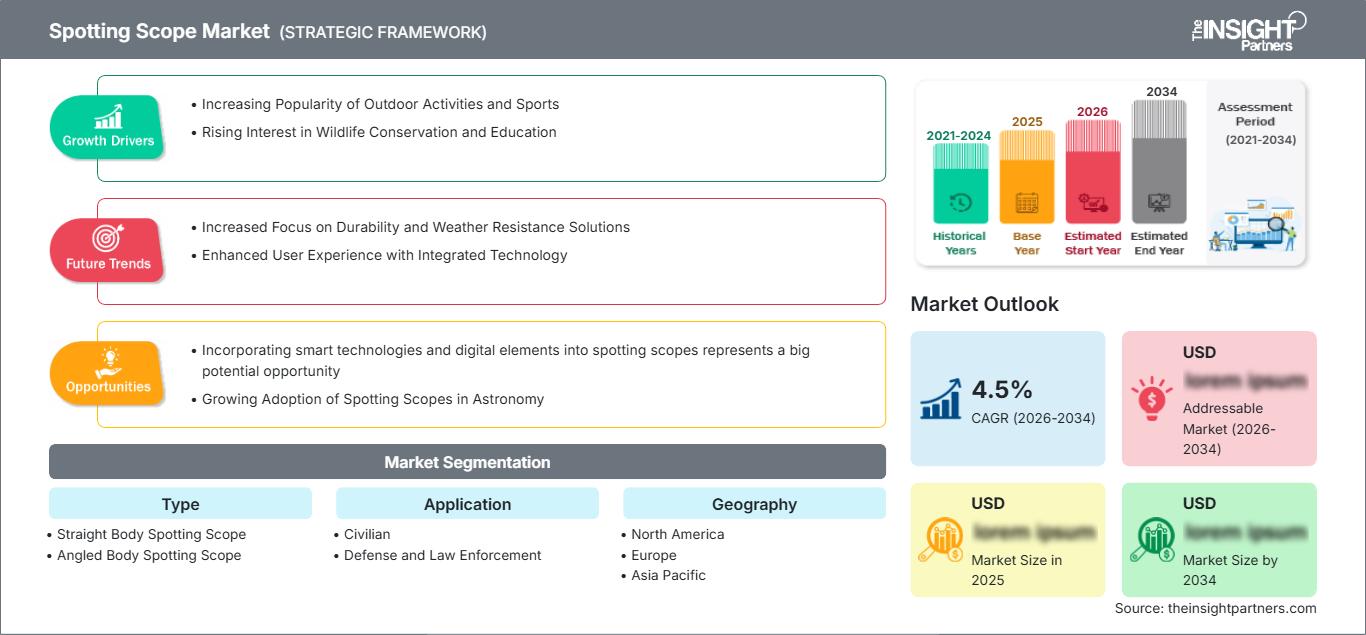
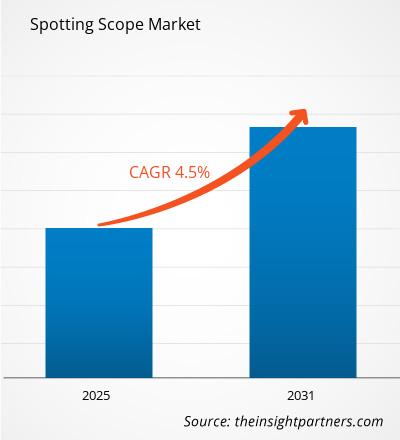
The Spotting Scope Market size is valued at US$ 1.65 Billion in 2025 and is projected to reach US$ 2.96 Billion by 2034, registering a CAGR of 6.71% during 2026–2034. The market includes optical observation instruments used for long-distance viewing across civilian recreation, wildlife observation, hunting, target shooting, and defense and law enforcement activities. Product development increasingly emphasizes optical clarity, lightweight construction, wider fields of view, ergonomic handling, durable housings, and compatibility with digital imaging accessories.
North America is expected to expand at a ~6% CAGR through 2034, supported by established outdoor recreation and hunting participation, strong specialty-optics distribution, and continued demand from professional observation and shooting applications. The region's mature user base also supports replacement purchases as consumers and institutional users upgrade toward lighter bodies, improved optical coatings, higher contrast, and accessories that connect scopes with smartphones and cameras.
Spotting Scope Market Assessment and Insights
Regional Outlook
- North America: ~38% of the global Spotting Scope Market share in 2025 | ~6% CAGR through 2034. Market position: North America holds the largest regional position, supported by established hunting and wildlife observation communities, professional shooting applications, strong specialty retail networks, and high acceptance of premium optical equipment among experienced users.
- US: ~70% of North American market revenue in 2025 | ~6% CAGR through 2034. Market position: The US is the largest country market within North America, supported by hunting, target shooting, wildlife observation, conservation activities, and professional optics demand. Strong specialist distribution and established brands reinforce purchasing depth.
- Europe: ~29% of the global market in 2025 | ~6% CAGR through 2034. Market position: Europe is a mature premium optics market led by Germany, with the UK, France, Italy, and Spain contributing through birding, hunting, wildlife observation, sport shooting, and specialist outdoor equipment channels.
- Asia Pacific: ~25% of the global market in 2025 | ~8% CAGR through 2034. Market position: Asia Pacific is the fastest-growing region, led by China and supported by Japan, India, South Korea, and Australia. Rising outdoor recreation, wildlife tourism, optical manufacturing capabilities, and expanding premium consumption support regional expansion.
Segment Outlook
- Angled Body Spotting Scope: ~58% Share in 2025 | ~7% CAGR through 2034. Market position: Angled configurations lead because they provide comfortable viewing from tripods, facilitate shared observation, and suit extended wildlife, birding, hunting, and target-shooting sessions. Their ergonomic flexibility supports broader civilian adoption and premium positioning.
- Defense and Law Enforcement: ~32% Share in 2025 | ~7% CAGR through 2034. Market position: This application is positioned for above-average growth as observation requirements increasingly emphasize long-range identification, field durability, low-light performance, compact deployment, and compatibility with surveillance and precision-observation equipment.
Competitive Coverage
Bushnell, Celestron, LLC, Kowa Optimed, Leica Camera AG, Leupold Optics, Nikon Corporation, Pentax, Swarovski Optik, VIXEN CO., Ltd., Vortex Optics
Methodology
The Insight Partners follows Data Collection & Secondary Research, Primary Research, Data Analysis, and Data Triangulation & Final Review to validate market estimates and insights.
Source: The Insight Partners' analysis based on proprietary research, government publications, company annual reports, investor presentations, industry databases, and expert interviews.
There is an evolving trend in the optical engineering that is transforming the market from the traditional long-distance view devices into sophisticated products that consider magnification, brightness, field of view, portability, and durability factors. The engineers are improving coating technologies, optics correction, material types, focusing methods, and eyepieces design without increasing the total weight of the device. Angled design is becoming more significant due to tripod mounted observation since it allows enhancing the ergonomics and sharing the observation. Moreover, the digital adapter and smartphone attachment are increasing the efficiency of optical devices, as the observers can record and share their observations through the smartphones.
In the future, the market will be more and more determined by the growing number of tourists who travel outdoors and watch the wild animals in the Asia Pacific region, while there will also continue to be a high demand on this product in North America and Europe. The investments in the development of optical assemblies are directed towards compactness, better light transmission, waterproof construction, and digital features. There is another institutional segment of customers – defense and law enforcement services, which should attract manufacturers' attention.
Spotting Scope Market Report Scope
| Report Attribute | Details |
|---|---|
| Market size in 2025 | US$ 1.65 Billion |
| Market Size by 2034 | US$ 2.96 Billion |
| Global CAGR (2026 - 2034) | 6.71% |
| Historical Data | 2021-2024 |
| Forecast period | 2026-2034 |
Spotting Scope Market Analysis
Demand has been created due to the need for spotting scopes that offer more detail when identifying distant subjects than conventional binoculars do. Observers, birders, hunters, competitive shooters and institutional customers have different requirements in terms of magnification, field of view, night-time visibility, portability, and robustness. Consequently, Spotting Scopes Market development will be determined by the level of participation in outdoor activities as well as replacements of old equipment. High-end consumers are mostly concerned about the quality of optics and durability of equipment, whereas cost-conscious consumers consider portability and ease of use more important.
The value chain involves providers of optical glass, experts in coatings, providers of precision machining services, producers of optical systems, producers of accessories, distributors, specialty stores, e-commerce channels, and end-users. Competitiveness of the supply chain depends on access to optical components of high quality, precise alignment, coatings, materials resistant to weather conditions, and quality control. Premium companies compete on the basis of optical engineering and branding, whereas mass-market companies compete through product line and pricing strategies. Increasingly the market is getting support from various accessories like adapters for smartphones, tripod systems, protection cases, and digital imaging interfaces.
Spotting Scope Market analysis reveals a differentiating market structure, where existing optics firms compete based on optical performance, specialization, distribution, and product ecosystems. The Swarovski Optik and Leica Camera AG stress on high-end optics design; Vortex Optics, Bushnell, Leupold Optics, and Celestron, LLC cater to mixed requirements of professionals and non-professionals. Kowa Optimed and Nikon Corporation possess excellent optical competence; Pentax and VIXEN CO., Ltd. participate through their specialization in optics. Competitive differentiation is based on weight, optical quality, durability, ergonomic design, and compatibility with accessories.
The focus for investment will be on compact optical systems with high performance as well as premium products that can generate good margins. There will also be an increase in the digitalization of the product through accessories like smartphones and imaging accessories which help to document and share information without changing the basic optical device. The premium companies can further consolidate through specialist dealer network, demonstration, warranty coverage, and application based education. Mid-range companies can benefit through good optics and reasonable pricing.
● REPORT CUSTOMIZATION
Tailor This Report To Align With Your Specific Business Requirements
This report can be customized to align precisely with your business objectives, scope, and target markets. Customization options include tailored segmentation, geography, competitive analysis, and strategic insights to support informed decision-making.
Customize This Report →WHAT YOU CAN ADJUST
- ● Segmentations
- ● Geography
- ● Competitive Analysis
- ● Language Preferences
Spotting Scope Market: Strategic Insights
Regional Insights
North America Spotting Scope Market
North America accounted for ~38% of the global market in 2025 and is expected to grow at a ~6% CAGR through 2034. There is already a tradition of hunting, observing wildlife, bird watching, competitive shooting, and outdoor leisure in the region. There is an extensive specialist retail infrastructure that promotes knowledge among consumers of magnification, diameter of objective lenses, optical coatings, and tripod mounting. High-end products are also helped by the existence of informed users who are ready to upgrade their equipment when there is considerable improvement in terms of optical quality, lightness, and low-light performance.
US continues to be the key demand center in the region, but Canada plays its role via wildlife observation, hunting, and outdoor tourism. There are two sources of demand in the region: civilian recreational and professional usage. Professionals prefer portable designs that allow to carry the binoculars longer distance, and hunters and target shooters value stability and clarity of images at long distances.
U.S. Spotting Scope Market
The US represented ~70% of North American market revenue in 2025 and is projected to expand at a ~6% CAGR through 2034. There is a diverse ecosystem of hunting, wildlife watching, target shooting, conservation, and outdoor activities within the country. Spotting Scope Market share will be strengthened due to existing specialty brands, sporting goods store chains, online selling networks, and customer base that is familiar with quality optical instruments. Often product choices tend to be field-specific rather than universal.
There is an increased demand for products having angled design that are mounted on tripods and used during prolonged watching, while straight designs have use for car-based viewing and applications that require fast mounting. Professional customers will place more focus on durability, consistent optics, and night vision characteristics. Civilian market is more diverse as these products can be used for birdwatching, hunting, nature watching, and sport shooting. Therefore, the country has significant potential both for replacement and high-end optics demand.
Europe Spotting Scope Market
Europe represented ~29% of the global market in 2025 and is expected to register a ~6% CAGR through 2034. The leader in Europe is Germany with a rich history in precision optics, outdoors equipment industry, hunting, and manufacturing of specialized products. The UK is characterized by an active birding and wildlife watching community; France features a mix of hunting, conservation, tourism, and outdoor recreation demand. Italy participates in the market via specialized sports optics, and Spain gains from hunting, wildlife watching, and nature tourism.
Demand in Europe has a structural premium bias as the users usually appreciate high-quality optics including high light transmission, accurate colors, waterproofness, precision mechanics, and longevity. Swarovski Optik and Leica Camera AG strengthen the premium bias, whereas foreign brands compete at more diverse price levels. Angled optics fit well for a prolonged tripod use and group observation which makes them popular among birders and wildlife watchers.
The region's outlook also reflects increased interest in nature-based recreation and optical equipment capable of supporting digiscoping. Smartphone-compatible adapters allow users to capture distant subjects and extend the utility of traditional observation equipment. Germany should remain the principal European demand center, while the UK, France, Italy, and Spain provide diverse civilian markets. Replacement purchases and premium product upgrades are expected to support steady expansion alongside selective institutional demand.
APAC Spotting Scope Market
APAC accounted for ~25% of the global market in 2025 and is expected to grow at a ~8% CAGR through 2034, making it the fastest-growing region. China is the leading country in Asia Pacific, supported by manufacturing capabilities, expanding outdoor recreation, and a growing consumer market for optical equipment. Japan and South Korea contribute through advanced optics and technology-oriented consumers, while India and Australia provide growing demand tied to wildlife, outdoor activities, and specialist observation.
Industrial capabilities support local supply and product development, while rising disposable income and expanding nature tourism broaden the civilian user base. Japan and South Korea remain important for premium optics and technical expertise. India offers longer-term expansion potential as organized outdoor recreation and wildlife tourism develop, while Australia benefits from extensive wildlife and outdoor observation applications. Regional growth is therefore supported by both production capabilities and increasing end-user adoption.
Middle East & Africa Spotting Scope Market
Middle East & Africa is projected to expand at a ~7% CAGR through 2034. Saudi Arabia is the leading country in the Middle East & Africa based on the region's combination of outdoor recreation, hunting-related activities, security requirements, and investment in tourism and infrastructure. The UAE contributes through tourism, outdoor leisure, security applications, and specialist retail, while South Africa provides a diverse base spanning hunting, wildlife observation, conservation, and nature tourism.
Energy and infrastructure investment can indirectly support institutional demand by increasing requirements for field observation and security equipment. Wildlife tourism and conservation programs provide an additional civilian and professional use case, particularly in South Africa and other African markets. Product durability, optical clarity, weather resistance, and ease of transport are important purchasing considerations. Distribution partnerships and specialist dealer networks remain important because technical product education can materially influence premium optical purchases.
Segmentation Analysis
Type
Type is divided into Straight Body Spotting Scope and Angled Body Spotting Scope. The Spotting Scope Market scope within this segment covers optical systems differentiated by viewing geometry, tripod positioning, user ergonomics, and field deployment. Angled designs favor shared and extended viewing, while straight systems provide direct alignment and convenient vehicle-based use.
- Straight Body Spotting Scope: Straight configurations are valued for rapid subject acquisition and convenient use from vehicles, window mounts, or low-angle observation positions. They can also be easier to align for users transitioning from conventional telescopic optics. Their compact handling characteristics support hunting, target observation, and mobile field applications.
- Angled Body Spotting Scope: Angled configurations provide an ergonomic viewing position when mounted on tripods and are particularly suitable for prolonged observation. The upward eyepiece orientation can accommodate users of different heights and facilitates shared viewing, making this format important for birding, wildlife observation, hunting, and sport shooting.
Application
Application is divided into Civilian and Defense and Law Enforcement uses. The segmentation reflects differences in operating environments, observation objectives, durability requirements, procurement processes, and performance expectations. Civilian demand spans recreation and sport, while institutional users prioritize dependable long-range observation under demanding field conditions.
- Civilian: Civilian use encompasses birding, hunting, wildlife observation, target shooting, nature tourism, and related outdoor activities. Buyers range from first-time users to experienced enthusiasts seeking premium optical performance. Product decisions are influenced by optical clarity, magnification, portability, price, tripod compatibility, and the intended observation environment.
- Defense and Law Enforcement: Defense and law enforcement users require dependable observation at extended distances, often under variable weather and lighting conditions. Procurement priorities include rugged construction, optical clarity, low-light capability, portability, secure deployment, and compatibility with broader surveillance or observation equipment. Institutional purchasing can favor specialized premium configurations.
Opportunity Snapshot
| Application | Revenue Contribution | Trend Tag | Adoption Stage |
|---|---|---|---|
| Civilian | High | Wildlife Optics | Mature |
| Defense and Law Enforcement | Medium | Field Surveillance | Scaling |
Spotting Scope Market Growth Drivers and Impact Analysis
Rising Participation in Wildlife Observation and Outdoor Recreation
Increasing participation in birding, wildlife observation, hunting, nature tourism, and outdoor recreation expands the addressable user base for long-distance optical instruments. Spotting scopes occupy a distinct position because they provide higher magnification and detailed observation beyond the practical capability of many binocular configurations. Experienced users also tend to upgrade when optical clarity, low-light performance, weight, or ergonomic handling improves. This creates a combination of first-time demand and replacement demand rather than relying solely on growth in overall outdoor participation. Manufacturers can capture this opportunity by offering clearly differentiated product tiers for casual users, serious enthusiasts, and professional observers. Specialist retailers and educational content further influence purchasing because optical products often require comparison of technical features before purchase.
Demand for Higher-Resolution Long-Range Observation
Users increasingly expect observation equipment to deliver clear detail at extended distances while maintaining practical portability. Hunters need to distinguish subjects across large landscapes, birders require accurate identification, and target shooters use scopes to inspect distant impacts. Defense and law enforcement users add requirements for ruggedness and dependable observation under challenging conditions. These use cases encourage manufacturers to improve optical coatings, lens correction, focusing mechanisms, and body construction. The resulting product upgrades can support higher-value purchases because performance improvements are directly visible to users. Lightweight materials are equally important because larger objectives and high magnification can increase equipment weight. Manufacturers that balance optical performance with portability can therefore address a wider range of field conditions.
Expansion of Digital Imaging and Digiscoping Compatibility
Smartphone and camera compatibility is increasing the practical value of conventional optical observation equipment. Users can attach digital devices to scopes to document wildlife, share observations, support educational activities, or create content without requiring a separate dedicated camera system. This capability also improves the attractiveness of premium optical systems because users can combine high-quality glass with familiar digital devices. Manufacturers benefit by selling adapters, mounting systems, and compatible accessories alongside the core scope. Digital integration can also make spotting scopes more relevant to younger outdoor users who expect equipment to support content capture and sharing. The opportunity is strongest where manufacturers can preserve optical performance while simplifying alignment, mounting, and image capture.
Spotting Scope Market Future Trends
Greater Integration of Smart Imaging Features
Future optical systems are likely to move beyond passive viewing toward greater integration with digital imaging, smartphone connectivity, image capture, and computational assistance. This evolution could allow users to record observations more easily, transfer images to mobile devices, and apply digital enhancement without changing the core optical workflow. The Spotting Scope Market trends therefore point toward a convergence between traditional precision optics and consumer electronics. Manufacturers will need to manage this integration carefully because additional electronics can increase weight, power requirements, and complexity. Products that provide useful digital functionality without compromising optical clarity or field reliability are likely to gain stronger acceptance among advanced civilian users and selected institutional applications.
Lightweight Premium Optics and Modular Accessories
Product development is expected to place greater emphasis on reducing carrying weight while preserving brightness and image quality. Advances in optical design, lightweight housings, coatings, and compact mechanical assemblies can make higher-performance scopes easier to transport during extended outdoor activities. Modular accessories should also become more important as users customize tripods, phone adapters, protective equipment, and eyepiece configurations around specific applications. The combination of lighter scopes and application-specific accessories can expand adoption among users who previously avoided larger optical systems because of carrying burden. Premium manufacturers can differentiate through integrated ecosystems in which the optical instrument, accessories, mounting hardware, and digital interfaces are designed to work together.
Spotting Scope Market Opportunities
Premium Civilian Observation and Nature Tourism
The Spotting Scope Market Forecasts indicate an opportunity to address premium civilian users who seek high optical performance for wildlife observation, birding, hunting, and nature tourism. These customers can support stronger value capture because product selection is often based on image quality, durability, weight, and long-term reliability rather than purchase price alone. Manufacturers can target this group through compact premium scopes, high-transmission optics, specialist accessories, and field-oriented product education. Partnerships with wildlife-tourism operators, specialist retailers, birding organizations, and outdoor communities can provide targeted channels for demonstration and conversion. Premium products can also benefit from replacement cycles driven by improvements in optical coatings, portability, and digital compatibility.
Institutional Observation and Security Applications
Defense and law enforcement users offer an opportunity for suppliers to develop application-specific observation systems emphasizing ruggedness, portability, low-light performance, and dependable optical identification. Institutional customers can require equipment that performs consistently across field conditions and integrates with existing tripods, observation posts, transport systems, or digital recording equipment. Suppliers can strengthen market access through specialized distributors and government-oriented procurement channels while providing training and technical support. The opportunity is not limited to defense agencies because border monitoring, conservation enforcement, emergency response, and critical-site observation can also require long-distance optical equipment. Suppliers that adapt civilian optical platforms to institutional durability and procurement requirements can broaden addressable demand.
Recent Developments
- July 2026: With the AT Endura 21-65x75, SWAROVSKI OPTIK is launching a high-quality and lightweight optical instrument and modernizing its spotting scope portfolio for hunting and birdwatching. Engineered, constructed, and produced in Absam (Austria), the spotting scope will be available worldwide from specialist retailers and in the SWAROVSKI OPTIK online store from October 6, 2026. It is being launched in the North American market on July 10, 2026. The AT Endura combines the recognized SWAROVSKI OPTIK image quality with a low weight and, thanks to the new product concept and efficient production processes, offers reliable performance at an attractive price.
- November 2025: SWAROVSKI OPTIK is setting a new milestone in the world of premium spotting scopes with the AT/ST Balance. The Tyrolean family company has launched a pioneering model that combines the outstanding optical performance of SWAROVSKI OPTIK with state-of-the-art image stabilization technology in one device. The result is a spotting scope that reveals an absolutely shake-free picture – even without a tripod. Its integrated image stabilization means that the system precisely balances out the slightest movements and even allows handheld observation at high magnification. The AT/ST Balance was developed for discerning users who don’t want to compromise between technical performance and practical application. The new spotting scope is available from the end of November 2025 from selected SWAROVSKI OPTIK retailers and from the SWAROVSKI OPTIK online shop.
- January 2024: Ricoh Imaging Americas Corporation announced the PENTAX PF-85EDA spotting scope, a compact, highly portable and waterproof terrestrial telescope ideal for a variety of applications including birdwatching, and nature and astronomical observations. Newly designed optics incorporate a large-aperture 85mm objective lens delivering a bright, clear, high-contrast field of view for high-quality observations. ED (Extra-low Dispersion) glass optical elements effectively minimize chromatic aberrations, and the latest multi-layer coating process drastically reduces reflectance. The roof prism optical design enables the PENTAX PF-85EDA to be compact and highly portable, making it comfortable to carry for outdoor explorations.
Frequently Asked Questions

- Comprehensive Market Sizing and Forecast Analysis
- Detailed Segmentation Analysis
- In-Depth Market Dynamics Assessment
- Regional and Country-Level Insights
- Competitive Landscape and Company Benchmarking
- Strategic Business Intelligence
Recent Reports
Testimonials

The Insight Partners provided valuable market intelligence that supported our global go-to-market strategy. Their team was professional, responsive, and attentive to our feedback, providing thoughtful analysis and helpful methodological clarifications throughout the project.
Junmo Kim Chief Financial Officer (CFO), Enertech Co., Ltd.
The Insight Partners' SCADA System Market report is comprehensive, with valuable insights on current trends and future forecasts. The team was highly professional, responsive, and supportive throughout. We are very satisfied and highly recommend their services.
RAN KEDEM Partner, Reali Technologies LTDs
I requested a report on a very specific software market and the team produced the report in a few days. The information was very relevant and well presented. I then requested some changes and additions to the report. The team was again very responsive and I got the final report in less than a week.
JEAN-HERVE JENN Chairman, Future Analytica
We worked with The Insight Partners for an important market study and forecast. They gave us clear insights into opportunities and risks, which helped shape our plans. Their research was easy to use and based on solid data. It helped us make smart, confident decisions. We highly recommend them.
PIYUSH NAGPAL Sr. Vice President, High Beam Global
The Insight Partners delivered insightful, well-structured market research with strong domain expertise. Their team was professional and responsive throughout. The user-friendly website made accessing industry reports seamless. We highly recommend them for reliable, high-quality research services
YUKIHIKO ADACHI CEO, Deep Blue, LLC.
This is the first time I have purchased a market report from The Insight Partners.While I was unsure at first, I visited their web site and felt more comfortable to take the risk and purchase a market report.I am completely satisfied with the quality of the report and customer service. I had several questions and comments with the initial report, but after a couple of dialogs over email with their analyst I believe I have a report that I can use as input to our strategic planning process.Thank you so much for taking the extra time and making this a positive experience.I will definitely recommend your service to others and you will be my first call when we need further market data.
JOHN SUZUKI President and Chief Executive Officer, Board Director, BK Technologies
I wish to appreciate your support and the professionalism you displayed in the course of attending to my request for information regarding to infectious disease IVD market in Nigeria. I appreciate your patience, your guidance, and the fact that you were willing to offer a discount, which eventually made it possible for us to close a deal. I look forward to engaging The Insight Partners in the future, all thanks to the impression you have created in me as a result of this first encounter.
DR CHIJIOKE ONYIA MANAGING DIRECTOR, PineCrest Healthcare Ltd.Reason to Buy
- Informed Decision-Making
- Understanding Market Dynamics
- Competitive Analysis
- Identifying Emerging Markets
- Customer Insights
- Market Forecasts
- Risk Mitigation
- Boosting Operational Efficiency
- Strategic Planning
- Investment Justification
- Tracking Industry Innovations
- Aligning with Regulatory Trends





 Get Free Sample for