
Stadium Lighting Market Growth, Trends & Demand by 2034
Coverage: By Components (Lamps and Luminaires, Control Systems, Installation Services); Light Type (LED, Others); Installation Type (New, Retrofit); Application (Indoor, Outdoor) , and Geography (North America, Europe, Asia Pacific, and South and Central America)
- Status : Data Released
- Report Code : TIPRE00005594
- Category : Electronics and Semiconductor
- No. of Pages : 150
- Available Report Formats :


- Last update date : October 30, 2026


2025 Market Size
US$ 801.1 Mn
Base year value
2034 Forecast
US$ 2,024.7 Mn
Projected by 2034
CAGR 2026-2034
10.85 %
Growth rate
Addressable Market
US$ 12,498.51 Mn
(2026-2034)
The Stadium Lighting Market was valued at US$ 801.1 Million in 2025 and is projected to reach US$ 2,024.7 Million by 2034, registering a 10.85% CAGR from 2026 to 2034. The market encompasses lighting products and related services used across stadium and sports-venue environments, including lamps and luminaires, control systems, installation services, LED and other light types, new installations, retrofits, and indoor and outdoor applications. Demand is increasingly shaped by energy efficiency, broadcast requirements, operational flexibility, and modernization of aging lighting infrastructure.
North America represents a significant demand center for the Stadium Lighting Market Size, supported by extensive sports infrastructure, renovation programs, and adoption of digitally controlled LED systems. The regional market is expected to expand at a ~9% CAGR through 2034. Replacement of conventional lighting, requirements for broadcast-quality illumination, and increasing integration of controls with venue-management systems are creating recurring investment opportunities across professional, collegiate, municipal, and multipurpose sports facilities.
Stadium Lighting Market Assessment and Insights
Regional Outlook
- North America: ~31% of the global market in 2025 | ~9% CAGR through 2034. Market position: North America maintains a major market position because of its large installed base of professional and collegiate venues, mature sports infrastructure, high retrofit activity, and demand for connected controls, broadcast-quality illumination, and energy-efficient LED systems.
- US: ~80% of North American market revenue in 2025 | ~9% CAGR through 2034. Market position: The US is the leading country in North America, supported by professional sports venues, universities, municipalities, and extensive replacement activity. Demand spans both new stadium construction and modernization of existing fields and arenas.
- Europe: ~28% of the global market in 2025 | ~10% CAGR through 2034. Market position: Europe has a mature stadium infrastructure base and strong modernization requirements. Germany is the leading country in Europe, while the UK, France, Italy, and Spain contribute through football, multipurpose venues, public facilities, and refurbishment programs.
- Asia Pacific: ~30% of the global market in 2025 | ~13% CAGR through 2034. Market position: Asia Pacific is the fastest-growing region, driven by new sports infrastructure, urban development, professional leagues, international events, and LED conversion. China is the leading country in Asia Pacific, supported by venue investment and expanding sports infrastructure.
Segment Outlook
- Light Type: ~72% Share in 2025 | ~11% CAGR through 2034. Market position: LED represents the largest technology-oriented portion of stadium lighting demand because of its controllability, efficiency, long operating life, rapid switching, dimming capability, and compatibility with broadcast and entertainment requirements.
- Installation Type: ~55% Share in 2025 | ~12% CAGR through 2034. Market position: Retrofit activity has a high-growth profile because stadium owners can modernize illumination without completely rebuilding supporting infrastructure. Replacement projects also provide opportunities to introduce controls, monitoring, and more precise optical systems.
Competitive Coverage
Acuity Brands Lighting, Inc., Eaton Corporation, General Electric Company, Hubbell Incorporated, Ideal Industries Inc., LG Electronics, Musco Sports Lighting, LLC., Panasonic Corporation, Signify Holding, Zumtobel Group AG
Methodology
The Insight Partners follows Data Collection & Secondary Research, Primary Research, Data Analysis, and Data Triangulation & Final Review to validate market estimates and insights.
Source: The Insight Partners' analysis based on proprietary research, government publications, company annual reports, investor presentations, industry databases, and expert interviews.
The evolution of the Stadium Lighting market has taken place from lighting using high-intensity discharge and metal-halide lamps towards LED lighting systems that can offer higher levels of control, better optics, and reduced maintenance needs. Today’s stadium lighting systems are not being looked at in isolation as lighting systems, but more as electrical/digital infrastructure that includes the lighting system. This is impacting the choice of equipment, the control systems design, installation considerations, and the maintenance of the equipment itself. Production trends include the use of modular luminaires, configurable optics, intelligent drivers, and maintenance-friendly systems.
In 2034, there will be an increase in investments in developing sports ecosystem lighting in Asia-Pacific, Middle Eastern, and some parts of Europe. New stadium construction projects will allow for a full lighting system deployment, whereas old stadiums are going to create another wave of replacement cycles. An increasing focus on efficiency from regulatory and procurement perspectives may help improve the justification for installing LED lighting systems, especially when lighting becomes a cost for recurring operation. Connectivity, remote control, automation, and entertainment applications are bringing more needs for equipment and software. The multipurpose nature of stadiums is now leading to the evaluation of the lighting systems in terms of their capability of handling sports, music, events, hospitality, and broadcasting at the same time.
Stadium Lighting Market Report Scope
| Report Attribute | Details |
|---|---|
| Market size in 2025 | US$ 801.1 Million |
| Market Size by 2034 | US$ 2,024.7 Million |
| Global CAGR (2026 - 2034) | 10.85% |
| Historical Data | 2021-2024 |
| Forecast period | 2026-2034 |
Stadium Lighting Market Analysis
Growth in the Stadium Lighting Market has much to do with the modernization of sports facilities and the economics of enhancing facility operations while managing operating costs. The stadium operators demand a consistent light source, glare control, beam distribution, and operational performance through a longer period of operation. The LED technology meets the above criteria and also helps with control, instant on-off capabilities, dimming, and lighting sequences. The system encompasses a range of stakeholders from component makers to luminaire producers, controls companies, engineering companies, electricians, installation companies, and facility managers. The procurement process is thus increasingly focused on life-cycle cost instead of just fixture costs.
The supply chain is getting increasingly technology-based as suppliers distinguish themselves via optics, thermal management, intelligent drives, control interoperability, and project-specific designs. Coordination is required for stadium lighting projects in terms of collaboration among lighting companies, architects, electrical engineers, sport associations, television networks, and stadiums management. Thus, there emerges a project-specific supply chain whereby the technical parameters of the product as well as installation experience may affect the choice of supplier. In retrofit projects there appear extra challenges as the new system should be compatible with current poles, wiring, structural design, and control systems.
Also mentioned in the Stadium Lighting Market report is a growing trend of suppliers focusing on integrated solutions. Acuity Brands Lighting, Inc. is building up its capabilities in sports lighting through new products and acquisitions; Musco Sports Lighting, LLC. continues to maintain a prominent project-oriented focus in sports lighting and infrastructure lighting. Signify Holding provides stadium luminaires along with integrated controls and venue management capabilities. Eaton Corporation, Hubbell Incorporated, Ideal Industries Inc., and General Electric Company operate within the ecosystem related to electrical, controls, connections, and lighting. Panasonic Corporation, LG Electronics, and Zumtobel Group AG offer complementary capabilities in electronics, lighting, controls, and buildings.
As a result, the investments will be shifting to those products which could add value throughout the whole project lifecycle. The suppliers are focusing on offering modular LED solutions, remote controls, energy management features, and ease of maintenance as part of their overall solution for venues' modernization. Also important for creating competitive advantages are capabilities for installation in complex environments, optical performance reliability, and customization of systems to venue geometries. Building strategic partnerships with stadium owners, sports leagues, engineering companies, and contractors would help build project pipelines.
● REPORT CUSTOMIZATION
Tailor This Report To Align With Your Specific Business Requirements
This report can be customized to align precisely with your business objectives, scope, and target markets. Customization options include tailored segmentation, geography, competitive analysis, and strategic insights to support informed decision-making.
Customize This Report →WHAT YOU CAN ADJUST
- ● Segmentations
- ● Geography
- ● Competitive Analysis
- ● Language Preferences
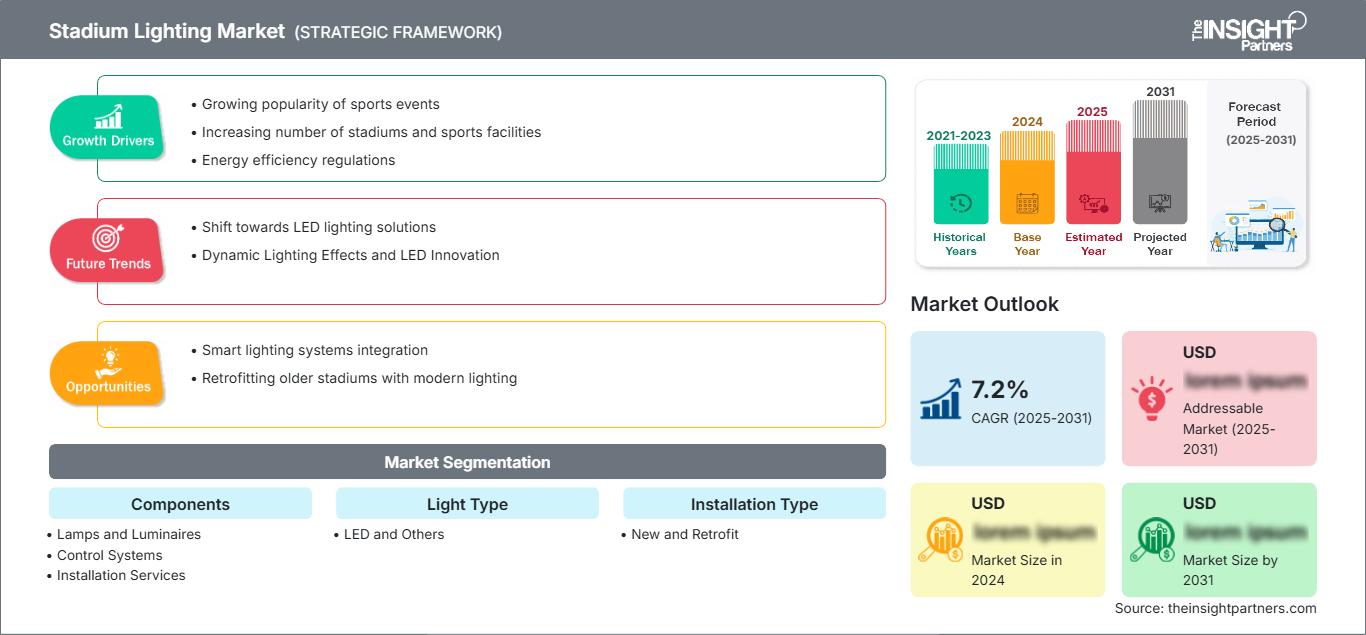
Stadium Lighting Market: Strategic Insights
Regional Insights
North America Stadium Lighting Market
The North America region was responsible for about 31% of the overall Stadium Lighting Market share in 2025 and is expected to grow at a CAGR of ~9% during the forecast period of 2026 to 2034. The region is known to have an extensive number of installations of professional sports stadiums, college athletics facilities, municipal fields, and arenas, among other types of installations. Most demand emanates from the modernization of existing installations rather than new projects. Modernizations may be required due to the shortcomings of the old installation in terms of energy consumption, maintenance costs, light distribution, and control.
The largest contributor to the North American region market revenues is the United States, which contributes ~80% of total revenue in the region. The current needs in North America include requirements related to broadcast quality illumination, programmable scenes, glare control, and central control. The contribution of Canada to the region's demand arises from professional sports, collegiate facilities, recreation centers, and public facilities. The combination of inventory, modernization, and high project requirements ensures that demand for lighting solutions will continue.
U.S. Stadium Lighting Market
The United States accounted for approximately 80% of the total revenue generated from the North America Stadium Lighting Market in 2025 and is anticipated to have a ~9% CAGR during 2034. The demand arises from professional league, university, school, municipal authorities, entertainment events, and multi-purpose sport facilities. New stadium construction plays an essential part in selling the equipment, but retrofit activities are especially noteworthy, as many venues are seeking to improve the lighting without changing the construction radically.
The competition features such firms as Acuity Brands Lighting, Inc., Musco Sports Lighting, LLC., Eaton Corporation, Hubbell Incorporated, and others. The application characteristics differ considerably from one category of venues to another (professional stadiums, collegiate fields, indoor arenas, municipal facilities). The professional venues pay more attention to broadcasting quality, uniformity, dynamics, and control, whereas the municipal and educational establishments value efficiency, reliability, ease of installation, and life cycle cost more.
Europe Stadium Lighting Market
Europe represented ~28% of the global Stadium Lighting Market in 2025 and is projected to grow at a ~10% CAGR through 2034. The region has a mature inventory of football stadiums, athletics venues, arenas, and multipurpose facilities, creating a substantial modernization opportunity. Germany is the leading country in Europe, supported by its large sports infrastructure base and strong professional and amateur sports ecosystem. The UK also represents an important market because of extensive football and rugby infrastructure and frequent venue modernization requirements.
The German market is characterized by a combination of football professional facilities and municipal community sports facilities, creating opportunities for demand on both premium and standardized lighting systems. In the UK market, factors such as stadium upgrades, broadcast needs, and the development of multi-purpose entertainment venues are of significance. The French market is characterized by sports such as football, rugby, athletics, and event facilities, whereas the Italian market is dominated by an already large installed base which is to be modernized and made more energy efficient. The Spanish market is supported by football facilities and sports infrastructure in general.
Lighting systems able to support various functions of stadiums are increasingly being adopted in European projects. The stadium might require different lighting functions ranging from lighting matches to training activities, entertainment scenes, lighting hospitality areas, and events through a single control system. The fact that retrofit projects are increasingly common means that improvement of lighting performance is achieved while at the same time maintaining the existing structures and avoiding the disruption brought about by rebuilding.
APAC Stadium Lighting Market
APAC accounted for ~30% of the Global Stadium Lighting Market Share in 2025 and is projected to grow at a ~13% CAGR to become the fastest growing region. The primary driving factors of growth in the APAC region include development of sports infrastructures, professional stadiums and investments in the urban areas of China. Japan and South Korea have stadiums equipped with advanced technology and professional sports facilities, whereas India holds growing demand because of cricket, football, athletics and multipurpose venues.
The growth of the APAC region also includes Australia as the market here features developed sports infrastructure market with focus on renovation of venues. Some of the factors driving the growth of the APAC region include adoption of LED lighting, energy efficiency, international broadcasting needs and construction of new venues. Governmental investments in sports infrastructures and private investments in entertainment venues may bring chances for adoption of integrated lighting systems using high-quality luminaries with lighting control and monitoring system.
Middle East & Africa Stadium Lighting Market
The Middle East and Africa market is projected to record a ~11% CAGR through 2034. Saudi Arabia represents the leading country in the Middle East & Africa region where evidence supports a particularly strong venue-development opportunity, while the UAE remains an important market for premium sports, entertainment, tourism, and multipurpose facilities. South Africa contributes through established football, rugby, cricket, and municipal sports infrastructure.
Large-scale infrastructure development and international sporting events create demand for high-performance lighting capable of meeting demanding visibility and broadcast requirements. Energy efficiency is also relevant in climates where stadium cooling and electrical loads are significant operating considerations. In Africa, procurement is more differentiated by infrastructure availability and project financing, creating opportunities for suppliers that can provide reliable systems, installation support, and manageable lifecycle costs. In the Middle East, integrated lighting and entertainment functionality can increase the value proposition of stadium projects.
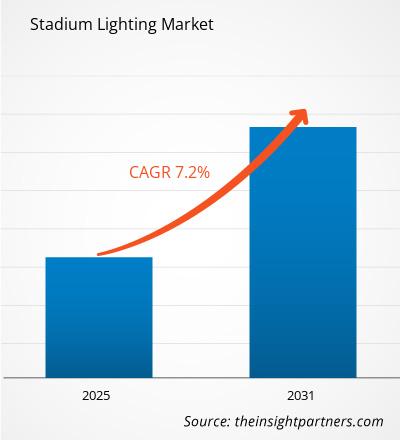
Segmentation Analysis
Components
Components are projected to register a ~10% CAGR from 2026 to 2034. The segment includes physical illumination equipment, control infrastructure, and installation services required to deliver operational stadium lighting. Demand is increasingly influenced by integrated procurement, in which venue owners evaluate luminaires and controls together with installation, commissioning, and maintenance requirements. The replacement cycle for existing infrastructure provides a recurring demand base, while new stadium construction creates larger system-level projects.
- Lamps and Luminaires: These products remain central to stadium lighting projects, with purchasing decisions influenced by optical performance, efficiency, thermal management, durability, mounting flexibility, glare control, and compatibility with venue-specific lighting requirements. LED luminaires increasingly form the technological foundation of new and replacement installations.
- Control Systems: Control systems are strategically important because stadium operators increasingly require programmable scenes, dimming, scheduling, remote monitoring, and centralized management. Their role extends beyond energy management to event operations, entertainment, maintenance coordination, and integration with broader building-management infrastructure.
- Installation Services: Installation services connect lighting equipment with existing or newly constructed electrical and structural infrastructure. Retrofit projects particularly depend on specialized installation expertise because contractors must accommodate existing poles, wiring, mounting structures, access limitations, and venue operating schedules.
Light Type
Light Type is expected to expand at a ~11% CAGR from 2026 to 2034. LED systems account for the dominant technology pathway because they provide controllability, long operating life, rapid switching, and compatibility with intelligent controls. Other lighting technologies retain relevance in selected legacy installations, but modernization projects increasingly favor systems capable of meeting contemporary efficiency and performance requirements.
- LED: LED systems are increasingly selected for stadiums because they can combine high output with precise optical distribution, dimming, dynamic control, and reduced maintenance requirements. Their ability to support broadcast environments and programmed entertainment scenes further strengthens their position in new and retrofit projects.
- Others: Other technologies remain relevant primarily within existing installations and specialized applications where replacement has not yet occurred. Their strategic importance is connected to the installed base, replacement timing, infrastructure compatibility, and the economics of conversion to newer systems.
Installation Type
Installation Type is projected to record a ~12% CAGR from 2026 to 2034. Retrofit demand is supported by aging lighting systems, efficiency objectives, maintenance considerations, and the ability to improve venue performance without complete infrastructure reconstruction. New installations remain important because stadium construction allows integrated planning of luminaires, controls, power infrastructure, and structural mounting systems.
- New: New installations provide opportunities to design lighting systems around current performance standards, broadcast requirements, control architecture, and energy-management objectives. Projects can incorporate lighting infrastructure into the original stadium design, reducing integration constraints and enabling more comprehensive system optimization.
- Retrofit: Retrofit projects address existing stadiums where operators seek improved efficiency, reliability, optical performance, and controllability. Replacement can often be phased around event schedules, making retrofit a practical pathway for facilities that cannot undertake full reconstruction.
Application
Application is expected to register a ~10% CAGR from 2026 to 2034. Indoor and outdoor facilities have different optical, environmental, mounting, and operational requirements. Outdoor stadiums typically require high-output floodlighting and environmental durability, whereas indoor facilities place greater emphasis on ceiling height, glare control, uniformity, and integration with arena operations.
- Indoor: Indoor applications include arenas and enclosed sports facilities where lighting must accommodate structural constraints, spectator sightlines, broadcast requirements, and multipurpose event programming. Efficient controls and precise optical distribution are important for balancing performance with occupant comfort.
- Outdoor: Outdoor applications include open-air stadiums, sports fields, racetracks, and multipurpose venues. Systems must address weather exposure, mounting height, light spill, beam control, and long-distance illumination while supporting sports performance, spectators, and television broadcasting.
Opportunity Snapshot
| Segments | Revenue Contribution | Trend Tag | Adoption Stage |
|---|---|---|---|
| Components | High | Integrated Systems | Scaling |
| Light Type | High | LED Conversion | Mature |
| Installation Type | High | Retrofit Programs | Scaling |
| Application | Medium | Venue Modernization | Scaling |
Stadium Lighting Market Growth Drivers and Impact Analysis
Replacement of Conventional Systems with High-Efficiency LED
The replacement of legacy lighting systems is a major structural driver for the Stadium Lighting Market because venue owners increasingly evaluate illumination according to energy consumption, maintenance frequency, controllability, and lifecycle performance. LED systems can provide rapid switching, dimming, programmable operation, and precise beam control, making them suitable for venues that operate across different event formats. Retrofit projects can also reduce the need for complete structural reconstruction by using existing poles and electrical arrangements where compatible. The impact extends beyond energy savings because improved control can support event scheduling, training modes, maintenance planning, and entertainment functions. For suppliers, this creates recurring replacement demand and opportunities to bundle luminaires with controls, installation, commissioning, and service agreements.
Expansion of Broadcast-Ready and Multi-Event Venue Requirements
Modern stadiums increasingly need lighting systems that support multiple forms of content and venue activity. Sports broadcasts require consistent illumination, controlled glare, and stable performance suitable for cameras and replay technologies, while concerts and special events can require dynamic scenes and rapid changes in lighting levels. Multipurpose facilities therefore favor systems that can be reconfigured through software and controls rather than relying solely on fixed illumination. This requirement broadens the addressable value chain for lighting suppliers because procurement can encompass luminaires, drivers, controls, software, installation, and commissioning. The Stadium Lighting Market impact is particularly relevant for professional stadiums and premium entertainment venues, where lighting performance contributes directly to operational flexibility and event quality.
Development of New Sports and Entertainment Infrastructure
New sports infrastructure is another important driver, particularly in regions investing in professional leagues, tourism, entertainment districts, and international sporting events. New construction allows stadium owners to incorporate lighting requirements into structural and electrical planning from the initial design stage. This can support higher-value system integration because lighting, controls, electrical distribution, and venue-management systems can be coordinated rather than installed independently. Emerging sports markets can also adopt current LED and connected technologies without passing through the same long legacy-technology cycle found in mature regions. For suppliers, project pipelines are therefore influenced not only by replacement demand but also by stadium construction, arena development, urban regeneration, and public investment in sports facilities.
Stadium Lighting Market Future Trends
Connected Lighting and Automated Venue Management
The Stadium Lighting Market trends are increasingly moving toward connected lighting architectures in which luminaires, controls, sensors, software, and facility-management platforms operate as an integrated system. Through 2034, the value of connectivity is expected to shift from basic remote switching toward automated scheduling, condition monitoring, performance analytics, and venue-wide orchestration. Stadium operators can use centralized platforms to manage pitch lighting, spectator areas, hospitality zones, entrances, and exterior spaces through coordinated operating schedules. This evolution can also support predictive maintenance by identifying abnormal system behavior before a fixture failure affects an event. Suppliers that develop open interfaces and interoperable control platforms may be better positioned to participate in projects involving multiple technology vendors and complex facility-management environments.
Lighting Designed for Immersive Sports and Entertainment Experiences
Another future direction is the expansion of stadium lighting from functional illumination into programmable entertainment infrastructure. Lighting systems can increasingly support color changes, dynamic scenes, synchronized effects, pre-event presentations, halftime programming, and post-event experiences. This creates a closer relationship between sports lighting and digital entertainment systems. The opportunity is particularly relevant to venues seeking to host concerts, esports, ceremonies, and other non-sporting activities between major matches. Over time, lighting specifications may therefore place greater emphasis on control resolution, response time, interoperability, and software functionality alongside conventional photometric performance. This trend can increase the importance of technology partnerships between lighting manufacturers, controls providers, venue operators, broadcast specialists, and entertainment-production companies.
Stadium Lighting Market Opportunities
Expansion of Retrofit-as-a-Service and Lifecycle Solutions
The Stadium Lighting Market Forecasts indicate an opportunity for suppliers to move beyond one-time equipment sales toward lifecycle-oriented retrofit models. Stadium operators may benefit from procurement structures that combine assessment, system design, equipment replacement, installation, controls integration, commissioning, monitoring, and maintenance. Such models can simplify capital planning for facilities with constrained budgets while giving suppliers recurring service relationships. Retrofit programs can also be phased according to venue schedules, reducing disruption to sports seasons and event calendars. Vendors with strong engineering and installation capabilities can differentiate through project execution rather than relying solely on fixture specifications. Financing structures, performance-based contracts, and maintenance agreements could further expand adoption among municipal, educational, and community facilities.
Integrated Lighting Solutions for Emerging Sports Infrastructure
Emerging sports markets offer opportunities for suppliers that can deliver standardized but configurable stadium-lighting platforms. New facilities in Asia Pacific and the Middle East can incorporate LED luminaires, controls, broadcast-ready illumination, and entertainment functions during initial construction, reducing some of the integration constraints faced by older venues. Suppliers can develop modular architectures that accommodate different stadium sizes, sports, mounting structures, and operating requirements. Local partnerships with engineering firms, contractors, and distributors can improve project execution and after-sales support. For international vendors, localization of installation capability, technical support, and procurement channels can be as important as product performance when entering rapidly developing venue markets.
Recent Developments
- August 2026: Signify Holding announced a strategic partnership with NXTPLAY Capital focused on connected lighting innovation across sports and entertainment assets, including stadium applications. The collaboration is intended to combine connected lighting, operational efficiency, and immersive fan experiences across venues and related sports ecosystems.
- August 2025: Musco Sports Lighting, LLC. announced an LED floodlighting upgrade for Croke Park in Dublin, replacing the stadium's original 2007 incandescent system. The project is designed to provide improved energy efficiency, broadcast-quality illumination, and reduced maintenance, with the upgraded system scheduled for use during the 2025 NFL International Series event.
- May 2025: Acuity Brands Lighting, Inc., through Acuity Inc., acquired the business assets of M3 Innovation, adding sports-lighting capabilities to its portfolio. The acquired technology is designed for both new and retrofit applications and is intended to integrate with Acuity's lighting controls platform, extending its sports-lighting offering across educational, municipal, infrastructure, and professional venue applications.
Frequently Asked Questions

- Comprehensive Market Sizing and Forecast Analysis
- Detailed Segmentation Analysis
- In-Depth Market Dynamics Assessment
- Regional and Country-Level Insights
- Competitive Landscape and Company Benchmarking
- Strategic Business Intelligence
Recent Reports
Testimonials

The Insight Partners provided valuable market intelligence that supported our global go-to-market strategy. Their team was professional, responsive, and attentive to our feedback, providing thoughtful analysis and helpful methodological clarifications throughout the project.
Junmo Kim Chief Financial Officer (CFO), Enertech Co., Ltd.
The Insight Partners' SCADA System Market report is comprehensive, with valuable insights on current trends and future forecasts. The team was highly professional, responsive, and supportive throughout. We are very satisfied and highly recommend their services.
RAN KEDEM Partner, Reali Technologies LTDs
I requested a report on a very specific software market and the team produced the report in a few days. The information was very relevant and well presented. I then requested some changes and additions to the report. The team was again very responsive and I got the final report in less than a week.
JEAN-HERVE JENN Chairman, Future Analytica
We worked with The Insight Partners for an important market study and forecast. They gave us clear insights into opportunities and risks, which helped shape our plans. Their research was easy to use and based on solid data. It helped us make smart, confident decisions. We highly recommend them.
PIYUSH NAGPAL Sr. Vice President, High Beam Global
The Insight Partners delivered insightful, well-structured market research with strong domain expertise. Their team was professional and responsive throughout. The user-friendly website made accessing industry reports seamless. We highly recommend them for reliable, high-quality research services
YUKIHIKO ADACHI CEO, Deep Blue, LLC.
This is the first time I have purchased a market report from The Insight Partners.While I was unsure at first, I visited their web site and felt more comfortable to take the risk and purchase a market report.I am completely satisfied with the quality of the report and customer service. I had several questions and comments with the initial report, but after a couple of dialogs over email with their analyst I believe I have a report that I can use as input to our strategic planning process.Thank you so much for taking the extra time and making this a positive experience.I will definitely recommend your service to others and you will be my first call when we need further market data.
JOHN SUZUKI President and Chief Executive Officer, Board Director, BK Technologies
I wish to appreciate your support and the professionalism you displayed in the course of attending to my request for information regarding to infectious disease IVD market in Nigeria. I appreciate your patience, your guidance, and the fact that you were willing to offer a discount, which eventually made it possible for us to close a deal. I look forward to engaging The Insight Partners in the future, all thanks to the impression you have created in me as a result of this first encounter.
DR CHIJIOKE ONYIA MANAGING DIRECTOR, PineCrest Healthcare Ltd.Reason to Buy
- Informed Decision-Making
- Understanding Market Dynamics
- Competitive Analysis
- Identifying Emerging Markets
- Customer Insights
- Market Forecasts
- Risk Mitigation
- Boosting Operational Efficiency
- Strategic Planning
- Investment Justification
- Tracking Industry Innovations
- Aligning with Regulatory Trends





 Get Free Sample for