
Static VAR Compensator Market Trends, Share & Demand by 2034
Coverage: by Type (Thyristor-Based, MCR-Based); Component (Power Electronic Device, Harmonic Filter, Thyristor, Reactor, Capacitor Bank, GIS Switchgear, Others); Vertical (Electric Utility, Renewable, Railway, Industrial, Oil and Gas) , and Geography (North America, Europe, Asia Pacific, and South and Central America)
- Status : Data Released
- Report Code : TIPRE00012265
- Category : Electronics and Semiconductor
- No. of Pages : 150
- Available Report Formats :


- Last update date : November 11, 2026


2025 Market Size
US$ 29.06 Bn
Base year value
2034 Forecast
US$ 46.95 Bn
Projected by 2034
CAGR 2026-2034
5.47 %
Growth rate
Addressable Market
US$ 344.57 Bn
(2026-2034)
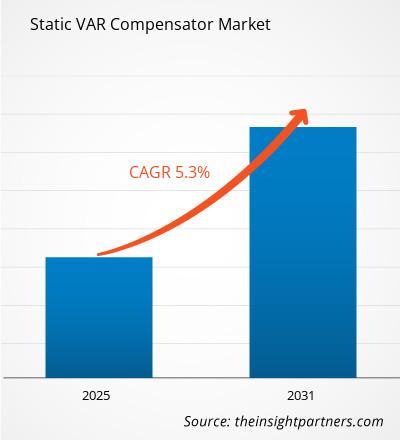
The Static Var Compensator Market was valued at US$ 29.06 Billion in 2025 and is projected to reach US$ 46.95 Billion by 2034, expanding at a CAGR of 5.47% during 2026–2034. The market encompasses thyristor-based and MCR-based systems and associated equipment including power electronic devices, harmonic filters, thyristors, reactors, capacitor banks, and GIS switchgear. Demand is closely linked to grid voltage regulation, transmission capacity enhancement, renewable integration, and power-quality requirements across utilities and industrial applications.
Across North America, the Static Var Compensator Market Size is supported by transmission modernization, increasing interconnection requirements for variable generation, and the need to extract additional capacity from constrained networks. The regional CAGR is estimated at ~5%, with utilities increasingly evaluating dynamic reactive-power equipment alongside conventional grid reinforcement. Industrial loads, data-center development, renewable generation, and aging transmission assets provide multiple demand channels, while established engineering capabilities support replacement and retrofit activity.
Static VAR Compensator Market Assessment and Insights
Regional Outlook
- North America: ~23% of the global market in 2025 | ~5% CAGR through 2034. Market position: North America represents a mature market supported by transmission reliability requirements, renewable interconnection, industrial power-quality needs, and replacement of aging grid assets. The US accounts for most regional demand, while Canada contributes through utility modernization and resource-intensive industrial applications.
- US: ~78% of North American market revenue in 2025 | ~5% CAGR through 2034. Market position: The US is the leading country in North America, supported by transmission expansion, renewable interconnection queues, industrial electrification, and large-load connections. Utilities increasingly require voltage-support technologies where conventional network reinforcement faces lengthy permitting or construction cycles.
- Europe: ~24% of the global market in 2025 | ~5% CAGR through 2034. Market position: Europe is a mature market where renewable penetration, cross-border transmission, and voltage-stability requirements sustain demand. Germany represents the leading country in Europe, followed by established activity in the UK, France, Italy, and Spain.
- Asia Pacific: ~45% of the global market in 2025 | ~6% CAGR through 2034. Market position: Asia Pacific represents the largest regional market and the fastest-growing region, driven by extensive transmission investment, renewable capacity additions, industrial electrification, and grid modernization. China is the leading country in Asia Pacific, with Japan, South Korea, India, and Australia providing additional demand.
Segment Outlook
- Thyristor-Based: ~76% Share in 2025 | ~5% CAGR through 2034. Market position: Thyristor-based systems retain the largest position because established SVC architectures provide controllable reactive compensation for high-voltage transmission and industrial loads. Their installed base, proven operating characteristics, and compatibility with large utility projects support replacement, refurbishment, and new-installation demand.
- Renewable: ~24% Share in 2025 | ~8% CAGR through 2034. Market position: Renewable applications have the strongest growth outlook as wind and solar projects increasingly require dynamic voltage support and grid-code compliance. Growth is linked to higher renewable penetration, weaker-grid conditions, and greater requirements for controllable reactive power at points of interconnection.
Competitive Coverage
ABB, American Superconductor, Eaton Corporation plc, GE Vernova Inc., Hyosung Heavy Industries Corporation, JEMA Energy, Mitsubishi Electric Corporation, NR Electric Co., Ltd., Rongxin Power Electronic Co., Ltd., Siemens Energy AG
Methodology
The Insight Partners follows Data Collection & Secondary Research, Primary Research, Data Analysis, and Data Triangulation & Final Review to validate market estimates and insights.
Source: The Insight Partners' analysis based on proprietary research, government publications, company annual reports, investor presentations, industry databases, and expert interviews.
Static VAR Compensator Market has shifted from single devices to stability systems of the grid. The current designs contain thyristor controlled reactors, switched capacitor, harmonic filter, digital control, transformer and protection to solve the problem of voltage variations and power quality. The engineering features include modularity, standardization of power electronic modules, footprint reduction, and life cycle of the system. The design of main reactors can be without filtering while digital control helps in system installation, diagnostics, and control. Such tendencies extend the scope of application not only for transmission substations, but also for renewable energy generation stations, railway, mining, steel and heavy industry.
Moving forward, investments will be made more actively in regions where conditions for faster voltage management appear due to renewable energy, congested power grids, and electrification processes. Expansion of APAC region should continue due to large scale investments in grid projects and industrial capacities. Reinforcement of network with increased share of variable generation and cross-border electricity flows will be characteristic for Europe. Opportunities in North America will arise because of transmission improvements, emergence of new large consumers, and renewables integration. Focus on grid reliability and efficiency should ensure further demand for dynamic reactive power devices.
Static VAR Compensator Market Report Scope
| Report Attribute | Details |
|---|---|
| Market size in 2025 | US$ 29.06 Billion |
| Market Size by 2034 | US$ 46.95 Billion |
| Global CAGR (2026 - 2034) | 5.47% |
| Historical Data | 2021-2024 |
| Forecast period | 2026-2034 |
Static VAR Compensator Market Analysis
The demand is driven mostly by utilities' need for voltage stability, transmission capacity enhancement, and reliable operation under varying load and generation conditions. Another source of demand stems from renewable power plants since generation fluctuations may cause voltage disturbances and the need for reactive power support at the point of grid connection. Steel plants, mines, rolling mills, and other heavy industries with varying load conditions also have a demand for compensation due to voltage and power quality disturbances. Railways and oil and gas installations contribute with their specialized needs for voltage stability and reliable operation.
The supply chain starts with engineering studies and grid modeling and continues with sourcing of power electronics, thyristors, reactors, capacitors, harmonic filters, transformers, controls, and switchgear. Systems integrators perform engineering, procurement, construction, testing, commissioning, and lifecycle services. The supply dynamics benefit vendors who have a capability to produce components, conduct high voltage tests, perform software design, and execute projects. The replacement and refurbishment business represents an auxiliary business area since the SVC installation has a life-long electrical equipment installed there, yet it requires more sophisticated control and protection equipment.
The Static VAR Compensator Market Report defines growth driven by technical qualifications, reference installation, project implementation, customization capacity, and compatibility of SVC systems with other transmission systems. ABB offers a wide FACTS product line, while Siemens Energy AG integrates SVC with grid stability solutions. GE Vernova Inc. supplies classic and main reactor SVCs, and Mitsubishi Electric Corporation offers grid-related SVCs. Hyosung Heavy Industries Corporation has expanded its offerings in terms of grid-stability systems especially in Asia. American Superconductor concentrates on power control technologies, and NR Electric Co., Ltd., Rongxin Power Electronic Co., Ltd., and JEMA Energy provide further specialist and regional competition.
Current investment approaches include new installations combined with modernizations. Suppliers can offer turnkey installations, equipment sets, control system improvements, long-term services, and retrofits, which allows to tap various revenues from the installed base. Thus, the differentiation is shifting from equipment qualification to digital control systems, compactness, fewer harmonic filters requirements, standardization, localized production, fast commissioning, and overall lifecycle support. The competitive landscape is also highly specialized since every SVC project is affected by grid strength, voltage levels, load characteristics, fault condition, and required reactive power range.
● REPORT CUSTOMIZATION
Tailor This Report To Align With Your Specific Business Requirements
This report can be customized to align precisely with your business objectives, scope, and target markets. Customization options include tailored segmentation, geography, competitive analysis, and strategic insights to support informed decision-making.
Customize This Report →WHAT YOU CAN ADJUST
- ● Segmentations
- ● Geography
- ● Competitive Analysis
- ● Language Preferences
Static VAR Compensator Market: Strategic Insights
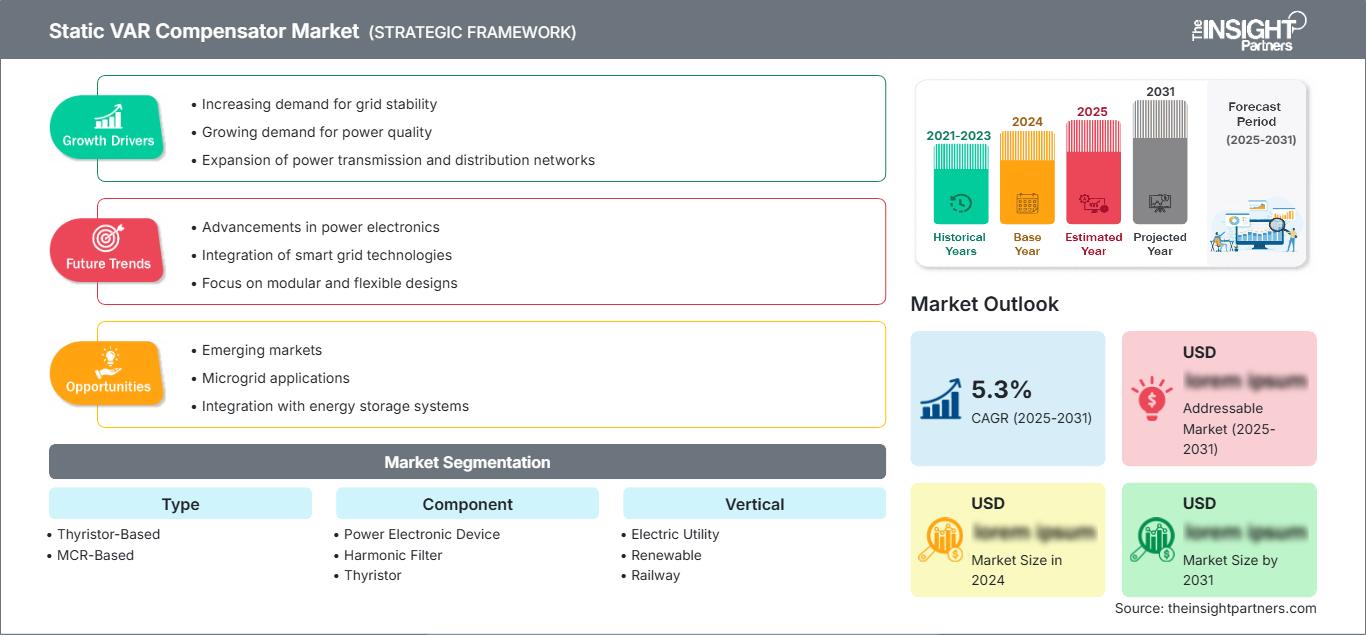
Regional Insights
North America Static Var Compensator Market
North America represents ~23% of global demand in 2025, with the regional market expected to expand at ~5% CAGR through 2034. The US constitutes the principal demand center because utilities are addressing transmission constraints, renewable interconnection requirements, and increasing electricity demand from large commercial and industrial loads. SVC installations can provide reactive-power support without requiring every network constraint to be addressed through new transmission construction, making them relevant to modernization programs.
Canada's participation comes through the development of the transmission system, which is linked to resource-based industries, the transportation of power across great distances, and generation from renewable sources. In the region, demand is also shaped by the upgrading of outdated compensation equipment. Digital control improvements, remote monitoring, and lifetime service contracts help increase the longevity of the equipment while at the same time providing greater visibility into operations. Compensation is used in industrial operations for load balancing and power quality.
U.S. Static Var Compensator Market
The US accounts for ~78% of North American Static VAR Compensator Market Size in 2025 and is projected to grow at ~5% CAGR through 2034. Transmission operators increasingly need technologies that support voltage stability as renewable projects, large industrial facilities, and digitally intensive loads connect to networks with localized constraints. SVC systems can be deployed at substations and industrial points of connection where dynamic reactive-power management is required.
The companies in this market are widespread, including ABB, American Superconductor, Eaton Corporation plc, GE Vernova Inc. and Siemens Energy AG. The industrial segment involves steel, mining, manufacturing, pipelines and motors, whereas utility application focuses on transmission and renewables. The growing focus on utilization of the available network capacity gives another reason to have compensating devices installed. Retrofit opportunities exist due to the modernization of control, protection systems and related switchgear.
Europe Static Var Compensator Market
Europe accounted for ~24% of the world Static VAR Compensator Market share in 2025 and is projected to register ~5% CAGR from 2025 to 2034. Germany is the leading European nation due to the presence of substantial renewable energy generation, transmission upgrades, and mandatory voltage stability at network nodes. The UK also constitutes a significant market owing to the integration of offshore wind energy and evolving transmission needs. There are opportunities for France owing to large-scale transmission network development and renewable energy installations, whereas Italy and Spain are driven by renewable energy integration, transmission requirements, and grid strengthening.
The leading position of Germany arises out of the relationship between high renewable energy and grid stability equipment requirements. In France and the UK, there are sophisticated transmission networks wherein dynamic compensation can help ensure reliability and power transfer. Opportunities are also present in Italy and Spain where solar and wind energy generation drive the requirement for controllable reactive power. Within Europe, purchases are increasingly being linked to grid enhancement programs rather than stand-alone equipment purchases. It incentivizes manufacturers to offer engineering studies, digital controls, equipment installation, commissioning, and service along with SVC.
APAC Static Var Compensator Market
Asia Pacific held ~45% of the global market in 2025 and is expected to expand at ~6% CAGR through 2034, making it the largest and fastest-growing regional market. China is the leading country in Asia Pacific, supported by large-scale transmission investment, industrial electricity demand, and substantial renewable-energy deployment. Japan and South Korea maintain technically advanced power networks and significant industrial applications requiring power-quality management.
The Indian market is an important growth market because of the trend in transmission development to integrate renewable energy sources and develop high-voltage grids. Australia offers demand for such services through renewable energy integration and widely distributed generation. Growth will be driven by industrialization, manufacturing capacity, electrification, and the expansion of networks. Manufacturing and engineering capacity is important because SVC applications involve high voltage tests, systems study, installation, and after-sales support services. Expansion of the network and industrial demand drives procurement.
Middle East & Africa Static Var Compensator Market
The Middle East and Africa market is projected to grow at ~5% CAGR through 2034. Saudi Arabia represents the leading country in the Middle East & Africa market where evidence supports leadership, supported by transmission investment, industrial loads, and large-scale power-system development. The UAE also contributes through infrastructure development, industrial expansion, and increasing integration of variable generation.
South Africa provides a distinct demand base associated with transmission reliability, industrial electricity consumption, and renewable integration. Elsewhere in the region, oil and gas facilities, mining operations, large pumping systems, and remote industrial loads create specialized requirements for voltage stabilization and power-quality improvement. Investment in transmission infrastructure and renewable generation provides an additional demand channel. Because many projects operate under demanding environmental and network conditions, equipment reliability, compact design, service availability, and long-term maintenance capabilities can influence procurement decisions.
Segmentation Analysis
Type
Thyristor-based systems represent the largest type segment in the Static VAR Compensator Market, with an estimated ~5% CAGR through 2034. Their established architecture, mature supply chain, and suitability for high-voltage transmission applications support continued demand. Utilities and industrial customers can use thyristor-controlled reactors and switched capacitors to regulate reactive power while retaining proven operating characteristics. MCR-based systems address applications where main-reactor configurations can simplify harmonic management and reduce equipment footprint, creating a complementary pathway for technology adoption.
- Thyristor-Based: The dominant technology configuration is widely applicable to transmission substations and large industrial facilities. Its mature engineering ecosystem, established installed base, and compatibility with high-power applications support procurement, replacement, refurbishment, and modernization activity.
- MCR-Based: Main-reactor configurations provide an alternative architecture where harmonic management, footprint, and system optimization are important. Their strategic value increases where customers seek compact installations and reduced reliance on extensive filtering arrangements.
Component
The component segment in the Static VAR Compensator Market is expected to register ~6% CAGR through 2034 as SVC projects increasingly incorporate upgraded power electronics, controls, protection systems, and optimized high-voltage equipment. Power electronic devices and thyristors remain central to controllable reactive compensation, while reactors, capacitor banks, harmonic filters, and GIS switchgear determine the system's electrical configuration and footprint. Component demand is also supported by refurbishment programs that replace aging controls or electrical assemblies without necessarily replacing the entire installation.
- Power Electronic Device: Power electronic equipment enables rapid control of reactive power and supports modern compensation architectures. Demand is linked to system ratings, control requirements, grid-code performance, and the modernization of installed SVC equipment.
- Harmonic Filter: Harmonic filters manage distortion generated by controlled power-electronic equipment. Their configuration depends on network characteristics and SVC topology, making engineering optimization an important part of system design.
- Thyristor: Thyristors provide the switching and control functionality central to traditional SVC architectures. Reliability, thermal performance, voltage rating, and replacement compatibility influence both new installations and refurbishment demand.
- Reactor: Reactors regulate inductive reactive power and are fundamental to thyristor-controlled SVC arrangements. Main-reactor designs can also contribute to harmonic isolation and compact system configurations.
- Capacitor Bank: Capacitor banks provide capacitive reactive power and operate alongside reactors to establish the required compensation range. Their sizing depends on voltage conditions, load characteristics, and required dynamic performance.
- GIS Switchgear: GIS switchgear supports compact high-voltage installations where space, environmental conditions, and operational reliability are important. Integration with SVC systems can reduce substation footprint and simplify high-voltage connections.
Vertical
The vertical segment in the Static VAR Compensator Market is projected to expand at ~7% CAGR through 2034, with renewable applications providing the strongest growth trajectory. Electric utilities remain the principal addressable customer group because voltage support is fundamental to transmission and distribution reliability. Renewable projects increasingly require controllable reactive power at interconnection points. Railways and industrial facilities use compensation for specialized power-quality requirements, while oil and gas applications depend on stable power for large motors, pumps, and electrically intensive operations.
- Electric Utility: Utilities use SVC systems to improve voltage stability, increase usable transmission capacity, and manage changing network conditions. Utility procurement typically involves large ratings, detailed system studies, and long lifecycle requirements.
- Renewable: Wind and solar facilities require dynamic reactive-power management to support grid interconnection and voltage stability. Increasing renewable penetration strengthens the strategic importance of compensation equipment at generation and transmission interfaces.
- Railway: Electrified rail systems can experience rapidly changing loads and voltage fluctuations. SVC installations support power quality, voltage regulation, and reliable operation where traction demand creates dynamic electrical conditions.
- Industrial: Steel, mining, manufacturing, and other heavy industries use SVC systems to manage fluctuating loads, power factor, voltage disturbances, and harmonic effects. Reliability improvements can protect production continuity and electrical equipment.
- Oil and Gas: Oil and gas operations often involve large motors, compressors, pumps, and remote facilities. Reactive compensation can help maintain stable voltage and power quality while supporting reliable operation under variable electrical loading.
Opportunity Snapshot
| Industry Vertical | Revenue Contribution | Trend Tag | Adoption Stage |
|---|---|---|---|
| Electric Utility | High | Grid Modernization | Mature |
| Renewable | High | Renewable Integration | Scaling |
| Railway | Medium | Traction Stability | Mature |
| Industrial | Medium | Power Quality | Mature |
| Oil and Gas | Low | Motor Stability | Scaling |
Static VAR Compensator Market Growth Drivers and Impact Analysis
Expansion of Renewable Generation and Grid Interconnection Requirements
Rapid additions of wind and solar generation are changing the electrical characteristics of transmission networks. Variable generation can create localized voltage-management challenges, particularly where projects connect to relatively weak networks or where generation is geographically distant from demand centers. SVC systems provide controllable reactive-power compensation that can help manage voltage conditions and support interconnection performance. For project developers, appropriate compensation can reduce the risk that network limitations delay energization or restrict operating capability. For utilities, the technology provides a means of supporting renewable integration while maintaining voltage quality. The resulting demand is not limited to renewable plants themselves, because transmission substations serving renewable corridors may also require reactive-power reinforcement. This creates a multi-layered growth mechanism extending from generation projects to broader transmission infrastructure.
Transmission Capacity Optimization and Aging Grid Infrastructure
Transmission systems are facing pressure from rising electricity demand, changing generation patterns, and the need to use existing infrastructure more efficiently. Building entirely new transmission corridors can require substantial land acquisition, permitting, engineering, and construction time. Dynamic compensation provides an alternative or complementary approach by improving voltage management and allowing selected networks to operate closer to their technical capability. SVC systems can therefore become part of grid-enhancement packages designed to address localized bottlenecks without treating every constraint as a requirement for new lines. Aging substations also create replacement opportunities because older compensation systems may require upgraded controls, protection, cooling, thyristor assemblies, or switchgear. This creates demand across both greenfield and brownfield projects, broadening the addressable market for equipment suppliers and service providers.
Electrification of Heavy Industrial Loads and Power-Quality Requirements
Industrial electrification is increasing the importance of power quality in facilities operating large motors, furnaces, compressors, drives, and other fluctuating electrical loads. Steelmaking, mining, railways, manufacturing, and oil and gas operations can experience voltage fluctuations, reactive-power requirements, and disturbances that affect productivity or equipment reliability. SVC technology provides a means of dynamically managing these conditions while supporting stable operation at the point of connection. As industrial facilities pursue higher production capacity and greater electrification, electrical disturbances can become more consequential because individual processes represent larger connected loads. Suppliers can therefore address a broader value proposition than basic reactive compensation, including improved equipment utilization, reduced disturbances, system reliability, and integration with plant electrical controls. Industrial applications also diversify demand beyond utility-led transmission projects.
Static VAR Compensator Market Future Trends
Integration of Digital Controls and Lifecycle Intelligence
Future installations in the Static VAR Compensator Market Trends are likely to incorporate increasingly sophisticated digital control, monitoring, diagnostics, and asset-management capabilities. The shift is driven by utilities and industrial customers seeking greater visibility into equipment condition and network performance rather than relying only on periodic maintenance. Digital systems can support remote monitoring, event recording, predictive maintenance, control optimization, and faster troubleshooting. Over time, this could change the commercial model from one-time equipment delivery toward integrated lifecycle services. Suppliers with strong control software, cybersecurity capabilities, remote diagnostics, and high-voltage engineering expertise may therefore differentiate themselves alongside conventional equipment performance. Data from operating SVC systems can also improve maintenance planning and help operators understand changing network conditions, particularly where renewable generation and electrified loads alter reactive-power requirements over time.
Compact and Hybrid Compensation Architectures
A second structural trend is the development of more compact and application-specific compensation architectures. Space constraints at substations, industrial facilities, and renewable interconnection points encourage designs that reduce equipment footprint while maintaining required reactive-power performance. Main-reactor configurations, hybrid compensation, optimized filtering, and modular designs can contribute to this objective. Future projects may increasingly combine conventional SVC functionality with other grid-stability technologies where customers need multiple services from the same installation. Such combinations can address voltage regulation, power-quality management, and, in selected configurations, broader stability requirements. The commercial implication is that vendors will increasingly compete on system architecture and integration rather than individual components. Engineering flexibility will remain important because network strength, voltage level, load behavior, and site conditions differ significantly between projects.
Static VAR Compensator Market Opportunities
Retrofit and Modernization of Existing SVC Installations
The installed base creates an opportunity for suppliers to provide modernization packages without requiring complete replacement of functional high-voltage equipment. Older systems can require updated control platforms, protection equipment, thyristor replacements, monitoring systems, cooling upgrades, harmonic-filter modifications, or integration with modern substation automation. Retrofit programs can be attractive where the primary electrical infrastructure remains serviceable but the control architecture has reached the end of its support cycle. Vendors can combine engineering assessments with component replacement, software upgrades, testing, commissioning, and long-term maintenance. This approach also creates recurring service relationships and enables customers to extend asset life while improving operational visibility. Suppliers with historical knowledge of installed systems have an advantage in such programs because compatibility, outage planning, and site-specific engineering can materially influence project execution.
Localized Manufacturing and Regional Service Networks
Regionalization of power-equipment supply chains creates opportunities for vendors that can combine global technology with local engineering, manufacturing, testing, and service capabilities. Large SVC projects involve high-value equipment and specialized commissioning, making local support important for customers seeking shorter response times and lower project risk. Asia Pacific in particular provides scope for localized manufacturing as transmission and renewable investments expand, while North America and Europe offer opportunities through retrofit, engineering, and service networks. Local content can also improve procurement competitiveness in Static VAR Compensator Market Forecast where utilities prioritize domestic manufacturing or regional technical capabilities. Suppliers can pursue partnerships, service centers, local assembly, and component sourcing strategies while retaining centralized control over specialized technologies. The resulting model can improve delivery responsiveness and strengthen long-term lifecycle relationships.
Recent Developments
- February 2025: At ELECRAMA 2025 in New Delhi, Hyosung Heavy Industries showcased grid-stability technologies including STATCOM systems intended to support stable power supply for renewable generation and data centers. The company used the event to present its broader power-equipment portfolio and emphasize solutions associated with the energy transition and grid stability.
- December 2025: GE Vernova published an updated Static Var Compensator solutions brochure describing its classic and patented Main Reactor SVC configurations. The material highlights compact system design, harmonic isolation, advanced thyristor valves, digital control, and lifecycle support, reflecting continued product development around utility and industrial reactive-power applications.
- April 2026: Siemens Energy reported grid-stabilization work in Germany involving a Static Var Compensator Frequency Stabilizer with supercapacitors. The system is designed to provide reactive-power compensation alongside rapid active-power response, with the project addressing voltage and frequency stability in a network undergoing energy-transition-related changes.
Frequently Asked Questions

- Comprehensive Market Sizing and Forecast Analysis
- Detailed Segmentation Analysis
- In-Depth Market Dynamics Assessment
- Regional and Country-Level Insights
- Competitive Landscape and Company Benchmarking
- Strategic Business Intelligence
Recent Reports
Testimonials

The Insight Partners provided valuable market intelligence that supported our global go-to-market strategy. Their team was professional, responsive, and attentive to our feedback, providing thoughtful analysis and helpful methodological clarifications throughout the project.
Junmo Kim Chief Financial Officer (CFO), Enertech Co., Ltd.
The Insight Partners' SCADA System Market report is comprehensive, with valuable insights on current trends and future forecasts. The team was highly professional, responsive, and supportive throughout. We are very satisfied and highly recommend their services.
RAN KEDEM Partner, Reali Technologies LTDs
I requested a report on a very specific software market and the team produced the report in a few days. The information was very relevant and well presented. I then requested some changes and additions to the report. The team was again very responsive and I got the final report in less than a week.
JEAN-HERVE JENN Chairman, Future Analytica
We worked with The Insight Partners for an important market study and forecast. They gave us clear insights into opportunities and risks, which helped shape our plans. Their research was easy to use and based on solid data. It helped us make smart, confident decisions. We highly recommend them.
PIYUSH NAGPAL Sr. Vice President, High Beam Global
The Insight Partners delivered insightful, well-structured market research with strong domain expertise. Their team was professional and responsive throughout. The user-friendly website made accessing industry reports seamless. We highly recommend them for reliable, high-quality research services
YUKIHIKO ADACHI CEO, Deep Blue, LLC.
This is the first time I have purchased a market report from The Insight Partners.While I was unsure at first, I visited their web site and felt more comfortable to take the risk and purchase a market report.I am completely satisfied with the quality of the report and customer service. I had several questions and comments with the initial report, but after a couple of dialogs over email with their analyst I believe I have a report that I can use as input to our strategic planning process.Thank you so much for taking the extra time and making this a positive experience.I will definitely recommend your service to others and you will be my first call when we need further market data.
JOHN SUZUKI President and Chief Executive Officer, Board Director, BK Technologies
I wish to appreciate your support and the professionalism you displayed in the course of attending to my request for information regarding to infectious disease IVD market in Nigeria. I appreciate your patience, your guidance, and the fact that you were willing to offer a discount, which eventually made it possible for us to close a deal. I look forward to engaging The Insight Partners in the future, all thanks to the impression you have created in me as a result of this first encounter.
DR CHIJIOKE ONYIA MANAGING DIRECTOR, PineCrest Healthcare Ltd.Reason to Buy
- Informed Decision-Making
- Understanding Market Dynamics
- Competitive Analysis
- Identifying Emerging Markets
- Customer Insights
- Market Forecasts
- Risk Mitigation
- Boosting Operational Efficiency
- Strategic Planning
- Investment Justification
- Tracking Industry Innovations
- Aligning with Regulatory Trends





 Get Free Sample for