
Stepper Motor Controller Market Demand, Size & Forecast by 2034
Coverage: By Type (Motor Starters, Reduced Voltage Starters, Adjustable-speed Drives, Intelligent Controllers); Application (Permanent Magnet Stepper Motor, Hybrid Synchronous Stepper Motor, Variable Reluctance Stepper Motor) , and Geography (North America, Europe, Asia Pacific, and South and Central America)
- Status : Data Released
- Report Code : TIPRE00017180
- Category : Electronics and Semiconductor
- No. of Pages : 150
- Available Report Formats :


- Last update date : October 30, 2026


2025 Market Size
US$ 4,199.12 Mn
Base year value
2034 Forecast
US$ 5,456.95 Mn
Projected by 2034
CAGR 2026-2034
2.95 %
Growth rate
Addressable Market
US$ 43,828.39 Mn
(2026-2034)
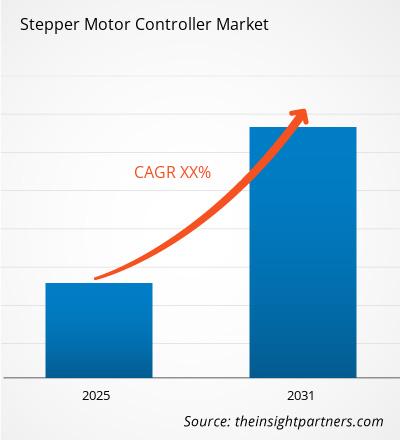
The Stepper Motor Controller Market is projected to expand from US$ 4,199.12 Million in 2025 to US$ 5,456.95 Million by 2034, registering a CAGR of 2.95% during 2026–2034. The market covers control technologies that regulate stepper motor movement, speed, torque, positioning, and sequencing across automation and precision-motion applications. Demand is shaped by increasing automation, greater use of digitally controlled motion systems, and the integration of sensing, microstepping, diagnostics, and communications into compact motor-control architectures.
North America remains an important Stepper Motor Controller Market Size for stepper motor controllers because of its established automation ecosystem, advanced manufacturing base, laboratory instrumentation, and adoption of digitally integrated motion systems. The regional market is expected to record a CAGR of ~2% through 2034. Demand is supported by investments in robotics, semiconductor equipment, medical instrumentation, additive manufacturing, and industrial automation requiring accurate and programmable motion.
Stepper Motor Controller Market Assessment and Insights
Regional Outlook
- North America: ~32% of the global Stepper Motor Controller Market in 2025 | ~2% CAGR through 2034. Market position: North America represents the largest regional market, supported by mature industrial automation, high adoption of precision equipment, established motion-control suppliers, and strong demand from robotics, semiconductor manufacturing, laboratory automation, and advanced production systems.
- US: ~82% of North American market revenue in 2025 | ~2% CAGR through 2034. Market position: The US accounts for most North American demand, reflecting its broad automation installed base and concentration of technology developers, machine builders, semiconductor equipment manufacturers, research institutions, and precision instrumentation users.
- Europe: ~27% of the global market in 2025 | ~2% CAGR through 2034. Market position: Europe is a mature regional market with strong industrial automation capabilities. Germany is the leading country in Europe, followed by the UK, France, Italy, and Spain, with demand linked to machinery, automotive production, electronics, and factory modernization.
- Asia Pacific: ~30% of the global Stepper Motor Controller Market in 2025 | ~4% CAGR through 2034. Market position: Asia Pacific is the fastest-growing region, supported by electronics manufacturing, factory automation, robotics, equipment localization, and expanding production capacity. China is the leading country in Asia Pacific, with Japan, South Korea, India, and Australia contributing across specialized applications.
Segment Outlook
- Intelligent Controllers: ~38% Share in 2025 | ~4% CAGR through 2034. Market position: Intelligent controllers lead because manufacturers increasingly require integrated motion intelligence, programmable control, diagnostics, feedback compatibility, and communication capabilities. Their adoption is particularly relevant where equipment designers seek higher functionality without substantially increasing system complexity.
- Adjustable-speed Drives: ~28% Share in 2025 | ~4% CAGR through 2034. Market position: Adjustable-speed drives have strong growth potential as machine builders seek coordinated speed and motion control. Their relevance increases in automated production systems where operating profiles must be adapted to load conditions, process requirements, and energy-management objectives.
Competitive Coverage
Adafruit Industries, Infineon Technologies AG, MediaTek Inc., Microchip Technology Inc., Motion Group, National Instruments Corp., NXP Semiconductors, onsemi, Panasonic Corporation, Zaber Technologies Inc., Texas Instruments Incorporated, STMicroelectronics N.V., Analog Devices, Inc.
Methodology
The Insight Partners follows Data Collection & Secondary Research, Primary Research, Data Analysis, and Data Triangulation & Final Review to validate market estimates and insights.
Source: The Insight Partners' analysis based on proprietary research, government publications, company annual reports, investor presentations, industry databases, and expert interviews.
The development in stepper motor control has taken a step from a simple open-loop switch to integrated motion systems involving current control, microstepping, programmed acceleration, position control, diagnostic features, and digital communication. Modern controllers and drivers have incorporated functions which before had to be provided by separate components. Such an arrangement not only optimizes board space but also allows equipment makers to configure the motion profile as desired by their applications such as printers, laboratory apparatus, CNC machines, automation machines, and precise positioning systems. The ecosystem thus created includes semiconductor companies, controller makers, motor producers, motion system integrators, and specialized equipment makers.
For the future, there will be wider adoption in developing manufacturing economies where more automated equipment will be used and local manufacturers will need compact motion control systems. Funding is increasingly being allocated to controllers that can interface equipment, provide feedback, detect faults, and offer programmability of operation. Such trends are indirectly driven by regulatory and efficiency considerations that push manufacturers to monitor performance of their equipment and minimize energy use unnecessarily.
Stepper Motor Controller Market Report Scope
| Report Attribute | Details |
|---|---|
| Market size in 2025 | US$ 4,199.12 Million |
| Market Size by 2034 | US$ 5,456.95 Million |
| Global CAGR (2026 - 2034) | 2.95% |
| Historical Data | 2021-2024 |
| Forecast period | 2026-2034 |
Stepper Motor Controller Market Analysis
Demand for stepper motor controllers is tightly linked with the growth of automated positioning systems. Controllers convert system-level instructions into the electric pulse sequences that define motor operation, so these devices are essential elements of systems where repetitive positioning and controlled acceleration are necessary. Manufacturers of systems prefer integrated approaches due to potential simplicity of electronics design and implementation of such features as microstepping, current regulation, and protection capabilities.
The value chain goes from semiconductor design and manufacturing to drivers/controllers design/development, electronics assembly, integration into motion systems, and finally to systems manufacturing. Competitiveness of suppliers relies on parameters such as maximum current capability, control resolution, thermal properties, software capabilities, communications, and compatibility with other electronic systems. As a result, supply dynamics depends not only on capacity of motor-control semiconductors but also on availability of power electronics, microcontrollers, sensors, and EMS.
Some of the competitors in the Stepper Motor Controller Market Report include semiconductor manufacturers, motion control manufacturers, instrument makers, and integrated automation vendors. Microchip Technology creates stepper motor controllers and drivers for conventional, microstepping, and closed loop systems whereas Zaber Technologies creates small controller devices that are built into precision motion devices. Adafruit Industries caters to development and prototyping customers with easily accessible stepper drivers whereas National Instruments enables stepper control within more general motion control settings.
Investments are now made in the direction of increased integration and smart control capabilities. Companies such as Infineon Technologies, NXP Semiconductors, onsemi, Texas Instruments, STMicroelectronics, and Analog Devices are all participants in larger semiconductor ecosystems related to motor control where stepper control can be integrated together with diagnostics and power management functions. Companies such as Panasonic and Motion Group and others involved in motion-related systems provide system level features.
● REPORT CUSTOMIZATION
Tailor This Report To Align With Your Specific Business Requirements
This report can be customized to align precisely with your business objectives, scope, and target markets. Customization options include tailored segmentation, geography, competitive analysis, and strategic insights to support informed decision-making.
Customize This Report →WHAT YOU CAN ADJUST
- ● Segmentations
- ● Geography
- ● Competitive Analysis
- ● Language Preferences
Stepper Motor Controller Market: Strategic Insights

Regional Insights
North America Stepper Motor Controller Market
North America accounted for ~32% of the global market in 2025 and is projected to expand at a CAGR of ~2% through 2034. The region benefits from a mature automation ecosystem, extensive installed equipment base, and demand for precision motion in semiconductor production, laboratory automation, medical equipment, aerospace manufacturing, additive manufacturing, and industrial machinery. Controller suppliers also benefit from the region's concentration of technology developers and system integrators.
The regional market is defined by ongoing replacements of conventional motor control hardware architecture with digital configurability. Increasing demands for micro-stepping capabilities, feedback compatibility, programmed acceleration and diagnostics, along with the capability to communicate, provide the basis for controller architectures that provide more value than switching architectures. Development and prototyping also drive demand since engineers need controller and driver development platforms prior to integrating motion control functionality into commercial machines. The maturation of automation coupled with equipment development drives growth, but replacement demand limits the rate compared to manufacturing regions with lower penetration rates.
U.S. Stepper Motor Controller Market
The US represented ~82% of North American Stepper Motor Controller Market Share in 2025 and is expected to record a CAGR of ~2% through 2034. Its position reflects the scale of domestic automation, advanced manufacturing, semiconductor equipment, research instrumentation, and technology-intensive machinery. Stepper controllers are used where repeatable movement and programmable positioning are required without the system complexity of higher-cost servo architectures.
The suppliers of the country include Microchip Technology, National Instruments, Adafruit Industries, Zaber Technologies, as well as semiconductor companies for motor control applications. In the product development process, closed loop control, microstepping, current control, fault detection, and configurable motion have been gaining more importance. Industrial automation is an important application area; however, laboratory equipment, printers, CNC machines, robotics sub-systems, and precision positioning equipment add to the demand. The wide variety of end users provides resilience to the US market, as manufacturers upgrade old machinery as well as design new digitally controlled machines.
Europe Stepper Motor Controller Market
Europe represented ~27% of the global Stepper Motor Controller Market in 2025 and is expected to grow at a CAGR of ~2% through 2034. Germany is the leading country in Europe, supported by its machinery and industrial automation base, while the UK maintains strong demand in scientific instrumentation, advanced manufacturing, and automation. France contributes through aerospace, industrial equipment, and automated production, while Italy and Spain provide demand from machinery, packaging, automotive, and manufacturing industries.
Demand from Europe is increasingly driven by the upgrading of machinery with modern technology and the requirement of smaller, reconfigurable motion-control systems. In Germany, there are various applications involving precise positioning, coordination of machine operations, and programmability. In the UK, research and instrumentation activities play an important part, and in both these activities, precision movement is often required. France benefits from its aerospace and industrial equipment sectors providing niche applications, whereas Italy’s machinery and packaging industries are contributing volume demand for motor control components. Spain, on its part, makes a contribution via its automobile and industrial manufacturing industries. In the European market, there is an increasing expectation of support for digital interfacing, diagnostics, energy-awareness, and integration into automation systems.
Segmentation Analysis
Type
The Intelligent Controllers in the Stepper Motor Controller Market represent the largest main segment and are expected to register a CAGR of ~4% during 2026–2034. The segment benefits from demand for integrated motion intelligence, programmable control, diagnostics, feedback compatibility, and communications. Equipment designers increasingly seek controller architectures capable of performing more functions locally, reducing dependence on external control hardware. This approach is particularly relevant in automated production, precision instrumentation, robotics subsystems, and digitally connected equipment.
- Motor Starters: Motor starters address basic initiation and switching requirements where control complexity is limited. Their strategic importance is strongest in cost-sensitive equipment and straightforward machine architectures requiring dependable motor activation without extensive programmable functionality.
- Reduced Voltage Starters: Reduced voltage starters are relevant where controlled electrical starting characteristics are required. Their application is more specialized within stepper-related control architectures and is influenced by equipment design, electrical protection requirements, and system-level integration decisions.
- Adjustable-speed Drives: Adjustable-speed drives provide configurable operating profiles and support equipment requiring variable motion behavior. Their importance increases as machine builders seek coordinated speed control, process flexibility, and improved operating efficiency across automated equipment.
- Intelligent Controllers: Intelligent controllers integrate advanced control functions with monitoring and communications capabilities. Their strategic role is expanding in connected automation because they can support diagnostics, feedback, programmable motion profiles, and more autonomous machine operation.
Application
The Application segmentation covers Permanent Magnet Stepper Motor, Hybrid Synchronous Stepper Motor, and Variable Reluctance Stepper Motor. Controller requirements vary according to motor construction, torque characteristics, positioning requirements, operating speed, and application environment. Increasingly sophisticated equipment favors controller architectures that can accommodate precise current control and flexible motion profiles across different motor configurations.
- Permanent Magnet Stepper Motor: Permanent magnet stepper motors are used where straightforward positioning, compact construction, and controlled movement are required. Controllers for these motors emphasize dependable phase sequencing, current regulation, and compatibility with equipment requiring repeatable low-speed motion.
- Hybrid Synchronous Stepper Motor: Hybrid synchronous stepper motors combine characteristics of permanent magnet and variable reluctance designs and are widely relevant to precision positioning. Controller requirements emphasize fine microstepping, torque management, smooth movement, and increasingly sophisticated feedback and diagnostic capabilities.
- Variable Reluctance Stepper Motor: Variable reluctance stepper motors are suited to applications where construction simplicity and responsive positioning are important. Controller design must accommodate their magnetic characteristics and application-specific sequencing requirements, supporting specialized industrial and instrumentation uses.
Opportunity Snapshot
| Application | Revenue Contribution | Trend Tag | Adoption Stage |
| Permanent Magnet Stepper Motor | Medium | Compact Motion | Mature |
| Hybrid Synchronous Stepper Motor | High | Precision Motion | Scaling |
| Variable Reluctance Stepper Motor | Low | Specialized Control | Emerging |
Stepper Motor Controller Market Growth Drivers and Impact Analysis
Expansion of Industrial Automation and Precision Positioning
Industrial automation remains a fundamental demand driver because stepper motor controllers provide a practical means of converting digital commands into repeatable mechanical movement. Automated machines used in material handling, packaging, printing, inspection, laboratory equipment, and production tooling frequently require controlled positioning at a cost below that of more sophisticated servo architectures. As manufacturers automate additional process stages, controller requirements increasingly move beyond basic step generation toward microstepping, current regulation, feedback compatibility, and diagnostics. This shift increases the value of integrated controller and driver solutions. Suppliers that can provide scalable products across machine architectures can address both new equipment development and replacement demand. The impact is therefore not limited to higher unit volumes; it also encourages a gradual migration toward more capable controller products.
Growing Demand for Compact and Integrated Motion-Control Electronics
Equipment designers increasingly need to reduce cabinet space, wiring, component count, and thermal complexity while adding more control functionality. Integrated stepper controller solutions respond to this requirement by combining motion-control logic, current management, protection, communication, and diagnostic functions in smaller electronic architectures. Microstepping and programmable control can improve motion smoothness without requiring extensive external circuitry. For machine builders, higher integration can shorten development cycles and simplify system validation because fewer independent components need to be coordinated. The market impact is particularly relevant to compact automation equipment, scientific instruments, printers, and other applications where electronics density is high. Suppliers capable of integrating control and power functions while maintaining thermal and electrical performance can capture greater value per system.
Increasing Adoption of Connected and Feedback-Aware Motion Systems
Motion systems are increasingly expected to provide information about operating conditions rather than simply execute movement commands. Controllers with encoder compatibility, stall detection, fault reporting, serial interfaces, and programmable diagnostics allow equipment developers to identify abnormal operating conditions and improve maintenance workflows. This capability is valuable in automated equipment where unexpected positioning errors can disrupt downstream processes. Feedback-aware operation can also support more sophisticated control strategies and help bridge the gap between conventional open-loop stepper systems and higher-end motion architectures. As factories and equipment become more digitally connected, the ability to exchange motion data with supervisory controllers becomes a differentiating feature. This development supports demand for intelligent controller architectures and increases the importance of software, communication protocols, and diagnostic functionality alongside core power electronics.
Stepper Motor Controller Market Future Trends
Integration of Embedded Intelligence and Predictive Diagnostics
Future controller architectures are likely to incorporate greater embedded intelligence for tuning, fault detection, motion optimization, and condition monitoring. Current industry offerings already demonstrate the direction through integrated current sensing, stall detection, programmable motion profiles, and diagnostic interfaces. The next stage is expected to place more decision-making within the controller, reducing the need for continuous intervention by a host processor. Such architectures can identify abnormal load behavior, detect positioning problems, and adjust operating parameters according to application requirements. For equipment manufacturers, this trend could simplify system architecture while improving serviceability. The Stepper Motor Controller Market Trends will consequently increasingly distinguish products according to their ability to combine power electronics with motion algorithms, communications, feedback processing, and software-configurable functions rather than relying solely on electrical drive specifications.
Greater Adoption of High-Resolution Microstepping and Digital Interfaces
Higher-resolution microstepping is becoming an important design direction because smoother movement can reduce vibration, audible noise, and mechanical disturbances in precision equipment. Contemporary controller platforms increasingly support high microstep counts alongside interfaces such as SPI, UART, I2C, and STEP/DIR. These capabilities allow controllers to be integrated into increasingly sophisticated machine architectures without requiring large amounts of external control circuitry. Future systems are likely to combine high-resolution motion with more precise current sensing, automatic tuning, encoder inputs, and digital diagnostics. The result will be greater interoperability between controller hardware and software-based automation platforms. For manufacturers, the trend creates opportunities to differentiate through motion quality, ease of configuration, compact packaging, and compatibility with connected machine-control environments.
Stepper Motor Controller Market Opportunities
Expansion of Integrated Controller Solutions for Emerging Automation Markets
Manufacturing expansion in Asia Pacific and other developing automation markets creates opportunities for suppliers offering integrated controllers that balance functionality, reliability, and system cost. Machine builders entering automated production often need standardized controller platforms that can support multiple equipment configurations without extensive redesign. Products combining motor-control logic, power-stage functionality, communications, and diagnostics can reduce engineering effort and facilitate localization. The Stepper Motor Controller Market Forecast can benefit as suppliers develop scalable product families spanning low-power equipment through more demanding industrial applications. Local technical support, evaluation platforms, reference designs, and software libraries can also reduce adoption barriers for smaller equipment manufacturers. Companies able to combine competitive economics with straightforward integration are positioned to address fragmented machine-builder ecosystems and support broader adoption outside mature automation markets.
Advanced Motion Platforms for Precision Equipment and Laboratory Automation
Precision instrumentation, laboratory automation, optical systems, semiconductor equipment, and scientific devices create an opportunity for higher-value controller platforms. These applications place greater emphasis on positioning accuracy, smooth movement, repeatability, feedback, programmable acceleration, and communications than on basic motor activation. Suppliers can target this opportunity through compact controllers with integrated drivers, encoder support, advanced motion algorithms, and software tools that simplify configuration. Modular multi-axis architectures can further increase value by allowing equipment developers to coordinate several motors through a common platform. The opportunity extends beyond component sales because suppliers can provide development boards, APIs, configuration software, and application support. Such ecosystems can strengthen customer retention and accelerate the transition from prototype-stage motion control to production equipment.
Recent Developments
- August 2026: Summit Electronics introduces Atlas, a new series of driver and controller modules designed for OEMs and engineering teams developing compact, reliable motion applications. The range consists of single-axis and three-axis controller modules with an authentic Dutch design complemented by Atlas Engines, a complete range of stepper motors. Together, they provide a flexible motion platform that allows customers to match the right motor and controller to their specific application requirements.
- October 2025: Festo introduced the EMMT-ST stepper motor series for its CMMT-ST multi-protocol DC servo drive, expanding its light-duty servo motion portfolio for applications such as electronics assembly, packaging, automated laboratory equipment, pharmaceutical processing, and conveying. The CMMT-ST drive supports EtherNet/IP, EtherCAT, PROFINET, and Modbus TCP, allowing users to configure the required communication protocol through Festo Automation Suite.
- February 2026: Toshiba Electronics introduced the TB67S579FTG, a two-phase bipolar stepper motor driver IC featuring its newly developed Advanced Microstep Technology. The 40 V/2.0 A driver is designed to deliver smoother, quieter, and more efficient motor operation across applications including printers, scanners, surveillance cameras, projectors, ATMs, 3D printers, sewing machines, and industrial equipment.
Frequently Asked Questions

- Comprehensive Market Sizing and Forecast Analysis
- Detailed Segmentation Analysis
- In-Depth Market Dynamics Assessment
- Regional and Country-Level Insights
- Competitive Landscape and Company Benchmarking
- Strategic Business Intelligence
Recent Reports
Testimonials

The Insight Partners provided valuable market intelligence that supported our global go-to-market strategy. Their team was professional, responsive, and attentive to our feedback, providing thoughtful analysis and helpful methodological clarifications throughout the project.
Junmo Kim Chief Financial Officer (CFO), Enertech Co., Ltd.
The Insight Partners' SCADA System Market report is comprehensive, with valuable insights on current trends and future forecasts. The team was highly professional, responsive, and supportive throughout. We are very satisfied and highly recommend their services.
RAN KEDEM Partner, Reali Technologies LTDs
I requested a report on a very specific software market and the team produced the report in a few days. The information was very relevant and well presented. I then requested some changes and additions to the report. The team was again very responsive and I got the final report in less than a week.
JEAN-HERVE JENN Chairman, Future Analytica
We worked with The Insight Partners for an important market study and forecast. They gave us clear insights into opportunities and risks, which helped shape our plans. Their research was easy to use and based on solid data. It helped us make smart, confident decisions. We highly recommend them.
PIYUSH NAGPAL Sr. Vice President, High Beam Global
The Insight Partners delivered insightful, well-structured market research with strong domain expertise. Their team was professional and responsive throughout. The user-friendly website made accessing industry reports seamless. We highly recommend them for reliable, high-quality research services
YUKIHIKO ADACHI CEO, Deep Blue, LLC.
This is the first time I have purchased a market report from The Insight Partners.While I was unsure at first, I visited their web site and felt more comfortable to take the risk and purchase a market report.I am completely satisfied with the quality of the report and customer service. I had several questions and comments with the initial report, but after a couple of dialogs over email with their analyst I believe I have a report that I can use as input to our strategic planning process.Thank you so much for taking the extra time and making this a positive experience.I will definitely recommend your service to others and you will be my first call when we need further market data.
JOHN SUZUKI President and Chief Executive Officer, Board Director, BK Technologies
I wish to appreciate your support and the professionalism you displayed in the course of attending to my request for information regarding to infectious disease IVD market in Nigeria. I appreciate your patience, your guidance, and the fact that you were willing to offer a discount, which eventually made it possible for us to close a deal. I look forward to engaging The Insight Partners in the future, all thanks to the impression you have created in me as a result of this first encounter.
DR CHIJIOKE ONYIA MANAGING DIRECTOR, PineCrest Healthcare Ltd.Reason to Buy
- Informed Decision-Making
- Understanding Market Dynamics
- Competitive Analysis
- Identifying Emerging Markets
- Customer Insights
- Market Forecasts
- Risk Mitigation
- Boosting Operational Efficiency
- Strategic Planning
- Investment Justification
- Tracking Industry Innovations
- Aligning with Regulatory Trends





 Get Free Sample for