
Subsea Power Grid System Market Growth, Trends & Demand by 2034
Coverage: by Component (Cables, Variable Speed Drives, Transformers, Switchgears, Others); Power Supply (Captive Generation, Wind Power, Others) , and Geography (North America, Europe, Asia Pacific, and South and Central America)
- Status : Data Released
- Report Code : TIPRE00010056
- Category : Electronics and Semiconductor
- No. of Pages : 150
- Available Report Formats :


- Last update date : October 30, 2026


2025 Market Size
US$ 2.25 Bn
Base year value
2034 Forecast
US$ 5.27 Bn
Projected by 2034
CAGR 2026-2034
9.92 %
Growth rate
Addressable Market
US$ 33.47 Bn
(2026-2034)
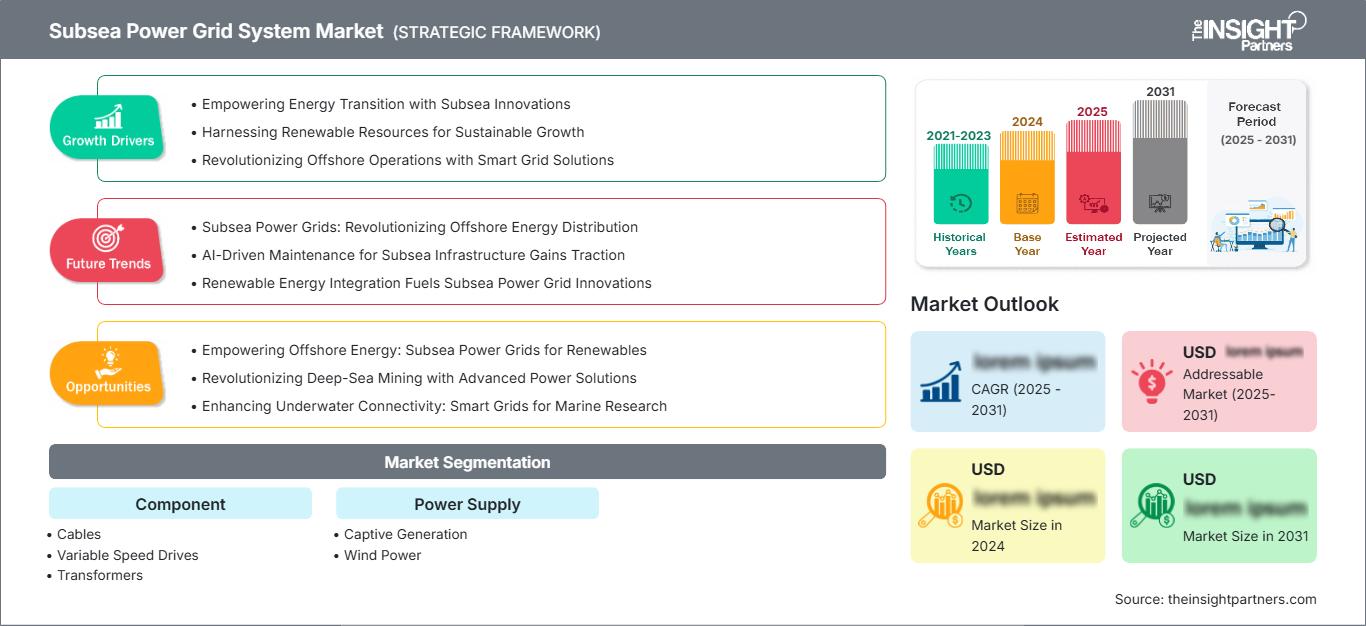
The Subsea Power Grid System Market is expanding as offshore energy projects, subsea production infrastructure, and cross-border electricity interconnections require reliable underwater power transmission and distribution. The market is valued at US$ 2.25 Billion in 2025 and is projected to reach US$ 5.27 Billion by 2034, registering a 9.92% CAGR from 2026 to 2034. The market encompasses subsea electrical infrastructure designed to transmit, transform, distribute, and control power across marine environments, including cables, variable speed drives, transformers, switchgears, and associated power supply architectures.
North America is supported by offshore wind development, subsea electrification, and modernization of offshore energy infrastructure. The regional market is projected to expand at approximately ~8% CAGR through 2034, supported by investment in offshore transmission, grid interconnection, and electrification of offshore assets. Increasing interest in reducing offshore emissions and improving the reliability of remote power systems is also encouraging adoption. These structural factors reinforce the Subsea Power Grid System Market size opportunity across utilities, offshore energy developers, and subsea industrial operators.
Subsea Power Grid System Market Assessment and Insights
Regional Outlook
- North America: ~27% of the global market in 2025 | ~8% CAGR through 2034. Market position: North America represents a substantial established market supported by offshore energy electrification, emerging offshore wind transmission, subsea production systems, and demand for resilient grid infrastructure connecting remote marine assets to mainland networks.
- US: ~82% of North American market revenue in 2025 | ~7% CAGR through 2034. Market position: The US accounts for most North American demand, with opportunities concentrated around offshore wind transmission, subsea electrification, coastal grid modernization, and specialized power systems serving offshore industrial installations.
- Europe: ~34% of the global market in 2025 | ~9% CAGR through 2034. Market position: Europe is the largest regional market, supported by mature offshore wind infrastructure and extensive subsea interconnection activity. Germany, the UK, France, Italy, and the Netherlands form important demand centers, with Germany and the UK particularly prominent in offshore grid development.
- Asia Pacific: ~29% of the global market in 2025 | ~12% CAGR through 2034. Market position: Asia Pacific is the fastest-growing region as China, Japan, South Korea, India, and Australia expand offshore renewable development and grid infrastructure. China is the leading country in Asia Pacific, supported by extensive offshore wind deployment and domestic electrical manufacturing capacity.
Segment Outlook
- Cables: ~60% Share in 2025 | ~10% CAGR through 2034. Market position: Cables represent the largest component segment because every subsea transmission architecture requires underwater power links. Growing transmission distances, higher voltage requirements, offshore wind development, and interconnector projects reinforce demand for specialized high-voltage subsea cable systems.
- Power Supply: ~40% Share in 2025 | ~11% CAGR through 2034. Market position: Power Supply is the high-growth main segment as offshore generation and electrification projects increasingly require integrated architectures for reliable energy delivery. Expansion of offshore wind and remote subsea operations supports demand for both captive generation and renewable power supply configurations.
Competitive Coverage
ABB, Aker Solutions ASA, General Electric Company, JDR Cable Systems Ltd., Nexans S.A., Oceaneering International, Inc., Prysmian Group, Schlumberger Limited, Siemens AG, TechnipFMC plc
Methodology
The Insight Partners follows Data Collection & Secondary Research, Primary Research, Data Analysis, and Data Triangulation & Final Review to validate market estimates and insights.
Source: The Insight Partners' analysis based on proprietary research, government publications, company annual reports, investor presentations, industry databases, and expert interviews.
The market has advanced from largely localized subsea electrical links to integrated solutions that can handle more transmission capacity, more distance, and greater offshore complexity. Cable technology has advanced in line with the development of offshore wind generation, subsea production, and interconnection needs, whereas transformers, switchgears, and variable speed drives are becoming essential components of integrated offshore electrical systems. The value chain currently includes equipment suppliers, cable suppliers, engineering firms, offshore installation service providers, utilities, transmission companies, and energy developers. This trend is pushing procurement towards comprehensive system engineering and life cycle support rather than component procurement alone.
Future expectations will be driven by offshore renewables investment, electricity interconnection across national borders, and electrification of offshore infrastructure. Europe is expected to continue being a strong center of investments, whereas Asia Pacific will offer considerable additional investment opportunities through the build-out of offshore wind farms and local value chain development. North America will continue concentrating its efforts on grid-connected offshore installations and offshore electrification. Further investments in projects could be bolstered by favorable regulatory environment supporting renewable integration, transmission resilience, maritime infrastructure, and emissions reductions, while permitting, financing, vessel availability, and cable manufacturing capacity remain execution risks.
Subsea Power Grid System Market Report Scope
| Report Attribute | Details |
|---|---|
| Market size in 2025 | US$ 2.25 Billion |
| Market Size by 2034 | US$ 5.27 Billion |
| Global CAGR (2026 - 2034) | 9.92% |
| Historical Data | 2021-2024 |
| Forecast period | 2026-2034 |
Subsea Power Grid System Market Analysis
The Subsea Power Grid System Market growth is very dependent on the offshore renewable generation expansion and electrification of marine resources. Wind turbines offshore farms have inter-array and export connections, and subsea oil and gas installations have a requirement for an electrical supply system through the seabed infrastructure. Cross-border projects and island interconnectors create the other side of the demand spectrum by allowing electricity transportation across geographically distant networks. Such applications will generate the need for equipment to be able to operate in conditions of high pressure, corrosion, mechanical forces, thermal limitations, and reduced accessibility.
The value chain starts from system engineering and designing, followed by manufacturing of cables, transformers, switchgears, drives, integration of the project, offshore deployment, testing, commissioning, monitoring, and maintenance. In particular, the cable manufacturers play a key role in the process as their manufacturing capacity, installation vessels, specialized manufacturing facilities, and engineering capability can become the critical factors limiting the schedule of the project.
Based on the findings presented in the Subsea Power Grid System Market report, the market environment is characterized by diversification of electrical equipment and technology companies alongside specialized cable, subsea engineering and offshore services providers. ABB, Siemens AG, and General Electric Company operate in the field of electrical equipment and technologies, whereas Nexans S.A., Prysmian Group, and JDR Cable Systems Ltd. demonstrate significant involvement in submarine cable systems. Aker Solutions ASA, Oceaneering International, Inc., Schlumberger Limited, and TechnipFMC plc provide subsea engineering and offshore power systems solutions.
Investments go into manufacturing capacities, high voltage transmissions systems, dynamic cables, offshore laying capacity, and engineering services. The market positioning will require not only good products but also project execution, cable laying, testing, grid codes, and services. In general, companies that are capable of providing equipment, engineering, laying, and full life-cycle services will be able to cope with the increasing complexity of offshore projects and reduce the coordination needed by developers and transmission companies.
● REPORT CUSTOMIZATION
Tailor This Report To Align With Your Specific Business Requirements
This report can be customized to align precisely with your business objectives, scope, and target markets. Customization options include tailored segmentation, geography, competitive analysis, and strategic insights to support informed decision-making.
Customize This Report →WHAT YOU CAN ADJUST
- ● Segmentations
- ● Geography
- ● Competitive Analysis
- ● Language Preferences
Subsea Power Grid System Market: Strategic Insights
Regional Insights
North America Subsea Power Grid System Market
North America represents approximately 27% of the worldwide Subsea Power Grid System Market Share in 2025 and is estimated to grow at around 8% CAGR up to 2034. Growth drivers for the North American market are seen to come from offshore wind power generation, offshore electrification, and offshore power transmission projects in the US, and offshore energy development and connectivity in Canada. Mexico’s market opportunities are mainly based on industrial usage of offshore electrical subsea cables and equipment.
The regional market includes both the existing oil and gas market knowledge and experience as well as the developing market for renewable energies. The US market includes electrical equipment suppliers, offshore engineering companies, offshore cable manufacturers, and offshore power transmission companies. ABB, General Electric Company, Oceaneering International, Inc., Schlumberger Limited, Siemens AG, and TechnipFMC plc have solutions for offshore power and subsea markets. Economics, licensing, availability, and offshore wind power regulations will affect the demand time schedule, and offshore electrification offers an alternative route to use subsea power systems.
U.S. Subsea Power Grid System Market
The US is responsible for approximately 82% of market revenue in North America in 2025 and is estimated to register a CAGR of ~7% through 2034. The demand drivers include offshore wind transmission, subsea power transmission, offshore production electrification, and modernization of the grid across key coastal regions. The country's huge utility network and engineering expertise enable the use of high-voltage equipment and subsea electrical systems.
The opportunities in the US range from export cables that connect offshore power generation to onshore transmission systems and dedicated electrical systems to provide power to remote offshore sites. Key players in the ecosystem include companies such as ABB, General Electric Company, Oceaneering International, Inc., and TechnipFMC plc in the electrical, subsea, and offshore engineering segments, while cable suppliers internationally cater to key transmission projects. There is a focus on reliability, installation, life cycle considerations, and local supply chain resilience.
Europe Subsea Power Grid System Market
Europe holds ~34% of the global market in 2025 and is projected to expand at ~9% CAGR through 2034. The region has the most mature offshore wind and subsea interconnection ecosystem, supported by coordinated energy-transition policies, cross-border electricity transmission, and established offshore engineering capabilities. Germany is the leading country in Europe, while the UK, France, Italy, and Spain contribute through offshore wind, interconnection, and transmission investments. Germany's North Sea infrastructure creates sustained requirements for HVDC and HVAC subsea transmission systems.
Importance of the market is due to offshore wind connection and integration and remote generation connection with mainland grid. Offshore transmission development is being made by France, while Italy is working on submarine interconnectors which link islands with mainland grid. Combination of offshore renewable energy and grid modernization needs make Spain interesting for the market, although offshore wind development there is at an early stage compared to northern Europe. Needs of Europe are now moving toward EPCI services, opening opportunities for cable manufacturing and electrical equipment producers with offshore development experience.
APAC Subsea Power Grid System Market
Asia Pacific represents ~29% of the global market in 2025 and is expected to register ~12% CAGR through 2034, making it the fastest-growing regional market. China is the leading country in Asia Pacific, supported by extensive offshore wind deployment, large domestic electrical manufacturing capabilities, and expanding transmission infrastructure. Japan and South Korea are developing offshore renewable projects alongside specialized marine engineering capabilities.
India represents an emerging opportunity as offshore wind planning and transmission infrastructure progress, while Australia provides potential through offshore renewable projects and remote energy infrastructure. China supports regional scale through manufacturing depth and large renewable deployment, whereas Japan and South Korea emphasize marine technology and high-value engineering. Regional investment in offshore wind, grid integration, marine energy infrastructure, and domestic supply chains is expected to increase the addressable requirement for subsea cables, transformers, switchgears, and power-control technologies.
Middle East & Africa Subsea Power Grid System Market
The Middle East & Africa market is projected to expand at ~10% CAGR through 2034. Demand is connected to offshore oil and gas electrification, marine infrastructure, energy diversification, and emerging renewable projects. Saudi Arabia and the UAE are developing large-scale energy infrastructure, while South Africa provides a significant renewable-energy and transmission opportunity within the African market. Rest of MEA demand is more fragmented and project-specific.
The region's offshore energy base creates an established requirement for reliable subsea power equipment, particularly where remote production assets require dependable electrical supply. Electrification can reduce reliance on offshore generation and improve operational integration with mainland grids. Renewable-energy diversification could broaden demand beyond traditional offshore applications, particularly as coastal transmission infrastructure develops. Suppliers with strong engineering, installation, corrosion management, and lifecycle-service capabilities can address the technical requirements associated with harsh marine environments and remote project locations.
Segmentation Analysis
Component
The Component segment in the Subsea Power Grid System Market includes Cables, Variable Speed Drives, Transformers, and Switchgears and represents the core hardware layer of subsea electrical infrastructure. It is estimated to expand at ~10% CAGR from 2026 to 2034. Cables account for the largest contribution because transmission and distribution across underwater environments depend on specialized power links. However, increasing system complexity is expanding requirements for protection, voltage transformation, motor control, and power management equipment. The Subsea Power Grid System scope therefore extends beyond cable supply toward integrated electrical architectures supporting offshore generation and subsea industrial loads.
- Cables: Cables form the essential transmission pathway between offshore generation, subsea equipment, offshore substations, and onshore networks. Demand emphasizes high-voltage performance, mechanical protection, installation reliability, and compatibility with fixed and floating offshore applications.
- Variable Speed Drives: Variable speed drives provide controlled electrical power for subsea motors, pumps, compressors, and rotating equipment. Their strategic importance increases where operators seek efficient motor operation, controllability, and improved performance across changing subsea load conditions.
- Transformers: Transformers support voltage conversion between generation, transmission, and distribution levels within offshore and subsea electrical architectures. Compact designs, insulation reliability, thermal management, and resistance to harsh marine conditions are important procurement considerations.
- Switchgears: Switchgears provide electrical isolation, protection, switching, and fault-management functions. Subsea deployment increases the importance of compact construction, dependable protection, remote operation, and equipment designs capable of maintaining reliability under demanding environmental conditions.
Power Supply
The Power Supply segment comprises Captive Generation and Wind Power and is expected to grow at ~11% CAGR through 2034. Its development reflects the transition from isolated offshore power generation toward integrated electricity supply architectures. Captive Generation remains relevant for remote offshore assets where independent power availability is essential, while Wind Power is gaining strategic importance as offshore renewable generation expands. The segment's growth is supported by the increasing need to connect offshore generation with mainland grids and to supply subsea infrastructure with reliable electricity.
- Captive Generation: Captive generation provides independent power for offshore and subsea assets where connection to mainland grids is technically difficult or economically constrained. Its role remains important in remote production environments requiring dependable continuous electricity.
- Wind Power: Wind Power is becoming increasingly important as offshore wind projects require subsea transmission infrastructure to move electricity from marine generation sites to onshore grids. Growth is reinforced by grid expansion, renewable-energy targets, and offshore project development.
Opportunity Snapshot
| Component | Revenue Contribution | Trend Tag | Adoption Stage |
| Cables | High | HV Transmission | Mature |
| Variable Speed Drives | Medium | Motor Control | Scaling |
| Transformers | Medium | Voltage Conversion | Scaling |
| Switchgears | Medium | Grid Protection | Scaling |
Subsea Power Grid System Market Growth Drivers and Impact Analysis
Expansion of Offshore Wind Transmission Infrastructure
Offshore wind development is one of the strongest structural drivers for subsea power-grid investment because electricity generated offshore must be collected, transformed, transmitted, and delivered to mainland networks. As projects move farther from shore and into deeper waters, subsea transmission becomes more technically important and requires higher-performance cables, offshore substations, transformers, switchgears, and dynamic electrical connections. The expansion of cross-border and hybrid offshore grids further increases system complexity because transmission assets can potentially serve multiple generation and interconnection functions. This changes procurement from individual cable purchases toward integrated grid architectures. Suppliers with high-voltage engineering, installation, testing, and commissioning capabilities can therefore capture a broader portion of project value while developers increasingly prioritize reliable interfaces and predictable installation schedules.
Electrification of Offshore and Subsea Industrial Assets
Offshore electrification is creating demand beyond renewable generation. Oil and gas platforms, subsea production systems, pumps, compressors, and other remote marine assets require reliable power where conventional onboard generation can create operational, emissions, and maintenance burdens. Supplying electricity from shore or centralized offshore facilities can simplify energy architectures and support lower-emission operations. Subsea electrical systems also allow equipment to be positioned farther from fixed infrastructure, potentially expanding field development options. This driver creates opportunities for variable speed drives, transformers, switchgears, and specialized power-control technologies in addition to cables. As offshore operators increasingly evaluate lifecycle efficiency, equipment suppliers that combine electrical reliability with monitoring, control, and service capabilities can address a wider range of subsea electrification requirements.
Growth of High-Voltage Interconnectors and Grid Resilience Projects
Subsea interconnectors are increasingly important for connecting geographically separated electricity systems, strengthening grid flexibility, and integrating variable renewable generation. Island grids and countries with constrained land corridors can use submarine transmission to move electricity without relying solely on terrestrial routes. High-voltage direct-current architectures are particularly relevant where long-distance transmission and asynchronous grid connections create technical advantages. These projects require substantial cable manufacturing, installation, converter, protection, and commissioning capabilities, generating demand throughout the subsea power ecosystem. Grid resilience considerations also support replacement and reinforcement projects as aging infrastructure reaches renewal points. The resulting project pipeline provides a market mechanism that extends beyond offshore wind and creates additional demand for specialized cable systems and electrical equipment.
Subsea Power Grid System Market Future Trends
Multi-Terminal and Hybrid Offshore Grid Architectures
The Subsea Power Grid System Market trends are increasingly moving toward interconnected offshore electricity architectures rather than isolated point-to-point connections. Hybrid projects can combine offshore wind evacuation with cross-border interconnection, allowing transmission infrastructure to serve multiple grid functions. Multi-terminal architectures could further improve asset utilization by connecting several offshore generation zones, national grids, and energy hubs. This transition will increase the importance of coordinated voltage management, protection systems, converter compatibility, and standardized interfaces. Cable technology will also evolve toward higher transmission capacity and improved dynamic performance for floating wind applications. For suppliers, the trend favors system-level engineering and interoperability rather than component-only positioning, while utilities and developers will increasingly assess subsea assets as long-lived strategic grid infrastructure.
Digital Monitoring and Condition-Based Subsea Maintenance
Digitalization is expected to become more important as subsea assets become larger, more dispersed, and more expensive to access. Sensors, remote diagnostics, condition monitoring, and data analytics can help operators identify abnormal electrical behavior, insulation deterioration, thermal stress, and equipment performance changes before failures occur. Predictive maintenance is particularly valuable for submarine cables and subsea switchgear because physical inspection and repair can require specialized vessels and favorable weather windows. Digital monitoring can therefore reduce uncertainty around asset condition and improve maintenance planning. Integration of monitoring platforms with control systems may also support centralized offshore operations, enabling operators to manage distributed assets with fewer site interventions. This Subsea Power Grid System Market trend creates opportunities for equipment suppliers to add software, monitoring, and lifecycle-service capabilities to hardware-focused offerings.
Subsea Power Grid System Market Opportunities
Integrated Cable and Offshore Electrical System Packages
Project developers increasingly require coordinated delivery across cables, transformers, switchgears, drives, engineering, installation, testing, and commissioning. This creates an opportunity for suppliers and contractors to offer integrated packages rather than isolated products. Such models can reduce interface complexity and provide a single technical responsibility across major electrical subsystems. Cable manufacturers with installation fleets can combine manufacturing and offshore execution, while electrical technology companies can integrate protection, transformation, switching, and control equipment. Partnerships between specialized suppliers can also address capability gaps without requiring every participant to manufacture every component. The opportunity is particularly relevant for complex offshore wind and interconnection projects where schedule coordination and interface management have a material impact on project execution.
Advanced Dynamic Cable and Floating Wind Solutions
Floating offshore wind creates a distinct opportunity because turbines and floating platforms introduce continuous movement that places additional mechanical demands on subsea electrical connections. Dynamic cables must accommodate motion, fatigue, environmental exposure, and long-term reliability while maintaining electrical performance. As floating wind expands into deeper-water regions, demand can extend to specialized inter-array and export architectures, dynamic cable systems, and integrated monitoring technologies. Engineering companies and cable manufacturers can capture value through design optimization, testing, installation engineering, and lifecycle services. The Subsea Power Grid System Market Forecasts therefore depend not only on fixed-bottom offshore wind deployment but also on the commercialization of floating projects, where subsea electrical design becomes a critical enabling technology.
Recent Developments
- March 2026: Prysmian has completed testing and is ready to launch the new global standard for high voltage direct current (HVDC) submarine cable systems qualifying the use of 525kV submarine energy cables at an increased operating temperature of up to 90°C. This breakthrough, which is founded on the higher withstand temperature of the cable plastic insulation while operating, means that the maximum power that can be transmitted through a single 525kV link increases from today's standard of 2GW to 2.5GW – and this power can already be deployed in the existing HVDC network infrastructure, with no impacts on the rest of the system. This is a significant boost for operational efficiency, as higher power transfers can be made without increasing voltage or converter and platform sizes, enabling more efficient power transmission in multi-terminal grids and hybrid interconnectors – combining long-distance energy transmission and offshore wind generation in a single and better utilized asset.
- September 2025: Terna, the Italian Transmission System Operator, and Nexans, a global leader in the design and manufacturing of cable systems and services, today started, from Fiumetorto, in the municipality of Termini Imerese (PA), the first installation phase of the Tyrrhenian Link’s western section. Once completed, the connection between Sicily (Termini Imerese, Palermo) and Sardinia (Terra Mala, Cagliari) will set a world record for the greatest installation depth of a high-voltage (HVDC) subsea cable, reaching 2,150 meters below sea level and establishing new benchmarks for the electricity transmission.
- December 2024: Yokogawa Electric Corporation (TOKYO: 6841) announces the release today of OpreX Subsea Power Cable Monitoring, a system for monitoring cables used in the transmission of electricity generated at offshore wind power facilities. By constantly monitoring temperature increases in the subsea power cables caused by damage, this product enables condition-based maintenance and the reduction of operational costs required for inspection and maintenance.
Frequently Asked Questions

- Comprehensive Market Sizing and Forecast Analysis
- Detailed Segmentation Analysis
- In-Depth Market Dynamics Assessment
- Regional and Country-Level Insights
- Competitive Landscape and Company Benchmarking
- Strategic Business Intelligence
Recent Reports
Testimonials

The Insight Partners provided valuable market intelligence that supported our global go-to-market strategy. Their team was professional, responsive, and attentive to our feedback, providing thoughtful analysis and helpful methodological clarifications throughout the project.
Junmo Kim Chief Financial Officer (CFO), Enertech Co., Ltd.
The Insight Partners' SCADA System Market report is comprehensive, with valuable insights on current trends and future forecasts. The team was highly professional, responsive, and supportive throughout. We are very satisfied and highly recommend their services.
RAN KEDEM Partner, Reali Technologies LTDs
I requested a report on a very specific software market and the team produced the report in a few days. The information was very relevant and well presented. I then requested some changes and additions to the report. The team was again very responsive and I got the final report in less than a week.
JEAN-HERVE JENN Chairman, Future Analytica
We worked with The Insight Partners for an important market study and forecast. They gave us clear insights into opportunities and risks, which helped shape our plans. Their research was easy to use and based on solid data. It helped us make smart, confident decisions. We highly recommend them.
PIYUSH NAGPAL Sr. Vice President, High Beam Global
The Insight Partners delivered insightful, well-structured market research with strong domain expertise. Their team was professional and responsive throughout. The user-friendly website made accessing industry reports seamless. We highly recommend them for reliable, high-quality research services
YUKIHIKO ADACHI CEO, Deep Blue, LLC.
This is the first time I have purchased a market report from The Insight Partners.While I was unsure at first, I visited their web site and felt more comfortable to take the risk and purchase a market report.I am completely satisfied with the quality of the report and customer service. I had several questions and comments with the initial report, but after a couple of dialogs over email with their analyst I believe I have a report that I can use as input to our strategic planning process.Thank you so much for taking the extra time and making this a positive experience.I will definitely recommend your service to others and you will be my first call when we need further market data.
JOHN SUZUKI President and Chief Executive Officer, Board Director, BK Technologies
I wish to appreciate your support and the professionalism you displayed in the course of attending to my request for information regarding to infectious disease IVD market in Nigeria. I appreciate your patience, your guidance, and the fact that you were willing to offer a discount, which eventually made it possible for us to close a deal. I look forward to engaging The Insight Partners in the future, all thanks to the impression you have created in me as a result of this first encounter.
DR CHIJIOKE ONYIA MANAGING DIRECTOR, PineCrest Healthcare Ltd.Reason to Buy
- Informed Decision-Making
- Understanding Market Dynamics
- Competitive Analysis
- Identifying Emerging Markets
- Customer Insights
- Market Forecasts
- Risk Mitigation
- Boosting Operational Efficiency
- Strategic Planning
- Investment Justification
- Tracking Industry Innovations
- Aligning with Regulatory Trends





 Get Free Sample for