
Substation Monitoring System Market Growth, Trends & Demand by 2034
Coverage: by Component (Hardware, Software); Communication Technology (Wireless, Wired); Sector (Transmission, Distribution); Industry Vertical (Steel, Oil and Gas, Transportation, Utility, Mining) , and Geography (North America, Europe, Asia Pacific, and South and Central America)
- Status : Data Released
- Report Code : TIPRE00008944
- Category : Electronics and Semiconductor
- No. of Pages : 150
- Available Report Formats :


- Last update date : October 26, 2026


2025 Market Size
US$ 4.07 Bn
Base year value
2034 Forecast
US$ 8.46 Bn
Projected by 2034
CAGR 2026-2034
8.47 %
Growth rate
Addressable Market
US$ 56.22 Bn
(2026-2034)
The Substation Monitoring System Market is evolving as utilities and industrial operators seek greater visibility into electrical assets, equipment condition, power quality, and operational performance. The market was valued at US$ 4.07 Billion in 2025 and is projected to reach US$ 8.46 Billion by 2034, registering a 8.47% CAGR from 2026 to 2034. The market includes hardware and software used to monitor substations across transmission and distribution networks, supported by wired and wireless communication technologies and applications spanning utilities, steel, oil and gas, transportation, and mining.
North America presents a mature demand base for digital substation monitoring, supported by aging grid assets, distributed energy resources, data-intensive loads, and utility modernization programs. The regional market is estimated to expand at approximately ~8% CAGR through 2034, driven by replacement of aging monitoring infrastructure and increasing requirements for real-time visibility and predictive maintenance. Utilities are also integrating monitoring with automation and asset-management platforms to improve operational decisions. These factors support sustained demand for the Substation Monitoring System Market size across transmission and distribution applications.
Substation Monitoring System Market Assessment and Insights
Regional Outlook
- North America: ~30% of the global market in 2025 | ~8% CAGR through 2034. Market position: North America represents the largest regional market, supported by advanced utility digitization, aging substations, distributed energy integration, data-center electricity demand, and established adoption of automation, communications, and asset-performance technologies.
- US: ~80% of North American market revenue in 2025 | ~8% CAGR through 2034. Market position: The US is the principal North American market, supported by utility modernization, transmission expansion, wildfire and storm resilience requirements, and monitoring needs across large transmission and distribution asset fleets.
- Europe: ~29% of the global market in 2025 | ~8% CAGR through 2034. Market position: Europe has a mature digital-grid ecosystem supported by renewable integration and cross-border transmission. Germany, the UK, France, Italy, and Spain are important markets, with Germany representing the leading country in Europe.
- Asia Pacific: ~28% of the global market in 2025 | ~11% CAGR through 2034. Market position: Asia Pacific is the fastest-growing region, supported by grid expansion, industrial electrification, renewable integration, and smart-grid programs. China is the leading country in Asia Pacific, followed by substantial technology and infrastructure demand across Japan, South Korea, India, and Australia.
Segment Outlook
- Hardware: ~64% Share in 2025 | ~8% CAGR through 2034. Market position: Hardware leads because sensors, intelligent electronic devices, monitoring units, communications equipment, and measurement systems form the physical foundation of substation visibility. Replacement programs and digitalization of conventional substations reinforce recurring hardware demand.
- Distribution: ~56% Share in 2025 | ~10% CAGR through 2034. Market position: Distribution represents the high-growth segment because utilities increasingly require visibility at feeder and substation level as distributed generation, electric mobility, storage, and variable demand make local power flows more dynamic.
Competitive Coverage
ABB Ltd., CG Power and Industrial Solutions Limited, Cisco Systems, Inc., Eaton Corporation plc, GE Vernova Inc., NovaTech, LLC, Schneider Electric SE, Schweitzer Engineering Laboratories, Inc., Sentient Energy, Inc., Siemens AG
Methodology
The Insight Partners follows Data Collection & Secondary Research, Primary Research, Data Analysis, and Data Triangulation & Final Review to validate market estimates and insights.
Source: The Insight Partners' analysis based on proprietary research, government publications, company annual reports, investor presentations, industry databases, and expert interviews.
Monitoring in substations has come a long way from the time when it was done periodically through manual inspection and stand-alone measurement to real-time digital monitoring that is integrated within the protection, automation, communication, and asset management systems. Traditional substations now are increasingly using intelligent electronic devices, condition sensors, digital relays, remote terminal units, and measurement systems. The change in the supply structure due to such development has been characterized by the competition among electrical equipment manufacturers, automation suppliers, communication companies, software providers, and systems integrators in interlinked layers.
Going forward, the investment will focus more on solutions that are not only able to provide asset visibility but also analytics, remote control, cybersecurity, and interoperability capabilities. There is much potential in the distribution networks due to growing distributed generation and flexible load. Furthermore, emerging markets can become another driver for the market since grid expansion initiatives will involve digital-ready equipment from the very beginning. Reliability, resiliency, cybersecurity, and renewable integration requirements are likely to stimulate investments while the timing of deployments will be dependent upon other factors.
Substation Monitoring System Market Report Scope
| Report Attribute | Details |
|---|---|
| Market size in 2025 | US$ 4.07 Billion |
| Market Size by 2034 | US$ 8.46 Billion |
| Global CAGR (2026 - 2034) | 8.47% |
| Historical Data | 2021-2024 |
| Forecast period | 2026-2034 |
Substation Monitoring System Market Analysis
The factors driving the development of Substation Monitoring System Market include the demand for improving the reliability of power grids despite increasing variability in power flow. High-resolution situational awareness is needed by transmission companies, while more information from substations and feeders is required by distribution utilities due to the impact of renewable energy production from rooftops, batteries, electric vehicles, and flexible loads on power flows. The applications of the monitoring systems can include fault detection, asset condition monitoring, power quality management, maintenance, and operations.
The value chain includes sensors and measuring devices, intelligent electronic devices, communication technologies, monitoring software, analytics, cybersecurity, integration, installation, commissioning, and lifecycle services. The hardware continues to be important because the monitoring solutions are based on the data collected from the field, but the role of the software becomes bigger and bigger in context of processing of the data. Companies offering a range of capabilities can lower interoperability risks, while specialized providers can offer sensors, communications, analytics, or asset monitoring applications.
The Substation Monitoring System market report highlights competition between diversified electrical technology companies, grid automation firms, communications experts, and dedicated monitoring solutions providers. Companies like ABB Ltd., Schneider Electric SE, Siemens AG, Eaton Corporation plc, and GE Vernova Inc. offer broad product range in substation hardware, automation, protection, and digital solutions. Schweitzer Engineering Laboratories, Inc. and NovaTech, LLC are focusing on protection, automation, communications, and monitoring technologies. Cisco Systems, Inc. specializes in networking solutions. Sentient Energy, Inc. offers dedicated sensing and analytics technologies for the grid edge.
Increasing investment in digital substations, condition-based maintenance, network transformation, cybersecurity, and interoperable connection with asset management software become a priority. Competitive differentiation becomes oriented towards interoperability and lifecycle value rather than just monitoring devices. Suppliers who are able to integrate field sensing, communications, analytics, connectivity, and services will be involved in modernization projects, and specialized players will be able to take advantage of opportunities related to distribution visibility and asset monitoring.
● REPORT CUSTOMIZATION
Tailor This Report To Align With Your Specific Business Requirements
This report can be customized to align precisely with your business objectives, scope, and target markets. Customization options include tailored segmentation, geography, competitive analysis, and strategic insights to support informed decision-making.
Customize This Report →WHAT YOU CAN ADJUST
- ● Segmentations
- ● Geography
- ● Competitive Analysis
- ● Language Preferences
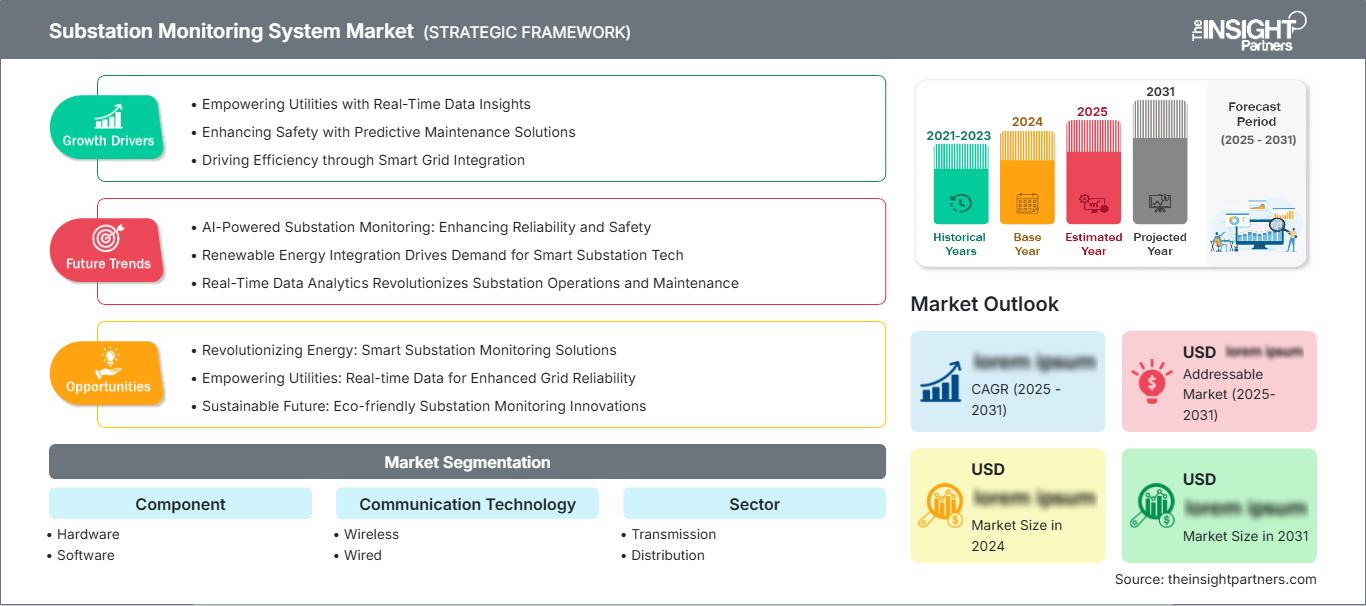
Substation Monitoring System Market: Strategic Insights
Regional Insights
North America Substation Monitoring System Market
North America accounts for ~30% of the global market in 2025 and is projected to grow at ~8% CAGR through 2034. The region has a mature installed base of transmission and distribution infrastructure, creating demand for modernization without requiring complete replacement of primary electrical assets. Utilities are increasingly deploying sensors, intelligent devices, communications, and analytics to obtain greater visibility from existing substations. Reliability requirements associated with extreme weather, wildfire exposure, congestion, and changing load profiles further support monitoring investment.
North America serves as the dominant source of demand, while Canada has its role to play by way of distribution system modernization, expansion of transmission network, and incorporation of renewable sources of electricity generation. There are several companies such as ABB Ltd., Eaton Corporation plc, GE Vernova Inc., Schneider Electric SE, Siemens AG, Schweitzer Engineering Laboratories, Inc., Cisco Systems, Inc., and NovaTech, LLC that possess skills related to automation, communication, protection, and monitoring. Distribution system modernization is playing an increasingly critical role as utilities have to contend with bi-directional power flow and distributed generation.
U.S. Substation Monitoring System Market
The US accounts for ~80% of North American market revenue in 2025 and is projected to expand at ~8% CAGR through 2034. Utility spending is supported by aging substations, transmission reinforcement, distribution automation, grid resilience programs, and increasing electricity demand from industrial facilities and data-intensive infrastructure. Monitoring systems are used to improve asset visibility and support maintenance decisions across transformers, breakers, protection equipment, and other critical electrical assets.
The US also has a deep technology ecosystem encompassing ABB Ltd., Eaton Corporation plc, GE Vernova Inc., Schneider Electric SE, Siemens AG, Cisco Systems, Inc., Schweitzer Engineering Laboratories, Inc., NovaTech, LLC, and Sentient Energy, Inc. Demand is extending from transmission control rooms toward distribution substations and grid-edge assets. Utilities increasingly seek monitoring architectures that can connect field devices with SCADA, asset-management systems, and analytics platforms while maintaining cybersecurity and compatibility with installed equipment.
Europe Substation Monitoring System Market
Europe represents ~29% of the global market in 2025 and is projected to grow at ~8% CAGR through 2034. Germany is the leading country in Europe, supported by extensive transmission infrastructure, industrial electricity demand, renewable integration, and grid reinforcement requirements. The UK is also a major market because offshore wind expansion and transmission modernization increase requirements for asset visibility and automated network management. France combines a large transmission network with nuclear, renewable, and industrial power requirements, creating demand for monitoring across high-value electrical assets.
Italy is supported by distribution modernization, interconnection requirements, and increasing renewable penetration, while Spain is investing in grid flexibility and renewable integration. Across the region, monitoring systems are increasingly incorporated into digital-substation programs rather than deployed solely as aftermarket sensors. Utilities are emphasizing interoperability, cybersecurity, remote diagnostics, and condition-based maintenance to improve asset utilization. The regional competitive environment includes ABB Ltd., Schneider Electric SE, Siemens AG, Eaton Corporation plc, and GE Vernova Inc., alongside specialized automation and protection providers.
APAC Substation Monitoring System Market
Asia Pacific accounts for ~28% of the global Substation Monitoring System Market Share in 2025 and is projected to register ~11% CAGR through 2034, making it the fastest-growing region. China is the leading country in Asia Pacific, supported by large-scale grid construction, industrial electricity demand, renewable integration, and domestic manufacturing of electrical and automation equipment. Japan and South Korea provide mature technology markets with strong requirements for reliability, automation, and advanced monitoring.
India represents a significant expansion opportunity as transmission and distribution infrastructure is modernized and renewable capacity is integrated into increasingly complex networks. Australia is investing in grid modernization to accommodate renewable generation and geographically dispersed power resources. Regional adoption is being encouraged by smart-grid programs, industrial automation, renewable integration, and the need to improve reliability across rapidly expanding networks. Monitoring systems are increasingly incorporated during new substation construction, while retrofit opportunities remain substantial across established urban and industrial networks.
Middle East & Africa Substation Monitoring System Market
The Middle East & Africa market is projected to expand at ~9% CAGR through 2034. Saudi Arabia and the UAE are significant demand centers because large infrastructure programs, industrial development, energy diversification, and transmission expansion require reliable monitoring of critical electrical assets. South Africa provides an important market through grid modernization, industrial electricity demand, and renewable-energy integration, while Rest of MEA remains more project-driven and fragmented.
Saudi Arabia represents the leading country in the Middle East & Africa based on the scale of current infrastructure development and utility modernization requirements. Monitoring demand is increasingly linked to transmission expansion, new substations, industrial facilities, and renewable projects. Digital monitoring can also support remote operation of assets across large geographic areas where physical inspection is resource-intensive. Vendors with strong engineering, cybersecurity, communications, and lifecycle-service capabilities can address the region's requirements for reliable operation under demanding environmental and infrastructure conditions.
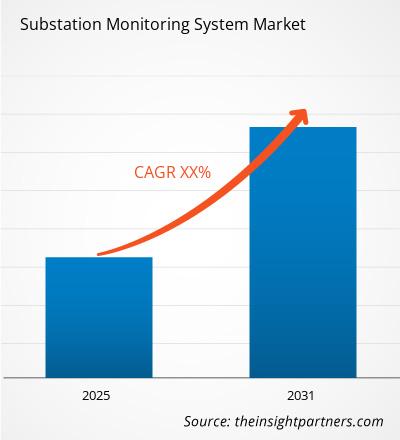
Segmentation Analysis
Component
The Component segment comprises Hardware and Software and is projected to grow at ~8% CAGR through 2034. Hardware remains fundamental because sensors, intelligent electronic devices, measurement equipment, communication gateways, and monitoring units generate the operational data required by digital platforms. Software is gaining strategic importance as utilities seek advanced analytics, visualization, asset-health assessment, and integration with enterprise systems. The Substation Monitoring System scope therefore increasingly encompasses an integrated combination of physical sensing infrastructure and software-driven intelligence.
- Hardware: Hardware provides the sensing and communication foundation for monitoring substations. Demand centers on equipment that can capture electrical, thermal, mechanical, and asset-condition information while operating reliably within harsh electrical environments.
- Software: Software converts field measurements into asset-health information, alarms, trends, diagnostics, and operational insights. Integration with SCADA, asset-management, and analytics platforms is increasingly important for utilities seeking centralized decision support.
Communication Technology
The Communication Technology segment in the Substation Monitoring System Market includes Wireless and Wired and is estimated to expand at ~9% CAGR through 2034. Communication architecture determines how reliably monitoring data moves between field assets, substations, control centers, and cloud or enterprise applications. Wired systems remain important for deterministic, high-reliability environments, while wireless technologies support geographically dispersed assets and retrofit applications where new cabling is difficult. Hybrid architectures are becoming increasingly relevant as utilities combine legacy systems with modern monitoring infrastructure.
- Wireless: Wireless communication supports flexible deployment across geographically dispersed substations and grid-edge assets. It can reduce physical cabling requirements and simplify retrofit projects, particularly where extending wired infrastructure is costly or operationally disruptive.
- Wired: Wired communication remains important where deterministic performance, high availability, cybersecurity, and predictable latency are required. Fiber-based and industrial Ethernet architectures are particularly relevant to modern digital-substation environments.
Sector
The Sector segment consists of Transmission and Distribution and is expected to expand at ~9% CAGR through 2034. Transmission applications prioritize system-wide visibility, high-voltage asset condition, stability, and coordinated control, while distribution applications require increasingly granular information as distributed resources change local power flows. Distribution is the faster-expanding opportunity because utilities must monitor a larger and more diverse asset base. The segment's development is therefore increasingly linked to grid-edge visibility and automated distribution management.
- Transmission: Transmission substations require monitoring for critical high-voltage assets, protection systems, transformers, breakers, and network conditions. Monitoring supports reliability, condition assessment, coordinated operations, and maintenance planning across strategically important grid infrastructure.
- Distribution: Distribution monitoring is increasingly important as utilities manage distributed generation, storage, electric vehicles, and changing load patterns. Substation and feeder visibility supports fault management, voltage optimization, outage response, and improved asset utilization.
Industry Vertical
The Industry Vertical segment in the Substation Monitoring System Market covers Steel, Oil and Gas, Transportation, Utility, and Mining and is estimated to grow at ~8% CAGR through 2034. Utility applications represent the central demand base because substations form core grid infrastructure, but industrial users also require monitoring to maintain power reliability and protect production assets. Monitoring adoption is influenced by electrical asset criticality, outage consequences, operating environment, and the ability to integrate data with industrial control systems.
- Steel: Steel facilities require reliable electrical supply for energy-intensive production processes. Monitoring supports transformer, switchgear, power-quality, and distribution visibility where electrical interruptions can affect continuous operations.
- Oil and Gas: Oil and gas facilities use monitoring to improve reliability across electrically intensive production and processing infrastructure. Remote and hazardous operating environments increase the value of automated condition assessment and centralized visibility.
- Transportation: Rail systems, metro networks, ports, and electrified transport infrastructure depend on reliable substations. Monitoring supports electrical continuity, asset diagnostics, power-quality management, and maintenance planning across distributed transportation networks.
- Utility: Utilities represent the core industry application because substations are central to transmission and distribution operations. Monitoring supports asset health, fault identification, maintenance optimization, grid visibility, and integration of modern automation systems.
- Mining: Mining operations require dependable power across remote and energy-intensive sites. Monitoring helps operators assess electrical equipment condition, identify abnormal operating conditions, and reduce the operational impact of equipment failures.
Opportunity Snapshot
| Industry Vertical | Revenue Contribution | Trend Tag | Adoption Stage |
| Steel | Medium | Power Quality | Scaling |
| Oil and Gas | Medium | Remote Monitoring | Scaling |
| Transportation | Medium | Rail Electrification | Scaling |
| Utility | High | Grid Visibility | Mature |
| Mining | Low | Remote Assets | Scaling |
Substation Monitoring System Market Growth Drivers and Impact Analysis
Rising Need for Real-Time Grid Visibility
Modern electricity networks are becoming more dynamic as renewable generation, distributed resources, electric mobility, storage, and large industrial loads alter conventional power-flow patterns. Substation monitoring provides the visibility required to understand equipment condition and network behavior without relying entirely on periodic inspections. This is particularly important for utilities operating large asset fleets where manual inspection cannot provide continuous information. Monitoring data can support faster identification of abnormal conditions, improved maintenance scheduling, and more informed operational decisions. The impact extends beyond individual equipment because better visibility can improve coordination between substations, control centers, and distribution management systems. As utilities seek to extract greater capacity and reliability from existing infrastructure, monitoring increasingly becomes a prerequisite for advanced automation and data-driven grid operations.
Expansion of Grid Modernization and Asset Replacement Programs
Aging electrical infrastructure is encouraging utilities to combine asset replacement with digital monitoring capabilities. Substation refurbishment creates an opportunity to install modern sensors, intelligent devices, communications, and software without waiting for a separate digitalization project. This approach can improve asset visibility while aligning monitoring investment with established capital programs. Replacement projects also provide opportunities to standardize communications and integrate monitoring with enterprise asset-management systems. Industrial users face a similar requirement where aging transformers, switchgear, and distribution equipment can create production risks. The market impact is therefore supported by both greenfield and brownfield investment. Vendors able to provide retrofit-friendly equipment, interoperable software, and engineering support can address customers that need modernization without completely rebuilding existing substations.
Increasing Reliability, Resilience, and Maintenance Requirements
Electricity networks face growing reliability requirements as interruptions can affect industrial production, transportation systems, data-intensive facilities, and essential public services. Substation monitoring helps operators move from reactive maintenance toward condition-based approaches by providing continuous information about critical equipment. Monitoring can identify abnormal temperatures, electrical behavior, mechanical conditions, or other indicators that warrant intervention. This can improve maintenance prioritization and reduce dependence on fixed inspection schedules. Resilience requirements also increase the value of remote monitoring where substations are difficult to access during storms, floods, wildfires, or other disruptions. As utilities and industrial operators place greater emphasis on continuity of service, monitoring becomes an operational tool rather than simply an instrumentation layer.
Substation Monitoring System Market Future Trends
AI-Enabled Predictive Asset Intelligence
The Substation Monitoring System Market trends are moving toward platforms that combine real-time sensor data with historical operating records, equipment models, and artificial intelligence. Instead of presenting isolated alarms, advanced systems can identify patterns associated with deterioration, abnormal operating conditions, and potential failures. This can help utilities prioritize maintenance based on asset condition and operational consequence rather than relying solely on fixed schedules. Digital twins are also becoming more relevant because they can connect measured equipment behavior with engineering models and operational scenarios. As data quality improves, AI-based systems may increasingly support operator decision-making, maintenance planning, and asset-life optimization. Cybersecurity and explainability will remain important because utilities require confidence that automated recommendations are based on reliable information and can be integrated safely into established operating procedures.
Convergence of Monitoring, Automation, and Digital Substations
Future monitoring architectures are likely to become more tightly integrated with protection, control, communications, and automation. Digital substations already rely on networked intelligent devices, standardized communications, and centralized data processing, reducing the separation between monitoring and operational control. This convergence allows the same data streams to support asset health, protection functions, automation, and network management. It can also reduce duplicated sensors and isolated data repositories. As utilities modernize substations, procurement decisions will increasingly consider interoperability, cybersecurity, software lifecycle management, and future expandability alongside measurement accuracy. The result is a transition from monitoring systems designed primarily for observation toward integrated platforms capable of supporting automated operational responses and broader grid-management workflows.
Substation Monitoring System Market Opportunities
Retrofit Monitoring for Aging Substations
A substantial opportunity exists in retrofit solutions that add digital monitoring to substations without requiring complete replacement of primary equipment. Utilities can use external sensors, intelligent gateways, communications devices, and software platforms to obtain additional visibility from existing transformers, breakers, switchgear, and auxiliary systems. Retrofit approaches can reduce project disruption and align digital investment with asset-maintenance programs. Suppliers can differentiate through compatibility with equipment from multiple manufacturers, simplified installation, secure communications, and integration with existing SCADA and asset-management environments. The opportunity extends to industrial facilities where electrical reliability directly affects production. Service models combining hardware installation, software subscriptions, remote monitoring, diagnostics, and periodic engineering reviews can create recurring lifecycle revenue while helping customers manage modernization within constrained capital budgets.
Integrated Monitoring for Distribution Grid Visibility
Distribution networks offer a significant commercial opportunity because utilities need greater visibility closer to customers and distributed energy resources. Monitoring platforms can combine substation measurements with feeder, transformer, and grid-edge data to provide a more complete view of local network conditions. Suppliers can develop integrated solutions connecting sensors, communications, analytics, and distribution-management applications rather than selling isolated devices. This creates opportunities for modular architectures that allow utilities to begin with high-priority substations and expand coverage as investment becomes available. Vendors with strong interoperability, cybersecurity, and communications capabilities can address diverse utility environments where legacy systems coexist with modern digital equipment. The Substation Monitoring System Market Forecasts therefore depend substantially on how quickly utilities translate distribution digitalization priorities into deployable monitoring programs.
Recent Developments
- February 2026: ABB has introduced the REX600, a next‑generation protection and control device that combines merging unit functionality, backup protection and fault detection in a single compact design. These capabilities make REX600 a dependable and flexible building block for today’s evolving grid needs.
- February 2026: NovaTech Automation, a leading provider of substation automation solutions for the electric utility industry, today announced the launch of Argus Fleet Management, a comprehensive monitoring platform designed to give utilities complete visibility into their distributed automation equipment. The cloud-capable solution addresses a critical blind spot in utility operations: secondary devices like RTUs, switches, and relays that often remain invisible to SCADA systems. Previously, utilities only discovered equipment issues when communication failed entirely—resulting in costly truck rolls, extended downtime, and reactive maintenance approaches.
- November 2025: Siemens has unveiled its latest innovation for energy infrastructure: the Siprotec 5 Precision Time Protocol (PTP) Grandmaster Clocks (GMC). Built to secure the backbone of modern power grids, this solution ensures resilient, fail-safe time synchronization for digital substations, safeguarding critical protection functions from disruption, shielding against external disturbances, and strengthening cybersecurity to boost overall grid reliability.
Frequently Asked Questions

- Comprehensive Market Sizing and Forecast Analysis
- Detailed Segmentation Analysis
- In-Depth Market Dynamics Assessment
- Regional and Country-Level Insights
- Competitive Landscape and Company Benchmarking
- Strategic Business Intelligence
Recent Reports
Testimonials

The Insight Partners provided valuable market intelligence that supported our global go-to-market strategy. Their team was professional, responsive, and attentive to our feedback, providing thoughtful analysis and helpful methodological clarifications throughout the project.
Junmo Kim Chief Financial Officer (CFO), Enertech Co., Ltd.
The Insight Partners' SCADA System Market report is comprehensive, with valuable insights on current trends and future forecasts. The team was highly professional, responsive, and supportive throughout. We are very satisfied and highly recommend their services.
RAN KEDEM Partner, Reali Technologies LTDs
I requested a report on a very specific software market and the team produced the report in a few days. The information was very relevant and well presented. I then requested some changes and additions to the report. The team was again very responsive and I got the final report in less than a week.
JEAN-HERVE JENN Chairman, Future Analytica
We worked with The Insight Partners for an important market study and forecast. They gave us clear insights into opportunities and risks, which helped shape our plans. Their research was easy to use and based on solid data. It helped us make smart, confident decisions. We highly recommend them.
PIYUSH NAGPAL Sr. Vice President, High Beam Global
The Insight Partners delivered insightful, well-structured market research with strong domain expertise. Their team was professional and responsive throughout. The user-friendly website made accessing industry reports seamless. We highly recommend them for reliable, high-quality research services
YUKIHIKO ADACHI CEO, Deep Blue, LLC.
This is the first time I have purchased a market report from The Insight Partners.While I was unsure at first, I visited their web site and felt more comfortable to take the risk and purchase a market report.I am completely satisfied with the quality of the report and customer service. I had several questions and comments with the initial report, but after a couple of dialogs over email with their analyst I believe I have a report that I can use as input to our strategic planning process.Thank you so much for taking the extra time and making this a positive experience.I will definitely recommend your service to others and you will be my first call when we need further market data.
JOHN SUZUKI President and Chief Executive Officer, Board Director, BK Technologies
I wish to appreciate your support and the professionalism you displayed in the course of attending to my request for information regarding to infectious disease IVD market in Nigeria. I appreciate your patience, your guidance, and the fact that you were willing to offer a discount, which eventually made it possible for us to close a deal. I look forward to engaging The Insight Partners in the future, all thanks to the impression you have created in me as a result of this first encounter.
DR CHIJIOKE ONYIA MANAGING DIRECTOR, PineCrest Healthcare Ltd.Reason to Buy
- Informed Decision-Making
- Understanding Market Dynamics
- Competitive Analysis
- Identifying Emerging Markets
- Customer Insights
- Market Forecasts
- Risk Mitigation
- Boosting Operational Efficiency
- Strategic Planning
- Investment Justification
- Tracking Industry Innovations
- Aligning with Regulatory Trends





 Get Free Sample for