
Superconducting Power Cables Market Growth, Share & Trends by 2034
Coverage: by Type of Design (Warm Dielectric, Cold Dielectric); Application (Healthcare, Electronics, Transportation, Others) , and Geography (North America, Europe, Asia Pacific, and South and Central America)
- Status : Data Released
- Report Code : TIPRE00012570
- Category : Electronics and Semiconductor
- No. of Pages : 150
- Available Report Formats :


- Last update date : November 12, 2026


2025 Market Size
US$ 354.38 Mn
Base year value
2034 Forecast
US$ 455.98 Mn
Projected by 2034
CAGR 2026-2034
2.84 %
Growth rate
Addressable Market
US$ 3,678.38 Mn
(2026-2034)
The Superconducting Power Cables Market accounted for US$ 354.38 Million in 2025 and is expected to reach US$ 455.98 Million by 2034, growing at a CAGR of 2.84% during 2026–2034. The market covers superconducting cable systems used to transmit and distribute electrical power through high-current, low-loss configurations. Demand is shaped by the need for compact high-capacity power infrastructure, grid reinforcement, electrified transportation, and specialized power systems where conventional conductors face space, thermal, or capacity constraints.
The Superconducting Power Cables Market size is being supported by North American investment in resilient power infrastructure, urban grid reinforcement, and advanced superconducting conductor manufacturing. North America is expected to expand at a modeled CAGR of ~3% through 2034, supported by utility modernization, constrained transmission corridors, and increasing interest in high-power applications that require greater capacity within existing infrastructure footprints.
Superconducting Power Cables Market Assessment and Insights
Regional Outlook
- North America: ~32% of the global Superconducting Power Cables Market share in 2025 | ~3% CAGR through 2034. Market position: North America represents the largest regional market, supported by established superconducting cable demonstrations, utility modernization, high-value technology development, and demand for compact transmission solutions in capacity-constrained urban and industrial networks.
- US: ~86% of North American market revenue in 2025 | ~3% CAGR through 2034. Market position: The US accounts for the largest portion of North American demand, supported by utility resilience programs, technology development, advanced conductor manufacturing, and applications requiring high power density across constrained transmission corridors.
- Europe: ~30% of the global market in 2025 | ~3% CAGR through 2034. Market position: Europe has a mature demonstration and deployment ecosystem, with Germany leading the region and the UK, France, Italy, and Spain contributing through grid modernization, rail electrification, offshore wind integration, and decarbonization programs.
- Asia Pacific: ~30% of the global market in 2025 | ~4% CAGR through 2034. Market position: Asia Pacific is the fastest-growing region, supported by superconducting cable development in China, Japan, and South Korea, expanding industrial electrification, dense urban grids, advanced manufacturing capabilities, and government-backed technology programs.
Segment Outlook
- Healthcare: ~44% Share in 2025 | ~3% CAGR through 2034. Market position: Healthcare represents the largest application segment because specialized medical infrastructure has longstanding requirements for superconducting technologies and high-reliability power environments. Existing technical expertise and the need for compact, efficient electrical systems support continued demand.
- Transportation: ~26% Share in 2025 | ~4% CAGR through 2034. Market position: Transportation is the high-growth application segment as rail systems, urban transit networks, and high-capacity electrification projects seek greater power delivery through constrained infrastructure. Superconducting cables can address high-current requirements where conventional cable expansion is difficult.
Competitive Coverage
American Superconductor Corporation, Bruker Corporation, Fujikura Ltd., Furukawa Electric Co., Ltd., MetOx International, Inc., Nexans S.A., Sumitomo Electric Industries, Ltd., SHSC, High Temperature Superconductors, Inc., SuNAM Co., Ltd.
Methodology
The Insight Partners follows Data Collection & Secondary Research, Primary Research, Data Analysis, and Data Triangulation & Final Review to validate market estimates and insights.
Source: The Insight Partners' analysis based on proprietary research, government publications, company annual reports, investor presentations, industry databases, and expert interviews.
Improvements in high-temperature superconductor technology have changed the focus from laboratory-based experiments to more practical cables. Earlier work was geared towards demonstrating the capacity for current transmission, cryogenics, cable performance, and integration with the existing power grid. Contemporary efforts have been more concerned with increasing cable lengths, power density, repeatability of manufacture, cryogenic integration, and infrastructure compatibility. The warm dielectric and cold dielectric systems remain useful depending on their respective engineering needs, and superconducting tape and conductor systems are becoming more advanced through improved manufacturing. These advances have resulted in an ecosystem of conductor makers, cable makers, cryogenic system makers, power companies, transport companies, research centers, and infrastructure providers.
As regards the year 2034, commercialization of this technology will proceed selectively instead of uniformly among power grids. Investments will be made in places where there is insufficient underground space available, capacity limits for transmission, or where costs for infrastructure are abnormally high for extension. The regions Europe and Asia Pacific are well poised to take advantage of demonstration efforts along with investments in electrical infrastructure while North America will be able to capitalize on utility modernization along with the superconducting technologies already present there.
Superconducting Power Cables Market Report Scope
| Report Attribute | Details |
|---|---|
| Market size in 2025 | US$ 354.38 Million |
| Market Size by 2034 | US$ 455.98 Million |
| Global CAGR (2026 - 2034) | 2.84% |
| Historical Data | 2021-2024 |
| Forecast period | 2026-2034 |
Superconducting Power Cables Market Analysis
Growth in the Superconducting Power Cables market is tied directly to the economics of high capacity electrical transmission via narrow physical paths. Urban substations, transport terminals, industrial facilities, and specialized infrastructure projects may experience a need to expand their capacity without being able to install additional conventional cables due to constraints related to significant civil work, large equipment footprint, or thermal dissipation. The superconducting cables solve this partly by combining high current density with a compact profile. Hence, demand becomes less dependent on the amount of electricity used and more on those cases where the density, reliability, and space-efficient capacity have infrastructure value.
Value chain in the Superconducting Power Cables market starts from superconducting materials and tapes, then follows conductor fabrication, cable design, insulation, cryogenics housing, connections, cooling systems, monitoring and maintenance systems, installation, and commissioning. Supply is specialized due to the need for interaction between electrical and cryogenic sub-systems. Thus, cable manufacturers with proven HTS material expertise can have an impact on the economics of such a system through conductor performance and fabrication yields. The buyers of superconducting cables tend to look at full system cost as opposed to just the cable cost.
Superconducting Power Cables Market research finds a relatively concentrated industry with highly specialized players that offer superconducting technology as well as general purpose cable manufacturers. Nexans offers systems made of superconducting cables and is involved in industrializing projects in Europe, American Superconductor Corporation supplies HTS wire and superconducting technology. Fujikura, Furukawa Electric and Sumitomo Electric Industries cover capabilities ranging from conductors to cables. Bruker can contribute through its superconducting technology capabilities; MetOx and SuNAM provide additional support for HTS materials. High Temperature Superconductors, Inc. also covers manufacture of HTS wires.
Increasingly, strategic positioning in the Superconducting Power Cables market is based on ability to link conductor technologies with cable systems engineering. Cable companies are focusing on production capacity development, more powerful superconducting tapes, integration with cryogenics, and system demonstrations of the technology rather than simply laboratory performance. Competitive advantage is moving towards production, system qualification, implementation and integration with utility, transportation and industrial infrastructures. The collaboration between cable manufacturers, utilities, R&D institutions, and infrastructure owners continues to be vital in order to validate the full system lifecycle during commercialization process.
● REPORT CUSTOMIZATION
Tailor This Report To Align With Your Specific Business Requirements
This report can be customized to align precisely with your business objectives, scope, and target markets. Customization options include tailored segmentation, geography, competitive analysis, and strategic insights to support informed decision-making.
Customize This Report →WHAT YOU CAN ADJUST
- ● Segmentations
- ● Geography
- ● Competitive Analysis
- ● Language Preferences
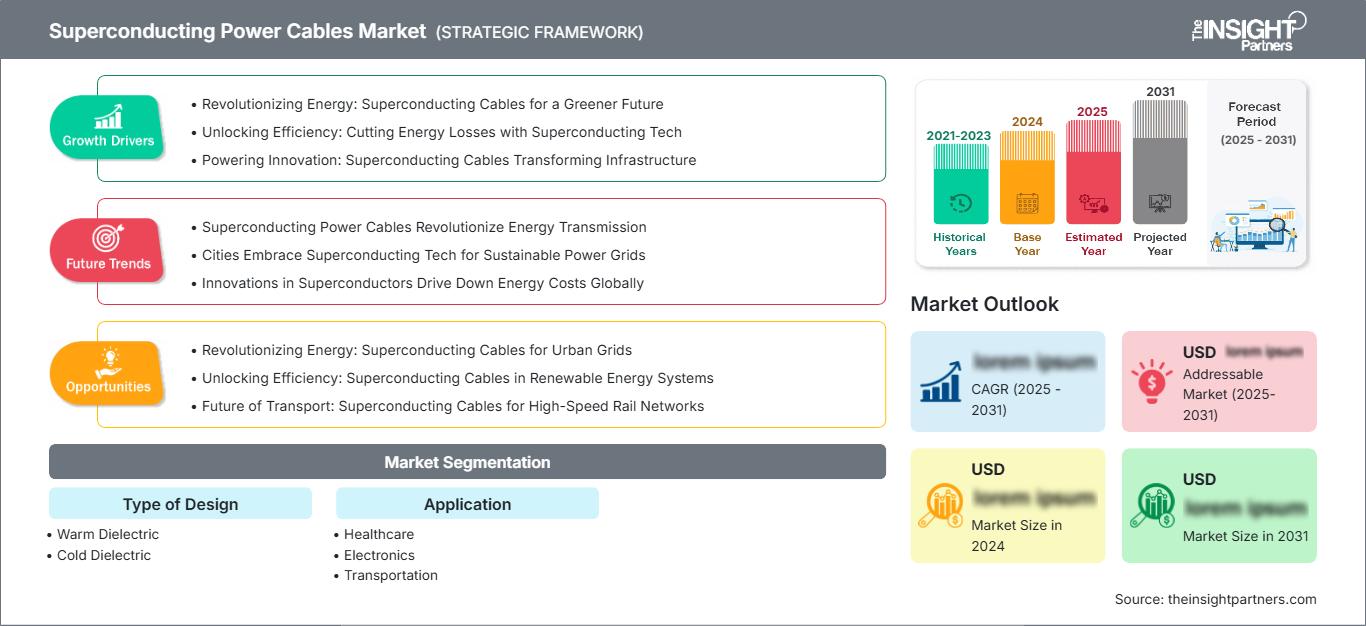
Superconducting Power Cables Market: Strategic Insights
Regional Insights
North America Superconducting Power Cables Market
North America accounted for ~32% of the global Superconducting Power Cables market in 2025 and is projected to record a ~3% CAGR through 2034. This area enjoys a fully developed superconductor R&D environment, well-established utilities, and prior demonstration projects. In terms of demand, the US is the primary source, while Canada adds value to the regional demand through R&D, material development, and energy technology expertise. The regional opportunity lies in the urban grids, high load sites, and transmission areas in which the conventional cable installation is not possible.
The US opportunity is driven by the need for grid resiliency, aging infrastructure, and growing needs for higher capacity in limited spaces. American Superconductor Corporation and other technology providers drive the regional supply, and foreign cable manufacturers take part in the supply chain through technology collaborations and project implementations. Superconductor systems could become particularly important in cases of underground installation, restricted rights-of-way, or situations when high currents are needed and it is too costly to install conventional cables.
U.S. Superconducting Power Cables Market
The US represented ~86% of North American market revenue in 2025 and is expected to grow at a ~3% CAGR through 2034. The demand centers on grid modernization, resilience, high-power urban infrastructure, and specialized infrastructure. The nation has built up an ecosystem that involves the producers of superconducting wires, system developers, utility firms, research organizations, and advanced technology firms. An ecosystem makes it easier for pilots to be deployed since there are technical know-how along the various stages of the value chain.
The Superconducting Power Cables market forecast reveals that application trends are moving beyond typical grid demonstrations. Power demands from data-rich facilities, transport infrastructure, industrial electrification, and resilience urban infrastructure create niche opportunities. The best applications will arise from locations where it is not easy to add more conventional wires into the corridor. Instead of the substitution of conventional wires in entire grids, US adoption will remain niche, driven by the need for compactness and high current-carrying capability of cryogenics.
Europe Superconducting Power Cables Market
Europe represented ~30% of the global market in 2025 and is projected to grow at a ~3% CAGR through 2034. Germany is the leading country in Europe, supported by industrial expertise, superconducting cable demonstrations, advanced electrical engineering, and participation in European energy-transition projects. France has developed superconducting applications for transportation infrastructure, while the UK, Italy, and Spain contribute through grid modernization, renewable integration, advanced industrial systems, and transport electrification.
Germany benefits from a strong manufacturing and research base and has hosted important superconducting cable demonstrations. France has demonstrated the relevance of superconducting systems to rail infrastructure where high power must be delivered through existing conduits. The UK market is shaped by transmission constraints, offshore renewable integration, and urban infrastructure requirements. Italy and Spain provide additional opportunities through grid reinforcement and renewable-energy infrastructure. Across Europe, the principal adoption mechanism is the ability to transmit high power through compact routes while reducing the need for extensive civil construction.
European investment is increasingly directed toward system qualification and industrial-scale demonstrations. Projects involving superconducting transmission for offshore wind, medium-voltage high-capacity networks, and specialized infrastructure can improve technical confidence and procurement readiness. However, adoption remains dependent on achieving competitive lifecycle economics, standardized system specifications, reliable cryogenic operation, and clearer utility procurement frameworks. Consequently, Europe is expected to remain a high-value market characterized by project-led adoption rather than broad replacement of conventional cables.
APAC Superconducting Power Cables Market
APAC accounted for ~30% of the global market in 2025 and is expected to register a ~4% CAGR through 2034, making it the fastest-growing regional market. China is the leading country in Asia Pacific, supported by large-scale power infrastructure, manufacturing depth, and government-backed advanced technology development. Japan and South Korea maintain significant superconducting expertise, while India and Australia provide opportunities through expanding electricity infrastructure and specialized technology applications.
Japan and South Korea have developed substantial expertise in superconducting materials, cable systems, and demonstration projects. China benefits from its scale in electrical infrastructure and manufacturing. India presents a longer-term opportunity as transmission requirements and industrial electrification expand, while Australia offers specialized opportunities linked to grid development and large-distance power infrastructure. Regional growth is therefore supported by both technology capability and increasing demand for efficient high-capacity electrical systems.
Middle East & Africa Superconducting Power Cables Market
Middle East & Africa is projected to grow at a ~3% CAGR through 2034. Saudi Arabia is the leading country in the Middle East & Africa region where evidence supports the strongest near-term opportunity, reflecting large infrastructure investment, industrial development, and power-system modernization. The UAE also presents opportunities through advanced urban infrastructure and high-density power requirements, while South Africa remains the principal African market for sophisticated electrical infrastructure.
The regional opportunity is linked to energy-intensive industrial facilities, urban development, renewable integration, and the need for reliable high-capacity electricity infrastructure. Superconducting systems are most relevant where compactness or capacity density can offset the additional complexity of cryogenic systems. Adoption is expected to remain project-specific, with large infrastructure developers and specialized facilities more likely to evaluate the technology before wider utility deployment.
Segmentation Analysis
Type of Design
The Type of Design segment is expected to register a ~3% CAGR through 2034. Design selection depends on voltage requirements, dielectric architecture, cooling configuration, installation environment, thermal management, and desired power density. Warm dielectric systems can provide advantages where the insulation remains outside the primary cryogenic region, while cold dielectric configurations can integrate insulation within the cooled structure. Procurement decisions increasingly consider lifecycle reliability and installation complexity alongside conductor performance.
- Warm Dielectric: Warm dielectric configurations maintain the dielectric system outside the cryogenic environment and can simplify selected cable-system architectures. Their strategic importance is associated with installation flexibility, thermal separation, and applications where the cable design must balance superconducting performance with practical insulation and maintenance requirements.
- Cold Dielectric: Cold dielectric systems place the dielectric arrangement within the cryogenic environment and can support compact, high-performance cable architectures. Their relevance increases in applications where physical footprint and high current density are critical, although cryogenic integration and thermal management require careful engineering.
Application
The Application segment is expected to record a ~3% CAGR through 2034. Healthcare remains the largest application because superconducting technology has established relevance in specialized medical infrastructure, while transportation represents the high-growth opportunity as electrified rail systems seek higher power delivery within constrained corridors. Electronics applications provide additional demand where high-performance, compact electrical systems are required.
- Healthcare: Healthcare applications benefit from established superconducting technology expertise and requirements for reliable high-performance electrical systems. Demand is associated with specialized facilities and equipment environments where power quality, reliability, compact infrastructure, and integration with superconducting technologies influence system design decisions.
- Electronics: Electronics applications represent a specialized opportunity driven by high-density electrical requirements, advanced computing infrastructure, and superconducting technology development. The segment is strategically relevant because increasing power density can create situations where conventional electrical architectures face thermal and space limitations.
- Transportation: Transportation is becoming increasingly important as rail and urban transit systems require greater electrical capacity without extensive civil reconstruction. Superconducting cables can provide high current through compact routes, making them attractive for dense railway infrastructure and selected high-load transport applications.
Opportunity Snapshot
| Application | Revenue Contribution | Trend Tag | Adoption Stage |
| Healthcare | High | Specialized Power | Mature |
| Electronics | Medium | High-Density Power | Scaling |
| Transportation | Medium | Rail Electrification | Scaling |
Superconducting Power Cables Market Growth Drivers and Impact Analysis
Grid Capacity Expansion in Space-Constrained Corridors
Urban electricity networks increasingly face situations in which additional power capacity is required but conventional cable expansion is restricted by limited rights-of-way, underground congestion, construction disruption, or thermal constraints. Superconducting cables can address this problem by carrying very high currents through compact cable systems. The commercial impact is strongest where the value of additional capacity exceeds the cost premium associated with superconducting and cryogenic equipment. This creates a project-selection mechanism favoring dense cities, critical infrastructure corridors, and substations requiring significant capacity upgrades. As utilities increasingly prioritize resilience and infrastructure utilization, superconducting systems can become an alternative to constructing entirely new transmission corridors. The technology therefore competes not only against conventional cables but also against expensive civil expansion and new substations.
High Power Requirements from Electrified Infrastructure
Electrification of transportation, industrial facilities, digital infrastructure, and specialized energy systems is increasing the importance of high-capacity power delivery. Superconducting cables provide a pathway for moving substantial electrical power while maintaining a comparatively compact physical footprint. Transportation infrastructure is particularly relevant because railway substations and urban transit systems can require higher capacity without corresponding increases in available space. Industrial facilities face similar constraints where expansion of conventional conductors can require additional equipment and cooling infrastructure. The impact on the Superconducting Power Cables Market is therefore strongest in applications where power density has a direct economic value. Increasing electricity intensity also encourages infrastructure planners to compare lifecycle capacity, land requirements, installation disruption, and reliability rather than evaluating cable cost alone.
Advances in High-Temperature Superconducting Materials
Improvements in HTS tape performance, manufacturing consistency, conductor architecture, and production capacity are reducing technical barriers to wider cable deployment. Higher-performing conductors can improve current density and system efficiency, while better manufacturing yields can reduce the material contribution to overall project costs. These developments are important because superconducting cable economics depend heavily on conductor performance and reliable cryogenic operation. As suppliers scale production, cable manufacturers can develop more standardized system designs and pursue applications beyond demonstration projects. The resulting impact extends throughout the value chain, encouraging greater collaboration among conductor manufacturers, cable companies, utilities, transport operators, and engineering firms. Continued material development can also improve the feasibility of applications where conventional cables cannot deliver the required current within available space.
Superconducting Power Cables Market Future Trends
Integration with High-Density Digital and Industrial Power Systems
The Superconducting Power Cables Market trends are increasingly influenced by the rapid growth of power-intensive digital and industrial facilities. Hyperscale data centers, advanced computing infrastructure, and high-load industrial systems can require substantial power within limited sites, creating a potential role for compact superconducting distribution systems. Future projects are likely to evaluate superconducting cables as part of integrated electrical architectures rather than as standalone transmission products. This could encourage suppliers to develop low-voltage and medium-voltage configurations, modular cryogenic systems, and monitoring technologies designed for facility-level deployment. The trend is significant because data-intensive infrastructure has a different procurement cycle from traditional utilities, potentially enabling faster technology validation. Commercial adoption will depend on reliability, maintenance simplicity, and clear lifecycle economics.
Shift Toward Industrialized and Standardized HTS Cable Systems
Future development is expected to move from individually engineered demonstrations toward standardized cable architectures, repeatable manufacturing, and qualification procedures that reduce project-specific engineering requirements. Standardization can improve procurement comparability and enable utilities to evaluate superconducting systems using more consistent performance, reliability, and lifecycle criteria. Suppliers are likely to focus on longer cable lengths, improved joints and terminations, distributed cooling, fault protection, and monitoring systems. Industrialization should also improve coordination between HTS conductor producers and cable-system manufacturers, supporting larger production volumes and more predictable project execution. This transition will be important for moving superconducting cables from specialized infrastructure projects toward a broader set of commercial applications where deployment decisions depend on standardized specifications and proven operating performance.
Superconducting Power Cables Market Opportunities
Urban Grid Reinforcement Without Major Civil Expansion
A major opportunity exists in densely developed cities where electricity demand is rising but new transmission corridors, substations, or underground routes are difficult to construct. Superconducting cables can potentially increase capacity through existing conduits or constrained corridors, allowing infrastructure owners to obtain additional power transfer without proportional expansion of physical assets. Investment opportunities are therefore strongest in metropolitan areas with expensive land, high construction disruption, and growing peak loads. Suppliers can strengthen their position by offering integrated cable, cryogenic, monitoring, installation, and maintenance packages rather than standalone conductors. Projects should be prioritized using a lifecycle comparison that accounts for civil works, land requirements, installation time, capacity, reliability, and maintenance. This approach can identify locations where superconducting systems provide a measurable economic advantage.
Transportation and Specialized Infrastructure Electrification
Transportation operators represent an opportunity for suppliers because rail and transit infrastructure often combines high electrical loads with severe space constraints. Existing conduits, substations, and station infrastructure can limit the ability to install additional conventional conductors. Superconducting cables can address selected bottlenecks by providing high current capacity through compact routes. The opportunity extends to specialized industrial facilities and critical infrastructure where power reliability and footprint have higher economic value than standard cable cost. Companies with capabilities in conductor manufacturing, cryogenic systems, cable engineering, and installation can target integrated projects with infrastructure operators. Successful deployments can generate reference installations that support replication across comparable transport networks. Commercial strategy should therefore focus on high-value bottlenecks rather than broad substitution of conventional cable networks.
Recent Developments
- July 2025: Infineon Technologies AG - Infineon expanded its superconducting-related technology ecosystem through advanced sensor and semiconductor capabilities supporting monitoring and control requirements across high-performance electrical systems. The company’s broader sensor portfolio includes technologies relevant to demanding industrial and energy applications, reinforcing the importance of electronic monitoring around advanced power infrastructure.
- February 2026: Fujikura Ltd. - Fujikura announced a ¥5.6 billion capital investment to expand production facilities for high-temperature superconducting wire. The company stated that the additional investment is expected to further increase production capacity, following earlier investments intended to raise HTS production capacity substantially by fiscal 2027. The expansion supports the broader supply base required for superconducting cable and advanced power applications.
- November 2025: Nexans S.A. - Nexans joined Air Liquide, CentraleSupélec, ITP Interpipe, and RTE in the SupraMarine project to develop a high-voltage AC superconducting power transmission demonstrator for connecting offshore wind farms to shore. The project focuses on HTS cables and cryogenic systems and demonstrates increasing interest in applying superconducting transmission to offshore renewable-energy infrastructure.
Frequently Asked Questions

- Comprehensive Market Sizing and Forecast Analysis
- Detailed Segmentation Analysis
- In-Depth Market Dynamics Assessment
- Regional and Country-Level Insights
- Competitive Landscape and Company Benchmarking
- Strategic Business Intelligence
Recent Reports
Testimonials

The Insight Partners provided valuable market intelligence that supported our global go-to-market strategy. Their team was professional, responsive, and attentive to our feedback, providing thoughtful analysis and helpful methodological clarifications throughout the project.
Junmo Kim Chief Financial Officer (CFO), Enertech Co., Ltd.
The Insight Partners' SCADA System Market report is comprehensive, with valuable insights on current trends and future forecasts. The team was highly professional, responsive, and supportive throughout. We are very satisfied and highly recommend their services.
RAN KEDEM Partner, Reali Technologies LTDs
I requested a report on a very specific software market and the team produced the report in a few days. The information was very relevant and well presented. I then requested some changes and additions to the report. The team was again very responsive and I got the final report in less than a week.
JEAN-HERVE JENN Chairman, Future Analytica
We worked with The Insight Partners for an important market study and forecast. They gave us clear insights into opportunities and risks, which helped shape our plans. Their research was easy to use and based on solid data. It helped us make smart, confident decisions. We highly recommend them.
PIYUSH NAGPAL Sr. Vice President, High Beam Global
The Insight Partners delivered insightful, well-structured market research with strong domain expertise. Their team was professional and responsive throughout. The user-friendly website made accessing industry reports seamless. We highly recommend them for reliable, high-quality research services
YUKIHIKO ADACHI CEO, Deep Blue, LLC.
This is the first time I have purchased a market report from The Insight Partners.While I was unsure at first, I visited their web site and felt more comfortable to take the risk and purchase a market report.I am completely satisfied with the quality of the report and customer service. I had several questions and comments with the initial report, but after a couple of dialogs over email with their analyst I believe I have a report that I can use as input to our strategic planning process.Thank you so much for taking the extra time and making this a positive experience.I will definitely recommend your service to others and you will be my first call when we need further market data.
JOHN SUZUKI President and Chief Executive Officer, Board Director, BK Technologies
I wish to appreciate your support and the professionalism you displayed in the course of attending to my request for information regarding to infectious disease IVD market in Nigeria. I appreciate your patience, your guidance, and the fact that you were willing to offer a discount, which eventually made it possible for us to close a deal. I look forward to engaging The Insight Partners in the future, all thanks to the impression you have created in me as a result of this first encounter.
DR CHIJIOKE ONYIA MANAGING DIRECTOR, PineCrest Healthcare Ltd.Reason to Buy
- Informed Decision-Making
- Understanding Market Dynamics
- Competitive Analysis
- Identifying Emerging Markets
- Customer Insights
- Market Forecasts
- Risk Mitigation
- Boosting Operational Efficiency
- Strategic Planning
- Investment Justification
- Tracking Industry Innovations
- Aligning with Regulatory Trends





 Get Free Sample for