
Surface Inspection Market Growth, Share & Trends by 2034
Coverage: by Component (Camera, Lighting Equipment, Processors, Software, Others); Surface Type (3D, 2D); Industry Vertical (Automotive, Electronics and Semiconductor, Food and Packaging, Medical and Pharmaceutical, Others) , and Geography (North America, Europe, Asia Pacific, and South and Central America)
- Status : Data Released
- Report Code : TIPRE00008880
- Category : Electronics and Semiconductor
- No. of Pages : 150
- Available Report Formats :


- Last update date : November 03, 2026


2025 Market Size
US$ 5.33 Bn
Base year value
2034 Forecast
US$ 10.98 Bn
Projected by 2034
CAGR 2026-2034
8.37 %
Growth rate
Addressable Market
US$ 73.25 Bn
(2026-2034)
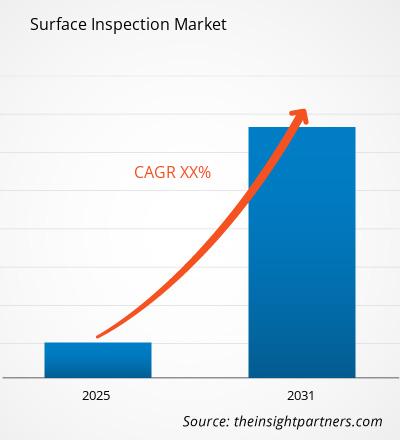
The Surface Inspection Market was valued at US$ 5.33 Billion in 2025 and is projected to reach US$ 10.98 Billion by 2034, expanding at a CAGR of 8.37% during 2026–2034. Demand spans camera, lighting equipment, processor, and software platforms used for 2D and 3D inspection across automotive, electronics and semiconductor, food and packaging, and medical and pharmaceutical production.
North America remains a high-value adoption center, with revenue projected to advance at ~7% CAGR through 2034. The Surface Inspection Market size in the region is supported by automated quality assurance in vehicle production, semiconductor fabrication, and regulated packaging. Brownfield manufacturers are replacing isolated vision stations with networked systems that combine faster image acquisition, edge processing, traceability, and defect analytics, while reshoring initiatives strengthen demand for repeatable inspection despite skilled-labor constraints.
Surface Inspection Market Assessment and Insights
Regional Outlook
- North America: ~34% of the global Surface Inspection Market share in 2025 | ~7% CAGR through 2034. Market position: The region ranks first, supported by dense automation investment, rigorous supplier quality programs, advanced semiconductor capacity, and early deployment of AI-enabled inspection across automotive and pharmaceutical plants.
- US: ~79% of North American market revenue in 2025 | ~7% CAGR through 2034. Market position: The United States leads North America through its large installed factory base, machine-vision supplier ecosystem, electronics investment, and broad use of inline inspection in vehicles, medical devices, and packaging.
- Europe: ~29% of the global market in 2025 | ~7% CAGR through 2034. Market position: Mature automotive, metals, and machinery clusters sustain demand, with Germany leading Europe and the UK, France, Italy, and Spain supporting upgrades tied to traceability and energy-efficient production.
- Asia Pacific: ~28% of the global market in 2025 | ~10% CAGR through 2034. Market position: Asia Pacific is the fastest-growing region as China, Japan, South Korea, and India expand electronics, battery, vehicle, and precision manufacturing capacity while local suppliers scale automation.
Segment Outlook
- Component: ~46% Share in 2025 | ~8% CAGR through 2034. Market position: Component leads because every inspection installation requires coordinated imaging, illumination, processing, and software, with camera replacement and computing upgrades creating recurring spending.
- Surface Type: ~37% Share in 2025 | ~10% CAGR through 2034. Market position: Surface Type captures high-growth demand as 3D inspection moves into complex geometries, reflective parts, welds, battery assemblies, and dimensional defect detection.
Competitive Coverage
AMETEK Surface Vision, Erhardt+Leimer GmbH, IMS Messsysteme GmbH, JENOPTIK AG, Maschinenfabrik Herkules GmbH & Co. KG, OMRON Corporation, Shelton Machines Ltd, TEMMER IMAGING AG, Taymer International Inc., VITRONIC
Methodology
The Insight Partners follows Data Collection & Secondary Research, Primary Research, Data Analysis, and Data Triangulation & Final Review to validate market estimates and insights.
Source: The Insight Partners' analysis based on proprietary research, government publications, company annual reports, investor presentations, industry databases, and expert interviews.
Visual inspection has moved from independent rule-based camera inspections to holistic solutions which categorize defects, archive images and send corrective signals back to production lines. With advances in sensor density, line scan technology, lighting control and edge computing, manufacturers can now inspect continuous webs, reflective metals, manufactured parts and microelectronics components at line rates. Manufacturers' cost models are thus moving from end-of-line sampling to in-process defect prevention, where early detection of coating streaks, scratches, contamination, dimensional errors or printing issues helps avoid losses and preserve yield.
By 2034, capital investment will extend from traditional factories to electronics manufacturing hubs in Asia, battery manufacturing, food and pharmaceutical processing, and modern packaging lines. Industrial policies aimed at developing semiconductor and electric vehicle capacity may lead to higher demand for traceable quality assurance systems, and increased customer auditing practices will reward platforms which keep a record of all units inspected. Deployment will rely on demonstrating return on investment in mixed-production environments and easing model deployment, calibration and maintenance for factories without vision capabilities.
Surface Inspection Market Report Scope
| Report Attribute | Details |
|---|---|
| Market size in 2025 | US$ 5.33 Billion |
| Market Size by 2034 | US$ 10.98 Billion |
| Global CAGR (2026 - 2034) | 8.37% |
| Historical Data | 2021-2024 |
| Forecast period | 2026-2034 |
Surface Inspection Market Analysis
The demand in the Surface Inspection Market is driven by the cost associated with not detecting flaws. It is crucial for automotive parts manufacturers to manage paint quality, welding quality, sealing, and machined surfaces; electronic products demand better inspection due to decreasing size of its components; packaging needs verifiable quality control without impacting the speed of production process. The ecosystem includes sensors, optics & lighting suppliers, processors, software suppliers, system integrators, machine designers and plant automations.
Supply is increasingly focusing on modular systems where cameras and lights are application specific, but the analysis can be reusable. The fast interfaces, graphics processing unit (GPU) ready processors and edge-based inference reduce the decision cycle time, whereas calibrated illumination becomes a necessity in case of reflective, patterned or poor contrast surfaces. System integrators increasingly compete in application engineering, data set preparation and lifecycle management and not only hardware.
The Surface Inspection Market report reveals a competitive landscape featuring general automation providers and specific equipment vendors. While OMRON Corporation and JENOPTIK AG are able to integrate vision into more comprehensive control and metrology offerings, AMETEK Surface Vision, IMS Messsysteme GmbH, VITRONIC, and Shelton Machines Ltd focus on challenging inline inspection tasks. Among other companies, Erhardt+Leimer GmbH, TEMMER IMAGING AG, Taymer International Inc., and Maschinenfabrik Herkules GmbH & Co. KG bring their expertise in web handling, imaging, extrusion, and roll grinding.
Increasing emphasis is being placed on explainable AI solutions, faster changeovers, remote diagnostics, and integration with manufacturing execution systems. This makes strategic positioning critical through demonstrable false reject rates, defect traceability, and installation robustness. Providers of optics, lighting, software, commissioning, and operator interfaces are able to mitigate integration challenges, while specialty companies benefit from their domain knowledge of material behavior or line configuration.
● REPORT CUSTOMIZATION
Tailor This Report To Align With Your Specific Business Requirements
This report can be customized to align precisely with your business objectives, scope, and target markets. Customization options include tailored segmentation, geography, competitive analysis, and strategic insights to support informed decision-making.
Customize This Report →WHAT YOU CAN ADJUST
- ● Segmentations
- ● Geography
- ● Competitive Analysis
- ● Language Preferences
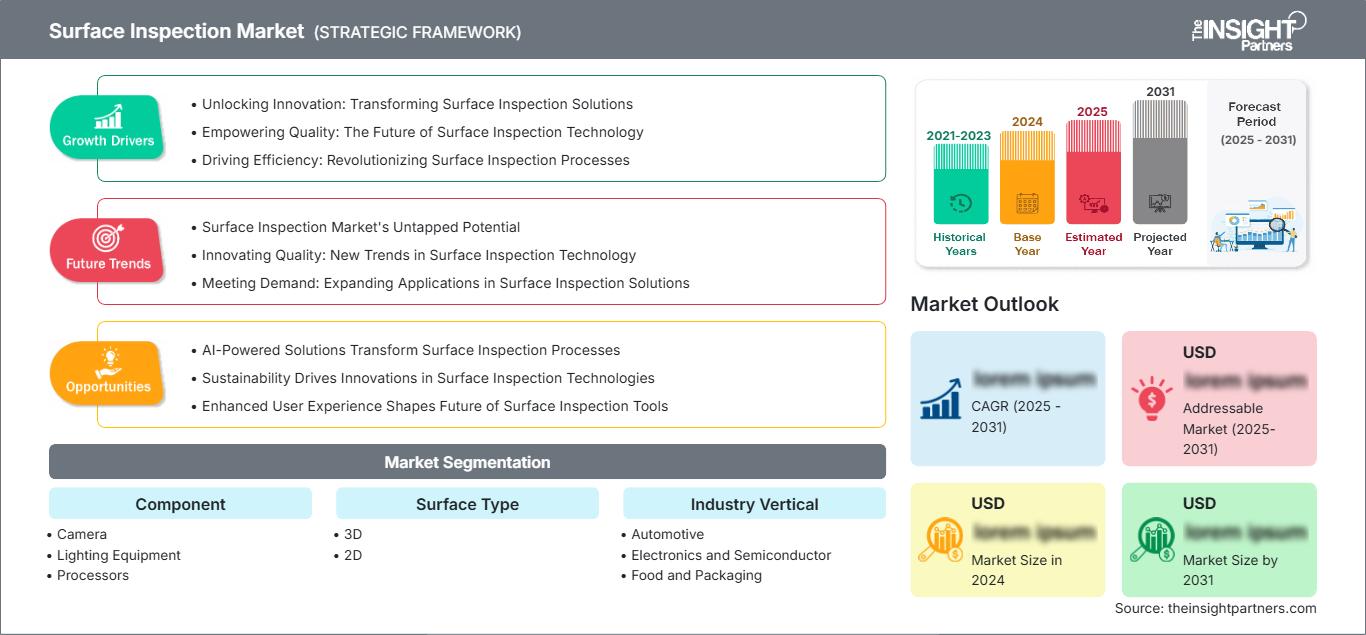
Surface Inspection Market: Strategic Insights
Regional Insights
North America Surface Inspection Market
North America is projected to expand at ~7% CAGR through 2034. Electrified automobiles, semiconductors, and pharmaceuticals with regulated production make inspection applications repetitive and data driven. Companies are integrating machine vision on brownfield lines where labor shortages, warranties, and auditing requirements make automated inspections worthwhile. The market also benefits from experienced integrators capable of combining cameras, control systems, robotics, and plant software.
The applications become increasingly process improvement related rather than just passing or failing objects. By looking at defect pictures, manufacturers can find problems with their coating process, tooling, alignment, or contaminations. That makes vision systems with reliable light management, edge analysis, secure data transfer, and recipe programming important. Canada adds its value through automotive, food, packaging, and advanced manufacturing industries, while Mexico provides export-oriented automobile and electronics factories.
U.S. Surface Inspection Market
The United States represented ~79% of North American revenue in 2025 and is expected to grow at ~7% CAGR through 2034. Its location is justified by its wide application in automotive assembly operations, semiconductor and electronics factories, medical devices manufacturing, metalworking facilities, and high-speed packaging processes. Investments in capacity increase the requirement for inline inspection that can prove the quality without creating manual constraints.
The availability of suppliers facilitates the implementation of these technologies. For example, OMRON Corporation offers comprehensive vision and automation systems, AMETEK Surface Vision delivers continuous process inspection solutions, and VITRONIC helps with automated optical quality processes. Customers demand AI-powered image classification, high-performance imaging, and system integration for traceability. The business argument for practical implementation includes elimination of escaped defects and reduction of rework without compromising the throughput during frequent product changes.
Europe Surface Inspection Market
Europe accounted for ~29% of global revenue in 2025 and is projected to record ~7% CAGR through 2034. Germany is the leading country in Europe, supported by automotive engineering, machine tools, metals, electronics, and an unusually dense base of inspection and automation suppliers. JENOPTIK AG, Erhardt+Leimer GmbH, IMS Messsysteme GmbH, Maschinenfabrik Herkules GmbH & Co. KG, and VITRONIC strengthen regional application knowledge and service access.
UK offers demand for aerospace, pharmaceuticals, food and specialty manufacturing industries, with Shelton Machines Ltd catering to inspection of fabrics and materials. France includes demand from vehicles, aerospace, luxury packaging, and life science manufacturing, and encourages inspection systems to offer both precision and documentation. Italy provides machinery, food manufacturing, packaging, and automotive chains and demands flexible inspection systems suitable for medium volume lines. Spain provides vehicle assembly, components, food manufacturing and industrial automation.
Energy savings, waste reduction, product traceability, and adherence to customers’ quality requirements are high on priority list of European buyers. This results in more investment towards retrofitting systems that link defect data with process parameters, and 3D solutions for intricate parts. Although Europe is mature market in terms of growth in terms of volume, it retains an enduring upgrade cycle through upgrading of legacy rule based stations and analytics driven solutions.
APAC Surface Inspection Market
Asia Pacific held ~28% of global revenue in 2025 and is forecast to grow at ~10% CAGR, making it the fastest-growing region through 2034. China is the leading country in Asia Pacific because of its scale in electronics, batteries, vehicles, metals, and packaging. Japan and South Korea sustain advanced semiconductor, display, and precision-manufacturing demand.
India’s expanding electronics assembly, pharmaceutical production, and vehicle supply chain widen the addressable base, while Australia offers targeted demand in food, packaging, medical products, and materials processing. Industrial localization programs and factory digitization support camera, processor, and software deployment, but vendor success depends on local integration, training, and service capacity.
Middle East & Africa Surface Inspection Market
The Middle East & Africa market is projected to expand at ~8% CAGR through 2034. The UAE is positioned as the leading country in the Middle East & Africa where diversified manufacturing, logistics, packaging, and pharmaceutical investment create concentrated demand. Saudi Arabia’s industrial localization and infrastructure programs support inspection for metals, packaging, and emerging downstream manufacturing.
South Africa contributes automotive assembly, food processing, packaging, and metals demand, while the Rest of MEA remains project-led. Energy and infrastructure investment can stimulate inspection of rolled materials, cables, coated products, and fabricated components. Adoption will depend on integrator availability, lifecycle support, and systems tolerant of varied operating environments.
Segmentation Analysis
Component
The Component main segment is projected to grow at ~8% CAGR during 2026–2034. Its Surface Inspection Market scope covers the coordinated hardware and software stack needed to illuminate, capture, process, classify, and record surface conditions. Replacement demand is strongest where faster lines or finer tolerances exceed legacy capability. Modular procurement also lets manufacturers upgrade processing or software without rebuilding the entire station.
- Camera: Cameras are the principal image-acquisition layer, with line-scan models serving continuous materials and area-scan devices addressing discrete parts. Resolution, frame rate, spectral response, and ruggedness determine which defects can be captured reliably.
- Lighting Equipment: Application-specific lighting reveals scratches, dents, coating variation, contamination, and print defects that ambient illumination can obscure. Stable intensity and geometry are strategically important for repeatability across shifts, batches, and reflective finishes.
- Processors: Processors convert high-volume image streams into line-speed decisions. Edge computing lowers latency and network load, while GPU-capable platforms support more complex models, multi-camera synchronization, and immediate feedback to upstream production equipment.
- Software: Software orchestrates image enhancement, defect classification, recipe management, reporting, and factory connectivity. Its importance rises as users seek explainable AI, simpler model training, remote diagnostics, and analytics that connect defects with process causes.
Surface Type
The Surface Type main segment is forecast to increase at ~10% CAGR through 2034. Growth reflects a transition from flat appearance checks toward dimensional and topographic inspection of complex parts. Selection depends on geometry, speed, reflectivity, defect depth, and acceptable false-reject rates. 2D remains practical for contrast-based tasks, while 3D expands where height and shape determine quality.
- 3D: 3D inspection captures height, depth, volume, and shape, enabling analysis of welds, sealants, stamped parts, connectors, battery assemblies, and machined surfaces. It is strategically important when color or texture alone cannot distinguish defects.
- 2D: 2D systems remain widely suitable for scratches, stains, print quality, color variation, presence checks, and continuous-web defects. Their mature hardware, high speed, and simpler integration preserve demand in cost-sensitive and high-throughput applications.
Industry Vertical
The Industry Vertical main segment is expected to post ~9% CAGR during 2026–2034. Adoption differs according to defect cost, regulation, product complexity, and line speed. Automotive and electronics buyers emphasize precision and traceability, food and packaging producers prioritize throughput and label integrity, and medical and pharmaceutical manufacturers require documented, validated inspection processes.
- Automotive: Automotive plants inspect body panels, paint, welds, glass, powertrain surfaces, battery materials, and assembled components. Electrification adds new defect modes and supplier interfaces, making flexible inline systems important for warranty control and launch quality.
- Electronics and Semiconductor: Miniaturization, dense interconnects, and yield sensitivity increase inspection intensity for wafers, packages, boards, displays, and connectors. High-resolution imaging and AI-assisted classification help separate critical anomalies from acceptable process variation.
- Food and Packaging: Producers use surface inspection for seals, labels, print, contamination, container finish, and package integrity at high speed. The strategic value lies in reducing recalls, avoiding material waste, and supporting batch-level traceability.
- Medical and Pharmaceutical: Regulated manufacturers inspect tablets, vials, syringes, devices, and packaging for cosmetic and functional defects. Validated software, audit trails, recipe control, and repeatable detection are central to adoption decisions.
Opportunity Snapshot
| Industry Vertical | Revenue Contribution | Trend Tag | Adoption Stage |
| Automotive | High | EV Quality | Mature |
| Electronics and Semiconductor | High | Microdefect Control | Scaling |
| Food and Packaging | Medium | Seal Integrity | Mature |
| Medical and Pharmaceutical | Medium | Validated Vision | Scaling |
Surface Inspection Market Growth Drivers and Impact Analysis
Zero-defect production economics
The presence of escaped defects can lead to rework, warranties, rejected loads, and production disruption, and therefore, inspection becomes a budgetary control rather than an optional practice for improving quality. Inspection in-line identifies surface defects prior to any value addition on them and limits the cost of processing such defective items. This is especially relevant to the industries of automobiles, semiconductors, medical devices, and continuous webs, in which case even small defects may be hazardous. Manufacturers’ increased focus on first pass yields and scrap means that the images of such defects become process data. This explains why the Surface Inspection Market is linked to productivity budgets.
AI-assisted detection across variable products
Standard algorithms fare well in stable cases but tend to reject too much when applied to textures, reflective, and otherwise variable surfaces. The use of machine vision supported by AI makes it easier to categorize defects with hard-to-encode boundaries, thus allowing a greater variety of products to be processed without changing the rules. On the shop floor level, it means less time needed for reviewing and quicker recipes. However, the solution works under the condition that the training set is representative enough and that decisions made are traceable. Hence, machine vision vendors are merging probabilistic and deterministic approaches.
Traceability and regulated quality assurance
Today’s clients and government agencies require more from manufacturers than just proof that inspections have been performed; rather, they seek evidence of how products are being verified. Surface systems provide an ability to correlate images, defect classifications, time stamps, and production/batch numbers with each part, providing audit and vendor discussion evidence. For pharmaceutical and medical device assembly lines, control of formulas is helpful, whereas for automobiles and electronics, traceability enables a company to deal promptly with problems at the supplier end. Market need is greater than just new systems – even old cameras and image processors will be upgraded so that their findings can go into databases at the factory.
Surface Inspection Market Future Trends
From defect detection to closed-loop process intelligence
The Surface Inspection Market trends are heading towards solutions that will tell the cause of the defect and advise process correction. In the forecast period, the data obtained through inspection will become more coordinated with coating variables, state of tools, temperature, web tension, robotic path, and lot of materials. Such an interface layer will allow detecting drifts before scrap increases significantly. The fastest adoption of this trend is expected on the sites with instrumentation and validation of safe control limits. Suppliers will require better analytical, interfacing, and cybersecurity capabilities, while buyers will consider results such as process stability and time to the cause of defect.
Multimodal and synthetic-data-enabled inspection
Future platforms will combine 2D color, 3D topography, line-scan, and selected spectral inputs when no single imaging mode captures the full defect signature. Such multimodal systems can distinguish a cosmetic mark from a dimensional flaw or contamination event, improving confidence on complex materials. Synthetic images and digital twins may supplement scarce defect samples during model development, particularly for new products. Commercialization depends on reproducibility under production lighting and on clear validation against real defects. The result should be broader coverage with fewer dedicated stations, although system design and calibration will become more specialized.
Surface Inspection Market Opportunities
Retrofit kits for connected brownfield factories
A large installed base still relies on stand-alone cameras or manual review, creating an opportunity for modular upgrades. Suppliers can package modern lighting, edge processors, software connectors, and validation services around existing mechanical frames and controls. Surface Inspection Market Forecasts favor vendors that quantify payback through reduced false rejects, faster troubleshooting, and lower scrap rather than requiring complete line replacement. Channel partners can build recurring revenue through calibration, model updates, remote diagnostics, and operator training. The most attractive projects will offer short installation windows and preserve approved production recipes while adding traceability.
Localized solutions for Asian capacity expansion
Electronics, battery, vehicle, pharmaceutical, and packaging capacity additions across Asia create room for systems engineered to local line speeds, product mixes, and service expectations. Investment can focus on application libraries for reflective foils, coated electrodes, miniature components, printed packaging, and pharmaceutical containers. Success requires regional integrators, multilingual software, responsive spare-parts support, and pricing architectures that scale from pilot cells to multiple plants. Companies that combine global quality methods with local commissioning can address first-time adopters while supporting multinational manufacturers seeking common inspection standards across geographically distributed facilities.
Recent Developments
- July 2026: OMRON Corporation announced expanded integration of its VT-X board inspection platform with NVIDIA Omniverse and Metropolis libraries. The initiative combines automated optical inspection and 3D-CT X-ray inspection with simulation and AI-driven diagnosis, targeting visualization of board warpage and more accessible inspection of advanced semiconductor assemblies.
- January 2025: AMETEK Surface Vision detailed the continued expansion of its automated online inspection portfolio across metals, nonwovens, paper, plastics, and battery materials. The company highlighted systems that combine high-definition defect imagery, classification, grading, archiving, and process insight, reinforcing its focus on turning continuous-surface data into actionable production decisions.
- October 2024: VITRONIC presented its VIRO WSI weld-seam inspection, VIRO WSM laser-welding monitoring, and Weldloop analytics at FABTECH 2024. The offering connects inspection outcomes with welding-process data so manufacturers can identify deviations, reduce manual rework, and improve control of safety-critical automotive welding operations.
Frequently Asked Questions

- Comprehensive Market Sizing and Forecast Analysis
- Detailed Segmentation Analysis
- In-Depth Market Dynamics Assessment
- Regional and Country-Level Insights
- Competitive Landscape and Company Benchmarking
- Strategic Business Intelligence
Recent Reports
Testimonials

The Insight Partners provided valuable market intelligence that supported our global go-to-market strategy. Their team was professional, responsive, and attentive to our feedback, providing thoughtful analysis and helpful methodological clarifications throughout the project.
Junmo Kim Chief Financial Officer (CFO), Enertech Co., Ltd.
The Insight Partners' SCADA System Market report is comprehensive, with valuable insights on current trends and future forecasts. The team was highly professional, responsive, and supportive throughout. We are very satisfied and highly recommend their services.
RAN KEDEM Partner, Reali Technologies LTDs
I requested a report on a very specific software market and the team produced the report in a few days. The information was very relevant and well presented. I then requested some changes and additions to the report. The team was again very responsive and I got the final report in less than a week.
JEAN-HERVE JENN Chairman, Future Analytica
We worked with The Insight Partners for an important market study and forecast. They gave us clear insights into opportunities and risks, which helped shape our plans. Their research was easy to use and based on solid data. It helped us make smart, confident decisions. We highly recommend them.
PIYUSH NAGPAL Sr. Vice President, High Beam Global
The Insight Partners delivered insightful, well-structured market research with strong domain expertise. Their team was professional and responsive throughout. The user-friendly website made accessing industry reports seamless. We highly recommend them for reliable, high-quality research services
YUKIHIKO ADACHI CEO, Deep Blue, LLC.
This is the first time I have purchased a market report from The Insight Partners.While I was unsure at first, I visited their web site and felt more comfortable to take the risk and purchase a market report.I am completely satisfied with the quality of the report and customer service. I had several questions and comments with the initial report, but after a couple of dialogs over email with their analyst I believe I have a report that I can use as input to our strategic planning process.Thank you so much for taking the extra time and making this a positive experience.I will definitely recommend your service to others and you will be my first call when we need further market data.
JOHN SUZUKI President and Chief Executive Officer, Board Director, BK Technologies
I wish to appreciate your support and the professionalism you displayed in the course of attending to my request for information regarding to infectious disease IVD market in Nigeria. I appreciate your patience, your guidance, and the fact that you were willing to offer a discount, which eventually made it possible for us to close a deal. I look forward to engaging The Insight Partners in the future, all thanks to the impression you have created in me as a result of this first encounter.
DR CHIJIOKE ONYIA MANAGING DIRECTOR, PineCrest Healthcare Ltd.Reason to Buy
- Informed Decision-Making
- Understanding Market Dynamics
- Competitive Analysis
- Identifying Emerging Markets
- Customer Insights
- Market Forecasts
- Risk Mitigation
- Boosting Operational Efficiency
- Strategic Planning
- Investment Justification
- Tracking Industry Innovations
- Aligning with Regulatory Trends





 Get Free Sample for