
Surface Thermometer Market Size, Share & Trends by 2034
Coverage: by Type (Thermocouple Thermometer, Infrared Thermometer, Others); Application (Industrial, Research, Others) , and Geography (North America, Europe, Asia Pacific, and South and Central America)
- Status : Data Released
- Report Code : TIPRE00007270
- Category : Electronics and Semiconductor
- No. of Pages : 150
- Available Report Formats :


- Last update date : November 11, 2026


2025 Market Size
US$ 2.56 Bn
Base year value
2034 Forecast
US$ 4.47 Bn
Projected by 2034
CAGR 2026-2034
6.41 %
Growth rate
Addressable Market
US$ 31.84 Bn
(2026-2034)
The Surface Thermometer Market is projected to expand from US$ 2.56 Billion in 2025 to US$ 4.47 Billion by 2034, registering a CAGR of 6.41% during 2026–2034. The market covers contact and non-contact instruments used to measure the external temperature of machinery, materials, products, and test samples across industrial, research, and other settings. Demand is supported by preventive maintenance, process control, energy efficiency, food safety, and laboratory quality assurance.
Across North America, the Surface Thermometer Market size is supported by an estimated ~6% CAGR through 2034. Extensive installed manufacturing assets, formal maintenance practices, and the growing use of infrared inspection in electrical, HVAC, food, pharmaceutical, and battery operations underpin replacement and upgrade demand. Connected instruments that transfer readings into maintenance records are also widening the value proposition beyond spot measurement.
Surface Thermometer Market Assessment and Insights
Regional Outlook
- North America: ~35% of the global Surface Thermometer Market share in 2025 | ~6% CAGR through 2034. Market position: The region ranks first, supported by a large installed industrial base, stringent safety practices, high maintenance spending, and early adoption of connected infrared inspection tools.
- US: ~78% of North American market revenue in 2025 | ~6% CAGR through 2034. Market position: The country leads North America through broad vendor coverage, strong calibration infrastructure, and demand from manufacturing, utilities, data centers, food processing, and research laboratories.
- Europe: ~29% of the global market in 2025 | ~6% CAGR through 2034. Market position: Mature process industries and energy-efficiency requirements sustain demand, with Germany leading and the UK, France, Italy, and Spain providing diversified application bases.
- Asia Pacific: ~27% of the global market in 2025 | ~8% CAGR through 2034. Market position: Asia Pacific is the fastest-growing region as factory automation, electronics production, infrastructure investment, and expanding quality systems accelerate adoption, led by China and Japan.
Segment Outlook
- Type: ~100% Share in 2025 | ~7% CAGR through 2034. Market position: Type captures all instrument revenue and reflects the transition from basic contact probes toward faster infrared, dual-mode, and digitally documented measurements.
- Application: ~100% Share in 2025 | ~6% CAGR through 2034. Market position: Application demand expands as industrial maintenance and research protocols formalize repeatable surface-temperature checks within safety, quality, and validation workflows.
Competitive Coverage
Carl ROTH GmbH + Co. KG, Endress+Hauser Group Services AG, Teledyne FLIR LLC, Fluke Corporation, PCE Deutschland GmbH, REED Instruments, Tel-Tru Manufacturing Company, Testo SE & Co. KGaA, Tramex Ltd., WIKA Alexander Wiegand SE & Co. KG
Methodology
The Insight Partners follows Data Collection & Secondary Research, Primary Research, Data Analysis, and Data Triangulation & Final Review to validate market estimates and insights.
Source: The Insight Partners' analysis based on proprietary research, government publications, company annual reports, investor presentations, industry databases, and expert interviews.
The development of instrument design is shifting from dials and single-channel contact probes into sturdy digital thermocouple meters, adjustable emissivity infrared models and thermal imaging technology. Manufacturing is still divided between volume electronics assembly, specialized sensors manufacture, calibration and end-use adaptation. Modularity of probes and standardization of thermocouple connectors ensure replacement business, while firmware upgrades, smartphone applications and cloud-based reporting enable further differentiation. In the Surface Thermometer Market, the winners will be those companies able to offer products that integrate accuracy of reading, sturdiness of construction, traceable calibration and ease of use rather than just low cost of the device itself.
In 2034, capital spending is forecast to expand into Asia Pacific region and selected Middle Eastern industrial centers, where new facilities will start using standardized surface temperature inspections at start-up. Energy management regulations, cold chain requirements and safety procedures in food industry will create need for tools that provide recording of readings and minimize exposure to live or out-of-reach surfaces. Local availability of service and calibration will be key, since trust in measurements relies not only on sensors specifications but also emissivity, probes choice and user training.
Surface Thermometer Market Report Scope
| Report Attribute | Details |
|---|---|
| Market size in 2025 | US$ 2.56 Billion |
| Market Size by 2034 | US$ 4.47 Billion |
| Global CAGR (2026 - 2034) | 6.41% |
| Historical Data | 2021-2024 |
| Forecast period | 2026-2034 |
Surface Thermometer Market Analysis
Surface Thermometer market growth will be driven by the rising costs associated with unscheduled down-time and pre-failure detection of overheating. Motors, bearings, switchgears, furnaces, pipes, refrigeration equipment, and building envelopes all present constant inspection needs. Potential buyers are interested in fast measurement time, high repeatability, suitable distance to spot ratio, and ease of access. Within the ecosystem, there are sensor and optical component providers leading to instrument manufacturers, whereas calibration labs, distributors, and maintenance companies affect the brand and the entire sales cycle.
Technologically, the supply chain is different. Instruments that use thermocouples have an established ecosystem of probes and connectors, allowing for fierce price competition and substitution. Infrared instruments rely on detectors, optics, processing, and emissivity correction – leaving more space for performance differentiation. Component availability, capabilities of the calibration labs, and local approval status may affect delivery times, while channel partners solve any adoption challenges through selection of the instrument with the right temperature range, spot size, surface and environmental ratings.Surface Thermometer Market analysis suggests that this market is highly competitive involving both broad instruments categories and specialized brands. Fluke Corporation, Testo SE & Co. KGaA, Teledyne FLIR LLC, and PCE Deutschland GmbH use portability of infrared lines, software compatibility, channels, and training to compete. Endress+Hauser Group Services AG and WIKA Alexander Wiegand SE & Co. KG have their strengths in industrial measuring contacts, and Tel-Tru Manufacturing Company, REED Instruments, Tramex Ltd., and Carl ROTH GmbH + Co. KG are serving specialized industrial, building, and laboratory markets.
New investments will focus on connected workflow, higher optical resolution, both contact and non-contact solutions, and application kits. Right positioning should include the balance between durability and accuracy and simpler documentation. The manufacturers can protect their margins from price wars through calibration, additional accessories, warranty, and software instead of purely hardware approach. Collaboration with industrial distributors and maintenance systems can speed up the sales cycle especially for procurement teams looking for unified fleet across locations.
● REPORT CUSTOMIZATION
Tailor This Report To Align With Your Specific Business Requirements
This report can be customized to align precisely with your business objectives, scope, and target markets. Customization options include tailored segmentation, geography, competitive analysis, and strategic insights to support informed decision-making.
Customize This Report →WHAT YOU CAN ADJUST
- ● Segmentations
- ● Geography
- ● Competitive Analysis
- ● Language Preferences
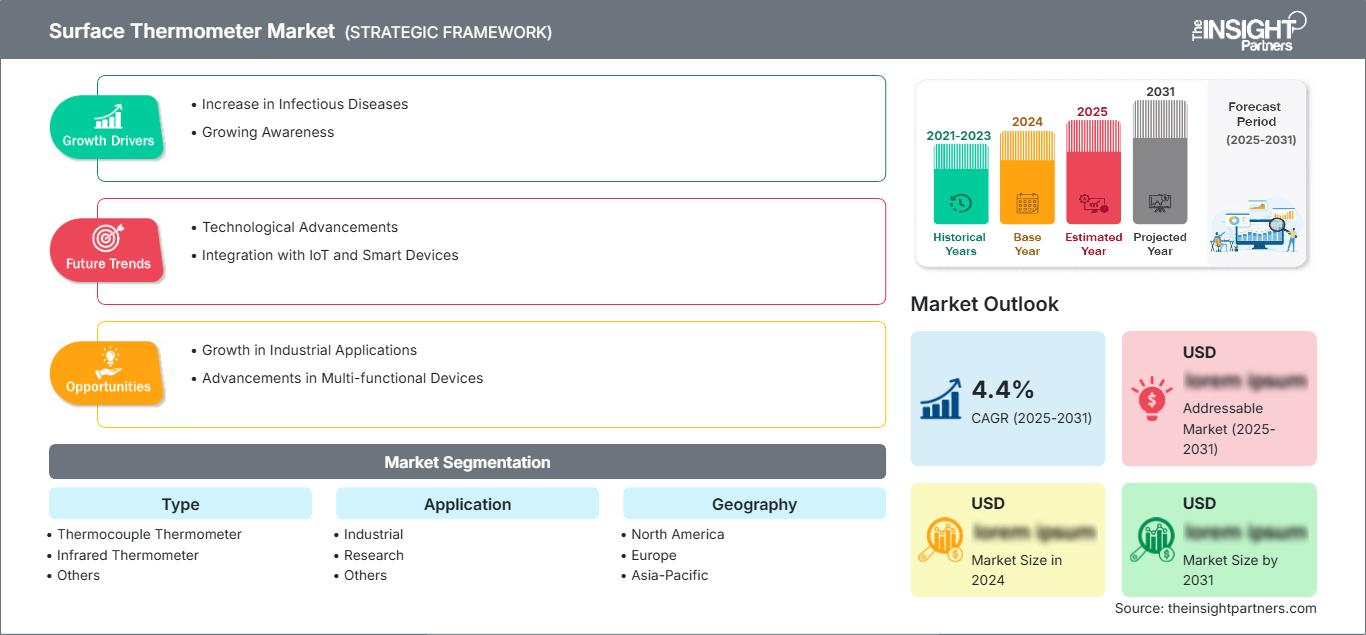
Surface Thermometer Market: Strategic Insights
Regional Insights
North America Surface Thermometer Market
North America is estimated to advance at a ~6% CAGR through 2034 while retaining the largest Surface Thermometer Market share. Demand is based on preventive maintenance initiatives in automotive, aerospace, chemical, food processing, power plants, and commercial buildings. Contact-less methods are used when equipment is live, rotates, extremely hot, or inaccessible, while contact-based thermocouple devices are still necessary when users need to validate low emissivity metal readings or probe placement.
A trend is emerging towards equipment that allows the combination of safe spot checking and imaging, mobile apps, and inspections. A well-developed calibration network and safety culture of the region facilitate the use of high-end equipment, although replacement cycles limit market growth compared to less matured markets. Canada offers its contribution via energy, mining, food processing, and building diagnostic applications, while Mexico capitalizes on growing automobile, appliance, electronic, and export manufacturing industry.
U.S. Surface Thermometer Market
The U.S. represents ~78% of North American revenue in 2025 and is projected to expand at a ~6% CAGR through 2034. This can be attributed to the diverse nature of process manufacturing, utilities, data centers, laboratories, and the food and pharmaceutical businesses which require regulated production. The maintenance staff uses infrared measuring devices for quick testing and thermocouples for confirmation, thus generating a need for mixed fleets rather than total replacement.
Both Fluke Corporation and Teledyne FLIR LLC have established strong domestic brand recognition backed by distributors, training material, and specialized application-oriented product lines. The applications have expanded from conventional testing of motors, HVAC, and electrical systems to battery packs, power electronics, semiconductor development, and solar components. Factors like data transmission capability, durability, calibration assistance, and uniformity of fleet along with temperature and accuracy requirements are important in procurement decisions.
Europe Surface Thermometer Market
Europe accounts for an estimated ~29% of global revenue in 2025 and is expected to grow at a ~6% CAGR through 2034. Germany is the dominant European nation, driven by machinery, automobiles, chemicals, metrology, and industrial automation. It is also helped by the density of its supply chain network for calibration, probe modification, and technology distribution. The UK offers additional demand for facilities management, food processing, research, and utilities, whereas France offers a mix of aerospace, energy, transport, and pharmaceutical applications.
Italian parts of equipment, food, ceramic, and building services give way to a broad spectrum of portable contacts and infrared devices. The support of Spain is shown via renewable energy, food logistics, construction, and maintenance of processes. Overall, all the countries of the region have an interest in decarbonization and energy efficiency measures which are important for thermal inspection of insulation, heating, motors, and electrical loads. The standardized procurement provides the market demand for calibration even with low-cost alternatives.
Among European suppliers such as Testo SE & Co. KGaA, WIKA Alexander Wiegand SE & Co. KG, PCE Deutschland GmbH, and Carl ROTH GmbH + Co. KG the competition occurs in terms of the depth of applications and local service provision. The growth will stay balanced between the replacement of installed instruments and adoption of connected ones which facilitate audit trails. Supplied solutions of emissivity issues and reflective surfaces' measurements may improve risk reduction and customer retention.
APAC Surface Thermometer Market
Asia Pacific holds an estimated ~27% global share in 2025 and is forecast to record a ~8% CAGR through 2034, making it the fastest-growing region. China is the leading country in Asia Pacific owing to its scale in electronics, machinery, metals, batteries, and industrial equipment. Japan and South Korea add high-value demand from precision manufacturing, automotive systems, semiconductors, and research.
Formalization of the industrial sector, infrastructure development, and advancements in India’s cold chain help increase the number of end-users, whereas Australia focuses on mining, utilities, construction diagnostics, and laboratory applications. Incentives through policies towards localization and energy efficiency boost adoption rates. Localization of channels and rugged instruments at low costs will be critical for smaller players.
Middle East & Africa Surface Thermometer Market
The Middle East & Africa region is projected to expand at a ~7% CAGR through 2034. Saudi Arabia is the leading country in the Middle East & Africa where petrochemical operations, utility assets, construction, and industrial diversification generate recurring inspection needs. The UAE contributes through logistics, aviation support, data centers, buildings, and energy infrastructure.
South Africa anchors demand in mining, power, processing, and commercial facilities, while the Rest of MEA remains more distributor-led. Harsh environments increase the value of rugged housings, suitable environmental ratings, and safe non-contact measurement. Growth depends on maintenance investment, calibration access, and technician training, especially where critical assets operate far from service centers.
Segmentation Analysis
Type
Type is projected to record a ~7% CAGR during 2026–2034. The Surface Thermometer Market scope by type spans thermocouple thermometers, infrared thermometers, and other designs. Purchasing decisions depend on contact requirements, response time, temperature range, target dimensions, emissivity, safety distance, and documentation needs. Infrared models gain from rapid screening, while thermocouple devices retain strategic relevance where direct contact improves confidence or validates readings on reflective materials.
- Thermocouple Thermometer: Mature probe availability, wide temperature coverage, and direct contact make these instruments important for laboratories, furnaces, food equipment, HVAC systems, and industrial troubleshooting where probe geometry and repeatability matter.
- Infrared Thermometer: Non-contact operation supports fast inspection of moving, energized, hot, or inaccessible surfaces. Adjustable emissivity, improved optics, visual targeting, and digital records raise value in maintenance, building diagnostics, and process screening.
Application
Application is expected to expand at a ~6% CAGR during 2026–2034. Industrial users account for the deepest recurring demand because surface-temperature checks connect directly with uptime, safety, quality, and energy performance. Research users prioritize accuracy, repeatability, configurable probes, and traceable calibration. Across both groups, adoption improves when instruments can export readings, fit established maintenance procedures, and provide clear guidance on measurement distance and surface emissivity.
- Industrial: Manufacturing, utilities, HVAC, food processing, chemicals, transport, and maintenance teams use surface thermometers to screen assets, verify process conditions, investigate heat loss, and reduce exposure during inspection.
- Research: Laboratories and engineering teams require controlled surface measurements for materials testing, electronics development, thermal validation, and experimental repeatability, favoring configurable sensors, calibration support, and recorded data.
Opportunity Snapshot
| Application | Revenue Contribution | Trend Tag | Adoption Stage |
| Industrial | High | Predictive Maintenance | Mature |
| Research | Medium | Thermal Validation | Scaling |
| Others | Low | Portable Screening | Emerging |
Surface Thermometer Market Growth Drivers and Impact Analysis
Predictive Maintenance Becomes a Standard Operating Discipline
Industrial operators are shifting from reactive repair toward condition-based inspection because an abnormal surface temperature can reveal friction, overload, insulation failure, blocked flow, or poor electrical contact before breakdown. Surface thermometers provide a low-friction entry point: technicians can screen many assets quickly, then escalate exceptions to thermal imaging, vibration analysis, or electrical testing. This workflow expands instrument deployment across maintenance teams and supports repeat purchases as plants standardize toolkits. The strongest market impact is likely in facilities with costly downtime, large motor populations, critical switchgear, and dispersed HVAC assets. Vendors that pair durable hardware with route-based documentation and calibration services can capture recurring revenue while helping customers improve inspection consistency.
Safety and Access Requirements Favor Non-Contact Measurement
Many surfaces cannot be touched safely or conveniently because they are energized, rotating, contaminated, extremely hot, moving, or physically inaccessible. Infrared thermometers allow workers to maintain distance while obtaining immediate readings, reducing exposure and shortening inspection time. This mechanism supports demand in electrical maintenance, metals, petrochemicals, food lines, transport, and building services. Product selection still depends on target size, optics, emissivity, and environmental conditions, so application training remains commercially important. The practical effect is not wholesale replacement of contact devices, but a larger combined toolkit in which infrared screening identifies anomalies and thermocouple probes provide confirmation when direct measurement is feasible and technically preferable.
Quality, Energy, and Compliance Workflows Require Better Records
Temperature checks increasingly feed formal quality, energy, and safety workflows rather than remaining informal spot observations. Food handling, pharmaceutical operations, laboratory testing, building commissioning, and process manufacturing benefit when readings are time-stamped, associated with an asset or location, and retained for review. This requirement raises demand for Bluetooth connectivity, mobile applications, onboard memory, and exportable reports. It also increases the importance of calibration certificates and user guidance, particularly where reflective surfaces or poor distance-to-spot discipline can distort results. Suppliers that make documentation simpler without adding excessive complexity can move buyers toward higher-value instruments and create service opportunities around calibration, fleet management, and training.
Surface Thermometer Market Future Trends
From Single Readings to Connected Inspection Evidence
Surface Thermometer Market trends point toward instruments becoming data nodes within maintenance and quality systems. Through 2034, more devices are expected to combine wireless transfer, asset tagging, guided workflows, and automatic report generation. The transition will be gradual because many buyers still value simplicity, long battery life, and offline operation. Successful products will therefore retain rapid point-and-measure interaction while adding optional connectivity. Interoperability with computerized maintenance management systems and laboratory records could become a meaningful selection criterion, especially for multi-site operators. Data integrity, cybersecurity, and uncomplicated user permissions will influence adoption where measurements support audits or regulated processes.
Hybrid Contact, Infrared, and Visual Workflows Expand
Future inspection practice will increasingly combine spot infrared readings, contact probes, and compact thermal visualization rather than treating them as separate categories. Visual context helps technicians locate hot and cold anomalies, while contact sensing can validate difficult surfaces or precise points. Manufacturers are likely to differentiate through better optics, clearer targeting, super-resolution processing, emissivity guidance, and application-specific accessories. This convergence may raise average selling values but also demands clearer positioning so buyers understand when each mode is appropriate. Training content and software that preserve measurement context will become as important as sensor specifications in reducing false conclusions.
Surface Thermometer Market Opportunities
Localized Industrial Service Ecosystems in High-Growth Economies
Asia Pacific and selected Middle Eastern markets offer room for suppliers to build distributor, calibration, and training capacity around expanding factories and infrastructure. Surface Thermometer Market Forecasts indicate that commercial success will depend less on shipping standalone devices and more on providing dependable local support, application selection, and periodic verification. Investors can prioritize cities with concentrated electronics, automotive, food, chemicals, energy, or laboratory demand. Bundled starter kits, local-language guidance, and tiered calibration services can lower adoption barriers for smaller facilities. Partnerships with maintenance contractors and vocational training providers may also create repeatable routes to market without requiring a fully owned service footprint.
Application-Specific Kits for Electrification and Electronics
Battery systems, power electronics, semiconductor development, solar installations, and data-center infrastructure create temperature-monitoring tasks that reward tailored instruments and workflows. Opportunities include compact infrared devices with suitable optics for small targets, contact probes for validation, insulated accessories, and software templates that organize readings by asset. Vendors should avoid generic positioning and instead document measurement limitations, reflective-surface handling, safe distances, and escalation paths. Collaboration with equipment manufacturers, commissioning firms, and technical distributors can embed surface-temperature checks into installation and maintenance procedures, producing higher-value sales and stronger customer retention than undifferentiated retail channels.
Recent Developments
- September 2026: Fluke Corporation expanded its iSee mobile imaging series with the TC03A thermal camera for maintenance teams. The launch strengthens the bridge between point-temperature measurement and portable visualization, supporting faster anomaly identification and field documentation in electrical, HVAC, and industrial inspection workflows.
- May 2025: Teledyne FLIR LLC highlighted its MIX platform for synchronized high-speed thermal and visible data in electronics research and development. The workflow targets design validation, heat dissipation analysis, and thermal-runaway investigation, showing how surface-temperature information is moving from isolated readings toward richer engineering evidence.
Frequently Asked Questions

- Comprehensive Market Sizing and Forecast Analysis
- Detailed Segmentation Analysis
- In-Depth Market Dynamics Assessment
- Regional and Country-Level Insights
- Competitive Landscape and Company Benchmarking
- Strategic Business Intelligence
Recent Reports
Testimonials

The Insight Partners provided valuable market intelligence that supported our global go-to-market strategy. Their team was professional, responsive, and attentive to our feedback, providing thoughtful analysis and helpful methodological clarifications throughout the project.
Junmo Kim Chief Financial Officer (CFO), Enertech Co., Ltd.
The Insight Partners' SCADA System Market report is comprehensive, with valuable insights on current trends and future forecasts. The team was highly professional, responsive, and supportive throughout. We are very satisfied and highly recommend their services.
RAN KEDEM Partner, Reali Technologies LTDs
I requested a report on a very specific software market and the team produced the report in a few days. The information was very relevant and well presented. I then requested some changes and additions to the report. The team was again very responsive and I got the final report in less than a week.
JEAN-HERVE JENN Chairman, Future Analytica
We worked with The Insight Partners for an important market study and forecast. They gave us clear insights into opportunities and risks, which helped shape our plans. Their research was easy to use and based on solid data. It helped us make smart, confident decisions. We highly recommend them.
PIYUSH NAGPAL Sr. Vice President, High Beam Global
The Insight Partners delivered insightful, well-structured market research with strong domain expertise. Their team was professional and responsive throughout. The user-friendly website made accessing industry reports seamless. We highly recommend them for reliable, high-quality research services
YUKIHIKO ADACHI CEO, Deep Blue, LLC.
This is the first time I have purchased a market report from The Insight Partners.While I was unsure at first, I visited their web site and felt more comfortable to take the risk and purchase a market report.I am completely satisfied with the quality of the report and customer service. I had several questions and comments with the initial report, but after a couple of dialogs over email with their analyst I believe I have a report that I can use as input to our strategic planning process.Thank you so much for taking the extra time and making this a positive experience.I will definitely recommend your service to others and you will be my first call when we need further market data.
JOHN SUZUKI President and Chief Executive Officer, Board Director, BK Technologies
I wish to appreciate your support and the professionalism you displayed in the course of attending to my request for information regarding to infectious disease IVD market in Nigeria. I appreciate your patience, your guidance, and the fact that you were willing to offer a discount, which eventually made it possible for us to close a deal. I look forward to engaging The Insight Partners in the future, all thanks to the impression you have created in me as a result of this first encounter.
DR CHIJIOKE ONYIA MANAGING DIRECTOR, PineCrest Healthcare Ltd.Reason to Buy
- Informed Decision-Making
- Understanding Market Dynamics
- Competitive Analysis
- Identifying Emerging Markets
- Customer Insights
- Market Forecasts
- Risk Mitigation
- Boosting Operational Efficiency
- Strategic Planning
- Investment Justification
- Tracking Industry Innovations
- Aligning with Regulatory Trends





 Get Free Sample for