
Telematics in Heavy Equipment Market Size, Trends & Growth by 2034
Coverage: by Technology (Cellular, Satellite); Application (Vehicle Tracking, Fleet Management, Satellite Navigation, Vehicle Safety Communications, Others); End-Use (Construction, Agriculture, Mining, Others) , and Geography (North America, Europe, Asia Pacific, and South and Central America)
- Status : Data Released
- Report Code : TIPRE00007377
- Category : Electronics and Semiconductor
- No. of Pages : 150
- Available Report Formats :


- Last update date : October 13, 2026


2025 Market Size
US$ 6.55 Bn
Base year value
2034 Forecast
US$ 15.77 Bn
Projected by 2034
CAGR 2026-2034
10.26 %
Growth rate
Addressable Market
US$ 99.15 Bn
(2026-2034)
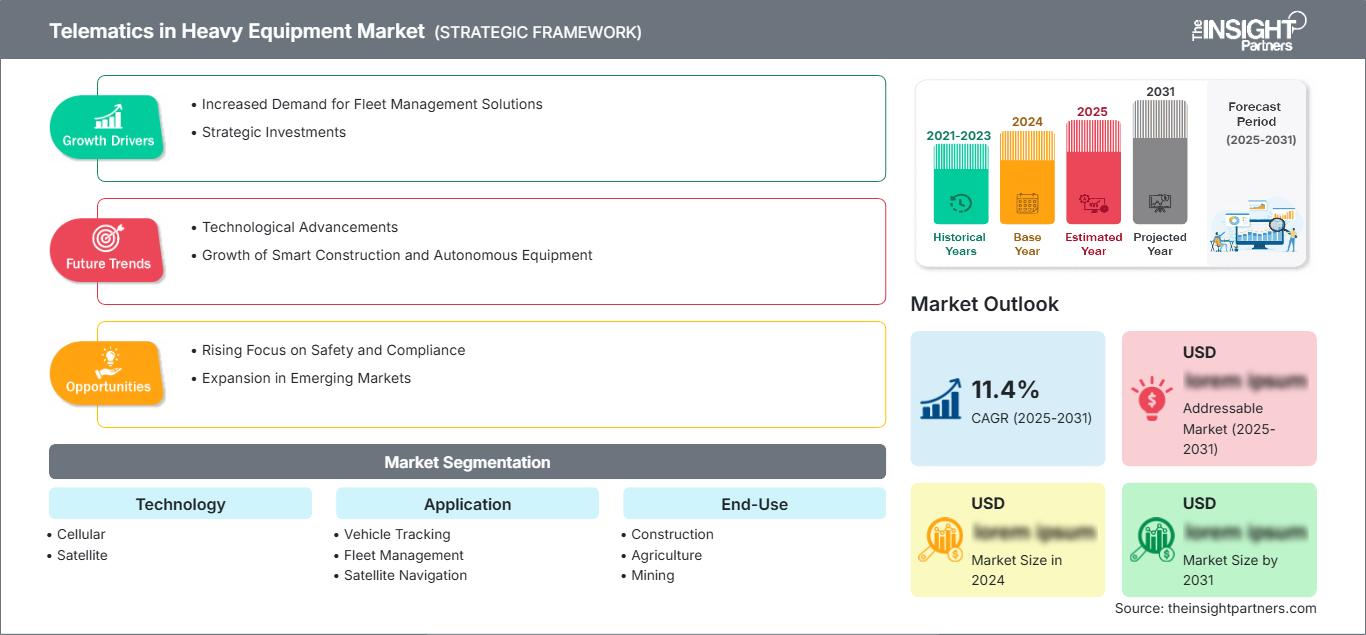
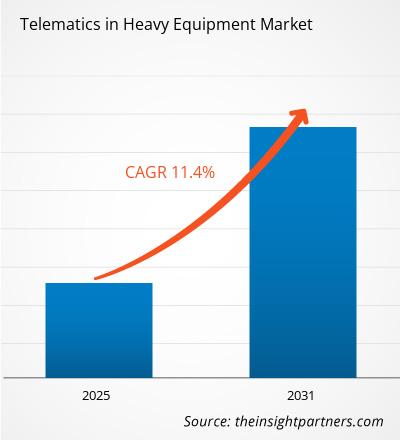
The Telematics in Heavy Equipment Market size reached US$ 6.55 Billion in 2025 and is projected to reach US$ 15.77 Billion by 2034, reflecting a CAGR of 10.26% during 2026–2034. The market covers connected technologies deployed across heavy machinery to support location intelligence, equipment utilization, fleet coordination, navigation, safety communication, and operational monitoring. Its scope spans cellular and satellite connectivity across construction, agriculture, mining, and other heavy-equipment applications.
North America remains a technology-intensive market, supported by high penetration of connected fleet platforms, established construction equipment digitization, and demand for preventive maintenance. The regional market is projected to expand at ~9% CAGR through 2034 as contractors and fleet operators integrate telematics with maintenance, asset management, utilization analytics, and jobsite workflow systems.
Telematics in Heavy Equipment Market Assessment and Insights
Regional Outlook
- North America: ~31% of the global Telematics in Heavy Equipment Market share in 2025 | ~9% CAGR through 2034. Market position: North America holds a leading regional position, supported by established telematics infrastructure, large construction fleets, equipment rental activity, and strong adoption of connected maintenance and asset-utilization platforms.
- US: ~75% of North American market revenue in 2025 | ~9% CAGR through 2034. Market position: The US represents the largest country market in North America, with contractors, rental companies, and mixed-fleet operators using telematics for utilization monitoring, preventive maintenance, theft prevention, compliance, and fleet productivity.
- Europe: ~27% of the global market in 2025 | ~9% CAGR through 2034. Market position: Europe is a mature connected-equipment market, with Germany the leading country in Europe, followed by strong deployment across the UK, France, Italy, and Spain as construction digitization and equipment efficiency requirements expand.
- Asia Pacific: ~29% of the global market in 2025 | ~13% CAGR through 2034. Market position: Asia Pacific is the fastest-growing region, driven by expanding construction and mining fleets, industrial digitization, infrastructure investment, and increasing use of connected machinery in China, Japan, South Korea, India, and Australia.
Segment Outlook
- End-Use: ~47% Share in 2025 | ~11% CAGR through 2034. Market position: End-use represents the largest main segment because telematics is increasingly embedded into operational processes for construction, agriculture, and mining fleets, where utilization, maintenance, safety, and equipment productivity directly influence operating economics.
- Technology: ~12% CAGR through 2034. Market position: Technology is the high-growth main segment as cellular connectivity benefits from expanding network availability, lower communication latency, integrated IoT architectures, and growing demand for continuous equipment data transmission.
Competitive Coverage
DPL Telematics, Heavy Construction Systems Specialists, Inc., LHP Telematics LLC, Navman Group, Teletrac, The Morey Corporation, TomTom N.V., Topcon Corporation, Trimble Inc., Zonar Systems, Inc.
Methodology
The Insight Partners follows Data Collection & Secondary Research, Primary Research, Data Analysis, and Data Triangulation & Final Review to validate market estimates and insights.
Source: The Insight Partners' analysis based on proprietary research, government publications, company annual reports, investor presentations, industry databases, and expert interviews.
From GPS-enabled tracking, the technology has developed into platforms for connected machinery, which integrates location, engine data, usage, diagnostics, maintenance notifications, and operator details. Cellular network has become key to data transmission, but satellite communications are still used in remote mining and agriculture operations where coverage is poor on the ground. Telematics of machinery is increasingly integrated into business systems, maintenance software, machine control systems, and project management tools as the benefit is no longer asset visibility, but operational intelligence.
In terms of future developments, the Telematics in Heavy Equipment Market will become more widespread in developing countries and regions of construction and mining industries that are investing in infrastructure and new machines. China, India, Southeast Asia, Australia, as well as oil-and-gas intensive countries in the Middle East will generate additional demand for connected machinery. The investments will be made in interoperable platforms to aggregate data from OEM equipment, after-market devices, and diverse fleets. Safety regulations, emission controls, equipment efficiency, and digital documentation will motivate operators to apply telematics as the management layer.
Telematics in Heavy Equipment Market Report Scope
| Report Attribute | Details |
|---|---|
| Market size in 2025 | US$ 6.55 Billion |
| Market Size by 2034 | US$ 15.77 Billion |
| Global CAGR (2026 - 2034) | 10.26% |
| Historical Data | 2021-2024 |
| Forecast period | 2026-2034 |
Telematics in Heavy Equipment Market Analysis
Demand in the Telematics in Heavy Equipment Market focuses on fleet-specific metrics and no longer relies on stand-alone tracking alone. Fleet utilization, idle time, need for service, geographical location and job-site movement are the key factors monitored by contractors using telematics technology in conjunction with equipment; mining companies need comprehensive visibility among their widely distributed equipment. Increasingly agricultural users start integrating equipment telematics with their precision-farming operations.
The supply of the telematics system components is largely defined by the need to integrate rugged hardware and vehicles’ IT infrastructure including sensors, communication modules and software solutions. Today’s gateways increasingly offer CAN-equipped machinery information, GNSS positioning, wireless communications and OTA updates capability. Competition among telematics vendors focuses on interoperability, ease of installation, security of the information, analytics possibilities and integration into existing fleet management systems.
The competition comprises globally recognized technology firms, fleet management vendors, telematics solutions providers, positioning companies, and equipment-focused solution vendors. Trimble and Topcon link telematics solutions to construction technology solutions, whereas Teletrac and Zonar specialize in fleet and equipment management. Morey Corporation offers robust hardware for telematics solutions, and DPL Telematics and LHP Telematics provide solutions for specialized fleet and assets. TomTom offers location solutions, routing capabilities, and traffic information that can be valuable for connected fleet applications.
There is more investment being made in the areas of software interoperability, connected processes, predictive maintenance, and data aggregation. Consequently, competitive positioning involves the capability to convert data into actions. Solutions providers capable of working with mixed fleets will be able to handle contractors who have different machines from various OEMs, whereas equipment-focused solutions providers can differentiate themselves with their robust hardware and deployment flexibility.
● REPORT CUSTOMIZATION
Tailor This Report To Align With Your Specific Business Requirements
This report can be customized to align precisely with your business objectives, scope, and target markets. Customization options include tailored segmentation, geography, competitive analysis, and strategic insights to support informed decision-making.
Customize This Report →WHAT YOU CAN ADJUST
- ● Segmentations
- ● Geography
- ● Competitive Analysis
- ● Language Preferences
Telematics in Heavy Equipment Market: Strategic Insights
Regional Insights
North America Telematics in Heavy Equipment Market
North America accounted for ~31% of the global market in 2025 and is expected to register ~9% CAGR through 2034. The region benefits from extensive construction and infrastructure activity, established fleet-management practices, equipment rental networks, and high awareness of connected asset monitoring. Contractors increasingly use telematics to compare equipment utilization across projects, identify idle assets, schedule maintenance, and strengthen theft protection.
The US is considered the central regional demand hub, whereas Canada plays its role by contributing in construction, mining, agriculture, and other resource-related industries. The regional market is also driven by the existing large number of heavy machinery and the need to achieve longevity of their operation. An integration with maintenance and construction software is becoming more relevant due to the desire of fleet operators to get an overall operational picture instead of tracking information only. The cellular connection is prevalent in the general-purpose implementation, while the satellite connection remains relevant in niche applications.
U.S. Telematics in Heavy Equipment Market
The US represented ~75% of North American market revenue in 2025 and is expected to expand at ~9% CAGR through 2034. Construction contractors, equipment rental businesses, utilities, agricultural operators, and mining companies are important demand groups. Telematics is increasingly used to monitor machine location, engine hours, utilization, fuel consumption, maintenance events, and unauthorized movement.
Competitors include Trimble, Zonar Systems, Teletrac, The Morey Corporation, DPL Telematics, and Topcon Corporation. Priorities of applications now favor integrated equipment management over tracking. This is backed up by integration with maintenance software, cloud fleet dashboards, and coordination needs for diverse fleets on multiple sites. This demand is additionally fueled by needs to minimize non-productive time of equipment and efficient use of capital, especially among construction companies managing high-priced equipment at different project locations.
Europe Telematics in Heavy Equipment Market
Europe represented ~27% of the global market in 2025 and is expected to grow at ~9% CAGR through 2034. Germany is the leading country in Europe, supported by its industrial equipment base, construction technology ecosystem, and strong engineering capabilities. The UK has substantial demand from construction, rental, logistics, and infrastructure operators, while France and Italy are developing connected equipment adoption through digital construction and fleet modernization. Spain contributes through infrastructure, construction, agriculture, and renewable-energy project activity.
European operators increasingly emphasize equipment productivity, emissions monitoring, preventive maintenance, and digital documentation. These requirements encourage telematics platforms that can integrate machine data with broader project-management and asset-management workflows. Equipment manufacturers and independent providers are therefore developing interoperable solutions that support different machine types and operating environments. The regional market also benefits from mature cellular infrastructure and widespread cloud software adoption. Demand is gradually moving from basic location tracking toward analytics, predictive maintenance, geofencing, utilization optimization, and connected jobsite management.
APAC Telematics in Heavy Equipment Market
The Telematics in Heavy Equipment Market forecast shows that Asia Pacific represented ~29% of the global market in 2025 and is expected to expand at ~13% CAGR through 2034, making it the fastest-growing region. China is the leading country in Asia Pacific, supported by extensive construction, mining, infrastructure, and equipment manufacturing activity. Japan and South Korea contribute through advanced industrial technology, while India is expanding connected-equipment adoption alongside infrastructure and construction activity.
Australia has particularly strong relevance for mining and remote asset applications. Across the region, industrial digitization, infrastructure investment, fleet modernization, and increasing availability of cellular networks support adoption. Telematics providers are also adapting platforms for mixed equipment environments, enabling operators to combine machinery data with maintenance and productivity systems.
Middle East & Africa Telematics in Heavy Equipment Market
The Middle East and Africa market is expected to register ~10% CAGR through 2034. Saudi Arabia and the UAE are important demand centers because large infrastructure, construction, logistics, and industrial projects require centralized visibility over expensive equipment fleets. South Africa contributes through mining, construction, agriculture, and resource-sector operations.
The region presents a strong use case for connected asset tracking because equipment often operates across large project areas and remote sites. Satellite connectivity remains strategically relevant where terrestrial networks are inconsistent, while cellular telematics is increasingly practical around established urban and industrial corridors. Equipment utilization, theft prevention, maintenance scheduling, and remote diagnostics are key applications. Large infrastructure programs can further encourage fleet operators to adopt digital systems that improve equipment coordination and project visibility.
Segmentation Analysis
Technology
Technology is expected to expand at ~12% CAGR through 2034. Cellular systems benefit from broad network coverage, scalable data transmission, and compatibility with cloud-based fleet platforms. Satellite solutions remain relevant where heavy equipment operates beyond reliable terrestrial coverage. The segment increasingly emphasizes rugged communication gateways, GNSS, remote diagnostics, and secure data transmission. As operators seek continuous equipment visibility, connectivity hardware is becoming a foundational layer for maintenance, safety, utilization, and productivity applications.
- Cellular: Cellular telematics supports continuous equipment communication across established coverage areas and integrates effectively with cloud fleet platforms. Demand is reinforced by the expansion of connected machinery, lower deployment complexity, and increasing use of real-time monitoring and remote maintenance workflows.
- Satellite: Satellite connectivity serves mining, agriculture, construction, and infrastructure assets operating in remote areas. Its strategic importance comes from extending equipment visibility beyond terrestrial networks, particularly where machinery travels across geographically dispersed or low-coverage operating environments.
Application
Application demand is driven by the increasing conversion of raw equipment data into operational decisions. Vehicle tracking remains foundational, while fleet management integrates utilization, maintenance, location, and operator information. Satellite navigation supports routing and positioning, and vehicle safety communications increasingly connect equipment status with risk-management workflows. The application landscape is moving toward integrated platforms that combine several functions rather than deploying isolated solutions.
- Vehicle Tracking: Vehicle tracking provides the foundational location layer for heavy-equipment fleets. Operators use real-time and historical location information for asset allocation, theft prevention, geofencing, project coordination, and verification of equipment movement across worksites.
- Fleet Management: Fleet management integrates location, utilization, maintenance, fuel, operator, and equipment data. It has strategic importance for contractors and rental companies seeking to improve capital utilization and coordinate mixed fleets across multiple projects.
- Satellite Navigation: Satellite navigation supports positioning, route planning, worksite coordination, and machine location. Its importance extends beyond navigation because precise positioning can support equipment productivity, field operations, mapping, and integration with digital construction workflows.
- Vehicle Safety Communications: Safety communications provide equipment and operator information that can support alerts, incident management, geofencing, and operational controls. Adoption is relevant where contractors seek stronger risk management across busy construction, mining, and industrial environments.
- Others: Other applications include remote diagnostics, equipment utilization analytics, maintenance alerts, asset security, and data integration. These functions increasingly complement core tracking and fleet-management capabilities, broadening telematics from visibility toward operational intelligence.
End-Use
End-use is expected to grow at ~11% CAGR through 2034 and represents the largest main segment. Construction leads demand because contractors operate diverse fleets across dispersed projects and require equipment visibility, utilization analytics, maintenance monitoring, and jobsite coordination. Agriculture and mining provide additional opportunities as machinery operates over large areas and increasingly incorporates precision, remote monitoring, and automation technologies.
- Construction: Construction represents the strongest application environment because contractors manage expensive mobile machinery across changing jobsites. Telematics helps coordinate assets, monitor utilization, schedule maintenance, support safety, and connect equipment information with broader project-management workflows.
- Agriculture: Agricultural machinery increasingly uses connected systems to support equipment utilization, positioning, diagnostics, and precision operations. Telematics can connect tractors and other machinery with farm-management platforms, supporting more coordinated equipment deployment and maintenance planning.
- Mining: Mining operations require robust monitoring across remote and demanding environments. Telematics supports equipment location, utilization, maintenance, safety, and operational coordination, with satellite connectivity providing additional value where terrestrial communication is limited.
Opportunity Snapshot
| Application | Revenue Contribution | Trend Tag | Adoption Stage |
| Vehicle Tracking | High | Asset Visibility | Mature |
| Fleet Management | High | Fleet Intelligence | Scaling |
| Satellite Navigation | Medium | Precision Routing | Mature |
| Vehicle Safety Communications | Medium | Safety Alerts | Scaling |
| Others | Low | Remote Diagnostics | Scaling |
Telematics in Heavy Equipment Market Growth Drivers and Impact Analysis
Rising Need to Improve Heavy-Equipment Utilization
Equipment owners increasingly need to extract more productive hours from expensive machinery because idle assets tie up capital without generating corresponding output. Telematics provides the operational data required to identify underused machines, compare utilization across sites, and relocate equipment to higher-demand projects. Connected utilization data can also support rental decisions and help contractors determine whether additional equipment purchases are justified. Maintenance teams gain further value by combining utilization and operating-hour information with service schedules. The resulting shift from equipment ownership toward data-supported asset productivity creates recurring demand for telematics platforms. It also changes purchasing criteria, as fleet operators increasingly evaluate solutions based on the quality of actionable insights rather than location tracking alone.
Expansion of Predictive and Connected Equipment Maintenance
Heavy equipment downtime can disrupt construction schedules, mining output, agricultural operations, and infrastructure projects. Telematics addresses this exposure by collecting operating information that can identify maintenance requirements before failures become more disruptive. Integration with maintenance-management systems allows service teams to combine machine location, engine hours, fault information, work orders, and technician schedules. This improves planning and can reduce dependence on manual inspection records. As equipment becomes more electronically controlled, the volume and relevance of machine-generated data also increase. Suppliers that connect telematics hardware with maintenance workflows can therefore move beyond tracking into lifecycle management, creating stronger recurring software and service opportunities across equipment fleets.
Growth of Mixed-Fleet and Multi-Site Equipment Operations
Contractors and rental companies frequently operate equipment from different manufacturers, acquired at different times and supported by different digital systems. This fragmentation increases the value of telematics platforms capable of aggregating information across OEM and aftermarket devices. Mixed-fleet compatibility allows operators to compare utilization, location, maintenance status, and operational performance through a common interface. Multi-site construction and infrastructure programs further increase the need for centralized visibility because equipment can move between projects as workloads change. Vendors that provide open integrations and standardized data interfaces can therefore address a broader installed base. This dynamic supports independent telematics providers while encouraging established technology companies to expand ecosystem partnerships.
Telematics in Heavy Equipment Market Future Trends
AI-Enabled Equipment Intelligence and Automated Maintenance Decisions
The next phase of telematics is likely to emphasize systems that interpret equipment data rather than simply display it. Machine-learning models can combine utilization, fault codes, operating conditions, maintenance history, and location information to identify patterns that require attention. For fleet managers, the commercial value lies in prioritizing maintenance events, detecting abnormal equipment behavior, and identifying assets whose utilization differs from operational expectations. AI-enabled interfaces can also reduce the effort required to interpret large equipment datasets by converting multiple signals into operational recommendations. As connected equipment becomes more common, the differentiation between telematics, maintenance software, and fleet intelligence is likely to become less distinct.
Convergence of Telematics With Digital Jobsites
The Telematics in Heavy Equipment Market trends indicate that telematics is increasingly becoming part of a wider connected-jobsite architecture in which machinery, workers, positioning systems, project software, and field data exchange information. Future platforms are likely to connect equipment utilization with scheduling, digital models, production tracking, safety workflows, and emissions monitoring. This convergence can allow project managers to compare planned work with actual equipment activity and identify operational deviations earlier. It also creates opportunities for APIs and integration platforms that bring together data from different equipment brands. The result is a transition from standalone telematics dashboards toward connected operational environments in which machine information supports broader project execution.
Telematics in Heavy Equipment Market Opportunities
Integrated Platforms for Emerging Construction and Mining Fleets
Emerging markets offer an opportunity to deploy telematics alongside new equipment rather than retrofit fragmented legacy systems. Infrastructure expansion in Asia Pacific, the Middle East, and selected African markets is increasing the number of projects requiring coordinated machinery. Suppliers can capture this opportunity through modular hardware, localized support, flexible connectivity, and software designed for mixed fleets. Construction and mining operators can benefit from centralized asset visibility even when equipment is dispersed across large areas. Commercial opportunities also exist for channel partnerships with equipment dealers, rental companies, and system integrators that can bundle telematics with equipment sales and maintenance services.
Satellite-Connected Solutions for Remote Heavy Equipment
Remote mines, agricultural properties, infrastructure corridors, and large construction sites can remain outside reliable cellular coverage. Satellite-enabled telematics provides a pathway to maintain equipment visibility, particularly for high-value machinery where the cost of losing operational information is substantial. Opportunity exists for hybrid connectivity systems that automatically use cellular networks where available and satellite communications where coverage becomes inadequate. Suppliers can also combine location, equipment health, safety alerts, and remote diagnostics into a single service. The strongest commercial propositions are likely to focus on operational continuity and asset protection rather than connectivity alone, particularly in mining and resource-intensive regions.
Recent Developments
- July 2026: Teletrac Navman announced the completion of its acquisition by Respida Capital and began operating as a standalone private company, creating a new ownership structure for its connected mobility and equipment-management business. Its 2026 equipment-utilization work also highlights the growing emphasis on integrated telematics, maintenance intelligence, and equipment productivity.
- July 2026: TomTom and Transit Technologies announced a strategic partnership integrating TomTom Orbis Maps and Live Traffic into fleet and logistics solutions for transit, paratransit, and non-emergency medical transportation networks across the US and Central America. The agreement expands TomTom’s location and routing capabilities within fleet-management workflows.
- March 2026: Topcon Positioning Systems announced new machine-control, safety, and geomatics technologies at CONEXPO-CON/AGG 2026, emphasizing centralized connections between equipment, people, and project workflows. The announcement reinforces the integration of connected machinery, machine control, safety functionality, and digital construction processes.
Frequently Asked Questions

- Comprehensive Market Sizing and Forecast Analysis
- Detailed Segmentation Analysis
- In-Depth Market Dynamics Assessment
- Regional and Country-Level Insights
- Competitive Landscape and Company Benchmarking
- Strategic Business Intelligence
Recent Reports
Testimonials

The Insight Partners provided valuable market intelligence that supported our global go-to-market strategy. Their team was professional, responsive, and attentive to our feedback, providing thoughtful analysis and helpful methodological clarifications throughout the project.
Junmo Kim Chief Financial Officer (CFO), Enertech Co., Ltd.
The Insight Partners' SCADA System Market report is comprehensive, with valuable insights on current trends and future forecasts. The team was highly professional, responsive, and supportive throughout. We are very satisfied and highly recommend their services.
RAN KEDEM Partner, Reali Technologies LTDs
I requested a report on a very specific software market and the team produced the report in a few days. The information was very relevant and well presented. I then requested some changes and additions to the report. The team was again very responsive and I got the final report in less than a week.
JEAN-HERVE JENN Chairman, Future Analytica
We worked with The Insight Partners for an important market study and forecast. They gave us clear insights into opportunities and risks, which helped shape our plans. Their research was easy to use and based on solid data. It helped us make smart, confident decisions. We highly recommend them.
PIYUSH NAGPAL Sr. Vice President, High Beam Global
The Insight Partners delivered insightful, well-structured market research with strong domain expertise. Their team was professional and responsive throughout. The user-friendly website made accessing industry reports seamless. We highly recommend them for reliable, high-quality research services
YUKIHIKO ADACHI CEO, Deep Blue, LLC.
This is the first time I have purchased a market report from The Insight Partners.While I was unsure at first, I visited their web site and felt more comfortable to take the risk and purchase a market report.I am completely satisfied with the quality of the report and customer service. I had several questions and comments with the initial report, but after a couple of dialogs over email with their analyst I believe I have a report that I can use as input to our strategic planning process.Thank you so much for taking the extra time and making this a positive experience.I will definitely recommend your service to others and you will be my first call when we need further market data.
JOHN SUZUKI President and Chief Executive Officer, Board Director, BK Technologies
I wish to appreciate your support and the professionalism you displayed in the course of attending to my request for information regarding to infectious disease IVD market in Nigeria. I appreciate your patience, your guidance, and the fact that you were willing to offer a discount, which eventually made it possible for us to close a deal. I look forward to engaging The Insight Partners in the future, all thanks to the impression you have created in me as a result of this first encounter.
DR CHIJIOKE ONYIA MANAGING DIRECTOR, PineCrest Healthcare Ltd.Reason to Buy
- Informed Decision-Making
- Understanding Market Dynamics
- Competitive Analysis
- Identifying Emerging Markets
- Customer Insights
- Market Forecasts
- Risk Mitigation
- Boosting Operational Efficiency
- Strategic Planning
- Investment Justification
- Tracking Industry Innovations
- Aligning with Regulatory Trends





 Get Free Sample for