
Temperature Signal Conditioners Market Growth, Demand & Size by 2034
Coverage: By Type (Current Output Signal, Voltage Output Signal); Application (Industrial Use, Commercial Use, Others) , and Geography (North America, Europe, Asia Pacific, and South and Central America)
- Status : Data Released
- Report Code : TIPRE00024671
- Category : Electronics and Semiconductor
- No. of Pages : 150
- Available Report Formats :


- Last update date : July 10, 2026


2025 Market Size
US$ 1.32 Bn
Base year value
2034 Forecast
US$ 2.55 Bn
Projected by 2034
CAGR 2026-2034
7.59 %
Growth rate
Addressable Market
US$ 17.43 Bn
(2026-2034)
The Temperature Signal Conditioners market was valued at US$ 1.32 billion in 2025 and is expected to reach US$ 2.55 billion by 2034; it is estimated to record a CAGR of 7.59% during 2026-2034.
Temperature Signal Conditioners Market Assessment and Insights
- North America: The region accounted for 32–35% of the Temperature Signal Conditioners Market share in 2025 and is projected to grow at a CAGR of 8.2–8.6% during 2026–2034, led by smart factory upgrades, energy infrastructure monitoring, and strict safety practices.
- US: The country represented 78–82% of North America share in 2025 and is expected to grow at a CAGR of 8.3–8.7% during 2026–2034, supported by process automation and industrial IoT adoption.
- Europe: Europe held 25–28% share in 2025 and is forecast to grow at a CAGR of 7.8–8.2% during 2026–2034, with Germany, the UK, France, Italy, and Spain leading industrial instrumentation demand.
- Asia Pacific: Asia Pacific captured 27–30% share in 2025 and is expected to grow at a CAGR of 9.2–9.6% during 2026–2034, supported by China, Japan, South Korea, India, and Australia.
- Largest Segment: Current Output Signal held 58–62% market share in 2025 and is projected to grow at a CAGR of 8.1–8.5% during 2026–2034 due to widespread 4–20 mA compatibility.
- High Growth Segment: Voltage Output Signal held 38–42% market share in 2025 and is forecast to grow at a CAGR of 9.0–9.4% during 2026–2034, driven by compact data acquisition systems.
- Key companies analyzed in detail: DwyerOmega, Red Lion Controls, Inc., WAGO GmbH & Co. KG, Yokogawa Electric Corporation, Pepperl+Fuchs SE, Schneider Electric SE, TE Connectivity Ltd., Advantech Co., Ltd., Moore Industries-International, Inc., Keysight Technologies, Inc.
Source: The Insight Partners' analysis based on proprietary research, government publications, company annual reports, investor presentations, industry databases, and expert interviews.
The signal conditioners that convert temperatures have come a long way from simple analog converters and are now becoming interface modules which separate, linearize, filter, and transmit sensor information to programmable logic controllers (PLC), distributed control systems (DCS), SCADA, and data acquisition systems. The market trend is moving towards the use of modular DIN rail design, flexible universal RTD and thermocouple inputs, high tolerance to temperature ranges, and software-supported configuration capabilities.
Future demand will be driven by the industrial electrification of operations, local manufacturing of goods in regions, and strict requirements for energy efficiency in such sectors as life sciences, food safety, energy industry, and commercial buildings. The APAC region will contribute the most to the growth of the Temperature Signal Conditioners due to the rapid expansion of the electronics, automotive, and process industries in the region.
Temperature Signal Conditioners Market Report Scope
| Report Attribute | Details |
|---|---|
| Market size in 2025 | US$ 1.32 Billion |
| Market Size by 2034 | US$ 2.55 Billion |
| Global CAGR (2026 - 2034) | 7.59% |
| Historical Data | 2021-2024 |
| Forecast period | 2026-2034 |
Temperature Signal Conditioners Market Analysis
The demand for the Temperature Signal Conditioners market is based on the necessity of translating thermocouple and RTD low-level outputs into reliable currents or voltages. In the industry, galvanic isolation, high noise immunity, and consistent calibration become priorities since incorrect temperature measurements can influence the quality of the manufactured products, protection of the equipment from damage, and compliance of the whole batch. Value chain actors include sensor producers, module makers, automation distributors, panel manufacturers, system integrators, and end-users running continuous or semi-continuous processes.
On the supply side, the advantage is given to those vendors capable of balancing the wide range of input capabilities with short lead times and international certifications. Factors like components availability, printed circuit board manufacturing, and firmware of the device become competitive differentiators. According to the 2025 outlook of IEA, increasing electrification of industries and growing complexity of power systems will make the monitoring hardware even more important in terms of precise measurements of energy-intensive assets.
The competitive landscape is moderately fragmented, with DwyerOmega, Yokogawa Electric Corporation, WAGO GmbH & Co. KG, Pepperl+Fuchs SE, and Moore Industries-International, Inc. serving precision instrumentation customers, while Schneider Electric SE, Advantech Co., Ltd., TE Connectivity Ltd., Red Lion Controls, Inc., and Keysight Technologies, Inc. contribute through automation, connectivity, test, and data acquisition ecosystems. Strategic positioning increasingly depends on configurable ranges, compact installation, channel depth, and documentation quality.
Investment is flowing into modular interface electronics, edge-ready monitoring panels, and software-defined configuration tools. Buyers compare total installed cost, calibration stability, approvals, and compatibility with existing control platforms rather than unit price alone. The Temperature Signal Conditioners share of broader signal conditioning spend rises when facilities standardize temperature inputs across distributed assets, especially where predictive maintenance depends on clean, repeatable thermal data.
● REPORT CUSTOMIZATION
Tailor This Report To Align With Your Specific Business Requirements
This report can be customized to align precisely with your business objectives, scope, and target markets. Customization options include tailored segmentation, geography, competitive analysis, and strategic insights to support informed decision-making.
Customize This Report →WHAT YOU CAN ADJUST
- ● Segmentations
- ● Geography
- ● Competitive Analysis
- ● Language Preferences
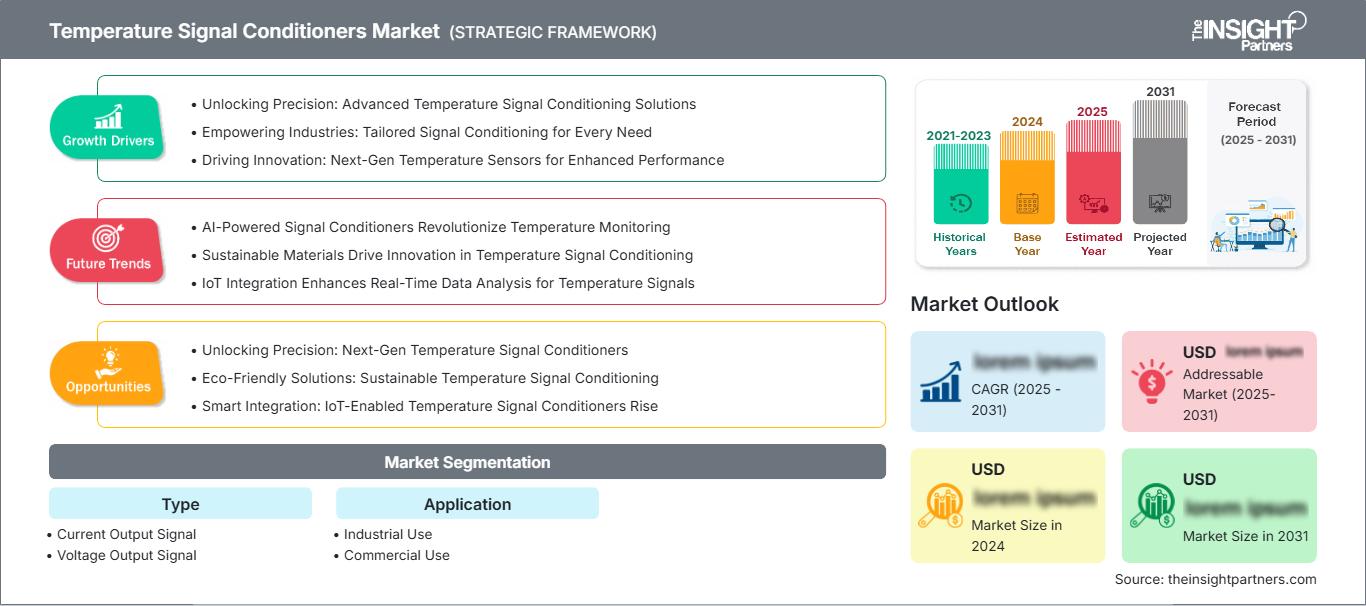
Temperature Signal Conditioners Market: Strategic Insights
Regional Insights
North America Temperature Signal Conditioners
North America held 32–35% share in 2025 and is expected to grow at a CAGR of 8.2–8.6% during 2026–2034. Demand is strongest in the US, followed by Canada and Mexico, where food processing, chemicals, energy, and advanced manufacturing sites continue replacing legacy analog panels with compact signal conditioning modules. Purchasers emphasize UL-listed components, fast technical support, and standardized 4–20 mA outputs for brownfield automation upgrades.
Structural drivers include industrial IoT deployment, reshoring of high-value manufacturing, and tighter operational safety requirements in temperature-critical facilities. Commercial applications are also expanding as building automation systems require accurate temperature conversion for HVAC optimization and energy management. The regional Temperature Signal Conditioners Market benefits from mature distributor coverage and installed PLC infrastructure.
U.S. Temperature Signal Conditioners Market
The US accounted for 78–82% of North America share in 2025 and is projected to grow at a CAGR of 8.3–8.7% during 2026–2034. Demand is concentrated in process industries, semiconductor fabrication support systems, utilities, laboratories, and packaged automation panels. Company presence is broad, with DwyerOmega, Red Lion Controls, Inc., Moore Industries-International, Inc., Keysight Technologies, Inc., and TE Connectivity Ltd. supporting domestic procurement channels.
Application trends show rising adoption of isolated current output devices in hazardous or electrically noisy environments, while voltage output modules gain traction in data logging and compact test systems. US buyers increasingly specify configurable units to reduce spare-part complexity across multi-site operations, strengthening replacement demand within the Temperature Signal Conditioners Market.
Europe Temperature Signal Conditioners Market
Europe represented 25–28% share in 2025 and is expected to grow at a CAGR of 7.8–8.2% during 2026–2034. Germany remains the leading country due to its automation-intensive machinery, chemical, automotive, and pharmaceutical sectors. German plants value precision, electromagnetic compatibility, and DIN-rail density, supporting adoption of configurable conditioners from established interface electronics suppliers.
The UK contributes through process safety upgrades, water infrastructure monitoring, pharmaceutical manufacturing, and energy transition projects. Demand is shaped by retrofit activity rather than only greenfield capacity, making technical documentation, replacement compatibility, and channel responsiveness important buying criteria. Commercial HVAC and building management projects also support selective voltage output adoption.
France, Italy, and Spain add demand from food processing, packaging, power, and industrial equipment manufacturing. France benefits from energy and life sciences projects, Italy from machinery exports and packaging lines, and Spain from renewable energy and industrial infrastructure modernization. Regional buyers favor products with recognized approvals and long service availability.
APAC Temperature Signal Conditioners Market
Asia Pacific accounted for 27–30% share in 2025 and is forecast to grow at a CAGR of 9.2–9.6% during 2026–2034. China is the leading country, supported by electronics, chemicals, renewable energy equipment, and large-scale manufacturing automation. Japan and South Korea add high-specification demand from automotive, semiconductor, and precision machinery plants.
India is moving from manual monitoring to automated process control in pharmaceuticals, food processing, and industrial utilities. Policy emphasis on domestic manufacturing and energy efficiency strengthens the need for dependable thermal measurement. Australia contributes through mining, energy, water infrastructure, and industrial safety applications.
Regional growth is also supported by expanding panel-building ecosystems and cost-sensitive demand for modular products. Vendors that balance price, approvals, and multilingual technical support are positioned to gain share as APAC facilities standardize temperature data acquisition.
Middle East & Africa Temperature Signal Conditioners Market
Middle East & Africa is projected to grow at a CAGR of 7.0–7.4% during 2026–2034. Saudi Arabia is the leading country, driven by oil and gas processing, petrochemicals, utilities, and industrial diversification projects. Temperature signal conditioning supports equipment protection, process safety, and control room visibility in harsh operating environments.
The UAE benefits from infrastructure, district cooling, commercial facilities, and energy management initiatives where accurate thermal signals support automated control. South Africa contributes demand from mining, power, water treatment, and food processing, with replacement cycles shaped by reliability and service availability.
Rest of MEA demand remains project-led, especially in energy, ports, and industrial zones. Buyers prioritize rugged products, isolation performance, and compatibility with international automation standards because local maintenance resources can be limited in remote assets.
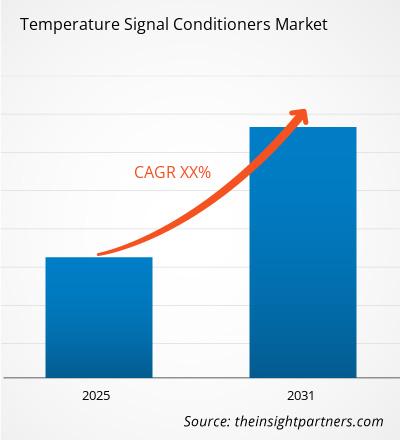
Segmentation Analysis
Type
The type segment is projected to grow at a CAGR of 8.4–8.8% during 2026–2034. Selection is primarily governed by the receiving control system, cable distance, electrical noise, and required accuracy. Current output remains dominant in industrial environments because 4–20 mA loops tolerate long runs and interference. Voltage output adoption is expanding where compact controllers, data loggers, and commercial monitoring systems need simple integration.
- Current Output Signal maintains the strongest market position in process plants, utilities, and heavy manufacturing because loop-powered transmission, isolation, and failure detection align well with long-distance industrial measurement requirements.
- Voltage Output Signal shows rising demand in data acquisition, laboratories, HVAC controls, and compact automation systems where shorter wiring distances and controller compatibility make voltage conversion strategically useful.
Application
The application segment is in the Temperature Signal Conditioners Market forecast is expected to grow at a CAGR of 8.5–8.9% during 2026–2034. Industrial use dominates because temperature integrity directly affects product consistency, asset protection, and process safety. Commercial use is expanding as smart buildings, energy management platforms, cold chain facilities, and HVAC systems require reliable signal conversion for automated monitoring and control decisions.
- Industrial Use leads revenue contribution as chemicals, oil and gas, pharmaceuticals, food processing, power, and machinery facilities require rugged signal conditioners for continuous control and compliance monitoring.
- Commercial Use is scaling through building automation, refrigeration, laboratories, and facility energy systems where stable sensor outputs help improve comfort, efficiency, and maintenance planning.
Opportunity Snapshot
| Application | Revenue Contribution | Trend Tag | Adoption Stage |
| Industrial Use | High | Process Safety | Mature |
| Commercial Use | Medium | Smart HVAC | Scaling |
Temperature Signal Conditioners Market Growth Drivers and Impact Analysis
Automation Retrofits in Process Industries
Brownfield instrumentation upgrades without total replacements of the whole control system require constant supplies of signal conditioners to connect old sensors to new PLCs and DCSs. Thermal drift becomes a problem in the case of temperature loops, which are among the most frequently updated in brownfield projects since it impacts product quality, energy savings, and equipment safety. The effect of this driver is demonstrated through the increase in demand for universal input signal conditioner, isolated signal conditioner, and DIN-rail signal conditioners that can help cut down engineering time at the panel upgrade stage.
Rising Need for Accurate Energy and Thermal Management
Energy efficiency in industries and commerce is becoming tighter with increased demand for power and increased variability in operating costs. Precise temperature readings will enable fine-tuning of boilers, chillers, furnaces, heat exchangers, refrigeration, and heating, ventilation and air conditioning systems. Conditioners reduce distortion in measurement by filtering out interference and converting raw sensor readings into standard signal that the control system can utilize. The implications on the market environment include wider applicability in domains outside process lines such as building automation, district cooling, and industrial utilities. The market for temperature signal conditioners size is therefore increasing.
Growth of Sensor-Dense Industrial IoT Architectures
There are many industrial IoT applications which require clear field data for the provision of any analysis, alarms, or even predictive maintenance features. Thermometer sensors are popular as the thermal performance of devices may show how healthy they are and the risks associated with their use. Such signal conditioners enable the interpretation of such data by reducing electrical interference, linearizing the output of sensors, and bringing the output into a form that is readable by edge gateways and controls systems. This driver contributes to the trends of temperature signal conditioners in relation to asset monitoring, diagnostic applications, and maintenance.
Temperature Signal Conditioners Market Future Trends
Software-Configurable Universal Input Modules
The future demand will shift towards universal modules that can be programmed to work for RTD, thermocouple, resistance, millivolt, current, or voltage inputs using software or near-field programming options. This simplifies SKUs for the distributors, panel manufacturers, and maintenance personnel. Audit ability will be an important feature due to regulation of industries that document calibration changes, ranges, and maintenance procedures. Suppliers within the Temperature Signal Conditioners Market will distinguish themselves by offering easy to use configuration software, parameter locking features, and diagnostics that minimize errors in the field. Universal modules could improve inventory management and implementation at global facilities.
Edge-Ready Signal Conditioning for Predictive Maintenance
Integration of signal conditioners with edge gateways, small controllers, and condition monitoring systems is anticipated. In contrast to previous generations where the signal conditioners would transmit analog values only, future products might be able to provide diagnostic services like detection of broken sensors, sensor drift, loop problems, and poor signal condition. This would be good for predictive maintenance as incorrect thermal data might lead to false alarms or might not show early degradation of equipment. Suppliers who will provide proper status output and information on how to integrate conditioners with other systems will increase their position in automation environments.
Temperature Signal Conditioners Market Opportunities
Standardized Retrofit Kits for Brownfield Automation
Retrofit kits comprising conditioners, terminal blocks, power supply, labeling, and configuration templates can be designed specifically for applications where there may be upgrade of process equipment. The Brownfield customers will have a tendency to have scattered wiring, old documentation, and limited downtime periods. This can result in a very good market opportunity for such kits that can be designed specifically for boilers, chillers, ovens, clean rooms, and chemical reactors. This is a good market opportunity since the vendors will be able to work with distribution partners and system integrators to preconfigure these kits.
Commercial Building Energy Optimization Programs
There are commercial buildings where HVAC, refrigeration, laboratories, and coolers use increasingly sophisticated digital controls to decrease their energy expenses and increase visibility of their assets. Signal conditioners for temperature may provide an opportunity to incorporate sensors from existing systems to new management systems for buildings without replacement of all field devices. Suppliers can reach out to facility managers, energy service companies, and contractors specializing in controls with small-size devices that have outputs of voltages and currents along with easy selection tools. The best chances will be found in buildings with mixed systems.
Recent Developments
- March 2026: Yokogawa Electric Corporation — the company continued promoting its JUXTA signal conditioner portfolio, highlighting compact VJ Series modules with wide I/O specifications, isolated outputs, field configurability, noise countermeasure functions, and longer lifecycle design for industrial measurement applications.
- January 2026: WAGO GmbH & Co. KG — the company expanded visibility for its signal conditioners and isolating amplifiers portfolio, emphasizing temperature signal conditioners for Pt, TC, Ni, KTY, and RTD sensors, plus push-in connection, configurable operation, and reliable transmission in harsh environments.
- May 2025: DwyerOmega — the company maintained its dedicated temperature signal conditioner selection platform, supporting comparison of signal conditioners for temperature measurement and reinforcing availability across thermocouple, RTD, transmitter, controller, data acquisition, and process instrumentation applications.
Frequently Asked Questions

- Comprehensive Market Sizing and Forecast Analysis
- Detailed Segmentation Analysis
- In-Depth Market Dynamics Assessment
- Regional and Country-Level Insights
- Competitive Landscape and Company Benchmarking
- Strategic Business Intelligence
Recent Reports
Testimonials

The Insight Partners provided valuable market intelligence that supported our global go-to-market strategy. Their team was professional, responsive, and attentive to our feedback, providing thoughtful analysis and helpful methodological clarifications throughout the project.
Junmo Kim Chief Financial Officer (CFO), Enertech Co., Ltd.
The Insight Partners' SCADA System Market report is comprehensive, with valuable insights on current trends and future forecasts. The team was highly professional, responsive, and supportive throughout. We are very satisfied and highly recommend their services.
RAN KEDEM Partner, Reali Technologies LTDs
I requested a report on a very specific software market and the team produced the report in a few days. The information was very relevant and well presented. I then requested some changes and additions to the report. The team was again very responsive and I got the final report in less than a week.
JEAN-HERVE JENN Chairman, Future Analytica
We worked with The Insight Partners for an important market study and forecast. They gave us clear insights into opportunities and risks, which helped shape our plans. Their research was easy to use and based on solid data. It helped us make smart, confident decisions. We highly recommend them.
PIYUSH NAGPAL Sr. Vice President, High Beam Global
The Insight Partners delivered insightful, well-structured market research with strong domain expertise. Their team was professional and responsive throughout. The user-friendly website made accessing industry reports seamless. We highly recommend them for reliable, high-quality research services
YUKIHIKO ADACHI CEO, Deep Blue, LLC.
This is the first time I have purchased a market report from The Insight Partners.While I was unsure at first, I visited their web site and felt more comfortable to take the risk and purchase a market report.I am completely satisfied with the quality of the report and customer service. I had several questions and comments with the initial report, but after a couple of dialogs over email with their analyst I believe I have a report that I can use as input to our strategic planning process.Thank you so much for taking the extra time and making this a positive experience.I will definitely recommend your service to others and you will be my first call when we need further market data.
JOHN SUZUKI President and Chief Executive Officer, Board Director, BK Technologies
I wish to appreciate your support and the professionalism you displayed in the course of attending to my request for information regarding to infectious disease IVD market in Nigeria. I appreciate your patience, your guidance, and the fact that you were willing to offer a discount, which eventually made it possible for us to close a deal. I look forward to engaging The Insight Partners in the future, all thanks to the impression you have created in me as a result of this first encounter.
DR CHIJIOKE ONYIA MANAGING DIRECTOR, PineCrest Healthcare Ltd.Reason to Buy
- Informed Decision-Making
- Understanding Market Dynamics
- Competitive Analysis
- Identifying Emerging Markets
- Customer Insights
- Market Forecasts
- Risk Mitigation
- Boosting Operational Efficiency
- Strategic Planning
- Investment Justification
- Tracking Industry Innovations
- Aligning with Regulatory Trends





 Get Free Sample for