
Tension Tester Market Growth, Trends & Forecast by 2034
Coverage: By Product (Wire Tension Tester, Belt Tension Tester, Screw Tension Tester, Others); Modularity (Handheld, Mounted); Type (Digital, Analog); Industry (Textile, Manufacturing, Automobile, Aviation, Wire, Medical, Fiber, Others) , and Geography (North America, Europe, Asia Pacific, and South and Central America)
- Status : Data Released
- Report Code : TIPRE00018435
- Category : Electronics and Semiconductor
- No. of Pages : 150
- Available Report Formats :


- Last update date : July 10, 2026


2025 Market Size
US$ 632.58 Mn
Base year value
2034 Forecast
US$ 957.85 Mn
Projected by 2034
CAGR 2026-2034
4.72 %
Growth rate
Addressable Market
US$ 7,220.73 Mn
(2026-2034)
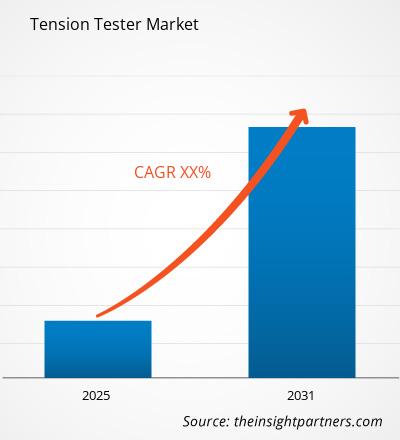
The Tension Tester Market size is projected to grow from US$ 632.58 Million in 2025 to US$ 957.85 Million by 2034; it is expected to register a CAGR of 4.72% during 2026–2034. Demand is supported by industrial quality control, maintenance verification, and precision measurement requirements across wire, textile, automotive, aviation, medical, fiber, and general manufacturing applications.
It is predicted that North America will grow at a rate of 4.3% to 4.7% CAGR during the forecast period due to its established aerospace maintenance, automotive production quality systems, and digital calibration trends. The presence of an extensive network of suppliers and manufacturers of testing equipment in North America helps drive the market.
Tension Tester Market Assessment and Insights
- North America: The region accounted for 31–34% Tension Tester Market share in 2025 and is projected to grow at a CAGR of 4.3–4.7% between 2026–2034, led by aviation, wire, and manufacturing quality assurance.
- US: The country represented 78–82% of North America in 2025 and is projected to grow at a CAGR of 4.4–4.8% between 2026–2034, reflecting automation-led inspection spending.
- Europe: Europe held a 25–28% share in 2025 and is projected to grow at a CAGR of 4.0–4.4% between 2026 and 2034, with Germany, the UK, France, and Italy leading precision testing adoption.
- Asia Pacific: APAC held 28–31% share in 2025 and is projected to grow at a CAGR of 5.0–5.4% between 2026–2034, driven by China, Japan, South Korea, and India.
- Largest Segment: Wire tension tester held 39–43% share of the Tension Tester market in 2025 and is projected to grow at a CAGR of 4.5–4.9% between 2026–2034.
- High Growth Segment: Digital type held 58–62% market share in 2025 and is projected to grow at a CAGR of 5.1–5.5% between 2026–2034.
- Key companies analyzed in detail: ADMET, Inc.; Electromatic Equipment Co., Inc.; Gates Corporation; Hans Schmidt & Co GmbH; IMADA Co., Ltd.; PCE Deutschland GmbH; PIX Transmissions Limited; Tension Measurement, Inc.; Vorpa S.r.l.; ABB Ltd.; Continental AG.
Source: The Insight Partners' analysis based on proprietary research, government publications, company annual reports, investor presentations, industry databases, and expert interviews.
Tension Tester Market has developed from analog gauges requiring manual input to digitally-based models featuring log data, USB capabilities, wireless technology, and software-based record keeping capabilities. Changes in the production process now see the adoption of small-sized portable testers for maintenance applications in the field and permanently installed testers for monitoring processes. Such developments are especially important in textile, wire, and belt conveyor manufacturing lines, where accuracy and quality records are now important decision-making criteria.
Demand in the future would be more inclined towards Asia Pacific industrial zones, North American aviation servicing centers, and advanced manufacturing hubs of Europe. With the focus on safety, accuracy of machines, and documentation, the Tension Tester market forecast has moved away from laboratory testing. The activities of predictive maintenance, industrial IoT, and digital calibration are making high-end equipment more lucrative.
Tension Tester Market Report Scope
| Report Attribute | Details |
|---|---|
| Market size in 2025 | US$ 632.58 Million |
| Market Size by 2034 | US$ 957.85 Million |
| Global CAGR (2026 - 2034) | 4.72% |
| Historical Data | 2021-2024 |
| Forecast period | 2026-2034 |
Tension Tester Market Analysis
Market demand is affected by production, maintenance, and safety considerations. Matching wire and cable production process to avoid breakage of wire, testing of yarns and filaments in the textile industry to maintain production capability, and maintaining proper belt tension in the automotive industry to avoid noise and energy loss are some examples of the applications contributing to the Tester market growth.
The supply chain includes sensor suppliers, mechanical fixturing producers, software firms, distribution channels, calibration centers, and maintenance units in the end-user companies. Market dynamics will remain somewhat fragmented because of differences in measurement ranges, roller geometries, and fixtures in various industries. Companies with a variety of accessories and service certification will be able to earn better profits.
The competitive environment consists of niche players in force measurement, along with diversified providers of industrial technologies. Tension Tester Market Report provides details of the following key players in the market: ADMET, Inc., Hans Schmidt & Co GmbH, IMADA Co., Ltd., PCE Deutschland GmbH, and Tension Measurement, Inc. Competing via accuracy of measurements, robustness of equipment, and engineering expertise in various applications. In addition, Gates Corporation, PIX Transmissions Limited, Continental AG, and ABB Ltd. provide relevant knowledge about belts, transmissions, and automation.
In terms of investment trends, preference is shown to equipment with digital interfaces and capabilities of software integration with maintenance logs. Positioning strategies increasingly rely upon channel capabilities, calibration speed, and capability to handle multiple materials. Electromatic Equipment Co., Inc. and regional distributors help in reaching small and medium producers, while product specialists target more valuable applications.
● REPORT CUSTOMIZATION
Tailor This Report To Align With Your Specific Business Requirements
This report can be customized to align precisely with your business objectives, scope, and target markets. Customization options include tailored segmentation, geography, competitive analysis, and strategic insights to support informed decision-making.
Customize This Report →WHAT YOU CAN ADJUST
- ● Segmentations
- ● Geography
- ● Competitive Analysis
- ● Language Preferences
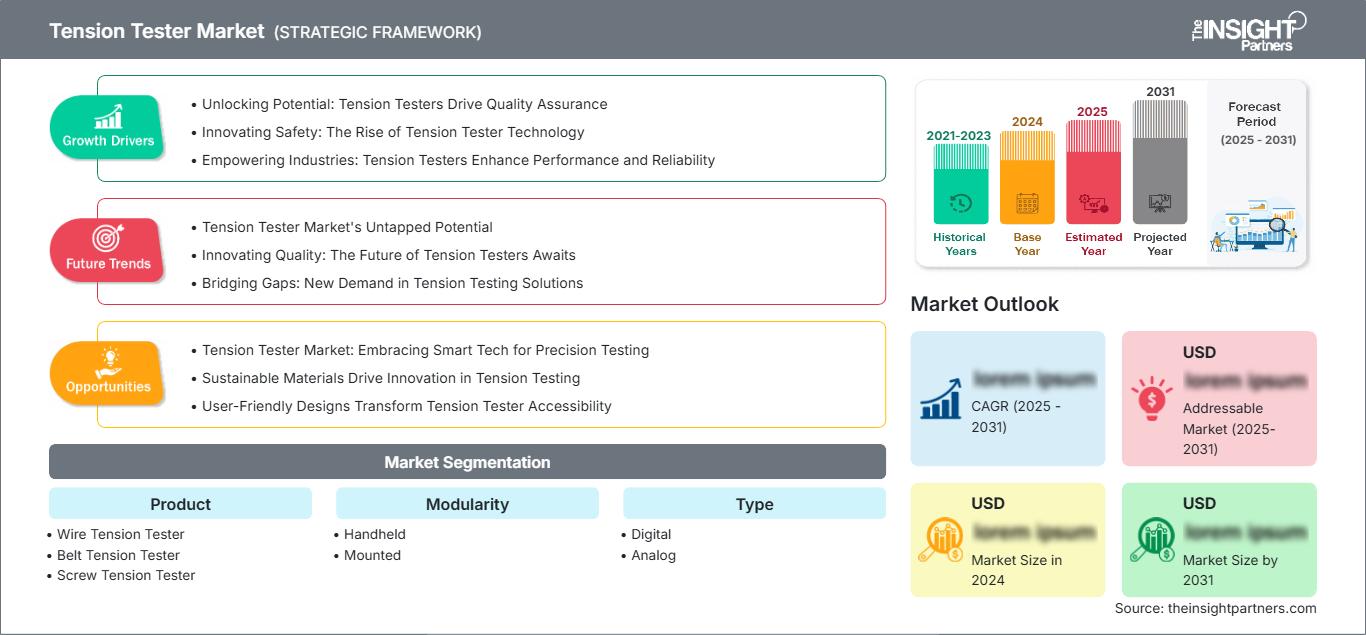
Tension Tester Market: Strategic Insights
Regional Insights
North America Tension Tester
North America held a 31-34% share of the Tension Tester Market in 2025 and is predicted to witness a CAGR of 4.3-4.7% over the forecast period 2026-2034. Demand growth will be driven by applications such as aerospace maintenance, automotive components testing, manufacturing of medical devices, and inspection of utility cables where accurate measurement helps reduce the risk of failure and audits.
In terms of structural demand drivers, there are OSHA-led equipment safety standards, growing predictive maintenance programs, and an excellent distribution channel network in the region. There is also the presence of companies such as Electromatic Equipment Co., Inc., ADMET, Inc., Gates Corporation, and Tension Measurement, Inc. in the region.
U.S. Tension Tester Market
The U.S. constituted 78% to 82% of North America in 2025 and is expected to have a CAGR of 4.4% to 4.8% between 2026 and 2034. The applications include aviation MRO, automotive assembly facilities, wiring harness fabrication, and medical device manufacturing applications wherein repeatable pull, belt and wire tension measurement are linked to documentation.
Firms are associated with their applications. ADMET, Inc. provides materials testing equipment, Electromatic Equipment Co., Inc. sells Checkline accurate measuring instruments, and Gates Corporation affects belt maintenance procedures. The digital instrumentation with calibration certification is favored by U.S. purchasers over equipment price due to concerns over downtime, liability issues and audits.
Europe Tension Tester Market
Europe held 25–28% share in 2025 and is projected to grow at a CAGR of 4.0–4.4% during 2026–2034. Germany leads regional demand through machinery, automotive, wire, and industrial automation activity, supported by strict quality systems and long-standing engineering procurement practices.
The UK market will benefit from aerospace services, laboratory testing, and manufacturing expertise. The users require handheld and electronic instruments that can perform under all conditions of maintenance. Textile machinery, industrial belts, cable manufacturing, and transport maintenance from France, Italy, and Spain are beneficial when prevention inspection reduces unexpected downtime.
Hans Schmidt & Co GmbH, PCE Deutschland GmbH, Vorpa S.r.l., Continental AG, and ABB Ltd. bring credibility to the region through instruments, industrial systems, and distribution channels. European adoption depends on the need for traceability, machinery practices related to CE, and repeatable tension testing in high-mix production environments.
APAC Tension Tester Market
APAC accounted for 28–31% share in 2025 and is expected to register a CAGR of 5.0–5.4% during 2026–2034, making it the fastest-growing region. China leads demand, supported by large-scale wire, textile, automotive, and electronics manufacturing.
Japan and South Korea focus on accuracy, compatibility, and traceability, whereas India is catching up due to its manufacturing growth and cable needs related to infrastructure. Australia adds value with the help of mining, energy, and industrial maintenance applications.
Policy-led industrial upgrading, export quality requirements, and factory automation are strengthening Tension Tester analysis across the region. Suppliers with durable handheld products, localized distributors, and calibration support are positioned to capture incremental purchases from small and mid-sized plants.
Middle East & Africa Tension Tester Market
Middle East & Africa is projected to grow at a CAGR of 3.8–4.2% during 2026–2034. Saudi Arabia leads regional demand as infrastructure, energy, and industrial diversification programs increase maintenance and testing requirements.
The UAE market is shaped by aviation, logistics, and facility maintenance, while South Africa contributes through mining, manufacturing, and wire applications. Rest of MEA demand remains project-linked, especially in energy, ports, and construction supply chains.
Adoption is more service-led than production-led, with buyers prioritizing rugged devices and distributor availability. Energy infrastructure, conveyor reliability, and cable installation quality create steady demand, although budget cycles and import dependency moderate growth versus APAC and North America.
Segmentation Analysis
Product
The product segment in the Tension Tester market is expected to grow at a CAGR of 4.4–4.9% during 2026–2034. Demand varies by measured component, with wire testers supporting cable and filament quality, belt testers serving maintenance reliability, and screw tension testers supporting fastening integrity. Product selection is increasingly tied to measurement range, portability, data capture, and calibration traceability.
- Wire Tension Tester: This sub-segment leads because cable, textile, fiber, and wire producers require repeatable tension control to prevent breakage, uneven winding, and quality deviations during high-speed processing.
- Belt Tension Tester: Adoption is driven by conveyor, automotive, and industrial drive maintenance, where correct belt tension reduces slippage, vibration, energy loss, and premature component wear.
- Screw Tension Tester: Demand is tied to fastening reliability in machinery, construction, and assembly operations, where verification of applied tension helps reduce loosening, fatigue, and safety-related failures.
Modularity
The modularity segment in the Tension Tester market is projected to grow at a CAGR of 4.5–5.0% during 2026–2034. Handheld units dominate maintenance and inspection environments because they are portable and cost-effective. Mounted systems are gaining relevance in continuous production lines where real-time process control and automated alarms reduce operator intervention.
- Handheld: Handheld testers remain essential for field technicians, quality inspectors, and maintenance teams that need flexible measurement across multiple machines, lines, or customer sites.
- Mounted: Mounted testers support continuous monitoring in textile, wire, and belt applications, where fixed sensors improve consistency, reduce manual checks, and enable process-linked tension correction.
Type
The type segment in the Tension Tester market is expected to grow at a CAGR of 4.7–5.2% during 2026–2034. Digital testers are gaining share as users require saved readings, software integration, and reduced interpretation error. Analog devices remain relevant for simple checks, harsh sites, and cost-sensitive buyers with limited reporting requirements.
- Digital: Digital testers support the strongest adoption because they improve readability, store inspection data, connect with maintenance systems, and help plants document compliance-driven measurement routines.
- Analog: Analog devices remain valued for durability, simplicity, and lower cost, especially in basic maintenance environments where operators need quick visual readings without software dependency.
Industry
The industry segment in the Tension Tester market is projected to grow at a CAGR of 4.6–5.1% during 2026–2034. Manufacturing and wire applications generate broad baseline demand, while aviation, medical, and fiber applications require tighter documentation and higher precision. Industry-specific fixtures, calibration intervals, and environmental durability strongly influence procurement decisions.
- Textile: Textile users rely on yarn and filament tension control to maintain fabric uniformity, reduce breakage, and improve throughput on winding, weaving, and finishing lines.
- Manufacturing: General manufacturing demand comes from preventive maintenance, assembly validation, and quality control programs that require fast verification of belts, wires, springs, and fastened components.
- Automobile: Automotive plants use testers for belt drives, wire harnesses, and component validation, supporting reliability targets, warranty reduction, and consistent assembly line performance.
- Aviation: Aviation applications prioritize traceability and accuracy because cable, belt, and fastening integrity can directly affect maintenance records, operational reliability, and safety assurance.
- Wire: Wire producers require frequent tension verification during drawing, winding, coating, and cabling processes to reduce scrap, improve surface quality, and stabilize line speed.
- Medical: Medical manufacturers use tension testing for tubing, sutures, wires, and device components where repeatable measurement supports product validation and regulated quality systems.
- Fiber: Fiber applications include optical fiber, technical yarn, and filament handling, where controlled tension protects product integrity and prevents micro-damage during production.
Opportunity Snapshot
| Industry | Revenue Contribution | Trend Tag | Adoption Stage |
| Textile | Medium | Yarn Control | Mature |
| Manufacturing | High | Line Uptime | Mature |
| Automobile | High | Belt Reliability | Scaling |
| Aviation | Medium | MRO Traceability | Scaling |
| Wire | High | Cable Quality | Mature |
| Medical | Medium | Validation Records | Scaling |
| Fiber | Medium | Filament Integrity | Emerging |
Tension Tester Market Growth Drivers and Impact Analysis
Rising Preventive Maintenance Across Automated Production
Automation makes any unscheduled downtime more costly, turning tension testing into an effective method of maintenance control rather than optional inspection. Conveyor belts, drive belts, wires, and filaments move faster in today’s facilities, and slight imbalances result in vibration, waste or premature wear. The market for Tension Tester will prosper as factories move from repair-oriented work to scheduling regular measurements. Digital testing will add value through the ability to document results and track them over time for maintenance purposes.
Quality Documentation in Regulated and Export-Oriented Industries
Documentation of inspection results is becoming more and more important among buyers from the medical industry, aviation, automobile sector, and manufacturers of exports. This demand for documentation can be covered by tension testers that produce consistent readings on cables, sutures, belts, fasteners, and fibers used to make safety or performance-related products. In case of customers who undergo auditing process, warranty claims, or evaluation of suppliers, the importance of these devices is at its maximum.
Expansion of Wire, Fiber, and Belt-Driven Industrial Systems
The growth in the number of cable network applications, factory automation, textile manufacturing, and logistics operations increases the number of components that need to be managed under tension control. Activities such as wire drawing, handling of optical fibers, belt conveyance, and rotating machinery all have to be carefully managed to ensure there is no breakage, slippage, or variability in the quality of the final product. It enables the Tension Tester sales through new product purchases and replacements of old analog systems that lack traceability.
Tension Tester Market Future Trends
Connected Measurement and Maintenance Data Integration
Tension Tester market trends will revolve around the use of testers that link measurement activity with maintenance systems of enterprises. Consumers are bound to be attracted to measurement equipment that is capable of exporting data, recognizing the person making the measurement, stamping the date and time of inspection, and providing trend reporting. This trend is not expected to displace portable tension testers, but rather ensure that portability goes together with a digital audit trail.
Application-Specific Fixtures and Miniaturized Sensors
Specialized fixtures and miniaturization would determine the differentiation of products in the future as end users test smaller fibers, narrower belts, micro-wires, and difficult to reach assemblies. Standard probes often fall short where there is lack of access, delicate materials, and fast assembly lines. In the future, product innovation would focus on roller interchangeability, low force ranges, wireless probes, and small probe heads. The Tension Tester market share in premium equipment would grow since customers would buy solutions to specific process challenges.
Tension Tester Market Opportunities
Calibration Services and Lifecycle Support Bundles
One area of opportunity is the bundling of instrumentation with services such as calibration, repairs, training, and documentation. The majority of end-users do not have their own metrology department but need to prove that they have consistent measurement processes in place during auditing or customer reviews. Service offerings help to generate repeat business through annual service agreements, loaners, and quick calibration turnaround times. Such an approach not only strengthens the bond between customers and companies but also increases future sales as replacements occur from the existing service base.
Localized Growth in APAC Mid-Market Manufacturing
APAC provides a lucrative chance within the category of medium-size manufacturers who are moving up from manual testing or cheap analog devices. The customers in China, India, Southeast Asia, and South Korea are more than ever in need of cheap digital testers that enhance quality but do not necessitate expensive automation. Those companies that localize manuals, train distributors, and have access to calibration can seize this volume chance as well as increase brand equity.
Recent Developments
- June 2026: Hans Schmidt & Co GmbH — highlighted its electronic tension meter range for textile and wire industry applications, including handheld units, compact measuring heads, software support, and interfaces such as USB, RS-232, RS-422, and WLAN for data processing in tension measurement workflows
- May 2026: ADMET, Inc. — emphasized ISO/IEC 17025:2017 accredited calibration and service programs for materials testing systems, supporting traceability to ASTM and ISO standards and helping customers maintain measurement integrity for audit-sensitive quality control environments
- July 2025: IMADA Co., Ltd. — continued promoting digital force gauge capabilities with high-speed sampling, software-based data management, and handheld measurement functions, supporting tension and compression testing applications across quality control and product validation workflows
Frequently Asked Questions

- Comprehensive Market Sizing and Forecast Analysis
- Detailed Segmentation Analysis
- In-Depth Market Dynamics Assessment
- Regional and Country-Level Insights
- Competitive Landscape and Company Benchmarking
- Strategic Business Intelligence
Recent Reports
Testimonials

The Insight Partners provided valuable market intelligence that supported our global go-to-market strategy. Their team was professional, responsive, and attentive to our feedback, providing thoughtful analysis and helpful methodological clarifications throughout the project.
Junmo Kim Chief Financial Officer (CFO), Enertech Co., Ltd.
The Insight Partners' SCADA System Market report is comprehensive, with valuable insights on current trends and future forecasts. The team was highly professional, responsive, and supportive throughout. We are very satisfied and highly recommend their services.
RAN KEDEM Partner, Reali Technologies LTDs
I requested a report on a very specific software market and the team produced the report in a few days. The information was very relevant and well presented. I then requested some changes and additions to the report. The team was again very responsive and I got the final report in less than a week.
JEAN-HERVE JENN Chairman, Future Analytica
We worked with The Insight Partners for an important market study and forecast. They gave us clear insights into opportunities and risks, which helped shape our plans. Their research was easy to use and based on solid data. It helped us make smart, confident decisions. We highly recommend them.
PIYUSH NAGPAL Sr. Vice President, High Beam Global
The Insight Partners delivered insightful, well-structured market research with strong domain expertise. Their team was professional and responsive throughout. The user-friendly website made accessing industry reports seamless. We highly recommend them for reliable, high-quality research services
YUKIHIKO ADACHI CEO, Deep Blue, LLC.
This is the first time I have purchased a market report from The Insight Partners.While I was unsure at first, I visited their web site and felt more comfortable to take the risk and purchase a market report.I am completely satisfied with the quality of the report and customer service. I had several questions and comments with the initial report, but after a couple of dialogs over email with their analyst I believe I have a report that I can use as input to our strategic planning process.Thank you so much for taking the extra time and making this a positive experience.I will definitely recommend your service to others and you will be my first call when we need further market data.
JOHN SUZUKI President and Chief Executive Officer, Board Director, BK Technologies
I wish to appreciate your support and the professionalism you displayed in the course of attending to my request for information regarding to infectious disease IVD market in Nigeria. I appreciate your patience, your guidance, and the fact that you were willing to offer a discount, which eventually made it possible for us to close a deal. I look forward to engaging The Insight Partners in the future, all thanks to the impression you have created in me as a result of this first encounter.
DR CHIJIOKE ONYIA MANAGING DIRECTOR, PineCrest Healthcare Ltd.Reason to Buy
- Informed Decision-Making
- Understanding Market Dynamics
- Competitive Analysis
- Identifying Emerging Markets
- Customer Insights
- Market Forecasts
- Risk Mitigation
- Boosting Operational Efficiency
- Strategic Planning
- Investment Justification
- Tracking Industry Innovations
- Aligning with Regulatory Trends





 Get Free Sample for