
Test Benches Market Size, Trends & Growth by 2034
Coverage: By Component (Hardware, Software); Type (Valve, Force, Torque, Others); Test Stands (Manual, Motorized); Application (Semiconductor and Electronics, Industrial Manufacturing and Engineering, Automotive and Transportation, Power Generation and Utilities, Oil and Gas, Others), and Geography (North America, Europe, Asia Pacific, and South and Central America)
- Status : Data Released
- Report Code : TIPRE00013810
- Category : Electronics and Semiconductor
- No. of Pages : 150
- Available Report Formats :


- Last update date : July 13, 2026


2025 Market Size
US$ 1.29 Bn
Base year value
2034 Forecast
US$ 1.96 Bn
Projected by 2034
CAGR 2026-2034
4.76 %
Growth rate
Addressable Market
US$ 14.75 Bn
(2026-2034)
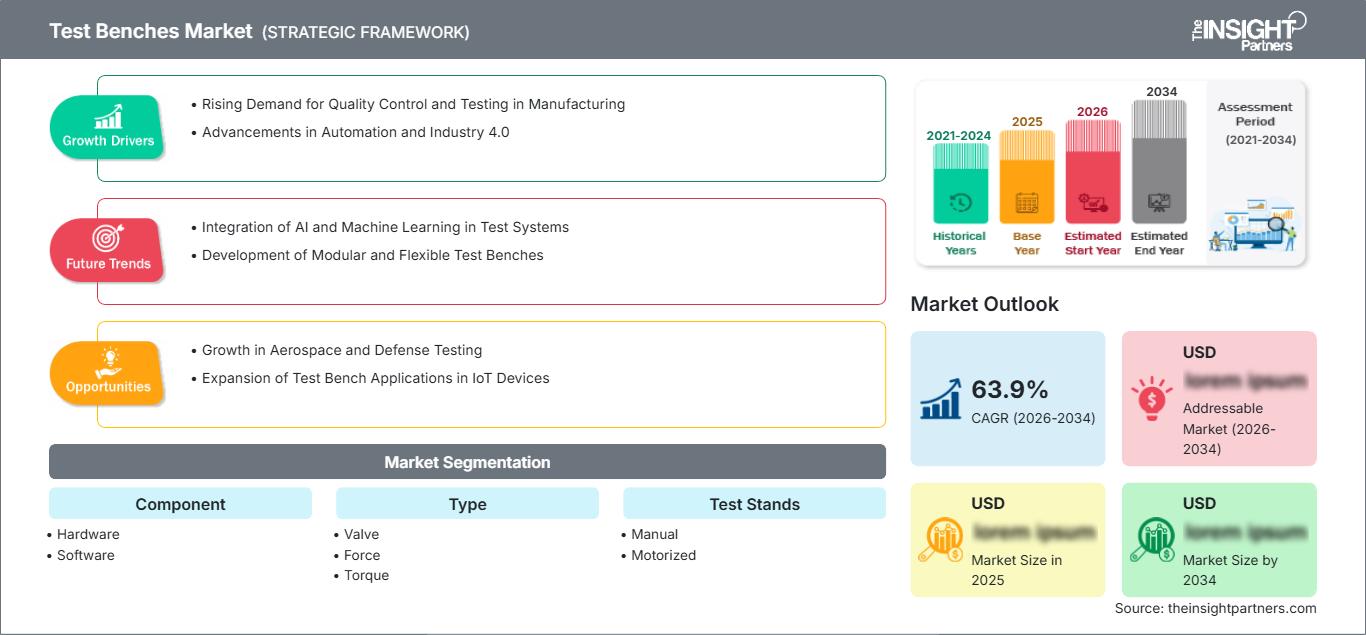
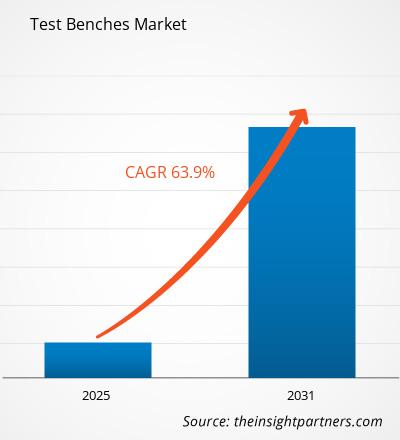
The Test Benches Market size is expected to reach US$ 1.96 Billion by 2034 from US$ 1.29 Billion in 2025. The market is estimated to record a CAGR of 4.76% from 2026 to 2034. Demand is supported by precision validation needs across semiconductor and electronics, industrial manufacturing, automotive and transportation, power generation and utilities, and oil and gas applications.
North America Test Benches Market is expected to record a 4.4–4.8% CAGR during 2026–2034, driven by software-defined vehicle validation, factory automation upgrades, and safety-critical testing requirements. The region benefits from established automotive engineering centers, aerospace qualification activity, and energy infrastructure modernization, which collectively raise procurement of modular, software-enabled test benches for torque, force, valve, and electromechanical testing workflows.
Test Benches Market Assessment and Insights
- North America: The region held 30–33% of the Test Benches Market share in 2025 and is projected to grow at 4.4–4.8% CAGR between 2026–2034, supported by EV validation, aerospace testing, and automated inspection investments.
- US: The country accounted for 76–79% of North America share in 2025 and is expected to grow at 4.5–4.9% CAGR between 2026–2034, led by automotive software validation.
- Europe: The region represented 25–28% share in 2025 and is forecast to expand at 4.1–4.5% CAGR between 2026–2034, with Germany, the UK, France, Italy, and Spain leading adoption.
- Asia Pacific: The region captured 28–31% share in 2025 and is expected to grow at 5.3–5.8% CAGR between 2026–2034, led by China, Japan, South Korea, and India.
- Largest Segment: Hardware held 52–55% market share in 2025 and is projected to grow at 4.0–4.4% CAGR between 2026–2034 due to sensor, actuator, frame, and fixture demand.
- High Growth Segment: Software accounted for 45–48% market share in 2025 and is expected to grow at 5.5–6.1% CAGR between 2026–2034 as digital twins and automation expand.
- Key companies analyzed in detail: Atlas Copco AB, dSPACE GmbH, ETH-messtechnik GmbH, JM Test Systems, LLC, Mark-10 Corporation, Nidec Industrial Solutions S.p.A., OPAL-RT TECHNOLOGIES Inc., Robert Bosch GmbH, SELHA Group, VTB Valve Test Bench Manufacturing Co., Ltd.
Source: The Insight Partners' analysis based on proprietary research, government publications, company annual reports, investor presentations, industry databases, and expert interviews.
The Test Benches Market forecast has evolved from mechanically isolated benches to validation solutions consisting of hardware, sensors, automation controller, and analytics software. Manufacturers have increasing need for repeatable tests since components are subjected to greater tolerances, stresses, and electronic control systems. The evolution can be seen in test solutions for electric vehicle powertrains, semiconductor packaging, valves integrity, and torque verification in industry applications where quick feedback ensures lesser rework and higher assurance for product release.
In coming years, growth in manufacturing centers, safety, emission, reliability and grid resilience requirements for manufactured products will expand the Test Benches Market size. It is expected that investors will prefer modular benches suitable for a range of applications compared to purpose-built benches. Suppliers with mechanical design and calibration expertise along with software integration capabilities will be more attractive to buyers.
Test Benches Market Report Scope
| Report Attribute | Details |
|---|---|
| Market size in 2025 | US$ 1.29 Billion |
| Market Size by 2034 | US$ 1.96 Billion |
| Global CAGR (2026 - 2034) | 4.76% |
| Historical Data | 2021-2024 |
| Forecast period | 2026-2034 |
Test Benches Market Analysis
Factors affecting demand include more rigorous product qualification cycles, higher levels of device complexity, and component verification prior to field use. Test Benches facilitate connections between frame suppliers, load cells, valves, actuators, software, data acquisition modules, calibration, and system integration services. Thus, value chain favors suppliers of test benches with a capability to accelerate the commissioning process without sacrificing the repeatability of measurements.
Mixed supply factors include the lengthy qualification cycles for precision measuring instruments and industrial controllers as well as local production capabilities to minimize lead times. In addition, the Test Benches Market development will be facilitated by miniaturized electronics, high voltage mobility systems, and energy equipment monitoring requiring benches that simulate working conditions of the equipment under controlled loads and electronic documentation.
The Test Benches market report focuses on a competitive environment that features diversified industrial companies and specialty validation organizations. Industrial scale and engineering capabilities make Atlas Copco AB and Robert Bosch GmbH competitive in Test Benches Market, while dSPACE GmbH and OPAL-RT TECHNOLOGIES Inc. improve software-based simulation offerings in this market segment. Mark-10 Corporation, ETH-messtechnik GmbH, and VTB Valve Test Bench Manufacturing Co., Ltd. target specialty mechanical and valve testing needs.
The focus of investment is gradually changing towards modular systems, predictive diagnostics and software-based verification. Some examples of companies that fit this criteria include JM Test Systems, LLC, Nidec Industrial Solutions S.p.A. and SELHA Group. Differentiation through strategic integration and application engineering and regional coverage is becoming important for the industry.
● REPORT CUSTOMIZATION
Tailor This Report To Align With Your Specific Business Requirements
This report can be customized to align precisely with your business objectives, scope, and target markets. Customization options include tailored segmentation, geography, competitive analysis, and strategic insights to support informed decision-making.
Customize This Report →WHAT YOU CAN ADJUST
- ● Segmentations
- ● Geography
- ● Competitive Analysis
- ● Language Preferences
Test Benches Market: Strategic Insights
Regional Insights
North America Test Benches
North America held 30–33% share in 2025 and is expected to expand at 4.4–4.8% CAGR. Adoption is mainly limited to automotive software testing, aerospace component testing, torque measurement in industries, and inspection of power equipment. The Test Benches Market share in the region is bolstered by engineering companies needing repeated validation of loads, pressures, and signals.
The installation base in the region is well established, although the need for replacements is increasing as the old manual test benches are inadequate for traceability and frequency testing. The adoption needs for integrated hardware and software test benches are driven by EV platforms, grid modernization, and semiconductors quality testing.
U.S. Test Benches Market
The U.S. accounted for 76–79% of North America share in 2025 and is projected to grow at 4.5–4.9% CAGR. Automotive, aerospace, semiconductor, and energy customers are investing in validation benches that can manage high-voltage electronics, mechanical loads, and automated data capture across development and production floors.
Company presence is supported by domestic calibration networks, engineering service providers, and automation specialists. Application trends favor motorized test stands, software-enabled fixtures, and real-time simulation benches for software-defined vehicles. U.S. buyers increasingly assess total validation throughput, not just equipment price, which benefits suppliers offering commissioning, calibration, and lifecycle service support.
Europe Test Benches Market
Europe represented 25–28% share in 2025 and is expected to grow at 4.1–4.5% CAGR. Germany remains the leading country because automotive powertrain engineering, industrial automation, and machinery exports require rigorous validation benches for torque, valve, and electromechanical performance.
The UK is shaped by aerospace, defense, motorsport, and advanced manufacturing programs that require repeatable testing and documentation. Buyers prioritize flexible rigs that can validate low-volume, high-complexity components and support compliance-oriented workflows in propulsion, materials, electronics, and industrial systems.
France, Italy, and Spain contribute through energy infrastructure, industrial machinery, transport equipment, and electronics manufacturing. France benefits from aerospace and nuclear-adjacent testing needs, Italy from machinery and valve production, and Spain from automotive assembly and renewable power equipment qualification.
APAC Test Benches Market
APAC captured 28–31% share in 2025 and is expected to grow at 5.3–5.8% CAGR, making it the fastest-expanding regional opportunity. China leads due to electronics, EV, industrial equipment, and power infrastructure scale.
Japan and South Korea add high-precision demand from automotive electronics, semiconductors, robotics, and battery systems. Their manufacturers emphasize repeatability, low measurement uncertainty, and integration between laboratory validation and automated production testing.
India and Australia support regional growth through manufacturing incentives, energy projects, mining equipment, and transport modernization. Localized assembly and service capability are increasingly important as buyers seek shorter installation cycles and lower downtime.
Middle East & Africa Test Benches Market
Middle East and Africa is expected to grow at 3.8–4.2% CAGR, led by Saudi Arabia. Energy diversification, refinery maintenance, valve testing, and utility infrastructure create demand for durable benches that validate pressure, torque, and functional reliability.
The UAE supports adoption through aviation, logistics, advanced manufacturing, and clean-energy investments, where qualification equipment helps maintain asset reliability and certification readiness. Buyers often favor imported systems backed by local service partnerships.
South Africa and the rest of MEA contribute through mining, utilities, oil and gas servicing, and industrial maintenance. Growth is slower than APAC because procurement is project-linked, yet lifecycle testing needs remain structurally important.
Segmentation Analysis
Component
The component segment in the Test Benches Market is expected to grow at 4.7–5.1% CAGR during 2026–2034. Hardware remains the purchasing anchor because physical structures, sensors, actuators, and measurement devices define accuracy and durability. Software is gaining strategic weight as customers require automated sequences, real-time monitoring, digital twins, and standardized data exports for quality systems.
- Hardware holds the largest spending position because customers require robust frames, fixtures, load cells, pressure modules, drives, and control cabinets that can withstand continuous industrial validation cycles.
- Software is increasingly strategic as automated procedures, analytics dashboards, digital records, and simulation interfaces improve throughput, reduce operator variation, and support remote troubleshooting.
Type
The type segment in the Test Benches Market is projected to grow at 4.5–4.9% CAGR from 2026–2034. Valve benches remain important in energy, utilities, and process industries, while force and torque benches benefit from industrial quality assurance and electromechanical component validation. Buyers increasingly select configurable platforms to serve multiple test programs and reduce capital duplication.
- Valve benches serve oil and gas, utilities, and industrial maintenance teams that need leak, pressure, and functional validation before installation, overhaul, or safety-critical recommissioning.
- Force benches are used in materials, electronics, packaging, and mechanical assemblies where controlled compression, tension, or fatigue testing supports product reliability and specification compliance.
- Torque benches support rotating components, fasteners, motors, tools, and drivetrain systems, making them important for manufacturing plants seeking repeatable mechanical performance verification.
Test Stands
The test stands segment in the Test Benches Market is expected to grow at 4.6–5.0% CAGR during 2026–2034. Manual stands remain relevant where testing volumes are moderate and operator control is acceptable. Motorized stands are gaining share because they deliver consistent speed, load application, and repeatability, especially in production environments with frequent quality checks.
- Manual stands retain demand among laboratories, maintenance shops, and lower-volume production lines that value affordability, setup simplicity, and operator flexibility for varied test routines.
- Motorized stands are preferred in higher-throughput facilities because programmable motion, consistent force application, and data integration improve repeatability and reduce human-dependent measurement variation.
Application
The application segment is projected to grow at 4.8–5.2% CAGR between 2026–2034. Automotive and transportation, semiconductor and electronics, and industrial manufacturing remain core demand pools. Power generation, utilities, and oil and gas add resilience because infrastructure operators need reliable validation of valves, rotating assets, electrical components, and safety-critical systems.
- Semiconductor and electronics users require precise validation for circuit assemblies, sensors, connectors, and packaging, with demand shaped by miniaturization, thermal performance, and functional reliability requirements.
- Industrial manufacturing and engineering buyers use benches for incoming inspection, process validation, and end-of-line quality checks across machinery, tools, actuators, and mechanical assemblies.
- Automotive and transportation customers need benches for EV systems, powertrain components, braking, steering, ADAS-related hardware, and software-defined vehicle validation under repeatable operating conditions.
- Power generation and utilities deploy benches for equipment reliability, grid asset maintenance, switchgear-related components, valves, and rotating machinery used in conventional and renewable power systems.
- Oil and gas operators rely on valve and pressure testing benches to reduce leakage risk, support maintenance turnarounds, and validate critical equipment before field redeployment.
Opportunity Snapshot
| Segment Name | Revenue Contribution | Trend Tag | Adoption Stage |
| Semiconductor and Electronics | High | Chip Validation | Scaling |
| Industrial Manufacturing and Engineering | High | Factory QA | Mature |
| Automotive and Transportation | High | EV Testing | Scaling |
| Power Generation and Utilities | Medium | Grid Assets | Scaling |
| Oil and Gas | Medium | Valve Integrity | Mature |
| Others | Low | Custom Rigs | Emerging |
Test Benches Market Growth Drivers and Impact Analysis
Rising Complexity of Electrified and Software-Defined Products
Electric cars, automatic equipment, intelligent grid equipment, and connected industrial machines need verification not only mechanically but also electrically, thermally, and software-wise. This increases the need for benches that provide both physical stress and measurement and simulation software capabilities. In the Test Benches Market, this is most important in cases when there is a risk of product failure which will cause problems related to safety, liability, or legislation. Customers are replacing separate rigs with systems that simulate different scenarios and gather reliable data. As a result, more money is being spent on motorized stands and HIL systems with software solutions.
Quality Assurance Pressure in High-Precision Manufacturing
The reason for stricter quality control measures from manufacturers is that narrow tolerances and increased automation speed make any defects at the later stages even costlier. The test bench allows identifying problems such as leakage, torque variation, fatigue characteristics, loading behavior, and inconsistency in functionality before products are shipped to the customer or field assets. This effect can be traced in the following market segments: semiconductors, electronics, machinery, valves, and mobility systems, where repeatability leads to better yield and reduced number of recalls. The driver under consideration makes Test Benches Market more understandable through connecting equipment purchase with operational results.
Infrastructure Maintenance and Energy Reliability Requirements
Utilities, refineries, power plants, and other industrial organizations need proven devices in order to minimize downtimes and accidents. The use of valves, pressure, torque, and rotating equipment test benches is very important while carrying out maintenance, during commissioning, and while extending asset life spans. With the development of grids through the integration of renewables and technological upgrade of the industries, there is an ongoing need for validation equipment that will guarantee the performance of these machines under controlled conditions. This is a factor that enables consistent purchasing despite variations in the number of capital investments.
Test Benches Market Future Trends
Digital Twin-Linked Validation Workflows
The future test bench will be connected with simulation and physical result comparisons. It will happen mostly within sectors such as mobility, electronics, and power. In those areas, simulation can help speed up the prototyping process but the physical validation is still required. Companies which provide integration of data collection, model integration, and report generation services will obtain more valuable projects. According to the Test Benches Market trends, there is a transition from equipment purchase only to validation architecture choice, when test bench becomes an element of the engineering data chain.
Service-Enabled and Remotely Supported Test Platforms
With the rising software content on test benches, the customers are expected to demand services such as remote diagnostics, calibration notifications, troubleshooting assistance, and lifecycle services. These demands will be met better by companies having service networks regionally and capabilities for connectivity. The ability to provide remote services can lower downtime at geographically dispersed facilities as well as help smaller groups manage more sophisticated machines. In the Test Benches Market, the service-enabled platforms will provide revenue streams to the suppliers in the form of software upgrades, calibration, and performance monitoring.
Test Benches Market Opportunities
Modular Platforms for Multi-Industry Validation Labs
The supplier’s growth lies in providing modular benches which would cater to multiple uses with the help of interchangeable fixtures, recipes, and sensors. This concept is attractive to contract testing laboratories, academic institutions, OEM engineering centers, and industries that require flexibility without buying a separate rig for each family of products. The market potential is highest for those who value budget efficiency and quick reconfigurability. Modularity enables suppliers to charge premium prices and sell more after-market fixtures, while increasing customers’ loyalty. Moreover, modularity positively impacts the forecast for Test Benches Market size by moving from one-time sales to platforms.
Localized Service and Calibration Networks in Emerging Hubs
The nascent manufacturing hubs usually experience time lags as far as the provision of customized testing facilities is concerned as it needs external support from abroad. The firms that create local support systems of calibration, spare parts, commissioning, and training will be able to distinguish themselves from others in terms of product specifications. Such an option is quite important for India, Southeast Asia, the Middle East, and some parts of Eastern Europe as industrialization in these regions is growing but not fully developed yet in terms of services.
Recent Developments
- April 2025: dSPACE GmbH — MAHA and dSPACE announced collaboration to develop and market vehicle-in-the-loop test benches for periodic technical inspections and functional tests of automated and autonomous vehicles. The platform combines chassis dynamometer capability with simulation-based ADAS and autonomous driving sensor stimulation for lifecycle safety checks.
- January 2025: dSPACE GmbH — Stellantis and dSPACE signed a non-binding memorandum of understanding to integrate dSPACE’s VEOS platform into the Stellantis Virtual Engineering Workbench. The initiative supports cloud-based software-in-the-loop testing, enabling engineers to validate vehicle software before production hardware availability.
- December 2024: dSPACE GmbH — dSPACE announced its CES 2025 showcase for end-to-end SIL and HIL validation, including power electronics simulation software capable of highly dynamic switching frequencies up to 1.5 MHz. The demonstration highlighted battery charging, battery management, and electric machine simulation use cases.
Frequently Asked Questions

- Comprehensive Market Sizing and Forecast Analysis
- Detailed Segmentation Analysis
- In-Depth Market Dynamics Assessment
- Regional and Country-Level Insights
- Competitive Landscape and Company Benchmarking
- Strategic Business Intelligence
Recent Reports
Testimonials

The Insight Partners' SCADA System Market report is comprehensive, with valuable insights on current trends and future forecasts. The team was highly professional, responsive, and supportive throughout. We are very satisfied and highly recommend their services.
RAN KEDEM Partner, Reali Technologies LTDs
I requested a report on a very specific software market and the team produced the report in a few days. The information was very relevant and well presented. I then requested some changes and additions to the report. The team was again very responsive and I got the final report in less than a week.
JEAN-HERVE JENN Chairman, Future Analytica
We worked with The Insight Partners for an important market study and forecast. They gave us clear insights into opportunities and risks, which helped shape our plans. Their research was easy to use and based on solid data. It helped us make smart, confident decisions. We highly recommend them.
PIYUSH NAGPAL Sr. Vice President, High Beam Global
The Insight Partners delivered insightful, well-structured market research with strong domain expertise. Their team was professional and responsive throughout. The user-friendly website made accessing industry reports seamless. We highly recommend them for reliable, high-quality research services
YUKIHIKO ADACHI CEO, Deep Blue, LLC.
This is the first time I have purchased a market report from The Insight Partners.While I was unsure at first, I visited their web site and felt more comfortable to take the risk and purchase a market report.I am completely satisfied with the quality of the report and customer service. I had several questions and comments with the initial report, but after a couple of dialogs over email with their analyst I believe I have a report that I can use as input to our strategic planning process.Thank you so much for taking the extra time and making this a positive experience.I will definitely recommend your service to others and you will be my first call when we need further market data.
JOHN SUZUKI President and Chief Executive Officer, Board Director, BK Technologies
I wish to appreciate your support and the professionalism you displayed in the course of attending to my request for information regarding to infectious disease IVD market in Nigeria. I appreciate your patience, your guidance, and the fact that you were willing to offer a discount, which eventually made it possible for us to close a deal. I look forward to engaging The Insight Partners in the future, all thanks to the impression you have created in me as a result of this first encounter.
DR CHIJIOKE ONYIA MANAGING DIRECTOR, PineCrest Healthcare Ltd.Reason to Buy
- Informed Decision-Making
- Understanding Market Dynamics
- Competitive Analysis
- Identifying Emerging Markets
- Customer Insights
- Market Forecasts
- Risk Mitigation
- Boosting Operational Efficiency
- Strategic Planning
- Investment Justification
- Tracking Industry Innovations
- Aligning with Regulatory Trends





 Get Free Sample for