
Thermal Imaging Cameras Market Size, Trends & Demand by 2034
Coverage: by Product (Handheld Camera, Fixed/Mounted Core, Scopes and Vision Goggles); Application (Detection and Measurement, Monitoring and Inspection, Personal Vision System, Search and Rescue, Security and Surveillance, Others); End-User (Automotive, Commercial, Government and Defense, Healthcare and Life Sciences, Industrial, Residential, Others) , and Geography (North America, Europe, Asia Pacific, and South and Central America)
- Status : Data Released
- Report Code : TIPRE00007694
- Category : Electronics and Semiconductor
- No. of Pages : 150
- Available Report Formats :


- Last update date : July 16, 2026


2025 Market Size
US$ 3.03 Bn
Base year value
2034 Forecast
US$ 3.83 Bn
Projected by 2034
CAGR 2026-2034
2.64 %
Growth rate
Addressable Market
US$ 31.14 Bn
(2026-2034)
The Thermal Imaging Cameras Market size is projected to grow from US$ 3.03 Billion in 2025 to US$ 3.83 Billion by 2034, registering a CAGR of 2.64% during 2026–2034. The demand is driven by the use of infrared sensing technology in the domains of military, inspections, healthcare applications, vehicle safety systems, and perimeter security solutions. The demand is being influenced by transitioning from imaging hardware to connected products which integrate thermal imaging data and ruggedized deployment capabilities with analytics.
North America Thermal Imaging Cameras Market is expected to hold a key structural position in the future on account of the growth in defense modernization, public safety, and reliability programs in the region. The regional market is estimated to grow at a CAGR of 2.5-2.9% in the period of 2026-2034. The United States will contribute largely to this expansion through border surveillance, electrical inspections, fire protection, and smart security infrastructure needs.
Thermal Imaging Cameras Market Assessment and Insights
- North America: The region accounted for 31–33% of the Thermal Imaging Cameras Market share in 2025 and is projected to grow at a 2.5–2.9% CAGR between 2026–2034, led by defense, industrial inspection, and smart security upgrades.
- US: The US represented 78–82% of North America in 2025 and the Thermal Imaging Cameras Market forecast is expected to register a 2.4–2.8% CAGR between 2026–2034, supported by defense and infrastructure monitoring.
- Europe: Europe held 23–25% share in 2025 and is expected to grow at a 2.1–2.5% CAGR between 2026–2034, with Germany, the UK, and France leading industrial and defense demand.
- Asia Pacific: Asia Pacific captured 27–29% share in 2025 and is projected to expand at a 3.0–3.4% CAGR between 2026–2034, led by China, Japan, India, and South Korea.
- Largest Segment: Detection and Measurement held 32–35% of the Thermal Imaging Cameras market share in 2025 and is projected to grow at a 2.3–2.7% CAGR between 2026–2034, reflecting broad industrial utility.
- High Growth Segment: Security and Surveillance held 18–21% market share in 2025 and is projected to grow at a 3.1–3.5% CAGR between 2026–2034, supported by perimeter protection.
- Key companies analyzed in detail: Axis AB, BAE Systems plc, Teledyne FLIR LLC, Fortive Corporation, L3Harris Technologies, Inc., Leonardo S.p.A., Seek Thermal, Inc., Lynred, RTX Corporation, Hikvision Digital Technology Co., Ltd., Raytron Technology Co., Ltd., and Thales S.A.
Source: The Insight Partners' analysis based on proprietary research, government publications, company annual reports, investor presentations, industry databases, and expert interviews.
Thermal camera technology development has shifted from exclusive military use to modular systems for predictive maintenance, mobility, healthcare checks, and infrastructural protection. The uncooled long-wave infrared cameras have resulted in decreased price of systems while small core sizes made integration into drones, cars, static cameras, and portable scanners possible. Manufacturing trends have been oriented towards high detector output, software-based image analysis, and edge computation that let companies focus their efforts on sensitivity, robustness, integration time, and life cycle management, and not on the mere resolution of hardware.
During the forecast period, new geographies will create demand due to applications of border surveillance, energy infrastructure, industrial automation, and firefighting. The regulations in workplace safety, critical infrastructure protection, and non-contact examination will further drive the use of the technology in energy utilities, oil and gas, transport, and public sector. Investments will be oriented towards AI-powered thermal cameras, dual-sensor surveillance, and thermographic inspection processes which would bring the buyers noticeable benefits due to decreased downtime and increased efficiency.
Thermal Imaging Cameras Market Report Scope
| Report Attribute | Details |
|---|---|
| Market size in 2025 | US$ 3.03 Billion |
| Market Size by 2034 | US$ 3.83 Billion |
| Global CAGR (2026 - 2034) | 2.64% |
| Historical Data | 2021-2024 |
| Forecast period | 2026-2034 |
Thermal Imaging Cameras Market Analysis
The thermal imaging camera market is highly influenced by applications that benefit from visibility, temperature difference, and rapid anomaly detection since it is determining for the effectiveness of safety or availability of equipment. In industrial sectors, thermography technology is used to detect overheating of electrical panel, insulation failure type, stress of rotating machines, process disturbance, and deviations before the problem occurs. Users from military and security sectors prefer thermal technology due to less dependence on day light, smoke, fog, and sunlight.
The value chain comprises the suppliers of infrared detectors, suppliers of optics components, the manufacturers of the camera core, developers of the software embedded in the camera, and system integrators and strategic partners. The characteristics of supply depend on the availability of detector materials, export restrictions, wafer level package, and calibration knowledge.
Leading companies in the field mainly feature experts that possess sensor expertise, certification in security, and a global service chain. The thermal imaging camera market report highlights key companies including Teledyne FLIR LLC, Axis AB, L3Harris Technologies, Inc., Leonardo S.p.A., BAE Systems plc, Thales S.A., RTX Corporation, Lynred, Seek Thermal, Inc., Raytron Technology Co., Ltd., Hikvision Digital Technology Co., Ltd., and Fortive Corporation who work to develop their own offer in a segment that can be subdivided into OEM applications, surveillance cameras, portable testing devices, and rugged fighting systems
As the Thermal Imaging Cameras market changes, innovations and investments are directed towards improving photon capture technologies with smaller pixel sizes and energy-efficient operation, the trend towards the development of AI-based system for the classification of captured image, the ability to use multispectral fusion technologies, as well as broader integration with drones and robots. The changes in the Thermal Imaging Cameras market also take into consideration the specifics of a particular region in terms of procurement and manufacturing as well as certifications needed for the software and device applications. Companies offering reliable devices combined with analytics, SDK, and safe supply chain will be able to compete for premium contracts in thermal imaging cameras.
● REPORT CUSTOMIZATION
Tailor This Report To Align With Your Specific Business Requirements
This report can be customized to align precisely with your business objectives, scope, and target markets. Customization options include tailored segmentation, geography, competitive analysis, and strategic insights to support informed decision-making.
Customize This Report →WHAT YOU CAN ADJUST
- ● Segmentations
- ● Geography
- ● Competitive Analysis
- ● Language Preferences
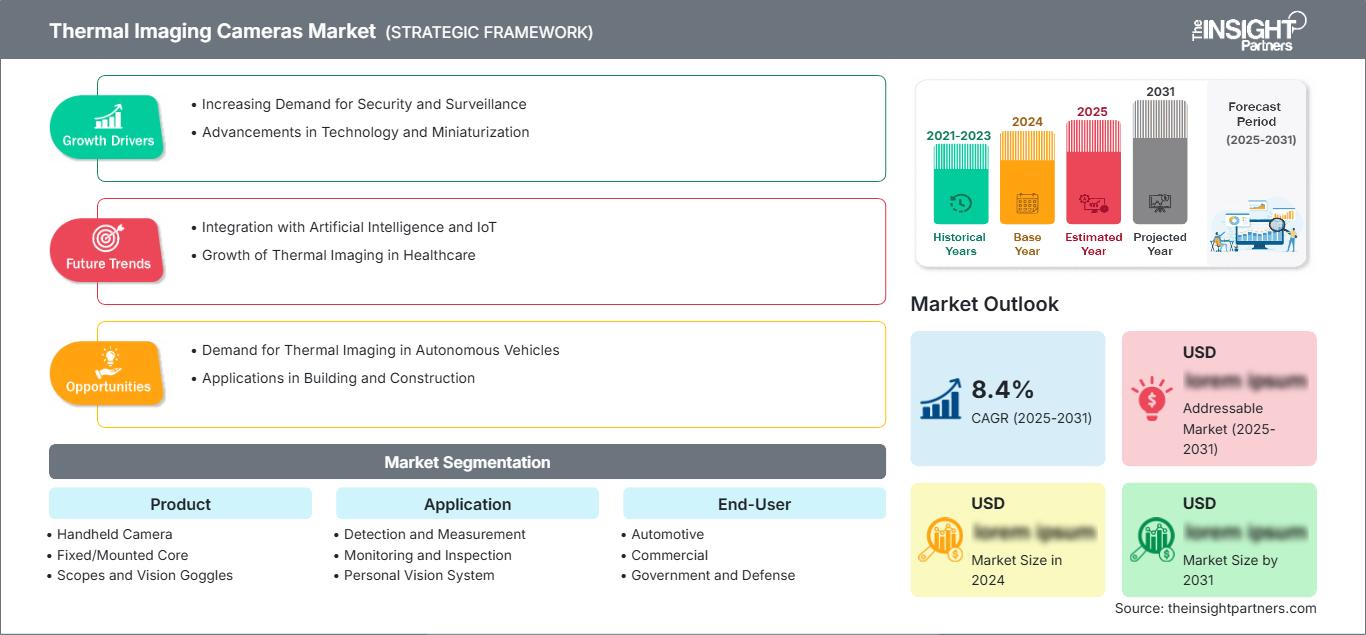
Thermal Imaging Cameras Market: Strategic Insights
Regional Insights
North America Thermal Imaging Cameras
North America accounted for 31–33% share in 2025 and is expected to grow at a 2.5–2.9% CAGR during 2026–2034. Modernizing defense equipment, monitoring borders, inspecting utilities, upgrading firefighting gear, and making programs for reliability in industry creates a demand for thermal imaging cameras in the given region. The existing procurement practices in the Thermal Imaging Cameras Market lead to the demand for making cameras compliant with whole requirements, creating robust devices, increasing the cybersecurity level, ensuring long-term product support, etc.
The use of thermal imaging cameras in different industries is increasing: logistics companies, data centers, refineries, and transport firms come up with fixed thermal imaging devices for monitoring. Moreover, the implementation of dual technology decreases the possibility of false alarms and enhances video surveillance operations when there are low lights or bad weather conditions.
U.S. Thermal Imaging Cameras Market
The US represented 78–82% of North America in 2025 and is projected to grow at a 2.4–2.8% CAGR during 2026–2034. Demand is shaped by defense readiness, airport perimeter security, emergency response modernization, electrical inspection, and commercial building safety. Local presence of Teledyne FLIR LLC, L3Harris Technologies, Inc., RTX Corporation, Fortive Corporation, and Seek Thermal, Inc. supports procurement confidence.
Application trends show rising integration of thermal cameras into drones, autonomous ground systems, access-controlled facilities, substations, and smart traffic corridors. Buyers increasingly prefer platforms that combine thermal imaging with video analytics, secure firmware, and network management tools. This supports replacement demand and reinforces the US as the leading contributor to regional Thermal Imaging Cameras growth.
Europe Thermal Imaging Cameras Market
Europe held 23–25% of the Thermal Imaging Cameras market share in 2025 and is forecast to expand at a 2.1–2.5% CAGR during 2026–2034. Germany leads regional adoption through manufacturing automation, automotive testing, utilities, and process industries that use thermography to improve uptime and energy efficiency.
The UK market is supported by defense modernization, port security, rail safety, and critical infrastructure resilience programs. BAE Systems plc, Leonardo S.p.A., Thales S.A., and Axis AB strengthen the European ecosystem through defense electronics, network security platforms, and surveillance integration capabilities.
France, Italy, and Spain contribute demand from aerospace, public safety, energy, and transport infrastructure. France benefits from defense electronics and sensor expertise, Italy from aerospace and industrial inspection, and Spain from airport, grid, and perimeter security projects.
APAC Thermal Imaging Cameras Market
Asia Pacific captured 27–29% of the Thermal Imaging Cameras market share in 2025 and is projected to grow at a 3.0–3.4% CAGR during 2026–2034, with China as the leading country. Industrial automation, electronics manufacturing, public surveillance, and automotive sensing support regional expansion.
Japan and South Korea emphasize factory automation, robotics, mobility safety, and high-precision inspection. India’s demand is linked to border monitoring, smart cities, energy infrastructure, and industrial safety programs.
Australia adds opportunities in mining, wildfire detection, ports, and remote infrastructure monitoring. Local detector capacity, policy support for domestic electronics, and rising security budgets improve affordability and broaden Thermal Imaging Cameras market trends across applications.
Middle East & Africa Thermal Imaging Cameras Market
Middle East and Africa Thermal Imaging Cameras market is projected to grow at a 2.6–3.0% CAGR during 2026–2034, led by Saudi Arabia. Energy infrastructure, border security, airports, ports, and smart city investments create sustained demand for fixed and handheld thermal systems.
The UAE prioritizes airport security, critical infrastructure monitoring, and integrated urban surveillance, while South Africa uses thermal cameras in mining, utilities, public safety, and wildlife protection.
Rest of MEA demand is more project-based, tied to oil and gas facilities, perimeter protection, and power transmission monitoring. Harsh climates favor rugged cameras with dust resistance, long detection range, and low-maintenance operation.
Segmentation Analysis
Product
The product segment in the Thermal Imaging Cameras market is projected to grow at a 2.4–2.8% CAGR during 2026–2034. Adoption is driven by the balance between portability, fixed deployment, and mission-specific optics. Buyers select products based on range, thermal sensitivity, durability, calibration stability, connectivity, and integration with inspection, surveillance, or personal vision workflows.
- Handheld Camera: Handheld units remain essential for maintenance, firefighting, building inspection, and field diagnostics because users require portability, fast temperature visualization, and flexible deployment without permanent infrastructure.
- Fixed/Mounted Core: Fixed and mounted cores support continuous monitoring in security, process control, vehicles, drones, and automation systems where thermal data must feed broader operational platforms.
- Scopes and Vision Goggles: Scopes and vision goggles serve defense, law enforcement, search, and outdoor safety needs by improving target visibility, navigation, and situational awareness in darkness or obscured environments.
Application
The application segment in the Thermal Imaging Cameras market is projected to grow at a 2.5–2.9% CAGR during 2026–2034. Demand is strongest where thermal contrast supports faster decisions than visible inspection alone. Detection, measurement, monitoring, personal vision, search, rescue, and surveillance applications benefit from declining sensor costs, better analytics, and higher integration with enterprise safety and security systems.
- Detection and Measurement: This application leads because industrial, electrical, mechanical, and building users rely on thermal signatures to identify faults, document conditions, and improve preventive maintenance programs.
- Monitoring and Inspection: Monitoring and inspection demand is rising in utilities, manufacturing, refineries, transport, and data centers where continuous thermal visibility helps prevent failures and unplanned downtime.
- Personal Vision System: Personal vision systems are strategically important for tactical users, firefighters, and outdoor professionals who need compact devices that improve awareness during low-visibility operations.
- Search and Rescue: Search and rescue teams use thermal cameras to locate people, detect heat signatures through smoke or darkness, and shorten response times in complex emergency environments.
- Security and Surveillance: Security and surveillance systems are gaining share as facilities combine thermal, visible, radar, and analytics to protect perimeters while reducing nuisance alarms.
End-User
The end-user segment in the Thermal Imaging Cameras market is projected to grow at a 2.3–2.7% CAGR during 2026–2034. Adoption patterns vary by risk profile: government and defense prioritize mission assurance, industrial users emphasize uptime, healthcare focuses on non-contact screening and diagnostics support, and commercial buyers value integrated surveillance and facility protection.
- Automotive: Automotive adoption centers on night vision, driver assistance, battery thermal management, and testing workflows where infrared sensing improves safety evaluation and visibility beyond visible cameras.
- Commercial: Commercial users deploy thermal cameras for perimeter protection, facility safety, occupancy-sensitive monitoring, and energy inspection across logistics, offices, retail sites, and transportation hubs.
- Government and Defense: Government and defense remain strategic buyers because thermal imaging supports surveillance, targeting, border control, force protection, and emergency operations under low-light or obscured conditions.
- Healthcare and Life Sciences: Healthcare and life sciences use thermography for non-contact screening, research, animal health, laboratory monitoring, and patient-flow safety where temperature patterns provide supportive insights.
- Industrial: Industrial facilities rely on thermal imaging to inspect electrical assets, rotating equipment, furnaces, pipelines, and building envelopes, improving reliability and reducing shutdown risk.
- Residential: Residential demand is smaller but relevant for home inspection, energy audits, security, HVAC diagnostics, and consumer-grade devices that translate professional thermal capabilities into accessible tools.
Opportunity Snapshot
| End-User | Revenue Contribution | Trend Tag | Adoption Stage |
| Automotive | Medium | Night Vision | Scaling |
| Commercial | Medium | Smart Perimeter | Scaling |
| Government and Defense | High | Force Protection | Mature |
| Healthcare and Life Sciences | Low | Contactless Screening | Emerging |
| Industrial | High | Predictive Maintenance | Mature |
| Residential | Low | Energy Audits | Emerging |
| Others | Low | Specialty Uses | Emerging |
Thermal Imaging Cameras Market Growth Drivers and Impact Analysis
Critical Infrastructure Security Modernization
The use of thermal surveillance is increasing among utilities, as well as in airports, ports, refineries, data centers, and transport companies as visible cameras can hardly work under certain conditions, such as in the absence of light and in the presence of fog, smoke, glare, and long-range perimeter conditions. The impact of this trend can be noticed mainly in fixed locations where analytics can distinguish moves and send alerts to fixed cameras without the need for constant human action.
Predictive Maintenance Across Industrial Assets
Thermal inspection is being treated more and more by industrial practitioners as a reliable technology instead of a routine safety test. Cameras register unusual temperature in switchgear, electric motors, bearings systems, ovens, insulator and piping systems, so that the damage is still unseen. The result for market is a lower unscheduled shutdowns and a more efficient use of maintenance teams. Both portable and stationary thermographic devices are benefited, as factories, power stations or processing sites connect their thermal images and computer-maintained equipment.
Defense, Public Safety, and Emergency Response Demand
Thermal imaging devices have proven to be indispensable for purposes including security, firefighting, rescue missions, and law enforcement. This can be attributed to the fact that their users require dependable visibility in cloudy, dark, dusty, or covered distances. Commercial use necessitates procuring lighter equipment with longer vision distances and compatibility with vehicles, drones, helmets, and control systems.
Thermal Imaging Cameras Market Future Trends
Edge AI and Multispectral Fusion
The newer thermal camera systems will include a mix of infrared, visible, radar, acoustic, and other forms of data collection methods in the field. This change has multiple benefits, including lower bandwidth requirements and faster classification of persons, machines, animals, fire, or equipment malfunctions. The manufacturers offering SDKs, built-in models, and secure device management will have growing clout in shaping the system architecture. The trend contributes to the rising share of thermal imaging technology in intelligent sensing budgets, as customers require fewer false alarms, quicker verification, and enhanced automation.
Miniaturized Thermal Cores for Mobility Platforms
The expansion in the use of smaller thermal cores having less power will make way for greater acceptance of them in such applications as drones, robots, cars, helmets, and handheld devices. Because the size of pixels is decreasing and packaging is advancing, thermosensitive components can be integrated without any significant increase of weight, power consumption or complexity of the system. This tendency is favorable for the development of autonomy, remote inspections, firefighting robots, and advanced driver assistance systems for situations when visual cameras do not work well.
Thermal Imaging Cameras Market Opportunities
Utility Grid and Renewable Asset Monitoring
Power utilities and renewable energy operators offer a focused opportunity for thermal camera vendors because grid equipment, solar farms, wind assets, substations, and battery systems require regular heat-based inspection. Suppliers can create value by packaging cameras with analytics that flag hot spots, prioritize maintenance, and integrate with asset-management platforms. The opportunity is investment-ready because grid reliability budgets are rising, while operators need tools that reduce field visits and prevent failures. Partnerships with utilities, drone service providers, and industrial software firms can accelerate adoption.
AI-Enabled Perimeter Security for Commercial Facilities
Commercial facilities are moving from passive video recording toward proactive perimeter intelligence, creating an opportunity for thermal cameras paired with analytics and network security platforms. Warehouses, campuses, ports, rail yards, energy sites, and logistics parks need systems that detect intrusions in darkness while limiting false alarms from weather, shadows, and animals. Vendors can differentiate through open integration, cybersecurity, low-light verification, and managed services. This opportunity supports recurring revenue models and strengthens the Thermal Imaging Cameras size outlook beyond traditional defense procurement.
Recent Developments
- June 2026: Teledyne FLIR OEM, a business unit of Teledyne Technologies Incorporated (NYSE:TDY), announced Prism™ Ground ISR, a mission-ready software stack for ground-based intelligence, surveillance, and reconnaissance (ISR). Building on the recently announced Prism C-UAS for aerial drone threats, Prism Ground ISR brings advanced computational imaging and AI-driven perception to ground platforms, enabling rapid detection, classification and tracking of diverse targets including specific military vehicle classes.
- September 2025: Axis Communications AB — unveiled multisensory security technologies at GSX 2025, including a bispectral PTZ camera combining thermal and visual imaging, AI-powered bullet cameras, next-generation radars, and environmental sensing to enhance integrated physical security and operational awareness
- May 2025: Teledyne FLIR LLC — released the Tau 2+ longwave infrared camera module, offering improved sensitivity, enhanced image processing, and drop-in compatibility for unmanned vehicles, security applications, and thermal sights where long-range detection and reliability are critical
Frequently Asked Questions

- Comprehensive Market Sizing and Forecast Analysis
- Detailed Segmentation Analysis
- In-Depth Market Dynamics Assessment
- Regional and Country-Level Insights
- Competitive Landscape and Company Benchmarking
- Strategic Business Intelligence
Recent Reports
Testimonials

The Insight Partners' SCADA System Market report is comprehensive, with valuable insights on current trends and future forecasts. The team was highly professional, responsive, and supportive throughout. We are very satisfied and highly recommend their services.
RAN KEDEM Partner, Reali Technologies LTDs
I requested a report on a very specific software market and the team produced the report in a few days. The information was very relevant and well presented. I then requested some changes and additions to the report. The team was again very responsive and I got the final report in less than a week.
JEAN-HERVE JENN Chairman, Future Analytica
We worked with The Insight Partners for an important market study and forecast. They gave us clear insights into opportunities and risks, which helped shape our plans. Their research was easy to use and based on solid data. It helped us make smart, confident decisions. We highly recommend them.
PIYUSH NAGPAL Sr. Vice President, High Beam Global
The Insight Partners delivered insightful, well-structured market research with strong domain expertise. Their team was professional and responsive throughout. The user-friendly website made accessing industry reports seamless. We highly recommend them for reliable, high-quality research services
YUKIHIKO ADACHI CEO, Deep Blue, LLC.
This is the first time I have purchased a market report from The Insight Partners.While I was unsure at first, I visited their web site and felt more comfortable to take the risk and purchase a market report.I am completely satisfied with the quality of the report and customer service. I had several questions and comments with the initial report, but after a couple of dialogs over email with their analyst I believe I have a report that I can use as input to our strategic planning process.Thank you so much for taking the extra time and making this a positive experience.I will definitely recommend your service to others and you will be my first call when we need further market data.
JOHN SUZUKI President and Chief Executive Officer, Board Director, BK Technologies
I wish to appreciate your support and the professionalism you displayed in the course of attending to my request for information regarding to infectious disease IVD market in Nigeria. I appreciate your patience, your guidance, and the fact that you were willing to offer a discount, which eventually made it possible for us to close a deal. I look forward to engaging The Insight Partners in the future, all thanks to the impression you have created in me as a result of this first encounter.
DR CHIJIOKE ONYIA MANAGING DIRECTOR, PineCrest Healthcare Ltd.Reason to Buy
- Informed Decision-Making
- Understanding Market Dynamics
- Competitive Analysis
- Identifying Emerging Markets
- Customer Insights
- Market Forecasts
- Risk Mitigation
- Boosting Operational Efficiency
- Strategic Planning
- Investment Justification
- Tracking Industry Innovations
- Aligning with Regulatory Trends





 Get Free Sample for