
Thermal Printing Market Report by Share, Growth and Size: 2034
Coverage: by Technology (Direct Thermal (DT), Thermal Transfer (TT), Dye Diffusion Thermal Transfer (D2T2)); Printer Type (Barcode Printers, RFID Printers, POS Printers, Kiosk and Ticket Printers, Others); Vertical (Industrial and Manufacturing, Healthcare, Transportation and Logistics, Retail, Government, Others) , and Geography (North America, Europe, Asia Pacific, and South and Central America)
- Status : Data Released
- Report Code : TIPRE00006069
- Category : Electronics and Semiconductor
- No. of Pages : 150
- Available Report Formats :


- Last update date : July 17, 2026


2025 Market Size
US$ 15.92 Bn
Base year value
2034 Forecast
US$ 46.33 Bn
Projected by 2034
CAGR 2026-2034
12.6 %
Growth rate
Addressable Market
US$ 271.69 Bn
(2026-2034)
The Thermal Printing Market is projected to grow from US$ 15.92 Billion in 2025 to US$ 46.33 Billion by 2034, registering a CAGR of 12.6% during 2026–2034. The market is expanding as enterprises continue to digitize labeling, ticketing, receipt, patient identification, logistics tracking, and industrial coding workflows that require fast, low-maintenance, and high-throughput print output.
The North American Thermal Printing market size will be driven by systematic investments in warehouse automation, healthcare traceability, and omnichannel retailing. North America is expected to witness a CAGR of 11.8-12.4% in the coming decade due to the presence of well-established barcode technology infrastructure, RFID pilot projects, and a focus on product/shipment/specimen identification.
Thermal Printing Market Assessment and Insights
- North America held 31–34% share of the Thermal Printing market in 2025 and is growing at a CAGR of 11.8–12.4% during 2026–2034, led by healthcare compliance, retail POS modernization, and high-volume distribution hubs.
- US represented 77–80% of North America in 2025 and is advancing at a CAGR of 11.6–12.2% during 2026–2034, driven by e-commerce fulfillment and hospital identification.
- Europe accounted for 24–27% share in 2025 and is expanding at a CAGR of 10.9–11.6% during 2026–2034, with Germany, the UK, France, Italy, and Spain leading adoption.
- Asia Pacific captured 30–33% of the Thermal Printing Market share in 2025 and is growing at a CAGR of 13.4–14.2% during 2026–2034, supported by China, Japan, South Korea, India, and Australia.
- Largest Segment Barcode Printers held 43–47% market share in 2025 and is growing at a CAGR of 11.4–12.1% during 2026–2034, reflecting durable demand across labels and logistics.
- High Growth Segment RFID Printers held 12–15% market share in 2025 and is growing at a CAGR of 14.8–15.6% during 2026–2034, as asset visibility expands.
- Key companies analyzed in detail: BIXOLON Co., Ltd.; Brother Industries, Ltd.; Fujitsu Limited; Honeywell International Inc.; SATO Holdings Corporation; Seiko Epson Corporation; Star Micronics Co., Ltd.; Toshiba Corporation; TSC Auto ID Technology Co., Ltd.; Zebra Technologies Corporation.
Source: The Insight Partners' analysis based on proprietary research, government publications, company annual reports, investor presentations, industry databases, and expert interviews.
The technology migration process has led to Thermal Printing advancing from just receipts to being integrated into systems for label, wristband, ticketing, and product code printing. Direct Thermal printing is best suited for media with a short lifespan, whereas Thermal Transfer printing is suited for industrial labeling that is resistant to moisture, wear, and temperature changes.
Future demand will depend on the rise of manufacturing clusters, healthcare technology, logistics management, and identity systems in the public sector. The direction of investments will shift towards cloud-based fleet solutions, linerless media, printing-mechanism efficiency, and RFID-capable solutions that require less reconciliation work. Regulatory tailwinds around medical device traceability, food safety labeling, and transport documentation will continue expanding the Thermal Printing Market size by increasing the value of reliable print infrastructure in both mature and developing economies.
Thermal Printing Market Report Scope
| Report Attribute | Details |
|---|---|
| Market size in 2025 | US$ 15.92 Billion |
| Market Size by 2034 | US$ 46.33 Billion |
| Global CAGR (2026 - 2034) | 12.6% |
| Historical Data | 2021-2024 |
| Forecast period | 2026-2034 |
Thermal Printing Market Analysis
The opportunity for Growth in Thermal Printing lies in repeated, volume-based processes, wherein speed, clarity, and consistency deliver natural advantages. The retail industry needs consistent printed receipts and labels; the hospital industry needs patient wristbands and labels; and the logistics industry needs bar codes.
The supply chain consists of printhead providers, media adapters, ribbon providers, printer OEMs, software systems, distributors, and managed service providers. The dynamics of the supply chain favor those who can provide robust hardware, qualified consumables, monitoring capabilities, and integration services, as users are increasingly looking at the entire workflow rather than just the device purchase.
Thermal Printing analysis indicates a competitive landscape defined by the factors such as installed base, channel and specialization. The companies which compete effectively in industrial and logistic labeling applications include Zebra Technologies Corporation, SATO Holdings Corporation, TSC Auto ID Technology Co., Ltd., and Honeywell International Inc., while Seiko Epson Corporation, Star Micronics Co., Ltd., and BIXOLON Co., Ltd., remain visible in POS and kiosk applications.
Thermal Printing Market trends point towards an investment focus on smart fleets, RFID coding, packaging sustainability, and cloud-compatible printer management. The companies that position themselves using small-sized, mobile, or enterprise-based printing equipment include Brother Industries, Ltd., Fujitsu Limited, and Toshiba Corporation. Service delivery and media availability continue to be important criteria for enterprise buying departments.
● REPORT CUSTOMIZATION
Tailor This Report To Align With Your Specific Business Requirements
This report can be customized to align precisely with your business objectives, scope, and target markets. Customization options include tailored segmentation, geography, competitive analysis, and strategic insights to support informed decision-making.
Customize This Report →WHAT YOU CAN ADJUST
- ● Segmentations
- ● Geography
- ● Competitive Analysis
- ● Language Preferences
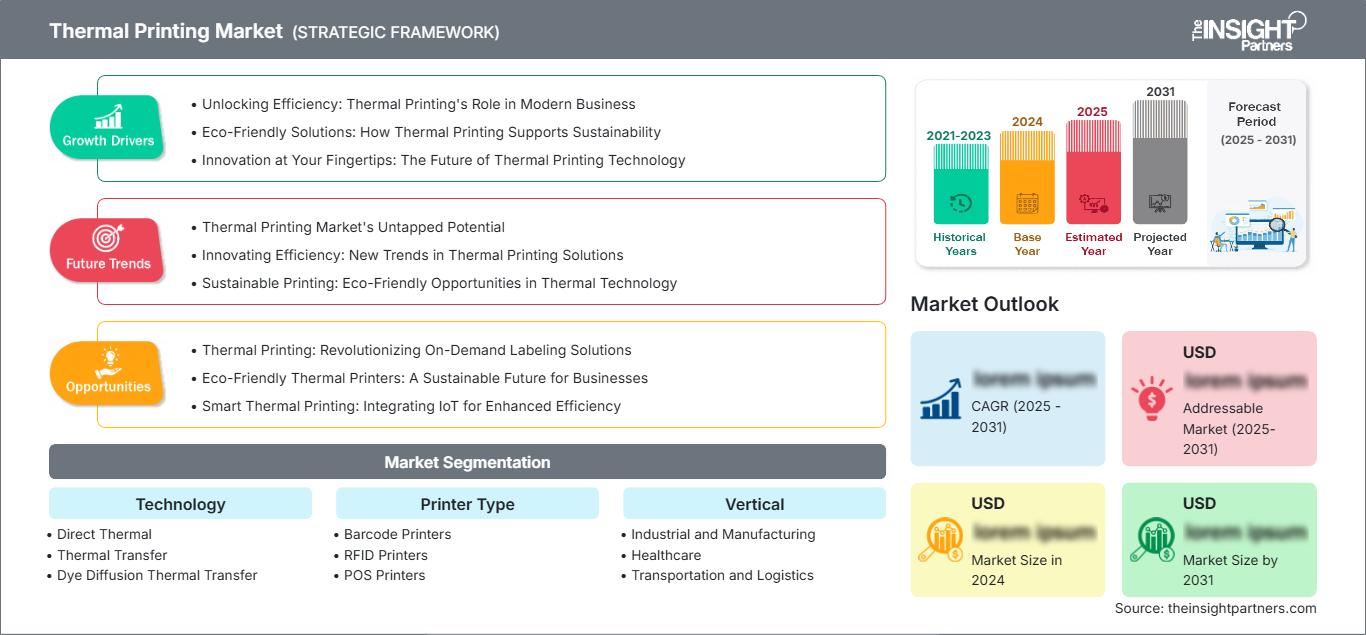
Thermal Printing Market: Strategic Insights
Regional Insights
North America Thermal Printing Market
North America accounted for 31–34% share of the Thermal Printing market in 2025 and is projected to expand at a CAGR of 11.8–12.4% during 2026–2034. Demand is reinforced by warehouse automation, hospital safety protocols, and widespread adoption of barcode-backed inventory control across retail, manufacturing, parcel, and food service operations.
The region also benefits from established distribution networks and key solution providers that integrate printers, scanners, software, and services. There is a shift toward RFID-based labeling in full-scale operations for applications such as garments, cold chain, and asset management. Meanwhile, there continues to be a standardization of wristbands, prescription labels, and specimens in healthcare facilities.
U.S. Thermal Printing Market
The U.S. represented 77–80% of North America in 2025 and is expected to grow at a CAGR of 11.6–12.2% during 2026–2034. The country has a large installed base across retail POS, warehouse labeling, field service documentation, airline baggage tags, and hospital patient identification, creating recurring replacement and consumables demand.
Companies such as Zebra Technologies Corporation, Honeywell International Inc., Brother Industries, Ltd., Seiko Epson Corporation, and BIXOLON Co., Ltd. have active business presence both directly and via the channel-led route. The trend within applications includes shift towards networked desktop printer labels, linerless labels for quick service restaurants, RFID labels for inventory management, and mobile solutions for delivery verification.
Europe Thermal Printing Market
Europe represented 24–27% share in 2025 and is expected to witness a CAGR of 10.9–11.6% from 2026 to 2034. Germany drives regional demand through industrial automation, automotive manufacturing, and logistics exports. The UK maintains its dominance in retail, healthcare, and transportation ticketing, as POS and mobile label printers help manage distributed services.
Contribution from France, Italy, and Spain is through pharmacy labeling, food traceability, hotel billing, and manufacturer identification. The need for robust labeling and product codes in EU supply chain transparency, electronic invoicing, and food safety standards is driving continuous demand for these products. The vendors' approach focuses on energy efficiency, distribution networks, localization, and media compatibility.
APAC Thermal Printing Market
APAC captured 30–33% of the Thermal Printing market share in 2025 and is projected to grow at a CAGR of 13.4–14.2% during 2026–2034, making it the fastest expanding regional base. China leads demand through manufacturing, e-commerce fulfillment, and logistics infrastructure, while Japan and South Korea emphasize factory automation and high-quality retail systems.
India and Australia contribute to market growth through organized retail, digitization in the health sector, modernization of postal services, and transportation ticketing. Digital manufacturing, product tracking, and resilience in the domestic supply chain continue to fuel the Thermal Printing Market growth, supported by policies that promote investments in labeling infrastructure.
Middle East & Africa Thermal Printing Market
Middle East & Africa is expected to expand at a CAGR of 9.8–10.6% during 2026–2034, supported by infrastructure, healthcare, aviation, and retail modernization. Saudi Arabia is the leading country, with large projects in logistics zones, airports, healthcare facilities, and public services requiring reliable label and ticket generation.
POS systems, kiosks, and baggage tag printers are among the compact printing technologies used in the UAE. South Africa requires the use of print technologies due to demand in the pharmaceutical, retail, and transport industries. The remainder of the MEA region requires opportunities, which include the requirement of durable label printers in energy and import projects.
Segmentation Analysis
Technology
Technology is expected to grow at a CAGR of 11.9–12.7% during 2026–2034. The Thermal Printing scope across technology choices is defined by media life, image durability, print speed, and operating environment. Direct thermal supports short-cycle receipts and labels, while thermal transfer and dye diffusion thermal transfer address longer-life, higher-quality, and specialty output requirements.
- Direct Thermal serves receipts, shipping labels, food service tags, and wristbands where speed and simple media handling are prioritized over long image life or harsh exposure resistance.
- Thermal Transfer printing is ideal for the manufacture of industrial labels, asset tags, chemical identification, and logistics labels because of their requirement for durability in harsh conditions.
- Dye Sublimation Thermal Transfer printing is preferred in cases where print images of high-quality color control and tone transfer are necessary.
Printer Type
Printer Type is projected to grow at a CAGR of 12.3–13.1% during 2026–2034. Barcode printers remain the volume anchor because most supply chains still depend on scan-ready labels. RFID printers are gaining strategic importance as organizations combine printed identifiers with electronic product codes for item-level visibility and automated reconciliation.
- Barcode Printers have been dominating the use of printers in logistics, retail, healthcare, and manufacturing industries due to the continued importance of linear and two-dimensional barcodes in tracking.
- RFID Printers have been growing in demand where businesses require both print and encode functions, especially in apparel, pharmaceutical, reusable asset, luggage, and warehouse automation applications.
- POS Printers print receipts, kitchen tickets, transaction confirmations, and service-related information, with footprint and connectivity emerging as essential factors for buying decisions.
- Kiosks and Ticket Printers are used in transport systems, lotteries, entertainment systems, parking systems, and other forms of unattended self-service retail environments where performance plays an important role.
Vertical
Vertical demand is forecast to grow at a CAGR of 11.6–12.4% during 2026–2034. Industrial and manufacturing users require durable labeling for parts, work-in-process, packaging, and shipment identification. Healthcare, retail, logistics, and government applications add recurring demand as traceability, authentication, service speed, and audit readiness become operational priorities.
- Industrial and Manufacturing uses labels for components, work orders, cartons, pallets, and safety instructions, making printer ruggedness, media compatibility, and integration with production systems important.
- Healthcare sector uses wristbands, specimen labels, prescription labels, and asset labels where print quality becomes important in terms of safety and efficiency.
- The Transportation & Logistics industry uses shipping labels, baggage tags, route sheets, and delivery verification prints where mobility and RFID capabilities are essential for real-time visibility.
- Retail utilizes point of sale receipts, shelf labels, price tags, coupons, and return receipts, with omnichannel commerce driving the need for more versatile desktop and kiosk solutions.
- Government sector uses permit cards, identification programs, tickets, evidence labels, and receipts where security, reliability, and purchase quality become critical criteria.
Opportunity Snapshot
| Vertical | Revenue Contribution | Trend Tag | Adoption Stage |
| Industrial and Manufacturing | High | Smart Labels | Mature |
| Healthcare | High | Patient ID | Scaling |
| Transportation and Logistics | High | Asset Visibility | Scaling |
| Retail | Medium | Omnichannel POS | Mature |
| Government | Medium | Secure Issuance | Emerging |
Thermal Printing Market Growth Drivers and Impact Analysis
Warehouse Automation and Parcel Visibility
Thermal Printing Market analysis indicates that fulfillment by automation depends on readable labels from each point of picking, packing, sorting, and shipping. With the increase in the volume of parcels and the implementation of conveyors, scanners, and mobile stations by distribution centers, printing mistakes result in rework, delays, and chargebacks. Thermal printers allow quick printing of labels near operations, eliminating wait times and increasing scanning accuracy. It has an effect in e-commerce, third party logistics, and manufacturing warehouses, where the labels need to match with serialized labels, carton labels, and return labels in the warehouse management system.
Healthcare Traceability and Patient Safety Mandates
Healthcare organizations are investing more in printed barcodes due to the risks associated with drug administration, testing, and patient mismatch. Barcodes on wristbands, test tubes, blood bag labels, and prescriptions have to withstand the stresses of transport and cleaning, as well as cold storage temperatures. Thermal transfer printing and direct thermal-coated media help healthcare facilities keep barcodes visible while enabling integration with medical records and pharmacy software. The impact of thermal printing is evident in hospitals, diagnostic centers, and the pharmaceutical industry, where printers are considered essential equipment.
Retail POS Modernization and Self-Service Expansion
Retailers are replacing legacy receipt and label systems as stores blend checkout, pickup, returns, and online order fulfillment. Compact POS printers, kiosk ticket printers, and mobile label devices support faster queues, accurate price changes, and flexible customer service points. Paper-saving functions, multiple connectivity options, and smaller footprints are increasingly valued because store counters and self-service stations have limited space. This affects everything from the supermarket, quick service restaurant, specialty retailers, to entertainment locations, where there is still a need for printing due to compliance, customer documents, coupons, order routing, and accounting.
Thermal Printing Market Future Trends
Cloud-Managed Printer Fleets
Thermal Printing trends would see increasing emphasis on fleets being managed from the cloud, which helps the IT department track their status, firmware, usage, media consumption, and maintenance notifications. This approach allows proactive servicing and standardization of security policy for network printers. Retail outlets, hospitals, and logistics firms would be interested in the visibility of devices since printing errors affect their daily operations. Manufacturers that offer not only hardware but also software dashboards and analytics have a better chance of making their products more than just one-time purchases.
Sustainable Media and Linerless Labels
Sustainability is expected to influence the choice of media, printer packaging, and device energy consumption. Linerless labels reduce waste from backing materials, while recycling-friendly packaging and power-saving print technology enable corporations to align their purchases with their environmental goals. The use will be most prevalent in cases where a large number of labels results in obvious waste, such as in the fast food chains, retail, distribution, and healthcare sectors. Suppliers that validate consumables with specific printer families will continue shaping Thermal Printing Market trends by reducing implementation risk and strengthening long-term account retention.
Thermal Printing Market Opportunities
RFID-Ready Labeling in High-Value Supply Chains
The Thermal Printing Market forecast indicates the most promising strategic opportunity lies in RFID-enabled labeling for apparel, pharmaceuticals, aviation luggage, electronics, and returnable transport items. The target customer base comprises companies that print bar code labels but need to implement electronic identification technology to improve inventory control, speed up auditing, and increase item visibility. This is a market opportunity that extends beyond printers, as media, software, reading devices, and consulting services drive wallet share growth. Companies that minimize difficulties with calibration, tagging, and workflow implementation will succeed.
Managed Print Services for Distributed Enterprises
Companies that operate in a distributed model can use mixed printer fleets across their stores, clinics, depots, factories, and field teams. These inefficiencies result in additional expenses due to non-standard media procurement, time lost repairing devices, lack of firmware, and local troubleshooting activities. Managed print services provide a way to turn all of these issues into revenue-generating opportunities through fleet assessments, equipment standardization, preventive maintenance, consumables management, and results monitoring. This solution is very appealing for OEMs, channel partners, and system integrators, as many customers opt for outcomes-oriented maintenance
Recent Developments
- April 2026: BIXOLON Co., Ltd, a leading global Mobile, Label, and POS Printer manufacturer today announced the launch of two new products designed to enhance efficiency, reliability, and flexibility across retail, hospitality, and enterprise environments: the SRP-G300 thermal printer and the BK5-41 kiosk label printer. The new product introductions reflect BIXOLON’s ongoing commitment to delivering innovative printing solutions that meet the evolving needs of modern businesses.
- October 2025: Seiko Epson Corporation – Epson announced that OnQ integrated its POS thermal receipt printers into the Converge Take-a-Ticket retail display platform, supporting nationwide in-store kiosks that digitize item information, reduce pre-printed card dependency, and help shoppers print checkout information for products in stock or online.
- June 2025: SATO Holdings Corporation – SATO introduced paper-based biodegradable cushioning for its CL4NX Plus industrial label printer shipments, replacing foamed plastic materials and estimating approximately 39% CO2 emissions savings per unit, while maintaining shipping protection through drop, vibration, and compression testing.
Frequently Asked Questions

- Comprehensive Market Sizing and Forecast Analysis
- Detailed Segmentation Analysis
- In-Depth Market Dynamics Assessment
- Regional and Country-Level Insights
- Competitive Landscape and Company Benchmarking
- Strategic Business Intelligence
Recent Reports
Testimonials

The Insight Partners provided valuable market intelligence that supported our global go-to-market strategy. Their team was professional, responsive, and attentive to our feedback, providing thoughtful analysis and helpful methodological clarifications throughout the project.
Junmo Kim Chief Financial Officer (CFO), Enertech Co., Ltd.
The Insight Partners' SCADA System Market report is comprehensive, with valuable insights on current trends and future forecasts. The team was highly professional, responsive, and supportive throughout. We are very satisfied and highly recommend their services.
RAN KEDEM Partner, Reali Technologies LTDs
I requested a report on a very specific software market and the team produced the report in a few days. The information was very relevant and well presented. I then requested some changes and additions to the report. The team was again very responsive and I got the final report in less than a week.
JEAN-HERVE JENN Chairman, Future Analytica
We worked with The Insight Partners for an important market study and forecast. They gave us clear insights into opportunities and risks, which helped shape our plans. Their research was easy to use and based on solid data. It helped us make smart, confident decisions. We highly recommend them.
PIYUSH NAGPAL Sr. Vice President, High Beam Global
The Insight Partners delivered insightful, well-structured market research with strong domain expertise. Their team was professional and responsive throughout. The user-friendly website made accessing industry reports seamless. We highly recommend them for reliable, high-quality research services
YUKIHIKO ADACHI CEO, Deep Blue, LLC.
This is the first time I have purchased a market report from The Insight Partners.While I was unsure at first, I visited their web site and felt more comfortable to take the risk and purchase a market report.I am completely satisfied with the quality of the report and customer service. I had several questions and comments with the initial report, but after a couple of dialogs over email with their analyst I believe I have a report that I can use as input to our strategic planning process.Thank you so much for taking the extra time and making this a positive experience.I will definitely recommend your service to others and you will be my first call when we need further market data.
JOHN SUZUKI President and Chief Executive Officer, Board Director, BK Technologies
I wish to appreciate your support and the professionalism you displayed in the course of attending to my request for information regarding to infectious disease IVD market in Nigeria. I appreciate your patience, your guidance, and the fact that you were willing to offer a discount, which eventually made it possible for us to close a deal. I look forward to engaging The Insight Partners in the future, all thanks to the impression you have created in me as a result of this first encounter.
DR CHIJIOKE ONYIA MANAGING DIRECTOR, PineCrest Healthcare Ltd.Reason to Buy
- Informed Decision-Making
- Understanding Market Dynamics
- Competitive Analysis
- Identifying Emerging Markets
- Customer Insights
- Market Forecasts
- Risk Mitigation
- Boosting Operational Efficiency
- Strategic Planning
- Investment Justification
- Tracking Industry Innovations
- Aligning with Regulatory Trends





 Get Free Sample for