
Thermostat Market Growth, Demand & Size by 2034
Coverage: By Product (Smart Thermostats, Mechanical, Programmable, Non-Programmable, Manual, Others.); Mode of Operation (Line Voltage Thermostats, Low Voltage Thermostats, Millivolt Thermostats.); Distribution Channel (Utility, Retail, Security, Others); Application (Residential, Commercial (Educational; Offices; Hospital and Others), Industrial Uses.) , and Geography (North America, Europe, Asia Pacific, and South and Central America)
- Status : Data Released
- Report Code : TIPRE00027606
- Category : Electronics and Semiconductor
- No. of Pages : 150
- Available Report Formats :


- Last update date : July 15, 2026


2025 Market Size
US$ 7,832.29 Mn
Base year value
2034 Forecast
US$ 31,088.57 Mn
Projected by 2034
CAGR 2026-2034
16.55 %
Growth rate
Addressable Market
US$ 163,726.45 Mn
(2026-2034)
The Thermostat Market is expected to grow from US$ 7,832.29 Million in 2025 to US$ 31,088.57 Million by 2034 at a CAGR of 16.55% between 2026 and 2034 due to increasing usage of internet enabled thermostats, more replacement of traditional mechanical thermostats and increased adoption of temperature control in building automation, demand response utilities, and energy management systems.
North America is a strategic revenue segment for the Thermometer market because of the size advantages of Thermostats in North America due to high penetration of central HVAC systems, utility rebates and growing consumer preference for smartphone enabled energy control systems. North America is expected to grow at a CAGR of 15.8 - 16.6% between 2026 and 2034.
Thermostat Market Assessment and Insights
- North America held 35–38% share in 2025 and is expected to grow at a CAGR of 15.8–16.6% during 2026–2034, driven by HVAC replacement, utility enrollment, and smart home compatibility.
- US accounted for 78–82% of North America in 2025 and is projected to grow at a CAGR of 15.9–16.7% during 2026–2034.
- Europe represented 24–27% share in 2025 and is expected to grow at a CAGR of 14.8–15.6% during 2026–2034, led by Germany, the UK, France, Italy, and Spain.
- Asia Pacific captured 26–29% share in 2025 and is projected to grow at a CAGR of 18.2–19.1% during 2026–2034, with China, Japan, India, South Korea, and Australia leading adoption.
- Largest Segment Smart Thermostats held 38–42% market share in 2025 and is expected to grow at a CAGR of 18.6–19.5% during 2026–2034.
- High Growth Segment Residential applications held 44–48% market share in 2025 and are projected to grow at a CAGR of 17.4–18.3% during 2026–2034.
- Key companies analyzed in detail: Danfoss A/S, FSTB, Beijing Hailin Control Technology Inc., Honeywell Home, Jiu Long Thermostat Factory, Johnson Controls International plc, Otter Controls Limited, Schneider Electric SE, Shenzhen Saswell Technology Co., Ltd., Siemens AG.
Source: The Insight Partners' analysis based on proprietary research, government publications, company annual reports, investor presentations, industry databases, and expert interviews.
Innovation in products is changing from static switching to adaptive control, occupancy detection, wireless setup, and interoperability with home energy management systems. In terms of manufacturing, companies are modifying designs to support lower power consumption, Matter protocol compliance, cloud-based data analysis, and easy hardware installation. Mechanical/manual systems will still be of use for low-budget and industrial consumers, but smart systems will affect refresh rates through integration of comfort, efficiency, monitoring, and utility participation.
During the forecast period, new geographic markets are anticipated to contribute to market growth through increased air conditioning ownership and stricter building codes. The prevailing regulatory environment, which includes energy savings and investments in smart grid and digital buildings, will expand the product adoption base to cover not only premium houses.
Thermostat Market Report Scope
| Report Attribute | Details |
|---|---|
| Market size in 2025 | US$ 7,832.29 Million |
| Market Size by 2034 | US$ 31,088.57 Million |
| Global CAGR (2026 - 2034) | 16.55% |
| Historical Data | 2021-2024 |
| Forecast period | 2026-2034 |
Thermostat Market Analysis
Increased demand will be driven by the demonstrated ability of temperature management to reduce HVAC energy use, particularly as electricity tariffs, peak load rates, and building performance standards become increasingly stringent. Increased adoption of heat pump technology, zoning, and connectivity with other appliances will also drive growth in thermostat sales.
There are many players in the industry's supply chain,, including sensor manufacturers, semiconductor makers, thermostat assembly companies, HVAC OEMs, system integrators, utility companies, retailers, and software platforms. Supply trends have improved following previous chip shortages but manufacturers continue to distinguish themselves using installers' tools, cybersecurity, mobile applications, and analytics.
Positioning for competitiveness requires considerations such as brand trust, channel accessibility, product diversity, and integration. Thermostat analysis implies that companies like Honeywell Home, Johnson Controls International plc, Schneider Electric SE, Siemens AG, and Danfoss A/S focus on wide HVAC and building automation portfolio, while companies such as Beijing Hailin Control Technology Inc., Shenzhen Saswell Technology Co., Ltd., FSTB, Jiu Long Thermostat Factory, and Otter Controls Limited pay attention to a regional and parts-oriented approach.
Investments are being made in smart software-based control solutions, grid-connected devices, and thermostats that help monitor indoor air quality. The strategy is now focusing more on life-cycle profits rather than on single-device sales through utilities' programs, professional installation services, maintenance notifications, and building management integration. Companies will be favored if they can combine cheap devices and reliable infrastructure.
● REPORT CUSTOMIZATION
Tailor This Report To Align With Your Specific Business Requirements
This report can be customized to align precisely with your business objectives, scope, and target markets. Customization options include tailored segmentation, geography, competitive analysis, and strategic insights to support informed decision-making.
Customize This Report →WHAT YOU CAN ADJUST
- ● Segmentations
- ● Geography
- ● Competitive Analysis
- ● Language Preferences
Thermostat Market: Strategic Insights
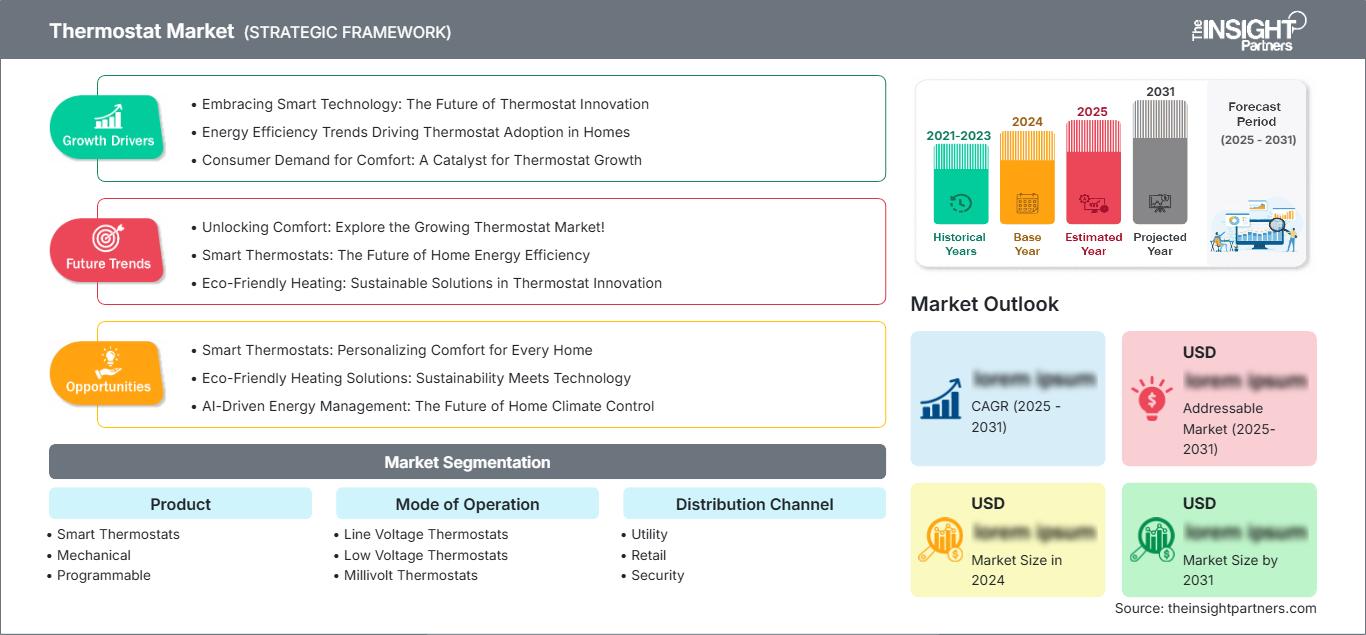
Regional Insights
North America Thermostat
In 2025, North America had a market share of 35-38%, which is projected to grow at 15.8-16.6% CAGR from 2026 to 2034. The Thermostat market share in North America is driven by strong HVAC replacement, participation in utility demand response programs, and customer readiness to pay for connectivity-enabled energy management. A second wave of growth comes from commercial buildings where offices, hospitals, educational institutions, and retail chains invest in more efficient energy use by controlling devices. Manufacturers have opted to leverage professional HVAC channels for easier installation, while retailers and utilities continue to expand their residential reach.
U.S. Thermostat Market
The U.S. accounted for 78-82% share of North America in 2025 and is expected to register a CAGR of 15.9%-16.7% during 2026-2034. The adoption is high in households with central HVAC systems, broadband connections, and those enrolled in rebates or peak load management schemes. Honeywell Home, Johnson Controls International plc, Schneider Electric SE, Siemens AG, and Danfoss A/S are prominent through their presence through retail, contractor, commercial automation, and utility routes. Demand from the residential segment is inclined towards Matter-controlled devices, whereas the commercial sector focuses on diagnostics, zone control, and BMS integration.
Europe Thermostat Market
The European region accounted for 24% to 27% of the market in 2025 and is anticipated to expand at a CAGR of 14.8% to 15.6% between 2026 and 2034. Demand will be driven by Germany, which will witness increasing adoption due to the installation of heat pumps, building renovation, and energy cost concerns. The UK witnesses consistent uptake owing to smart home renovations, efficiency standards in rental housing, and energy awareness campaigns by utilities. Germany enjoys advantages in heating system modernization, while France, Italy, and Spain see demand driven by retrofitting of residential units and the hospitality sector, as well as other temperature-control measures.
APAC Thermostat Market
APAC held 26–29% share in 2025 and is forecast to record an 18.2–19.1% CAGR during 2026–2034. China is the leading country, supported by large residential construction, smart appliance ecosystems, and commercial building automation investment. Japan and South Korea emphasize high-efficiency buildings and connected homes, while India and Australia add demand through air-conditioning growth, urban housing, and energy management policies. Industrial users also adopt controls for process areas, warehouses, and facility comfort management.
Middle East & Africa Thermostat Market
The Middle East & Africa region will experience a compound annual growth rate (CAGR) of 13.6 to 14.5 percent between 2026 and 2034, owing to high cooling load requirements, smart city initiatives, and commercial real estate development. The UAE will contribute to the use of luxury building automation systems, South Africa to replacement demand, and the Rest of MEA will see investments in hotels and healthcare facilities. The primary reason energy efficiency is an important purchasing factor is cooling costs in hot regions.
Segmentation Analysis
Product
The product segment is projected to grow at a 16.1–17.0% CAGR during 2026–2034. The Thermostat scope across products is widening as buyers shift from basic switching devices to programmable, connected, and learning controls that reduce manual adjustment and support HVAC optimization.
- Smart Thermostats: These devices lead value creation by combining remote access, learning algorithms, utility enrollment, and energy insights, making them strategically important for residential and light-commercial upgrades.
- Mechanical: Mechanical models remain relevant in cost-sensitive buildings and rugged settings where simplicity, durability, and low maintenance outweigh software features or connectivity.
- Programmable: Programmable devices support scheduled control for households and small businesses seeking efficiency without full smart home integration or advanced app-based management.
- Non-Programmable: Non-programmable models serve replacement demand in basic HVAC systems, especially where users prefer direct control and low upfront cost.
- Manual: Manual thermostats retain niche demand in industrial, temporary, and utility spaces where standardized, low-complexity temperature switching is sufficient.
Mode of Operation
The mode of operation segment is expected to grow at a 15.4–16.2% CAGR during 2026–2034. Selection depends on electrical architecture, HVAC type, installation environment, and safety requirements, making compatibility a decisive factor for contractors and distributors.
- Line Voltage Thermostats: Line voltage units are important in electric baseboard heating and direct-load applications where devices must control higher voltage circuits safely and reliably.
- Low Voltage Thermostats: Low voltage models dominate central HVAC applications because they fit most residential furnaces, heat pumps, air conditioners, and smart retrofit installations.
- Millivolt Thermostats: Millivolt products address specialized heating equipment, fireplaces, and legacy systems where self-powered operation and simple control architecture remain valuable.
Distribution Channel
The distribution channel segment is projected to grow at a 15.8–16.8% CAGR during 2026–2034. Channel performance depends on installation complexity, rebate structures, contractor influence, and consumer confidence in configuring connected devices.
- Utility: Utility channels support adoption through rebates, demand-response programs, and customer education, especially where thermostats help manage peak electricity loads.
- Retail: Retail channels remain essential for self-install and replacement purchases, combining brand comparison, price visibility, and broad consumer access.
- Security: Security channels are gaining relevance as thermostats become part of broader connected home bundles with sensors, cameras, alarms, and professional monitoring services.
Application
The application segment is forecast to grow at a 16.7–17.6% CAGR during 2026–2034. Residential demand leads unit volumes, while commercial and industrial uses create higher-value requirements for reliability, multi-zone control, and integration with building systems.
- Residential: Residential applications lead adoption as households seek comfort automation, energy bill reduction, remote control, and compatibility with smart speakers and home apps.
- Commercial: Commercial users prioritize scheduling, centralized monitoring, occupant comfort, and energy reporting across offices, retail outlets, schools, hotels, and healthcare facilities.
- Industrial Uses: Industrial users deploy thermostats in production zones, storage areas, equipment rooms, and worker comfort spaces where controlled temperatures support safety and continuity.
Opportunity Snapshot
| Application | Revenue Contribution | Trend Tag | Adoption Stage |
| Residential | High | Home Energy | Scaling |
| Commercial | Medium | Building Automation | Scaling |
| Industrial Uses | Medium | Process Control | Emerging |
Thermostat Market Growth Drivers and Impact Analysis
Rising Need for HVAC Energy Optimization
HVAC systems account for a substantial share of controllable energy use in buildings; thus, temperature management is a feasible way to achieve energy savings. Effective scheduling, occupancy sensing, and remote control will help avoid unnecessary heating and cooling while maintaining comfortable conditions. Such drivers concern both individual customers and business users due to the convergence of energy costs, green objectives, and utility issues with peak loads. The effect on suppliers includes increased demand for equipment capable of saving money, receiving rebates, and supporting energy-saving processes.
Expansion of Connected Home and Building Ecosystems
Nowadays, thermostats are commonly bought as part of larger ecosystems rather than separately. Being compatible with voice assistants, cell phones, security systems, and management systems of buildings is an advantage for thermostats as users are able to automate comfort along with lighting, occupancy and safety devices. The effect on the market is a tendency to shift towards an ecosystem in which the software experience and its compatibility become as important as the hardware itself when making purchases.
Utility Programs and Grid Flexibility Requirements
Connected thermostats are being used by utilities to implement demand response, peak shaving, and distributed energy resource (DER) initiatives. The result is an established deployment path, as rebates reduce upfront costs and offer a tangible incentive for customers to get involved. The effect is not limited to retail sales; commercial customers can use aggregated controls to manage their loads under stressed grid conditions. Product manufacturers have much to gain from certification of their products for utility registration and secure communication.
Thermostat Market Future Trends
AI-Based Comfort and Predictive HVAC Control
Thermostat evolution in the coming years will involve more predictive control, which combines knowledge of occupant behavior, weather forecasts, tariff rates, and equipment performance. As opposed to depending on fixed schedules, future thermostats will take into account heating and cooling in advance, while suggesting maintenance when there is deviation in performance. This trend may reduce user interaction and increase trust among typical consumers. Commercial deployment of this technology will flourish where predictive control assists facilities managers in handling comfort complaints, equipment runtime, and energy reporting without additional building automation expenses.
Interoperability Through Open Smart Building Standards
Interoperable standards are likely to affect the design, acquisition, and post-sales service of products. As people move towards mixed ecosystems, the use of thermostats that seamlessly integrate across platforms will face lower switching costs and become more attractive to retailers, utilities companies, installation experts, and facilities management personnel. In commercial buildings, such capabilities will facilitate the integration of temperature control with other systems, such as lighting, access controls, and energy monitoring.
Thermostat Market Opportunities
Utility-Led Residential Upgrade Programs
Utilities could encourage faster adoption through a combination of rebates, easy sign-ups, and confirmed energy savings within their customer programs. Thermostat Forecasts suggest that even greater potential exists when there is coordination in how devices are installed and in whether they qualify for demand response capabilities among manufacturers, retailers, and utilities. The appeal here lies in its practicality, as it reduces costs and provides consistent engagement for consumers and energy providers. Companies offering compliant products, software solutions, and multilingual services could have their programs designated as preferred programs.
Commercial Retrofit and Multi-Site Facility Control
Commercial retrofits offer a viable path for manufacturers to deliver reliable controls without replacing all existing building automation systems. Chain stores, schools, medical facilities, and small-business offices would like more accurate scheduling, remote monitoring, and alarms for faults, but cannot afford the cost of complex systems. Manufacturers of thermostats can capitalize on this market by providing solutions with scalable hardware, cloud-based interfaces, and installer deployment. The key to success here will be proving cost savings, rapid ROI, and facility management ease.
Recent Developments
- December 2025: Resideo Technologies, Inc. — The company launched the Honeywell Home X8S smart thermostat, adding a five-inch touchscreen, indoor air quality indicators, humidity monitoring, VOC and carbon dioxide estimation, and video doorbell integration with Ring and First Alert devices. The launch positioned the product as a premium connected comfort hub for residential energy management.
- May 2025: Generac Holdings Inc. - Generac introduced ecobee by Generac Smart Thermostat Enhanced with Home Energy Management, connecting thermostat operation with home standby generators and PWRcell 2 solar battery storage. The solution is designed to improve real-time visibility, coordinate HVAC loads during outages, and support annual heating and cooling bill savings.
- February 2025: Schneider Electric SE - Schneider Electric launched the SpaceLogic Touchscreen Room Controller at AHR Expo, combining thermostat simplicity with direct digital control for commercial buildings. The device supports wired or wireless deployments, AI-driven room optimization at the edge, ASHRAE 55 comfort alignment, and energy management across offices, hospitals, schools, and retrofit projects.
Frequently Asked Questions

- Comprehensive Market Sizing and Forecast Analysis
- Detailed Segmentation Analysis
- In-Depth Market Dynamics Assessment
- Regional and Country-Level Insights
- Competitive Landscape and Company Benchmarking
- Strategic Business Intelligence
Recent Reports
Testimonials

The Insight Partners' SCADA System Market report is comprehensive, with valuable insights on current trends and future forecasts. The team was highly professional, responsive, and supportive throughout. We are very satisfied and highly recommend their services.
RAN KEDEM Partner, Reali Technologies LTDs
I requested a report on a very specific software market and the team produced the report in a few days. The information was very relevant and well presented. I then requested some changes and additions to the report. The team was again very responsive and I got the final report in less than a week.
JEAN-HERVE JENN Chairman, Future Analytica
We worked with The Insight Partners for an important market study and forecast. They gave us clear insights into opportunities and risks, which helped shape our plans. Their research was easy to use and based on solid data. It helped us make smart, confident decisions. We highly recommend them.
PIYUSH NAGPAL Sr. Vice President, High Beam Global
The Insight Partners delivered insightful, well-structured market research with strong domain expertise. Their team was professional and responsive throughout. The user-friendly website made accessing industry reports seamless. We highly recommend them for reliable, high-quality research services
YUKIHIKO ADACHI CEO, Deep Blue, LLC.
This is the first time I have purchased a market report from The Insight Partners.While I was unsure at first, I visited their web site and felt more comfortable to take the risk and purchase a market report.I am completely satisfied with the quality of the report and customer service. I had several questions and comments with the initial report, but after a couple of dialogs over email with their analyst I believe I have a report that I can use as input to our strategic planning process.Thank you so much for taking the extra time and making this a positive experience.I will definitely recommend your service to others and you will be my first call when we need further market data.
JOHN SUZUKI President and Chief Executive Officer, Board Director, BK Technologies
I wish to appreciate your support and the professionalism you displayed in the course of attending to my request for information regarding to infectious disease IVD market in Nigeria. I appreciate your patience, your guidance, and the fact that you were willing to offer a discount, which eventually made it possible for us to close a deal. I look forward to engaging The Insight Partners in the future, all thanks to the impression you have created in me as a result of this first encounter.
DR CHIJIOKE ONYIA MANAGING DIRECTOR, PineCrest Healthcare Ltd.Reason to Buy
- Informed Decision-Making
- Understanding Market Dynamics
- Competitive Analysis
- Identifying Emerging Markets
- Customer Insights
- Market Forecasts
- Risk Mitigation
- Boosting Operational Efficiency
- Strategic Planning
- Investment Justification
- Tracking Industry Innovations
- Aligning with Regulatory Trends





 Get Free Sample for