
Thin-Film Encapsulation Market Trends, Share & Demand by 2034
Coverage: by Technology (Inorganic Layers, Organic Layers); Application (OLED Display, Lighting, Thin-Film Photovoltaics) , and Geography (North America, Europe, Asia Pacific, and South and Central America)
- Status : Data Released
- Report Code : TIPRE00005282
- Category : Electronics and Semiconductor
- No. of Pages : 150
- Available Report Formats :


- Last update date : July 21, 2026


2025 Market Size
US$ 1.5 Bn
Base year value
2034 Forecast
US$ 2.39 Bn
Projected by 2034
CAGR 2026-2034
6.00 %
Growth rate
Addressable Market
US$ 18.27 Bn
(2026-2034)
The Thin-Film Encapsulation Market Size is projected to grow from US$ 1.5 Billion in 2025 to US$ 2.39 Billion by 2034, registering a CAGR of 6.00% from 2026 to 2034. The market reflects rising need for ultra-thin moisture and oxygen barriers across OLED display, lighting, and thin-film photovoltaics, where device lifetime, flexibility, and production yield increasingly determine commercial adoption.
North America is expected to record a 5.4–6.2% CAGR through 2034 as display materials localization, advanced electronics investment, and solar manufacturing incentives strengthen demand. Thin-Film Encapsulation Market size in the region is supported by OLED adoption in premium devices and by barrier film requirements in lightweight photovoltaic modules used for distributed energy and specialty industrial applications.
Thin-Film Encapsulation Market Assessment and Insights
- North America accounted for 28–32% of the Thin-Film Encapsulation Market share in 2025 and is projected to grow at a 5.4–6.2% CAGR between 2026 – 2034, supported by OLED R&D, defense electronics, and solar module reliability programs.
- US represented 72–76% of North America in 2025 and is forecast to expand at a 5.5–6.3% CAGR between 2026 – 2034.
- Europe held 20–24% share in 2025 and is expected to grow at a 4.8–5.6% CAGR between 2026 – 2034, led by Germany, the UK, France, Italy, and Spain.
- Asia Pacific captured 38–42% share in 2025 and is projected to grow at a 6.6–7.4% CAGR between 2026 – 2034, driven by China, South Korea, Japan, India, and Australia.
- Largest Segment OLED Display held 58–62% market share in 2025 and is expected to grow at a 6.1–6.9% CAGR between 2026 – 2034.
- High Growth Segment Thin-Film Photovoltaics held 16–20% market share in 2025 and is projected to grow at a 6.8–7.6% CAGR between 2026 – 2034.
- Key companies analyzed in detail: 3M Company, AIXTRON SE, AMS Technologies AG, Angstrom Engineering Inc., Applied Materials, Inc., LG Chem, Ltd., Meyer Burger Technology AG, Samsung SDI Co., Ltd., Universal Display Corporation, and Veeco Instruments Inc.
Source: The Insight Partners' analysis based on proprietary research, government publications, company annual reports, investor presentations, industry databases, and expert interviews.
OLED production is moving away from rigid glass barrier solutions in favor of multiple layers of organic-inorganic barriers that allow for foldable displays, rollable devices, and light photovoltaics. The Thin-Film Encapsulation technology has progressed due to improvements in atomic layer deposition, plasma enhanced chemical vapor deposition, and inkjet-compatible organic layers, which allows for better water-vapor resistance and stronger mechanical properties. Companies need to find the right balance between barrier properties and throughput since encapsulation process costs have a significant effect on OLED panel pricing.
In the future, the demand for thin film deposition equipment is expected to rise due to qualification of larger substrates by the panel makers, installation of curved interior display panels by car companies, and thin film PV flexible technologies by the renewable energy firms. The need for energy efficiency, electronics manufacturing in the region, and durability of consumer goods will present investment opportunities. There may also be manufacturing clusters in India, Southeast Asia, and the Middle East.
Thin-Film Encapsulation Market Report Scope
| Report Attribute | Details |
|---|---|
| Market size in 2025 | US$ 1.5 Billion |
| Market Size by 2034 | US$ 2.39 Billion |
| Global CAGR (2026 - 2034) | 6.00% |
| Historical Data | 2021-2024 |
| Forecast period | 2026-2034 |
Thin-Film Encapsulation Market Analysis
Drivers are manufacturers of OLED display devices desiring longevity, slim profile, and increased reliability of their flexible products. The adoption of Thin-Film Encapsulation Market will be dependent on the phone refresh cycle, high-end information technology screens, wearables, and cockpit displays where water damage can lead to loss of brightness and degradation of components.
There are precursors manufacturers, thin film coating materials providers, thin film deposition equipment providers, panel fabricators, and modules manufacturers. There is a supply-side trend where companies with defect-free inorganic coatings and stress free organic coatings are favored. Thin-Film Encapsulation Market Report reveals that there are customer trends towards total cost of ownership, availability, and Gen 6-Gen 8 line compatibility.
There are competition drivers for materials expertise, thin-film deposition uniformity, and customer qualification cycles. The companies in equipment platform competition are Applied Materials, Inc. and Veeco Instruments Inc. The companies in materials and enclosures intellectual property competition include LG Chem, Ltd., Samsung SDI Co., Ltd., 3M Company, and Universal Display Corporation.
There are investments in scalable hybrid stacks, process control, and large substrate compatibility. The companies supporting such a concept include AIXTRON SE, Angstrom Engineering Inc., AMS Technologies AG, and Meyer Burger Technology AG. Positioning requires reliable data of process reliability, local customer service, and capability to minimize the losses in encapsulation.
● REPORT CUSTOMIZATION
Tailor This Report To Align With Your Specific Business Requirements
This report can be customized to align precisely with your business objectives, scope, and target markets. Customization options include tailored segmentation, geography, competitive analysis, and strategic insights to support informed decision-making.
Customize This Report →WHAT YOU CAN ADJUST
- ● Segmentations
- ● Geography
- ● Competitive Analysis
- ● Language Preferences
Thin-Film Encapsulation Market: Strategic Insights
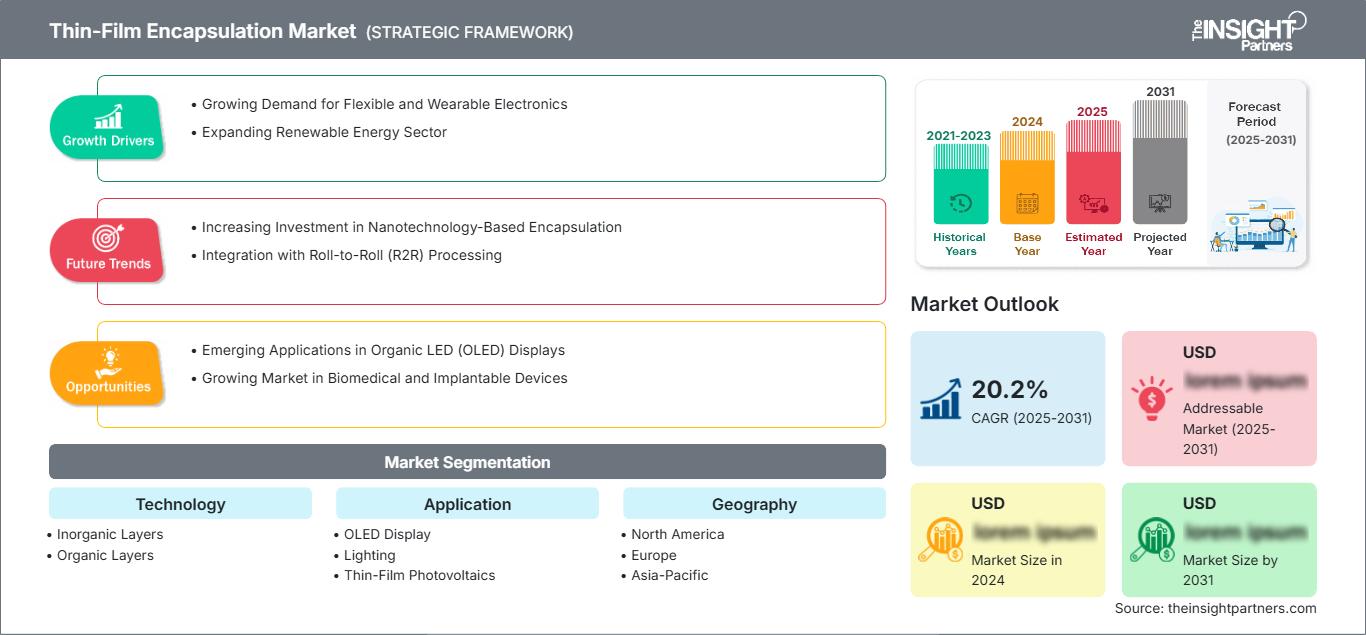
Regional Insights
North America Thin-Film Encapsulation Market
North America held 28–32% Thin-Film Encapsulation Market share in 2025 and is projected to grow at a 5.4–6.2% CAGR. Demand is anchored in premium electronics design, OLED materials research, aerospace display qualification, and thin-film photovoltaic testing supported by public and private clean-energy investment.
The region benefits from close interaction between equipment suppliers, materials developers, universities, and device companies. US-based innovation hubs accelerate reliability testing for foldable displays and specialty solar modules, while Canadian and Mexican electronics assembly capacity supports downstream integration across automotive, industrial, and consumer device supply chains.
U.S. Thin-Film Encapsulation Market
The U.S. accounted for 72–76% of North America in 2025 and is expected to grow at a 5.5–6.3% CAGR. Demand is strongest in OLED materials development, defense-grade displays, medical wearables, and photovoltaic reliability testing where encapsulation quality directly affects lifetime performance.
Company presence includes Applied Materials, Inc., 3M Company, Universal Display Corporation, and Veeco Instruments Inc., which support equipment, materials, and technology licensing activity. Application trends emphasize tablets, automotive displays, advanced lighting prototypes, and flexible energy devices that require validated barrier performance under bending, thermal cycling, and humidity exposure.
Europe Thin-Film Encapsulation Market
Europe held 20–24% share in 2025 and is projected to expand at a 4.8–5.6% CAGR, with Germany leading regional adoption. Thin-Film Encapsulation demand is shaped by automotive display engineering, organic electronics research, and solar manufacturing resilience initiatives.
The UK contributes through flexible electronics research, pilot coating centers, and university-linked commercialization programs. Germany leads with equipment, automotive electronics, and photovoltaic process expertise, while France, Italy, and Spain add demand from lighting, aerospace, and renewable energy applications. European buyers emphasize sustainability, material safety, and equipment energy efficiency during supplier qualification.
APAC Thin-Film Encapsulation Market
APAC captured 38–42% share in 2025 and is forecast to grow at a 6.6–7.4% CAGR, making it the leading region. China, South Korea, and Japan dominate OLED production, while India and Australia add emerging electronics and photovoltaic demand.
Policy support for display localization, semiconductor equipment, and clean energy strengthens investment. South Korea leads high-end OLED manufacturing, China scales panel capacity, Japan supplies specialty materials, and India’s electronics incentives create longer-term opportunities for localized encapsulation adoption.
Middle East & Africa Thin-Film Encapsulation Market
Middle East & Africa is projected to grow at a 4.6–5.4% CAGR, with the UAE leading adoption through electronics distribution, solar pilots, and smart infrastructure programs. Saudi Arabia supports demand through renewable energy localization and industrial diversification.
South Africa contributes through specialty electronics, mining-related monitoring systems, and distributed solar projects. Rest of MEA demand remains selective, focused on imported displays, lighting systems, and photovoltaic modules where encapsulation durability improves performance in heat, dust, and high-irradiance environments.
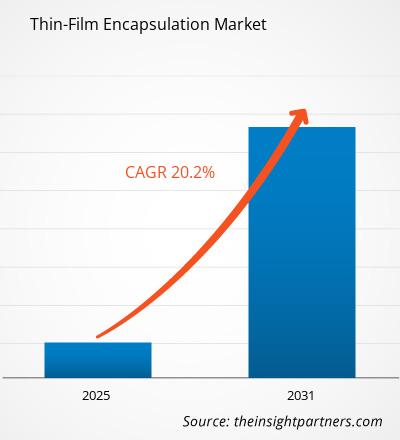
Segmentation Analysis
Technology
Technology is expected to grow at a 5.8–6.6% CAGR from 2026 to 2034 as manufacturers optimize barrier stacks for flexibility, transparency, and throughput. Thin-Film Encapsulation Market scope in this segment centers on balancing inorganic moisture protection with organic stress relief, enabling reliable coatings for OLED panels, lighting modules, and thin-film photovoltaic devices.
- Inorganic Layers remain essential for low water-vapor transmission, strong oxygen barriers, and long device life, especially in OLED displays requiring high reliability and consistent optical performance.
- Organic Layers provide flexibility, surface planarization, and mechanical stress management, making them strategically important in foldable devices, curved lighting panels, and hybrid barrier architectures.
Application
Application is projected to grow at a 6.0–6.8% CAGR from 2026 to 2034. OLED Display remains the commercial anchor because panel makers need encapsulation to preserve brightness and lifetime. Lighting applications benefit from thin, uniform barriers, while thin-film photovoltaics gain from lightweight protection against moisture, heat, and outdoor exposure.
- OLED Display leads demand as smartphones, tablets, wearables, automotive screens, and IT panels require reliable encapsulation that supports flexible form factors and high display uniformity.
- Lighting uses encapsulation to improve panel lifetime, maintain luminous consistency, and enable slim architectural designs where traditional rigid packaging limits design freedom.
- Thin-Film Photovoltaics is gaining strategic relevance as lightweight solar modules require durable barriers that withstand humidity, temperature cycling, bending, and prolonged outdoor exposure.
Opportunity Snapshot
| Application | Revenue Contribution | Trend Tag | Adoption Stage |
| OLED Display | High | Foldable Panels | Mature |
| Lighting | Medium | Architectural OLED | Scaling |
| Thin-Film Photovoltaics | Medium | Flexible Solar | Emerging |
Thin-Film Encapsulation Market Growth Drivers and Impact Analysis
Flexible OLED commercialization accelerates barrier demand
For the development of flexible OLEDs, there should be an encapsulation technology that can protect the organic emission material from moisture and oxygen without affecting its bending ability. With the increasing popularity of smartphones, tablets, wearable devices, and car displays that are thin and curved in nature, the panel manufacturers have to develop multilayer films that do not contain any defect and have stable optical characteristics. This effect is reflected in the high standards required by the deposition machines and barriers.
Thin-film solar durability needs stronger protection
Photovoltaic modules based on thin films have been gaining traction due to the demand for lighter, building-integrated, and portable energy systems. Such systems are exposed to humidity, heat, UV rays, and stress; therefore, encapsulation plays an important role in ensuring their reliability. Improved barrier properties will help to limit degradation, increase the lifetime of the module, and make projects economically more viable when their installation requires additional efforts. Market benefits would be noticeable mostly for manufacturers of energy solutions for transportation, infrastructure, and distributed power supply.
Advanced deposition tools improve yield economics
Encapsulation efficiency is significantly dependent on deposition uniformity, particulates management, and process consistency. Technical advances made in atomic layer deposition, plasma-enhanced chemical vapor deposition, and selective deposition enable companies to improve quality and boost production speed. It is not only about materials’ efficiency, but also a reduction in the cost of production and an ability to bring flexible OLED panels and photovoltaic devices to market. Equipment suppliers who can provide monitoring, services, and compatibility between generations of equipment are likely to affect the purchasing decision of panel manufacturers.
Thin-Film Encapsulation Market Future Trends
Hybrid multilayer stacks become standard for flexible devices
Thin-Film Encapsulation Market trends will increasingly favor hybrid stacks that combine dense inorganic layers with mechanically compliant organic layers. The structure makes it possible for devices to be foldable, rollable, and stretchable with minimal risks of cracks and moisture protection. For the future, it will be necessary to consider fewer layers, curing speed, and enhanced optical neutrality. Suppliers who manage to keep stack designs simple without compromising long life span performance will assist display panel manufacturers in reducing takt time and improving yields.
Localized supply chains reshape qualification strategies
The display and solar industry is projected to seek diversification in terms of sourcing in order to mitigate geopolitical risk, logistical issues, and constraints on the availability of specific materials. In this scenario, encapsulation suppliers will have to adapt to regionalize their service teams, precursor supplies, and pilot coating services in relation to key device hubs. As a result, this strategy is expected to lead to a collaborative approach to qualifications, with customers seeking to qualify alternate sources that meet the processing criteria and reliability standards.
Thin-Film Encapsulation Market Opportunities
Gen 8 OLED panel expansion creates equipment openings
Larger OLED substrates create investment opportunities for deposition platforms, process control systems, and encapsulation materials capable of uniform coating across wider areas. Thin-Film Encapsulation Market Forecasts indicate that suppliers with scalable systems can benefit as panel makers target tablets, notebooks, monitors, and televisions. The actionable opportunity is to co-develop recipes with display manufacturers early, validate reliability under production conditions, and offer service models that reduce downtime. Equipment and material vendors that align with capacity expansions can convert pilot wins into multi-year supply positions.
Flexible solar modules open adjacent revenue pools
Opportunities with thin-film photovoltaic encapsulation extend beyond consumer electronics to benefit building integrated solar, transport, portable power generation, and remote monitoring sectors. Opportunities for investment lie with material systems that enhance environmental durability without sacrificing light weight and flexibility. Business development collaborations with module manufacturers, construction material providers, and renewable energy companies will speed up commercialization as performance verification over time is required for users. Film suppliers with accelerated testing and application engineering skills have unique selling propositions in solar markets limited by traditional glass encapsulation technology.
Recent Developments
- June 2026: Applied Materials, Inc. — introduced SENZ, a fully integrated visual system for next-generation smart glasses, reinforcing the company’s role in advanced display manufacturing ecosystems where compact optical modules and durable device packaging are critical. The launch supports broader demand for precision deposition and encapsulation-compatible processes in wearable electronics.
- May 2025: Universal Display Corporation — reported an investor update highlighting more than 6,500 patents issued and pending worldwide and continued development of OLED materials, technology transfer, and innovation platforms. Its UNIVERSALBARRIER thin-film encapsulation capability remains relevant for ultra-flexible plastic substrate systems used in OLED, photovoltaic, battery, and related thin-film devices.
- November 2024: Applied Materials, Inc. — introduced MAX OLED, an integrated OLED manufacturing solution combining deposition and encapsulation technologies for larger glass substrates. The company stated the system can support Gen 8 and beyond, improve brightness and resolution, reduce power use, and extend display lifetime, with Samsung Display assessing an alpha system.
Frequently Asked Questions

- Comprehensive Market Sizing and Forecast Analysis
- Detailed Segmentation Analysis
- In-Depth Market Dynamics Assessment
- Regional and Country-Level Insights
- Competitive Landscape and Company Benchmarking
- Strategic Business Intelligence
Recent Reports
Testimonials

The Insight Partners' SCADA System Market report is comprehensive, with valuable insights on current trends and future forecasts. The team was highly professional, responsive, and supportive throughout. We are very satisfied and highly recommend their services.
RAN KEDEM Partner, Reali Technologies LTDs
I requested a report on a very specific software market and the team produced the report in a few days. The information was very relevant and well presented. I then requested some changes and additions to the report. The team was again very responsive and I got the final report in less than a week.
JEAN-HERVE JENN Chairman, Future Analytica
We worked with The Insight Partners for an important market study and forecast. They gave us clear insights into opportunities and risks, which helped shape our plans. Their research was easy to use and based on solid data. It helped us make smart, confident decisions. We highly recommend them.
PIYUSH NAGPAL Sr. Vice President, High Beam Global
The Insight Partners delivered insightful, well-structured market research with strong domain expertise. Their team was professional and responsive throughout. The user-friendly website made accessing industry reports seamless. We highly recommend them for reliable, high-quality research services
YUKIHIKO ADACHI CEO, Deep Blue, LLC.
This is the first time I have purchased a market report from The Insight Partners.While I was unsure at first, I visited their web site and felt more comfortable to take the risk and purchase a market report.I am completely satisfied with the quality of the report and customer service. I had several questions and comments with the initial report, but after a couple of dialogs over email with their analyst I believe I have a report that I can use as input to our strategic planning process.Thank you so much for taking the extra time and making this a positive experience.I will definitely recommend your service to others and you will be my first call when we need further market data.
JOHN SUZUKI President and Chief Executive Officer, Board Director, BK Technologies
I wish to appreciate your support and the professionalism you displayed in the course of attending to my request for information regarding to infectious disease IVD market in Nigeria. I appreciate your patience, your guidance, and the fact that you were willing to offer a discount, which eventually made it possible for us to close a deal. I look forward to engaging The Insight Partners in the future, all thanks to the impression you have created in me as a result of this first encounter.
DR CHIJIOKE ONYIA MANAGING DIRECTOR, PineCrest Healthcare Ltd.Reason to Buy
- Informed Decision-Making
- Understanding Market Dynamics
- Competitive Analysis
- Identifying Emerging Markets
- Customer Insights
- Market Forecasts
- Risk Mitigation
- Boosting Operational Efficiency
- Strategic Planning
- Investment Justification
- Tracking Industry Innovations
- Aligning with Regulatory Trends





 Get Free Sample for