
Time-Sensitive Networking Market Demand, Size & Forecast by 2034
Coverage: by Component (Switches, Hubs, Routers and Gateways, Connectors, Power Supply Devices, Controllers and Processors, Memory, Others); Application (Power and Energy, Automotive, Transportation, Oil and Gas, Aerospace, Others) , and Geography (North America, Europe, Asia Pacific, and South and Central America)
- Status : Data Released
- Report Code : TIPRE00011231
- Category : Electronics and Semiconductor
- No. of Pages : 150
- Available Report Formats :


- Last update date : July 21, 2026


2025 Market Size
US$ 354.6 Mn
Base year value
2034 Forecast
US$ 7,865.4 Mn
Projected by 2034
CAGR 2026-2034
41.11 %
Growth rate
Addressable Market
US$ 25,783.17 Mn
(2026-2034)
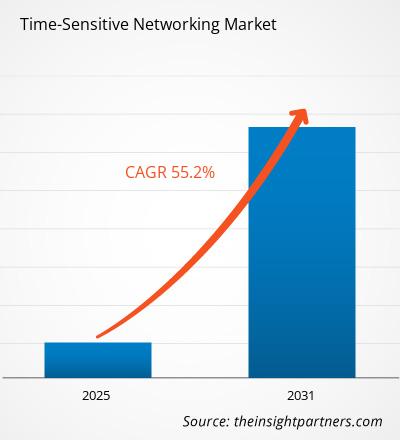
The Time-Sensitive Networking Market size is projected to grow from US$ 354.6 Million in 2025 to US$ 7,865.4 Million by 2034, registering a CAGR of 41.11% during 2026–2034. There is an increasing demand for Time Sensitive Networking due to the need for real-time data transfer, synchronization, and improved network availability in areas such as industrial Ethernet, software-defined vehicles, power automation, and intelligent manufacturing systems.
The Time Sensitive Networking market in North America will be driven by developments in factory automation, improvements in edge computing infrastructure, and increased OT cyber security investments. The CAGR growth rate for the region between 2026 and 2034 is anticipated to be in the range of 39-42%.
Time-Sensitive Networking Market Assessment and Insights
- North America held 31–34% share in 2025 and is expected to grow at a CAGR between 39–42% during 2026–2034, supported by automation refresh cycles, TSN-ready switching, and digital grid investments.
- US accounted for 72–76% of North America in 2025 and is projected to grow at a CAGR between 39–42%, driven by automotive, aerospace, and industrial edge adoption.
- Europe represented 27–30% share in 2025 and is forecast to grow at a CAGR between 38–41%, led by Germany, the UK, France, Italy, and Spain.
- Asia Pacific captured 28–31% share in 2025 and is likely to advance at a CAGR between 42–45%, with China, Japan, South Korea, and India expanding smart manufacturing.
- Largest Segment IEEE 802.1 AS held 34–38% market share in 2025 and is expected to grow at a CAGR range of 39–42%, due to synchronization needs.
- High Growth Segment Switches held 40–44% market share in 2025 and is projected to grow at a CAGR range of 42–45%, reflecting network infrastructure upgrades.
- Key companies analyzed in detail: Belden Inc., Cisco Systems, Inc., Texas Instruments Incorporated, Siemens AG, Marvell Technology, Inc., NXP Semiconductors N.V., Microchip Technology Incorporated, Analog Devices, Inc., Broadcom Inc., and Renesas Electronics Corporation.
Source: The Insight Partners' analysis based on proprietary research, government publications, company annual reports, investor presentations, industry databases, and expert interviews.
Technological migration from proprietary fieldbus networks to open architecture Ethernet is taking place in deterministic networking. The 802.1 standards specify such functions as synchronization, scheduling, frame replication, and preemption. This allows the merging of control, vision, safety, and analytics traffic to take place on common platforms. Changes in production environments include the inclusion of TSN-compatible technology in processors, controllers, and PHY by semiconductor manufacturers, as well as switch development in regard to temperature resistance, vibration, and cybersecurity compliance in production facilities, automotive, utility and transportation sectors.
Most progress will be seen where industrial Ethernet upgrades coincide with software-based automation and electrification, and safety-critical communications. New implementations in India, Southeast Asia, the Gulf region, and Eastern Europe will receive additional support from brownfield upgrades and government manufacturing initiatives. Regulatory considerations regarding functional safety, cyber-resilience, and grid stability will make deterministic transport more desirable, since deterministic data delivery eliminates downtime risks and ensures performance levels.
Time-Sensitive Networking Market Report Scope
| Report Attribute | Details |
|---|---|
| Market size in 2025 | US$ 354.6 Million |
| Market Size by 2034 | US$ 7,865.4 Million |
| Global CAGR (2026 - 2034) | 41.11% |
| Historical Data | 2021-2024 |
| Forecast period | 2026-2034 |
Time-Sensitive Networking Market Analysis
Time-Sensitive Networking Market growth is driven by the transition to converged industrial networking that supports motion control, machine vision, safety, and telemetry communications without compromising on determinism. IEEE 802.1AS and IEEE 802.1Qbv are essential, as synchronized time and traffic windows facilitate predictable cycle times in robotics, packaging, automotive assembly, and process automation.
Market dynamics are positive with suppliers of Ethernet switches, semiconductor companies, and automation players aligning their product roadmap to TSN profiles. The value chain includes physical layer devices, processors, controllers, gateways, embedded software, design solutions, and integration services. Testing for interoperability continues to be crucial, as customers seek guaranteed determinism in multi-vendor environments.
Time-Sensitive Networking Market report indicates competition is based on comprehensive industrial networking portfolios rather than individual products. Belden Inc. and Siemens AG focus on OT-ready switching and industrial automation systems, whereas Cisco Systems, Inc. seeks secure convergence of enterprise and factory floor networks. Leading semiconductor players include Texas Instruments Incorporated, NXP Semiconductors N.V., and Microchip Technology Incorporated.
There are investments being made to edge computing technology, deterministic Ethernet chips, and software configuration tools. Marvell Technology, Inc., Analog Devices, Inc., Broadcom Inc., and Renesas Electronics Corporation have positioned themselves using their connectivity, timing, and embedded processing. Differentiation will be based on latency, redundancy, cyber security compliance, and lifecycle management for brownfield modernization.
● REPORT CUSTOMIZATION
Tailor This Report To Align With Your Specific Business Requirements
This report can be customized to align precisely with your business objectives, scope, and target markets. Customization options include tailored segmentation, geography, competitive analysis, and strategic insights to support informed decision-making.
Customize This Report →WHAT YOU CAN ADJUST
- ● Segmentations
- ● Geography
- ● Competitive Analysis
- ● Language Preferences
Time-Sensitive Networking Market: Strategic Insights
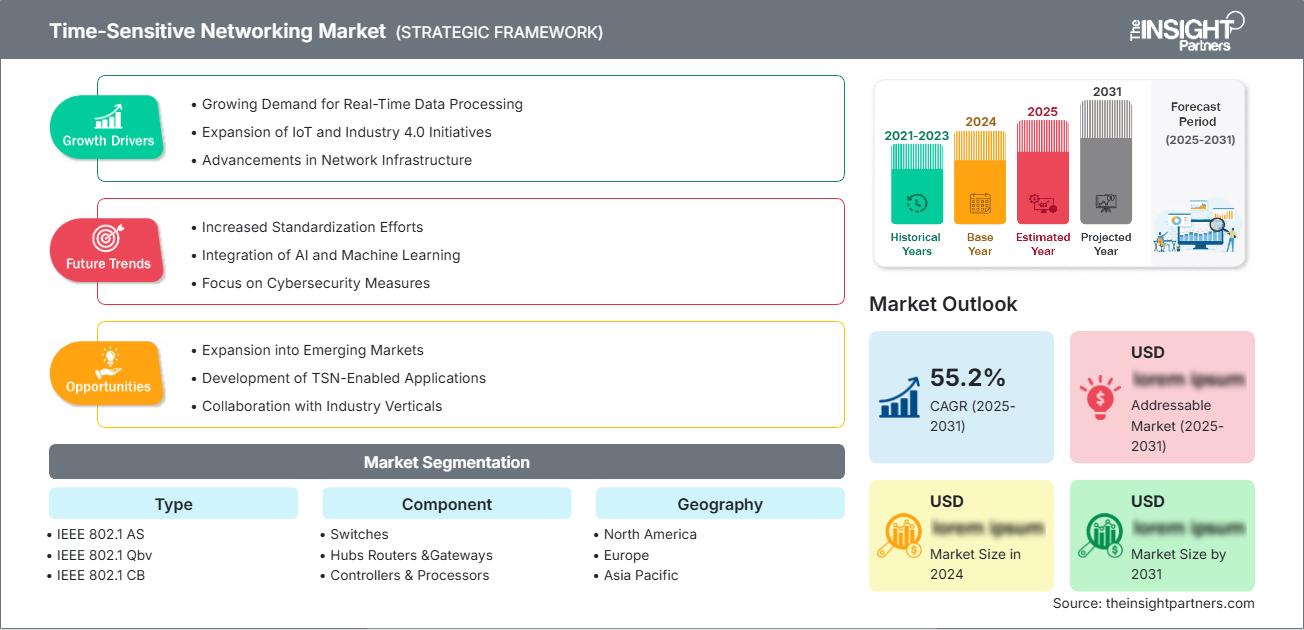
Regional Insights
North America Time-Sensitive Networking Market
North America held 31–34% share in 2025 and is expected to grow at a CAGR between 39–42% during 2026–2034. The Time-Sensitive Networking Market share in this region reflects early adoption of industrial Ethernet, strong cloud-to-edge architecture spending, and active validation of deterministic networking in automotive, aerospace, oil and gas, and utility automation.
Factories are prioritizing network convergence to reduce cabling, maintenance, and protocol fragmentation. Grid operators are also evaluating synchronized communications for substations and distributed energy resources. IEEE’s TSN standards portfolio supports bounded latency, low delay variation, and low packet loss, which fits regional priorities for resilience, uptime, and secure operational technology modernization.
U.S. Time-Sensitive Networking Market
The US accounted for 72–76% of North America in 2025 and is projected to grow at a CAGR between 39–42%. Demand centers around automotive test systems, semiconductor manufacturing equipment, aerospace electronics, and mission critical infrastructure. The application trend indicates the need for TSN-enabled switches, controllers, and processors that will be able to handle deterministic motion control, machine vision, and edge analysis in common networks.
The industry boasts wide representation with Cisco Systems, Inc., Texas Instruments Incorporated, Microchip Technology Incorporated, Analog Devices, Inc., Broadcom Inc., and Belden Inc. all contributing to the environment via networking, silicon, and industrial connectivity. Standardization of automotive Ethernet, with IEEE 802.1DG-2025 as a standard for in-vehicle profiles, increases trust in deterministic Ethernet for safety-related communication of data.
Europe Time-Sensitive Networking Market
Europe represented 27–30% share in 2025 and is forecast to grow at a CAGR between 38–41%. Germany takes the lead because of deep automation, machine building knowledge, and wide use of industrial communication standards. The UK develops its smart manufacturing, rail systems, and infrastructure development, which brings the need for deterministic Ethernet in distributed control systems.
France, Italy, and Spain increase the number of applications using aerospace industry, automotive components, energy management systems, and advanced packaging machinery. Siemens AG is the major automation player in this region, while NXP Semiconductors N.V. brings the semiconductor expertise.
APAC Time-Sensitive Networking Market
APAC captured 28–31% share in 2025 and is likely to advance at a CAGR between 42–45%. China is the dominant country because of its electronics manufacturing in a big way, industrial robotics, and smart factories. Japan and South Korea help in adoption with automotive Ethernet, precision machines, and semiconductor manufacturing.
India and Australia increase the demand because of their manufacturing, mining automation, power sector, and transportation infrastructure. Domestic electronics manufacturing, digitizing factories, and building resilience into supply chain make TSN an interesting choice for control networking. Buyers in this region are highly interested in low-cost switches, processors, and gateways.
Middle East & Africa Time-Sensitive Networking Market
Middle East and Africa is expected to grow at a CAGR between 35–38% during 2026–2034. Saudi Arabia has been a leader in regional implementation due to the need for reliable communications for industrial diversification, automation of refineries and utilities, while the UAE has been implementing infrastructure and logistics automation solutions due to its predictable performance and thus high availability capabilities.
The process of implementation in South Africa and the Rest of MEA regions is more gradual due to mining, energy generation, port automation, and municipal infrastructure needs. Funding limitations may hinder widespread adoption; however, deterministic Ethernet will match modernization strategy well due to expensive down time. Integrators will play a crucial role because facilities often need phased upgrades of existing networks.
Segmentation Analysis
Type
Type is expected to grow at a CAGR range of 40–43% during 2026–2034. The Time-Sensitive Networking Market scope across type standards reflects the need to combine synchronization, traffic scheduling, redundancy, and frame preemption. Buyers typically implement more than one standard because deterministic Ethernet performance depends on coordinated timing, priority handling, and fail-safe packet delivery.
- IEEE 802.1 AS provides timing and synchronization for time-sensitive applications, making it the foundation for coordinated packet scheduling, motion control, and deterministic operations across distributed industrial devices.
- IEEE 802.1 Qbv enables time-aware shaping by assigning transmission windows to critical traffic, reducing queuing delays and supporting applications requiring predictable cycle times and low jitter.
- IEEE 802.1 CB supports frame replication and elimination for reliability, strengthening availability in safety-critical applications where path redundancy prevents packet loss during network disruptions.
- IEEE 802.1 Qbu enables frame preemption so high-priority packets can interrupt lower-priority traffic, improving latency performance in mixed-load Ethernet environments with heavy data traffic.
Component
Component is expected to grow at a CAGR range of 41–44% during 2026–2034. Demand is strongest for hardware that can process synchronized traffic, enforce deterministic schedules, and connect legacy systems. Switches remain central, while controllers, processors, gateways, isolators, and convertors extend adoption into machines, substations, vehicles, and distributed industrial assets.
- Switches dominate deployment because deterministic Ethernet requires traffic scheduling, time synchronization, redundancy, and industrial ruggedization at network aggregation points.
- Hubs Routers & Gateways support brownfield migration by connecting legacy field devices, enterprise networks, and modern TSN domains without requiring full infrastructure replacement.
- Controllers & Processors integrate TSN capabilities into machines and edge nodes, allowing deterministic control, local analytics, and synchronized communication within compact automation architectures.
- Isolators & Convertors protect signal integrity and translate interfaces in harsh environments, supporting staged upgrades where electrical noise, distance, or legacy protocols remain constraints.
Opportunity Snapshot
| Component | Revenue Contribution | Trend Tag | Adoption Stage |
| Switches | High | Rugged TSN | Scaling |
| Hubs Routers & Gateways | Medium | Brownfield Bridge | Scaling |
| Controllers & Processors | High | Edge Control | Emerging |
| Isolators & Convertors | Low | Signal Integrity | Mature |
Time-Sensitive Networking Market Growth Drivers and Impact Analysis
Converged Industrial Ethernet Architecture
Manufacturers are now using converged Ethernet to replace control, safety, vision, and information networks separately to simplify cabling and diagnostics. There are several advantages that TSN offers to the Time-Sensitive Networking Market by enabling critical packets to be delivered in a scheduled and synchronized manner and non-critical information on the same network. Plants benefit from a change in their cost structure because engineers can standardize the use of tools, eliminate gateway layers, and have better visibility into the manufacturing process. This effect is more evident in the assembly of cars, packaging, electronics, and process control industries where milliseconds matter in terms of throughput and quality.
Software-Defined Vehicles and In-Vehicle Ethernet
Vehicles are shifting toward zonal architectures, centralized compute, advanced driver assistance, and software-defined functions that require high-bandwidth, low-latency communications. IEEE 802.1DG-2025 supports bounded latency automotive Ethernet profiles, strengthening the case for TSN in in-vehicle networks. This driver expands demand for processors, PHYs, switches, and software stacks validated for automotive reliability. Suppliers that demonstrate timing precision, redundancy, and security can capture design wins early in platform cycles. The market impact extends beyond premium vehicles because electrification and automated features are pushing deterministic connectivity into broader model ranges, increasing long-term volume potential for TSN-enabled semiconductor and networking components.
Grid Automation and Critical Infrastructure Resilience
Utilities, transport operators, and energy companies are modernizing communications to handle distributed assets, renewable integration, and real-time monitoring. TSN provides deterministic Ethernet capabilities that can support synchronized substation automation, protection signaling, and resilient control networks. The impact is practical because outages, latency variability, and packet loss can create operational and safety risks in critical infrastructure. As utilities connect more sensors, power electronics, and edge devices, network timing becomes a design requirement rather than a performance enhancement. Adoption will be phased, but TSN-capable gateways, switches, isolators, and controllers can enter modernization programs where reliability metrics justify higher equipment specifications.
Time-Sensitive Networking Market Future Trends
Profile-Based Interoperability Testing
The most important Time-Sensitive Networking Market trends will center on profile-based interoperability rather than isolated standard support. Buyers will increasingly request proof that switches, controllers, processors, and gateways work together under defined industrial, automotive, aerospace, or utility profiles. Test labs and vendor alliances will gain influence because deterministic performance must be validated across topology changes, cyber controls, and mixed traffic loads. This will reduce integration risk and shorten procurement cycles. Vendors that publish latency, jitter, synchronization, and failover results in repeatable test conditions will be better positioned with manufacturers seeking scalable deployments across multiple plants and regions.
TSN Integrated into Edge AI Platforms
Edge AI workloads in inspection, robotics, and process optimization will require deterministic access to high-quality operational data. TSN will increasingly be embedded into industrial edge platforms so synchronized sensors, cameras, drives, and controllers can feed local inference engines without unpredictable delay. This trend will influence processor design, switch firmware, and orchestration software. Over time, deterministic networking and AI operations will become linked buying criteria, especially in factories where closed-loop decisions must occur near machines. The result will be deeper collaboration between automation suppliers, chipmakers, and industrial software vendors.
Time-Sensitive Networking Market Opportunities
Brownfield Factory Upgrade Packages
The strongest Time-Sensitive Networking Market Forecasts point to brownfield factories as a high-value opportunity because most production assets cannot be replaced at once. Vendors can package TSN-capable switches, gateways, engineering software, and migration services for staged deployment. This approach lowers adoption risk, preserves existing PLC and fieldbus investments, and gives plant managers measurable benefits such as simplified diagnostics and reduced downtime exposure. Channel partners and system integrators should focus on reference architectures for common use cases, including motion control cells, vision inspection lines, and synchronized packaging systems. Financing models tied to uptime improvements can accelerate procurement decisions.
Automotive Ethernet Validation Ecosystems
Automotive suppliers have an opportunity to build validation ecosystems around TSN profiles for zonal architectures, safety domains, and high-bandwidth sensor fusion. The opportunity extends from silicon and switches to simulation tools, compliance testing, and integration support. Original equipment manufacturers need repeatable evidence that deterministic Ethernet can meet latency and reliability targets across vehicle platforms. Providers that combine hardware with test data, reference software, and security features can become preferred partners early in development cycles. This creates defensible positions because automotive qualification timelines are long, and validated components often remain embedded across multiple vehicle generations.
Recent Developments
- August 2025: Belden Inc. — launched next-generation connectivity and cybersecurity products for critical automation and smart infrastructure applications, including RemoteIP OSP cables, the Belden Industrial Firewall IAF-240, PROVIZE Suite updates, and Hirschmann BOBCAT switch certification to IEC 62443-4-2 Security Level 2 requirements.
- June 2026: Cisco Systems, Inc. — introduced Cisco Cloud Control, an agentic platform intended to operate critical IT infrastructure with trusted AI agents and human operators, reinforcing the company’s positioning around resilient, AI-ready network operations relevant to converged industrial and enterprise environments.
Frequently Asked Questions

- Comprehensive Market Sizing and Forecast Analysis
- Detailed Segmentation Analysis
- In-Depth Market Dynamics Assessment
- Regional and Country-Level Insights
- Competitive Landscape and Company Benchmarking
- Strategic Business Intelligence
Recent Reports
Testimonials

The Insight Partners' SCADA System Market report is comprehensive, with valuable insights on current trends and future forecasts. The team was highly professional, responsive, and supportive throughout. We are very satisfied and highly recommend their services.
RAN KEDEM Partner, Reali Technologies LTDs
I requested a report on a very specific software market and the team produced the report in a few days. The information was very relevant and well presented. I then requested some changes and additions to the report. The team was again very responsive and I got the final report in less than a week.
JEAN-HERVE JENN Chairman, Future Analytica
We worked with The Insight Partners for an important market study and forecast. They gave us clear insights into opportunities and risks, which helped shape our plans. Their research was easy to use and based on solid data. It helped us make smart, confident decisions. We highly recommend them.
PIYUSH NAGPAL Sr. Vice President, High Beam Global
The Insight Partners delivered insightful, well-structured market research with strong domain expertise. Their team was professional and responsive throughout. The user-friendly website made accessing industry reports seamless. We highly recommend them for reliable, high-quality research services
YUKIHIKO ADACHI CEO, Deep Blue, LLC.
This is the first time I have purchased a market report from The Insight Partners.While I was unsure at first, I visited their web site and felt more comfortable to take the risk and purchase a market report.I am completely satisfied with the quality of the report and customer service. I had several questions and comments with the initial report, but after a couple of dialogs over email with their analyst I believe I have a report that I can use as input to our strategic planning process.Thank you so much for taking the extra time and making this a positive experience.I will definitely recommend your service to others and you will be my first call when we need further market data.
JOHN SUZUKI President and Chief Executive Officer, Board Director, BK Technologies
I wish to appreciate your support and the professionalism you displayed in the course of attending to my request for information regarding to infectious disease IVD market in Nigeria. I appreciate your patience, your guidance, and the fact that you were willing to offer a discount, which eventually made it possible for us to close a deal. I look forward to engaging The Insight Partners in the future, all thanks to the impression you have created in me as a result of this first encounter.
DR CHIJIOKE ONYIA MANAGING DIRECTOR, PineCrest Healthcare Ltd.Reason to Buy
- Informed Decision-Making
- Understanding Market Dynamics
- Competitive Analysis
- Identifying Emerging Markets
- Customer Insights
- Market Forecasts
- Risk Mitigation
- Boosting Operational Efficiency
- Strategic Planning
- Investment Justification
- Tracking Industry Innovations
- Aligning with Regulatory Trends





 Get Free Sample for