
Touch Sensor Market Trends, Size & Growth by 2034
Touch Sensor Market Size and Forecasts (2021–2034), Global and Regional Share, Trends, and Growth Opportunity Analysis Report Coverage : By Type (Resistive, Capacitive, Surface Acoustic Wave (SAW), Infrared, and optical), Channel Type (Multi-Channel & Single Channel), Installation Area (Smartphones & Tablets, Laptops, Cars & Aircraft Solutions, Elevators, ATMs, Medical Devices, Panel Control System, Kiosk Solutions & Others), End-User (Consumer Electronics, Automotive, Aerospace, Medical, Factory Automation, Retail & Others)
- Status : Data Released
- Report Code : TIPRE00039656
- Category : Electronics and Semiconductor
- No. of Pages : 150
- Available Report Formats :


- Last update date : October 30, 2026


2025 Market Size
US$ 7.56 Bn
Base year value
2034 Forecast
US$ 14.55 Bn
Projected by 2034
CAGR 2026-2034
7.55 %
Growth rate
Addressable Market
US$ 99.65 Bn
(2026-2034)
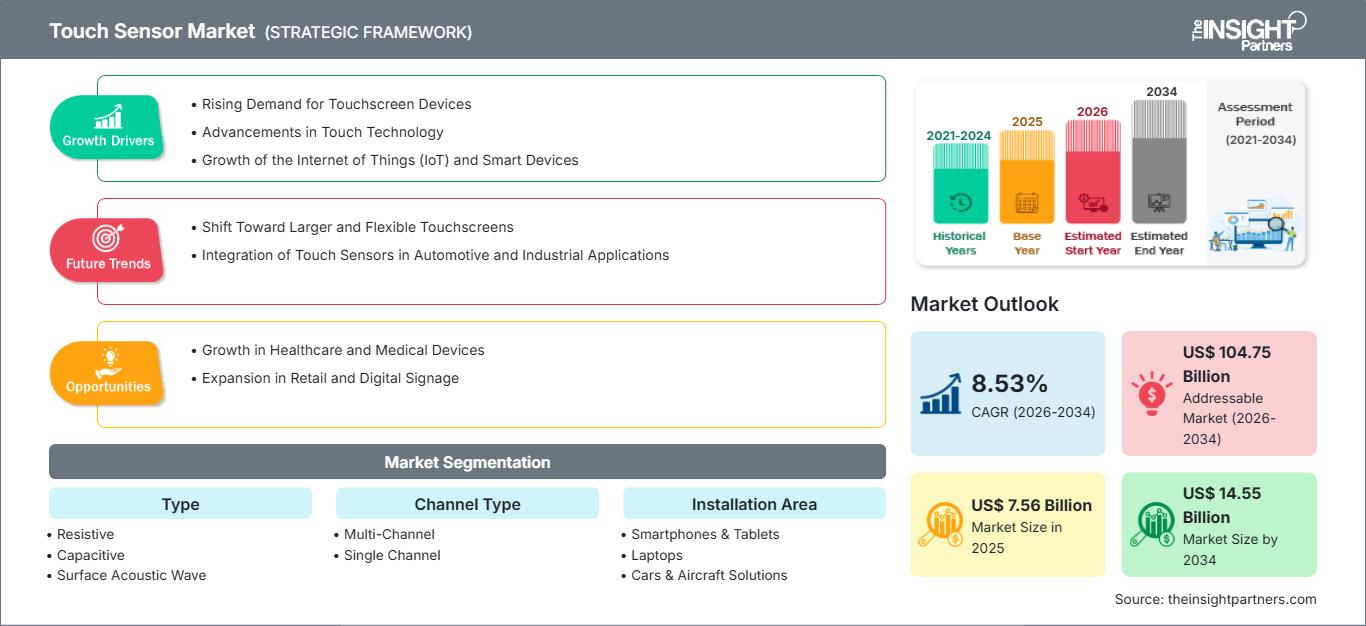
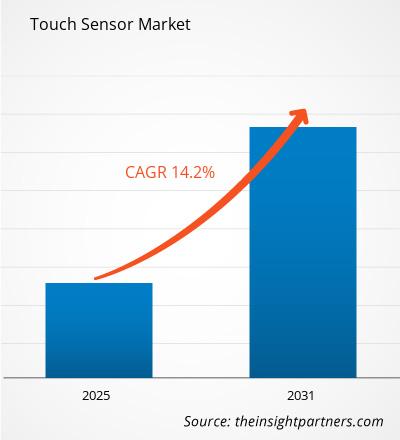
The Touch Sensor Market is valued at US$ 7.56 Billion in 2025 and is projected to reach US$ 14.55 Billion by 2034, registering a CAGR of 7.55% from 2026 to 2034. The market encompasses sensing solutions for detection of touch or proximity or touch-based interaction on consumer, automotive, aerospace, medical, industrial and retail products.
Growing adoption of intuitive human machine interface solutions will boost the Touch Sensor Market Size due to the widespread use of capacitive sensors in connected devices, automotive controls, industrial controls, and interactive kiosks. North America continues to be a hub of technological design and innovation and is also driven by demand from automobile digitization, touch-enabled devices, and low power embedded sensors.
Touch Sensor Market Assessment and Insights
Regional Outlook
- North America: ~24% of the global market in 2025 | ~7% CAGR through 2034. Market position: North America maintains a substantial market position because of established semiconductor capabilities, high adoption of connected consumer equipment, advanced automotive electronics, and demand for sophisticated human-machine interfaces across industrial and medical applications.
- US: ~87% of North American market revenue in 2025 | ~7% CAGR through 2034. Market position: The US accounts for most North American revenue, supported by semiconductor design capabilities, consumer electronics, automotive technology development, aerospace systems, medical equipment, and industrial automation requiring reliable touch interfaces.
- Europe: ~23% of the global market in 2025 | ~7% CAGR through 2034. Market position: Europe has a mature technology base, with Germany representing the leading country in Europe. Automotive electronics, factory automation, medical equipment, industrial controls, and premium vehicle interfaces support continued demand.
- Asia Pacific: ~43% of the global market in 2025 | ~9% CAGR through 2034. Market position: Asia Pacific represents the largest regional market and the fastest-growing region, supported by China, Japan, South Korea, India, and Australia. Electronics manufacturing, smartphone production, automotive electrification, and expanding industrial automation underpin regional demand.
Segment Outlook
- End-User - Consumer Electronics: ~46% Share in 2025 | ~8% CAGR through 2034. Market position: Consumer electronics represents the largest demand concentration because smartphones, tablets, laptops, personal devices, and interactive equipment depend heavily on touch-enabled interfaces. High unit volumes and recurring device replacement sustain sensor deployment.
- Installation Area - Smartphones & Tablets: ~34% Share in 2025 | ~9% CAGR through 2034. Market position: Smartphones and tablets remain a high-volume installation area, while larger touch surfaces, thinner sensor stacks, improved wet-touch performance, and low-power controllers support continued technology development and replacement demand.
Competitive Coverage
STMicroelectronics, Texas Instruments Incorporated, Infineon Technologies AG, NXP Semiconductors N.V., onsemi, Honeywell International Inc., Qualcomm Incorporated, Abatek, Shin-Etsu Polymer Europe B.V., Crystal Display Systems Ltd.
Methodology
The Insight Partners follows Data Collection & Secondary Research, Primary Research, Data Analysis, and Data Triangulation & Final Review to validate market estimates and insights.
Source: The Insight Partners' analysis based on proprietary research, government publications, company annual reports, investor presentations, industry databases, and expert interviews.
Touch sensing has expanded to become an embedded sensing interface that enables the use of displays, buttons, sliders, proximity sensing, gestures, and even advanced vehicle controls. Resistive touch sensing still has its applications in situations involving pressure interaction and harsh operating environments, whereas capacitive sensing has become fundamental to mass electronic interface applications. Surface acoustic wave, infrared, and optical technologies have found use in areas requiring different environmental factors.
The development of the Touch Sensor Market can also be attributed to the growing incorporation of the sensors with microcontrollers, display controllers, communications interfaces, and software. Rather than looking at the sensing technology independently, there has been a tendency among the equipment manufacturers to consider the performance of the touch interface in relation to the whole human-machine interface system. Other factors like noise resistance, water rejection, glove use, latency, and EMC considerations thus affect purchasing decisions.
From now until 2034, the need will arise for touch sensors to be used in vehicle interiors, industrial machines, medical devices, kiosks, automated vending machines, and control panels. In the case of automotive applications, this is highly important, since car manufacturers are switching from using traditional buttons and switches to touch sensors while still needing reliability and performance in various environmental conditions such as temperature, electromagnetic interference, moisture, and vibration.
Touch Sensor Market Report Scope
| Report Attribute | Details |
|---|---|
| Market size in 2025 | US$ 7.56 Billion |
| Market Size by 2034 | US$ 14.55 Billion |
| Global CAGR (2026 - 2034) | 7.55% |
| Historical Data | 2021-2024 |
| Forecast period | 2026-2034 |
Touch Sensor Market Analysis
The Touch Sensor Market depends on the proliferation of electronic human machine interface systems used in mass-produced and specialized equipment. The demand comes from OEMs, display system providers, automotive suppliers, automation equipment suppliers, medical equipment providers, and consumer electronics companies. This market encompasses sensing materials and electrodes, sensor components, controller chips, software, display panels, interfaces, and final equipment assembly. Supply conditions depend on availability of semiconductors, manufacturing capacity of displays, prices of sensor materials, and the capability of suppliers to provide application specific designs.
According to the Touch Sensor Market Report, the significance of capacitive sensing technology lies in its ability to enable multi touch, proximity detection, gesture control, low power consumption, and sealed interface capabilities. Supplier competition revolves around the advancement of their products in terms of signal to noise ratio, noise rejection capability, water management, use in glove mode, response time, size and integration capability.
The competitive positioning encompasses companies operating in semiconductors, touch controller technology, sensor materials and display systems. The touch-control product offerings from STMicroelectronics cover a wide range of consumer, automotive, industrial and commercial applications, while Texas Instruments provides solutions for capacitive HMI design leveraging embedded processing and sensing. Infineon puts a very strong emphasis on automotive and embedded touch, particularly high voltage and functional safety oriented platforms, while NXP is building up automotive touch capabilities based on software defined vehicles architecture.
The areas of investments include automotive electronics, cockpit interface technology, low power sensing, small controllers and manufacturing scale. The extended cockpit interface ecosystem of Qualcomm also underlines the importance of touch functionality for connected vehicle designs, while companies like Honeywell cater to industrial and aerospace interfaces where reliability and environmental performance are important. The resulting competitive environment continues to be highly diversified, with each supplier putting emphasis on different aspects such as consumer volumes, automotive qualifications, industrial performance, display or application specific customizations.
● REPORT CUSTOMIZATION
Tailor This Report To Align With Your Specific Business Requirements
This report can be customized to align precisely with your business objectives, scope, and target markets. Customization options include tailored segmentation, geography, competitive analysis, and strategic insights to support informed decision-making.
Customize This Report →WHAT YOU CAN ADJUST
- ● Segmentations
- ● Geography
- ● Competitive Analysis
- ● Language Preferences
Touch Sensor Market: Strategic Insights
Regional Insights
North America Touch Sensor Market
North America constituted approximately 24% of the worldwide market in 2025 and is forecasted to grow by approximately 7% CAGR till 2034. North America is favored by existing semiconductor design capabilities and robust demand in consumer electronics, automotive electronics, aerospace electronics, medical electronics, and industrial automation electronics. The United States contributes to approximately 87% of the total North American revenues, which makes it the main regional market.
The regional market opportunity becomes more and more associated with the intersection of sensing and embedded computing. Automotive producers need reliable touch interfaces that will work in difficult environmental conditions, while industrial and medical products require low-power consumption, EMI resistance, and reliability of the user interaction. While the demand from consumer electronics remains high-volume, the growth is driven by more varied use cases, where touch control replaces conventional buttons or creates additional ways of interaction.
U.S. Touch Sensor Market
The US accounted for ~87% of North American revenue in 2025 and is projected to grow at a ~7% CAGR through 2034. The country combines large electronics consumption with substantial semiconductor, automotive, aerospace, medical, and industrial technology capabilities. Demand is therefore distributed across high-volume consumer applications and technically demanding professional equipment.
Suppliers that are located in the United States and operate on an international scale cover several application sectors, such as STMicroelectronics, Texas Instruments Incorporated, Honeywell International Inc., and Qualcomm Incorporated. Touch-based interfaces are becoming increasingly important in automotive HMI due to the evolution of digital cockpits that involve an increased number of touch screens. Touch screens are also used in industrial machinery and medical devices as part of connected equipment.
Europe Touch Sensor Market
Europe represented ~23% of the global Touch Sensor Market Share in 2025 and is expected to register a ~7% CAGR through 2034. Germany is the leading country in Europe, supported by its automotive manufacturing base, industrial automation ecosystem, machinery production, and engineering capabilities. France, Italy, Spain, and the UK also contribute through automotive, aerospace, industrial, medical, and consumer applications.
Automotive markets present special relevance since there is ongoing development of digitally integrated cabins and advanced interfaces by European automotive producers. Touch controls have to work reliably with interference from electromagnetic signals, temperature changes, moisture, gloves, and other factors of the real world. There is yet another significant demand source in industrial automation, where machine interfaces evolve from mechanical to programmable displays and touch screens.
The European Touch Sensor Market is also characterized by presence of well-known electronic component vendors. For example, Infineon Technologies AG is strongly represented with engineering and manufacturing capacity in Europe, while semiconductor companies like STMicroelectronics are providing touch controllers and embedded sensing devices for equipment manufacturers. Therefore, the competition environment in the region focuses on reliability, functional integration, automotive certification, and long product life cycles, not just volumes in consumer devices.
APAC Touch Sensor Market
APAC accounted for ~43% of the global Touch Sensor Market Share in 2025 and is forecast to expand at a ~9% CAGR through 2034. China is the leading country in Asia Pacific, supported by its extensive electronics manufacturing ecosystem, large consumer-device market, automotive production, and industrial automation activity. Japan and South Korea remain important technology and component centers, while India is expanding electronics manufacturing and digital infrastructure.
There is regional demand for the industry due to the concentration of smartphones, tablets, displays, semiconductors, automotive and electronics manufacturing. There is also an increasing use of touch sensors in machinery, retail terminals, medical devices, and automobiles. Large-scale electronics manufacturing provides an opportunity for manufacturers to improve the production of components, while increased automotive electronics adds more applications than just in mobile devices.
Middle East & Africa Touch Sensor Market
Middle East & Africa is supported by expanding infrastructure digitization, industrial modernization, retail automation, medical equipment deployment, and smart-building initiatives. Saudi Arabia and the UAE represent important technology adoption centers in the Middle East, while South Africa contributes through industrial, retail, automotive, and medical applications.
The region is forecast to grow at a CAGR of around 6% through 2034. There is greater demand on an application-by-application basis as opposed to that in APAC, and opportunities will lie in areas such as interactive kiosks, control panels, point-of-sales systems, healthcare systems, smart facilities, and automotive applications. The construction of connected infrastructure can result in more human machine interfaces, and harsh environmental conditions lead to requirements for robust sensor solutions.
Segmentation Analysis
The Touch Sensor Market scope covers four main dimensions: Type, Channel Type, Installation Area, and End-User. Each dimension captures a different aspect of technology selection and deployment, ranging from the sensing principle and channel architecture to the physical location and industry purchasing the technology.
Type
Type segment in the Touch Sensor Market is expected to register a ~8% CAGR from 2026 to 2034. Capacitive sensing is strategically important because it combines high responsiveness with multi-touch capability, low-power operation, and flexible integration into modern interfaces. Resistive sensing remains relevant in applications requiring pressure-based input or operation with gloves and tools. Surface acoustic wave, infrared, and optical technologies address specialized interface requirements.
- Resistive: Resistive sensors remain relevant in industrial equipment, point-of-sale terminals, medical systems, and applications where pressure-based operation is useful. Their ability to respond to gloves or stylus input supports continued deployment where environmental and interaction requirements outweigh the preference for advanced multi-touch functionality.
- Capacitive: Capacitive technology is central to modern touch interfaces because it supports multi-touch, proximity, gesture functions, and thin sensor structures. Consumer electronics provide substantial demand, while automotive, industrial, and smart-device applications increasingly adopt capacitive sensing for sealed and programmable interfaces.
- Surface Acoustic Wave: Surface acoustic wave technology uses acoustic-wave interaction across a touch surface and can provide clear optical performance. It is suited to selected larger display and public-interface applications where surface durability and visual quality are important purchasing considerations.
- Infrared: Infrared sensing detects interruptions or changes in an optical field and can support large-format interactive surfaces. Its characteristics make it relevant to kiosks, public displays, specialized control interfaces, and environments where sensor placement can be separated from the display surface.
- Optical: Optical touch technologies use light-based detection to determine interaction. They can support specialized large-area or interactive applications where conventional electrode structures are less suitable, creating opportunities in selected commercial, industrial, and display environments.
Channel Type
Channel Type segment in the Touch Sensor Market is projected to grow at a ~7% CAGR from 2026 to 2034. Channel architecture affects sensing resolution, response behavior, system complexity, and the number of touch inputs that can be processed. Multi-channel configurations are increasingly important for interfaces requiring multiple simultaneous inputs or distributed sensing, while single-channel designs remain attractive for straightforward touch or proximity functions.
- Multi-Channel: Multi-channel architectures support complex touch surfaces, multiple keys, sliders, proximity sensing, and multi-point interaction. They are particularly relevant to automotive cockpit interfaces, consumer devices, industrial panels, and applications where several sensing elements must be monitored within one controller architecture.
- Single Channel: Single-channel designs offer a simpler implementation for individual buttons, switches, proximity functions, or compact equipment interfaces. Their lower complexity can support cost-sensitive applications and designs where multiple simultaneous sensing points are unnecessary.
Installation Area
Installation Area segment in the Touch Sensor Market is expected to register a ~9% CAGR from 2026 to 2034. Smartphones and tablets remain important because of their high installed base and replacement cycles, while automotive displays, aircraft interfaces, elevators, ATMs, medical equipment, control panels, and kiosks diversify demand. Larger interactive surfaces are creating additional requirements for noise management, durability, and precise touch detection.
- Smartphones & Tablets: Smartphones and tablets remain a major installation area because touch is fundamental to device interaction. Demand increasingly emphasizes thin structures, accurate multi-touch, low power consumption, water rejection, stylus compatibility, and reliable operation across changing display architectures.
- Laptops: Touch-enabled laptops add interactive functionality to conventional computing platforms. Demand depends on premium device penetration, convertible form factors, user-interface preferences, and integration between displays, touch controllers, operating systems, and power-management architectures.
- Cars & Aircraft Solutions: Vehicle and aircraft interfaces increasingly use touch-enabled displays and controls to reduce mechanical components and consolidate functions. Automotive demand is particularly important because larger displays, smart surfaces, haptic feedback, and personalized interfaces increase sensing requirements.
- Elevators: Touch interfaces are being introduced into elevator controls and destination systems where hygiene, aesthetics, accessibility, and flexible user interaction are important. Adoption is concentrated in modern commercial, hospitality, healthcare, and high-end residential projects.
- ATMs: ATMs continue to use touch displays for transaction navigation and authentication workflows. Sensor reliability, vandal resistance, accessibility, and operation under varied environmental conditions influence technology selection.
- Medical Devices: Medical equipment uses touch interfaces to simplify configuration, monitoring, and workflow navigation. Demand favors reliable sensing, easy cleaning, clear visual feedback, and compatibility with gloves or other operating constraints.
- Panel Control System: Industrial control panels use touch sensing to consolidate machine controls, diagnostics, status displays, and configuration functions. The opportunity is linked to factory automation and the shift toward programmable human-machine interfaces.
- Kiosk Solutions: Kiosks use touch sensors for self-service transactions, information access, ticketing, ordering, and customer interaction. Large user-facing surfaces require durable sensing and reliable response under continuous public use.
End-User
End-User segment in the Touch Sensor Market is projected to expand at a ~8% CAGR through 2034. Consumer electronics remains the largest demand center, while automotive and factory automation are important sources of diversification. Medical and aerospace applications emphasize reliability and specialized performance, whereas retail applications benefit from self-service and interactive equipment deployment.
- Consumer Electronics: Consumer electronics represents the largest end-user category because smartphones, tablets, laptops, smart devices, and interactive personal equipment use touch as a primary interface. Replacement cycles and increasing interface sophistication support sustained sensor demand.
- Automotive: Automotive demand is expanding as vehicle interiors incorporate larger displays, touch buttons, smart surfaces, steering-wheel sensing, and digital cockpit functions. Safety, electromagnetic compatibility, wet-touch rejection, glove operation, and low latency influence adoption.
- Aerospace: Aerospace applications require robust and reliable interfaces for cockpit, cabin, and equipment controls. Long qualification cycles and demanding environmental conditions favor suppliers capable of delivering application-specific designs and stable long-term component support.
- Medical: Medical end users prioritize intuitive operation, cleanable surfaces, reliability, and precise interaction. Touch interfaces can reduce mechanical controls while improving workflow visibility, particularly in monitoring equipment, diagnostic systems, and treatment devices.
- Factory Automation: Factory automation uses touch interfaces for machine controls, operator panels, diagnostics, and programmable workflows. The movement toward connected manufacturing increases the importance of integrated sensing, communication, visualization, and control.
- Retail: Retail applications include point-of-sale equipment, self-service terminals, kiosks, digital ordering systems, and interactive displays. Demand is linked to labor-saving automation, customer self-service, and the digitization of physical retail environments.
Opportunity Snapshot
| End-User | Revenue Contribution | Trend Tag | Adoption Stage |
|---|---|---|---|
| Consumer Electronics | High | Multi-Touch | Mature |
| Automotive | High | Smart Cockpit | Scaling |
| Aerospace | Medium | Avionics HMI | Scaling |
| Medical | Medium | Cleanable HMI | Scaling |
| Factory Automation | Medium | Digital HMI | Scaling |
| Retail | Medium | Self-Service | Scaling |
Touch Sensor Market Growth Drivers and Impact Analysis
Expansion of Digital Human-Machine Interfaces
The replacement of mechanical switches, buttons, and control interfaces with touch-enabled alternatives remains a fundamental demand mechanism in the Touch Sensor Market. Touch interfaces allow manufacturers to consolidate functions, dynamically change controls, integrate visual feedback, and support software-defined user experiences. In consumer devices, this capability is already embedded into mainstream product architectures, while automotive, industrial, medical, and retail applications are expanding the addressable installed base. The economic benefit is not limited to the sensing element itself. A touch interface can reduce mechanical components, simplify product appearance, and enable software-driven functionality. As equipment becomes more connected, manufacturers can also integrate touch sensing with displays, embedded processors, communication systems, and haptic technologies. This encourages suppliers to develop complete sensing platforms rather than standalone sensor components, increasing the strategic importance of controller integration and application-specific software.
Increasing Automotive Adoption of Touch-Based Controls
Automotive electronics are creating a significant expansion opportunity because vehicle manufacturers are incorporating touch surfaces into center displays, instrument clusters, steering wheels, doors, consoles, and other cabin functions. Modern automotive touch systems must satisfy requirements that are more demanding than those of many consumer devices, including operation across temperature changes, moisture, electromagnetic interference, gloves, and unintended contact. This encourages innovation in signal processing, noise suppression, water rejection, proximity detection, haptics, and functional safety. The resulting technology requirements increase the value of integrated touch controllers and automotive-qualified semiconductor platforms. As vehicle architectures move toward centralized and software-defined systems, touch sensing can increasingly become a connected element of the digital cockpit rather than an isolated input device. This creates opportunities for suppliers that combine sensing, processing, diagnostics, communication, and safety features.
Growth of Automation and Self-Service Equipment
Factory automation, medical equipment, retail kiosks, ATMs, elevators, and other self-service systems are increasing the number of environments in which users interact directly with electronic equipment. Touch sensing provides a flexible interface because screen content and control functions can be modified through software without redesigning the entire physical control panel. In industrial settings, touch interfaces can combine machine status, alarms, configuration functions, and operator controls on one programmable surface. Retail and public equipment benefit from self-service workflows, while medical equipment can use touch interfaces to present complex information through simplified menus. These applications also introduce specialized requirements such as durability, hygiene, glove operation, accessibility, vandal resistance, and continuous-use reliability. Suppliers that adapt sensor technologies to these operating conditions can address applications beyond high-volume consumer electronics.
Touch Sensor Market Future Trends
Integration of Touch, Proximity, Haptics, and Intelligent Sensing
Future Touch Sensor Market trends are likely to emphasize convergence between touch, proximity, gesture, force, and haptic functions. Instead of detecting only whether a surface has been touched, advanced systems can determine interaction context, distinguish different users or objects, and trigger feedback before or after physical contact. Automotive interfaces are particularly suitable for this evolution because manufacturers are seeking intuitive controls without increasing driver distraction. Industrial and consumer products can also use proximity sensing to wake displays or activate low-power functions only when a user approaches. Integration with embedded processors and software allows filtering algorithms to adapt to environmental noise, water, gloves, and changing operating conditions. The commercial implication is a shift toward multifunctional sensing platforms, with controller capability and software becoming increasingly important alongside electrode or sensor construction.
Higher Integration and Lower-Power Touch Architectures
Touch interfaces are expected to become more integrated with microcontrollers, display systems, communication interfaces, and power-management functions. This can reduce component count, PCB area, development complexity, and energy consumption. Battery-powered consumer products will continue to prioritize low-power sensing, while automotive and industrial systems will emphasize reliability and simplified wiring. Large displays will require improved signal processing to address display noise and electromagnetic interference without compromising responsiveness. Integration can also accelerate product development because equipment manufacturers can use validated controller architectures, software libraries, evaluation tools, and reference designs rather than creating every layer independently. Through 2034, the competitive emphasis is therefore likely to move from basic sensing capability toward complete platforms that combine hardware, firmware, diagnostics, safety functions, and application-specific tuning.
Touch Sensor Market Opportunities
Automotive Smart Surfaces and Advanced Cockpit Interfaces
A major commercial opportunity lies in automotive smart surfaces that combine touch, proximity, haptics, lighting, and display functionality. Vehicle manufacturers are seeking differentiated interiors while simultaneously reducing mechanical controls and improving software configurability. This creates demand for controllers capable of handling large touch areas, multiple interaction modes, wet fingers, gloves, electromagnetic interference, and safety-related diagnostics. Suppliers can capture value by developing platforms that combine sensor electronics with embedded software, automotive communication interfaces, and functional-safety features. Opportunities also extend beyond central infotainment screens to steering wheels, door panels, seats, overhead consoles, and other surfaces. The strongest commercial models are likely to involve early collaboration with automotive OEMs and Tier 1 suppliers because sensor geometry, materials, display construction, and software integration are typically defined during vehicle development rather than after production begins.
Expansion into Industrial, Medical, and Self-Service Equipment
Industrial, medical, and self-service applications provide opportunities to diversify beyond consumer electronics and reduce dependence on high-volume mobile devices. Industrial equipment manufacturers can use touch interfaces to consolidate controls and diagnostics, while medical equipment producers can prioritize sealed, cleanable, and glove-compatible interfaces. Retail kiosks, ATMs, elevators, and public terminals require durable sensing that can withstand repeated interaction and variable environmental conditions. These Touch Sensor Market Forecasts can support specialized designs where performance and lifecycle support matter more than the lowest component price. Suppliers can also develop vertical-specific reference designs, software libraries, and qualification packages to shorten customer development cycles. Over time, broader deployment of connected equipment and automated service points can increase the installed base of touch-enabled systems and create recurring replacement and upgrade demand.
Recent Developments
- June 2025: Infineon Technologies AG expanded its PSoC 4 HV microcontroller platform with the PSoC 4 HVMS family, integrating high-voltage functionality and advanced analog sensing for space-constrained applications. The platform targets automotive HMI functions including touch buttons, sliders, touchpads, steering-wheel sensing, door handles, and other vehicle controls.
- February 2025: STMicroelectronics updated a series of technical resources covering touch sensing on STM32 devices, including guidance for touch sensing control, ESD robustness, sampling capacitors, surface-sensor design, conducted-noise robustness, touchkey expansion, and application tuning. The updates strengthen design support for embedded capacitive touch implementations.
- January 2025: Qualcomm Incorporated expanded its collaboration with Alps Alpine to support next-generation automotive in-cabin experiences. The collaboration includes touch input panels alongside switches, sensors, actuators, electronic shifters, and other automotive interface technologies, reinforcing the role of touch-enabled interaction within connected digital cockpit systems.
Frequently Asked Questions

- Comprehensive Market Sizing and Forecast Analysis
- Detailed Segmentation Analysis
- In-Depth Market Dynamics Assessment
- Regional and Country-Level Insights
- Competitive Landscape and Company Benchmarking
- Strategic Business Intelligence
Recent Reports
Testimonials

The Insight Partners provided valuable market intelligence that supported our global go-to-market strategy. Their team was professional, responsive, and attentive to our feedback, providing thoughtful analysis and helpful methodological clarifications throughout the project.
Junmo Kim Chief Financial Officer (CFO), Enertech Co., Ltd.
The Insight Partners' SCADA System Market report is comprehensive, with valuable insights on current trends and future forecasts. The team was highly professional, responsive, and supportive throughout. We are very satisfied and highly recommend their services.
RAN KEDEM Partner, Reali Technologies LTDs
I requested a report on a very specific software market and the team produced the report in a few days. The information was very relevant and well presented. I then requested some changes and additions to the report. The team was again very responsive and I got the final report in less than a week.
JEAN-HERVE JENN Chairman, Future Analytica
We worked with The Insight Partners for an important market study and forecast. They gave us clear insights into opportunities and risks, which helped shape our plans. Their research was easy to use and based on solid data. It helped us make smart, confident decisions. We highly recommend them.
PIYUSH NAGPAL Sr. Vice President, High Beam Global
The Insight Partners delivered insightful, well-structured market research with strong domain expertise. Their team was professional and responsive throughout. The user-friendly website made accessing industry reports seamless. We highly recommend them for reliable, high-quality research services
YUKIHIKO ADACHI CEO, Deep Blue, LLC.
This is the first time I have purchased a market report from The Insight Partners.While I was unsure at first, I visited their web site and felt more comfortable to take the risk and purchase a market report.I am completely satisfied with the quality of the report and customer service. I had several questions and comments with the initial report, but after a couple of dialogs over email with their analyst I believe I have a report that I can use as input to our strategic planning process.Thank you so much for taking the extra time and making this a positive experience.I will definitely recommend your service to others and you will be my first call when we need further market data.
JOHN SUZUKI President and Chief Executive Officer, Board Director, BK Technologies
I wish to appreciate your support and the professionalism you displayed in the course of attending to my request for information regarding to infectious disease IVD market in Nigeria. I appreciate your patience, your guidance, and the fact that you were willing to offer a discount, which eventually made it possible for us to close a deal. I look forward to engaging The Insight Partners in the future, all thanks to the impression you have created in me as a result of this first encounter.
DR CHIJIOKE ONYIA MANAGING DIRECTOR, PineCrest Healthcare Ltd.Reason to Buy
- Informed Decision-Making
- Understanding Market Dynamics
- Competitive Analysis
- Identifying Emerging Markets
- Customer Insights
- Market Forecasts
- Risk Mitigation
- Boosting Operational Efficiency
- Strategic Planning
- Investment Justification
- Tracking Industry Innovations
- Aligning with Regulatory Trends





 Get Free Sample for