
Touchable Holographic Display Market Share, Demand & Growth by 2034
Coverage: by Product (Digital Signage, Notebooks, Medical Scanners, Kiosk, Others); Applications (Consumer Industry, Medical Sector, Defense Sector, Industrial Sector, Commercial sector, Others) , and Geography (North America, Europe, Asia Pacific, and South and Central America)
- Status : Data Released
- Report Code : TIPRE00007970
- Category : Electronics and Semiconductor
- No. of Pages : 150
- Available Report Formats :


- Last update date : October 30, 2026


2025 Market Size
US$ 3.93 Bn
Base year value
2034 Forecast
US$ 31.79 Bn
Projected by 2034
CAGR 2026-2034
26.16 %
Growth rate
Addressable Market
US$ 134.50 Bn
(2026-2034)
The Touchable Holographic Display Market is entering a high-expansion phase as interactive three-dimensional visualization moves from demonstrations toward practical deployments. The market was valued at US$ 3.93 Billion in 2025 and is projected to reach US$ 31.79 Billion by 2034, registering a CAGR of 26.16% during 2026–2034. The trajectory reflects advances in optical systems, spatial computing, gesture sensing, and real-time 3D content that broaden the commercial relevance of touchable displays.
Demand in North America is supported by early enterprise adoption, medical visualization, defense simulation, and premium digital signage. The region is expected to record a ~25% CAGR through 2034 as buyers prioritize immersive interfaces that can communicate complex information without conventional touchscreens or head-mounted devices. Investment in interactive display infrastructure, spatial computing, and specialized 3D content also supports adoption.
Touchable Holographic Display Market Assessment and Insights
Regional Outlook
- North America: ~31% of the global market in 2025 | ~25% CAGR through 2034. Market position: North America represents the largest regional market, supported by technology development, enterprise visualization, defense applications, medical imaging, digital advertising, and established ecosystems for advanced computing and interactive display solutions.
- US: ~84% of North American market revenue in 2025 | ~25% CAGR through 2034. Market position: The US accounts for most North American demand, with adoption spanning healthcare visualization, defense training, retail experiences, entertainment, and industrial design. Technology developers and specialized display integrators reinforce domestic commercialization.
- Europe: ~23% of the global market in 2025 | ~24% CAGR through 2034. Market position: Europe has a developed research and industrial base, with Germany, the UK, France, Italy, and Spain supporting demand. Germany has a strong position within Europe through industrial visualization, engineering, automotive applications, and technology development.
- Asia Pacific: ~28% of the global market in 2025 | ~30% CAGR through 2034. Market position: Asia Pacific is the fastest-growing region, driven by expanding consumer electronics manufacturing, digital retail, medical technology, industrial automation, and investment in immersive interfaces. China represents the leading country in Asia Pacific.
Segment Outlook
- Digital Signage: ~36% Share in 2025 | ~25% CAGR through 2034. Market position: Digital signage leads because retailers, advertisers, museums, venues, and public-facing organizations can use interactive three-dimensional imagery to differentiate physical environments and communicate products or information without relying solely on conventional flat-panel displays.
- Medical Sector: ~22% Share in 2025 | ~30% CAGR through 2034. Market position: Medical applications have a strong growth mechanism because three-dimensional visualization can translate CT, MRI, ultrasound, and other volumetric data into interactive representations for education, planning, diagnostics, and procedural visualization.
Competitive Coverage
Zebra Imaging, AV Concepts, Displair, EON Reality Inc., Holoxica Ltd., Konica Minolta, Inc., Musion Das Hologram Ltd., Provision Holding, Inc., Qualcomm Incorporated, RealView Imaging Ltd.
Methodology
The Insight Partners follows Data Collection & Secondary Research, Primary Research, Data Analysis, and Data Triangulation & Final Review to validate market estimates and insights.
Source: The Insight Partners' analysis based on proprietary research, government publications, company annual reports, investor presentations, industry databases, and expert interviews.
From static or projective three-dimensional imaging, the technology base has advanced to interactive systems that utilize optical reconstructions along with motion detection, gesture recognition, spatial computing, and real-time rendering. In early implementations, the technology focus was on visual innovation and advertisement, whereas later applications are becoming more geared towards meeting professional needs, including medical visualization, engineering design, education and simulation, and even communication purposes. This development is also occurring due to improvements in the processing power, light modulators, sensors, optical components, and three-dimensional content generation software.
The forward outlook for the Touchable Holographic Display Market share is increasingly shaped by commercialization beyond traditional entertainment applications. New deployments in Asia-Pacific will be driven by advances in electronics manufacturing and digital infrastructure, whereas North America and Europe will see continued adoption in specialized applications in healthcare, military, and enterprise segments. Adoption of regulations, especially for clinical visualization solutions, will play a significant role in determining healthcare purchasing cycles and timelines for commercialization. Additionally, investments in spatial computing, edge computing, AI, and sophisticated display modules are anticipated to drive more sophisticated three-dimensional visualizations, reduced latency, and faster touchless interfaces. Market share will increasingly accrue to companies that can deliver high-end holographic visualization along with interactive technology, computing platform, and application integration capabilities.
Touchable Holographic Display Market Report Scope
| Report Attribute | Details |
|---|---|
| Market size in 2025 | US$ 3.93 Billion |
| Market Size by 2034 | US$ 31.79 Billion |
| Global CAGR (2026 - 2034) | 26.16% |
| Historical Data | 2021-2024 |
| Forecast period | 2026-2034 |
Touchable Holographic Display Market Analysis
The Touchable Holographic Display Market growth is closely associated with demand for interfaces that make complex information easier to interpret spatially. Healthcare providers can use interactive anatomical visualization, manufacturers can review three-dimensional engineering models, retailers can create differentiated product presentations, and defense organizations can visualize terrain or operational scenarios. The value proposition goes beyond aesthetics and into information understanding, decision making in space, customer engagement, and training.
The ecosystem consists of optical elements, light sources, spatial light modulators, projection equipment, sensing hardware, processors, enclosure for displays, rendering software, content platform, integration, and application services. The supply depends upon the availability and pricing of special optics, semiconductor elements, high-performance graphics processors, and accurate sensors. It also depends upon the software’s interoperability since companies expect their products to be compatible with CAD, medical imaging, simulations, content management, and data visualization.
Competition combines specialist holographic developers with companies that contribute display hardware, immersive software, imaging systems, or processing technologies. Holoxica has developed holographic, volumetric, and light-field technologies for professional visualization, while RealView Imaging focuses on interactive medical holography. EON Reality contributes interactive 3D and spatial computing capabilities, and Qualcomm provides computing technologies relevant to advanced display and immersive-device architectures. Konica Minolta participates through imaging and visualization expertise, while AV Concepts, Displair, Musion Das Hologram, Provision Holding, and Zebra Imaging address specialized holographic and visual communication applications.
With increasing investment in platforms over standalone displays, developers look at getting value through software, content libraries, application programming interfaces, system integration, and vertical applications. Hence, strategic positioning will be about the optics of the display, its precision in interaction, content compatibility, footprint of the system, installation needs, and proving value. Strategic alliances with hospitals, retail chains, manufacturers, defense establishments, and tech companies can help reduce time-to-market by integrating the display into the existing ecosystem.
● REPORT CUSTOMIZATION
Tailor This Report To Align With Your Specific Business Requirements
This report can be customized to align precisely with your business objectives, scope, and target markets. Customization options include tailored segmentation, geography, competitive analysis, and strategic insights to support informed decision-making.
Customize This Report →WHAT YOU CAN ADJUST
- ● Segmentations
- ● Geography
- ● Competitive Analysis
- ● Language Preferences
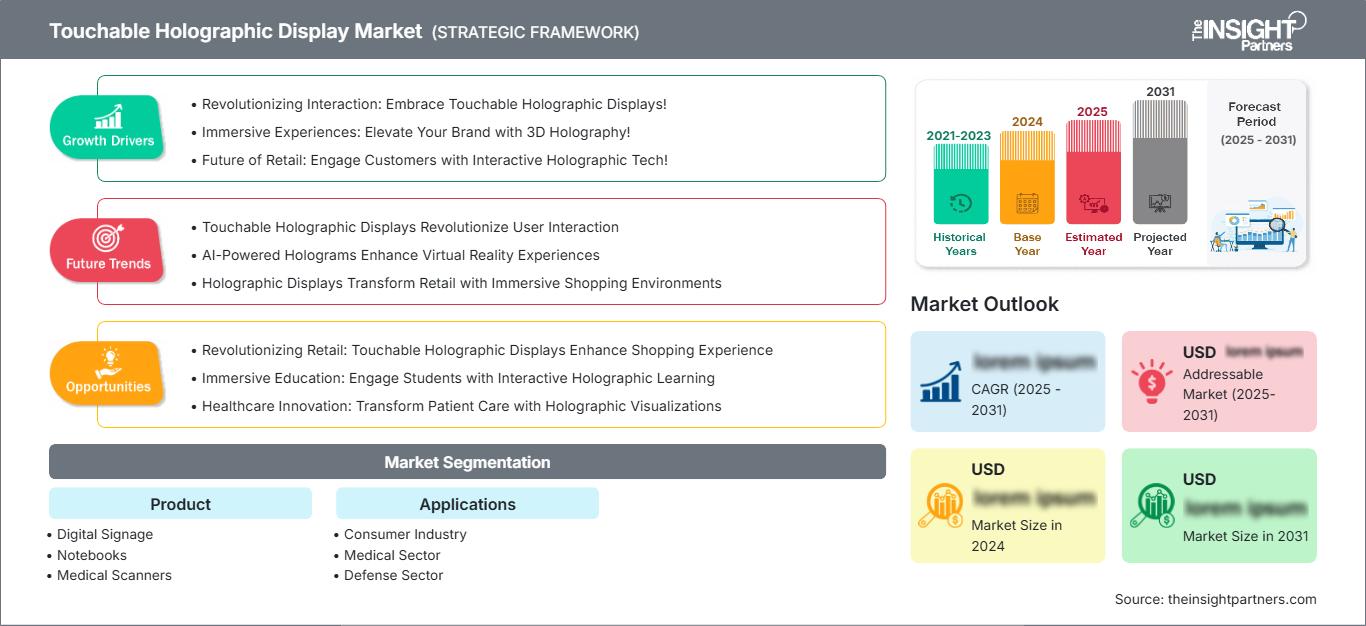
Touchable Holographic Display Market: Strategic Insights
Regional Insights
North America Touchable Holographic Display Market
North America accounted for an estimated ~31% of global Touchable Holographic Display Market revenue in 2025 and is projected to expand at a ~25% CAGR through 2034. The region has very good engagement in terms of advanced computing, display technologies, medical technologies, defense systems, advertising technologies, and immersive software. The United States is the main consumer market, while Canada adds its strength by way of research, creative technologies, and visualization technologies.
Corporate and institutional needs are moving toward applications where three-dimensional interaction can bring a practical benefit, rather than just an entertainment value. For healthcare facilities, interactive visualization can be used in the study of anatomy and procedure planning, and manufacturers can utilize glasses-free 3D visualization technology in engineering and design processes. Defense-related applications also bring in demand for terrain, equipment, and operations visualization. The combination of technology suppliers, venture capital, research organizations, and corporate consumers provides the base for commercialization in North America.
U.S. Touchable Holographic Display Market
The US represented approximately ~84% of North American Touchable Holographic Display Market revenue in 2025 and is expected to expand at a ~25% CAGR through 2034. The country's market position is supported by technology companies, medical institutions, defense organizations, retailers, entertainment operators, and industrial enterprises with established budgets for advanced visualization systems. Demand is particularly relevant where spatial understanding is difficult to achieve through conventional flat displays.
It is one such application where interactive holography plays a significant role, as it can interpret volumetric data into a medium that allows for investigation of anatomy and process communication. In the same way, users in the fields of defense and aerospace may use the three-dimensional interpretation in training and situation analysis. Business users have started using holographic signage and installations. Industrial users, on their part, can connect display systems with Computer-Aided Design and simulations. The presence of firms like EON Reality, Qualcomm, and AV Concepts, among others, further strengthens its commercial presence.
Europe Touchable Holographic Display Market
Europe represented an estimated ~23% of the global Touchable Holographic Display Market revenue in 2025 and is expected to register a ~24% CAGR through 2034. Germany holds a leading position within Europe, supported by industrial engineering, automotive development, research infrastructure, and demand for advanced visualization. The UK contributes through specialist holographic research and technology companies, while France supports aerospace, defense, healthcare, and creative-industry applications.
The industrial capabilities of Germany present opportunities in holographic visualization in design, simulation, product development, and technical training. The UK has an advanced specialist sector with companies like Holoxica and technology development through research. France and Italy have opportunities in healthcare, manufacturing, retail, cultural installation, and engineering applications. In Spain, there are opportunities in tourism, advertising, entertainment, and commercial visualization. Integration with enterprise software and measurable productivity benefits is an important procurement criterion across the European Union.
The development of responsible technology, data management, energy efficiency, and industrial digitization is another factor affecting the adoption of holographic technology in Europe. Applications in medicine have additional needs for regulatory compliance, clinical validation, and integration with imaging systems. This might slow down commercialization processes, but will lead to the development of better quality products with a clear purpose. When display technologies are mature, the market in Europe will be increasingly focused on specialized applications in industry, medicine, defense, and business.
APAC Touchable Holographic Display Market
Asia Pacific accounted for approximately ~28% of global Touchable Holographic Display Market revenue in 2025 and is expected to achieve a ~30% CAGR through 2034, making it the fastest-growing region. China is the leading country in the Asia Pacific, supported by its electronics manufacturing ecosystem, expanding digital commerce, technology investment, and a large base of consumer and commercial display users. Japan and South Korea contribute through advanced electronics, imaging, display, and semiconductor capabilities.
India presents opportunities through digital retail, healthcare modernization, education, defense technology, and expanding technology services, while Australia provides demand in healthcare, education, mining-related visualization, defense, and specialized enterprise applications. The regional growth mechanism combines manufacturing scale with expanding adoption of immersive interfaces. Local content development and improving computing infrastructure can also lower deployment barriers.
Middle East & Africa Touchable Holographic Display Market
The Middle East and Africa Touchable Holographic Display Market region is expected to register a ~27% CAGR through 2034 as investment in tourism, retail modernization, smart infrastructure, healthcare, entertainment, and defense creates specialized demand for advanced visualization. Saudi Arabia represents the leading country in the Middle East & Africa based on investment intensity and large-scale digital and experiential infrastructure programs.
The UAE provides a strong environment for premium retail, hospitality, exhibitions, tourism, and smart-city applications, while South Africa offers opportunities in healthcare, education, entertainment, and industrial visualization. Rest of the MEA demand is more selective and tends to concentrate on high-value installations. Energy-sector visualization, infrastructure planning, command centers, and large public venues can create additional applications where spatial communication provides an operational advantage.
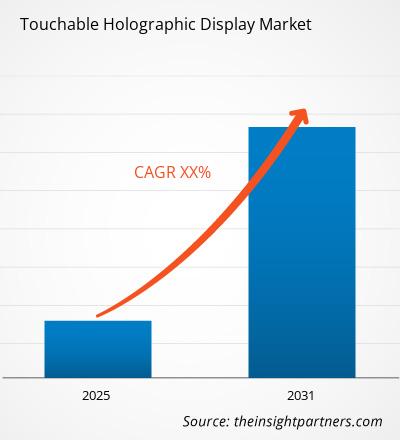
Segmentation Analysis
Product
The Product segment is expected to expand at a ~25% CAGR from 2026 to 2034. Product formats determine how holographic technology is integrated into customer environments, ranging from public-facing visual communication to specialized professional systems. Digital signage remains central because it can be deployed in retail, advertising, exhibitions, entertainment, and information environments. Notebooks, medical scanners, and kiosks broaden the addressable base by connecting holographic interaction with established hardware workflows.
- Digital Signage: Digital signage supports interactive advertising, product visualization, exhibitions, public information, and experiential retail. Its strategic importance comes from the ability to create differentiated visual environments while allowing content to be updated digitally across multiple campaigns and locations.
- Notebooks: Holographic notebooks represent an emerging pathway for integrating three-dimensional visualization into personal computing. Their potential is strongest in design, education, engineering, creative work, and professional applications where users benefit from manipulating spatial content alongside conventional computing workflows.
- Medical Scanners: Medical scanners provide a specialized pathway for interactive visualization of volumetric information. Their importance is tied to converting complex diagnostic data into three-dimensional representations that clinicians, students, and patients can examine more intuitively.
- Kiosk: Kiosks provide a practical deployment format for self-service, wayfinding, retail engagement, exhibitions, and public information. Interactive holographic kiosks can combine visual attraction with guided navigation or digital assistance in locations where user interaction occurs without extensive staff support.
Applications
The Applications segment is expected to register a ~27% CAGR through 2034 as touchable holographic interfaces move into sector-specific workflows. Consumer-oriented environments create volume opportunities through advertising and experiences, while medical and defense applications can support higher-value deployments. Industrial buyers increasingly evaluate three-dimensional visualization for design and training, and commercial organizations use holographic systems to strengthen customer engagement.
- Consumer Industry: Consumer applications emphasize entertainment, product presentation, interactive experiences, gaming, education, and personal visualization. Adoption depends on system affordability, content availability, ease of interaction, and the ability to provide compelling experiences without requiring specialized headsets.
- Medical Sector: Medical applications use interactive three-dimensional representations for imaging, education, treatment planning, visualization, and communication. The segment is strategically important because medical data is inherently spatial and can benefit from interfaces that enable users to inspect structures from multiple perspectives.
- Defense Sector: Defense applications include simulation, mission planning, terrain visualization, training, command environments, and equipment presentation. The strategic value comes from representing complex spatial relationships in an interactive format that can support collaborative analysis and scenario-based decision-making.
- Industrial Sector: Industrial applications include engineering design, digital twins, manufacturing planning, simulation, maintenance, and technical training. Holographic visualization can allow engineering teams to inspect three-dimensional models without relying exclusively on physical prototypes or conventional two-dimensional drawings.
- Commercial sector: Commercial applications span retail, hospitality, exhibitions, events, corporate communication, museums, and public-facing installations. Demand is influenced by the need for memorable customer experiences, flexible digital content, spatial storytelling, and differentiated physical environments.
Opportunity Snapshot
| Applications | Revenue Contribution | Trend Tag | Adoption Stage |
|---|---|---|---|
| Consumer Industry | High | Immersive Experiences | Scaling |
| Medical Sector | Medium | Clinical Visualization | Scaling |
| Defense Sector | Medium | Mission Visualization | Scaling |
| Industrial Sector | Medium | 3D Engineering | Scaling |
| Commercial Sector | High | Experiential Retail | Scaling |
Touchable Holographic Display Market Growth Drivers and Impact Analysis
Expansion of Interactive Medical Visualization
Healthcare is turning out to be a significant demand driver owing to the generation of highly complicated three-dimensional datasets in medical imaging that are challenging to understand through traditional two-dimensional user interfaces. The interactive holographic technologies will help medical professionals, students, and patients with a more understandable visualization of anatomy, space relations, and procedure communication. The significance is seen in diagnosis, planning of the treatment, clinical training, and medical training. The adoption trend is expected to benefit those vendors who manage to integrate their holographic displays with existing imaging and hospitals' information processes. The regulatory approval, clinical proof, cybersecurity, and integration with imaging devices continue to be the major factors in the procurement process. With healthcare providers focusing more on the visualization tools that improve their workflows, applications with clearly identified clinical processes can ensure sustainability in procurement and specializations in display development and medical technologies.
Demand for Immersive Customer and Brand Experiences
Retailers, advertisers, museums, entertainment venues, and hospitality operators are seeking digital experiences that can attract attention in crowded physical environments. Touchable holographic displays can create interactive product demonstrations, virtual presenters, three-dimensional advertisements, navigation systems, and experiential installations that combine visual communication with user participation. The commercial impact is strongest where conventional signage has limited differentiation or where customers must understand complex products quickly. Deployment economics remain important because installation, content creation, maintenance, and replacement costs can influence return on investment. Vendors that offer reusable content frameworks and remote content management can improve the commercial case by allowing one hardware platform to support multiple campaigns. As experiential retail and digital advertising become more integrated, holographic displays can increasingly compete as specialized engagement infrastructure rather than as standalone visual effects.
Three-Dimensional Visualization for Industrial and Defense Workflows
Industrial and defense organizations manage information that is inherently spatial, including machinery, facilities, terrain, equipment, technical drawings, and operational scenarios. Interactive holographic visualization can allow teams to inspect these representations collaboratively and identify spatial relationships that may be difficult to communicate through conventional screens. In manufacturing, the technology can support design reviews, digital-twin visualization, assembly planning, and training. In defense, it can support terrain interpretation, mission preparation, simulation, and command visualization. The commercial impact depends on interoperability with CAD, GIS, simulation, and enterprise data systems. Vendors that integrate their displays into established workflows can reduce the need for organizations to redesign existing processes. This creates opportunities for software partnerships, systems integration, and specialized content development alongside hardware sales.
Touchable Holographic Display Market Future Trends
AI-Generated Spatial Content and Adaptive Interfaces
Artificial intelligence is expected to influence how holographic content is created, personalized, and manipulated. Instead of relying entirely on manually produced three-dimensional assets, future systems can increasingly use AI-assisted workflows to generate models, modify scenes, interpret user intent, and organize complex datasets for spatial presentation. This can reduce content-production friction and allow displays to respond more dynamically to users and environments. The Touchable Holographic Display Market trends will therefore increasingly reflect the convergence of generative AI, computer vision, speech recognition, spatial mapping, and three-dimensional rendering. For enterprises, the value will depend on whether AI reduces content costs while improving usability. Developers that combine display hardware with intelligent interaction layers can potentially create platforms that adapt the visual experience to individual users, operational conditions, or application requirements.
Convergence of Holographic Displays With Spatial Computing
Future display architectures are likely to become increasingly connected with spatial computing platforms rather than operating as isolated visualization devices. Integration with digital twins, real-time sensor data, 3D mapping, simulation engines, and collaborative software can turn a display into a spatial information interface. This direction is particularly relevant for engineering, healthcare, defense, education, and enterprise collaboration. Multi-user visualization can also expand the value proposition by allowing several people to examine different perspectives of the same three-dimensional model. Hardware development will consequently focus not only on image quality but also on processing efficiency, viewing angles, interaction accuracy, connectivity, and compatibility with common development environments. These changes can shift competitive emphasis toward integrated platforms that combine display, software, sensing, content, and application services.
Touchable Holographic Display Market Opportunities
Verticalized Solutions for Hospitals and Medical Institutions
Medical institutions represent an opportunity for vendors that can package holographic hardware, imaging integration, visualization software, training content, and service support into application-specific solutions. Rather than selling a generic display, suppliers can address defined use cases such as structural heart visualization, surgical planning, anatomical education, patient communication, or radiology training. The Touchable Holographic Display Market Forecasts indicate substantial room for expansion if vendors successfully move from demonstrations to repeatable clinical workflows. Partnerships with hospitals, medical universities, imaging companies, and healthcare technology providers can help validate use cases and establish reference installations. The opportunity is particularly attractive for systems capable of handling volumetric imaging data while maintaining precise interaction. Regulatory strategy, clinical validation, interoperability, data security, and service capabilities will remain important factors determining commercialization speed.
Interactive Retail and Public-Space Deployment Models
Retail chains, airports, museums, hotels, trade venues, and entertainment operators offer opportunities for scalable deployment models based on standardized hardware and centrally managed content. Suppliers can develop systems that support multiple installations while allowing local content changes through software platforms. This approach can reduce the operational complexity associated with maintaining holographic experiences across locations and create recurring revenue through content management, analytics, support, and creative services. Commercial buyers can also integrate displays with customer engagement systems, product databases, promotional campaigns, and interactive navigation. The most practical opportunities are likely to emerge where three-dimensional visualization solves a clear communication or engagement problem. Vendors that demonstrate reliability, simple installation, manageable maintenance, and reusable content architectures can improve adoption among organizations operating multiple physical locations.
Recent Developments
- September 2025: Looking Glass unveiled the Hololuminescent Display (HLD), a new category of thin (under 1 inch), up to 4K display that turns standard video into lifelike 3D holograms without needing 3D software pipelines, aimed at advertising, retail, and live environments alongside its existing light-field displays.
- April 2025: Researchers led by Asier Marzo (Public University of Navarra) unveiled the first touchable, floating 3D holograms interactive mid-air graphics people can grab and manipulate with bare hands, no headset needed made possible by a flexible oscillating diffuser sheet with real-time image correction as it deforms.
Frequently Asked Questions

- Comprehensive Market Sizing and Forecast Analysis
- Detailed Segmentation Analysis
- In-Depth Market Dynamics Assessment
- Regional and Country-Level Insights
- Competitive Landscape and Company Benchmarking
- Strategic Business Intelligence
Recent Reports
Testimonials

The Insight Partners provided valuable market intelligence that supported our global go-to-market strategy. Their team was professional, responsive, and attentive to our feedback, providing thoughtful analysis and helpful methodological clarifications throughout the project.
Junmo Kim Chief Financial Officer (CFO), Enertech Co., Ltd.
The Insight Partners' SCADA System Market report is comprehensive, with valuable insights on current trends and future forecasts. The team was highly professional, responsive, and supportive throughout. We are very satisfied and highly recommend their services.
RAN KEDEM Partner, Reali Technologies LTDs
I requested a report on a very specific software market and the team produced the report in a few days. The information was very relevant and well presented. I then requested some changes and additions to the report. The team was again very responsive and I got the final report in less than a week.
JEAN-HERVE JENN Chairman, Future Analytica
We worked with The Insight Partners for an important market study and forecast. They gave us clear insights into opportunities and risks, which helped shape our plans. Their research was easy to use and based on solid data. It helped us make smart, confident decisions. We highly recommend them.
PIYUSH NAGPAL Sr. Vice President, High Beam Global
The Insight Partners delivered insightful, well-structured market research with strong domain expertise. Their team was professional and responsive throughout. The user-friendly website made accessing industry reports seamless. We highly recommend them for reliable, high-quality research services
YUKIHIKO ADACHI CEO, Deep Blue, LLC.
This is the first time I have purchased a market report from The Insight Partners.While I was unsure at first, I visited their web site and felt more comfortable to take the risk and purchase a market report.I am completely satisfied with the quality of the report and customer service. I had several questions and comments with the initial report, but after a couple of dialogs over email with their analyst I believe I have a report that I can use as input to our strategic planning process.Thank you so much for taking the extra time and making this a positive experience.I will definitely recommend your service to others and you will be my first call when we need further market data.
JOHN SUZUKI President and Chief Executive Officer, Board Director, BK Technologies
I wish to appreciate your support and the professionalism you displayed in the course of attending to my request for information regarding to infectious disease IVD market in Nigeria. I appreciate your patience, your guidance, and the fact that you were willing to offer a discount, which eventually made it possible for us to close a deal. I look forward to engaging The Insight Partners in the future, all thanks to the impression you have created in me as a result of this first encounter.
DR CHIJIOKE ONYIA MANAGING DIRECTOR, PineCrest Healthcare Ltd.Reason to Buy
- Informed Decision-Making
- Understanding Market Dynamics
- Competitive Analysis
- Identifying Emerging Markets
- Customer Insights
- Market Forecasts
- Risk Mitigation
- Boosting Operational Efficiency
- Strategic Planning
- Investment Justification
- Tracking Industry Innovations
- Aligning with Regulatory Trends





 Get Free Sample for